Introduction
Several authors have described an association between anterograde amnesia and semantic memory impairment both in amnesic MCI patients (Adlam, Bozeat, Arnold, Watson, & Hodges, Reference Adlam, Bozeat, Arnold, Watson and Hodges2006; Dudas, Clague, Thompson, Graham, & Hodges, Reference Dudas, Clague, Thompson, Graham and Hodges2005; Howieson et al., Reference Howieson, Carlson, Moore, Wasserman, Abendroth and Payne-Murphy2008; Murphy, Rich, & Troyer, Reference Murphy, Rich and Troyer2006) and at the onset of AD, defined according to the classical NINCDS-ADRDA (McKhann et al., Reference McKhann, Drachman, Folstein, Katzman, Price and Stadlan1984) criteria. Indeed, even if according to these criteria Alzheimer's disease (AD) usually sets out with severe episodic memory disorders that are later accompanied by defects of the executive functions, timed attentional tasks, naming and visual-spatial abilities, the neuropsychological patterns of presentation are not similar among AD patients. Some patients with AD pathology present with progressive focal neocortical syndromes (Alladi et al., Reference Alladi, Xuereb, Bak, Nestor, Knibb and Patterson2007; Galton, Patterson, Xuereb, & Hodges, Reference Galton, Patterson, Xuereb and Hodges2000) and other patients show isolated defects of episodic and semantic memory (Butters, Lopez, & Becker, Reference Butters, Lopez and Becker1996; Cappa et al., Reference Cappa, Calcagni, Villa, Giordano, Marra and De Rossi2001). These isolated defects of episodic and semantic memory have been attributed to a bilateral dysfunction of the temporal lobes and have been labeled ‘focal Temporal Lobe Dysfunction’ (TLD). These AD patients have been distinguished from those showing the classic AD pattern (cAD) characterized by a more diffuse cognitive impairment mainly involving executive functions, divided attention, and constructive abilities in addition to memory disorders.
Butters et al. (Reference Butters, Lopez and Becker1996) proposed that TLD patients may constitute a distinct subgroup of AD, probably affected by a biological variant. This hypothesis was supported by Cappa et al. (Cappa et al., Reference Cappa, Calcagni, Villa, Giordano, Marra and De Rossi2001), who showed that patients affected by probable AD, with a neuropsychological profile characterized by isolated defects of episodic and semantic memory, display also specific perfusion deficits at HMPAO-SPET (bilateral hypoperfusion in mesial temporal regions vs. bilateral temporo-parietal hypoperfusion in cAD).
The results of these studies may alternatively lead to the assumption that TLD and cAD represent distinct phenotypic variants of AD, with different functional involvement of neuroanatomical structures, or different stages of the disease.
The aim of the present study was to compare the clinical course of subjects affected by classic, “diffuse” AD (cAD) with patients with TLD. Our predictions are that if the two groups represent two different stages of the disease no differences in the rate of progression between baseline and follow-up should be observed and some TLD patients are expected to convert to cAD in the course of the disease.
Methods
Subjects
Fifty-five subjects fulfilling the NINCDS-ADRDA criteria for probable AD (McKhann et al., Reference McKhann, Drachman, Folstein, Katzman, Price and Stadlan1984) and with CDR ≥ 1, were included in the study among all subjects referring to the Neuropsychology Unit of our University Hospital for suspect dementia. None of them had a history of epilepsy, alcoholism, or other major neurologic or psychiatric diseases. All patients and/or proxy care-givers gave an informed consent to participate to the study, according to the guidelines of our Ethical Committee.
Each patient underwent a complete medical and neurologic examination and blood tests to rule out possible secondary dementias. None of the sample subjects met the criteria for possible Frontotemporal Dementia (Neary et al., Reference Neary, Snowden, Gustafson, Passant, Stuss and Black1998).
To exclude structural abnormalities of mesial temporal structures (e.g., hippocampal sclerosis) a detailed MRI study of these regions was performed. Furthermore, as in our previous study on this subject (Cappa et al., Reference Cappa, Calcagni, Villa, Giordano, Marra and De Rossi2001) perfusion deficits at HMPAO-SPET were investigated in all patients.
All subjects were medication-free at the inclusion; after the baseline, all of them were started on the same cholinesterase inhibitor (ChEi) at the same dosage (donepezil 5 mg). At the follow-up examination 12 TLD and 18 cAD had increased the donepezil dose to 10 mg whereas 3 TLD and 2 cAD had discontinued therapy for side effects. Patients taking other ChEi and Memantine were not included in the study. Follow-up was conducted 24 months (±2 months) after the baseline evaluation.
At baseline, a control group (healthy controls, HC; N = 65, 35 women) was formed from the Italian care-givers of patients referring to our Unit; most of whom were spouses or relatives accompanying the patients to the study. Eligibility was made after excluding the presence of any neurological, psychiatric or any other major medical illnesses potentially interfering with neuropsychological performances.
Neuropsychological Examination
To establish a global index of their cognitive decline, each patient underwent the CDR and MMSE (Folstein, Folstein, & McHugh, Reference Folstein, Folstein and McHugh1975). In addition, patients were administered an extensive neuropsychological battery; including tasks of verbal memory [Rey's Auditory Verbal Learning Test (RAVLT)] allowing separate scores for immediate and delayed recall and forced-choice recognition (Rey, Reference Rey1958), digit span forward and backward (Wechsler, Reference Wechsler1981); phonological (PWF) and semantic (SWF) word fluency; an executive functions task (Stroop Test) (Caffarra, Vezzadini, Dieci, Zonato, & Venneri, Reference Caffarra, Vezzadini, Dieci, Zonato and Venneri2002); a demanding visual attentional task [Multiple Features Targets Cancellation test (MFTC)] (Gainotti, Marra, & Villa, Reference Gainotti, Marra and Villa2001) and abstract reasoning (Raven's Colored Progressive Matrices; PM'47) (Raven, Reference Raven1949). Constructional praxis was evaluated by means of copy of drawings with and without landmarks (Gainotti, Miceli, & Caltagirone, Reference Gainotti, Miceli and Caltagirone1977).
On the basis of the pattern of neuropsychological presentation, AD patients were assigned to the TLD or cAD groups. According to the normative values for the Italian population (Carlesimo, Caltagirone, & Gainotti, Reference Carlesimo, Caltagirone and Gainotti1996), in each patient the normal or pathological rank of any test was recorded. Patients were considered TLD if they performed below the cut-off scores on two or more memory scores and on the SWF, whereas cAD had to perform below the cut-off scores in memory and other neuropsychological tasks.
Statistical Analysis
Data were analyzed using STATISTICA software for statistics. One-way analyses of variance (ANOVAs) were carried out to analyze differences in cognitive and demographic variables among normal controls, cAD and TLD subjects.
The changes between baseline and follow-up scores in the neuropsychological variables were analyzed in AD patients by means of a two-way multivariate ANOVA (MANOVA) for repeated measures, considering AD onset (cAD or TLD) and test–retest condition as independent variables, and neuropsychological scores as dependent variables.
Within the different multivariate statistical tests, we chose to use Wilks’ lambda, thus determining the presence of significant effects between the main factors and the interaction between the dependent variables (Lee, Harrell, Tolley, & Rosati, Reference Lee, Harrell, Tolley and Rosati1983). After correction for multiple comparisons, significance level was set at p = .003.
Post hoc comparisons between groups were performed by means of Tukey's test for unequal sample size.
Results
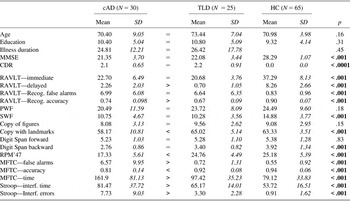
The sample of AD patients included 30 patients (16 women) diagnosed as cAD and 25 patients (13 women) with TLD. Table 1 reports the main demographic (age and educational level) and clinical characteristics (disease duration, MMSE and CDR scores, taken as an index of general mental impairment, and scores obtained at the baseline on each test of the neuropsychological battery) of the two patient groups and of HC.
Demographical and neuropsychological scores comparisons at the baseline in the three groups of cAD, TLD, and HC
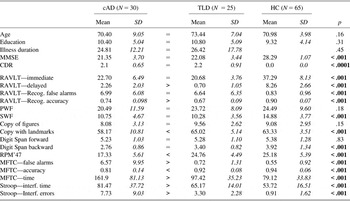
Note. In bold type are reported significant differences after Bonferroni correction; the symbols “<” and “>” indicate significant differences between TLD and cAD.
RAVLT—immediate (Rey's Auditory Verbal Learning Test immediate recall); RAVLT—delayed (Rey's Auditory Verbal Learning Test delayed recall); RAVLT Recog. False alarms and accuracy (Forced-choice recognition of RAVLT accuracy and false alarms); PWF (phonological word fluency); SWF (semantic word fluency); RPM'47 (Raven's Coloured Progressive Matrices); MFTC (Multiple Features Targets Cancellation test); Stroop (Stroop test short form).
There was no statistically significant difference in age and educational level between the groups. The groups were homogeneous for gender distribution (χ2 = 0.03; p = .863).
The one-way ANOVA carried out to compare TLD, cAD and HC displayed a significant main effect of the “group” variable (Wilk's lambda = 0.07; p < .001). Significant differences were observed in most of the neuropsychological measures, as shown in Table 1.
Post hoc comparisons revealed that at baseline TLD subjects scored worse than HC on all measures of episodic memory tasks (RAVLT immediate recall: p < .001; RAVLT delayed recall: p < .001; RAVLT Recog. False: p < .001; RAVLT Recog. Accuracy: p < .001), semantic memory (SWF: p < .001) and at the MMSE (p < .001), no differences in the other tests were found between TLD and HC. Furthermore, TLD obtained worse scores than cAD on RAVLT recognition accuracy (p = .013) and RAVLT delayed recall (p = .05) and performed better on Copy with landmarks (p < .01), PM ‘47 (p < .001), MFTC false alarms (p < .001), MFTC accuracy (p < .001), MFTC time (p < .001), Stroop interference time (p = .039), Stroop interference errors (p = .004).
It is worth noting that TLD and cAD patients reported similar MMSE and CDR scores and that cAD patients performed worse than HC on all cognitive tasks, with the exception of digit span forward, PWF and Copy of drawings.
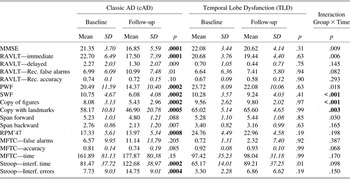
The progression of the two AD groups was compared by means of a two-way MANOVA for repeated measures (Table 2).
Test retest comparisons of the two subgroups of AD with classical or focal onset
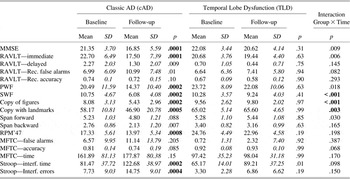
Note. In bold type are reported significant differences after Bonferroni correction.
RAVLT—immediate (Rey's Auditory Verbal Learning Test immediate recall); RAVLT—delayed (Rey's Auditory Verbal Learning Test delayed recall); RAVLT Recog. False alarms and accuracy (Forced-choice recognition of RAVLT accuracy and false alarms); PWF (phonological word fluency); SWF (semantic word fluency); RPM'47 (Raven's Coloured Progressive Matrices); MFTC (Multiple Features Targets Cancellation test); Stroop (Stroop test short form).
The general interaction of AD subgroup (TLD vs. cAD) versus Test–retest condition (baseline vs. retest scores) was statistically significant (Wilks’ lambda = 0.51; p = .03); also, group and test–retest condition showed an independent significant overall effect on change of cognitive performances between baseline and follow-up (respectively, Wilks’ lambda = 0.38; p < .0001; and Wilks’ lambda = 0.30; p < .0001).
When the interaction between AD subgroup and disease progression (Subgroup × Test–retest interaction) was investigated at the level of the individual test scores (see Table 2), significant specific effects were found on constructional praxis tasks (Copy of figures without and with landmarks), and semantic verbal fluency tasks (SWF). Statistical trends (considering Bonferroni Correction) in the univariate interaction analyses were obtained for MMSE, RAVLT – immediate recall, RAVLT – false alarms on recognition, phonological verbal fluency tasks, span forward and accuracy on MFTC. At the follow-up, in all these tasks, always cAD worsened more than TLD.
Post hoc comparisons were also used to evaluate separately whether any significant change occurred between first and second evaluation in cAD and TLD subjects.
As shown in Table 2, cAD patients displayed a general worsening of cognitive performances at the follow-up evaluation. In particular, scores obtained on MMSE and on tasks exploring episodic memory (RAVLT: immediate recall); visual-praxis abilities (copy of figures with and without landmarks); word list generation (PWF, SWF); and executive tasks (Stroop test interference time and errors) showed a significant decline at follow-up. A tendency toward a worsening was also observed on RAVLT delayed recall and on RAVLT recognition accuracy.
On the other hand, cognitive performances of TLD patients were relatively unchanged between baseline and follow-up, as only Stroop interference time score displayed a trend toward worsening (p = .01). It's worth noting that in TLD a ‘floor effect’ could have concealed the decline on RAVLT delayed recall.
Discussion
Several studies have already described different cognitive pattern of amnesic MCI and the association of episodic and semantic deficit have been largely reported in the past (Adlam et al., Reference Adlam, Bozeat, Arnold, Watson and Hodges2006; Howieson et al., Reference Howieson, Carlson, Moore, Wasserman, Abendroth and Payne-Murphy2008; Murphy, Rich, & Troyer, Reference Murphy, Rich and Troyer2006). The present paper represents an attempt to detect if this peculiar pattern still extends when the cognitive decline progress to a condition of overt AD. On this purpose, we compared two groups of AD patients with distinctive neuropsychological profiles at onset.
At baseline, the global severity of cognitive impairment (assessed by means of the MMSE and CDR) was similar in TLD and cAD patients, but the pattern of neuropsychological impairment shown by the two AD groups was different as expected by the selection criteria. TLD patients obtained pathological scores only on tests of episodic memory (RAVLT immediate and delayed recall, recognition accuracy, and false alarms) and semantic fluency, whereas cAD patients obtained pathological scores on episodic memory (RAVLT immediate and delayed recall, recognition accuracy and false alarms) attentional-executive (digit span backward, Stroop test and MFTC) and visual-spatial tests (RPM'47 and constructional praxis). Furthermore, when the two AD groups were directly compared, TLD subjects showed greater impairment in the accuracy on RAVLT recognition subtest and in the RAVLT delayed recall, whereas cAD patients obtained significantly lower scores on attentional-executive (digit span backward, Stroop test and MFTC) and visual-spatial tests (RPM'47 and constructional praxis).
The most relevant difference between the two groups of AD consisted in the different rate of progression. Indeed, no significant worsening as a whole was observed in TLD patients with the exception of a slight worsening in the time of execution of the Stroop test. Interestingly enough TLD patients were even more impaired in long term memory than at the baseline but, due to a floor effect, this further worsening was not significant. On the other hand, a wider significant decline was observed in cAD patients both on the global MMSE scores and on various memory, executive and visual-spatial measures. Executive functions were the most impaired over time in cAD and even the worsening shown on memory tests was partly due to an impairment of control functions. In fact, the most important change on the RAVLT concerned the recognition subtest and was due to a strong increase of false alarms, causing a decline of the accuracy score.
The main criticism advanced to explain the specific neuropsychological features of TLD has been advanced by Bien et al. (Bien, Helmstaedter, & Elger, Reference Bien, Helmstaedter and Elger2001), who suggested that some patients classified as TLD do not actually have AD, but rather hippocampal sclerosis (HS). This suggestion stemmed from the necropsy observation of HS in one of the patients of the Butters’ study (Butters et al., Reference Butters, Lopez and Becker1996). Indeed, HS patients show characteristic memory impairments, the progression of memory impairment is very slow, and other cognitive functions are mostly preserved (Helmstaedter & Elger, Reference Helmstaedter and Elger1999). However this condition is quite rare and could hardly affect the majority of our TLD patients; moreover none of our patients was affected by epilepsy and the MRI study of mesial temporal structures allowed the exclusion of features of hippocampal sclerosis.
Two main interpretations can, in our opinion, be advanced to explain the specific neuropsychological features and the slow cognitive decline of TLD patients.
The first interpretation assumes that TLD represents a distinct phenotypic variant of AD, with a functional involvement of specific temporal structures and slower spreading of the pathological process to the frontal and parietal association areas. As mentioned above, this variant is probably detectable also in the MCI condition (Adlam et al., Reference Adlam, Bozeat, Arnold, Watson and Hodges2006; Murphy et al., Reference Murphy, Rich and Troyer2006) and could represent a continuum since from the onset of the pathological process. Moreover, a recent study by Libon et al. (Reference Libon, Xie, Eppig, Wicas, Lamar and Lippa2010) identifies three subtypes of neuropsychological patterns in the MCI condition. One of them is characterized by amnesia associated only with semantic impairment. This pattern could maintain its cognitive profile also after the conversion to overt AD and thus could represent a prodromal condition of TLD group.
The same authors also suggest that a different neuropathology could underlie these manifestations compared to the other MCI characterized by an amnesic and dysexecutive condition.
Argyrophilic Grain Disease (AGD), first described by Braak & Braak (Reference Braak and Braak1987, Reference Braak and Braak1989) could partially correspond to the neuroimaging, neuropsychological and evolutionary features of TLD. This disease is characterized by the presence of argyrophilic grains (AGs) and pre-tangle neurons in the mesial temporal lobe limbic structures (Braak & Braak, Reference Braak and Braak1989). Amnesia is its most common initial symptom (Ferrer, Santpere, & van Leeuwen, Reference Ferrer, Santpere and van Leeuwen2008), whereas other cognitive functions are relatively spared. However AGD usually appears in very old patients (in our sample only three patients were above 75); in addition, our TLD patients lack the behavioral disturbances (irritability agitation, delusions, and apathy) frequently reported in dementia associated with AGD (Steuerwald et al., Reference Steuerwald, Baumann, Taylor, Mittag, Adams and Tolnay2007; Togo et al., Reference Togo, Isojima, Akatsu, Suzuki, Uchikado and Katsuse2005).
The hypothesis that TLD represents a phenotypic AD variant is also supported by a voxel based morphometric MRI study (Shiino et al., Reference Shiino, Watanabe, Maeda, Kotani, Akiguchi and Matsuda2006), that identified four patterns of brain atrophy at onset in AD patients over 65 years of age, one of which, analogously to our TLD group, shows a slower progression.
The second interpretation assumes that TLD represents an earlier stage of disease progression than cAD. According to this interpretation, the neuropsychological features of TLD could be due to the early selective involvement of the entorhinal cortex and hippocampus and to the subsequent circumscribed spreading of the pathological process to the adjacent temporal neocortex, subsuming the associated semantic memory disorders (Ahmed, Arnold, Thompson, Graham, & Hodges, Reference Ahmed, Arnold, Thompson, Graham and Hodges2008; Convit et al., Reference Convit, de Asis, de Leon, Tarshish, De Santi and Rusinek2000; Hodges & Patterson, Reference Hodges and Patterson1995). Only at a later stage the pathological process would spread to the frontal and parietal association areas, causing the executive, attentional and visual-spatial disorders typical of cAD patients. However, a strict version of this interpretation is at variance with the fact that the global severity of cognitive and functional impairment (assessed by means of CDR and MMSE) and the illness duration did not differ at baseline between TLD and cAD patients and that no conversion was observed from the TLD to the cAD category during the 24-month follow-up.
The main weakness of our study consists of the fact that AD was not diagnosed on the basis of pathology, but of clinical, SPET, and MRI data. We cannot, therefore, exclude that some of our patients were suffering from semantic dementia (SD), HS or AGD. The diagnosis of SD was discarded because none of the TLD patients met the criteria for possible Frontotemporal Dementia (Neary et al., Reference Neary, Snowden, Gustafson, Passant, Stuss and Black1998) and atrophic lesions (at the MRI) and perfusion deficits (at HMPAO-SPET) prevailed in mesial temporal regions, whereas in SD the mesial temporal structures are relatively spared and the atrophy prevails on the anterior, inferior and lateral aspects of the temporal lobes (Nestor, Fryer, & Hodges, Reference Nestor, Fryer and Hodges2006). Some authors (Davies, Graham, Xuereb, Williams, & Hodges, Reference Davies, Graham, Xuereb, Williams and Hodges2004) have, however, shown that at the individual level mesial temporal regions can be at least as atrophic in SD, when compared with AD.
In a similar manner, MRI data and lack of seizure history were used to rule out a diagnosis of hippocampal sclerosis, and the lack of a very old age and of behavioral disturbances led us to exclude a diagnosis of AGD. It must be acknowledged, however, that it is difficult to identify HS in the elderly, because they do not have the characteristic signal intensity noted for HS in the context of epilepsy (Zarow, Sitzer, & Chui, Reference Zarow, Sitzer and Chui2008) and that the clinical overlap between AD and AGD symptoms renders very difficult a differential diagnosis between these two degenerative diseases. It is, therefore, difficult to say if TLD must be considered as a phenotype of AD or as a syndrome that can result from different pathologies.
The main prediction that we had made at the beginning of our study was that, if TLD and cAD patients represent two different stages of AD, some TLD patients should convert to cAD in the course of the disease. Even if we cannot say if TLD must be considered as a phenotype of AD or as a syndrome resulting from different pathologies, our data clearly show that TLD does not represent an early stage of evolution of ‘classical’ AD, because no conversion from TLD to cAD was observed during the 2-year follow-up. Furthermore, the same data show that patients classified as TLD from the neuropsychological and neuroradiological point of view, show a slower rate of cognitive decline and/or a better response to ChEi therapy than cAD patients. Such data are also in agreement with the complementary observations made by several authors (Burns, Jacoby, & Levy, Reference Burns, Jacoby and Levy1991; Drachman, O'Donnell, Lew, & Swearer, Reference Drachman, O'Donnell, Lew and Swearer1990; Marra, Silveri, & Gainotti, Reference Marra, Silveri and Gainotti2000; Ortof & Crystal, Reference Ortof and Crystal1989; Teri, Hughes, & Larson, Reference Teri, Hughes and Larson1990) that the early occurrence of failures on executive function or on attentional tasks predicts a quicker decline in the clinical course of AD. Our observations might represent an important source of variance that should be taken into account when evaluating results of both therapeutic trials and clinical studies on the progression of ‘probable’ AD. In any case, the distinction between TLD and cAD deserves further investigation and confirmation by larger independent studies that should consider also neuropathological investigations.
Acknowledgments
We thank Dr. Livia Wright for revising the English form of the manuscript. All the authors disclose any financial or non-financial competing interest related to the content of this manuscript. The study was supported by a grant of the ‘Strategic Research Program 2006’ (“Strumenti e procedure diagnostiche per le demenze utilizzabili nella clinica ai fini della diagnosi precoce e differenziale, della individuazione delle forme a rapida o lenta progressione e delle forme con risposta ottimale alle attuali terapie”) of the Italian Ministry of Health.