





Prior to 2022, the National Health Service (NHS) investigated and reported on significant events using the Serious Incident Framework 2015 (SIF). Serious incidents in healthcare were described as events that were identified to have had the most significant consequences for patients, families and carers, staff and organisations. 1 Following further review, NHS England has since published the new Patient Safety Incident Response Framework (PSIRF) which replaces the SIF. Key principles that guide the process include an important descriptive change – there is now no distinction between patient safety incidents and those deemed to cross the threshold into being a serious incident. This classification and threshold is removed, and PSIRF is also different in that it is not an investigative framework that stipulates what to investigate, as SIF did. The shift now focuses on ensuring response to patient safety incidents and promotes both learning and improvement more widely; that it supports compassionate engagement and involvement of all those affected; utilises a range of system-based approaches to learning, rather than using methods that ultimately focus on linear identification of a single cause and also considers proportionate dedication of resource to respond to safety incidents. There should be supportive oversight to provide an effective governance structure. 2
This study was conducted prior to the above change in framework and focused on the experience of the SIF. Previous studies identified the emotional impact of serious incidents on healthcare professionals including shame, isolation, Reference Ullstrom, Andreen Sachs, Hansson, Ovretveit and Brommels3 guilt and self-doubt, prompting Wu (2000) to introduce the concept of ‘second victims’. Reference Wu4 Support, a safe environment, Reference Ullstrom, Andreen Sachs, Hansson, Ovretveit and Brommels3,Reference Ozeke, Ozeke, Coskun and Budakoglu5 reflective spaces and a culture of openness, learning, empathy and reflection may mitigate the emotional impact. Reference Iedema, Jorm, Wakefield, Ryan and Dunn6 Serious incident investigations in mental health settings may in addition, however, also present particular challenges for those involved. It is identified that some high-risk behaviours are more likely found in mental health settings compared with general medical settings, including suicide and violence and aggression incidents. Reference Mills, Watts, Shiner and Hemphill7,Reference Archer, Thibaut, Dewa, Ramtale, D’Lima and Simpson8 Suicide in particular, causes significant distress for staff. Reference Mills, Watts, Shiner and Hemphill7,Reference Martens, Van Gerven, Lannoy, Panella, Euwema and Sermeus9 One qualitative study of health professionals (mainly allied, but with two psychiatrists) suggests that insufficient support is offered and that to seek the required support can be seen as a sign of weakness. Reference Rivett and Wood10
It is known that UK doctors, including resident doctors, Reference Zhou, Panagioti, Esmail, Agius, Van Tongeren and Bower11,Reference Petrie, Deady, Lupton, Crawford, Boydell and Harvey12 experience high levels of psychiatric morbidity, burnout and emotional exhaustion Reference Imo13 which are amplified by the work conditions, by a culture of blaming and shaming and by a lack of support. Reference Riley, Buszewicz, Kokab, Teoh, Gopfert and Taylor14 To address some of these issues, NHS England has recently developed a ten-point plan to improve the working lives of resident doctors in England, with an emphasis on fixing unacceptable working practices, and involving resident doctors in decisions that impact directly on themselves. 15
The patient population with whom doctors work in mental health settings, where the diagnoses and associated high-risk behaviours can be more prevalent as outlined, does then expose doctors to potentially challenging incident investigation processes. There is also a growing recognition of the impact of moral injury in healthcare settings on clinicians, their psychological well-being and their willingness to remain in practice. Reference Rabin, Kika, Lamb, Murphy, Stevelink and Williamson16 This study sought to use qualitative methods to explore the lived experiences, perceptions and emotional responses of resident doctors involved in SI investigations when working in mental health settings specifically.
Method
Design
This study employed a qualitative design using semi-structured interviews to explore resident doctors’ experiences, perceptions and beliefs about the serious incident investigatory process within mental health settings.
Researcher characteristics
The researchers involved in this study were J.H., a female consultant psychiatrist with an interest in medical education and a focus on wanting to understand the motivation of residents to make decisions about subspecialty training. She was a psychiatry resident at the time of data collection; I.M., a male consultant psychiatrist and clinical academic with experience in qualitative research methods; S.W., a male consultant psychiatrist and clinical academic with experience in mental health care and resident doctor experiences; A.I., a male research assistant with experience in qualitative research methods. Interviews were conducted by J.H.. Data analysis was conducted by J.H., I.M., S.W. and A.I.
Participants
A volunteer sample of ten resident doctors training or working in psychiatry were recruited through email distributions within the NHS organisation. The email to potential participants was sent out via the Medical Education department within the Trust, and not directly from the author J.H. In total, 53 email invitations were distributed. Inclusion criteria required participants to be current resident doctors within the trust. There was no requirement for residents to have been in post for a specified amount of time. The email included a participant information sheet about the study and a consent form. All participants were required to give informed written consent prior to the interview, and recorded verbal consent was obtained at the start of their structured interview. While it was planned to continue recruitment beyond the current sample, the study was limited by the number of people who responded to the request for participants.
Although she was herself a resident doctor at the time of this project, author J.H. was not party to whether respondents were aware of or influenced in any way by her own personal experience of serious incidents prior to them expressing their interest in taking part in the study.
Data collection and analysis
Data were collected through one-to-one semi-structured interviews guided by a topic guide (see Appendix A), influenced by the researcher’s past experience during clinical training and developed iteratively by the researcher with the research team. The topic guide was not piloted, and there were no repeat interviews. Interviews were conducted on Microsoft (MS) Teams; they were transcribed using the transcription function within MS Teams, then rewatched for quality checking and accuracy, then amended as necessary. However, they were not returned to participants for comments. Interviews lasted between 28 min 48 s and 64 min 32 s. The mean interview length was 40 min 05 s.
Thematic analysis was conducted following Braun and Clarke’s six-phase framework, using a manual, paper-based visual method. Reference Braun and Clarke17 The process was iterative and informed by a constant comparative approach, Reference Glaser18 whereby data segments were continually compared across transcripts to support the development and refinement of codes and themes. This involved: (a) familiarisation with the data through repeated reading of transcripts and noting initial ideas; (b) generating initial codes systematically across the data-set, conducted by three researchers; (c) searching for themes by collating codes into potential themes; (d) reviewing themes to ensure they accurately reflected the data and worked in relation to the coded extracts and the dataset as a whole; (e) defining and naming themes through refining the specifics of each theme; and (f) producing the report, selecting extracts from the data to support findings. Participants did not provide feedback on the codes and themes generated.
Results
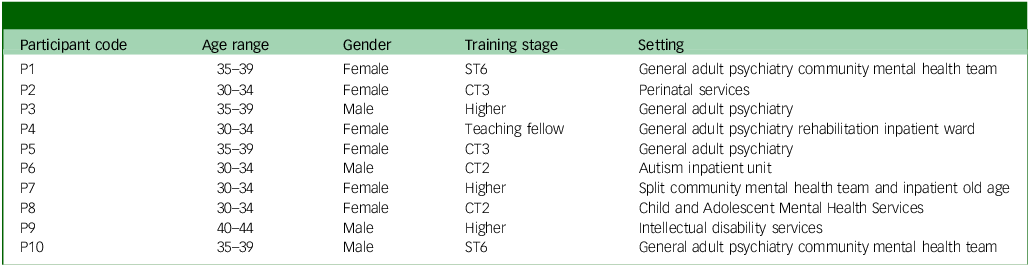
Eleven participants expressed an interest in taking part. One participant was about to complete training and opted not to take part in an interview. Ten participants were recruited in all; six identified as female and four as male. The age of participants ranged from 31 to 40 (mean = 34.9, s.d. = 3.107). Participant characteristics can be found in Table 1.
Participant characteristics

Table 1 Long description
The table has ten rows and five columns. The columns are labeled Participant code, Age range, Gender, Training, and Setting. Each row lists details for a participant. Row 1: Participant code P1, Age range 35-39, Gender Female, Training ST6, Setting General adult psychiatry community mental health team. Row 2: Participant code P2, Age range 30-34, Gender Female, Training CT3, Setting Perinatal services. Row 3: Participant code P3, Age range 35-39, Gender Male, Training Higher, Setting General adult psychiatry. Row 4: Participant code P4, Age range 30-34, Gender Female, Training Teaching fellow, Setting General adult psychiatry rehabilitation inpatient ward. Row 5: Participant code P5, Age range 35-39, Gender Female, Training CT3, Setting General adult psychiatry. Row 6: Participant code P6, Age range 30-34, Gender Male, Training CT2, Setting Autism inpatient unit. Row 7: Participant code P7, Age range 30-34, Gender Female, Training Higher, Setting Split community mental health team and inpatient old age. Row 8: Participant code P8, Age range 30-34, Gender Female, Training CT2, Setting Child and Adolescent Mental Health Services. Row 9: Participant code P9, Age range 40-44, Gender Male, Training Higher, Setting Intellectual disability services. Row 10: Participant code P10, Age range 35-39, Gender Male, Training ST6, Setting General adult psychiatry community mental health team.
The data in the ‘Training stage’ column are how the resident doctors identified themselves, some using the training year (e.g. ST6) and some instead giving the equivalent term that describes their stage of training (e.g. ‘Higher’). Please note the following explanation of training codes and equivalent terms used: CT2 and CT3 = ‘Core’; ST6 = ‘Higher’; ‘Teaching fellow’ refers to someone who was not in a training post but was, in this case, a doctor who had already completed core training.
Of the ten participants, eight participants had direct experience of the serious incident process. Of those eight, six were very clear about their involvement, while two felt their involvement in some of the processes that followed a serious incident was more indirect. All eight who had been through the serious incident process also had experience within the same Trust (Cumbria Northumberland Tyne and Wear (CNTW)), but two had additional international perspectives of serious incidents before coming to train in the UK.
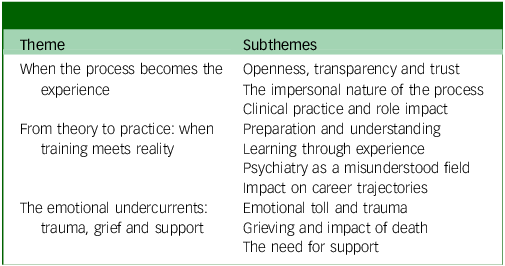
The 10 transcripts yielded 247 initial codes. These were developed into 49 preliminary themes by the original research team using an iterative process. These preliminary themes were reviewed and refined collaboratively by the researchers inductively to develop nine major themes, which were then grouped into three overarching themes, which can be found in Table 2. The coding and theme development process is described in Appendix B.
Themes and subthemes derived from thematic analysis

Table 2 Long description
A table with three rows and two columns. The first column lists three themes: When the process becomes the experience, From theory to practice: when training meets reality, and The emotional undercurrents: trauma, grief and support. The second column lists subthemes corresponding to each theme: Openness, transparency and trust; The impersonal nature of the process; Clinical practice and role impact; Preparation and understanding; Learning through experience; Psychiatry as a misunderstood field; Impact on career trajectories; Emotional toll and trauma; Grieving and impact of death; The need for support.
Theme 1: When the process becomes the experience
This theme captures how resident doctors often experience the investigation process itself as having varied personal and clinical impacts. It highlights a lack of transparency, inconsistent and impersonal communication, and the issues that follow, particularly in the absence of inclusive and supportive structures.
Subtheme 1.1: Openness, transparency and trust
Participants reflected on the importance of openness and transparency in the serious incident investigation process, often highlighting its absence. While some acknowledged that the UK system may be more transparent than international counterparts, there remained a pervasive sense that incidents were not discussed openly, either by individuals involved or by the system itself.
‘My supervisor didn’t actually speak to me at all about it, but just documented in the end of supervisor report that he had no concerns about my involvement … but I didn’t have a conversation [about it].’ – P2
This was also contributed to by a fear of saying the wrong thing or being blamed for something that had happened. A lack of trust in the organisation’s internal processes led some residents to seek reassurance, support or indemnity advice from external bodies.
‘There is… a culture that it’s too big to talk about or hidden in some way, and so actually people take it personally that they’ve gotta take it away and deal with it outside of work when actually we should be in debriefing process as necessary.’ – P1
A significant point of reflection among participants was the role of external agencies, particularly the police and the coroner, in the investigation process. There was widespread recognition of the importance of understanding how these external systems operate, yet several resident doctors described feeling unclear and unfamiliar with how these bodies conduct investigations, and how their processes differ from those carried out internally by NHS organisations.
‘I think that there’s an independent system for investigating mental health related deaths and other than that the coroner would be involved, and the police, but other than that I don’t really know.’ – P5
Subtheme 1.2: The impersonal nature of the process
Residents frequently described the serious incident investigation process as lacking structure, communication and inclusion. Many reported first being informed of their involvement in uncontrolled and impersonal ways, most often by email, which they found distressing and inappropriate given the sensitivity of the situation. This method of communication, rather than offering clarity or reassurance, provoked anger. A common concern was that resident doctors were excluded from much of the formal process, contributing to a sense of being peripheral to something that affected them but that they had little or no influence over. There was a shared desire to be involved throughout the process and to receive feedback or outcomes, both to facilitate closure and to support learning, feeling the lack of feedback was a missed opportunity.
‘…got an email being like you’re invited to this after-action review, and I was like what? What even like what?!! You know is this how we’re telling people that a patient of theirs has not just died but died by suicide.’ – P7
Participants also reflected on miscommunication between different teams during the course of reviews and expressed dissatisfaction with the initial incident reviews (sometimes referred to as ‘After Action Reviews’ or ‘Early Learning Reviews’) in which those involved come together to review the incident soon after the event. This was viewed by some as flawed. The experience of the investigation lead officer was seen as being important in shaping their experience.
‘… expectations and roles of two different teams when there’s more than one involved in caring for a patient. It just really highlighted the opportunities for miscommunication and misinformation … especially when you’re working with different specialties. So, I think it made me reflect about being much more clear and consistent and about communicating between teams and asking for updates from them as well.’ – P4
Subtheme 1.3: Clinical practice and role impact
Residents described varied and lasting impacts of the serious incident process on their clinical roles and professional identity. Many spoke of feeling isolated, left out of debriefs, unsure of their role in the process and of not feeling like they are ‘part of a team’, particularly when they were the only medic involved, and unsure of where to find supervision and support. Additionally, without the presence of a senior medic, one participant felt stressed about answering questions about their documentation. Resident doctors said that this led to feelings of isolation, uncertainty and disrupted clinical confidence. At the same time, those who had experienced an incident during training often described it as a valuable learning opportunity that enhanced their confidence when encountering similar situations later in their careers.
‘…particularly how it’s made me think about my documentation and…what I should be writing…even if it’s not directly myself that’s criticised, thinking about how other people’s actions or documentation is being criticised sometimes, it’s made me more clear, but it’s made me think a bit more defensively I suppose.’ – P10
Interactions with legal teams or coroners (in England, Wales and Northern Ireland), or procurator fiscals (in Scotland),Footnote a were highlighted as particularly useful in reducing fear and improving understanding of the broader investigative context.
‘…it’s made me less scared of After-Action Reviews and SIs [serious incidents] and coroners… I think the next time it happens I will still have a human gut fear, but knowing what to expect, I anticipate that it’s really not going to be as bad.’ – P6
Participants also noted that the emotional tone of feedback, especially if perceived as overly critical, could result in defensive or avoidant behaviour. Across accounts, there was a strong emphasis on the highly individual nature of these impacts. Residents rejected the assumption that medics or psychiatrists should be uniformly resilient, instead calling for a more person-centred and supportive approach.
Theme 2: From theory to practice: when training meets reality
This theme explores the navigation of the serious incident process by resident doctors. It reveals that residents report limited preparation and gained experience primarily through lived experience. It highlights the unique challenges of working in psychiatry, the emotional and professional weight of involvement in incidents and how these factors can shape future career decisions.
Subtheme 2.1: Preparation and understanding
Residents described a general lack of clarity and confidence about the serious incident investigation process, with many feeling unprepared to engage with it. While a small number had attended Trust-organised training sessions, learning days or had observed serious incident panels, the majority had not received any formal preparation.
‘I don’t think I’d be prepared just ‘cause I haven’t had any training about it … I would feel quite worried that I was … at fault or something that I had missed was going to be blamed on me … I would automatically feel quite worried about that.’ – P8
Experiences of training were mixed, with some finding external courses helpful and others suggesting that simulated serious incident events or real-life case examples could have enhanced their understanding prior to being involved in serious incidents. There was uncertainty about what qualifies as a serious incident, when a coroner / procurator fiscal might become involved and what the process typically entails. This ambiguity left many feeling unfamiliar with the procedures and unsure of what would be expected of them if involved in an investigation.
‘…there was no other senior medic around as well and I was then asked some questions about my documentation, which I hadn’t been prepared for that, and then had to leave halfway through for a Mental Health Act assessment, so that felt quite, erm, quite a stressful experience I think, and quite a distressing experience.’ – P10
Subtheme 2.2: Learning through experience
Residents viewed involvement in a serious incident investigation as a meaningful learning opportunity. While often challenging, the experience was described as valuable for professional development and future preparedness. Some participants expressed gratitude for the chance to be involved, particularly when the process was handled well.
‘The help from my clinical supervisor was vital… it gave me contact with how the process is dealt with. And then, the events organized by the trust exploring the SI [serious incident] process … that sort of shed some light on how things, things are done.’ – P9
Serious incident reports were seen as important tools for service improvement, offering insights that could inform changes to practice, such as improved documentation or clearer communication pathways. Residents emphasised that the core purpose of investigations should be to understand what happened and prevent recurrence, rather than to assign blame. For some, the process also deepened their understanding of the patient involved, offering a fuller context for the incident.
‘…if it picks up an area that’s a problem then it can make you a better doctor… it’s definitely a potential learning point… if you genuinely done something wrong then you should know about it and know how to do it better next time.’ – P5
Subtheme 2.3: Psychiatry as a misunderstood field
Residents highlighted the unique challenges of working in psychiatry in relation to serious incidents. The nature of psychiatric care is felt to create distinct emotional and procedural complexities. Deaths are not uncommon in healthcare settings, but for psychiatrists, patient deaths, particularly by suicide, are often sudden and unexpected. Some participants felt that the existence of a prevailing narrative that ‘every death is preventable’, was untrue and potentially harmful. Routine tasks such as conducting mental health assessments or having brief involvement with a patient can unexpectedly result in being included in a serious incident investigation, sometimes even years later. This creates a sense of vulnerability and unpredictability.
‘I was contacted two years later and asked for a statement, quite out of the blue. And that was a bit surprising uhm, ‘cause … I was only aware that I was … linked to the case when I did my yearly ARCP, having got a complaints email and it came back that I’d been linked to two (incidents).’ – P2
Participants also spoke of the societal stigma surrounding psychiatric deaths, noting that suicide is often treated differently than physical health outcomes, with staff feeling judged by both internal systems and the wider public. Media and social media scrutiny further intensified this experience, with some describing a sense of collective blame directed at community mental health services for broader societal failings.
‘We’re the only specialty where nobody is allowed to die from the illness…people genuinely don’t believe that mental illness could ever be severe or real enough to be a threat to someone’s life…there’s side effects, you know there shouldn’t be any side effects to this. Never mind chemo or surgery or anything else ‘cause that’s justified, and that’s you know, that’s a real thing.’ – P7
Subtheme 2.4: Impact on career trajectories
Resident doctors described how serious incident investigations could significantly influence their career decisions, particularly in relation to specialty or sub-specialty choice. Negative or unsupported experiences during investigations often left lasting impressions, leading some to reconsider their future in psychiatry.
‘If you don’t feel confident enough to do your job, that again can have an effect on your training or even in some extreme cases you’re … you’re really decided that you want to leave training altogether. So that could have an impact on more people really.’ – P9
The heightened emotional impact of certain incidents, especially the death of a child or young person, and the perception of increased scrutiny within mental health, particularly inpatient settings, were key factors. Participants reflected on how societal narratives around preventability and blame in psychiatric deaths shaped their own feelings of fault, even when no individual failings had occurred.
‘I think the whole investigations (process) should look out for areas that can be improved and where help is needed to prevent future events from happening. But obviously it’s not 100% preventable because we are dealing with people and we’re not dealing with machines, so it’s not a foolproof system.’ – P9
SIs also impacted training milestones, such as exam preparation and progression. For some, these experiences reinforced a deeper understanding of the inherent risks in psychiatry, and the limits of what clinicians can control, influencing later career choices. Several participants emphasised the need for a cultural shift within the profession; to accept that not all deaths are preventable, and that serious incidents, while distressing, are an unavoidable part of the work.
‘So negative experiences we know influence our, you know, attitudes toward speciality… there is a potential maybe you leave psychiatry and not just the subspeciality but just leave psychiatry.’ – P1
Theme 3: The emotional undercurrents: trauma, grief and support
This theme captures the emotional landscape resident doctors navigate when involved in serious incident investigations. Residents reported experiences of trauma, unresolved grief and emotional vulnerability, often compounded by a lack of structured support. The presence or absence of supervision and peer connection significantly shaped their capacity to process and learn from these events.
Subtheme 3.1: Emotional toll and trauma
Residents described the serious incident process as emotionally taxing, particularly when they lacked prior experience or support. Initial involvement often triggered feelings of anxiety, guilt and shame, with coronial processes seen as especially intimidating. The emotional impact could be profound, with some describing the experience as traumatic and requiring time off work. Participants reported a loss of confidence, a sense of vulnerability and a fear of being perceived as incompetent by colleagues.
‘I think it would definitely knock your confidence, which is something that you’re trying really hard to build, erm but it can come crashing down with this and I think you would need a bit of time to, to sort of separate yourself from the events in order to process them. So that could have an impact if you need some time off, that can have a knock-on effect on your training.’ – P9
These feelings sometimes influenced clinical decision-making, leading to avoidance or overly cautious practice. Over time, some found that space to reflect, along with distance from the event, helped mitigate the emotional intensity.
‘…initially I was… really upset and angry about what happened and anxious about being involved in the process and quite preoccupied with that and the discussions around that…’ – P4
Subtheme 3.2: Grieving and impact of death
Residents emphasised the upsetting nature of patient deaths, describing them as deeply affecting both personally and at a team level. The shared experience of loss within teams could foster cohesion but also expose communication difficulties and emotional strain. Participants noted that the grief process is often truncated or sidelined in clinical practice, with no time or space to mourn. Knowing the patient personally intensified the emotional toll, and some described feeling sadness and anger. There was also recognition of the value SI investigations can have for bereaved families, though this added a further emotional dimension for those involved in the process.
‘…but there seems to be so much less space and time and acceptance to just be able to grieve the fact that this person isn’t with us anymore. You know, I think it’s really sad that the first thing people who work in the mental health field do when they hear someone has died is to check the notes to make sure that they’ve updated the risk summary. Or they’ve done the care plan or that all their notes are up to date.’ – P7
Subtheme 3.3: The need for support
Support during the serious incident process emerged as a critical factor shaping residents’ experiences. Supervisory support was seen as especially important; a good supervisor could provide reassurance, structure and emotional containment, whereas the absence of support left residents feeling isolated and overwhelmed.
‘… when you work in a big hospital in the medical scene, you are genuinely part of the team and there are other people around … there’s three or four doctors and you sort of … kick ideas around whereas for us (in psychiatry) it can genuinely be quite a lonely experience.’ – P3
Experiences of supervision did vary and quite significantly, with some participants receiving consistent guidance not just during a serious incident investigation process, but also during their entire training post. Some supervisors were found to support participants more fully within their training role, attending patient assessments with their trainee and also giving opportunities for observation of their own practice. Some supervisors also had experience of serious incident investigations themselves in their own job role and could support trainees more fully if they were involved in an incident, due to their own knowledge and reflections. Other participants felt completely unsupported and more isolated in their working role when seeing patients, without many opportunities to observe seniors. Not all participants had a supervisor who had been through a serious incident investigation, and this made them feel more alone during the process when it happened as they could not share experience. The approach taken by individual supervisors was seen to dictate how manageable the process felt. Alongside formal supervision, peer support was also highly valued; sharing experiences with colleagues and accessing informal mentoring helped normalise reactions and reduce feelings of isolation.
‘…because I think that if, say, we went out with a supervisor with a consultant for the first six months or whatever, and actually we did the first couple of assessments together and stuff, and perhaps if we had a supervisor coming with us to do an after action review, a lot of the things that I’m talking about would sort of go away, then you would feel much more comfortable I guess in that position.’ – P3
Discussion
Summary
This study sought to examine and understand the experiences of resident psychiatric doctors of the serious incident process in NHS mental health settings. Three themes were identified: (a) when the process becomes the experience: from theory to practice; (b) when training meets reality; and (c) the emotional undercurrents: trauma, grief and support.
The findings indicate that communication systems within serious incident processes are often perceived as lacking transparency and personalisation, failing to acknowledge the emotional impact of events on resident doctors. It is now well established that transparency is critical to ensure learning, Reference Thomas, Brook, Wilde and Agarwala19,Reference Gallagher, Yi-Frazier, Yi, White and Bell20 and that encouragement to be open in both the disclosure and management of adverse events requires significant interpersonal skills and an ability to appreciate the context of the situation. Reference Myren, de Hullu, Bastiaans, Koksma, Hermens and Zusterzeel21 The serious incident process was found to significantly influence subsequent clinical practice, altering resident doctors’ approaches to their work. While some viewed direct serious incident experience as a valuable learning opportunity, they reported feeling unprepared due to insufficient training. Participants highlighted unique challenges in psychiatric serious incident investigations, particularly concerning misunderstood public narratives surrounding patient suicides and their potential harm. Many felt the serious incident experience profoundly impacted their career trajectory. The study also revealed potential trauma for staff witnessing patient deaths and the accompanying difficult emotions, compounded by insufficient time for grieving. Participants emphasised the critical role of effective supervision and adequate support for resident doctors undergoing serious incident investigations.
Interpretation
The findings are supported by previous research that provides quantitative evidence of the negative emotional impact suicides (patient, colleague or personal relationship) have on resident psychiatrists, their need for support and the effect the event has on their medicolegal view. Reference Pilkinton and Etkin22 Specifically concerning patient suicides, studies using quantitative survey data show that only 28% of resident psychiatrists receive training on suicide-related serious incidents and that informal support is seen as most beneficial. Reference Dewar, Eagles, Klein, Gray and Alexander23 Furthermore, psychiatrists score more highly on morbidity, acute stress and post-traumatic stress checklists if they had experienced a patient suicide during training. Reference Ruskin, Sakinofsky, Bagby, Dickens and Sousa24 Our findings are also consistent with a broader literature around moral injury in clinical settings, with a lack of support identified to be a key component of poorer psychological outcomes for clinicians. Reference Williamson, Lamb, Hotopf, Raine, Stevelink and Wessely25 The present study expanded on previous literature by giving in-depth qualitative findings on the experiences of resident doctors who have undergone a serious incident event. It highlights the emotional toll not just of the death of a patient, but additionally the impact of the investigatory process itself. Significantly, it builds on and points towards the reasons for this, such as the lack of time to grieve, the narratives which follow patient deaths and the problems with not receiving adequate support during the investigation process. This aligns with recent policy analyses, which have shown that despite a national shift towards system-wide learning, local serious incident investigation policies often fail to explicitly embed support or meaningful involvement of those affected, describing these processes passively rather than as active contributors to learning. Reference McHugh, Louch, Ludwin, Sheard and O’Hara26 This policy gap may contribute to the inconsistencies our participants reported in the support they received.
Moreover, previous survey results have shown the effect patient suicides can have on doctors’ career trajectories, and the detriment to their confidence in their work. Reference Gibbons, Brand, Carbonnier, Croft, Lascelles and Wolfart27 The present study confirmed prior findings but also broadened the focus from being solely on patient suicide to a broader consideration about deaths of patients. We have demonstrated that the emotionality and scrutiny that follow a patient death are factors in career decisions, and that impacted confidence may result in particular adaptations in participants‘ work, such as defensiveness or avoidance. The fear of independent scrutiny after a patient death (for example, in coroners’ courts) was also highlighted by participants. Given the likelihood of encountering a sudden death during a working career and the prospect of involvement in such proceedings, there is a clear need for better preparation for all clinicians. Reference Pendlebury28,Reference van Dellen, Harris, Merryweather, Simsek and Pendlebury29
A major subtheme in this study was the necessity of adequate support after a serious incident event. The role of consultant supervisors in a training role was found to be especially important. A supervisor with experience of being involved in incidents themselves and knowledge of the process that followed was found to be reassuring and helpful for trainees going through an investigation themselves. There was also an identified need for clear support in terms of the training role more generally. A supervisor who was more available to trainees during their training post, attending patient assessments with them and using these as learning opportunities, was identified by some participants as vital for reducing feelings of isolation in clinical decision making. This feeling was something participants spoke about more so in psychiatry training than in their experience of working in other medical specialties. It was identified that in those other specialties, being part of a larger, more identifiable team, particularly out of hours, was felt to be protective against this. The study also highlighted how important good support, particularly from peers, was in shaping the experience of resident doctors. Professionally facilitated, consultant-only peer groups dedicated to suicide and homicide have previously been shown to be key components helping qualified psychiatrists process their grief. Reference Tamworth, Killaspy, Billings and Gibbons30 This points to greater urgency in addressing the issue found in the present study of allowing resident psychiatrists time to grieve patient deaths, alongside structured peer support systems. ‘Connectedness’ is predominant in the lived experience of resident psychiatrists, Reference Beattie, Crampton, Schwarzlose, Kumar and Cornwall31 and they are predisposed to depressive symptoms associated with emotional labour, Reference Rogers, Creed and Searle32 thus the emotional toll patients’ deaths take on them and support through this loss of connection are crucial points for consideration.
Implications
The current support systems in place following serious incidents appear inconsistent and, in some cases, inadequate. Participants described variable access to supervisory and peer support, with some receiving none. Given the emotional toll of serious incidents, structured and reliable support mechanisms are necessary. This includes timely, accessible supervision that acknowledges the emotional dimensions of the event, and formalised peer support spaces to process the experience collectively. It is likely that there are pockets of good practice nationally, but there may be inadequate channels for sharing learning and good practice. The development of a standardised and consistent post-incident support framework may be key to reducing isolation and promoting well-being not just for resident doctors, but for clinicians more widely.
The variability in supervisory approaches raises questions about the role of clinical and academic tutors in supporting doctors through these processes. Supervisor training should include guidance on how to support residents through emotionally charged events such as serious incidents, and how to integrate learning opportunities while protecting mental well-being. Supervisors may need institutional support themselves to take on this role effectively, particularly given the increasing emotional labour of supporting staff through traumatic events.
The findings also indicate that resident doctors frequently feel unprepared to handle the emotional, procedural and ethical complexities of serious incidents. This highlights a gap in postgraduate training curricula. Training programmes may benefit from incorporating structured education on the practical and emotional dimensions of serious incidents, including simulation-based teaching, reflective practice sessions and guidance on legal, professional and personal implications. Making this a core component of training would help normalise and prepare doctors for these inevitable events, improving both individual well-being and professional development.
Moreover, the study suggests that current systems may inadvertently compromise learning outcomes by creating defensive or avoidant clinical behaviours. Residents described becoming overly cautious or disengaged following incidents, which may hinder growth and clinical confidence. This raises concerns for both patient care and clinician development and implies a need to foster a safer reflective space where mistakes and adverse events can be openly explored without fear of blame.
Limitations
This study was a higher specialist psychiatry trainee research project conducted in 2021. This was a convenience sample of ten participants; a higher sample size with more resident doctors at differing points of their training would have resulted in more dependable and generalisable themes being developed from the data. Additionally, the interviews were all conducted by the main researcher, which could have resulted in unconscious bias in the data collection and analysis processes. At the time of this study, J.H. was working with Medical Education to better understand what influenced resident doctors’ decisions about subspecialty training. As part of this, she developed a ‘learning from serious incidents training forum’ which alongside her growing knowledge of this topic area, led to her interest in understanding resident doctors’ experiences of both serious incidents and the processes put in place by organisations. It is likely that this may have influenced her development of the topic guide and her approach to data analysis. Two of the other researchers involved in analysis (I.M. and S.W.) had also experienced serious incidents in the past and will have brought other perspectives to the process. It is also possible that some of the participants within the study were aware of J.H.’s interest in this area which may have influenced their decision either to participate, or not to participate in this project. However, the findings here are of relevance to resident doctors who will almost inevitably be exposed to serious incidents and their investigation at some point in their careers.
We used semi-structured interviews to ensure we addressed the areas in the approved topic guide. Future research could utilise more in-depth approaches such as a biographical narrative approach to gain deeper contextual and subjective insights into how individuals experience serious incident investigations and make sense of these events. It would also allow a greater understanding of how their personal stories are shaped by broader contexts such as their personal and professional experiences.
Additionally, it may have been beneficial to pilot the topic guide in advance to ensure relevance and validity. However, we were hampered by time constraints and limited resources, and given J.H. and S.W.’s clinical expertise in this area, it was felt that the final guide was enhanced as far as possible. Indeed, no changes were felt to be required during the study.
Since the study’s conduction, the NHS has introduced the PSIRF system for serious incident investigations, and thus this study examines the experiences of participants prior to this change, under the old framework. However, this does provide results which can be used as a comparator against any new studies which aim to ascertain the experiences of serious incidents for resident doctors under the new PSIRF system.
Future research
With the study’s snapshot findings on how resident doctors experienced the serious incident process under the older, SIF, and the recent change to PSIRF, a similar study on current resident doctors and their experiences can be conducted with the aim of comparing and assessing for any changes or improvements in their experiences. Additionally, the sample eligibility criteria could be widened to include resident doctors from acute or other services who also use PSIRF in a multi-site study.
Supplementary material
The supplementary material is available online at https://doi.org/10.1192/bjo.2026.12126
Data availability
The participant interview data are not publicly available due to confidentiality considerations and to preserve the privacy of research participants. Coding data are available from the corresponding author upon reasonable request.
Acknowledgement
This article was conceived, written and revised entirely by the authors. No artificial intelligence tools were used in its preparation or development.
Author contributions
J.H., S.W. and I.M. conceptualised and designed this project. All authors took part in data analysis, drafted and approved the final manuscript. All agree to be accountable for all aspects of the integrity and accuracy of the work.
Funding
There was no specific funding for this project. S.W. and I.M. are supported by the National Institute for Health and Care Research (NIHR) Newcastle Biomedical Research Centre (BRC). I.M. is an NIHR Senior Clinician and Practitioner Research Award (SCPRA) Fellow. The views expressed are those of the author(s) and not necessarily those of the NIHR or the Department of Health and Social Care.
Declaration of interest
None.
Ethical standards
The authors assert that all procedures contributing to this work comply with the ethical standards of the relevant national and institutional committees on human experimentation and with the Helsinki Declaration of 1975, as revised in 2013. All procedures involving human participants were approved as a service evaluation by Cumbria Northumberland Tyne and Wear (CNTW) NHS Foundation Trust (SER-21-004), and additionally, a favourable ethical opinion was obtained from Newcastle University Research Ethics Committee (12197/2020). Participants gave either written or recorded verbal informed consent prior to the interviews and were assured of confidentiality. Data were anonymised during transcription and were kept in a secure locked location.
Note on terminology
This project was completed prior to the adoption by the British Medical Association (BMA) of the term ‘resident doctor’, which replaced ‘junior doctor’ in September 2024. This paper is written using the new terminology, but the data analysis took place in part prior to this and therefore older terminology such as ‘trainee’ will be found in the coding and analysis.


 Open access


eLetters
No eLetters have been published for this article.