In July 1986, the U.S. Army activated the first AH-64 Apache attack helicopter battalion at Fort Hood, Texas.Footnote 1Designed to destroy Soviet tanks in the event of a conventional war in Europe, the Hughes AH-64 served as the Army’s premier anti-armor helicopter, equipped with laser-guided Hellfire air-to-surface missiles, upgraded engines and advanced avionics for nap-of-earth (terrain following) flight, and all-weather and nighttime flying capabilities. The introduction of the Apache marked the culmination of a long development process that began in 1972, when the Army issued a requirement for the advanced attack helicopter (AAH). This requirement, however, did not emerge suddenly. It evolved from the remnants of the Army’s earlier, abortive attempt during the Vietnam War to acquire a high-speed, heavily armed helicopter gunship—the Lockheed AH-56 Cheyenne—to provide fire support for ground combat units and protect rotary-wing aircraft transporting infantry, weapons, and supplies to forward battle areas.
Rather than award separate contracts for research and development (R&D) and production to structure the Cheyenne program, as it had done for other weapons programs in the past, the Army used a new contracting mechanism called total package procurement (TPP). Secretary of Defense Robert McNamara had adopted total package procurement from the Air Force in the mid-1960s to prevent weapons makers from underestimating the costs of R&D to obtain noncompetitive, sole-source production contracts that set prices sufficiently high to guarantee returns in excess of any losses incurred during development. Although it looked good on paper and satisfied McNamara’s predilection for more centralized control of military planning and weapons acquisition in the Office of the Secretary of Defense (OSD), total package procurement lacked the flexibility to accommodate the technological risks built into the Cheyenne’s design and the concomitant costs and schedule delays necessary to eliminate them as the program evolved. Frustrated by cost growth at Lockheed and the firm’s failure to abide by the requirements of the TPP contract, the Army canceled production of the Cheyenne in 1969, one year after McNamara had left the Department of Defense. The demise of the Cheyenne and other similarly structured weapons programs prompted President Richard Nixon’s new secretary of defense, Melvin Laird, and his deputy—business executive David Packard—to dismantle total package procurement in favor of a decentralized acquisition process that mandated a return to separately negotiated contracts for R&D and production and also shifted more programmatic control of weapons procurement from OSD back to the military departments.
This study will examine the evolution of the Apache helicopter from two different but related perspectives: reform of the weapons acquisition process by the Office of the Secretary of Defense between 1969 and 1971 to avoid the problems that beset the development of the Cheyenne and other similarly structured TPP programs; and, given this restructuring, the ongoing challenges that the Army still faced throughout the 1970s and early 1980s to control costs and maintain development and production schedules while pushing the technological state-of-the-art in the Apache program. Initially, the Army expected the Apache to be a less technologically ambitious and cheaper alternative to the Cheyenne, in part to reduce the likelihood of another programmatic failure and also to accommodate the impending cancelation of the original armed escort and fire-suppression requirement (known as air assault) as doctrinal planning began to shift from counterinsurgency warfare in Vietnam to mechanized combat against concentrated Soviet armor in central Europe. Because the military departments executed the policies established by the Office of the Secretary of Defense, the Army controlled the extent to which OSD-initiated acquisition reforms structured weapons programs. As the Apache program evolved, costs escalated and schedules slipped because of required design modifications and the Army’s decision to add more advanced weapons and avionics systems to the helicopter airframe. Congressional hostility to the Apache’s rising cost, however, forced the Army leadership to restructure the program and reduce the total number of helicopters requested.
The Apache is a technological artifact of these patterns of institutional behavior. The history of its development and production fills an important gap in the historiography of Army aviation, which lacks a critical analysis of the advanced attack helicopter program during a transformative period in the evolution of tactical doctrine.Footnote 2 More important, however, the following narrative adds a long-neglected historical perspective to the social science literature on military procurement. Written primarily from a public policy perspective, much of this work has used the history of cost growth, schedule delays, and technological failures in major weapons programs to recommend the targeted restructuring of key elements of the acquisition process. Representative examples include, but are not limited to, defense planning and the establishment of weapons requirements, congressional oversight of the acquisition process, and regulation and competition in the defense industry. This study deliberately avoids prescriptive analysis. Nor does it proclaim, as many studies of weapon systems often do, that the Apache program has been either an unmitigated success or a spectacular failure.Footnote 3Rather, it draws on the history of the Apache’s development and production to expose a broader, fundamental weakness of acquisition reform that persisted throughout the Cold War. No single reform initiative could systematically regulate the costs of managing technological change across the private-sector and government institutions responsible for weapon systems acquisition. All of the participants acted out of self-interest, which diffused the potency of structural reform and often introduced conflicting expectations for programmatic success. The acquisition reforms introduced by Deputy Secretary of Defense David Packard promised to control costs, but that outcome remained elusive because the Army still faced the intractable problem of managing the Apache program with finite resources while simultaneously adding system modifications to meet evolving battlefield requirements. While not unique to the Army or to the development of the Apache, the recurring challenge of managing technological innovation in an environment where program variables seldom remained stable over the long term transcended the structural reforms put in place by the Office of the Secretary of Defense to lower costs and improve operating efficiencies among the major stakeholders responsible for weapon systems acquisition.Footnote 4
RISE AND FALL OF THE CHEYENNE
On December 12, 1967, the first public flight of an AH-56 Cheyenne prototype took place at the local airport next to the Lockheed Aircraft Corporation’s assembly plant in the Van Nuys section of Los Angeles. Speaking to the crowd of Defense Department officials, company employees and subcontractor representatives, and news reporters who had gathered to observe the demonstration, Lockheed president A. Carl Kotchian called the Cheyenne “a new kind of achievement in the whole field of aircraft.”Footnote 5 The Army shared Kotchian’s enthusiasm. Earlier in the year, Lieutenant General Austin Betts, the Army’s chief of research and development, singled out the new attack helicopter as “the most versatile and potent aerial weapons system the Army has ever developed.”Footnote 6 Their heady optimism quickly faded as the Cheyenne program matured. Lockheed, which had just entered the helicopter business and possessed limited knowledge of the field, had pushed the boundaries of rotary-wing technology beyond industry standards to meet the Army’s urgent requirement for a fast attack aircraft to perform the air assault mission in Vietnam.Footnote 7The company had also deliberately overlapped R&D and production—a standard practice at the time—to accelerate the acquisition cycle, but technological instability in the design uncovered when flight testing began in 1968 disrupted the orderly transition from prototype to production aircraft. The consequent cost growth and schedule delays prompted the Army to cancel production of the Cheyenne in 1969.
The terms of the total package procurement contract for the Cheyenne redressed the distribution of risk between the Department of Defense as the sole buyer of weapon systems and the industrial firms that developed and manufactured them to military specifications. Prior to World War II and throughout the early postwar period, the government had accepted most of the risk of weapons development, and this trend continued into the 1950s. Rapid technological diversification in the aircraft and electronics industries and the corresponding proliferation of new weapons programs that accompanied the onset of the Cold War placed a premium on system performance at the expense of cost control. Given the pace of technological change and the urgency of military preparedness, defense firms had little incentive to estimate accurately the costs of development because the cost-plus-fixed-fee contracts awarded by the Department of Defense reimbursed all allowable R&D expenses and also paid a predetermined profit. Firms could, and often did, bid low on R&D contracts, knowing they could fix problems during development and bill the government for the added expenditures. Cost-plus contracting also encouraged firms to submit optimistic assessments of system performance at the outset, a practice that further inhibited cost control and undermined program stability.
In the early 1960s, Secretary of Defense Robert McNamara strongly encouraged the use of incentive rather than fixed-fee contracts to reduce the risk of cost growth in weapons programs. Like its fixed-fee counterpart, a cost-plus-incentive-fee contract reimbursed all allowable R&D expenses, but it calculated a profit based on how well the contractor managed costs above or below a negotiated target price. Completion of the contract at or below the target price required the government to pay a fee equal to or above a set target profit. If, however, expenditures exceeded the target price, the contractor had to pay a share of the full cost of the overrun. A fixed-price-incentive contract used the same type of cost-sharing agreement, but it held the contractor liable for all expenses incurred above a specified ceiling price. Although it promised to limit the government’s liability by charging a penalty for contractor optimism, the incentive contract did not prevent firms from underestimating the costs of R&D, especially if they could recover the discount by leveraging that advantage to obtain more lucrative follow-on production contracts. This pattern of behavior, called “buying in,” enabled the winning firm in a competition to use the development contract to build sufficient traction into a program to the extent that the government would be unlikely to switch to another contractor and begin the process all over again should problems arise during the transition from R&D to production. Moreover, as the sole qualified source, the contractor effectively controlled the costs of production for the life of the program. Total package procurement adopted the cost-sharing procedures of incentive contracting and also closed the loophole that favored the award of sole-source contracts for production; it locked in prices and schedules for R&D, manufacturing, and delivery at the outset to prevent the “buy in.”Footnote 8
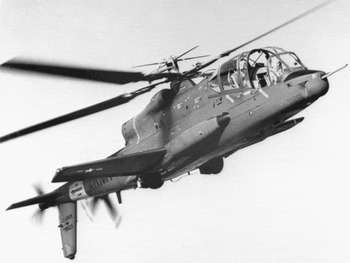
The programmatic stability promised by total package procurement remained elusive in the case of the Cheyenne, given the performance requirements demanded by the Army and the technological complexity of Lockheed’s design. The Army had begun using armed helicopters—modified aircraft originally designed to transport infantry and supplies—on a large scale for air assault missions during the Vietnam War. The addition of externally mounted weapons to conventional helicopter airframes, however, increased firepower at the expense of speed and maneuverability.Footnote 9 The Army expected the Cheyenne, the first dedicated attack helicopter based on an original design, to avoid these trade-offs. The Cheyenne incorporated features of both rotary and fixed-wing aircraft to extend speed and performance capabilities beyond the aerodynamic limits tolerated by conventional helicopters.Footnote 10 Swept wings protruding from the center section of the fuselage and a pusher propeller attached to the tail unloaded the main rotor after takeoff, providing the bulk of the propulsive power that enabled high-speed flight. Lockheed also incorporated a rigid rather than a standard hinged rotor and a new type of control system into the design to reduce vibrations, improve stability, and lower maintenance costs. Expected to fly more than twice as fast as the armed UH-1B Iroquois utility helicopters that the Army intended to replace in Vietnam, this two-seat hybrid aircraft, known as a compound helicopter, carried a formidable array of weapons, including gun turrets built into the nose and underside of the airframe and rocket launchers mounted externally on the wings. Integrated avionics and fire-control systems improved combat effectiveness even further, enabling the pilot and copilot/gunner to track and destroy multiple ground targets independently (Figure 1).Footnote 11
In its public flight debut, an AH-56 Cheyenne prototype is put through its paces near Lockheed’s Van Nuys, California, assembly plant on December 12, 1967. Note the swept wings and the pusher propeller attached to the tail assembly. © Bettmann/CORBIS.

The Army Materiel Command (AMC)—the organization responsible for weapon systems acquisition—awarded Lockheed a two-part total package procurement contract in March 1966.Footnote 12The engineering development phase required Lockheed to fabricate ten prototype aircraft for ground and flight testing. The production phase of the contract included options to purchase a maximum of 1,500 helicopters, but it initially lacked a specified number of aircraft because of funding instability projected for fiscal years 1968 and 1969. The Army finally settled on a reduced total of 375 helicopters early in 1968. Lockheed completed the assembly of all ten prototype aircraft that summer and planned to begin full-scale manufacturing in September, before the testing program had ended. The company expected to deliver the first production helicopter to the Army in the fall of 1969.Footnote 13
Lockheed deliberately overlapped R&D and production—a practice called concurrency—to meet the deadlines built into the total package procurement contract. Some overlapping of these functions had always existed in the private sector, where industrial firms often exploited synergies between R&D and manufacturing to improve productivity on the assembly line. After World War II, especially following the start of the Korean War in 1950 and also in response to the Truman administration’s expectation of armed conflict with the Soviet Union, all three military departments began urging defense contractors to employ the concept more broadly to accelerate the acquisition of new weapon systems that incorporated sophisticated but operationally immature technologies. Concurrency increased the risk of schedule delays and cost growth in programs, such as the Cheyenne, that advanced the technological state-of-the-art.Footnote 14
Lockheed engineers had not perfected the helicopter’s rigid rotor technology prior to the start of production, a shortcoming that contributed directly to flight instability and other control problems. One prototype aircraft broke apart and crashed during a test flight off the southern California coast in March 1969, killing the pilot. Immediately following the accident, while the first production helicopter sat on the assembly line at the Van Nuys factory awaiting completion, Lockheed suspended flight testing and grounded the remaining prototypes.Footnote 15 The company proposed slipping the delivery date of the first production aircraft into 1970 to work out the technical bugs and get the program back on track, but the Army rejected that option. The Army canceled production of the Cheyenne for default in May 1969 and boosted procurement of the AH-1 Cobra gunship, a slower interim attack helicopter derived from the UH-1 airframe that had entered service in Vietnam in 1967.Footnote 16This outcome prompted General Betts, who had proclaimed the Cheyenne’s superiority two years earlier, to acknowledge that both the Army and Lockheed had been too optimistic in their shared assumptions about the maturity and operational readiness of rigid rotor technology. The Army’s experience, Betts observed, put “one more nail in the coffin” of total package procurement.Footnote 17
FROM CHEYENNE TO APACHE
Betts’s pessimistic assessment of total package procurement played out unfavorably at Lockheed. Financial penalties triggered by delays in the Cheyenne and other troubled TPP programs—most notably the Air Force’s C-5A heavy logistics transport aircraft—nearly bankrupted the company. The fallout from these and other similarly structured programs under way elsewhere, such as the F-111 tactical fighter produced for the Air Force by the General Dynamics Corporation, marked the end of total package procurement as the primary contracting mechanism used by the Department of Defense to acquire weapon systems.Footnote 18 The Army directed Lockheed to resume flight testing of the Cheyenne in the summer of 1969, despite the absence of a production contract.Footnote 19 The United States, however, had already started to withdraw combat forces from Southeast Asia. Moreover, doctrinal planning within the Army began to shift from the immediate requirements of counterinsurgency warfare in Vietnam to renewed emphasis on mechanized combat against Soviet forces in Europe.Footnote 20This reorientation quickly rendered the Cheyenne’s air assault mission obsolete and prompted the Army to cancel the entire program in 1972 in favor of a new attack helicopter designed to meet the minimum requirement for anti-armor warfare in Europe and also satisfy the new acquisition procedures established by Robert McNamara’s successor in the Office of the Secretary of Defense.
Melvin Laird, who had taken office as President Richard Nixon’s secretary of defense early in 1969, delegated responsibility for acquisition reform to his deputy, David Packard, co-founder and president of the Hewlett Packard Company, a big West Coast electronics firm and defense contractor. A respected corporate executive, Packard approached the problem of acquisition reform from the same perspective he had used to run his company—management by objective. Unlike Laird’s predecessor, Robert McNamara, who had reduced the independence of the military departments and concentrated managerial authority over weapon systems acquisition in the Office of the Secretary of Defense, Packard encouraged more decision-making outside OSD. In Packard’s mind, the role of the Office of the Secretary of Defense should be limited to periodic rather than continuous oversight of acquisition programs. OSD should establish clear objectives at the outset and delegate managerial control for weapons development and production to the military departments.Footnote 21
In the spring of 1969, Packard established the Defense Systems Acquisition Review Council (DSARC), which institutionalized the concept of management by objective. At specific points in the acquisition cycle—called milestones—the DSARC reviewed the status of a given program as it evolved from initial concept to deployment of the completed weapon system. Progression from one milestone to the next depended on the extent to which the program results satisfied the objectives and performance targets established by the responsible military department. The council also cast the deciding vote on proposed changes that extended beyond allowable thresholds, such as cost, established at program initiation. Over the course of a program’s lifetime, the council conducted at least three milestone reviews: program initiation (milestone one), full-scale development (milestone two), and production and deployment (milestone three). The secretary of defense either approved or rejected advancement to the next milestone. After each review, OSD stepped back from direct involvement, leaving day-to-day program management to the responsible military department’s acquisition organizations.Footnote 22The Army established an equivalent board—the Army Systems Acquisition Review Council (ASARC)—to conduct the same program review and approval process internally prior to evaluation by the DSARC.Footnote 23
The staggered review procedures built into the DSARC’s charter encouraged sequential rather than concurrent progression through the acquisition cycle. Packard, who favored a reduction in the use of concurrency, had stipulated that a program should progress from one milestone to another—for example, from development to production—only after the completion of sufficient hardware testing and prototyping. He also preferred competitive prototyping in place of paper studies to select the winning bid among rival contractor proposals, a requirement absent from total package procurement. The Army had based its selection of the winning design for the Cheyenne on paper studies submitted by Lockheed and the Sikorsky Aircraft Division of the United Aircraft Corporation rather than on hardware tests using full-scale prototype aircraft. Similarly, as a consequence of concurrency, production of the Cheyenne—the equivalent of milestone three—had begun before Lockheed successfully demonstrated to the Army’s satisfaction the operational readiness of the rigid rotor system. Packard encouraged all three military departments to conduct comprehensive prototype competitions in advance of contract awards for full-scale development, and the Congress set aside special funds specifically for this purpose.Footnote 24
Packard overhauled the contracting procedures used by the military departments. He dismantled total package procurement in favor of separately issued contracts for each milestone in the acquisition cycle. Packard attributed the failure of total package procurement to the assumption that estimates of R&D expenditures could be used to predict accurate costs of production. The preponderance of technological risk present during development precluded such an outcome, a limitation that Packard explicitly addressed in July 1971, when the Office of the Secretary of Defense issued the first departmental directive stating the new guidelines for the acquisition of major weapon systems: “It is not possible to determine the precise production cost of a new complex defense system before it is developed; therefore, such systems will not be procured using the total package procurement concept. . . . Cost type prime and subcontracts are preferred where substantial development effort is involved. . . . When risk is reduced to the extent that realistic pricing can occur, fixed-price type contracts should be issued.”Footnote 25In August, the Army, which had continued to fund development and testing of the Cheyenne prototypes after the cancelation of the production option, restructured the original TPP contract. In place of the existing fixed-price-incentive contract, the Army awarded Lockheed a cost-plus-no-fee contract in accordance with Packard’s new acquisition guidelines.Footnote 26
One year later, in August 1972, Secretary of the Army Robert Froehlke terminated the Cheyenne program and sought funds for a new helicopter gunship whose design would more closely resemble conventional rotary-wing aircraft. The justification for a new program start rested on the impending obsolescence of the Cheyenne’s original air assault mission and the Army’s decision to trade technological sophistication for cost savings. Frustrated by the program’s lack of cost discipline, some lawmakers in the Congress had pressured the Army to cancel the Cheyenne; the Senate Armed Services Committee deleted appropriations for the program in the Defense Department’s budget request for fiscal year 1973.Footnote 27 Meanwhile, the withdrawal of combat forces from Vietnam eliminated the Cheyenne’s primary purpose—fire suppression and armed escort. Well suited to counterinsurgency warfare against a geographically dispersed enemy, these capabilities did not satisfy the Army’s air assault requirements for the defense of Western Europe against Soviet armor protected by coordinated air defenses. Rather than refit the Cheyenne to execute a function that it had not been designed to perform, the Army substituted agility for speed and opted for a new tank killer—now called the advanced attack helicopter—capable of nap-of-earth flight and continuous operation at night and in inclement weather.Footnote 28This version of air assault—which exploited a tactic called the “pop-up” maneuver—captured the Army’s operational expectations for the new attack helicopter: a round-the-clock ability to dash into well-defended forward battle areas, quickly target and discharge anti-armor weapons, and rush for protective cover behind natural and artificial obstructions, all on a moment’s notice.Footnote 29
One week after Secretary Froehlke canceled the Cheyenne, the Army Systems Acquisition Review Council authorized a new program start for the advanced attack helicopter. In September, the Defense System Acquisition Review Council approved milestone one—program initiation—but with some added requirements. Hoping to avoid a repetition of the problems that had beset the development of the Cheyenne, Deputy Secretary of Defense William Clements, Packard’s successor, imposed strict limits on the projected unit cost of the new attack helicopter before the Army issued any contracts. Excluding expenditures for research and development, the Army set the maximum unit price of the helicopter at $1.6 million (in fiscal year 1972 constant dollars), almost 40 percent less than the projected unit cost of the Cheyenne at termination. Clements tied technological trade-offs directly to cost estimates for production, operation, and support from the outset—a concept called design-to-cost. One of the acquisition reforms introduced by David Packard, design-to-cost required the Army to permit contractor deviations below the minimum required technical performance guidelines initially built into the program if unit costs rose above the $1.6 million ceiling.Footnote 30
Although OSD’s new contracting and cost-estimating procedures promised to reduce the likelihood of unexpected cost overruns in the advanced attack helicopter program, the Army had to convince the Congress that expenditures would not escalate uncontrollably. Brigadier General William Maddox, the director of Army aviation, presented the Army’s case during an appearance before the House Appropriations Committee’s Subcommittee on the Department of Defense in March 1973. Maddox assured the committee that “this is not a high risk program. We are not pressing the frontiers of science as we did when we started the Cheyenne [program].”Footnote 31He also confirmed the Army’s commitment to the $1.6 million design-to-cost ceiling, but added one crucial exception. Representative John Rhodes (R-Ariz.) asked Maddox, “[Do] [y]ou think the $1.6 million figure is liable to hold reasonably firm or will it accelerate or increase?” Maddox answered, “It should not increase unless we decide to add something to the program.”Footnote 32
In June 1973, the Army selected two contractors—the Bell Helicopter Company and the Hughes Helicopter Division of the Summa Corporation—to proceed with prototype development. On July 19, Clements approved the Army’s request to proceed with engineering development—the equivalent of milestone two—in two phases. The cost-plus-incentive-fee contracts for phase I required Bell and Hughes each to construct two flight-ready prototype helicopters and a ground-test vehicle for competitive evaluation. The phase II contract obligated the winner of the fly-off competition at the end of phase I to build and test additional helicopters equipped with avionics and weapon systems. The Army expected to award the production contract in 1978 and start taking deliveries two years later.Footnote 33Competitive testing of the Bell and Hughes prototypes ended in September 1976, and in early December the Defense Systems Acquisition Review Council authorized the transition to phase II engineering development, the last stage prior to the start of production. Hughes, which edged out Bell Helicopter in the fly-off competition, won the phase II contract. Meanwhile, the Army increased its initial production requirement from 472 to 536 helicopters.Footnote 34
FROM DEVELOPMENT TO PRODUCTION
When the Army Materiel Command awarded the phase II engineering development contract to Hughes, the scheduled production decision had already slipped two years—from 1978 to 1980. Upgrades to the Apache’s avionics and weapon systems and modifications to the airframe slowed development and also raised program expenditures. In June 1980, Brigadier General Edward Browne, the Apache program manager, presented data to the House Appropriations Committee’s Subcommittee on the Department of Defense showing that total estimated program costs had increased more than 40 percent (in constant 1972 dollars).Footnote 35 Surprises of this kind did not sit well with lawmakers in the Congress, who balked at the prospect of funding another expensive weapon system that had fallen behind schedule and gone over budget.Footnote 36 Meanwhile, growing public disgust directed at defense contractors accused of defrauding the government prompted the Congress to assume a more proactive role in the oversight of weapons acquisition.Footnote 37 The regulatory legislation enacted by the Congress did not directly impact the Apache program, but the hostile political environment that gave rise to it undermined the Defense Department’s credibility at the same time the Army prepared to transition the helicopter from development to production.Footnote 38Facing significant cost growth and the likelihood of a backlash from lawmakers, the Army restructured the program in 1981 to obtain timely approval of milestone three—production and deployment—from the Defense Systems Acquisition Review Council.Footnote 39
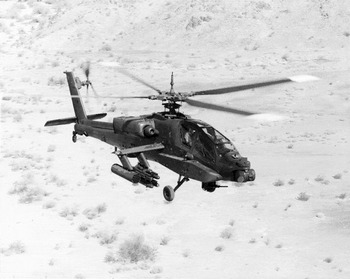
The Tube-launched, Optically-tracked, Wire-guided (TOW) missile served as the Apache’s primary anti-armor weapon when the Army established the original requirement for the advanced attack helicopter in the summer of 1972.Footnote 40 At the same time, the Army had already begun working on a faster, more lethal, and longer-range alternative—the Heliborne Laser Fire-and-Forget (Hellfire) missile. Development of the Hellfire originated separately from the Apache program at the Army Missile Command (MICOM) at Redstone Arsenal in Huntsville, Alabama. Substitution of the TOW in favor of the Hellfire increased the risk to the program; the Army would have to abandon a proven, technologically stable weapon system for one that promised but had not yet demonstrated superior combat capabilities on the battlefield. General Maddox acknowledged this trade-off during an appearance before the House Appropriations Committee’s Subcommittee on the Department of Defense in March 1973. “The aerial TOW system was selected,” he told the subcommittee, “to provide the antitank capability as it is combat proven and consequently reduces the technical and cost risks in . . . the . . . advanced attack helicopter program.” When pressed by the subcommittee to assess the same risks for the Hellfire, Maddox conceded that “a definitive answer cannot be made at this point in time.”Footnote 41 Given this uncertainty, the Army initially planned to equip the first production attack helicopters with TOW missiles, leaving open the option to add the Hellfire to the TOW launch platform at a later date pending the outcome of the development program at MICOM. Two years later, in March 1975, Brigadier General Samuel Cockerham, who had preceded General Browne as the Apache program manager, acknowledged that his office had initiated cost studies of both anti-armor weapons to determine the feasibility of a second option to drop the TOW system entirely in favor of the Hellfire missile and a dedicated launcher. Results of this comparative analysis supported the latter option, and early in 1976, after the Army canceled the TOW requirement altogether, the Hellfire program passed the DSARC milestone review for full-scale engineering development.Footnote 42 Meanwhile, the Hellfire upgrade prompted the Army to develop a complementary integrated avionics package for the Apache that included a laser tracking system to replace the TOW missile’s optical sight. The Target Acquisition Designation Sight/Pilot Night Vision Sensor (TADS/PNVS) combined state-of-the-art fire control and the round-the-clock, all-weather flight capabilities specified in the original program requirement (Figure 2).Footnote 43
An AH-64 Apache attack helicopter hovers over the Arizona desert during a flight to test the fire-control system. Note the TADS/PNVS in the nose turret and the Hellfire missiles attached to the inboard weapons pylon. Copyright © Boeing.

Justification for the Hellfire upgrade emerged from the rapid evolution of Army doctrine that followed the Arab-Israeli War in October 1973. This brief conflict, in which Israel’s Arab neighbors launched a massive, Soviet-style invasion, starkly demonstrated the lethality and increased pace of modern, mechanized warfare, especially the devastating effectiveness of anti-armor and surface-to-air missiles. Likewise confronted by technologically proficient and numerically superior Soviet forces in Europe, the Army developed new tactical doctrines and weapon systems that substituted firepower for manpower.Footnote 44This shift in doctrinal thinking structured the Army’s decision to replace the TOW on the Apache. During a briefing to the Senate Armed Service Committee’s Subcommittee on Tactical Airpower in March 1974, two years before the Army approved the upgrade, Colonel John Hanby, the Hellfire program manager, confirmed that “[l]essons learned from the Middle East war further substantiated the Army’s requirement for a weapons system that provides helicopters with increased stand-off ranges, reduced exposure times, and a capacity to suppress forward air defense weapons. Hellfire has the potential to accomplish these requirements.” Likely in a direct reference to the TOW, Hanby continued, “[T]his system [Hellfire], in comparison to current heliborne missile systems, should provide reduced missile time-of-flight [and] increased missile maneuverability.”Footnote 45
From the outset, the Army officers who managed the Apache program reassured lawmakers that the Hellfire and TADS/PNVS upgrades would not raise the design-to-cost ceiling originally established in 1972.Footnote 46During a hearing of the Senate Armed Services Committee’s Subcommittee on Tactical Air on March 2, 1977, however, then Colonel Edward Browne (he received a promotion to brigadier general shortly thereafter) acknowledged the likelihood of development challenges that might raise program costs. In response to a question from Senator Strom Thurmond (D-S.C.), who asked: “What are the main development problems remaining on the [advanced attack helicopter]?” Browne replied, “The basic development problems that we face in phase II . . . are the target acquisition designation system and the pilot’s night vision system, and then the integration of the fire control into the total weapons systems platform. The basic air frame itself, we have some difficulties. They are small technical difficulties that we were apprised of during . . . phase I . . . which are not technologically as risky as the overall TADS and PNVS development.” Eight days later, on March 10, the Army Materiel Command awarded cost-plus contracts to the Martin Marietta Corporation and the Northrop Corporation for competitive development of the TADS/PNVS.Footnote 47
The Hellfire and TADS/PNVS upgrades disrupted the transition of the Apache from development to production. At first glance, the likelihood of a quick production start looked promising given the surge in defense spending that followed the election of Ronald Reagan to the presidency in 1980. Caspar Weinberger—Reagan’s new secretary of defense—guided the administration’s efforts to push large increases in the defense budget through the Congress.Footnote 48The Army took advantage of the spending windfall to advance the modernization of the force structure that had been under way since the end of the Vietnam War, offsetting prior funding shortfalls in nearly a dozen major weapon programs poised to enter full-scale production. But three weapon systems already in production—the M1 Abrams main battle tank, the UH-60 Black Hawk utility helicopter, and the Stinger surface-to-air missile—had consumed more resources than originally planned during the transition from development, which restricted the Army’s flexibility to accommodate cost increases in other acquisition programs. General Browne had to accept trade-offs to compensate for the cost growth already incurred in the Apache program prior to the production start.Footnote 49
By the end of the 1980 fiscal year (September 30), the Army had estimated the cost for procurement of 536 Apache helicopters to be $4.752 billion (adjusted for inflation).Footnote 50 Meanwhile, the planned production start had slipped another year to December 1981 to accommodate the lack of advance funds necessary to purchase critical materials and fix problems with the cockpit seating and tail assembly. The procurement cost remained nearly constant until October of that year, when Browne revised the estimate sharply upward to $5.955 billion, an increase of 25 percent, in anticipation of the upcoming program evaluation by the Defense Systems Acquisition Review Council.Footnote 51 Browne had begun to get a clearer picture of the cost growth in September 1981, when Hughes submitted a production proposal that included updated estimates. “While many areas in the Hughes proposal appear to be overstated and reducible in negotiations,” Browne wrote in a status report he sent to the headquarters of the Materiel Development and Readiness Command (DARCOM), “I am doubtful that we will be able to do the program for less than [$5.955 billion].”Footnote 52Given these circumstances and the risk of additional cost growth, the Army Systems Acquisition Review Council set a higher estimate of $6.518 billion in November, while Secretary of the Army John Marsh ordered a reduction in the number of aircraft to be acquired, citing affordability concerns. “For the first time . . . we are addressing the issue of differing costs estimates between the Project Manager [Browne] and our [ASARC] independent effort,” Marsh wrote Deputy Secretary of Defense Frank Carlucci shortly after the ASARC completed its evaluation.Footnote 53
Marsh cut the procurement total by 15 percent, from 536 to 446 helicopters. “This will allow equipping of our highest priority units,” he told Carlucci.Footnote 54He also ordered an increase in the planned production rate of the Apache to take advantage of economies of scale, thereby lowering program costs. Guided by these new requirements, Browne revised downward his cost figures for the reduced production buy, this time projecting an outlay of $5.336 billion. Still concerned about the possibility of unexpected increases in program expenditures, the ASARC relied on its own internal calculations, lowering the total projected procurement cost from $6.518 billion to $5.864 billion, roughly equivalent to the estimate Browne submitted in October, but for 90 fewer aircraft. The difference between the ASARC estimate for 446 helicopters and the one prepared by Browne—$528 million—sat in a special contingency account that he could access to pay for unanticipated expenses as the program transitioned from development to production. In December 1981, the ASARC raised the projected procurement cost $286 million to $6.150 billion to reflect revised inflation indices submitted by the Office of Management and Budget. Hughes estimated a final procurement cost of $6.360 billion for 446 helicopters, but the Army rejected that figure and pushed the company to lower the price before seeking approval for a production start from the Defense System Acquisition Review Council.Footnote 55
Cutting the procurement total and accelerating the production rate helped offset the sharp increase in program costs in 1981, but only to a point. The ASARC concluded that these actions would reduce the cost growth by 40 percent, still leaving a large gap in the program budget.Footnote 56 The Army had already planned to produce a maximum of eight aircraft per month, about half the number Browne judged to be necessary to maximize manufacturing efficiencies. “I think an economic production rate, speaking strictly from a manufacturing viewpoint, would be in the order of 15 helicopters per month,” he had told the House Appropriations Committee’s Subcommittee on Army Tactical Aircraft and Missile Programs in June 1981. Because the Army had limited funds to buy all of the weapons it considered necessary for a balanced force structure, however, Browne had to settle for higher unit costs at less-than-optimal production rates.Footnote 57 Similar circumstances had reduced production quotas of the Abrams tank, the Bradley infantry fighting vehicle, and the TOW, Patriot, and Pershing II missiles. Funding restrictions prompted the Army to set production levels of these weapons at “less than efficient . . . rates” starting in fiscal year 1983. OSD recommended the transfer of funds from other programs to help offset the shortfall, an alternative flatly rejected by Major General Patrick Roddy, director of program analysis and evaluation in the Office of the Army Chief of Staff. “The Army does not support providing additional funding to these systems at the expense of other . . . programs,” Roddy replied in November 1981. “If the necessary funding had been available to the Army at the time of Budget Submission,” he explained, “we would have programmed these systems at efficient rates. The identification of offsets to bring these systems to efficient rates is not prudent or possible at this time.”Footnote 58It is not known why Roddy’s policy guidance did not also extend to the Apache program. Whatever the reason, the Army Systems Acquisition Review Council identified and the Office of the Secretary of Defense approved the transfer of funds from other weapon programs to help reduce further the cost growth in the Apache program, but even after Marsh ordered the production-rate increase, these additional resources only allowed Browne to raise the maximum monthly total to twelve helicopters, still below the desired fifteen aircraft optimum.Footnote 59
Already constrained by the competition for resources, Browne lost more credibility after presenting updated program cost and production estimates to the Congress early in 1982. Senator Barry Goldwater (R-Ariz.) fired the first salvo at a hearing of the Senate Armed Services Committee’s Subcommittee on Tactical Warfare in February. Goldwater, who served as chairman, opened the hearing with a stinging criticism: “[T]he cost management of this program has been poor. . . . [T]he members of this subcommittee are not going to just sit here and throw money at the problem.”Footnote 60Browne and James Ambrose, a retired vice president of the Ford Aerospace and Communications Corporation whom President Reagan had just appointed Undersecretary of the Army, spearheaded the Army’s effort to rehabilitate the Apache program in the Congress and facilitate a smooth transition from development to production.Footnote 61
Taking advantage of his status as a new political appointee, Ambrose avoided direct responsibility for the program’s recent cost growth. “[U]ntil . . . 1981,” Ambrose explained during a hearing of the House Armed Services Committee’s Subcommittee on Procurement and Military Nuclear Systems in March 1982, “neither side had really faced up to the totality of the cost of this aircraft in a thorough enough way that the estimates could be traced back to real drawings, real parts counts, real tooling lists and so forth.”Footnote 62Representative Samuel Stratton (D-N.Y.), the subcommittee chairman, expressed his dissatisfaction more directly: “How is it that we are able to allow this kind of thing to happen . . . that the Hughes price goes up so astronomically? Who is on the job here? What do we hire inspectors for? . . . Has nobody bothered to find out what Hughes is doing so that we know before the thing gets up here to this astronomical figure . . . that they are overrunning? . . . I thought when you have a contract with somebody there is supposed to be some device . . . that tells you exactly what the price status is from time to time.” Ambrose put some of the blame on the Army’s acquisition organization. “[I]t was not a matter of the contractor [Hughes] alone not coming out with the right numbers,” he told Stratton. “Both sides were waiting until the end of a development contract when there was a formal requirement for a submission of the design to unit cost estimate to add it all up. Clearly this thing did not all take place overnight; it was accumulating as the design evolved.” Browne admitted as much when he explained that the recent cost growth could be traced back to the weapons and avionics upgrades added to the program in 1976: “[P]erhaps we should have done something earlier, but I submit it is not to the extent that we have been sitting here doing nothing and just didn’t pay attention to what was occurring.”Footnote 63
Browne also attributed the program’s cost growth to inherent limits in the estimating process. One month earlier, in February 1982, he had presented this argument to Goldwater’s senate subcommittee on tactical warfare. When Senator John Warner (R-Va.) asked him to explain the most recent cost growth in the Apache program, Browne admitted that “our estimating techniques . . . are inadequate to project costs 5 to 7 years in the future.” Browne elaborated further: “[W]hat you are seeing is what happens as the design evolves. . . . [Y]ou start evolving the design . . . and then as you get closer to the production decision [you get] a much cleaner definition of what it is that you will have to produce in the machine shops and in the factories. . . . [W]e don’t have a very good recipe to do that kind of cost analysis and projection with the clarity that we all would like to see.”Footnote 64 In 1975, just before the Defense Systems Acquisition Review Council approved full-scale development in the Hellfire program, the Army estimated the procurement cost of 24,600 missiles to equip the Apache fleet at $297.9 million. Five years later, in 1980, the figure had nearly doubled to $553.9 million (in constant 1975 dollars). The increase stemmed from revised system requirements, higher hardware and engineering costs, and added expenditures for testing, warranty provisions, and management overhead.Footnote 65 Development costs for the TADS/PNVS avionics suite followed a similar upward trajectory. Costs remained stable during the first year of competitive development between Martin Marietta and Northrop. “At this time, all elements of the TADS and the PNVS developments are proceeding on schedule, within cost, and meeting technical objectives,” Browne reported to the Senate Armed Service Committee’s Subcommittee on Tactical Air in March 1978.Footnote 66By mid-1981, one year after Martin Marietta won the competition and received a cost-plus-incentive-fee contract to continue development of the system, program costs had increased sharply. This outcome forced Browne to acknowledge publicly that “the Army has been gravely concerned with the Martin Marietta TADS/PNVS cost escalation” and also fend off allegations initially raised during an internal investigation conducted by the House Appropriations Committee’s Subcommittee on the Department of Defense that the company had deliberately submitted optimistic cost projections—that is, executed the “buy in”—to obtain the contract. Although he denied direct knowledge of a “buy in,” Browne reassured the subcommittee that “Close scrutiny will be maintained to preclude recoupment [by Martin Marietta] of [incentive] fees lost on this program.”Footnote 67
Inaccurate estimates of the labor hours required to complete the wiring on each Apache helicopter increased costs further. James Ambrose, who had accompanied Browne to the February 1982 hearing of the Senate Armed Services Committee’s Subcommittee on Tactical Warfare, confirmed that the quantity of wiring in the Apache had increased by a factor of four since the program’s inception in 1972, largely because of the addition of the Hellfire and the TADS/PNVS to the airframe. Pending approval of the production decision by the DSARC, the Army expected to buy eleven helicopters in fiscal year 1982, down from fourteen after the restructuring of the program. Estimates submitted to the Army by Hughes for the total labor hours required to complete the wiring on these helicopters had increased sharply between 1978 and 1981: from 1,317 to 20,451 hours. Ambrose attributed this programmatic instability to the long intervals, sometimes lasting more than a year, between design-to-cost reviews. “You can’t make a formal design-to-cost review every month,” he told the subcommittee, “but that interval is simply too long and in that period individual groups, individual people, obviously knew more wires were going into that [helicopter], more costs here, more something there. . . . I think the explanation . . . is that the methodology of the reporting system was simply utilized to delay the explicit casting up of the score and reporting it either to Army management or anywhere else.”Footnote 68
The Army failed to abide by the original design-to-cost estimate of $1.6 million established by the Office of the Secretary of Defense in 1972. Senator Goldwater asked Browne to explain the Army’s conduct, referring specifically to the sudden absence of updated design-to-cost figures in the program status reports—called selected acquisition reports (SAR)—periodically compiled by the military departments and submitted for review to the Secretary of Defense and to the Congress.Footnote 69The Army had adjusted the estimate upward to $1.7 million in 1974. Browne explained to Goldwater that the revised figure had still “applied to a TOW missile equipped . . . [helicopter], and the Army’s goal was to procure to that configuration or apply hardware to reduce costs to that figure. The entire range of hardware trade-offs was to be considered.” Between January 1975 and April 1979, the period in which the estimated outlay for the Hellfire production buy had remained stable, the SAR cost summaries for the Apache confirmed the original $1.7 million ceiling: “The flyaway cost goal of $1.704 million (in constant fiscal year 1972 dollars) will be adhered to by the Army through trade-offs.” Now, early in 1982, Goldwater wanted to know why this statement had been omitted in all subsequent reporting. The first signs of significant cost growth in the Hellfire program appeared in January 1980, leaving Browne with no option but to acknowledge the irrelevance of the design-to-cost threshold. He explained to Goldwater that “subsequent to the decisions to increase the procurement objective to 536 [helicopters]; incorporate the Hellfire missile system and the TADS/PNVS into the [helicopter]; as well as OSD redefinition of Design-To-Cost to include the impact of revised cost accounting standards, allowance for cost of money, system program management costs, and engineering changes; the statement was no longer appropriate.” Obtaining a fair price for the Apache now depended solely on the outcome of the contract negotiations under way between the Army and Hughes.Footnote 70
By February 1982, Hughes had lowered its original estimate by 5 percent to $5.994 billion, still $658 million more than the $5.336 billion figure Browne had submitted to the Army Systems Acquisition Review Council three months earlier. Despite the availability of the $528 million contingency fund to offset most of the difference, the Army pressed Hughes for more price flexibility.Footnote 71On March 25, the day before the Defense Systems Acquisition Review Council approved the Army’s request to start production, Undersecretary Ambrose told Senator Goldwater that Hughes had lowered its cost estimates even further. “On the basis of the latest Hughes offer,” Ambrose assured Goldwater, “I consider it quite probable that . . . we can conclude a prime contract which satisfies the conditions of reasonable competitive costs, no excessive start-up costs with a new [manufacturing] plant, and being within the Program Manager’s budget.” Absent the contingency fund but adjusted for inflation, Ambrose confirmed on March 29 that the Army and Hughes had agreed to a final cost of $5.6 billion for 446 helicopters.Footnote 72
Ambrose waited for Secretary of Defense Caspar Weinberger to render a decision. In December, the General Accounting Office (GAO)—the Congress’s investigative arm—had urged Weinberger to postpone the production start, citing inadequate testing of the Apache’s weapons, fire-control, and propulsion systems and financial instability at Hughes. In a letter summarizing these concerns, W. H. Sheley, director of the GAO’s mission analysis and systems acquisition division, identified the crucial trade-off that Weinberger had to consider before proceeding. “[T]he costs associated with postponing the [production] decision,” Sheley wrote, “must be weighed against the benefits of obtaining better information and greater confidence in the total system’s merits.”Footnote 73 The Army had already paid a premium for its patience—interim funding equivalent to 6 percent of the total procurement budget for eleven helicopters in fiscal year 1982—to allow Hughes to continue preparations for production during the labored restructuring of the program that preceded OSD’s final approval.Footnote 74Weinberger upheld the DSARC’s decision to start production. But, in a direct reference to the GAO’s previously stated concerns, he cautioned the Secretary of the Army that program risks had to be monitored carefully. “[O]f concern is the cost control of the AH-64 procurement program,” Weinberger wrote Secretary Marsh on April 15. “The Army must manage this aspect of the program with particularly great intensity. Provisions must be established to enable early detection and correction of factors which could cause program costs to increase above those now foreseen.”Footnote 75
The Army used a combination of fixed-price-incentive and firm-fixed-price contracts to structure helicopter production. The type of contract depended on the extent to which the Army expected technological instability to raise costs. On April 15, the same day Weinberger cautioned Marsh to monitor the program’s cost growth, the Army awarded a fixed-price-incentive contract to Hughes for the first eleven Apache helicopters scheduled for production in fiscal year 1982.Footnote 76 A fixed-price-incentive contract also structured the acquisition of the TADS/PNVS from Martin Marietta, but not the Apache’s T700-GE-701 gas turbine engines manufactured by the General Electric Company. Major General Charles Drenz, who had replaced Browne as the Apache program manager at the end of 1982, explained the difference in contracting procedures to the House Appropriations Committee’s Subcommittee on the Department of Defense in March 1983, two months after helicopter production had begun at Hughes. “The Army has procured over 1,000 of the T700 family of engines from General Electric,” Drenz told the subcommittee.Footnote 77“The availability of actual cost data gives confidence in using firm fixed price contracts for engines for the Apache. Fixed price incentive contracts are appropriate for the other components at this stage of production, and are structured with the intent to minimize risk while insuring delivery for the best price.”Footnote 78
The completion of contract negotiations with Hughes in the spring of 1982 boosted the Army’s confidence in the stability of the Apache program. Anticipating lower unit costs based on a higher production rate, the Army elected to use the extra $528 million held in reserve to purchase an additional sixty-nine Apaches, raising the number of helicopters to be acquired by 1987 to 515, still twenty-one aircraft shy of the original 536 requested, but without surpassing the total program outlay of $6.15 billion.Footnote 79 That optimism vanished during the summer as cost estimates at Hughes rose sharply. The time lost restructuring the program at the end of 1981 threatened to jeopardize the production increase and derail negotiations between the Army and Hughes for the second lot of forty-eight helicopters to be purchased in fiscal year 1983. Claiming insufficient preparation time, Hughes still rushed to meet the August 1, 1982 contract proposal deadline, but not to Browne’s satisfaction. “[T]he proposal seems to be about 23% higher than what I had planned,” he wrote DARCOM commander General Donald Keith.Footnote 80 At Browne’s request, Keith pressured Hughes to submit a revised proposal that also met the Army’s late December deadline for the award of the fiscal year 1983 production contracts. “I . . . emphasized . . . that it was absolutely essential that this be worked expeditiously and thoroughly because we can’t afford a replay of last year,” Keith wrote Undersecretary Ambrose in October. Meanwhile, Ambrose had offered “to yell at [Hughes president Jack] Real” on Browne’s behalf. Having conveyed to Hughes that “we can stand no bad news on this program,” Keith got the company to agree to more favorable contract terms that kept the cost of the fiscal year 1983 production buy within the Army’s allocated budget.Footnote 81 In early December 1982, with the program back on track, Deputy Secretary of Defense Carlucci approved the release of the $528 million in the contingency account.Footnote 82 Hughes started helicopter production at a new factory in Mesa, Arizona, the following January, and the first completed Apache rolled off the assembly line in September. One year later, in October 1984, Hughes delivered to the Army the last of the eleven helicopters on contract in fiscal year 1982.Footnote 83
THE SOCIAL RELATIONS OF WEAPON SYSTEMS ACQUISITION
The Army used two different contracting mechanisms to develop and produce the Cheyenne and Apache attack helicopters, neither of which achieved its originally intended objective to control costs. Total package procurement promised to reduce the government’s liability by preventing contractors from exploiting the high barriers to entry that accompanied a new program start, but it lacked the flexibility to accommodate technological uncertainty. Because total package procurement had yielded disappointing results in the Cheyenne and similarly structured weapon programs in the 1960s, David Packard reformed OSD’s acquisition procedures to eliminate the bottlenecks that had undermined the helicopter’s transition from development to production. Rather than lock in prices and schedules for R&D and production at the outset, Packard favored the use of separate contracts for each function. The type of contract awarded for a specific task in a given weapon program had to be flexible enough to mitigate technological risk without raising costs uncontrollably. Packard also introduced competitive prototyping in place of paper studies and the design-to-cost concept to limit cost growth.
The effectiveness of Packard’s new acquisition directives, however, relied to a greater extent than before on the cooperation of the military departments, a crucial difference that placed a premium on the Army’s ability to manage weapons programs effectively. Except for the supervisory role filled by the Defense Systems Acquisition Review Council, programmatic action occurred locally in the contract negotiations between the Army Materiel Command and the network of industrial firms that produced the Apache’s major components. Although additions and modifications to the program, such as the Hellfire missile system and the TADS/PNVS bundled avionics package, proceeded within the scope of established OSD policy, technological unknowns, uncertainties in the cost-estimating process, and lapses in oversight by the Army and Hughes contributed directly to the cost growth that accumulated throughout the 1970s and reached its peak in 1981. This programmatic instability exacted a high price. Congressional hostility to the lack of cost discipline forced the Army to restructure the Apache program and acquire fewer helicopters than originally planned, an outcome that left the department on edge even after production had started. James Ambrose considered the option of increasing helicopter production above the approved program limit, an alternative rejected outright in April 1983 by his deputy in charge of Army acquisition policy and oversight. “[T]he inclusion of . . . additional aircraft,” he wrote Ambrose, “completely discredits all of the actions we have taken to try and keep this program under control.”Footnote 84
Changes to the acquisition rules that had guided the execution of the Cheyenne program in the 1960s did little to alter cost-management outcomes in the development of the Apache in the 1970s. Costs rose sharply and schedules slipped in both programs. Rather than accept these results as the inevitable consequences of structurally flawed acquisition procedures in need of major reform—a central theme of the military procurement literature—the preceding narrative has underscored the role of programmatic instability as a recurring historical outcome of weapons development and production, particularly in programs that advanced the technological state-of-the-art. While this conclusion is not by itself novel—programs in all three of the military departments experienced cost growth and schedule delays—it does highlight the need for additional historical research to challenge more broadly the prescriptive assumptions that have long framed studies of weapon systems acquisition.Footnote 85 Patterns of organizational behavior in the management of technological innovation varied from program to program, and it is within those variations that social relations among the major participants—the fine structure of the weapons acquisition process—were defined and codified. Prescriptive analysis masks such historical subtleties to the extent that acquisition reform becomes a goal unto itself. The labored transition from the Cheyenne to the Apache attack helicopter is a vivid reminder that the institutions responsible for weapon systems acquisition responded more readily to local adjustments aimed at short-term programmatic goals than to far-reaching structural transformations designed to change the way the Department of Defense manages costs.
acknowledgments
I began the research for this essay as a contract historian on the Defense Acquisition History Project at the U.S. Army Center of Military History in Washington, D.C. I am especially grateful to Jeffrey J. Clarke, chief of military history (now retired), who hired me to work on the project and then granted me permission to publish some of my research independently after I moved to the Smithsonian Institution. J. Ronald Fox patiently tutored me in the intricacies of military contracting and other key elements of the weapons acquisition process. Dr. Clarke, Dr. Fox, Glen R. Asner, Elliott V. Converse III, Michael J. Neufeld, and Roger Connor read and critiqued the manuscript at various stages of development, improving it significantly along the way. Dr. Converse, Edgar F. Raines Jr., Walter S. Poole, Philip L. Shiman, and Walton S. Moody introduced me to the relevant historiography that frames this essay. I am indebted to them and also to the librarians, archivists, and historians who provided research assistance at the U.S. Army Center of Military History; the Historical Office, Office of the Secretary of Defense; the George C. Marshall Foundation; the U.S. Army Military History Institute; the National Defense University; the Library of Congress; the National Archives and Records Administration; and the National Air and Space Museum, Smithsonian Institution. Richard W. Stewart, chief historian at the U.S. Army Center of Military History, kindly provided funding to support archival research at the George C. Marshall Foundation. Martin J. Collins, my supervisor at the National Air and Space Museum, supported this project from the beginning and allotted me the time in my schedule to complete it. Finally, special thanks go to Donald T. Critchlow, Patricia E. Powers, and also to the anonymous referees who reviewed the manuscript for the Journal of Policy History.