



‘Don’t stop looking at this because that puts us back in the dark. Don’t look away however uncomfortable it makes you feel. It may seem like we’re not getting anywhere but we want you to keep reporting and reviewing the deaths of people with a learning disability. Our lives matter. Please listen, and then DO something!’
Foreword to the 2024 Learning from Lives and Deaths of People with a Learning Disability and Autistic People (LeDeR) annual report Reference Yu, Ditzel, Bokor, Sheehan, Magill and Ding1 from the Staying Alive and Well (Lived Experience) Group.
A healthcare system is ultimately judged not by how it cares for the healthiest, but by how it protects those who are most vulnerable. Few groups illustrate this more starkly than people with intellectual disability, who continue to experience some of the greatest health inequalities despite decades of policy initiatives, legal protections and commitments to equitable care. They have a median age of death 19 years earlier than the general population, and almost twice as many deaths are determined as avoidable. Reference Yu, Ditzel, Bokor, Sheehan, Magill and Ding1 These disparities are not explainable by biological vulnerability alone, but by persistent failures in recognising, coordinating and delivering equitable healthcare. 2 Against this backdrop, proposals to discontinue England’s national LeDeR programme and devolve mortality review to integrated care boards (ICBs) or to use high-level administrative data represent far more than a service reorganisation. 3
England’s forgotten health inequality
Approximately 1.7% of the global population have intellectual disability. Reference Nair, Chen, Dutt, Hagopian, Singh and Du4 Successive reports have consistently demonstrated that people with intellectual disability experience substantially shorter life expectancy, greater multimorbidity and significantly higher rates of preventable mortality than the wider population. Reference Yu, Ditzel, Bokor, Sheehan, Magill and Ding1
The Confidential Inquiry into Premature Deaths of People with Learning Disabilities (CIPOLD) estimated that avoidable deaths occur at almost twice the rate observed in the general population. Reference Heslop, Blair, Fleming, Hoghton, Marriott and Russ5 This significantly declined between 2021 and 2024 but remains much higher than the general population as detected in subsequent LeDeR reports. Reference Yu, Ditzel, Bokor, Sheehan, Magill and Ding1
People with intellectual disability have the same rights to good healthcare as everyone else and should not be viewed through the lens of a single diagnosis. Rather, they represent a population characterised by significant clinical complexity, on a background of lifelong developmental disability. Epilepsy, respiratory disease, gastrointestinal disorders, obesity, dementia and severe mental illness commonly coexist, while communication difficulties and cognitive impairment can obscure the presentation of acute illnesses. Reference Yu, Ditzel, Bokor, Sheehan, Magill and Ding1 Consequently, healthcare pathways designed around single diseases frequently fail to meet their needs and delayed diagnosis, fragmented services, failure to make reasonable adjustments and poor communication continue to contribute to avoidable harm. Reference Yu, Ditzel, Bokor, Sheehan, Magill and Ding1
Understanding the challenge: people, professionals and systems
The causes of avoidable mortality operate across three interconnected domains: person, clinician and system.
At the individual level, people with intellectual disability often present with multiple interacting conditions and communication difficulties and rely on family or paid carers to recognise changes in health, though they do not always feel listened to by professionals when they raise concerns. Reference Heslop, Blair, Fleming, Hoghton, Marriott and Russ5 Clinical deterioration may therefore be detected later, described less clearly and acted upon less promptly than in the wider population.
However, vulnerability alone does not explain the mortality gap. CIPOLD and LeDeR demonstrated that most individuals who died had recognised health needs before death, yet the healthcare they received was frequently inadequate. Reference Yu, Ditzel, Bokor, Sheehan, Magill and Ding1,Reference Heslop, Blair, Fleming, Hoghton, Marriott and Russ5 Diagnostic overshadowing, where physical symptoms are incorrectly attributed to intellectual disability or behavioural disturbance, remains a persistent problem. Many clinicians receive little formal training in intellectual disability, contributing to reduced confidence, delayed investigation and inconsistent implementation of reasonable adjustments. Healthcare systems compound these difficulties. Care of individuals with complex needs, including intellectual disability, is often fragmented between primary care, acute hospitals, mental health services and social care, with responsibility dispersed across organisations rather than coordinated around the individual.
These interacting person, clinician and system factors create the conditions in which preventable mortality persists despite universal healthcare. They also explain why a national programme dedicated to learning from deaths became not simply desirable, but essential.
Why LeDeR emerged: from tragedy to national learning
The premature mortality of people with intellectual disability was reported in academic literature in the 1990s. Reference Hollins, Attard, von Fraunhofer, McGuigan and Sedgwick6 In the early 2000s, a series of investigations highlighted unacceptable standards of care experienced by people with intellectual disability. Mencap’s landmark report Death by Indifference described six preventable deaths that exposed institutional discrimination within the National Health Service (NHS) and challenged the assumption that equal access automatically equated to equitable care. 2 Sir Jonathan Michael’s subsequent independent inquiry, Healthcare for All, concluded that widespread inequalities persisted throughout the NHS and recommended fundamental changes in education, accountability and service delivery. Reference Michael and Richardson7
These reports directly led to CIPOLD, described by the authors as only the second ‘population-based study in one area of the UK that explored cause-specific mortality in adults with intellectual disabilities compared to the general population.’ Reference Heslop, Blair, Fleming, Hoghton, Marriott and Russ5 Unlike conventional mortality statistics, CIPOLD reconstructed the clinical pathways preceding death by reviewing medical records, interviewing families and examining organisational decision-making. Reference Heslop, Blair, Fleming, Hoghton, Marriott and Russ5
Its findings fundamentally altered understanding of healthcare inequalities. Men with intellectual disability died, on average, 13 years earlier than the general population and women 20 years earlier. Due to CIPOLD participants being recruited from southwest England only, these findings were not necessarily generalisable on a national level; however, this nevertheless represented a landmark recognition of the mortality gap that exists between this patient group and the general population. Reference Heslop, Blair, Fleming, Hoghton, Marriott and Russ5 Forty-two per cent of reviewed deaths were considered premature. Importantly, these deaths were seldom attributable to rare diseases or unavoidable complications. Instead, they reflected recurrent failures in everyday healthcare: delayed diagnosis, poor communication, fragmented care, inadequate coordination, limited access to investigations and failure to implement reasonable adjustments. Reference Heslop, Blair, Fleming, Hoghton, Marriott and Russ5 Perhaps CIPOLD’s greatest contribution was philosophical rather than epidemiological. It helped reframe mortality review from an exercise in assigning blame to one of organisational learning. Every avoidable death became an opportunity to improve care for those still living. Rather than asking who was responsible, the programme asked what could the healthcare system learn? It also challenged the pervasive misconception that poorer outcomes were an inevitable consequence of intellectual disability, demonstrating instead that healthcare inequalities frequently arose because health services failed to respond appropriately to complexity.
Recognising that reducing inequalities requires continuous measurement rather than one-off inquiries, the authors of CIPOLD recommended establishing a permanent national mortality review programme. LeDeR, launched in 2017, became the first national programme of its kind anywhere in the world. Combining detailed qualitative review with national surveillance, it transformed individual deaths into collective learning. Beyond recording causes of death, LeDeR examined whether reasonable adjustments had been made, whether communication needs were recognised, whether families were involved in decision-making and whether opportunities for earlier intervention had been missed. In doing so, it established a unique model of mortality review that has informed national policy, professional education and service improvement, which is unique to England, Reference Yu, Ditzel, Bokor, Sheehan, Magill and Ding1 with no equivalent anywhere else in the world.
LeDeR’s impact: from describing inequalities to improving care
The value of a mortality review programme lies not in the number of deaths it records, but in the extent to which it changes the care of those still living. By this measure, LeDeR has become much more than a national mortality register. It has evolved into a quality improvement programme, providing clinicians, commissioners and policymakers with a unique understanding of where healthcare systems succeed, where they fail and, crucially, how those failures might be prevented.
Successive LeDeR reports have consistently identified recurrent themes, including inappropriate Do Not Attempt Cardiopulmonary Resuscitation (DNACPR) decisions, inconsistent application of the Mental Capacity Act, inequitable access to investigations and treatment and lack of co-ordination of care across systems and care pathways. Reference Yu, Ditzel, Bokor, Sheehan, Magill and Ding1 While critics argue that these findings are repetitive, the more concerning interpretation is that the inequalities themselves remain unresolved. Surveillance has not failed because the same problems recur; rather, it has continued to reveal the persistence of structural deficiencies within healthcare.
Despite the persistence of the inequalities in median age of death and avoidable mortality experienced by people with intellectual disability, LeDeR has nevertheless reported meaningful improvements in patient care over time, Reference Yu, Ditzel, Bokor, Sheehan, Magill and Ding1 including a highly significant (p < 0.001) reduction in the proportion of avoidable deaths, from 46.3% in 2021 to 39.0% in 2024. There have been similarly highly significant improvements in compliance with statutory processes such as patients having a DNACPR decision recorded at the time of their death (from 72.2% in 2021 to 77.4% in 2024), as well as the Mental Capacity Act being correctly followed (from 65.2% in 2021 to 66.6% in 2024). Relatedly, LeDeR has resulted in important changes to practice, some examples of which are summarised in Supplementary information 1 available at https://doi.org/10.1192/bjp.2026.10832.
Criticisms of LeDeR
No national programme should be immune from scrutiny, and LeDeR has legitimate limitations. Concerns have been raised regarding aspects of the LeDeR programme. First, incomplete case ascertainment is an issue, but this is a feature shared with most other mortality reviews, and the LeDeR group is nevertheless representative of people with learning disability accessing services. Additionally, while initial (first stage) LeDeR reviews follow a standardised approach consistent across regions, the focused reviews (second stage, limited to selected patients) vary regionally with respect to methodology, including criteria for case selection. Third, there is an uncertain impact of the LeDeR-informed recommendations on measurable outcomes for future patients, though this is partially attributable to a lack of academic independence from NHS commissioning structures.
These criticisms deserve serious consideration. National mortality review programmes should be transparent, methodologically robust and independently delivered and scrutinised. Improved linkage with routine datasets, greater academic influence over methodology and direction, improved access (with appropriate ethical safeguards) to LeDeR data for clinicians and academics and more timely reporting would strengthen LeDeR considerably. However, these arguments are for reform, not abolition. Recurrent findings should not be interpreted as evidence that surveillance has failed. Cancer registries continue because cancer persists. Maternal mortality enquiries continue because preventable maternal deaths still occur. National confidential enquiries repeatedly identify familiar clinical failures, yet their continued existence is rarely questioned.
Why England should not abandon LeDeR
Replacing LeDeR with routine administrative datasets and abandoning a national report of reviewed deaths as proposed represents a profound backwards shift in philosophy. 3 Administrative data can describe who died, when, where and often from what. They cannot reliably explain why opportunities for prevention were missed, whether reasonable adjustments were made, whether communication failures delayed diagnosis or whether fragmented care contributed to avoidable death. Mortality review provides understanding that coding alone cannot. Furthermore, such data cannot track changes in care related to new care models and policy developments.
Equally important is the loss of national consistency. Standardised methodology has enabled comparisons across regions, identification of national trends and development of evidence-based recommendations. Devolving responsibility to ICBs risks replacing one nationally coordinated programme with multiple local approaches, each operating with differing resources, expertise and priorities. While this could be interpreted as an attempt to facilitate local ownership in driving change, at a time when ICBs are undergoing significant organisational and financial restructuring, there is a genuine risk that mortality review for relatively small and politically underrepresented populations will become a lower priority. Additionally, it has been proposed that under this new system of devolved responsibility, limitations of current data sources will be addressed through linkage with wider datasets relating to hospital admissions and mental health service use. 3 However, these changes could also be implemented as part of the current LeDeR programme, while retaining the rich and detailed information on care of people with a learning disability and autistic people which is not available in alternative datasets. Furthermore, with ICBs operating separately rather than as part of a national collective, the potential to investigate inter-regional variation and share lessons learned at a national level will be woefully compromised. This goes directly against the needs of people with intellectual disability and their families, for whom it is important to know that the harm people with intellectual disability come to is systematically recorded and nationally collated to inform improvement.
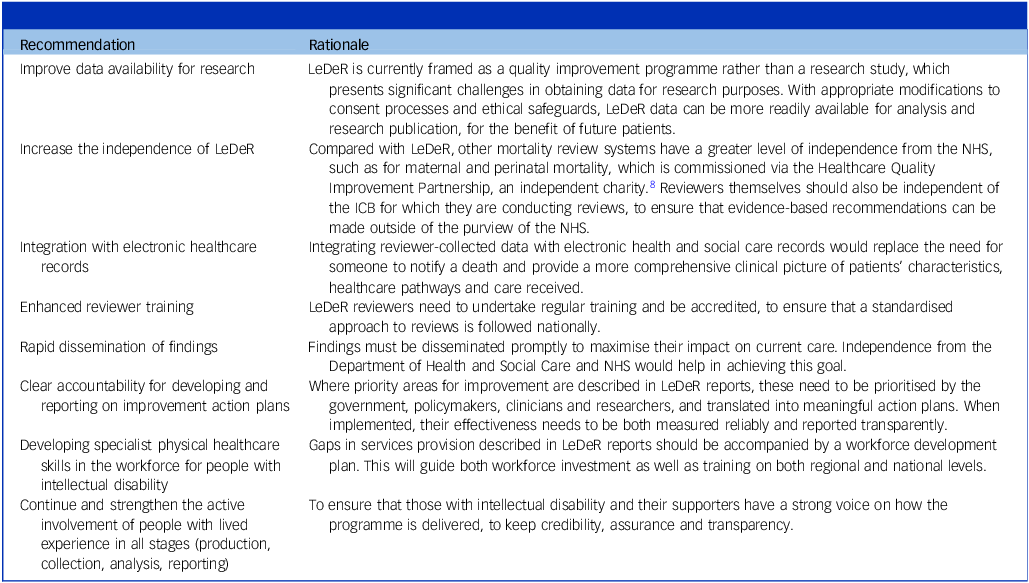
Continuous national surveillance remains essential because healthcare inequalities remain substantial, and policy developments, changes in systems or care approaches may inadvertently exacerbate these. Rather than replacing LeDeR, England should strengthen it through greater academic independence, integration with linked electronic health records, enhanced reviewer training and more rapid dissemination of findings. Modern data science and qualitative mortality review should be complementary, not competing, approaches. Table 1 summarises recommendations to enhance the LeDeR programme.
Recommendations to further enhance the LeDeR programme

Table 1 Long description
A table with two columns and eight rows. The first column lists recommendations, and the second column provides the rationale for each recommendation. Row 1: Recommendation: Improve data availability for research. Rationale: LeDeR is currently framed as a quality improvement programme rather than a research study, which presents significant challenges in obtaining data for research purposes. With appropriate modifications to consent processes and ethical safeguards, LeDeR data can be more readily available for analysis and research publication, for the benefit of future patients. Row 2: Recommendation: Increase the independence of LeDeR. Rationale: Compared with LeDeR, other mortality review systems have a greater level of independence from the NHS, such as for maternal and perinatal mortality, which is commissioned via the Healthcare Quality Improvement Partnership, an independent charity. Reviewers themselves should also be independent of the ICB for which they are conducting reviews, to ensure that evidence-based recommendations can be made outside of the purview of the NHS. Row 3: Recommendation: Integration with electronic healthcare records. Rationale: Integrating reviewer-collected data with electronic health and social care records would replace the need for someone to notify a death and provide a more comprehensive clinical picture of patients’ characteristics, healthcare pathways and care received. Row 4: Recommendation: Enhanced reviewer training. Rationale: LeDeR reviewers need to undertake regular training and be accredited, to ensure that a standardised approach to reviews is followed nationally. Row 5: Recommendation: Rapid dissemination of findings. Rationale: Findings must be disseminated promptly to maximise their impact on current care. Independence from the Department of Health and Social Care and NHS would help in achieving this goal. Row 6: Recommendation: Clear accountability for developing and reporting on improvement action plans. Rationale: Where priority areas for improvement are described in LeDeR reports, these need to be prioritised by the government, policymakers, clinicians and researchers and translated into meaningful action plans. When implemented, their effectiveness needs to be both measured reliably and reported transparently. Row 7: Recommendation: Developing specialist physical healthcare skills in the workforce for people with intellectual disability. Rationale: Gaps in services provision described in LeDeR reports should be accompanied by a workforce development plan. This will guide both workforce investment as well as training on both regional and national levels. Row 8: Recommendation: Continue and strengthen the active involvement of people with lived experience in all stages (production, collection, analysis, reporting). Rationale: To ensure that those with intellectual disability and their supporters have a strong voice on how the programme is delivered, to keep credibility, assurance and transparency.
LeDeR, Learning from Lives and Deaths of People with a Learning Disability and Autistic People; NHS, National Health Service; ICB, integrated care board.
Don’t shoot the messenger
Perhaps LeDeR’s greatest challenge is that it continues to reveal uncomfortable truths. There is an understandable temptation during periods of financial pressure to believe that reducing measurement somehow reduces the problem. History teaches the opposite. Though some have merged, none of the other confidential enquiries (including for maternal death, perioperative care and mental health) have been discontinued.
LeDeR has served precisely this function for the NHS. It has acted as England’s radar for healthcare inequalities experienced by people with intellectual disability, identifying recurring hazards, informing safer practice and ensuring that preventable deaths become opportunities for learning rather than isolated tragedies. Abandoning the LeDeR programme would be directly antithetical to the promise made in Fit for the Future: 10 Year Health Plan for England 9 to ‘make the NHS the most transparent healthcare system in the world.’
Future directions
The history of healthcare is punctuated by inquiries established after tragedy. The greater challenge is creating systems capable of identifying risks before they become scandals. LeDeR has been one of the few national programmes designed explicitly around that principle. The question therefore is not whether England can afford to continue LeDeR, but whether it can afford not to.
Supplementary material
The supplementary material is available online at https://doi.org/10.1192/bjp.2026.10832
Acknowledgements
No artificial intelligence tools have been used in the research or writing process for this manuscript.
Author contributions
All authors satisfy the International Committee of Medical Journal Editors guidance by substantially contributing to the design, analysis and interpretation of the work, drafting of the manuscript and final approval of the manuscript. All authors agree to be accountable for all aspects of the work, ensuring that questions related to the accuracy or integrity of any part of the work are appropriately investigated and resolved. R. Shankar contributed to conceptualisation, methodology, validation, visualisation, project administration, writing of the original draft and review and editing of the manuscript. S.J.T. contributed to conceptualisation, writing of the original draft and review and editing of the manuscript. J.d.V. contributed to writing, review and editing of the manuscript. B.P. contributed to writing, review and editing of the manuscript. R. Sheehan contributed to writing, review and editing of the manuscript. I.S. contributed to writing, review and editing of the manuscript. R.T.A. contributed to writing, review and editing of the manuscript. A.R. contributed to writing, review and editing of the manuscript. R.A.L. contributed to writing, review and editing of the manuscript. J.S. contributed to writing, review and editing of the manuscript. V.C. contributed to writing, review and editing of the manuscript. M.H. contributed to writing, review and editing of the manuscript. J.O. contributed to writing, review and editing of the manuscript. S.H. contributed to writing, review and editing of the manuscript. A.S. contributed to conceptualisation, writing of the original draft and review and editing of the manuscript.
Funding
This research received no specific grant from any funding agency in the public, commercial or not-for-profit sectors.
Declaration of interest
R. Sheehan and A.S. led the academic partnership that produced annual LeDeR reports for 2021–2024 (on a tender with NHS England), which is the central issue discussed in this editorial. R. Shankar, S.J.T., J.d.V., B.P., R. Sheehan, I.S., R.T.A., A.R., R.A.L., S.H. and A.S. are all Members or Fellows of the Royal College of Psychiatrists (RCPsych). They are also part of the RCPsych Faculty of Psychiatry of Intellectual Disability. S.J.T., J.d.V. and R. Shankar are current office bearers in the RCPsych Faculty of Psychiatry of Intellectual Disability. S.J.T., J.d.V., I.S., A.R. and A.S. are currently on the executive committee of the RCPsych Faculty of Psychiatry of Intellectual Disability. S.J.T. is also academic secretary and an executive committee member for the RCPsych Neurodevelopmental Psychiatry Special Interest Group. R. Shankar is the RCPsych Associate Dean for academic training. The authors assert that this feature in no manner reflects the views of the RCPsych as an organisation. R. Sheehan, S.J.T., B.P., R. Shankar, R.T.A., R.A.L. and A.S. hold institutional grants from various national and charity organisations outside the submitted work. R.T.A. is a member of the British Journal of Psychiatry editorial board but did not take part in the review or decision-making process for this paper. No other author has disclosed any conflicts. J.S. and V.C. are the Chief Executive Officer and Founder, respectively, of The Challenging Behaviour Foundation. M.H. and J.O. are Head of Research and Executive Director of Strategy and Influence, respectively, of the Royal Mencap Society.




eLetters
No eLetters have been published for this article.