Introduction
The majority of patients with psychosis, even at the time of their first episode, function at a cognitive level at least one standard deviation below that of healthy comparison groups (Reichenberg & Harvey, Reference Reichenberg and Harvey2007; Zanelli et al. Reference Zanelli, Reichenberg, Morgan, Fearon, Kravariti, Dazzan, Morgan, Zanelli, Demjaha, Jones, Doody, Kapur and Murray2010), with specific domains showing greater dysfunction, such as episodic memory, working memory and executive function (Flashman & Green, Reference Flashman and Green2004; Reichenberg & Harvey, Reference Reichenberg and Harvey2007). Patients with psychosis also show a more prominent history of stress exposure, such as increased rates of a history of childhood trauma (Read et al. Reference Read, van Os, Morrison and Ross2005; Fisher et al. Reference Fisher, Morgan, Dazzan, Craig, Morgan, Hutchinson, Jones, Doody, Pariante, McGuffin, Murray, Leff and Fearon2009 a), increased distress and inability to handle life events (Horan et al. Reference Horan, Ventura, Nuechterlein, Subotnik, Hwang and Mintz2005), and increased number of adverse life events (Bebbington et al. Reference Bebbington, Bhugra, Brugha, Singleton, Farrell, Jenkins, Lewis and Meltzer2004). However, whether or not there is an association between biological and psychosocial markers of stress and cognitive function in psychosis is unclear.
We have recently described, in a large group of first-episode psychosis (FEP) patients, increased levels of perceived stress and increased exposure to recent life events and childhood trauma, together with a specific abnormality in the hypothalamic–pituitary–adrenal (HPA) axis activity, namely, a blunted cortisol awakening response in the context of increased cortisol levels during the day (Mondelli et al. Reference Mondelli, Dazzan, Hepgul, Di Forti, Aas, D'Albenzio, Di Nicola, Fisher, Handley, Marques, Morgan, Navari, Taylor, Papadopoulos, Aitchison, Murray and Pariante2010 a). These data confirm previous findings of increased cortisol levels, increased pituitary volume, and glucocorticoid (GC) resistance (that is, a decreased HPA axis suppression response to the synthetic GC dexamethasone, in the dexamethasone suppression test) in patients with FEP (Pariante et al. Reference Pariante, Vassilopoulou, Velakoulis, Phillips, Soulsby, Wood, Brewer, Smith, Dazzan, Yung, Zervas, Christodoulou, Murray, McGorry and Pantelis2004, Reference Pariante, Dazzan, Danese, Morgan, Brudaglio, Morgan, Fearon, Orr, Hutchinson, Pantelis, Velakoulis, Jones, Leff and Murray2005; Ryan et al. Reference Ryan, Sharifi, Condren and Thakore2004; Ceskova et al. Reference Ceskova, Kasparek, Zourkova and Prikryl2006) and affective psychosis (Belanoff et al. Reference Belanoff, Kalehzan, Sund, Fleming Ficek and Schatzberg2001). It is particularly important to emphasize the uniqueness of the HPA axis abnormalities described in FEP: blunted cortisol awakening response in the context of increased cortisol levels during the day and GC resistance. These abnormalities are different from those described in post-traumatic stress disorder (PTSD) (blunted cortisol awakening response in the context of decreased cortisol levels during the day and GC hypersensitivity, that is, an enhanced HPA suppressive response to dexamethasone; Heim & Nemeroff, Reference Heim and Nemeroff2002; Yehuda, Reference Yehuda2005), and also from those described in depression (increased cortisol awakening response in the context of increased cortisol levels during the day and GC resistance; Pariante & Lightman, Reference Pariante and Lightman2008; Cowen, Reference Cowen2010). Therefore, the biological abnormalities described in the stress response of patients with FEP cannot be considered simply a consequence of distress or of co-morbid mental disorders, and indeed reflect a specific stress signature. Taken together, these lines of evidence strongly support the notion that an abnormal stress response, perhaps linked to the psychosocial environment, participates to the predisposition to psychosis (Belanoff et al. Reference Belanoff, Kalehzan, Sund, Fleming Ficek and Schatzberg2001; Myin-Germeys et al. Reference Myin-Germeys, van Os, Schwartz, Stone and Delespaul2001, Reference Myin-Germeys, Delespaul and van Os2005; Halari et al. Reference Halari, Kumari, Mehrotra, Wheeler, Hines and Sharma2004; Garner et al. Reference Garner, Pariante, Wood, Velakoulis, Phillips, Soulsby, Brewer, Smith, Dazzan, Berger, Yung, van den Buuse, Murray, McGorry and Pantelis2005; Gomez et al. Reference Gomez, Fleming, Keller, Flores, Kenna, DeBattista, Solvason and Schatzberg2006).
It is well known that stress and GC hormones can act on the brain (particularly on the hippocampus), leading to cognitive impairment. For example, disorders characterized by increased stress exposure such as depression, PTSD and chronic fatigue syndrome, also show cognitive impairment, particularly in memory and executive function (Porter et al. Reference Porter, Gallagher, Thompson and Young2003; Sandstrom et al. Reference Sandstrom, Rhodin, Lundberg, Olsson and Nyberg2005; Weber et al. Reference Weber, Clark, McFarlane, Moores, Morris and Egan2005). Moreover, animals or healthy humans treated with endogenous of synthetic GCs show cognitive impairment, again predominantly in memory and executive domains (McAllister-Williams & Rugg, Reference McAllister-Williams and Rugg2002; Hsu et al. Reference Hsu, Garside, Massey and Lister-Williams2003; Wolf, Reference Wolf2003). Elderly subjects with long-term stress exposure also show similar cognitive abnormalities (Lupien et al. Reference Lupien, Fiocco, Wan, Maheu, Lord, Schramek and Tu2005, Reference Lupien, Maheu, Tu, Fiocco and Schramek2007). However, notwithstanding the obvious potential association between high levels of stress, HPA axis abnormalities and cognitive function in patients with a psychotic disorder, the very few studies conducted until now (all in patients with an established diagnosis and a long duration of illness) have led to inconclusive results.
Over two decades have passed since the first study investigating the HPA axis and cognitive abnormalities in schizophrenia was published (Saffer et al. Reference Saffer, Metcalfe and Coppen1985), showing a strong correlation between dexamethasone non-suppression and worse cognitive performance, but only in patients with predominantly negative symptoms. Walder et al. (Reference Walder, Walker and Lewine2000) evaluated patients with schizophrenia, schizo-affective disorder, other psychiatric disorders and healthy controls, and found, in the entire sample, that cortisol levels were negative correlated with performance in memory and executive tasks. The study by Halari et al. (Reference Halari, Kumari, Mehrotra, Wheeler, Hines and Sharma2004) also demonstrated a relationship between increased cortisol levels and decreased performance on processing speed in 20 male patients with chronic schizophrenia. Similar findings of a relationship between increased cortisol during the day and cognitive impairment in patients with psychotic depression have also been reported in the literature (Belanoff et al. Reference Belanoff, Kalehzan, Sund, Fleming Ficek and Schatzberg2001). There are, of course, several confounders in evaluating the HPA axis and cognition in patients with an established diagnosis of schizophrenia, including the effects of age and of many years of continuous illness, antipsychotic treatment and repeated relapses. To date, there are no studies that have investigated the HPA axis together with cognition in FEP, which is the aim of this paper. Our primary hypothesis was that an abnormal HPA axis function, as indicated by a blunted cortisol awakening response and increased cortisol levels during the day, would be associated with a worse cognitive performance in FEP patients.
It is also of interest that, to our knowledge, no studies have directly related cognitive performance to psychosocial measures of stress in FEP. Previous published papers show a link between psychosocial stress and changes in the structure of important brain regions associated with cognitive function, such as the hippocampus (Szeszko et al. Reference Szeszko, Betensky, Mentschel, Gunduz-Bruce, Lencz, Ashtari, Malhotra and Bilder2006; Gianaros et al. Reference Gianaros, Jennings, Sheu, Greer, Kuller and Matthews2007). Moreover, several studies show an association between a history of childhood trauma and poorer scores on several cognitive tasks when assessed in adulthood (Perez & Widom, Reference Perez and Widom1994). Only two studies have investigated cognition and early trauma in people with psychosis, both in individuals with an established diagnosis and a long duration of illness. Lysaker et al. (Reference Lysaker, Meyer, Evans and Marks2001) found that patients with childhood sexual abuse had impaired processing speed, working memory and executive function compared with patients without abuse. Schenkel et al. (Reference Schenkel, Spaulding, DiLillo and Silverstein2005) found that patients with a history of childhood trauma showed a decreased score on learning and visual context processing compared to non-abused patients. To our knowledge, no studies have investigated psychosocial stress together with cognitive performance in FEP, or other aspects of psychosocial stress besides childhood trauma. Therefore, our secondary hypothesis is that increased exposure to psychosocial stressors, as indicated by increased levels of perceived stress, more recent life events or a history of childhood trauma, is associated with a worse cognitive performance in FEP.
The patients described in this paper belong to a larger group described previously, as mentioned earlier (Mondelli et al. Reference Mondelli, Dazzan, Hepgul, Di Forti, Aas, D'Albenzio, Di Nicola, Fisher, Handley, Marques, Morgan, Navari, Taylor, Papadopoulos, Aitchison, Murray and Pariante2010 a). This paper presents, for the first time, the cognitive data in this sample, together with the relationship between cognitive function and the biological and psychosocial stress measures. We also specifically investigate the effects of cannabis use, as patients with psychosis tend to have higher use of cannabis compared to the general population (Di Forti et al. Reference Di Forti, Morgan, Dazzan, Pariante, Mondelli, Marques, Handley, Luzi, Russo, Paparelli, Butt, Stilo, Wiffen, Powell and Murray2009), and the literature shows an association between cannabis use and both cognitive function (Loberg & Hugdahl, Reference Loberg and Hugdahl2009; Ringen et al. Reference Ringen, Vaskinn, Sundet, Engh, Jonsdottir, Simonsen, Friis, Opjordsmoen, Melle and Andreassen2009) and cortisol levels (Mondelli et al. Reference Mondelli, Dazzan, Hepgul, Di Forti, Aas, D'Albenzio, Di Nicola, Fisher, Handley, Marques, Morgan, Navari, Taylor, Papadopoulos, Aitchison, Murray and Pariante2010 a) in psychosis.
Method
Subjects
FEP patients were recruited in London (UK) from the South London and Maudsley (SLAM) National Health Service (NHS) Foundation Trust (boroughs of Lambeth, Southwark and Croydon), as part of the Genetic and Psychosis (GAP) study (Di Forti et al. Reference Di Forti, Morgan, Dazzan, Pariante, Mondelli, Marques, Handley, Luzi, Russo, Paparelli, Butt, Stilo, Wiffen, Powell and Murray2009; Mondelli et al. Reference Mondelli, Dazzan, Hepgul, Di Forti, Aas, D'Albenzio, Di Nicola, Fisher, Handley, Marques, Morgan, Navari, Taylor, Papadopoulos, Aitchison, Murray and Pariante2010 a, Reference Mondelli, Pariante, Navari, Aas, D'Albenzio, Di Forti, Handley, Hepgul, Marques, Taylor, Papadopoulos, Aitchison, Murray and Dazzanb). The recruitment strategy was based on contacting in-patient and out-patient services regularly, interviewing staff and reviewing clinical notes to identify all subjects aged 18–65 years who presented for the first time to these services for a functional psychotic illness (ICD-10 F10–19, excluding coding F1x.0 for Acute Intoxication; F20–29 and F30–39, psychotic codings) (WHO, 1992), as in previous similar studies in this setting (Dazzan et al. Reference Dazzan, Morgan, Orr, Hutchinson, Chitnis, Suckling, Fearon, Salvo, McGuire, Mallett, Jones, Leff and Murray2004, Reference Dazzan, Morgan, Orr, Hutchinson, Chitnis, Suckling, Fearon, McGuire, Mallett, Jones, Leff and Murray2005, Reference Dazzan, Lloyd, Morgan, Zanelli, Morgan, Orr, Hutchinson, Fearon, Allin, Rifkin, McGuire, Doody, Holloway, Leff, Harrison, Jones and Murray2008). Patients with organic psychosis, learning disabilities, a history of traumatic brain injury, or requiring a translator because of lack of English fluency were excluded from the study. Controls were recruited from the same catchment area as the patients through advertisement in local newspapers, hospitals and job centres, and from existing volunteer databases. Controls were screened using the Psychosis Screening Questionnaire (PSQ; Bebbington & Nayani, Reference Bebbington and Nayani1995), and excluded if they met criteria for a present or past psychotic disorder. Both patients and controls were excluded if taking hormonal treatment, or if they had a diagnosis of neuroendocrine disorder (e.g. Cushing's syndrome). The study was approved by the local Ethical Committee, in accordance with the code of ethics of the World Medical Association, and written informed consent was obtained from all participants.
Thirty patients and 26 healthy age- and gender-matched controls underwent neuropsychological, clinical and endocrinological assessments, as detailed below. All assessments were conducted within 6 months of the first contact with mental health services for psychosis; the average duration of illness (defined as above) was, however, much shorter, at 41±33 days. Five of the patients were drug naïve or medication free, 22 were taking atypical antipsychotics, and three were taking typical antipsychotics; 27 patients had a diagnosis of schizophrenia or delusional disorder, and three had a diagnosis of ‘other psychosis’, according to DSM-IV criteria (APA, 2000). None of the subjects were taking drugs such as antidepressants or steroids, known to affect the HPA axis.
Questionnaires and clinical assessment
Sociodemographic data were collected using a modified version of the Medical Research Council (MRC) Sociodemographic Schedule. Validation of clinical diagnosis was obtained using the Operational Criteria (OPCRIT) computer program (McGuffin et al. Reference McGuffin, Farmer and Harvey1991), by reviewing the case-notes for the month following first contact with services. The presence or absence of symptoms was measured by the OPCRIT checklist using the strict OPCRIT definitions, which has excellent agreement with the currently accepted ‘gold standard’ of best estimate diagnosis in similar studies (McGuffin et al. Reference McGuffin, Farmer and Harvey1991). Inter-rater reliability between researchers for the OPCRIT was high (Cronbach's α=0.91).
We measured the perceived stress, in the previous month, using the Perceived Stress Scale (Cohen et al. Reference Cohen, Kamarck and Mermelstein1983). This is a 10-item scale measuring the degree to which situations in one's life are appraised as stressful. We also collected information about stressful life events, in the previous 6 months, using the Brief Life Events Questionnaire (Brugha & Cragg, Reference Brugha and Cragg1990). This questionnaire assesses both the number and the emotional impact of life stressors involving moderate or long-term threat. History of childhood physical abuse, sexual abuse, separation and loss was obtained with the Childhood Experience of Care and Abuse Questionnaire (CECA-Q). All trauma events used in the analyses occurred during childhood (0–11 years) (Thornberry et al. Reference Thornberry, Ireland and Smith2001; Widom et al. Reference Widom, Czaja and Dutton2008). Psychosis patients' responses on the CECA-Q have been demonstrated to have reasonable test–retest reliability and convergent validity (Fisher et al. Reference Fisher, Craig, Fearon, Morgan, Dazzan, Lappin, Hutchinson, Doody, Jones, McGuffin, Murray, Leff and Morgan2009 b). For the analyses, the most conservative cut-off points published by Bifulco et al. (Reference Bifulco, Bernazzani, Moran and Jacobs2005) were used to dichotomize responses on the CECA-Q into severe and non-severe categories for each maltreatment variable.
Salivary cortisol assessment
Saliva samples were collected to measure salivary cortisol using Salivettes (Sarstedt, UK), in which saliva is absorbed in a cotton roll. Subjects were instructed to collect saliva samples by chewing the cotton roll for 2 min, immediately after awakening (0 min) and 15, 30 and 60 min after awakening, and again at 12:00 and at 20:00 hours. Test–retest analyses over two consecutive days in a subset of patients confirm reliability of these measures (Mondelli et al. Reference Mondelli, Dazzan, Hepgul, Di Forti, Aas, D'Albenzio, Di Nicola, Fisher, Handley, Marques, Morgan, Navari, Taylor, Papadopoulos, Aitchison, Murray and Pariante2010 a). Saliva cortisol concentrations were determined using the ‘Immulite’, DPC's Immunoassay analyzer (Siemens, UK). The plasma cortisol assay of the analyser was suitably modified and then validated for these measurements; the details of the analytical procedures have also been described previously (Mondelli et al. Reference Mondelli, Dazzan, Hepgul, Di Forti, Aas, D'Albenzio, Di Nicola, Fisher, Handley, Marques, Morgan, Navari, Taylor, Papadopoulos, Aitchison, Murray and Pariante2010 a, Reference Mondelli, Pariante, Navari, Aas, D'Albenzio, Di Forti, Handley, Hepgul, Marques, Taylor, Papadopoulos, Aitchison, Murray and Dazzanb). For our analyses, we used the Area Under the Curve (AUC) of the increase (AUCi) of cortisol levels after awakening, and the AUC of cortisol levels during the day (awakening, 12:00 and 20:00 hours), as derived from the trapezoid formula, again as described previously (Mondelli et al. Reference Mondelli, Dazzan, Hepgul, Di Forti, Aas, D'Albenzio, Di Nicola, Fisher, Handley, Marques, Morgan, Navari, Taylor, Papadopoulos, Aitchison, Murray and Pariante2010 a, Reference Mondelli, Pariante, Navari, Aas, D'Albenzio, Di Forti, Handley, Hepgul, Marques, Taylor, Papadopoulos, Aitchison, Murray and Dazzanb).
Neuropsychological assessment
All patients and controls underwent neuropsychological assessment to assess the following six domains: (1) verbal memory; (2) non-verbal memory; (3) executive function and working memory; (4) processing speed; (5) perception and visuospatial abilities; and (6) general knowledge. Individual test scores were converted into standardized z scores based on the mean and standard deviation of test performance by the normal control group. To examine performance by domain, z scores in each domain were averaged together. Confirmatory correlational analyses were conducted to ensure that test scores within each domain shared similar variance and could therefore be considered of the same cognitive construct (Brickman et al. Reference Brickman, Buchsbaum, Bloom, Bokhoven, Paul-Odouard, Haznedar, Dahlman, Hazlett, Aronowitz, Heath and Shihabuddin2004). For these analyses, a Pearson correlation coefficient⩾0.50 was considered large enough to be considered from the same domain (Brickman et al. Reference Brickman, Buchsbaum, Bloom, Bokhoven, Paul-Odouard, Haznedar, Dahlman, Hazlett, Aronowitz, Heath and Shihabuddin2004); all tests within each domain met this criterion. All tests were administered and scored by specially trained research workers.
The neuropsychological battery (for each domain) was composed as follows (see also Table 2 in the Results section, and Supplementary material online). Raw data were used for all measures.
General cognitive function
Full-scale IQ was derived from the Wechsler Adult Intelligence Scale – Third Edition (WAIS-III; Wechsler, Reference Wechsler1997 a) from subtests in the neuropsychological battery. Pre-morbid IQ was obtained using the National Adult Reading Test (NART; Nelson & Willison, Reference Nelson and Willison1991).
Verbal memory
The Wechsler Memory Scale – Third Edition (WMS-III) was used to measure verbal memory (logical memory) at immediate and delayed (30-min delay) time points (Wechsler, Reference Wechsler1997 b).
Non-verbal memory
The WMS-III was administered to measure non-verbal memory (visual reproduction) at immediate and delayed (30-min delay) time points (Wechsler, Reference Wechsler1997 b).
Executive function and working memory
To measure executive function and working memory, we used Trail B and the Spatial Working Memory (SWM) from the Cambridge Neuropsychological Test Automated Battery (CANTAB; Gau & Shang, Reference Gau and Shang2010).
Perception and visuospatial abilities
Perception and visuospatial abilities were measured using the Block Design task (Wechsler, Reference Wechsler1997 a) and the Matrix Reasoning (Wechsler, Reference Wechsler1997 a).
Processing speed
Processing speed was measured by Digit Symbol Coding from the WAIS-III (Wechsler, Reference Wechsler1997 a), and Trail A. Trail A is considered a processing speed and attention task.
General knowledge
To measure general knowledge, we used information from the WAIS-III (Wechsler, Reference Wechsler1997 a), which includes questions about geography and literature and is part of the verbal subtests of the WAIS-III.
Statistical analyses
Data were analysed using SPSS version 15.0 (SPSS Inc., USA). Continuous variables are presented as means±standard deviation. A two-tailed independent t test was used to compare means of continuous variables between patients and controls (e.g. cognitive data and biological stress measures). We also conducted analyses of variance (ANOVA) and covariance (ANCOVA), controlling for education, ethnicity and lifetime cannabis use. The χ2 test was used to compare categorical variables (e.g. gender) between patients and controls. Z scores for individual tests were averaged to establish an overall score in each cognitive area. Cortisol awakening response was distributed normally in both patients and controls, whereas cortisol levels during the day were only distributed normally in the controls. Because of the small sample size, non-parametric Spearman's correlations were conducted when analysing cortisol levels and cognitive function. Analyses correlating individual cognitive tasks are presented with and without adjustment using Bonferroni's correction, as supplementary material online.
Results
Demographic and clinical characteristics of the sample
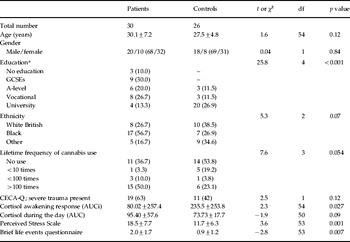
Sociodemographic and clinical characteristics of the sample are presented in Table 1. These characteristics are consistent with those described previously in a larger sample comprising these patients (Mondelli et al. Reference Mondelli, Dazzan, Hepgul, Di Forti, Aas, D'Albenzio, Di Nicola, Fisher, Handley, Marques, Morgan, Navari, Taylor, Papadopoulos, Aitchison, Murray and Pariante2010 a). There were no differences in age or gender distribution, but the controls had a higher level of education than the patients. Trend-significant differences were found for ethnicity and cannabis use, as there were more individuals of African or Caribbean origin in the patient group (p=0.07), and more patients had a lifetime history of cannabis use (p=0.054).
Sociodemographic and clinical characteristics of patients with first-episode psychosis (FEP) and gender- and age-matched controls

CECA-Q, Childhood Experience of Care and Abuse Questionnaire; AUC, Area Under the Curve; AUCi, increase in AUC; df, degrees of freedom.
Values given as n (%) or mean±standard deviation.
a The General Certificate of Secondary Education (GCSE) is taken at the final year of compulsory high-school education; A-levels are studied typically between the ages of 16 and 18 in preparation for university; a vocational degree prepares learners for jobs that are based on manual or practical activities, traditionally non-academic and related to a specific trade or occupation.
Cognitive function in patients and controls
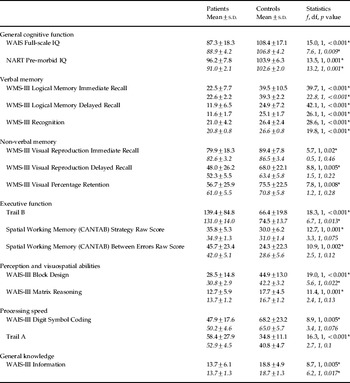
Table 2 shows the results of an ANOVA and an ANCOVA comparing patients and controls for cognitive performance on the tasks described above. Using unadjusted analyses, patients performed worse on all cognitive tests compared to controls, including current and pre-morbid IQ. Even after controlling for education, ethnicity and cannabis use, patients scored significantly worse than the controls on the majority of the individual cognitive tasks, and especially in verbal memory tasks.
Comparisons of individual task scores between patients and controls, with or without adjustment for education, ethnicity and cannabis use

WAIS, Wechsler Adult Intelligence Scale; NART, National Adult Reading Test; WMS, Wechsler Memory Scale; CANTAB, Cambridge Neuropsychological Test Automated Battery; s.d., standard deviation; df, degrees of freedom.
Estimated values and statistics after co-varying for education, ethnicities and cannabis use are shown in italics.
* Statistically significant difference (p<0.05).
Cortisol awakening response and cognitive function
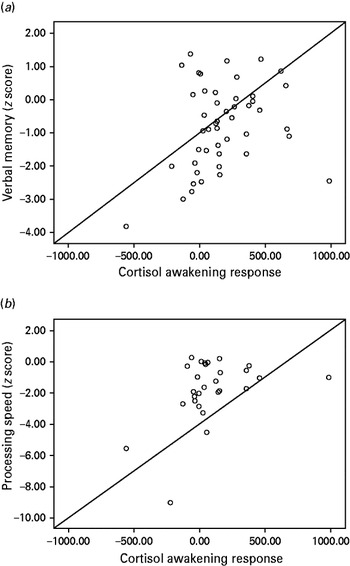
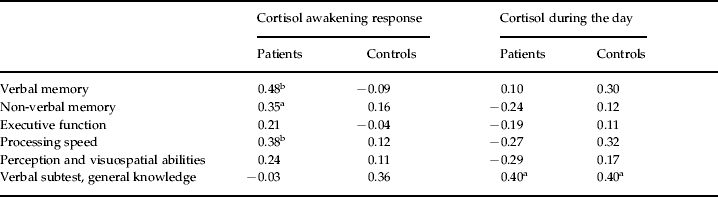
Patients had a smaller (blunted) cortisol awakening response (p=0.027) compared with controls (see Table 1). The relationship between the cortisol awakening response and cognitive tasks is shown in Table 3, using Spearman's analyses to correlate the AUCi with the z scores of the six cognitive domains. In patients, significant positive correlations were observed for the verbal memory (r=0.48, p=0.019) and processing speed (r=0.38, p=0.048) domains, and a trend-level correlation was present for the non-verbal memory domain (r=0.35, p=0.073). These data indicate that a smaller cortisol awakening response in patients (i.e. more blunted and hence more abnormal) was associated with worse performances on verbal and non-verbal memory, and also with worse processing speed. Fig. 1 shows the scatter plots of these data sets. No relationship between cortisol awakening response and cognitive domains was observed in the controls.
Scatter plot and linear regression of cortisol awakening response and z scores of (a) verbal memory and (b) processing speed domains, in patients. Significant positive correlations were observed for both verbal memory (r=0.48, p=0.019) and processing speed (r=0.38, p=0.048).

Spearman's correlations (r values) between cortisol and cognitive domains

a p<0.10, bp<0.05, cp<0.01.
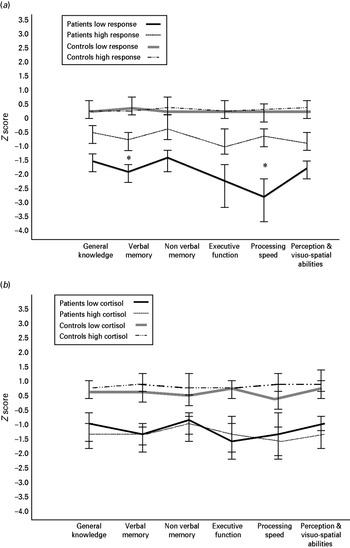
To corroborate these findings, we further analysed the data by dividing both patients and controls into two groups based on whether their cortisol awakening response was above or below the median of their group (see Fig. 2 a). Within patients, the group with the cortisol awakening response below the median (i.e. more blunted and hence more abnormal) did worse on verbal memory (t=−2.50, p=0.02) and processing speed (t=−2.81, p=0.012), and, at trend significance, on perception and visuospatial abilities (t=−1.75, p=0.09). Of interest, there were no differences between the two groups of patients in terms of age (t=−0.35, p=0.7), ethnicity (χ2=0.62, p=0.7), education (χ2=1.71, p=0.8), diagnoses (χ2 = 0.08, p=0.8), and cannabis use (χ2=1.5, p=0.7).
Z scores (means and standard deviations) of the individual cognitive domains in subjects divided into (a) those below and above the median of the cortisol awakening response and (b) those below and above the median of cortisol secretion during the day. The individual cognitive tests were grouped into six domains: Verbal memory; Non-verbal memory; Executive function perception; Visuospatial abilities; and Processing speed. Scores on each cognitive domain were calculated as the mean of standard (z) scores of the individual tests. Z scores were based on the mean and standard deviation of the control sample. (a) Within patients, the group with the cortisol awakening response below the median (i.e. more blunted and hence more abnormal) did worse on all cognitive domain, reaching statistical significance for verbal memory and processing speed, and trend significance for perception and visuospatial abilities. No differences were observed between controls with a high and with a low cortisol awakening response in any cognitive domains. (b) No differences were found in cognitive function between subjects with low and high cortisol levels during the day, in either patients or controls. * p<0.05.

Finally, is important to mention that these data are also consistent with the correlation analyses conducted between cortisol awakening response and the individual cognitive tasks (see Supplementary online material, Table S1), with a more blunted cortisol awakening response correlating significantly with a worse performance in tasks of verbal memory (Logical Memory Immediate Thematic score, Logical Memory Delayed Recall, Logical Memory Delayed thematic score), attention and processing speed (Trail A, Digit Symbol Coding), and, at trend level, for non-verbal memory (Visual Reproduction Delayed Recall, Visual Percentage Retention); however, in controls the cortisol awakening response did not correlate with any tasks.
Cortisol during the day and cognitive function
Patients had a trend for a higher cortisol level during the day (p=0.09) compared with controls (see Table 1). No significant correlations were found when investigating the correlations between cortisol AUCs during the day and cognitive domains, in either patients or controls (Table 3). Moreover, no differences were found in cognitive function between subjects with low and high cortisol levels during the day (divided based on the sample median), in either patients or controls (see Fig. 2 b).
Psychosocial stress and cognitive function
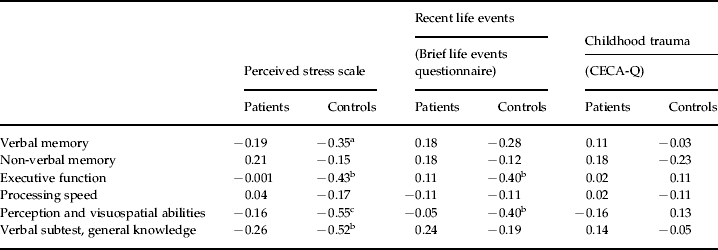
Patients had higher levels of perceived stress (p<0.001), recent stressful events (p<0.001) and childhood trauma (p=0.008) (see Table 1). In patients, we found no correlations between any of the cognitive domains and the scores at the Brief Live Events Questionnaire or the Perceived Stress Scale, or the presence or absence of a history of childhood trauma (see Table 4). However, in controls we found that higher levels of perceived stress and more recent life events were associated with a worse performance in executive function (r=−0.43, p=0.029 and r=−0.40, p=0.043 respectively) and perception and visuospatial abilities (r=−0.55, p=0.003 and r=−0.40, p=0.045 respectively). Correlation analyses with individual tasks also confirmed these findings (see Supplementary online material, Table S2).
Spearman's correlations (r values) between psychosocial stressors and specific cognitive domains

CECA-Q, Childhood Experience of Care and Abuse Questionnaire.
a p<0.10, bp<0.05, cp<0.01.
Discussion
In agreement with previous studies, patients with FEP in our sample showed significant cognitive deficits compared to healthy controls, in particular in verbal memory. Moreover, the deficits in verbal memory and processing speed were strongly correlated with a dysregulated HPA axis, as shown by a more blunted cortisol response to awakening. Surprisingly, cortisol levels during the day and psychosocial stressors (perceived stress, recent life events, history of childhood trauma) did not affect cognitive function in patients.
The blunted cortisol response to awakening in this sample has been described and discussed previously (Mondelli et al. Reference Mondelli, Dazzan, Hepgul, Di Forti, Aas, D'Albenzio, Di Nicola, Fisher, Handley, Marques, Morgan, Navari, Taylor, Papadopoulos, Aitchison, Murray and Pariante2010 a). In the present paper, we find that a smaller (more blunted) cortisol awakening response correlates with worse verbal memory and processing speed. One possible explanation for this association is that an abnormal function of the hippocampus cortex may underlie both the cognitive and the HPA axis abnormalities. The GC receptors (GRs) and the mineralocorticoid receptors (MRs) in the hippocampus play an important regulatory role on the HPA axis, by mediating the negative feedback by circulating GCs on the HPA axis, and are also significantly involved in the learning and memory processes localized in this area (Lupien et al. Reference Lupien, Fiocco, Wan, Maheu, Lord, Schramek and Tu2005, Reference Lupien, Maheu, Tu, Fiocco and Schramek2007). Indeed, both bilateral and unilateral hippocampus damage are associated with an absent or blunted cortisol awakening response (Buchanan et al. Reference Buchanan, Kern, Allen, Tranel and Kirschbaum2004). A reduced hippocampus volume has been reported in a meta-analysis of FEP patients, with a reduction of 9% in the right hippocampus and of 10% in the left hippocampus (Copolov et al. Reference Copolov, Velakoulis, McGorry, Carina, Yung, Rees, Jackson, Rehn, Brewer and Pantelis2000). Moreover, a study of an epidemiologically based sample of FEP patients has also confirmed a decreased grey matter in the hippocampus (Morgan et al. Reference Morrens, Krabbendam, Bak, Delespaul, Mengelers, Sabbe, Hulstijn, van Os and Myin-Germeys2007). However, the relationship between cortisol, stress and anatomic substrates of cognitive deficits is complex, and not all findings support this model. For example, our recent study indeed found that higher cortisol levels during the day were associated with a smaller (left) hippocampal volume in first-episode psychosis (Mondelli et al. Reference Mondelli, Pariante, Navari, Aas, D'Albenzio, Di Forti, Handley, Hepgul, Marques, Taylor, Papadopoulos, Aitchison, Murray and Dazzan2010 b), but a previous study by Gunduz-Bruce et al. (Reference Gunduz-Bruce, Szeszko, Gueorguieva, Ashtari, Robinson, Kane and Bilder2007) did not find any correlations. Another, non-mutually exclusive explanation for the association between abnormal cortisol awakening response and cognitive impairment is the presence of sleep disturbance, which is often seen in patients with psychosis (Suzuki et al. Reference Suzuki, Konno, Furihata, Osaki and Uchiyama2009). Indeed, a smaller awakening response is observed in patients with insomnia (Backhaus et al. Reference Backhaus, Junghanns and Hohagen2004), and insomnia is linked to decreased memory performance (Backhaus et al. Reference Backhaus, Junghanns, Born, Hohaus, Faasch and Hohagen2006). Therefore, sleep disturbances in these patients may contribute to the association between abnormal cortisol awakening response and cognitive impairment.
The slightly increased cortisol levels during the day in this sample have also been described and discussed before (Mondelli et al. Reference Mondelli, Dazzan, Hepgul, Di Forti, Aas, D'Albenzio, Di Nicola, Fisher, Handley, Marques, Morgan, Navari, Taylor, Papadopoulos, Aitchison, Murray and Pariante2010 a). It is of interest that a study by Lee et al. (Reference Lee, Glass, McAtee, Wand, Bandeen-Roche, Bolla and Schwartz2007) has shown that increased cortisol levels during the day are associated with a worse cognitive performance in a large sample of much older normal subjects (50–70 years of age). Moreover, many studies have shown that healthy participants given oral doses of cortisol or other GCs have impairment of both episodic memory and executive function (Newcomer et al. Reference Newcomer, Craft, Hershey, Askins and Bardgett1994; McAllister-Williams & Rugg, Reference McAllister-Williams and Rugg2002; Hsu et al. Reference Hsu, Garside, Massey and Lister-Williams2003; Brunner et al. Reference Brunner, Schaefer, Hess, Parzer, Resch and Schwab2006). Moreover, patients with psychotic depression, who have increased cortisol levels in the evening and night, show impaired verbal memory when compared not only with normal controls but also with non-psychotic depressed patients (Belanoff et al. Reference Belanoff, Kalehzan, Sund, Fleming Ficek and Schatzberg2001), and show correlations between higher cortisol levels and poorer verbal memory and processing speed (Gomez et al. Reference Gomez, Fleming, Keller, Flores, Kenna, DeBattista, Solvason and Schatzberg2006). Similar findings have been described in patients with schizophrenia (Walder et al. Reference Walder, Walker and Lewine2000; Halari et al. Reference Halari, Kumari, Mehrotra, Wheeler, Hines and Sharma2004) or bipolar disorder (Young et al. Reference Young, Gallagher, Watson, Del-Estal, Owen and Ferrier2004). Although it is somewhat surprising that we did not find a relationship between cortisol levels during the day and (worse) cognitive function in FEP, we should emphasize that the cortisol values in our samples were only mildly elevated. It is also of note that one study, administering GCs to patients with schizophrenia, found a lack of effects of dexamethasone on verbal memory (Newcomer et al. Reference Newcomer, Craft, Askins, Hershey, Bardgett, Csernansky, Gagliardi and Vogler1998). Taken together, these findings suggest that cognitive function in patients with psychosis is less sensitive to the effects of GCs than in healthy subjects, perhaps as part of a generalized ‘GC resistance’; that is, resistance of the brain to the effects of GCs (Pariante & Lightman, Reference Pariante and Lightman2008).
The mostly negative findings regarding the effects of psychosocial stressors on cognitive function in this sample should also be commented upon. Although, to our knowledge, this is the first study investigating the relationship between cognitive function and perceived stress, recent life events or childhood trauma in FEP, it is interesting that Myin-Germeys et al. (Reference Myin-Germeys, Krabbendam, Jolles, Delespaul and van Os2002) and Morrens et al. (Reference Morrens, Krabbendam, Bak, Delespaul, Mengelers, Sabbe, Hulstijn, van Os and Myin-Germeys2007) also did not find any relationship between negative emotions triggered by mild stressors in daily life and cognitive function in patients with established schizophrenia. We did find evidence for impaired executive function and impaired perception and visuospatial abilities in healthy controls with higher levels of perceived stress and more recent life events, thus confirming that our measures were sensitive enough to detect an effect, if present. We have also reported previously that there is no association between these psychosocial measures of stress and HPA axis activity in this sample of FEP, although there is an association between more recent life events and increased cortisol levels in controls (Mondelli et al. Reference Mondelli, Dazzan, Hepgul, Di Forti, Aas, D'Albenzio, Di Nicola, Fisher, Handley, Marques, Morgan, Navari, Taylor, Papadopoulos, Aitchison, Murray and Pariante2010 a). Taken together, these findings suggest that the abnormal HPA axis activity in these patients (and its association with impaired cognitive function) is not simply driven by the excess of psychosocial stressors before the onset of psychosis. It is also of note that two previous studies have found that a history of childhood trauma is associated with worse executive function in patients with established (not first-episode) schizophrenia/schizo-affective disorder (Lysaker et al. Reference Lysaker, Meyer, Evans and Marks2001; Schenkel et al. Reference Schenkel, Spaulding, DiLillo and Silverstein2005); it is possible that the effect of childhood trauma on cognition becomes evident with the progression of the psychotic illness from first episode to chronic status.
Finally, there is an important methodological consideration that needs to be taken into account in the interpretation of our findings. Specifically, patients and controls differed on important clinical and demographic measures such as education, ethnicity, use of cannabis, and antipsychotic administration. As these factors are all associated with psychosis, obtaining controls that are matched for them is almost impossible. However, patients continue to score lower than controls in the relevant cognitive tasks even after co-varying for these variables. Moreover, our main findings (the effects of cortisol awakening response on cognitive tasks in patients) are not explained by the effects of age, ethnicity, education, diagnoses, or cannabis use. Antipsychotics are also unlikely to play a role here: these findings are based on within-patients comparisons, and most patients were on antipsychotics; we have also shown previously that antipsychotic treatment does not influence the cortisol awakening response (Mondelli et al. Reference Mondelli, Dazzan, Hepgul, Di Forti, Aas, D'Albenzio, Di Nicola, Fisher, Handley, Marques, Morgan, Navari, Taylor, Papadopoulos, Aitchison, Murray and Pariante2010 a). However, we cannot exclude complex interactions between these variables, leading to different appraisals of stressful situations or different biological stress responses in patients (or subgroups of patients) when compared with controls. We also acknowledge the small sample size, and replication of our findings in a larger sample is imperative.
In summary, we have demonstrated a relationship between abnormal HPA axis activity (as measured by a blunted cortisol awakening response) and impaired cognitive function in patients with FEP. Future prospective studies are needed to dissect the direction of the effects: to test whether normalization of the clinical picture with antipsychotic treatment is associated with normalization of HPA axis activity, and, if so, whether this predicts improvement in cognitive function.
Note
Supplementary material accompanies this paper on the Journal's website (http://journals.cambridge.org/psm).
Acknowledgements
This specific aspect of the study was funded by a grant from the British Academy to C. M. Pariante. The study was also supported by the South London and Maudsley NHS Foundation Trust and the Institute of Psychiatry National Institute for Health Research (NIHR) Biomedical Research Centre for Mental Health; by a National Alliance for Research on Schizophrenia and Depression (NARSAD) Young Investigator Award, a grant from the BIAL Foundation, and a KCL Translational Research Grant, to P. Dazzan; by a King's College Development Trust (UK) Studentship, and a NARSAD Young Investigator Award, to V. Mondelli; and by additional funding to C. M. Pariante from the American Psychiatric Institute for Research and Education (APIRE), the NARSAD, the UK Medical Research Council, and the Commission of European Communities 7th Framework Programme Collaborative Project Grant Agreement no. 22963 (Mood Inflame). Finally, we thank the GAP researchers who helped with the data collection, and the patients who took part in the study.
Declaration of Interest
None.