





Through the second United Nations Sustainable Development Goal, nearly all countries have committed themselves to end hunger and achieve global food security by 2030(1). Despite this ambition, the prevalence of hunger and food insecurity has increased since 2015, driven by climate change, armed conflicts, the COVID-19 pandemic and widening socio-economic inequalities(2).
Food insecurity refers to the lack of regular access to sufficient, safe and nutritious food for normal growth, development and an active, healthy life, and it can occur with or without hunger(3). Hunger, by contrast, describes the condition that may result when individuals experience the most severe forms of food insecurity and lacks sufficient food to meet basic nutritional needs.
According to the 2025 edition of The State of Food Security and Nutrition in the World, an estimated 28 % of the world’s population – approximately 2·3 billion people – experienced moderate to severe food insecurity in 2024(2). This represents a 335 million increase from pre-pandemic levels and 683 more than in 2015. The prevalence of food insecurity varies markedly across regions and country income levels. Lower-middle-income countries account for the largest share of affected individuals, while low-income countries bear a disproportionately high burden relative to their population size. In high-income countries, more than 100 million people (8 %) were estimated to be moderately or severely food insecure, as measured by the Food Insecurity Experience Scale during 2022–2024(2). Importantly, while these figures highlight the global and regional scale of food insecurity, certain population groups – such as refugees – face compounded risks that are not captured by country averages.
In 2022, 80 % of the world’s 26 million refugees experienced food insecurity, underscoring the magnitude and urgency of addressing food availability and access among displaced populations(Reference Nisbet, Lestrat and Vatanparast4). Refugees face increased vulnerability to prolonged food insecurity at multiple stages of their migration journeys – before migration, during displacement and after resettlement. In pre-migration settings, food insecurity is typically driven by violence, poverty, breakdown of societal infrastructures and environmental degradation(Reference Lin, Kafri and Hammoudeh5). These dynamics are well illustrated in a study of Afghan refugees in Pakistan reporting limited access to nutritious food due to the combined effects of war, drought, transportation barriers and poverty(Reference Khakpour, Iqbal and GhulamHussain6). During migration, refugees frequently rely on humanitarian aid facing restricted access to food and water, inadequate shelter as well as exposure to violence and exploitation(Reference Cannings, Hall and Riggirozzi7). Indeed, refugees have been found to be especially vulnerable to food insecurity during pre-settlement and early resettlement, with refugee camps being particularly affected(Reference Wood, Leech and Margerison8). In the post-migration phase, difficulties in obtaining culturally familiar and acceptable foods, navigating unfamiliar food environments or preparing foods in ways that align with their dietary practices can disrupt the settlement process and prolong household food insecurity(Reference Gingell, Murray and Correa-Velez9).
Food insecurity is increasingly recognised as a hazard to global public health, but the situation for refugees resettled in high-income countries remains underexplored(Reference Gingell, Murray and Correa-Velez9). Existing research largely focuses on food insecurity in low- and middle-income settings or examines the situation in transit settings, such as refugee camps. Yet, resettling in a high-income country does not necessarily eliminate the threat of food insecurity. Evidence shows that refugees in high‑income contexts experience disproportionately high levels of food insecurity: a recent systematic review reported prevalence estimates ranging from 40 % to 71 %(Reference Gingell, Murray and Correa-Velez9). Refugees frequently face structural and intersecting challenges including economic hardship, language barriers and limited access to culturally appropriate food(Reference Henjum, Morseth and Arnold10,Reference Kamelkova, Strømme and Diaz11) . Although some studies find that forcibly displaced individuals in high-income countries are disproportionately affected by food insecurity despite robust social welfare systems(Reference Kamelkova, Strømme and Diaz11), these findings are scattered and rarely examine development over time or across different high-income contexts. This knowledge gap limits the ability of policy makers and welfare service providers to develop targeted strategies addressing the needs of resettled refugee populations.
With around 20 % of the world’s refugees resettled in high-income countries and growing recognition of food insecurity as a key determinant of health and well-being, there is an urgent need for targeted research in this area. Understanding the prevalence and underlying drivers of food insecurity among resettled refugees is essential for achieving international commitments such as the Sustainable Development Goals as well as for promoting equitable public health outcomes for displaced populations. This study examines changes in food insecurity 1 and 4 years after arrival among Syrian refugees resettled in Norway, a high-income context.
Methods
Study design, setting, data collection
This is a prospective cohort study of food insecurity among Syrian refugees resettled in Norway over time. Analyses are based on primary data from the CHART/Integration for Health study (I4H)(12), a longitudinal cohort study designed to explore integration processes and health-related outcomes among refugees along their resettlement journey.
Syrian refugees were selected as the focus of the study because they made up the largest number of newly arrived refugees to Norway at the onset of data collection. In 2017, 2667 of 2829 (94 %) resettlement refugees to Norway originated from Syria(13), and Syrians also represented the largest group among individuals granted asylum that year (1842 of 3833; 48 %)(14).
The term ‘refugee’ is used in accordance with the 1951 Refugee Convention. In Norway, individuals may receive refugee status either through the resettlement programme or after applying for asylum, and both pathways result in the same protection status. All participants in this study had been granted refugee status prior to baseline data collection. Asylum seekers were not part of the sample.
At baseline (timepoint 0, T0), Syrian refugees under the UN Refugee Agency (UNHCR)’s international protection mandate in Lebanon were recruited in connection with the mandatory Norwegian Cultural Orientation Programme offered by the International Organization for Migration (data collection period August 2017–April 2018, n 506).
Upon arrival to Norway, the refugees were settled directly into independent housing within local communities, rather than in camps or reception centres. Newly arrived refugees aged 18 and 55 years are expected to participate in the national Introduction Programme, which at the time of data collection was a 2-year programme. The programme focuses on Norwegian language training and preparation for education or employment, and participants are entitled to a monthly social protection benefit, which serves as their primary source of income during the programme period. Refugees are permitted to seek employment at any time after resettlement, but many struggle to access the labour market(15).
At timepoint 1 (T1), the Syrian refugees in the cohort were re-surveyed approximately 1 year after resettlement in Norway (data collection period December 2018–December 2019, n 353). At timepoint 2 (T2), the refugees had a length of stay of about 4 years (data collection period December 2022–January 2023, n 153). A 4‑year follow‑up timepoint was specified before onset to enable assessment of outcomes beyond the initial integration phase and within the planned duration of the I4H project. The current study relies on data collected 1 (T1) and 4 (T2) years after arrival in Norway. Food insecurity was not measured at baseline (T0). At both follow‑up timepoints (T1 and T2), data were collected using a structured questionnaire in Arabic administered as a telephone interview conducted by trained interviewers. A more detailed description of the data collection can be found in previous publications(Reference Strømme, Haj-Younes and Hasha16).
Dependent variables
The main outcome in this study is self-reported food insecurity. Food insecurity was assessed by asking the participants the following two questions:
-
1) In the last 12 months, did it happen that you and other household members worried that food would run out before you got money to buy more?
-
2) In the last 12 months, did it happen that the food that you and other household members bought did not last and you did not have money to get more?
The questions are part of the Seattle short form of The Household Food Security Survey Module, and a two-item version of The Household Food Security Survey Module has previously been validated(Reference Radandt, Corbridge and Johnson17). Responses were recorded on a four-point Likert scale (“Often true”/” Sometimes true”/” Never true in the last 12 months”/“Don’t know”). The responses were categorised binary and “Often true”/ “Sometimes true” on either of the two questions were considered indicating food insecurity.
Independent variables
Independent variables encompassed age (ref. < 40 years v. ≥ 40 years), gender (ref. male v. female), level of education (ref. lower: < 9 years v. higher: ≥ 10 years), cohabiting with partner or not, number of children (ref. no children v. one or more children) and work status prior to enforced displacement from Syria (ref. not working v. working). In addition, migration-related exposure factors were assessed, including solo migration (ref. did not migrate alone v. migrated alone) and exposure to potentially traumatic events during migration (ref. not exposed v. exposed). Solo migration was detected by asking whether the participant had left Syria with all immediate family member, with some immediate family members or alone. Information on subsequent family reunification during follow-up was not incorporated into the present analyses, which examined effect modification of food insecurity trajectories by baseline characteristics. Exposure to traumatic events was assessed using the Single General Trauma Item reading: ‘Sometimes things happen to people that would upset or frighten almost everyone. Examples of such difficult and frightening experiences are; being assaulted or witnessing other people being hurt or killed. Have you experienced any of these or some other terrifying event(s)?’ (‘Yes’/’No’)(Reference Sigvardsdotter, Nilsson and Malm18). Mental health was assessed using the Hopkins Symptoms Checklist (HSCL-10)(Reference Strand, Dalgard and Tambs19). Mean item scores were calculated, and a cut‑off of ≥ 1·85 (scale range 1–4) used to define poor mental health, reflecting clinically significant symptoms of anxiety and/or depression.
Statistical analysis
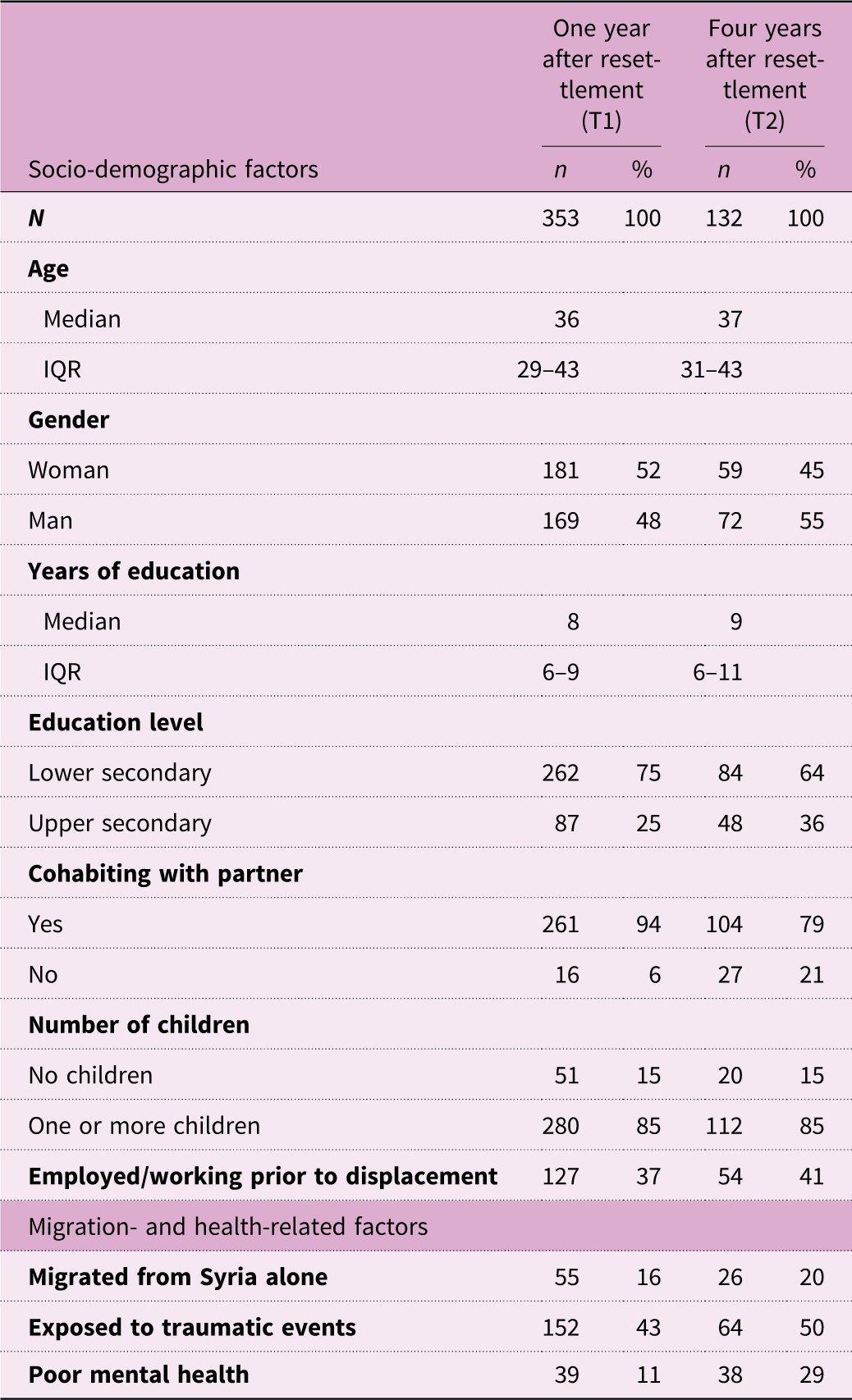
Socio-demographic and migration-related exposure factors are presented as counts and proportions for categorical variables and medians and interquartile ranges for continuous variables (Table 1).
Socio-demographic and migration-related factors at 1 (T1) and 4 (T2) years after resettlement

Table 1. Long description
A table comparing socio-demographic and migration-related factors at one year and four years after resettlement. The table has 13 rows and 6 columns. Column headers are Socio-demographic factors, One year after resettlement (T1) n, One year after resettlement (T1) %, Four years after resettlement (T2) n, Four years after resettlement (T2) %. Row labels include Age, Gender, Years of education, Education level, Cohabiting with partner, Number of children, Employed/working prior to displacement, Migrated from Syria alone, Exposed to traumatic events, Poor mental health. Row 1: Age, Median, 36,, 37,, IQR, 29-43,, 31-43, . Row 2: Gender, Woman, 181, 52, 59, 45, Man, 169, 48, 72, 55. Row 3: Years of education, Median, 8,, 9,, IQR, 6-9,, 6-11, . Row 4: Education level, Lower secondary, 262, 75, 84, 64, Upper secondary, 87, 25, 48, 36. Row 5: Cohabiting with partner, Yes, 261, 94, 104, 79, No, 16, 6, 27, 21. Row 6: Number of children, No children, 51, 15, 20, 15, One or more children, 280, 85, 112, 85. Row 7: Employed/working prior to displacement, 127, 37, 54, 41. Row 8: Migrated from Syria alone, 55, 16, 26, 20. Row 9: Exposed to traumatic events, 152, 43, 64, 50. Row 10: Poor mental health, 39, 11, 38, 29.
To account for repeated measures in the same individuals, generalised estimating equations were applied to analyse changes in food insecurity over time. Data in long format with two observations per individual were analysed with log as link function, binomial distribution specified and timepoint as covariate with data from the first timepoint (T1) as reference. The prevalences of food insecurity at the two timepoints are presented as prevalence proportions with 95 % CI with OR and 95 % CI for change.
Variations in changes in food insecurity over time by gender, age, education level, cohabiting with partner, number of children, work status prior to displacement, solo migration, trauma exposure and poor mental health were examined through analyses stratified by each exposure variable and through the introduction of interaction terms in the hierarchical regression models. Analyses of effect modification are reported as OR and 95 % CI for changes in the stratified analyses as well as P values from the interaction terms.
Attrition analyses were conducted by comparing both dependent and independent variables between those taking part at both timepoints (T1 and T2) and those lost-to-follow-up at the last timepoint (taking part at T1 only). Group differences were tested using Fischer’s’ exact test for categorical variables and linear regression for continuous variables.
Missing values were handled through listwise deletions. An α value of 0·05 was considered statistically significant. All analyses were conducted using STATA/IC software, version 18.5, (StataCorp LLC). The reporting follows the STROBE statements for cohort studies(20).
Results
A cohort of Syrian refugees participated in the study at 1 (n 353) and 4 (n 132) years after resettling in Norway (Table 1). At timepoint 1, the median age was 36 years (interquartile range 29–43) and 52 % were women. Around three-quarters of the participants had less than 9 years of education. Most (94 %) reported cohabiting with their partner, and 85 % had one or more children. Slightly more than one in three had been in work prior to displacement, 16 % had migrated alone from Syria, 43 % had experienced traumatic events along their migration journey and about one in ten reported indicators of poor mental health.
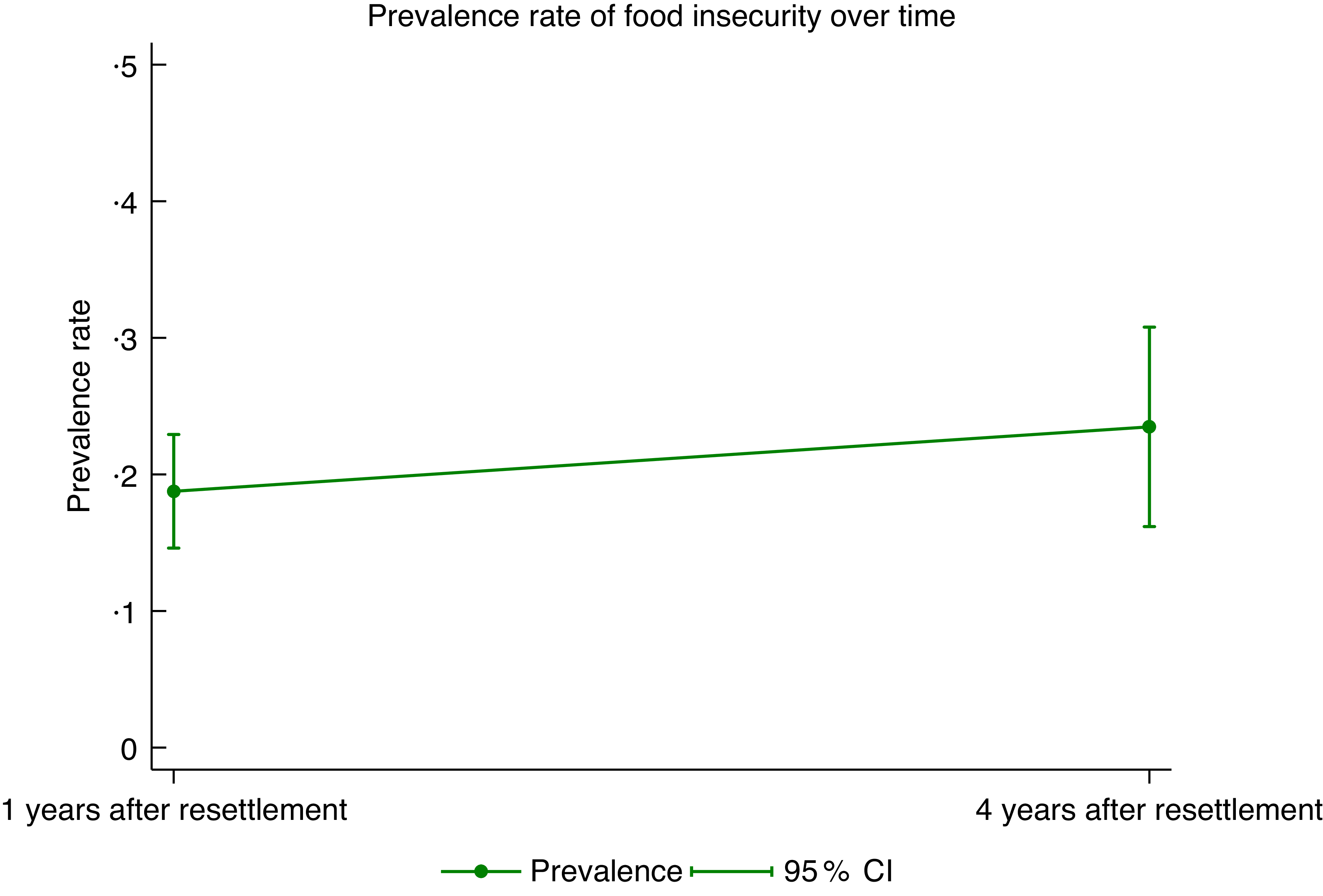
Overall, food insecurity among Syrian refugees changed from 18·0 % to 23·0 % (OR 1·3, 95 % CI: 0·8–2·0) between the first (T1) and fourth (T2) year after resettlement in Norway (Figure 1, Table S1). The sub-item ‘Worried about running out of food’ increased from 15·0 % to 22·0 % (OR 1·6, 95 % CI: 1·0–2·6), while ‘Experienced that food did not last’ slightly increased from 16·0 % to 18·0 % (OR 1·1, 95 % CI: 0·7–1·9). No statistically significant change in food insecurity over time was detected.
Prevalence of food insecurity (95 % CI) among Syrian refugees at 1- and 4-years post-resettlement in Norway.

Stratified analyses indicated that changes in food insecurity over time varied according to socio-demographic, migration-related and health-related factors (Table 2). Refugees who fled Syria alone experienced a steeper rise in food insecurity compared with those who migrated with family members. Differences in food insecurity trends across age groups, gender, education level, cohabiting status, number of children, employment prior to displacement, trauma exposure or mental health status were NS. Point estimates and the direction of associations for these factors are presented in Table 2.
Effect modifiers of change in food insecurity from 1 year (n 353) to 4 years (n 132) after resettlement

Table 2. Long description
A table comparing the effect modifiers of change in food insecurity from 1 year to 4 years after resettlement. The table has 11 rows and 6 columns. Column headers are OR, Lower 95 % CI, Upper 95 % CI, and P. Row labels include Age, Gender, Education, Cohabiting, Children, Work status, Solo migration, Trauma exposure, and Poor mental health. Each row provides odds ratios (OR) and confidence intervals (CI) for different socio-demographic, migration-related, and health-related factors. Notable trends include variations in food insecurity changes based on factors like solo migration and trauma exposure.
Those who completed both follow-ups and those who were lost to follow-up at the last round did not differ significantly in terms of socio-demographic characteristics, migration-related factors or mental health at baseline nor in terms of food insecurity reporting (Table S2).
Discussion
In this longitudinal study, approximately one in five Syrian refugees experienced food insecurity after resettlement in Norway, and these levels remained relatively stable between 1- and 4 years post-resettlement.
Prevalence and longitudinal change in food insecurity
The prevalence rate found in this study is lower than estimates reported in a systematic review of Middle Eastern and North African migrants and refugees in high-income countries, where rates ranged from 40 % to 71 %(Reference Mansour, Liamputtong and Arora21). Differences may reflect variations in measurement approaches as well as disparities in welfare systems across high-income settings. Our findings are also substantially lower than the 93 % reported among refugees living in Norwegian asylum reception centres(Reference Henjum, Morseth and Arnold10), underscoring the influence of living conditions and access to resources. However, this study brings about evidence of non-negligible levels of food insecurity also among community settled refugees in a high-income context.
The present study followed the same individuals over time and found no marked improvement in food insecurity between 1 and 4 years after arrival. While some studies have suggested that food insecurity among refugees may decrease by durations of residence available evidence largely relies on cross-sectional comparisons or point-prevalence estimates rather than longitudinal follow-up within the same cohort(Reference Girard and Sercia22,Reference Hadley, Zodhiates and Sellen23) . Several broader contextual factors – including economic conditions, cost of living and welfare policies – may explain the observed stability in food insecurity in the follow-up period. Although Norway is a high-income welfare state, most refugee households rely on limited social protection benefits linked to the Introduction Programme in the early years after resettlement. At the same time, the years following 2020 were characterised by rising inflation and higher living costs in Norway, contributing to heightened economic pressure at an overall population level(24). Such increases in cost-of-living may have constrained improvements in food security among refugee households despite increasing length of stay. However, as this study did not assess changes in employment, income, housing costs or changes in social protection policies over time, the influence of such structural micro- or macroeconomic factors on the observed food insecurity trajectories cannot be directly evaluated. Our findings highlight that food insecurity can persist beyond the initial integration phase despite inclusive welfare policies.
Variation in trends by socio-demographic, migration- and health-related factors
Variations in food insecurity trends were assessed through stratification by socio-demographic, migration-related and health-related factors. Refugees who fled Syria alone experienced a steeper increase in food insecurity compared with those who migrated with family members. No evidence of effect modification by gender, age, education level, cohabiting status, having children, employment prior to displacement, trauma exposure or baseline mental health was identified. The implications of solo migration are discussed first, followed by socio-demographic and health-related factors that did not modify food insecurity trajectories.
Solo migration and food insecurity
In our study, Syrian refugees who migrated without family members had a significantly higher risk of worsening food insecurity over time compared with those who migrated with family. This finding aligns well with research literature, emphasising the importance of social networks in mitigating vulnerability. Previous research suggests that family separation can increase migration-related stress and reduce access to emotional and practical support(25). Social networks, including extended family, neighbours and friends, have been shown to provide protection against food insecurity by facilitating resource sharing and support(Reference Vu, Raskind and Escoffery26). The absence of such networks may leave individuals more vulnerable, highlighting the critical role of social connectedness in mitigating food insecurity among resettled refugees(Reference Hunt, Benjamins and Khan27). These findings underscore the importance of policies that promote family reunification during and after migration, as well as integration programmes that strengthen social networks for individuals arriving alone.
Socio-demographic factors and food insecurity
Gender
In the present study, a tendency towards gender disparity, with women reporting higher levels of food insecurity over time compared with men was observed, although gender differences in trajectories were not statistically significant. This pattern aligns with findings from a large survey across twenty-seven European countries involving more than 60 000 adults, which reported higher food insecurity among women than men(Reference Garratt28). Similarly, evidence from Canada shows that women living in comparable households report greater food insecurity than men(Reference Matheson and McIntyre29).
Potential drivers of these gender differences include caregiving and household responsibilities, limited educational opportunities and barriers to labor market participation. For example, figures from Statistics Norway indicate that only 14 % of Syrian refugee women were employed in 2023, compared with 33 % of Syrian men(15). Previous research also suggests that mothers often reduce their own food intake during periods of scarcity to prioritise children’s needs(Reference McIntyre, Glanville and Raine30). These findings underscore the importance of addressing both societal structural barriers and household-level dynamics to reduce gendered disparities in food insecurity.
Age, cohabiting and children
Our study found a tendency for younger refugees (< 40 years) to report increasing food insecurity over time compared with those aged 40 years and above, although this difference was not statistically significant. Age and household composition have been shown to influence vulnerability to food insecurity(Reference Garratt28). Garratt’s study across several European countries identified older adults as being at increased risk. In contrast, young individuals may face unique challenges related to forced displacement, such as discontinued education and early career disruption, which can hinder labour market access, create financial constraints and impede efforts to build economic security(Reference Udayar, Fedrigo and Durante31,Reference Fasani, Frattini and Minale32) . Furthermore, young refugees have been shown to be more vulnerable to mental ill health due to psychological and social stressors associated with displacement(Reference Scharpf, Kaltenbach and Nickerson33), which may further contribute to food insecurity.
Protective effects of cohabiting with a partner were not observed. Previous research suggests that one-person and lone-parent households are at higher risk of food insecurity(Reference Wood, Leech and Margerison8,Reference Garratt28) , as single-adult households often rely on one income, making them more susceptible to financial strain. Cohabiting households may benefit from pooled resources, shared expenses and joint financial management, potentially improving their ability to purchase and prepare nutritious meals(Reference Chai34). Cohabitation may also provide access to broader social networks, including extended family, neighbours and friends, which previous research has linked to protection against food insecurity(Reference Vu, Raskind and Escoffery26). In this study, these potential advantages did not translate into differential improvements in food insecurity during the first 4 years after resettlement.
Our data also revealed a tendency towards increased food insecurity among those without children, although this finding was NS. In Norway, all families with children under 18 receive a universal monthly child benefit regardless of income or employment status(35). This welfare arrangement may play an important role in improving food access among economically disadvantaged families with children.
Education and work participation
Differences in the development of food insecurity over time based on education levels were not observed. Employment prior to displacement appeared to have some protection against worsening food insecurity, although this finding was not statistically significant. Refugees with higher education often face substantial barriers to labour market entry(Reference Eggenhofer-Rehart, Latzke and Pernkopf36), meaning that education may not confer the same protective effect against food insecurity for refugees as it does for the general population(Reference Ahmed, Sima and Lunde37). The present findings suggest that baseline education and pre-displacement work participation alone may be insufficient to improve food insecurity trajectories during early resettlement, highlighting the importance of post-arrival structural conditions rather than individual capacities at baseline.
Trauma, mental health and food insecurity
No diverging pattern in the development of food insecurity over time by baseline trauma exposure or baseline mental health was identified. This contrasts with substantial synthesised evidence pointing to associations between multiple forms of violence, poor mental health and food insecurity(Reference Frank, Daniel and Hays38). Proposed mechanism linking migration-related traumatic experienced and food insecurity are often explained as mediated through mental ill health(Reference Frank, Daniel and Hays38,Reference Becker, Middlemass and Johnson39) . However, the present analyses were designed to assess effect modification of food insecurity trajectories and were not intended to examine cross-sectional, bidirectional or time-varying relationships between trauma, mental health and food insecurity.
In summary, the findings from analyses of effect modification in this study challenge the assumptions that individual demographic or health characteristics strongly shape food insecurity risk after resettlement.
Strengths and limitations
This study has several limitations. First, a longer observation window would have provided deeper insight into how food insecurity evolves among refugees in high-income settings. Second, the sample size was limited, introducing uncertainty in estimates and reducing statistical power for detecting associations. With a larger sample size, adjusting interaction analyses for gender would be particularly relevant. Third, food insecurity was assessed using a two-item version of the Household Food Security Survey Module. Hence, hunger as a consequence of food insecurity cannot be assessed using these data. Although this abbreviated tool has been validated, the full scale could have offered greater detail and nuance. Finally, follow-up data collection occurred during the COVID-19 pandemic, which may have influenced food access. Most restrictions in Norway were lifted more than 12 months prior to data collection, yet the years of the pandemic and post-pandemic period following 2020, were characterised by rising inflation and higher living costs.
Despite these limitations, this study has notable strengths. The longitudinal cohort design allowed us to examine changes over time rather than relying on a cross-sectional snapshot, thereby addressing an important gap in the literature. The use of standardised, validated measures enhances comparability with other studies. Furthermore, the inclusion of both socio-demographic, migration-related and health-related factors provides insights into selected dimensions of food insecurity dynamics among resettled refugees.
Implications
The present results suggest that food insecurity can persist for several years after resettlement, even in a high-income context with an extensive welfare system. The absence of improvement over time highlights the need for sustained attention to food access beyond the initial integration phase.
Furthermore, the finding that refugees who migrated alone experienced worsening food insecurity trajectories points to the importance of migration experiences in shaping post-resettlement vulnerability. Policies and programmes that support individuals arriving without family, including interventions aimed at strengthening social support and access to resources, may be particularly relevant for preventing prolonged food insecurity.
Conclusion
This study examined food insecurity among refugees resettled in a high-income setting. Slightly more than one in six Syrian refugees reported food insecurity 1 year after resettlement, and the prevalence remained nearly unchanged 4 years later. This indicates that food insecurity can persist beyond the early resettlement phase, even within a context characterised by a relatively extensive social protection system for refugees.
Migration without accompanying family members emerged as a potential risk factor for worsening food insecurity over time, underscoring the importance of social support during and after displacement. Together, these findings highlight the need for interventions that ensure sustained attention to food access among resettled refugees, including measures that support refugees who arrive alone and policies that facilitate family unity during and after migration.
Supplementary material
For supplementary material accompanying this paper visit https://doi.org/10.1017/S1368980026103462
Acknowledgements
We would like to thank all refugees who participated in the study and the individuals involved in data collection. We also acknowledge the support of collaborating institutions and partners. The views expressed in this publication are those of the authors and do not necessarily reflect those of our collaborators.
Financial support
This work was supported by the Research Council of Norway (grant numbers 269835, 326661). The Research Council of Norway had no role in the design, analysis or writing of this article.
Competing interests
None.
Authorship
E.D. and E.M.S. contributed to the study design and data acquisition. E.M.S. performed statistical analyses. All authors participated in the interpretation of results and in drafting and revising the manuscript. All authors have read and approved the final manuscript for publication.
Ethical standards
This study was conducted according to the guidelines laid down in the Declaration of Helsinki, and all procedures involving research study participants were approved by the Regional Committee for Medical and Health Research Ethics of South-East Norway (Ref. No. 2017/377) and by the International Organization for Migration. Written informed consent was obtained from all subjects/patients.


 Open access

