I. INTRODUCTION
In recent years, iron borides have attracted great attention due to their excellent physical and chemical performances in the fields of powder metallurgy, magnetic material, catalysts, and metal-air battery. Reference Medvedovski, Jiang and Robertson1–Reference Bai, Wu, Wu, Yang and Wu7 The iron boride coatings on steels enhance the surfaces with high hardness, wear resistance, and corrosion resistance. In addition, the borided steels exhibit lower abrasion and erosion rates in comparison with carburized and nitrided steels. Reference Medvedovski, Jiang and Robertson1,Reference Doñu Ruiz, López Perrusquia, Sánchez Huerta, Torres San Miguel, Urriolagoitia Calderón, Cerillo Moreno and Cortes Suarez2 Fe–B compounds are typically soft magnetic materials and have been used as the soft phase in exchange coupled magnetic composites. Reference Li, Wei, Zhang, Li, Su, Ran, Xia, Jin and Liu3 Fe–B acting as an efficient dehydrogenation catalyst can accelerate dissociation of hydrogen from borohydrides. Reference Yu, Dong, Yang, Wang and Hou4,Reference Ocon, Tuan, Yi, de Leon, Lee and Lee5 Recently, FeB alloy is introduced as an anode material in metal/metalloid-air or alkaline secondary battery. Reference Abrenica, Ocon and Lee6,Reference Bai, Wu, Wu, Yang and Wu7
Although the method for the synthesis of metal boride powders such as ZrB2 and TiB2 has been widely investigated, the synthesis of Fe–B powders is less reported. According to the literature, Fe–B can be synthesized by a chemical reduction process with FeCl3/NaBH4, Fe(CO)5/(C2H5)3NBH3, or FeBr3/LiBH4 as raw materials. Reference Yu, Dong, Yang, Wang and Hou4–Reference Rades, Kornowski, Weller and Albert8 The obtained Fe–B powders are normally in amorphous with a nanosize. Crystallized FeB powders are reported to be synthesized by an electric arc method or a radio frequency thermal plasma method with elemental Fe and B powders. Reference Bai, Wu, Wu, Yang and Wu7,Reference Cheng, Choi and Watanabe9
It is well known that the morphology of the powders has significant effects on the properties of the materials. However, to the best of the authors’ knowledge, few reports concerned the special morphology of Fe–B powders. The only available literature is about Fe3B nanowires synthesized by a chemical vapor deposition method on either SiO2 or Si substrates using FeI2 and BI3 as precursors. Reference Li and Chang10 In the present paper, we demonstrate a simple method to synthesize crystallized FeB and Fe2B powders with special morphologies using elemental Fe and B powders as raw materials. Normally, the reaction between elemental metal and B powders is a highly exothermic solid–state reaction and can be easily ignited as a self-propagating high-temperature synthesis (SHS) reaction. The SHS reaction is too rapid to be controlled and easily leads to the formation of non-equilibrium phases and incomplete reactions. Reference Chamberlain, Fahrenholtz and Hilmas11,Reference Sun, Cao, Ran and Lv12 The novel point of the present paper is introducing molten salts to serve as an inhibitor to control the rate of the reaction.
II. EXPERIMENTAL
Commercial powders of Fe (>99%, 325 mesh, Sinopharm Chemical Reagent Co. Ltd., Shanghai, China) and amorphous B (>95%, d 50 ≤ 0.90 μm, Dandong Chemical Engineering Institute Co. Ltd., Dandong, China) were used to synthesize FeB and Fe2B powders. NaCl and KCl with a molar ratio of 1:1 and an eutectic point of 658 °C were used as molten salts. A mixture with proper amount of Fe, B, and NaCl/KCl powders was mixed by hand for 30 min in an agate mortal using a pestle. The weight of NaCl/KCl was 10 times that of the Fe/B. The mixture was put into an Al2O3 crucible and placed in a quartz tube furnace for heat treatment at 800–1000 °C. The heating rate was 10 °C/min and the dwelling time was 1 h. The whole heating and cooling process was carried out in flowing argon gas. After cooling to room temperature, the crucible was immersed in water to dissolve NaCl/KCl. The filtered cake was magnetic separated by a NdFeB magnet to remove unreacted B powders. For the synthesis of Fe2B powders, the filtered cake was treated with dilute HCl to remove unreacted Fe powders. Then, the product was washed by 80 °C water to remove possible product B2O3. Finally, after washed by water and absolute ethanol for several times, the product was dried at 60 °C for characterization.
The phase composition was determined by X-ray diffractometer (XRD; Bruker AXS D8 Discover, Germany). The morphology of the powders was examined by a scan electron microscopy (SEM; FEI-SEM S4800, Hitachi, Tokyo, Japan). The room-temperature hysteresis loops (MHLs) were measured on a vibrating sample magnetometer (VSM; Lakeshore 7401) with a maximum external field H m ≈ 1592 kA/m (20,000 Oe).
The electrochemical performances were evaluated using cyclic voltammetry, galvanostatic charge–discharge, electrochemical impedance test by a three-electrode test system, where a saturated calomel electrode (SCE) was served as the reference electrode, a Pt plate as the counter electrode, and the samples as the working electrode. The working electrodes were prepared by mixing the FeB powders (70%), acetylene black (20%), and polytetrafluoroethylene (PTFE) binder (10%), which were pressed onto a nickel foam. The electrolyte was a 6 M KOH aqueous solution.
III. RESULTS AND DISCUSSION
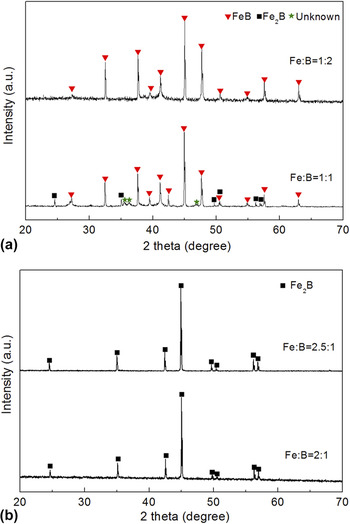
Figure 1 shows XRD patterns of samples synthesized at 1000 °C with different molar ratio of Fe/B. According to Fig. 1(a), when Fe/B was 1:1, FeB was the main phase with Fe2B and unknown phases as impurities. Increasing the proportion of B in Fe/B decreased the impurities and nearly pure FeB phase could be obtained at a Fe/B ratio of 1:2. When Fe/B was 2:1, although all XRD peaks could be indexed to Fe2B, as shown in Fig. 1(b), some nonmagnetic powders were found in the prepared powders during the process of magnetic separation, indicating the presence of unreacted B powders. The B powders were amorphous and therefore their presence was undetected by XRD. When Fe/B increased to 2.5:1, all prepared powders could be attracted by a NdFeB magnet. The above phenomena revealed that the excess of Fe powders was essential for the complete consumption of B powders in the raw materials. Although unreacted B powders could be removed by the magnetic separation technique, it was incomplete because there always was some B powder sticking to the magnetic substances in the product. In addition, the B powders are much expensive than Fe powders. As a result, using excess of Fe to remove B is more economic.
XRD patterns of (a) FeB and (b) Fe2B powders synthesized at 1000 °C by the molten salt method with different molar ratio of Fe/B.

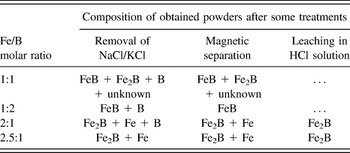
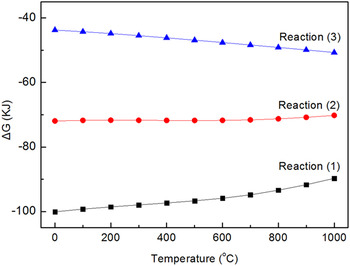
Table I summarizes the phase composition of the obtained powders in this study. It can be seen that both pure FeB and Fe2B phases could not be synthesized directly by the molten salt method with stoichiometric ratios of Fe/B. It might be ascribed to the big difference in particle size between raw Fe and B powders. Due to the large particle size of Fe powders, Fe was always excess in a local area when a Fe particle firstly contacted with B particles. As a result, the initial product was Fe2B which would react with B to form FeB. As shown in Fig. 2, the Gibbs’ free energy change (ΔG) of reaction (1) is always more negative than that of reaction (2), indicating that reaction (1) is more favourable. The negative ΔG for reaction (3) revealed that the initial produced Fe2B could be converted into FeB as there was enough B,
 $$2{\rm{Fe\ }} + {\rm{B}} = {\rm{Fe}}{}_2{\rm{B}}\quad {\rm{,}}$$
 $${\rm{Fe}} + {\rm{B}} = {\rm{FeB}}\quad {\rm{,}}$$
 $${\rm{F}}{{\rm{e}}_2}{\rm{B}} + {\rm{B}} = 2{\rm{FeB}}\quad {\rm{.}}$$
The effects of Fe/B and treatments on the composition of the powders.

Change in Gibbs’ free energy of reaction as a function of temperature for reaction (1)–(3) under 1.013 bar pressure.

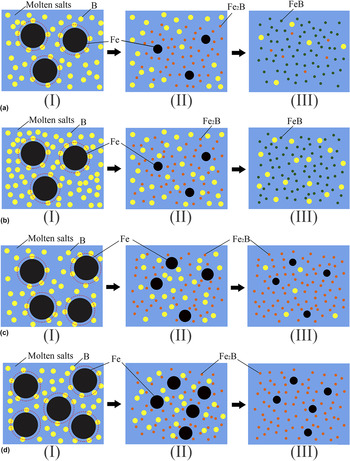
Figure 3 illustrates the formation mechanism of iron borides synthesized at molten salts with different molar ratio of Fe/B. When Fe/B was 1:1, as shown in Fig. 3(a), Fe powders firstly reacted with B powders to form Fe2B phase, and then Fe2B reacted with B to form FeB phase. However, due to the slow diffusion rate of species, there were still some Fe2B and B unreacted. Therefore, the final product was a mixture of FeB, Fe2B, and B, and the remained B powders could be removed by a magnetic separating process. When Fe/B was 1:2, the excess of B enhanced the probability that Fe2B contacted with B and all Fe2B particles could be converted into FeB [Fig. 3(b)]. When Fe/B was 2:1, some unreacted Fe and B remained [Fig. 3(c)]. When Fe/B = 2.5:1, enough Fe consumed all B to produce Fe2B [Fig. 3(d)], and the excessive Fe particles could be removed by leaching in HCl solution.
The formation mechanism of (a, b) FeB and (c, d) Fe2B powders when the molar ratio of Fe/B is (a) 1:1, (b) 1:2, (c) 2:1, and (d) 2.5:1. State (I), (II), and (III) represents the initial Fe + B powders in molten salts, the intermediate state, and the final state of the formation process, respectively.

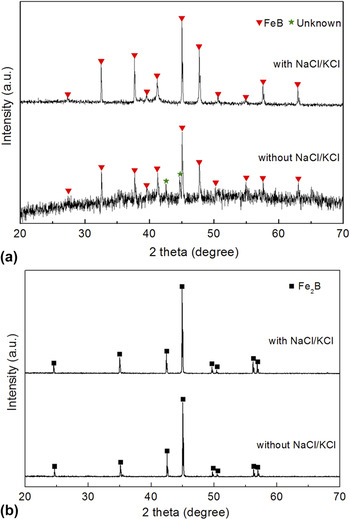
When Fe/B was 1:1 or 2:1 and there was no NaCl/KCl added, the obtained product was sometimes found to be consolidated together with some powders splashed in the crucible and the quartz tube, which was ascribed to the SHS reaction. When the SHS reaction was ignited, massive heat made the unreacted Fe melt, which solidified powders into a bulk matter during the cooling process. The rapid expansion of gas spilt some powders. It should be noted that the SHS reaction was not always ignited when Fe/B was 1:1 or 2:1 without the addition of NaCl/KCl, which might be due to the loose and dense condition of the powders in the crucible. When the powders were loose loaded, the gas between the powders could serve as a dilute to prevent the igniting of the SHS reaction. As the molar ratio of Fe/B changed to 1:2 and 2.5:1, the excess of B or Fe served as an inhibitor and as a result the SHS reaction was prevented. Figure 4 shows the XRD patterns of the products prepared with or without the addition of NaCl/KCl salts. Only when the NaCl/KCl salts were added, pure FeB phase could be obtained, as shown in Fig. 4(a). In Fig. 4(b), although all XRD peaks could be indexed to Fe2B, some nonmagnetic matters were found in the powders prepared without NaCl/KCl, which was similar to that in Fig. 1(b) with Fe/B = 2:1. The above results revealed that the presence of molten salt not only prevented the igniting of SHS reaction but also obviously accelerated the diffusion of species.
XRD patterns of (a) FeB and (b) Fe2B powders synthesized with or without the addition of NaCl/KCl salts. The molar ratio of Fe/B is (a) 1:2 and (b) 2.5:1.

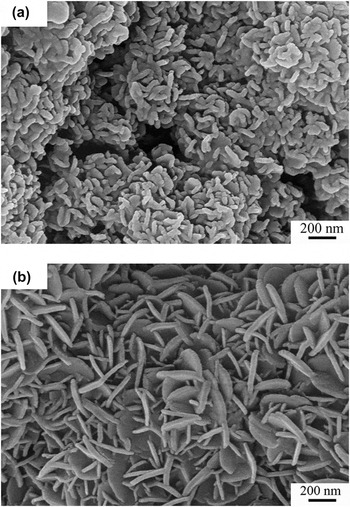
Figure 5 shows the SEM images of the FeB and Fe2B powders prepared by the molten salt method. FeB powders exhibit a short-rod like morphology with a diameter of 30–40 nm and a length of 100–150 nm, as shown in Fig. 5(a). The as-synthesized Fe2B powders have a uniform plate morphology with a thickness of 20–40 nm [Fig. 5(b)]. Although the synthesis temperature was as high as 1000 °C, the obtained powders were still in nanosize, which indicated that the addition of molten NaCl/KCl salts acted as a dilute to prevent the grain growth of fresh-produced iron boride particles during the heating process. Reference Sun, Cao, Ran and Lv12,Reference Wei, Huang, Zhou and Ran13 The morphologies of Fe–B powders synthesized by the molten salt method were relevant to many factors such as the calcining temperature, the calcining time, the amount of the NaCl/KCl salts, the molar ratio of Fe/B, etc., which needs to be further investigated.
SEM images of (a) FeB and (b) Fe2B powders synthesized by the molten salt method with (a) Fe/B = 1:2 and (b) Fe/B = 2.5:1.

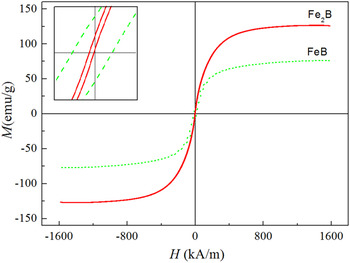
The magnetic properties of the as-synthesized FeB and Fe2B powders were evaluated using their magnetic hysteresis loops, as illustrated in Fig. 6. It can be seen that both FeB and Fe2B exhibit typical soft magnetic behavior. The saturation magnetization (M s) is 36.4 emu/g for FeB and 126.9 emu/g for Fe2B, respectively. The coercivity (H c) is 15.5 kA/m for FeB and 6.1 kA/m for Fe2B, respectively. The high M s values of FeB and Fe2B made them suitable as the soft phases to improve M s of hard magnetic materials by the exchange coupling interaction. Reference Li, Wei, Zhang, Li, Su, Ran, Xia, Jin and Liu3
Magnetic hysteresis loops of the as-synthesized FeB and Fe2B powders.

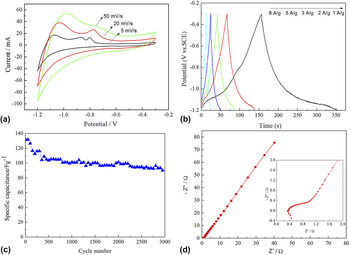
FeB powders have been reported to have excellent electrochemical properties as anode in metal/metalloid-air battery or alkaline secondary battery. Reference Abrenica, Ocon and Lee6,Reference Bai, Wu, Wu, Yang and Wu7 Figure 7(a) shows the curves of FeB electrode at different scanning rates ranging from 5 to 50 mV·s−1 within the potential range from −1.2 to −0.3 V for all sweep rates. The shape of the cyclic voltammetry curves clearly indicates the pseudocapacitive characteristics. The anodic peaks are located at around −1.07, −0.87, and −0.80 V when the scan rate is 5 mV·s−1. When the sweep rates increase, the current density increases and the positions of anodic and cathodic peaks shift to a more anodic and cathodic direction, respectively, denoting that the fast and reversible redox reactions occur at the electro/electrolyte interface. To get more information about the electrochemical performance of FeB material, the galvanostatic charge–discharge measurements are performed at various current densities with the potential window between −1.2 V and −0.3 V, as shown in Fig. 7(b). The discharge specific capacitance is calculated by the following equation:
 $$C = {{I\Delta t} \over {m\Delta V}}\quad ,$$
where m is the mass of active electrode, ΔV refers to the range of charge–discharge voltage, I refers to the discharge current, and Δt denotes the discharge time. The discharge specific capacitance of FeB electrode is 218.1 F/g, 162.3 F/g, 148.7 F/g, 138.4 F/g, and 116.7 F/g measured at discharge current density of 1 A/g, 2 A/g, 3 A/g, 5 A/g, and 8 A/g, respectively. In addition, the cyclic stability of the FeB electrode is further evaluated under galvanostatic charge-dicharge test at discharge current density of 5 A/g, as shown in Fig. 7(c). It can be seen that the specific capacitance is around 132 F/g at initial cycle. And then the specific capacitance of the FeB electrode tends to slowly decrease, 68.3% of the first capacitance is retained after 3000 cycles, denoting that this electrode material has a good cycle performance. To further investigate the electrochemical behavior of the FeB electrode, the electrochemical impedance spectroscopy (EIS) measurements are confirmed with a frequency range of 0.01 Hz–100 kHz, and the corresponding impedance Nyquist plots are shown in Fig. 7(d). The impedance spectra are composed of a semicircle at high frequency and a straight line at low frequency. In the high frequency region, the intercept of the semicircle with the horizontal axis represents R S, including the ionic resistance of the electrolyte, the intrinsic resistance of the active material, and the contact resistance at the active material/current collector interface. The R S value of the FeB electrode is around 0.44 Ω [Fig. 7(d) inset]. The charge-transfer resistance (R ct) is directly estimated from the diameter of semicircle. From Fig. 7(d), it can be seen that the FeB electrode displays a lower R ct value, indicating its good electron transport path and easy ion accessibility. In addition, the straight oblique line at low frequency represents Warburg impedance (W), which is described as a diffusion of ions within the electrode materials pores.
(a) CV curves of the FeB electrode at various scan rates ranging from 5 to 50 mV/s, (b) galvanostatic charge–discharge curves of FeB electrode at different current densities between −1.2 V and −0.3 V, (c) charge–discharge cycling test at 5 A/g, and (d) impedance Nyquist plots of the FeB electrode.

IV. CONCLUSIONS
In summary, nanosized FeB and Fe2B powders were successfully synthesized from the reaction between elemental Fe and amorphous B powders at 1000 °C. The presence of molten NaCl/KCl salts not only prevented the possibility of igniting SHS reaction but also inhibited the grain growth of boride particles. In addition, the as-synthesized FeB and Fe2B powders exhibited a uniform short-rod and plate like morphology, respectively. Both FeB and Fe2B exhibit typical soft magnetic behavior. The FeB electrode exhibited pseudocapacitive characteristics with a good cycle performance as well as a good electron transport path and easy ion accessibility.
ACKNOWLEDGMENTS
This work was financially supported by the Natural Science Foundation of China (No. 51302002, 11404004). Ya’nan Wei thanks the support from the Graduate Innovation Foundation of Anhui University of Technology (No. 2014082).