



No CrossRef data available.
Article contents
Can a developing country like Chile invest in biodiversity conservation?
Published online by Cambridge University Press: 05 October 2007
Abstract
An abstract is not available for this content. As you have access to this content, full HTML content is provided on this page. A PDF of this content is also available in through the ‘Save PDF’ action button.
Information
- Type
- Comment
- Information
- Copyright
- Copyright © Foundation for Environmental Conservation 2007
References
Brooks, T.M., Mittermeier, R.A., da Fonseca, G.A.B., Gerlach, J., Hoffmann, M., Lamoreux, J.F., Mittermeier, C.G., Pilgrim, J.D. & Rodrigues, A.S.L. (2006) Global biodiversity conservation priorities. Science 313: 58–61.CrossRefGoogle ScholarPubMed
Brzovic, F. (2002) Gasto, inversión y financiamiento para el desarrollo sostenible en Chile. Santiago, Chile: United Nations Publication Series.Google Scholar
Clapp, R. (2001) Tree farming and forest conservation in Chile: do replacement forests leave any originals behind? Society and Natural Resources 14: 341–356.CrossRefGoogle Scholar
CONAF (1998) Evaluación de resultados de la aplicación del Decreto Ley N° 701 de 1974. Oficina de Estudios y Planificación, Corporación Nacional Forestal, Ministerio de Agricultura, Santiago, Chile.Google Scholar
CONAF (2005) Balance Presupuestario Anual. Documento Interno, Corporación Nacional Forestal, Ministerio de Agricultura, Santiago, Chile.Google Scholar
De Moor, A. & Calamai, P. (1997) Subsidizing Unsustainable Development: Undermining the Earth with Public Funds. San José, Costa Rica: Earth Council.Google Scholar
Emerton, L., Bishop, J. & Thomas, L. (2006) Sustainable Financing of Protected Areas: a Global Review of Challenges and Options. Gland, Switzerland: IUCN.Google Scholar
Esty, D.C., Levy, M.A., Srebotnjak, T., de Sherbinin, A., Kim, C.H. & Anderson, A. (2006) Pilot 2006 Environmental Performance Index. New Haven, USA: Yale Center for Environmental Law and Policy.Google Scholar
James, A.N., Green, M.J.B. & Pain, J.R. (1999) Global Review of Protected Areas Budgets and Staff. Cambridge, UK: WCMC – World Conservation Press.Google Scholar
James, A., Gaston, K.J. & Balmford, A. (2001) Can we afford to conserve biodiversity? BioScience 51: 43–52.Google Scholar
Lara, A. & Veblen, T.T. (1993) Forest plantations in Chile: a successful model? In: Afforestation Policies, Planning and Progress, ed. Mather, A., pp. 118–139. London, UK: Belhaven Press.Google Scholar
McNeely, J. (1994) Protected areas for the 21st century: working to provide benefits to society. Biodiversity and Conservation 3: 390–405.Google Scholar
Myers, N. & Kent, R. (2001) Perverse Subsidies: How Tax Dollars can Undercut the Environment and the Economy. Washington, USA: Island Press.Google Scholar
Organización para la Cooperación y el Desarrollo Económico (2005) Environmental Performance Reviews – Chile. Paris, France: Organización para la Cooperación y el Desarrollo Económico.Google Scholar
PAF-CHILE (1994) Proyecto de fortalecimiento nacional de áreas silvestres protegidas. In: Plan de Acción Forestal para Chile, pp. 36–41. Santiago, Chile: Ministerio de Agricultura.Google Scholar
Pauchard, A. & Villarroel, P. (2002) Protected areas in Chile: history, current status, and challenges. Natural Areas Journal 22: 318–324.Google Scholar
Porter, G. (1998) Natural resource subsidies, trade and environment: the cases of forests and fisheries [www document]. URL http://www.ciel.org/Publications/NaturalResourceSubsidies.pdfGoogle Scholar
Robin, S., Wolcott, R. & Quintela, C.E. (2003) Perverse subsidies and the implications for biodiversity: a review of recent findings and status of policy reforms. Vth World Parks Congress: Sustainable Finance Stream, Durban, South Africa [www document]. URL http://www.conservationfinance.org/WPC/WPC_documents/Overview_PanB_Wolcott_v2.pdfGoogle Scholar
Valdebenito, G. (2005) Evaluación de efectividad del fomento forestal en Chile, período 1996–2003. Tesis Magíster, Facultad de Ciencias Físicas y Matemáticas, Universidad de Chile, Santiago, Chile.Google Scholar
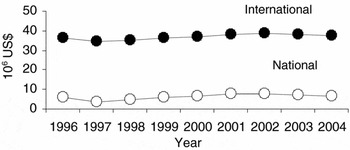
Figure 1 The SNASPE operational deficit (106 US$ km−2) based on international (James et al. 2001) and national (PAF-CHILE 1994) assessments.

Table 1 Annual costs of biodiversity conservation.
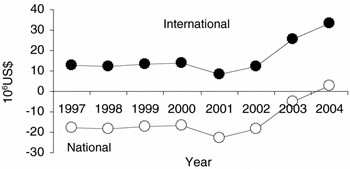
Figure 2 Capacity of the Chilean state to overcome the SNASPE operational deficit through government expenditure on DL 701, based on international (James et al. 2001) national estimates (PAF-CHILE 1994).
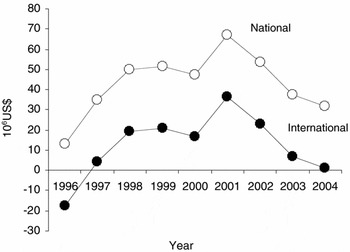
Figure 3 Capacity of the Chilean state to overcome the SNASPE operational deficit from maintaining DL 701 based on national (PAF-CHILE 1994) and international (James et al. 2001) estimates.
 You have
Access
- 4
- Cited by
Protected areas (PAs) are keystones of biological conservation (McNeely Reference McNeely1994) but their operation requires permanent funding. Current worldwide spending on PAs is insufficient, reaching an annual total of US$ 6.0 billion, 88% of which is spent by developed nations (James et al. Reference James, Green and Pain1999). Despite the benefits they grant, PAs have low priority for public investment, and this undermines their efficiency (Emerton et al. Reference Emerton, Bishop and Thomas2006).
Paradoxically, governments often target public funds to defray activities that negatively impact biodiversity (de Moor & Calamai Reference De Moor and Calamai1997). Subsidies supporting agricultural production, commercial fisheries and forestry keep prices below market levels, thereby encouraging resource overexploitation (Porter Reference Porter1998). These subsidies indirectly harm PAs, capturing funds otherwise assignable to their operational costs (James et al. Reference James, Gaston and Balmford2001; Robin et al. Reference Robin, Wolcott and Quintela2003).
In Chile, the national system of state protected areas (SNASPE) covers 19% (141 253 km2) of continental Chile (Pauchard & Villarroel Reference Pauchard and Villarroel2002). Although Chile's biota is regarded as an international priority for conservation (Brooks et al. Reference Brooks, Mittermeier, Fonseca, Gerlach, Hoffmann, Lamoreux, Mittermeier, Pilgrim and Rodrigues2006), SNASPE receives only 0.03% of the national budget (CONAF [National Forestry Corporation] 2005). In sharp contrast, Chile subsidizes the forestry industry. Decree Law 701 (DL 701) of 1974 and its later modifications, provides subsides for afforestation costs as well as tax reductions (Lara & Veblen Reference Lara, Veblen and Mather1993), a factor that has driven the expansion of plantations with exotic species (largely Pinus radiata), the replacement of native forests and a reduction in biodiversity (Lara & Veblen Reference Lara, Veblen and Mather1993; Clapp Reference Clapp2001).
Here, we analyse whether Chile has had, or has the economic capacity to overcome, the operational deficit in SNASPE. This deficit can be compared with (1) direct governmental expenditures on DL 701 and (2) state earnings, or the amount of economic resources earned by the state after subsidies are discounted from tax revenue. If any of these values is larger than the SNASPE operational deficit, Chile could fund its biodiversity conservation with a change in government policy. The first comparison might imply reducing forestry subsidies. In the second case, if profits are available, covering the SNASPE deficit may be economically feasible without affecting forestry subsidies.
To assess the SNASPE annual operational deficit, we gathered information about the budget allocated from 1996 to 2004 (CONAF 2005). We calculated the operational cost of SNASPE based on national (PAF-CHILE [Action Forest Plan for Chile] 1994) and international (James et al. Reference James, Gaston and Balmford2001) estimates of the cost of conservation activities per km2. Scaling them to the area administered by SNASPE provided estimates of funding requirements (Table 1). The SNASPE annual operational deficit was estimated by subtracting the annual budget from these values (Fig. 1). All figures are expressed in constant 2005 US dollars.
The SNASPE operational deficit (106 US$ km−2) based on international (James et al. Reference James, Gaston and Balmford2001) and national (PAF-CHILE 1994) assessments.
Annual costs of biodiversity conservation.
To assess Chilean capacity to cover the SNASPE annual operational deficit based on direct expenditures, we compared the expenditures associated with DL 701 with the SNASPE operational deficit. Funds allocated to DL 701 were estimated for 1996–2004. These funds were allocated to subsidize plantations, management, pruning, the recovery of degraded soils on private lands (average US$ 15 953 547 per year) and to cover costs incurred by CONAF in the administration of activities associated with DL 701 (average US$ 7 227 451 per year); Chile thus allocated on average US$ 23 180 998 annually between 1996 and 2004 to subsidize forestry plantations (CONAF 1998; INFOR 2005).
To assess the capacity to cover the SNASPE deficit using the state's earnings, we first estimated the increase in state earnings as a result of DL 701 implementation (CONAF 1998). The income corresponded to revenues in terms of Chilean taxes, including the ‘complementary global’, ‘first category rent’ and ‘added value’ taxes. To obtain the net productive increase of the state, we estimated the difference between the income from taxation and government costs of implementing DL 701. The difference between net earnings and the SNASPE deficit indicates the capacity of the state to overcome the deficit without affecting the application of DL 701, as this amount would be available for further investment.
On average, Chile invested US $6 208 292 yr−1 in supporting SNASPE. The annual operational deficit was higher, ranging between US$ 6 221 638 and US$ 36 841 981 (Fig. 1). Our estimates suggest that funding is available for SNASPE. Direct investment in DL 701 is 1.9 times higher than the SNASPE operational deficit according to PAF-CHILE (1994), but covers only 63% of the operational deficit according to James et al. (Reference James, Gaston and Balmford2001). Nevertheless, the 2004 data indicate that the SNASPE deficit is exceeded regardless of the assessment considered (Fig. 2).
Capacity of the Chilean state to overcome the SNASPE operational deficit through government expenditure on DL 701, based on international (James et al. Reference James, Gaston and Balmford2001) national estimates (PAF-CHILE 1994).
With respect to earnings, annual taxes have averaged US$ 72 371 425 (CONAF 1998; INFOR 2005). After discounting governmental expenditures on DL 701, the value is positive, therefore Chile is profiting from the subsidy to forestry. On average, Chile annually generates US$ 49 190 000 as profit, ranging from US$ 18 million in 1996 to US$ 74 million in 2001. If the operational deficit (US$ 6 or 36 million, depending on the national or international assessment) is discounted from revenues, the resulting figure still tends to be positive, except for 1996. From 1997 onwards, Chile has had enough funding to cover the SNASPE deficit and be able to cover other activities. Funds available after discounting expenditures and deficit from tax revenues have been US $1–67 million annually, varying according to the deficit estimate used (Fig. 3).
Capacity of the Chilean state to overcome the SNASPE operational deficit from maintaining DL 701 based on national (PAF-CHILE 1994) and international (James et al. Reference James, Gaston and Balmford2001) estimates.
SNASPE has an operational deficit that threatens biodiversity conservation. Our analysis demonstrates that Chile has had resources to overcome the SNASPE deficit; this is mainly a political decision rather than being attributable to a shortage of funds. From 1990 onwards, public budgetary allocation to environmental issues has increased 2.5 times, reaching over US$ 150 million by 2000. Funding for PAs however has decreased in real terms. By 2000, funding was only 0.8 times that allocated by the early 1990s (Brzovic Reference Brzovic2002; CONAF 2005). In fact, the Chilean funding level for wilderness protection is lower than the investment of other countries with similar gross national product (GNP) levels (Organización para la Cooperación y el Desarrollo Económico 2005; Esty et al. Reference Esty, Levy, Srebotnjak, de Sherbinin, Kim and Anderson2006).
In the case of the DL 701, a political decision allowed the increase in the forestry sector, turning it into the second most important national economic activity (3.4% GNP; INFOR [Instituto Forestal] 2005). Although the DL 701 involves a tax reduction to forestry activities (Valdebenito Reference Valdebenito2005), revenues by taxation are large enough to cover the SNASPE deficit. Regardless of how environmentally negative DL 701 could be, if profits were allocated to conservation, this would not only partially mitigate the environmental impact of forestry but also secure the proper funding of Chilean PAs. Thus, such funding ought to be considered an investment. Well-managed PAs could ensure sustained financing relying not only on public investments, but also on raising funds through innovative solutions such as receiving payment for the environmental services they provide (Emerton et al. Reference Emerton, Bishop and Thomas2006). Such an approach has yet to be taken in Chile.
Many perverse subsidies exist in developing countries that spend US$ 205 billon on subsidies for agriculture (Myers & Kent Reference Myers and Kent2001). Funds might be available for conservation of biodiversity not only in Chile, but also in other developing countries. What seems to be missing is the political will to allocate such funds.