1. Introduction
The question I want to consider is this: Is Newtonian particle mechanics a deterministic theory? John Norton argues, in “Causation as Folk Science” (Reference Norton2003) and in his article for this symposium, “The Dome: An Unexpectedly Simple Failure of Determinism” (Reference Norton2008, in this issue), that the answer is “No.” I do not particularly object to that answer once it is fully explained. But I am inclined to start differently. My answer is: “It depends.” It depends on what counts as a proper “Newtonian system,” and that is not entirely clear (at least not to me).
In what follows, I will identify some of the issues that arise in thinking about the question. I will also give a minitutorial on the geometry and dynamical properties of Norton's dome surface. The goal is to better understand how his example works and to better appreciate just how wonderfully strange it is. I will make the following points, among others.
(i) The dome surface has a singularity at the summit. (More precisely, it is  $C^{1}$ but not
 $C^{2}$ there. Elsewhere it is
 $C^{\infty }.$) One manifestation of the singularity is the fact that the Gaussian curvature of the surface blows up and goes to infinity as one approaches the summit.
(ii) The dome+particle system exhibits various pathologies, and all can be traced to the singularity at the summit. In particular, “Norton indeterminism” can be traced to it. On a surface that is everywhere  $C^{2}$, the behavior of a sliding particle is uniquely determined by its initial position and velocity. (This follows because in the everywhere-
 $C^{2}$ case the equation of motion for the sliding particle falls under the umbrella of the fundamental existence and uniqueness theorem for ordinary differential equations.)
(iii) Because of i, Norton's dome surface is, in a sense, “infinitely slippery”: no particle at the summit can stay on the surface if its velocity there is nonzero. (“Infinite downward pressure” would be required to keep it on.) So, if one gives an epsilon kick to a particle at the summit, it will fly off the surface no matter how small epsilon is.
(iv) Because of iii, it is only in a slightly delicate sense that one can characterize the system in question as one in which “a particle slides on a surface.” One is not dealing here with a “constraint system” in the usual textbook sense. (One arrives at the phase space for Norton's dome+particle system by starting with the phase space for a garden variety constraint system and then adding one boundary point.)
(v) If one restricts attention to the case where the particle is at the summit, an alternative analysis of its motion is available. On this alternative, the dome surface serves as no more than a platform (or golf tee) for the particle. If the latter's initial velocity is nonzero, it flies off the platform and follows a parabolic free-fall trajectory (at least for a short while). In the limiting case where the initial velocity is zero, it follows such a trajectory for zero seconds; that is, it stays put.
2. Differential Equations
The standard claim that Newtonian particle mechanics is deterministic is underwritten by the fundamental existence and uniqueness theorem concerning solutions to ordinary differential equations. Let us first recall one special case of the theorem.
Consider equations of the form

where  $f{:}\thinspace \: R^{+}\rightarrow R$ is a continuous function. Here
 $R^{+}$ is the set of nonnegative real numbers. For any particular choice of
 $f$, we can think of (1) as the equation of motion for a point particle of unit mass that moves along the positive
 $r$ axis. (In Norton's example,
 $r$ is the distance between the sliding particle and the summit of the dome [as measured on the dome] and
 $f( r) =\sqrt{r}$.) We understand a “solution” to (1) to be a
 $C^{2}$ function
 $r{:}\thinspace \:[ 0,\,\varepsilon ) \rightarrow R^{+}$, for some
 $\varepsilon > 0$, such that
 $( d^{2}r/ dt^{2}) ( t) =f( r( t) ) $ for all
 $t$.Footnote 1 Consider, as well, initial conditions:


We can think of these as capturing the requirement that our particle starts at the origin  $r=0$, with an initial velocity pointing in the positive
 $r$ direction. One version of the basic theorem under consideration is the following:Footnote 2
Proposition 1. If  $f$ is
 $C^{1}$, there is a unique maximally extended solution to (1) satisfying conditions (2) and (3).Footnote 3
Again, it is this theorem (and its various generalizations) that underwrite the claim that the motion of a particle in Newtonian mechanics is uniquely determined by its initial position and velocity. What is most important for present purposes is the hypothesis on  $f$. The theorem is only applicable in cases where the force acting on the particle is (representable as a function that is)
 $C^{1}$, that is, continuously differentiable. Without the hypothesis, uniqueness is not guaranteed. Suppose, for example, that
 $f( r) =r^{a}$, with
 $0< a< 1$, and
 $v_{0}=0$. Certainly, the trivial solution (
 $r( t) =0$ for all
 $t$) satisfies (2) and (3). But so does the solution

(If  $a=1/ 2$, the expression on the right is
 $( 1/ 144) t^{4}$, as in Norton's example.)
Now we confront a first issue in deciding whether Newtonian particle mechanics is a deterministic theory.
Issue 1. Are we allowed to posit (make-up) forces? If so, what restrictions, if any, apply?
If we are allowed to posit “forces” without restriction, the game is over. For then, as Norton points out, we can generate an indeterministic system simply by adapting the preceding example. In particular, we can posit the existence of mass points that exert an attractive (“Nortonian”) force of magnitude

on particles of mass  $m$ at distance
 $s$. (Here
 $L$ is some arbitrary length.) Suppose that we have one of these (source) particles at position
 $L$ on the
 $r$ axis. Further suppose that we have a (test) particle at position
 $r$ on that axis, with
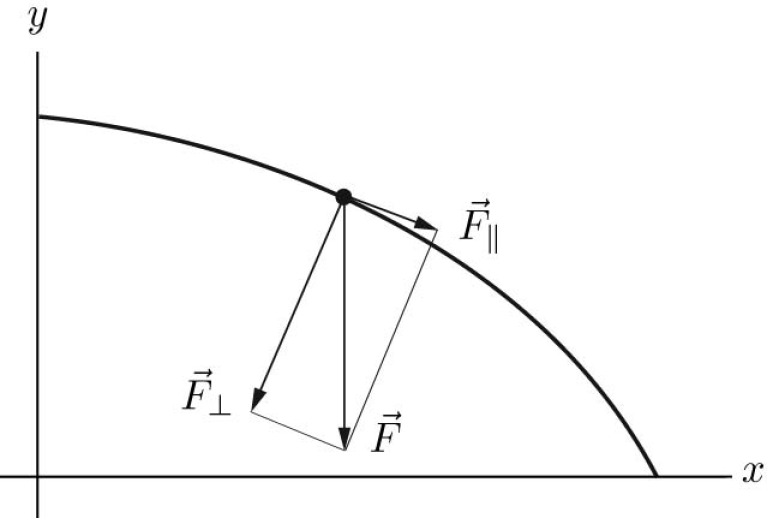
 $r< L$. (See Figure 1.) Then the former exerts a force of magnitude

on the latter. So the equation of the motion for the test particle is

exactly as in Norton's example. (We get the dome example without the dome.) If the particle starts at the origin ( $r=0$) with velocity
 $0$, it can either stay there forever or it can move to the right (toward the source particle) with trajectory
 $r( t) =( 1/ 144) t^{4}$.
A particle with mass  $m$ and coordinate
 $r$ (with
 $r< L$) on the
 $r$ axis is attracted to a Nortonian source particle with coordinate
 $L$ on that axis. It experiences a force of magnitude
 $m\sqrt{r}$.

The Nortonian force we have introduced is completely contrived, of course, and it is radically different from forces otherwise considered in Newtonian physics. For one thing, it introduces a fundamental length scale  $L$. (Its magnitude drops to
 $0$ at distance
 $L$ from the source particle.) Furthermore, it introduces singularities “in the middle of nowhere.” (The Newtonian gravitational field surrounding a point particle is singular at the site of the particle itself. But the Nortonian force field surrounding a point particle is singular at a distance
 $L$ from the particle.Footnote 4) For these reasons, some people will not be convinced that the example, by itself, shows Newtonian particle mechanics to be an indeterministic theory—at least not in any interesting sense. The nice thing about Norton's dome example (in its original form) is that it is cast in terms of Newtonian gravitation and a constraint surface rather than new funny forces. Before turning to the dome, we consider what may be the strongest and most direct argument for the indeterministic character of Newtonian particle mechanics.
3. Space Invaders
In Newtonian mechanics, there is no upper bound to the speed with which particles can travel (as determined relative to any background observer). This raises the possibility of “space invader” particles zooming in from spatial infinity in finite time. To make the case as dramatic as possible, we may as well consider the possibility of there being no particles present (anywhere) at some initial time  $t_{0}$ but one or more particles present (somewhere or other) at all times thereafter.
To get a precise question, one needs to specify what forces are present. In 1895, the French mathematician Paul Painlevé asked, specifically, whether one can have a space invader system of the sort described within the framework of pure Newtonian gravitation theory—where each of the  $n$ particles in the system is subject to the gravitational influence of the other
 $n-1$ particles but no other forces are present. Painlevé proved that it is not possible if
 $n\leq 3$, but he conjectured that it is possible if
 $n\geq 4$.
Painlevé's conjecture is still not completely settled. It is not known whether one can have a pure gravitational space invader system with exactly four particles. But Jeff Xia proved in 1988 that one can have such a system with  $n$ particles if
 $n\geq 5$.Footnote 5
The latter positive result points to a sense in which one might want to say that Newtonian particle mechanics is an indeterministic theory (even without funny forces). Consider a universe that is perfectly empty at time  $t_{0}$. The theory certainly allows for the possibility that it remains empty forever. But it also allows for there to be “present” at all times after
 $t_{0}$ a Xia system with, say, five particles. So the state of the universe at time
 $t_{0}$, together with the Newtonian laws of motion (for particles in the presence of a gravitational field), does not uniquely determine the state of the universe at subsequent times.
We have here a deep, highly nontrivial fact about Newtonian particle mechanics.Footnote 6 But whether it establishes the indeterministic character of the theory is a delicate question. Once again, I am inclined to say “it depends.” It depends on our answer to the following question.
Issue 2. Is the number of particles in a “Newtonian system” understood to be fixed?
Usually it is taken for granted that “particle number” is a fixed attribute of a Newtonian system—part of what characterizes the system in the first place, rather than a state variable whose value can change over time. One speaks of a “three body system,” for example, and one takes for granted that it has a phase space with a fixed dimension. But in the space invader example under consideration, we get indeterminism (at least as usually understood) only if we allow that one and the same “system” can have  $0$ particles at time
 $t_{0}$, and
 $5$ particles thereafter. (It is not as if we have a system with a fixed number of particles, either
 $0$ or
 $5$, that is seen to evolve in two different ways from given initial conditions.)
4. Norton's Dome in Profile
Now I turn to the promised minitutorial on the geometry and dynamic properties of Norton's dome surface. I will support the claims made in Section 1 and then revisit the question whether we are dealing here with a proper “Newtonian system.” (Some readers may want to skip to Section 7.)
Since we are only interested in radial curves through the summit of the dome surface (and since the surface exhibits rotational symmetry with respect to that point), we lose nothing if we restrict attention to a vertical cross section of the surface through the summit.
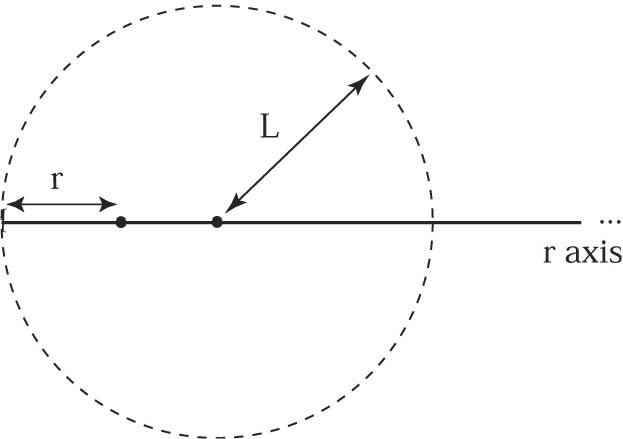
We can represent the section (or, rather, half of it) as the image of a curve  $\gamma {:}\thinspace \:[ 0,\, R) \rightarrow R^{2}$ that starts at the summit
 $\gamma ( 0) =( 0,\, y_{0}) $ and is parametrized by arc length. (See Figure 2.Footnote 7) It comes out as follows:Footnote 8

(We require that  $0< R< g^{2}$ and
 $y_{0}> 0$ but leave
 $R$ and
 $y_{0}$ otherwise unrestricted. For the moment,
 $g$ is just some positive number. It will later play a role as the acceleration of a freely falling particle [not too far from the earth's surface] due to the latter's gravitational field.)
Norton's dome surface in profile.

It is easy to check that  $\gamma $ is
 $C^{1}$ where
 $r\geq 0$ and
 $C^{\infty }$ where
 $r> 0$. Note that it is, in fact, parametrized by arc length, since

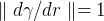
and so 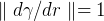 $\parallel d\gamma / dr\parallel =1$ everywhere. Note also that it is not differentiable to second order at
 $r=0$. The second derivative field

clearly blows up as  $r$ approaches
 $0$, as does the the curvature field

In what follows, we will understand a Norton ramp to be a half section of Norton's dome (as characterized above). For our purposes, the most important thing about a Norton ramp is the fact that we have just established: as one moves up the ramp and approaches the summit, it flattens to a horizontal orientation and the rate at which it flattens (relative to distance traversed) increases without bound.
It will be useful, at times, to step back a bit and consider a broader class of generic ramps. These will be represented by curves  $\gamma {:}\thinspace \:[ 0,\, R) \rightarrow R^{2},$ parametrized by arc length, that (i) are at least
 $C^{1}$ for
 $r\geq 0$ and at least
 $C^{2}$ for
 $r> 0$, (ii) start out “horizontally” from a summit point, and (iii) have a downward convex shape. If
 $\gamma _{x}$ and
 $\gamma _{y}$ are the component curves defined by
 $\gamma ( r) =( \gamma _{x}( r) ,\,\gamma _{y}( r) ) $, we can capture these assumptions as follows:


The final condition should be understood to hold at all points where the second derivatives are well defined—so for all  $r> 0$ and possibly at
 $r=0$. It may not be immediately clear where it comes from. Notice, first, that the slope of the curve can be expressed as the ratio
 $( d\gamma _{y}/ dr) / ( d\gamma _{x}/ dr) $. It is
 $0$ at
 $r=0$ and negative for
 $r> 0$. (This makes sense. We want the ramp to slant downward after its initial point.) Downward convexity is captured by the requirement that the derivative (with respect to
 $r$) of the ratio
 $( d\gamma _{y}/ dr) / ( d\gamma _{x}/ dr) $ is negative; that is, the slope is increasingly negative. This condition (together with the positivity of
 $d\gamma _{x}/ dr$) leads to (11).
5. Staying in Touch
Now we turn from geometry to physics and consider the motion of a particle sliding down a ramp—first, a generic ramp and then a Norton ramp, in particular. We look to Newtonian mechanics for an account of its motion.
Following Norton, we introduce a number of idealizations to make the problem tractable. We assume that (i) the ramp has a fixed position—it is bolted in place, (ii) the particle slides without friction, (iii) the free fall acceleration of the particle due to the earth's gravitational field is constant (with value  $g$), and so forth.
Some people, looking to disqualify Norton's example, might try to build a case on these idealizations. (Maybe the [apparent] violation of determinism disappears when we take into account the full complexity of the situation.) But I am not inclined to do so. The idealizations in question are standard fare in any textbook on Newtonian mechanics, and they are not sufficient, by themselves, to generate “Norton indeterminism.” (They cause no special difficulty when we are dealing with a garden-variety smooth ramp.) It seems to me that it is the singularity at the summit of a Norton ramp that is crucial here, and that is where I will direct my attention.
Suppose that a particle is released at some point on the ramp (not necessarily the summit) with an initial velocity (not necessarily oriented in a downward direction), and suppose that it begins to slide. We can represent its motion as a map,  $r{:}\thinspace \:[ 0,\,\varepsilon ) \rightarrow [ 0,\, R) $, for some
 $\varepsilon > 0$, where
 $r( t) $ is the particle's distance from the summit (as measured along the ramp) at time
 $t$. (We use
 $\varepsilon $ here to reinforce the idea that the particle's slide on the ramp may not last long.) Now consider the composed map
 $t\mapsto r( t) \mapsto \gamma ( r( t) ) $. The first and second derivatives of this composed map (where well defined) give the particle's velocity and acceleration.Footnote 9 We can calculate them using the chain rule:


The two terms on the right-hand side of (13) give the components of the particle's acceleration, respectively, tangent to and orthogonal to the ramp. (The first is proportional to the unit tangent vector  $d\gamma / dr$, the second to the “curvature vector”
 $d^{2}\gamma / dr^{2}$ [both evaluated at
 $r( t) $].) So, using obvious notation, we can express (13) as

Now the gravitational force on the particle is given by the “vertical” vector field  $F=( 0,\, -mg) $, where
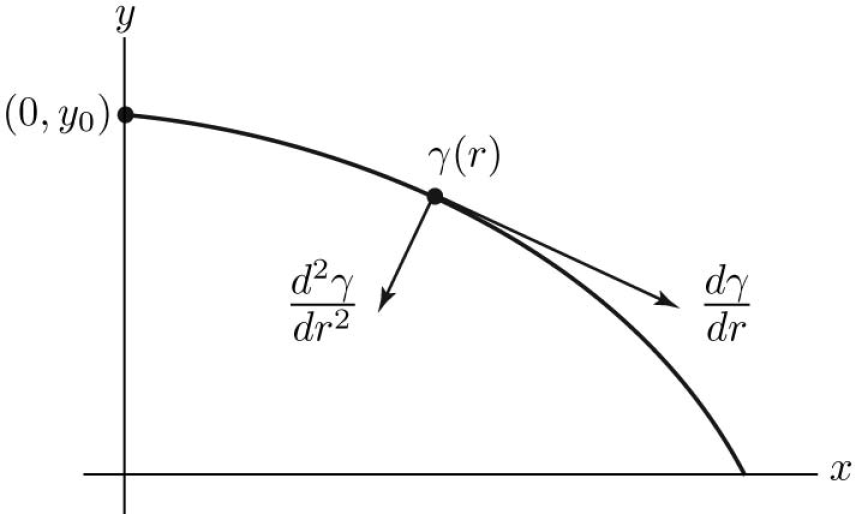
 $m$ is the mass of the particle. It, too, can be decomposed at every point into components tangent to and orthogonal to the ramp (see Figure 3):

Decomposition of the gravitational force vector.

The two play different roles.  $\vec{F}_{\perp }$ keeps the particle on the ramp. It is opposed by a corresponding force that the ramp itself impresses on the particle. In contrast,
 $\vec{F}_{\parallel }$ is unopposed and governs the motion of the particle as it slides down the ramp. We are thus led both to a constraint inequality

and an equation of motion

The inequality may not be immediately clear. It captures the requirement that, at any particular point, whatever else is the case, the background gravitational force is sufficiently strong to hold the particle on the ramp. It is thus a necessary condition for the applicability of the equation of motion at that point.
Think about the inequality this way. The vector fields  $\vec{F}_{\perp }$ and
 $m\vec{a}_{\perp }$ are coalligned (and point in the same direction).Footnote 10 So it is only their relative magnitude that is in question. Suppose that they are equal over some stretch of the ramp, that is, suppose that
 $\vec{F}_{\perp }=m\vec{a}_{\perp }$ holds there in addition to
 $\vec{F}_{\parallel }=m\vec{a}_{\parallel }$. In this case, the particle follows the course of the ramp, but it does so in a state of gravitational free fall. The ramp plays no role in its motion. (We could remove it without effect.) The particle is not really “on” the ramp. Suppose next that
 $\parallel \vec{F}_{\perp }\parallel $ is strictly greater than the critical value
 $\parallel m\vec{a}_{\perp }\parallel $ over that stretch of the ramp. In this case, the particle still follows the course of the ramp but is now pressed to it. Suppose, finally, that at some point
 $\parallel \vec{F}_{\perp }\parallel $ is strictly less than the critical value
 $\parallel m\vec{a}_{\perp }\parallel $. In this case, the particle there will simply fly off the ramp. There is no longer sufficient gravitational force to keep it on.
Let us now re-express (16) and (17). We have, at every point,


(Here we use the fact that

We also drop explicit reference to evaluation points.) So the two come out, respectively, as


Inequality (18) has a direct physical interpretation. At any point on the ramp, the unit tangent vector  $d\gamma / dr$ and the curvature
 $\parallel d^{2}\gamma / dr^{2}\parallel $ are fixed. They are “determined by the ramp.” What is not fixed is
 $dr/ dt,$ the speed with which the particle is sliding at the point. Inequality (18) tells us how great that speed can be without the particle flying off the ramp:

The greater the curvature, the smaller the critical fly-off speed. (That is certainly what one would expect.)
We claimed at the outset that Norton ramps are “infinitely slippery” at the summit—in the sense that the fly-off speed there is  $0$. We are now in a position to verify the claim. The term
 $d\gamma _{x}/ d_{r}$ in (20) goes to one as
 $r$ approaches zero. (Recall that
 $d\gamma / dr( 0) =( 1,\, 0) $.) So we have the following miniresult: the limiting value of the fly-off speed at the summit (of a generic ramp) is 0 iff the curvature of the ramp blows up as the summit is approached.
We are also in a position to verify our claim that Norton indeterminism cannot arise on a generic ramp that is everywhere  $C^{2}$. Consider the equation of motion (19). We know from the fundamental existence and uniqueness theorem for ordinary differential equations that if the right-hand-side term
 $d\gamma _{y}/ dr$ is a
 $C^{1}$ function of
 $r$, then there is a unique (maximally extended) solution to the equation satisfying the initial conditions
 $r( 0) =0$ and
 $d_{r}/ dt( 0) =0$. But
 $\gamma $ is
 $C^{2}$ iff
 $d\gamma _{y}/ dr$ and
 $d\gamma _{x}/ dr$ are both
 $C^{1}$.
In the special case of a Norton ramp (by eqq. [5] and [7]), (18) and (19) come out as


Here the left-hand side of inequality (21) is not well defined when  $r=0$. But we can understand it to be satisfied there if
 $dr/ dt$ goes to
 $0$ sufficiently fast as
 $r\rightarrow 0$ that the limiting value of the left-hand side is less than
 $2g$.
Note that on this understanding the solutions to (22) that Norton considers, namely, those of the form

all do satisfy the constraint inequality (for sufficiently small  $\varepsilon $).Footnote 11 So we cannot look to the latter to rule out the possibility that a particle starts at rest at the summit and spontaneously slides down the ramp. What it rules out is the possibility that a particle slides down the ramp if it starts at the summit with nonzero velocity.
6. Phase Space
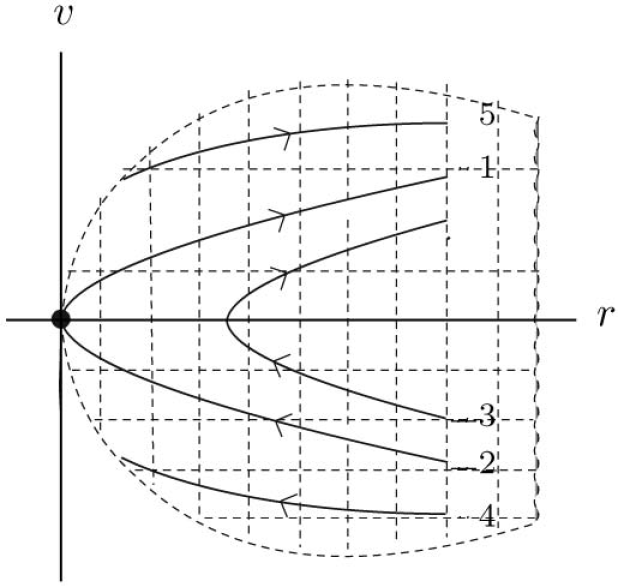
Let us now consider what the phase space of a Norton ramp+particle system looks like. It has several levels of mathematical structure, but at bottom it is a point set, each element of which is a pair  $( r,\, v) $ that represents a possible initial state of the system. (Here,
 $r$ is the initial position of the particle on the ramp [as determined by its distance from the summit] and
 $v$ is its initial speed [in the
 $r$-increasing direction].) Since we are only considering dynamical histories of the particle that keep it on the ramp, we only include pairs
 $( r,\, v) $ that satisfy the constraint inequality (21) (with
 $dr/ dt$ replaced by
 $v$). But we continue to understand the latter in such a way that the pair
 $( 0,\, 0) $ counts as satisfying it.Footnote 12

Using an obvious notation, we can express this as:  $\mathrm{NPS}\,=\{ ( 0,\, 0) \} \,\cup \,\mathrm{NPS}\,^{-}.$
It is important for our purposes that  $\mathrm{NPS}\,^{-},$ by itself, is the phase space of a garden-variety constraint system, namely, the one that one gets if one excises the summit point of a Norton ramp. Through every point of
 $\mathrm{NPS}\,^{-}$, there is exactly one maximally extended dynamical trajectory fully contained in
 $\mathrm{NPS}\,^{-}.$Footnote 13 (We know this, once again, because when
 $r> 0$, the equation of motion (22) falls under the umbrella of the fundamental existence and uniqueness theorem for ordinary differential equations.) All the difficulties of Norton's system arise from the addition of the one boundary point
 $( 0,\, 0) $.
Figure 4 gives a rough sketch of NPS and indicates a number of representative dynamical trajectories.Footnote 14 Trajectory 1 represents the history of a particle that starts at the summit and slides down the ramp, while trajectory 2 is the time-reversed counterpart to trajectory 1. It represents the history of a particle that starts lower down the ramp with just the right initial, upward directed speed to get it to the summit. (Upward directed speed counts here as “negative speed,” so it makes sense that trajectory 2 starts below the  $r$ axis.) Trajectory 3 represents the history of a particle that also starts from lower down on the ramp with an initial upward speed but does not make it to the summit because the initial speed is too small. Instead, it slides up the ramp for a while and then reverses direction and slides back down. In the case of trajectory 4, in contrast, the initial upward speed of the particle is too great, and it sails off the ramp before reaching the summit. Trajectory 5 is the time reverse of 4. It represents the history of a particle that “lands” on the ramp below the summit and slides down. The one remaining item for our list is the degenerate (one point) trajectory of a particle that starts at and forever stays at the summit.
Phase space of the particle+ramp system.

7. Is Norton's Example a Proper “Newtonian System”?
With these “data” in hand, we can identify two interrelated issues that arise in trying to decide whether Norton's example should qualify as a proper “Newtonian system.” One obvious question is this.
Issue 3. Do we allow constraint systems in which the defining constraints involve singularities? If so, how bad can the latter be?
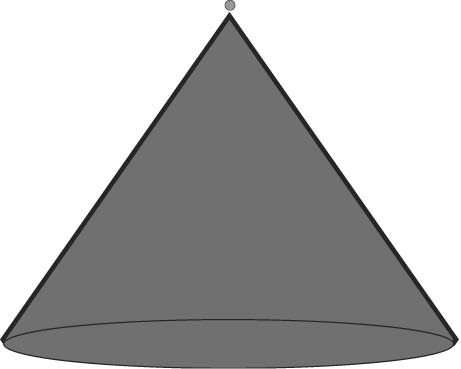
Suppose, for example, that we replace Norton's dome surface with a vertical cone (Figure 5). Does this composite system qualify as a proper Newtonian constraint system? I suspect that many people will be hesitant to recognize it as such. The cone surface is certainly “more singular” than Norton's dome surface. (The former is  $C^{0}$ but not
 $C^{1}$ at its apex, whereas the dome is
 $C^{1}$ but not
 $C^{2}$.) But I see no fundamental line of demarcation here, only a matter of degree.
A point particle on a surface that is  $C^{0}$ but not
 $C^{1}$. Is this a “Newtonian system”?

Those who hesitate to recognize the cone as a proper Newtonian constraint surface may be troubled because no point particle can be on the surface at the apex and still have a well-defined velocity—except in the degenerate case where the velocity there is  $0$. (Presumably it is essential to “Newtonian mechanics” that we be able to assign velocities to particles.) But there is a corresponding problem with Norton's surface. No particle can be on that one at the summit point and still have a well-defined acceleration—except in the degenerate case where its velocity there is
 $0$. I suppose that one might try to make the case that we cross some fundamental line when we move from non-well-defined accelerations to non-well-defined velocities. But it is not a case that is clear to me.
Another closely related issue here is the status of boundary points in a phase space. Usually, it is taken for granted that the phase space of a Newtonian system is an open set in some  $R^{n}$ or, more generally, a manifold (without boundary). It can be convenient to allow boundary points, for example, if one wants to consider the motion of a particle with a fixed starting point, but in garden-variety cases, the inclusion of these points is unproblematic because one can extend the phase space to an open set (or manifold without boundary). In the case of Norton's example, however, we have an isolated boundary point in the phase space that cannot be removed (i.e., cannot be turned into an interior point) by passing to an extension. (Recall Figure 4.)
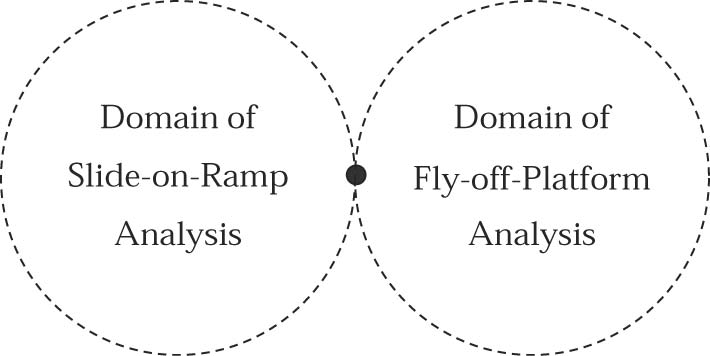
More is at stake here than the mathematical convenience of working with open sets. The presence of irremovable boundary points is connected with issues of well definedness and “boundary consistency.” Suppose that we restrict attention to the case where the particle is at the summit of Norton's ramp.Footnote 15 Then it is only in a somewhat delicate sense that its motion is governed by (22), since the latter only applies if the particle's velocity there is  $0$. (Usually when we claim that a particle is governed by a “law of motion,” we have in mind that we can look to the equation to tell us how the particle will move over some range of initial velocities.) But an alternative analysis of its motion is available in this case that applies no matter what its velocity. On this alternative, the ramp is no more than a platform (or golf tee). If the particle's initial velocity is nonzero, it flies off the platform and follows a parabolic, free-fall trajectory, at least for a very short time—until it hits the ramp or the “ground.” In the limiting case where the initial velocity is
 $0$, it follows a degenerate parabola for
 $0$ seconds; that is, it stays put.
Consider, for the moment, just the  $x$ coordinate of the particle. The present proposal is that the particle, when at the summit of the dome, is (also) governed by the equation

(Clearly, this equation has only one solution satisfying the initial conditions  $x( 0) =0$ and
 $( dx/ dt) ( 0) =0\mathrm{,}\,$ namely,
 $x( t) =0$, for all
 $t$.)
The picture I have is of two domains of analysis whose respective boundaries overlap. (See Figure 6.) If a particle is at some point on the ramp other than the summit, and if its initial speed is below the critical fly-off value for that point, the “slide on the ramp” analysis provides an unproblematic prescription for how it will move (subject, of course, to the idealizations discussed above). Alternatively, if it is at the summit with nonzero velocity, the “fly-off the platform” analysis provides such a prescription. But if it is at the summit with velocity  $0$, both analyses become applicable. And here they come into conflict. One allows for the possibility that the particle will leave the summit, and the other does not.
Alternative Newtonian analyses that both apply in the special case where the particle is at rest at the summit.

This problem of “boundary consistency” does not arise when we deal with garden-variety constraint surfaces (e.g., Norton's ramp without the summit point) because then we can restrict attention to initial velocities, at any particular point of the surface, that are strictly less than the critical fly-off speed there. The remarkable thing about Norton's ramp is that the fly-off speed at the summit is  $0$! So it is not possible to restrict attention in this fashion. Anyway, we have identified a further issue to consider.
Issue 4. Can a proper “Newtonian system” have a phase space that contains boundary points that cannot be removed (i.e., turned into interior points) by passing to an extension of the space?
One might take the presence of nonremovable boundary points in the phase space of a system to be an indication that one has pushed Newtonian theory beyond its natural “domain of application.”
8. Conclusion
I find Norton's example fascinating because it vividly demonstrates some of the difficulties that arise when one attempts to apply Newtonian particle mechanics in circumstances where standard background differentiability conditions do not obtain. Perhaps “difficulties” is too weak. There is a sense in which the theory breaks down. But I am not sure that the full complexity and interest of the breakdown is adequately captured by saying either “Newtonian particle mechanics is an indeterministic theory” (full stop) or “Norton's example is not a well-defined Newtonian system” (full stop). Indeed, I am not convinced that we have clearly posed alternatives here—because we do not have a sufficiently clear idea in the first place what should count as a “Newtonian system” (or count as falling within the “domain of application” of Newtonian theory). My inclination is to avoid labels here and direct attention, instead, to a rich set of issues that the example raises.