


1. Introduction
The last few decades have brought new challenges to global politics, with states, political actors, and armed conflicts calling into question the norms, institutions, laws, and practices that underpin the international system (Barnett and Finnemore, Reference Barnett and Finnemore1999; Börzel and Zürn, Reference Börzel and Zürn2021; Copelovitch and Pevehouse, Reference Copelovitch and Pevehouse2019; Keohane, Reference Keohane2020; Voeten, Reference Voeten2020). While these challenges affect a wide range of processes and issue areas among states, scholars remain divided on how they have impacted the international human rights regime—the set of norms, institutions, and legal guidelines that seek to establish basic rights for individuals worldwide.
One camp emphasizes resilience. Some research argues that cohesion within the human rights regime has increased by pointing to recent institutional achievements that promote global constitutionalism and the emergence of a borderless rule of law (Ikenberry, Reference Ikenberry2011). Generally, these scholars contend that transnational advocacy networks (Risse et al., Reference Risse, Ropp and Sikkink2013; Sikkink, Reference Risse, Ropp and Sikkink2011) and globalization (Buchan et al., Reference Buchan, Grimalda, Wilson, Brewer, Fatas and Foddy2009) have promoted a broader consensus on human rights, generating widespread normative support and strengthening the regime (Bob, Reference Bob2009). These claims are supported by evidence of increasing global compliance, as individuals and states adopt new human rights norms across diverse issue areas (Bob, Reference Bob2009; Fariss, Reference Fariss2019).
A second camp sees fragmentation. These scholars argue that globalization has produced divergent interpretations of human rights and further fragmented human rights norms. As social constructs, human rights norms are fluid, allowing actors to reshape meanings through their positions and actions (Berger, Reference Berger2023). This process creates space for resignification and fragmentation (Langlois, Reference Langlois2002). Structural shifts, such as the decline of Western dominance and China’s rise, challenge the notion of a unified regime (Pauselli et al., Reference Pauselli, Urdínez and Merke2023). Scholars have provided some evidence in favor of the fragmentation thesis by documenting extensive contestation over international human rights norms (Deitelhoff and Zimmermann, Reference Deitelhoff and Zimmermann2020; Dixon, Reference Dixon2017) and emerging fragmentation (Terman and Búzás, Reference Terman and Búzás2021).
Both camps, however, share a critical limitation: they treat the human rights regime as monolithic. This obscures substantial heterogeneity across issues. First, human rights span a wide range of concerns, from specific local matters—for example, negotiating ceasefires, refugee resettling refugees, and ending genocides—to broader moral claims—e.g., the scope of protections for minority populations, the processes through which individuals engage in politics, and how best to balance internal security while safeguarding individuals from state coercion (Hope and Ballon, Reference Hope and Ballon2021; Sarkin and Capazorio, Reference Sarkin and Capazorio2022). Second, there is ongoing debate about whether human rights are context-specific or a global process. In other words, is the global community or the state the ultimate arbiter of human rights (Deng, Reference Deng2010; Thakur, Reference Thakur2016)? Despite wide variation in the development and recognition of human rights, much of the existing research in this area treats the norms that constitute the international human rights regime as monolithic.
The main contribution of this article is therefore methodological as much as substantive. Existing studies of human rights regime fragmentation, including the influential work of Terman and Búzás (Terman and Búzás, Reference Terman and Búzás2021), identify fragmentation across broad clusters of state positions within a single institutional process. Our approach differs in two important respects. First, by analyzing sponsorship networks rather than voting or Universal Periodic Review (UPR) recommendations, we capture a more costly and deliberate signal of state alignment. States that co-sponsor a resolution are affirmatively investing political capital. Second, and more importantly, our network framework enables comparison of fragmentation within issue areas over time, revealing not just that the regime is divided, but where those divisions are deepest, how they vary across substantively distinct topics, and whether they have intensified or stabilized across nearly two decades of Council activity. How can we assess whether the human rights regime is cohesive or fragmented when the issue space itself is so diverse? It is plausible that some human rights norms remain cohesive and resilient, while others are highly fragmented. We address this research gap by disaggregating the regime by issue space. Specifically, we analyze the sponsorship networks of 2,234 resolutions in the United Nations Human Rights Council (UNHRC) from 2006 to 2024. Through our analysis, we identify key issue areas and sponsorship networks among states over time.
To identify issue areas, we adopt two approaches: (a) expert coding and (b) unsupervised machine learning. A member of the research team, working with research assistants, conducted the expert coding, while we used a BERT topic model to derive alternative UNHRC resolution topics. Topic labels from the BERT model were derived by finding the top nouns and verbs using the term frequency-inverse document frequency (TF-IDF) by topic. In total, there were seven expert topics: (a) civil and political rights, (b) country-specific, (c) economic, social, and cultural, (d) international cooperation, (e) Israel-Palestine, (f) minority rights, and (g) physical integrity. There were seven topics derived from the BERT topic model: (a) Belarus, Sudan, Central African, African; (b) cooperation, enhancement, and solidarity; (c) enforced disappearances, truth, and transitional; (d) girls, women, gender, trafficking; (e) government, Burundi, UPR; (f) Palestinian Territory, Jerusalem, and occupied; and (g) religion, belief, intolerance, and racism. With these issue spaces, we then assess whether there is general consensus or relative fragmentation in the human rights regime sponsorship network by issue.
This dual approach serves three purposes. First, combining expert and unsupervised machine learning coding allows us to assess more rigorously whether and how fragmentation varies across human rights issue areas. Second, the network approach surfaces patterns of cooperation and division that are not apparent from examining individual resolutions or voting records alone. Third, it enables us to track how these patterns shift across substantively distinct topics over nearly two decades of Council activity. Our analysis reveals that fragmentation is issue-dependent rather than regime-wide. Country-specific topic resolutions exhibit considerable fragmentation, whereas other issue areas attract broader, cross-cutting coalitions. The human rights regime is neither uniformly cohesive nor uniformly fractured: it is selectively contested. This has important implications for how scholars understand international regime dynamics and for practitioners seeking to build durable coalitions within multilateral human rights institutions.
2. Historical background
The foundation of the international human rights regime dates back to the end of World War II, when states institutionalized major treaties such as the Genocide Convention, the International Covenant on Civil and Political Rights, the International Covenant on Economic, Social and Cultural Rights, and the International Convention on the Elimination of All Forms of Racial Discrimination (Baderin and Ssenyonjo, Reference Baderin and Ssenyonjo2016). The increasing acceptance of these treaties is evident in their ratification rates over time, with the four foundational agreements now ratified by between 75% and 90% of states in the international system.
The subsequent evolution of the international human rights regime has been marked by significant institutional developments. The 1993 World Conference on Human Rights represented a critical turning point, leading to the establishment of the Office of the United Nations High Commissioner for Human Rights (OHCHR). Tasked with promoting human rights through information dissemination and timely reporting, the OHCHR significantly expanded the regime’s institutional capacity (Smith, Reference Smith2016). However, by the early 2000s, the regime faced a credibility crisis, prompting a comprehensive reform effort in 2005. This process culminated in the creation of the UNHRC and the UPR, mechanisms designed to restore confidence in the international human rights system (Smith, Reference Smith2016).
The HRC is an especially valuable source of data for measuring the fragmentation or cohesion of the human rights regime because its resolutions reflect both the level of agreement among diverse states and the contested nature of emerging norms. Over the last few decades, the HRC has emerged as the most influential international body dedicated to human rights (Hug, Reference Hug2016). Comprising 47 rotating UN member states serving three-year terms, the Council convenes regularly to address critical global human rights issues and build consensus on emerging norms. While its resolutions are non-binding, they are regarded as “soft law” and can exert meaningful normative influence on the international community. Importantly, any UN member state, whether a Council member or not, may sponsor a resolution, creating a more inclusive forum for human rights dialogue. This inclusiveness provides a unique window into the dynamics of norm entrepreneurship, alliance-building, and opposition within the international system. Due to the Council’s long duration, expansive membership, active participation, and the broad range of issues debated by member states, UNHRC resolutions provide an ideal dataset for analyzing the cohesion or fragmentation of the human rights regime.
3. Data and methods
Using the UNHRC data, we construct sponsorship networks by topic using (a) expert coding and (b) unsupervised clustering of UN resolutions. With both approaches, we then measure the relative cohesion versus fragmentation of topics. Next, we assess which UN topics exhibit greater levels of fragmentation.
3.1 Data assembly of resolution topics
Scholars have extensively studied how human rights regimes are constituted (Hafner-Burton et al., Reference Hafner-Burton, Helfer and Fariss2011; Lupu and Voeten, Reference Lupu and Voeten2012), created (Bell et al., Reference Bell, Clay and Murdie2012; Dietrich and Murdie, Reference Dietrich and Murdie2017; Edgerton, Reference Edgerton2024; Gallop and Minhas, Reference Gallop and Minhas2021; Greenhill, Reference Greenhill2010; Hagan, Reference Hagan1989), and reinforced (Berkovitch and Gordon, Reference Berkovitch and Gordon2008; Cordell et al., Reference Cordell, Clay, Fariss, Wood and Wright2022; Lupu, Reference Lupu2015; Pauls and Cranmer, Reference Pauls and Cranmer2017). Despite the breadth of research, there remains significant debate over whether human rights norms are broadly embraced or fragmented. To address this question, we draw on a novel data source: the RightsDocs UNHRC resolution dataset. The RightsDocs UNHRC data cover resolutions from 2006 to 2018. For resolutions adopted from 2019 to 2024, our research team manually collected the data and replicated the RightsDocs topic classification.
We adopted two complementary approaches to assess cohesion versus fragmentation across human rights topics: (a) expert coding and (b) BERT topic model labeling of UNHRC resolutions. The former approach allowed us to leverage existing literature on how human rights issues are typically categorized and discussed, while the latter enabled us to identify latent discursive differences and emergent patterns within the resolutions. The two approaches are complementary.
Specifically, the expert coding grounds our classification in accumulated scholarly consensus about how human rights issues are politically organized. The BERT topic model classification allows us to relax our priors. In so doing, we ask a different but complementary question: how do the resolutions themselves cluster as political texts? This matters because expert categories are retrospective and may inadvertently mask latent political cleavages that have emerged organically through state practice. Indeed, if fragmentation is partly a product of how issues are framed and contested rather than how they are theoretically categorized, then the resolution texts themselves add analytical leverage. Using both approaches therefore allows us to distinguish fragmentation that is robust across classification schemes (and thus reflects deep structural divisions) from fragmentation that is an artifact of how topics are aggregated. Where the two schemes converge, we have stronger evidence of meaningful political division; where they diverge, the BERT model recovers politically meaningful blocs that expert aggregation conceals by design.
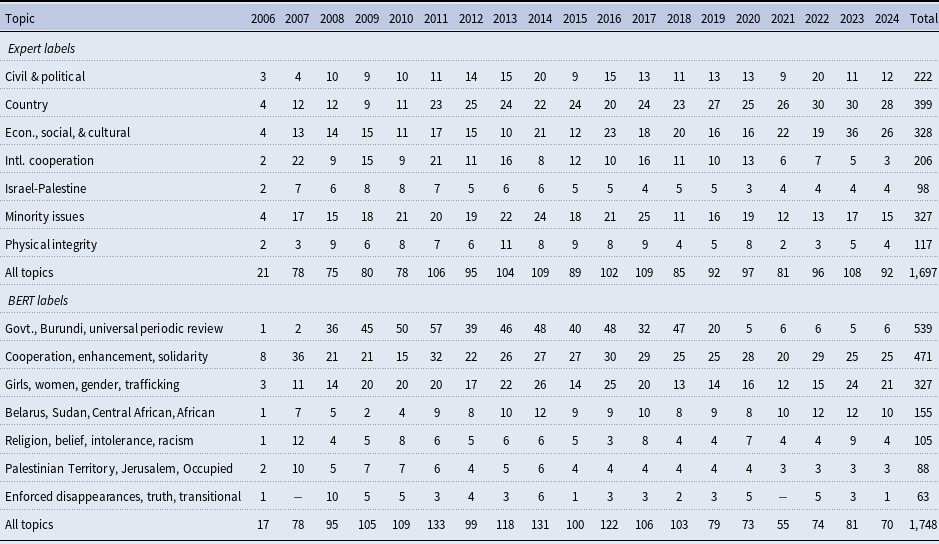
Table 1 displays the number of resolutions in each topic by year for both coding approaches.Footnote 1 Notably, there is considerable variation in the prevalence and frequency of topics across years.Footnote 2 Resolution adoption grew rapidly in the early period, from 21 resolutions in 2006 to a peak of roughly 109 resolutions in 2013 and 2017, before stabilizing at around 90 per year through 2024. Among the expert-coded topics, the fewest resolutions pertained to Israel-Palestine, with a total of 98 resolutions, compared with 399 resolutions addressing country-specific issues. In contrast, the BERT-coded topics revealed that topics related to enforced disappearances, truth, and transitional justice had the fewest resolutions with 63, while topics concerning government, Burundi, and Universal Periodic Review were the most frequent, totaling 539 resolutions.
Resolutions by topic and year for the UN cosponsorship networks derived from expert coding and the BERT topic model (2006–2024)

Table 1 Long description
Table displaying the number of resolutions by topic and year for two coding approaches, expert coding and BERT topic model, from 2006 to 2024. The table uses abbreviated names for each category, with full names provided in a footnote. The data shows considerable variation in the prevalence and frequency of topics across years. Resolution adoption grew rapidly from 21 in 2006 to a peak of roughly 109 in 2013 and 2017, stabilizing at around 90 per year through 2024. Among expert-coded topics, the fewest resolutions pertained to Israel-Palestine with 98, while country-specific issues had the most with 399. In BERT-coded topics, enforced disappearances, truth, and transitional justice had the fewest resolutions with 63, while government, Burundi, and Universal Periodic Review had the most with 539.
Note: Abbreviations used in Figures 4–5: C&P = Civil & Political; Cntry. = Country; ESC = Economic, Social & Cultural; Int’l Coop. = International Cooperation; ISR-PSE = Israel-Palestine; Min. = Minority Issues; Phy. Int. = Physical Integrity; UPR = Government, Burundi, Universal Periodic Review; Coop. = Cooperation, Enhancement, and Solidarity; Girls = Girls, Women, Gender, Trafficking; Sudan = Belarus, Sudan, Central African; Intol. = Religion, Belief, Intolerance, Racism; Pal. = Palestinian Territory, Jerusalem, and occupied; Enforced = Enforced Disappearances, Truth, Transitional.
3.1.1 Expert and BERT coding
For the expert coding, resolutions were grouped into several overlapping topics: (a) civil and political rights, (b) country-specific issues, (c) economic, social, and cultural rights, (d) international cooperation, (e) Israel-Palestine, (f) minority rights, and (g) physical integrity.Footnote 3 These labels are consistent with previous research on human rights issues that aggregates topics discussed or promoted within international organizations (Pauselli et al., Reference Pauselli, Urdínez and Merke2023; Terman and Voeten, Reference Terman and Voeten2018).
We used five steps for the BERT topic model classification. First, we preprocessed the resolution text to remove formatting artifacts, CSS rule blocks, UN document reference codes,Footnote 4 and an extended set of domain-specific stop words—including terms such as council, resolution, states, united, and nations alongside standard English stop words (Denny and Spirling, Reference Denny and Spirling2018). Second, we tuned the topic model by optimizing the number of topics using a silhouette score, a measure of clustering quality, across 3 to 29 topics and two minimum cluster sizes (30 and 50 resolutions) (Păvăloaia, Reference Păvăloaia2024; Rousseeuw, Reference Rousseeuw1987). For each configuration, the BERTopic pipeline (Grootendorst, Reference Grootendorst2022) combined sentence-level BERT embeddings with dimensionality reduction via UMAP and density-based clustering via HDBSCAN. To ensure reproducibility and prevent state mutation across iterations, the HDBSCAN model was pre-fitted on the shared UMAP embeddings and deep-copied for each candidate configuration. This allowed us to group documents into semantically coherent topics (Legnar et al., Reference Legnar, Daumke, Hesser, Porubsky, Popovic, Bindzus, Siemoneit and Weis2022; Rezaeipourfarsangi, Reference Rezaeipourfarsangi2023).
Third, after selecting the optimal configuration, each resolution was assigned to its primary topic. Resolutions assigned to topics with fewer than 20 total resolutions across the full time series were reclassified as outliers and excluded from the analysis. Fourth, the topics were assigned interpretable names using post-analysis TF-IDF labels based on the top four distinctive unigrams and bigrams per topic (Invernici et al., Reference Invernici, Bernasconi and Ceri2024).Footnote 5 And fifth, we saved the topic assignments for all retained resolutions.Footnote 6
Figure 1 displays a heatmap of the overlap coefficients among resolutions by topic for the expert and BERT topic model labels. There is substantial overlap across several issue areas. In particular, the expert-coded Israel-Palestine category has an overlap coefficient over 0.95 with the BERT label Palestinian Territory, Jerusalem, and occupied, indicating near-perfect correspondence.
Heatmap of the expert coding against the BERT topic model labels by resolution.

Figure 2 further explores the associations between the expert and BERT labeling schemes using an alluvial diagram. The width of each flow is proportional to the number of resolutions, allowing us to assess the extent to which the expert and BERT categories capture the same underlying political divisions. Where flows are narrow and cross between categories, the two coding schemes diverge; where flows are wide and concentrated, they converge on the same set of resolutions.
Overall, the expert and BERT topic labels exhibit high cohesion. There are 69 shared resolutions between the expert-labeled Israel-Palestine topic and the BERT-labeled Palestinian Territory, Jerusalem, and occupied topic, corresponding to an overlap coefficient of 0.96. Likewise, the expert-labeled topic Country shares 107 and 64 resolutions with the BERT-labeled Sudan and Government, Burundi, and UPR topics, corresponding to overlap coefficient of 0.59 and 0.35, respectively.
Flow of UNHRC resolutions from expert topic categories to BERT topic model assignments. Width of flows is proportional to the number of resolutions; colors indicate expert topic of origin. High overlap between Israel-Palestine (expert) and Palestinian Territory, Jerusalem, and occupied (BERT) and between Country (expert) and Sudan (BERT) confirms convergent validity across coding schemes.

Figure 2 Long description
A Sankey diagram showing the flow of UNHRC resolutions from expert topic categories to BERT topic model assignments. The width of the flows is proportional to the number of resolutions, and colors indicate the expert topic of origin. The diagram includes eight expert topics on the left: C&P, Country, ESC, International Cooperation, ISR-PSE, Mining, and Physical Intervention. On the right, there are eight BERT topics: Cooperation, Enforced, Girls, Intolerance, Palestine, Sudan, and UPR. The flows between these topics show how resolutions categorized by experts align with those assigned by the BERT topic model. Notable overlaps include high convergence between Israel-Palestine (expert) and Palestinian Territory, Jerusalem, and occupied (BERT), as well as between Country (expert) and Sudan (BERT). These overlaps confirm convergent validity across coding schemes.
3.1.2 Network analysis and community detection
After classifying the UNHRC resolutions with expert and BERT topic model labels, we measure cohesion and fragmentation in the network by topic. We define cohesion as the agreement among most parties on the meaning and relevance of a norm. Conversely, fragmentation is the disagreement among parties on the meaning and relevance of a norm. We observe these patterns by analyzing levels of agreement in support for resolutions within the HRC: widespread sponsorship—i.e., dense and broad networked interactions—indicates cohesion, whereas dense ties among groups of states—i.e., clustering at the subgraph level—reflect fragmentation. This is a behavioral definition: we observe fragmentation not by measuring what states say about norms, but by examining with whom they are willing to associate politically. Network modularity captures precisely this structural property: the degree to which cosponsorship ties concentrate within subgroups rather than bridging across them. High modularity therefore indicates that the sponsorship space is organized around distinct political blocs, which we interpret as the observable behavioral signature of underlying normative or geopolitical contestation.
This is evaluated in two steps. First, we measure the strength of network connections among states in the UNHRC sponsorship network by topic and year. Second, we measure the community structure and its modularity within those networks. For the topic networks, we treat sponsorship and cosponsorship as separate but overlapping network ties between states: all states that sponsor a resolution are coded as co-sponsoring that resolution, although states can co-sponsor a resolution without sponsoring it. This allows us to account for greater tie strength between states that engage in more costly forms of sponsorship. After this, we evaluate the Manhattan distance between states by year and topic.Footnote 7
Diagram of the measurement process. We combine UN sponsorship records by measuring the Manhattan distance between states by year and topic.

Figure 3 displays a simplified diagram of the measurement process used to derive the yearly topic networks. In this example, there are three UNHRC resolutions among states A, B, and C, represented as the network layers
 $\mathcal{N}_1$
,
 $\mathcal{N}_2$
, and
 $\mathcal{N}_3$
. The resolution networks are combined using the Manhattan distance formula to create a single-topic network per year, measured as the combined network at
 $t$
. To derive the edge weights, we use the formula outlined in the figure, with
 $\rho_V$
as the weighted tie for dyad
 $v, \omega _t$
as the Manhattan distance, and
 $\mathcal{N}_t$
as the normalized distance.Footnote
8
Several features of this aggregation strategy warrant brief justification. First, collapsing to yearly networks aligns with the UNHRC’s institutional calendar: the Council holds three regular sessions annually, with the annual cycle representing a natural unit of diplomatic activity and coalition formation. Second, the Manhattan distance preserves information about the intensity of cosponsorship relationships. States that consistently co-sponsor across multiple resolutions within a year receive stronger tie weights than those that co-sponsor only once, which would be lost under binary aggregation. Third, our robustness checks across four alternative distance metrics (reported in the Supplementary Information) confirm that the main findings are not sensitive to this choice.Footnote 9
After creating the yearly networks by topic, we identify the latent community structure using cross-sectional Louvain community detection.Footnote
10
This algorithm identifies communities by finding the most modular grouping of nodes—subgraphs within the network that maximize the proportion of ties within versus between communities. The modularity,
 $Q$
, for an undirected network is calculated as:
 \begin{equation} Q = \frac {1}{2m}\sum _{C}\sum _{i \in C}\sum _{j \in C}\biggr (A_{ij}-\frac {k_i k_j}{2m}\biggr ) \end{equation}
where the outer sum runs over communities
 $C$
,
 $m$
is the total edge weight of the network,
 $A$
is the weighted adjacency matrix, and
 $k_i$
and
 $k_j$
are the weighted degrees (strengths) of nodes
 $i$
and
 $j$
, respectively.
After deriving the community structure for each topic and year, we measure the community structure’s modularity, or fragmentation. This measure approximates how internally cohesive the subgraph groups of states are, with greater levels of modularity indicating greater fragmentation on a topic. Figure 4 displays the yearly modularity of the UNHRC networks by topic. Among the expert topic labels, the resolutions related to the Israel-Palestine topic exhibit the highest modularity (i.e., fragmentation), while in the BERT topic model labels, resolutions on (a) Sudan, Belarus, and the Central African region and (b) religion, belief, intolerance, and racism have the highest modularity.
The modularity of UNHRC sponsorship networks over time, by topic and coding scheme. Each colored point shows the modularity score for one topic in a given year; stems connect each point to the annual cross-topic mean (black step line), so points above the line indicate topics with above-average fragmentation that year. Left panel: expert-coded topics. Right panel: BERT topic model labels. Higher modularity indicates greater sponsorship fragmentation.

3.2 Methods
To assess differences in UNHRC topic fragmentation, we conduct an
 $F$
-test on yearly modularity estimates as experimental units, followed by a Tukey adjustment for multiple comparisons. For each model, we block on year as a nuisance parameter.Footnote
11
The equation follows:
 \begin{equation} F = \frac{SS_{\text{model}}/df_{\text{model}}}{SS_{\text{residuals}}/df_{\text{residuals}}}\end{equation}
where
 $SS_{\text{model}}$
is the sum of squares explained by the predictors,
 $SS_{\text{residual}}$
is the residual sum of squares representing unexplained variance,
 $df_{\text{model}}$
is the degrees of freedom associated with the model, and
 $df_{\text{residual}}$
is the degrees of freedom for the residuals.
4. Results
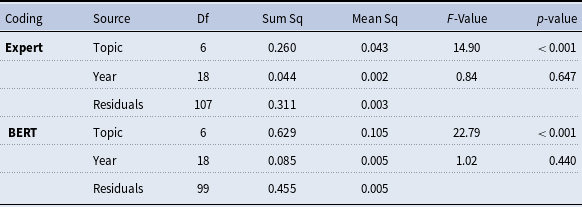
Table 2 displays the results. Across both specifications, we find differences in the fragmentation of UNHRC resolutions by topic.Footnote 12 Figure 5 helps us explore these differences further by displaying pairwise comparisons of UNHRC topic fragmentation. Notably, year is not a significant predictor in either specification, suggesting no secular trend in fragmentation over the study period.
 $ F$
-test results for modularity models

Table 2 Long description
The table presents the results of modularity models for UNHRC resolutions, comparing fragmentation by topic using expert and BERT labels across different years. The table has 20 rows and 7 columns. Column headers are: Topic, 2006, 2007, 2008, 2009, 2010, 2011, 2012, 2013, 2014, 2015, 2016, 2017, 2018, 2019, 2020, 2021, 2022, 2023, 2024, Total. Row labels include various topics such as Civil & political, Country, Econ., social, & cultural, Intl. cooperation, Israel-Palestine, Minority issues, Physical integrity, and All topics. The table also includes -test results for modularity models with columns: Coding Source, Df, Sum Sq, Mean Sq, -Value, p-value. The -test results are provided for Expert Topic, Year, and Residuals, as well as BERT Topic, Year, and Residuals. Notable trends include significant differences in the fragmentation of UNHRC resolutions by topic for both expert and BERT labels, with year not being a significant predictor in either specification.
Pairwise differences in mean modularity by UNHRC topic (Tukey HSD adjustment for multiple comparisons). Blue points indicate statistically significant differences (
 $p \lt 0.05$
); gray points are null comparisons. Cell (a) shows expert-coded topics: except for country-specific resolutions, Israel-Palestine exhibits significantly greater fragmentation than all other categories, followed by country-specific resolutions relative to civil and political rights, economic social and cultural issues, and physical integrity and international cooperation topics. Cell (b) shows BERT-coded topics: Sudan and intolerance-related resolutions display the greatest fragmentation, followed by Palestinian Territory, Jerusalem, and occupied. Both coding schemes consistently identify geopolitically contested topics as the most fragmented in the UNHRC sponsorship network.

In cell (a), we see differences in fragmentation by topic derived from expert coding. Except for country-specific resolutions, UNHRC resolutions related to Israel-Palestine topic exhibit significantly greater fragmentation than all other topics. Additionally, country-specific issues show greater sponsorship fragmentation compared to resolutions addressing (a) civil and political rights, (b) physical integrity, (c) international cooperation, and (d) economic, social, and cultural rights.
In cell (b), we see differences in fragmentation by topic derived from the BERT topic model. The Belarus, Sudan, Central African, and African topic is significantly more fragmented than the cooperation, enhancement, and solidarity topic; enforced disappearances, truth, and transitional topic; girls, women, gender, and trafficking topic; and government, Burundi, and Universal Periodic Review topic (
 $p \lt 0.001$
). The religion, belief, intolerance, and racism topic similarly exhibits significantly greater fragmentation than the cooperation, enhancement, and solidarity topic; enforced disappearances, truth, and transitional topic; and girls, women, gender, and trafficking topic (
 $p \lt 0.001$
), and government, Burundi, UPR topic (
 $p \lt 0.01$
). The Palestinian Territory, Jerusalem, and occupied topic exhibits significantly greater fragmentation than the cooperation, enhancement, and solidarity topic; enforced disappearances, truth, and transitional topic; and girls, women, gender, and trafficking topic (
 $p \lt 0.05$
). Topics related to cooperation, enhancement, and solidarity, as well as enforced disappearances, truth, and transitional topic have the lowest levels of modularity.
5. Discussion and conclusion
Network fragmentation in human rights sponsorship is not uniform. It varies significantly across substantive topic areas under expert and unsupervised learning-based coding schemes. The most consistently fragmented domain is the Israel-Palestine conflict cluster: expert-coded Israel-Palestine resolutions and BERT-coded Palestinian Territory, Jerusalem, and occupied topic resolutions are among the highest modularity scores across the full period, indicating the sharpest sponsor-bloc divisions within the network.Footnote 13 This suggests that these issues are particularly divisive compared to other human rights topics. On Israel-Palestine specifically, high modularity reflects cosponsorship organized into distinct and largely disconnected blocs, with few bridging sponsors that co-sponsor across coalitions. This structural separation—persistent across the full 2006–2024 period—distinguishes Israel-Palestine from other topics in the network and is consistent with documented geopolitical divisions over accountability in this issue area (Perugini and Gordon, Reference Perugini and Gordon2016).
Among the other expert-coded topics, country-specific resolutions show significantly greater fragmentation than civil and political rights, economic, cultural, and social, international cooperation, and physical integrity topics, though the difference from minority rights resolutions does not reach statistical significance. The BERT classification surfaces two additional polarized domains that the expert scheme conceals by construction. Resolutions related to Sudan and the Central African region—grouped into the broad “Country” category by expert coders—emerge as a distinctly fragmented cluster, reaching modularity levels in some years comparable to those observed for Israel-Palestine. Likewise, resolutions addressing religion, belief, intolerance, and racism—absorbed into the expert “Minority Issues” category—show comparably elevated fragmentation in the BERT partition; Sudan and religion, belief, intolerance, and racism resolutions are not significantly different from one another in mean modularity. These findings demonstrate a key analytical payoff of the unsupervised approach: by allowing topic boundaries to emerge from the resolution text itself rather than from an imposed scheme, the BERT model recovers bloc-forming dynamics that expert aggregation obscures.
The cluster structure within each topic makes the sources of variation legible. Israel-Palestine resolutions organize cosponsorship into two consistently separated blocs: one corresponding closely to OIC membership and a heterogeneous second community of European social democracies, Latin American governments, and sub-Saharan African states that also co-sponsors these resolutions through a structurally distinct coalition. Major Western powers (the United States, the United Kingdom, France, and Germany) appear in neither community because they do not co-sponsor Israel-Palestine resolutions. Sudan-related resolutions reproduce a comparably sharp but substantively distinct cleavage: a cohesive African Union bloc of approximately 54 states groups together on these resolutions, while a second community of Western and European states sponsors accountability-oriented resolutions targeting the Sudanese government. The two blocs share few cosponsorship ties, producing modularity scores that approach those observed for Israel-Palestine in peak years.
In total, these findings raise important avenues for future research. Most directly, the temporal variation in modularity raises the question of what drives shifts in network cohesion: do geopolitical realignments, such as the consolidation of illiberal coalitions, the reorientation of regional blocs, or the entry of new global powers systematically reshape sponsorship patterns? The BERT results are particularly suggestive here, as the emergence of Sudan-related and religious-intolerance topics as distinctly polarized clusters implies that topic-specific fragmentation may track discrete political crises rather than trends in regime type alone. Future work could leverage the topic-level modularity estimates produced here as dependent variables in event-study or panel designs, linking them to episodes of geopolitical rupture or institutional reform.
A second productive extension concerns enforcement. If states anticipate that sponsored resolutions will trigger condemnatory mechanisms, enforcement mechanisms designed to promote and protect human rights may inadvertently incentivize fragmentation, as illiberal regimes are less likely to support such mechanisms (Cottiero et al., Reference Cottiero, Hafner-Burton, Haggard, Prather and Schneider2025; Ginsburg, Reference Ginsburg2020). They might have structural incentives to fragment coalitions preemptively. Disentangling strategic defection from genuine preference divergence would require moving beyond network structure to examine the content of voting and cosponsorship behavior simultaneously.
The policy implications of this study are also highly relevant. The UNHRC’s legitimacy as a governance institution depends, in part, on whether it can generate coalitions broad enough to act on contested issues. Our results suggest that the most politically charged domains—that is, the Israel-Palestine cluster, country-specific accountability resolutions, and, as the BERT model reveals, Sudan and religious-intolerance topics—are precisely where coalition-building is hardest. For diplomats and multilateral practitioners, this points to a sequencing problem: durable coalitions may require the kinds of prior engagement and framing work that topic-level polarization makes especially costly (Perugini and Gordon, Reference Perugini and Gordon2016; United Nations Security Council, 2021). The Palestinian Territory, Jerusalem, and occupied topic area illustrates this acutely, as the persistent fragmentation we document across the full 2006–2024 period reflects not only entrenched geopolitical divisions but also the difficulty of translating documented civilian harm into a collective institutional response (United Nations Human Rights Council, 2022).
In this article, we show that fragmentation in UNHRC sponsorship networks is not regime-wide but topic-specific. Using network analysis and two complementary topic-classification strategies, we find that the sharpest divisions emerge around politically contested issue areas, while less contentious domains exhibit broader coalition formation. The comparison between expert coding and the BERT model also demonstrates the value of combining domain knowledge with unsupervised text analysis: computational methods can recover latent political blocs that broader expert categories might obscure. Together, these findings contribute to research on the internal politics of multilateral human rights institutions and clarify the conditions under which coalition-building becomes difficult within the contemporary human rights regime.
Acknowledgements
We are grateful for the generous feedback provided by Xinyuan Dai, Sara Kahn-Nisser and Karolina Milewicz (University of Illinois) and participants of the 2024 Annual Meeting of the American Political Science Association.
Supplementary material
The supplementary material for this article can be found at http://doi.org/10.1017/nws.2026.10041.
Data availability statement
Replication materials are available on Harvard Dataverse and Cecilia Cavero’s GitHub repository.
Funding statement
This research received no specific grant from any funding agency, commercial, or not-for-profit sectors.
Competing interests
The authors declare no competing interests.


 F

 p<0.05


 Open access

