


In seeking to understand why some people vote whereas others do not, political scientists tend to focus on adulthood—when citizens are already eligible to vote—rather than on childhood or early adolescence. Political socialization research once focused on childhood in hopes of discovering the roots of participation (e.g., Dawson and Prewitt Reference Dawson and Prewitt1968; Searing et al. Reference Searing, Schwartz and Lind1973), with early researchers arguing that “the more important a political orientation is in the behavior of adults, the earlier it will be found in the learning of the child” (Greenstein Reference Greenstein1965, 12). However, socialization studies struggled to measure political inputs in childhood, find childhood attributes that consistently predicted adult behaviors, and establish causality. Given these difficulties, studies of political behavior in recent years have “eschew[ed] . . .young children” and have instead “focus[ed] on the political learning years [of early adulthood]” (Niemi and Hepburn Reference Niemi and Hepburn1995, 7), justifying this focus by arguing that “the degree of activity or involvement in politics . . . seem[s] to be best explained in terms of [adult] experiences” (Verba and Almond Reference Verba and Almond1989, 267–68). As a result, there remains “little current empirical research shedding light on [the] early childhood antecedents to . . .civic engagement” (Astuto and Ruck Reference Astuto and Ruck2010, 249).Footnote 1
This approach stands in sharp contrast to work from other disciplines, which suggests that childhood is a critical period in determining adult outcomes (e.g., Becker and Tomes Reference Becker and Tomes1986; Chetty et al. Reference Chetty, Friedman, Hilger, Saez, Schanzenbach and Yagan2011; Currie and Thomas Reference Currie and Thomas1995; CPPRG 1999a ). In particular, psychologists, neuroscientists, and economists have noted that a set of so-called psychosocial or noncognitive skills developed in childhood appear to be especially important for success later in life. These skills capture the abilities, attitudes, and motivations that help individuals integrate in society, but that are not measured by achievement tests of cognitive proficiency (Heckman and Kautz Reference Heckman, Kautz, Heckman, Humphries and Kautz2014). These include the general ability to interact in social settings and to control one’s thoughts, emotions, motivations, and actions. Researchers have shown that individuals who develop psychosocial skills tend to stay in school longer, perform better while in school, have higher earnings, and report higher levels of life satisfaction (Dee and West Reference Dee and West2011; Duckworth et al. Reference Duckworth, Peterson, Matthews and Kelly2007; Heckman Reference Heckman2000; Heckman and Kautz Reference Heckman, Kautz, Heckman, Humphries and Kautz2014). Still, no work has considered whether psychosocial skills promote a broader set of well-being metrics, including active participation in democracy.
Are psychosocial or noncognitive skills developed in childhood important for adult civic behaviors like voting? Some have speculated that such attributes might matter (e.g., Astuto and Ruck Reference Astuto and Ruck2010). Moreover, there is a smattering of separate strands of empirical work showing that psychosocial attributes like grit or perseverance (Hillygus et al. Reference Hillygus, Holbein and Snell2016), general self-efficacy (e.g., Condon and Holleque Reference Condon and Holleque2013), emotion regulation (Denny and Doyle Reference Denny and Doyle2008), locus of control (Dawes et al. Reference Dawes, Cesarini, Fowler, Johannesson, Magnusson and Oskarsson2014), patience or delayed gratification (Fowler and Kam Reference Fowler and Kam2006; Hill Reference Hill2016; Schafer Reference Schafer2016), overall mental well-being (Ojeda Reference Ojeda2015), impulse control (albeit indirectly measured, e.g., Pacheco and Plutzer Reference Pacheco and Plutzer2007), and sociability (e.g., Fowler and Kam Reference Fowler and Kam2007; Uhlaner Reference Uhlaner1989)—to name a few—appear to predict voter participation. However, these studies have examined psychosocial attributes in isolation and have mostly relied on observational, cross-sectional data. As such, critical questions remain unanswered about causality and the potential for policies to promote such attributes in a way that also increases civic engagement. In other words, can early life psychosocial interventions have a long-run effect on civic engagement later in life? Or are psychosocial attributes innate and immovable attributes?
To explore these questions, I consider the broader effects of a program targeting, and moving, childhood psychosocial attributes. By using a unique dataset with random assignment, I can, for the first time, establish a causal connection between early life investments in psychosocial abilities and voter participation in adulthood. To do so, I leverage a unique 20-year, multisite field experiment—the Fast Track intervention. Previous research shows that this childhood intervention targeted—and successfully moved—a bundle of students’ psychosocial attributes like self-control, general self-efficacy, and empathy while leaving their cognitive abilities and other attributes relevant to political participation virtually unchanged (CPPRG 1999a , 2002, 2004, 2007, 2010).Footnote 2 Matching Fast Track participants to state voter files, I show that despite a low propensity for participation at baseline, children provided with the Fast Track program vote at a noticeably higher rate in adulthood than those in the control group. Assignment to the Fast Track program increased turnout by 7 to 9 percentage points (intent-to-treat [ITT]), with full exposure increasing participants’ turnout by 11 to 14 percentage points (treatment-on-the-treated [TOT])—constituting a 30 to 40% increase in baseline participation rates. Using mediation models, I provide some descriptive evidence that this effect was not the consequence of well-known correlates of political participation—such as cognitive ability, income, or social status—but instead appears to be directly the result of improvements in childhood psychosocial skills, which helped set children on a path toward participation in adulthood.
This article makes several important contributions to the study of civic participation. In exploring psychosocial attributes together, this work overcomes some of the challenges that have plagued the previously scattered research in this area.Footnote 3 By couching the study in the context of a randomized-control intervention, it provides the first causal evidence that psychosocial attributes targeted, and developed, early on can have a substantial impact on adult political behavior. By incorporating psychosocial attributes formally into studies of political behavior, this work connects to a broader framework and burgeoning literature from other disciplines (e.g., Dee and West Reference Dee and West2011; Duckworth et al. Reference Duckworth, Peterson, Matthews and Kelly2007; Farrington et al. Reference Farrington, Roderick, Allensworth, Nagaoka, Keyes, Johnson and Beechum2012; Heckman Reference Heckman2000; Heckman and Kautz Reference Heckman, Kautz, Heckman, Humphries and Kautz2014; Heckman and Rubinstein Reference Heckman and Rubinstein2001; Heckman et al. Reference Heckman, Stixrud and Urzua2006), therefore expanding collective understanding of the types of life outcomes influenced by psychosocial attributes. Doing so in a causal manner provides clear support for new avenues of research on the family of nonpolitical attributes, abilities, and motivations that drive people to participate in politics.
Second, the evidence presented here provides important theoretical insights into the points of the life course that matter in determining who votes. Although early life political socialization studies have dwindled in recent years, the results presented here provide clear support for a refocusing of attention back on early childhood. This article takes a meaningful step in that direction—providing concrete evidence that what happens in childhood can matter a great deal for political participation in adulthood. Although children may not be developing political attitudes and values when they are very young (Niemi and Hepburn Reference Niemi and Hepburn1995), they are developing the not explicitly political, but still vital, psychosocial skills that persist as resources that they can call upon in adulthood. These skills go beyond the political values, political knowledge, or cognitive abilities that children are thought to learn when they are in school (Campbell Reference Campbell2006; Nie et al. Reference Nie, Junn and Stehlik-Barry1996; Verba et al. Reference Verba, Schlozman and Brady1995). Instead, they involve the ability to regulate thoughts, motivations, emotions, and behaviors, as well as the ability to work with others. These skills play a vital, yet until now unexplored, role in encouraging political participation.
Finally, this article’s contributions cut across disciplinary boundaries and speak to current policy debates. Whereas most of the standard predictors of civic participation (e.g., age, race, income, and—according to some—psychological characteristics) are resistant to change, this work shows very clearly that psychosocial attributes important for voting are malleable. As such, this article offers insights into the design of new interventions to help remediate dismally low and unequal rates of civic participation. These findings suggest that to encourage active participation in democracy, schools should do more than just nurture students’ cognitive abilities—the predominant focus of schools captivated by students’ performance on standardized tests of academic achievement—and teach them knowledge and facts about government and politics. Schools should also promote the general psychosocial skills that play a vital role in encouraging active civic participation.
BACKGROUND AND CONCEPTUAL FRAMEWORK
Recent research from developmental psychology, neuroscience, economics, and other related fields shows that children who develop psychosocial skills are more likely to achieve various markers of life success in school and beyond (for recent overviews of this literature, see Farrington et al. [Reference Farrington, Roderick, Allensworth, Nagaoka, Keyes, Johnson and Beechum2012] and Heckman and Kautz [Reference Heckman, Kautz, Heckman, Humphries and Kautz2014]). Psychosocial skills are often called noncognitive skills, thus striking a contrast with the cognitive skills of logic, reasoning, learning, memory, and problem solving that have long been used in models of political behavior (e.g., Denny and Doyle Reference Denny and Doyle2008; Nie et al. Reference Nie, Junn and Stehlik-Barry1996; Verba et al. Reference Verba, Schlozman and Brady1995).Footnote 4 In general, scholars sort psychosocial skills into two subcomponents: those involving self-regulation and those involving social skills (Sorensen and Dodge Reference Sorensen and Dodge2016). Self-regulation skills help individuals “develop, implement, and . . .maintain planned behavior in order to achieve one’s goals” (Kanfer Reference Kanfer1970). Components of self-regulation include, but are not limited to, general self-efficacy, belief that one can do what he or she sets out to do; delayed gratification, the ability to resist temptation and patiently wait for later rewards (Fowler and Kam Reference Fowler and Kam2007); grit, the ability to persevere despite obstacles (Duckworth et al. Reference Duckworth, Peterson, Matthews and Kelly2007); emotion recognition and regulation, the ability to understand and control individual affect (Wellman et al. Reference Wellman, Cross and Watson2001); and behavioral control, the ability to avoid negative behavior and exhibit positive behavior (Astuto and Ruck Reference Astuto and Ruck2010). Social skills involve the ability to work with others productively—to communicate, build friendships, and solve group-based problems (CPPRG 1999a ).
Although there may be multiple subcomponents of psychosocial ability, scholars have shown conceptually and empirically that these attributes belong to a shared family of latent ability separate from cognitive aptitude (e.g., Heckman Reference Heckman2000; Heckman and Kautz Reference Heckman, Kautz, Heckman, Humphries and Kautz2014; Heckman and Rubinstein Reference Heckman and Rubinstein2001; Heckman et al. Reference Heckman, Stixrud and Urzua2006; Jackson 2012; Park et al. Reference Park, Tsukayama, Goodwin, Patrick and Duckworth2017). Conceptually, whereas cognitive ability involves logic, reasoning, and memory, noncognitive or psychosocial ability involves self-regulation, executive functioning, top-down processing, motivation, and sociability.Footnote 5 Empirical work supports this conceptual distinction. For example, measures of cognitive ability and measures of psychosocial ability load onto two distinct factors (Heckman et al. Reference Heckman, Stixrud and Urzua2006; Jackson Reference Jackson2012; Sorensen and Dodge Reference Sorensen and Dodge2016; Park et al. Reference Park, Tsukayama, Goodwin, Patrick and Duckworth2017; see also Section 1 of the Online Appendix). Further, fMRI studies show that psychosocial and cognitive abilities require different areas and networks within the human brain (e.g., Yang and Raine Reference Yang and Raine2009). Measures of individuals’ psychosocial ability also together predict several adult outcomes (education, income, health, etc.) above and beyond measures of cognitive ability (Farrington et al. Reference Farrington, Roderick, Allensworth, Nagaoka, Keyes, Johnson and Beechum2012). Finally, psychosocial abilities move together in shared interventions, as I show in the following analysis. (For further discussion and evidence on psychosocial attributes’ nature as a separate bundle of attributes, see Section 1 of the Online Appendix.) Thus, although a handful of previous empirical studies have shown a relationship between individual psychosocial attributes and political engagement, the current study is the first to evaluate the causal implications of this distinct bundle of individual abilities.
Why Psychosocial Attributes and Participation?
There are theoretically compelling reasons to suspect that psychosocial abilities could play a role in encouraging political participation. Scholars have long noted that participation comes with costs and barriers (e.g., Verba et al. Reference Verba, Schlozman and Brady1995). These costs include registering (Corvalan and Cox Forthcoming; Wolfinger and Rosenstone Reference Wolfinger and Rosenstone1980), locating and traveling to polling locations (Brady and McNulty Reference Brady and McNulty2011), waiting in line at the ballot box (Pettigrew Reference Pettigrew2016), finding a time to vote that works with one’s schedule (Garmann Reference Garmann2016), navigating potential inclement weather on Election Day (Gomez et al. Reference Gomez, Hansford and Krause2007), learning about the candidates and issues, and navigating a complex web of institutional rules (Leighley and Nagler Reference Leighley and Nagler2013). Political science research suggests that the resources people have—such as their levels of knowledge about politics, income, or how many years they spend in school—help them overcome these costs. In a complicated political environment, participation is thought to be a “skill-based act”; simply put, individuals’ skills act as resources that help make political participation “less daunting and costly” (Verba et al. Reference Verba, Schlozman and Brady1995, 304).
Chief among the skills thought to matter for voting are the verbal cognitive skills captured by standardized tests of individual ability (Denny and Doyle Reference Denny and Doyle2008; Luskin Reference Luskin1990; Nie et al. Reference Nie, Junn and Stehlik-Barry1996; Verba et al. Reference Verba, Schlozman and Brady1995; Wolfinger and Rosenstone Reference Wolfinger and Rosenstone1980). However, cognitive ability may not capture all of the individual abilities that matter for political participation. Simply put, a broader set of psychosocial or noncognitive skills may also act as resources that help citizens overcome voting barriers. Consistent with this view, some have argued—but not tested—that the psychosocial skills children learn in schools may “foreshadow the skills . . . of a civically engaged [citizen]” (Astuto and Ruck Reference Astuto and Ruck2010, 258). Perhaps independent of individuals’ cognitive ability, their ability to drum up the motivation, energy, and focus required to overcome the many obstacles and distractions that get in the way of voting may be important. Individuals who develop these skills early in life may be more oriented toward participating, able to follow through on their desire to participate, and less likely to experience negative life events that make them ineligible or unable to vote.
First, psychosocial skills may increase citizens’ general motivation, which may, in turn, increase their capacity to participate in politics. For example, the psychosocial ability to empathize with others—to be able to “put oneself into another’s shoes,” or to recognize that they have thoughts, emotions, beliefs, and desires that are independent from one’s own—may promote altruistic behavior, a known predictor of civic participation (Fowler and Kam Reference Fowler and Kam2007).Footnote 6 Thus, empathy may help citizens recognize when social problems are present and increase their desire to mobilize on behalf of others. Indeed, for these reasons, political theorists have speculated that those who develop an “empathic understanding” may be more likely to develop “civic virtue,” or an inclination toward participating (Dahl Reference Dahl1992, 53, 56–57). Similarly, a sense of general self-efficacy—the belief that actions across various life domains will yield desired results—may help individuals believe that they have the specific capacity to participate in politics (Condon and Holleque Reference Condon and Holleque2013). Together, the family of psychosocial abilities may give individuals the domain-specific motivation needed to participate in politics.
Second, psychosocial skills may empower individuals to follow through once they have a desire to participate (Hill Reference Hill2016). Given that voting is costly, citizens’ ability to self-regulate—or to voluntarily control behaviors, emotions, motivations, and thoughts in the presence of temptations or diversions—may be particularly important in helping them avoid the distractions and obstacles that get in the way of voting. For example, grit or perseverance may help individuals overcome the specific obstacles that impede voting, such as long lines on Election Day (Hillygus et al. Reference Hillygus, Holbein and Snell2016). Indeed, some have speculated that “perseverance could conceivably account for why some . . .overcome the start-up costs of registration [to vote]” (Plutzer and Wiefek Reference Plutzer and Wiefek2006, 674). Similarly, the ability to delay gratification may help individuals overcome the immediate costs and delayed benefits of voting (Fowler and Kam Reference Fowler and Kam2006; Hill Reference Hill2016; Schafer Reference Schafer2016). Other psychosocial attributes such as emotion regulation, locus of control, and impulse control may work in a similar way (Denny and Doyle Reference Denny and Doyle2008; Dawes et al. Reference Dawes, Cesarini, Fowler, Johannesson, Magnusson and Oskarsson2014; Pacheco and Plutzer Reference Pacheco and Plutzer2007). Together, psychosocial abilities may work to reinforce voters’ ability to follow through on their vote intentions.
Finally, psychosocial skills may influence participation by making citizens less likely to experience negative life events that make them ineligible or unable to vote. Previous work shows that individuals’ psychosocial skills may reduce the likelihood of negative health (e.g., teenage pregnancy), education (e.g., dropping out of school), and criminal behaviors (Heckman and Kautz Reference Heckman, Kautz, Heckman, Humphries and Kautz2014; Sorensen and Dodge Reference Sorensen and Dodge2016). Moreover, previous work in political science shows that individuals with such negative life experiences are, on average, much less likely to vote (e.g., Gerber et al. Reference Gerber, Huber, Meredith, Biggers and Hendry2015; Pacheco and Plutzer Reference Pacheco and Plutzer2007). Putting these parallel strands together, psychosocial skills may together help children avoid demobilizing life events that make them ineligible, unwilling, or unable to participate in adulthood.
Undoubtedly, the mechanisms are many and complex, but based on these theoretical reasons and the strong relationship found for nonpolitical outcomes, psychosocial skills are ripe for examination as to their role in influencing political participation. As already mentioned, a few studies have found an observational relationship between psychosocial skills and political participation (e.g., Condon and Holleque Reference Condon and Holleque2013; Dawes et al. Reference Dawes, Cesarini, Fowler, Johannesson, Magnusson and Oskarsson2014; Denny and Doyle Reference Denny and Doyle2008; Fowler and Kam Reference Fowler and Kam2006, Reference Fowler and Kam2007; Hill Reference Hill2016; Hillygus et al. Reference Hillygus, Holbein and Snell2016; Ojeda Reference Ojeda2015; Pacheco and Plutzer Reference Pacheco and Plutzer2007; Schafer Reference Schafer2016; Uhlaner Reference Uhlaner1989). However, it remains unclear whether psychosocial attributes actually causally affect participation or instead reflect other observable factors—such as income or cognitive ability—or unobservable factors that also influence political participation. Given this, understanding the role which psychosocial skills developed in childhood play for adult participation requires a causal identification strategy.
EMPIRICAL CASE: FAST TRACK INTERVENTION
The Fast Track intervention provides an opportunity to explore the causal effect of psychosocial skills. This intervention was one of the earliest, and largest, randomized-control trials to target children’s psychosocial skills as a means of attempting to improve their life outcomes. Started in 1992, this multisite program began with a sample of children who were just finishing kindergarten. The intervention was administered in four communities—Durham, North Carolina, Nashville, Tennessee, rural central Pennsylvania, and Seattle, Washington—and three cohorts. Within these sites, the principal investigators targeted children “for whom the prospect of [life] success . . .[was] most daunting” (CPPRG 2011, 332). Following a clustered design, the Conduct Problems Prevention Research Group (CPPRG) selected 55 high-risk schools to be randomized to either treatment or control groups. This resulted in 445 children in the treatment group and 446 in the control group. More details about subject recruitment can be found in Section 2.1 of the Online Appendix.
The Fast Track intervention drew heavily from the broad psychology literature on child development. It was explicitly “devised to increase [children’s] emotion regulation and social-cognitive skills” (CPPRG 1999a , 633). It was hoped that targeting students’ psychosocial skills would encourage them to “becom[e] a nondisruptive and nonaggressive member of a classroom” (CPPRG 1999a , 633). To achieve its goals, the principal investigators designed a multicomponent, multiyear treatment program that was primarily implemented while children were in elementary school. This six-part intervention included a formal curricula, home visits, parent training groups, tutoring, friendship groups, and peer pairing. One of the key components was an instructor-led curriculum called PATHS. This curriculum taught children, through hands-on applications, “skills for emotional understanding and communication (i.e., recognizing and labeling emotions), friendship skills (i.e., participation, cooperation, fair play, and negotiation), self-control skills (i.e., behavioral inhibition and arousal modulation), and social problem-solving skills (i.e., problem identification, response generation, response evaluation, and anticipatory planning)” (CPPRG 1999a , 637). The other five components of the program were designed to reinforce these skills by promoting positive behavior management skills, enhancing students’ social skills, and fostering problem-solving and life management skills. The intervention featured discussions, stories, films, games, crafts, joint reading activities, and role-plays (CPPRG 1999a ). Sessions built on each other and focused on reviewing and practicing the skills taught in previous weeks. Group meetings were held often in the initial stages but later declined in their frequency. In short, although the program had several components, all were unified in their targeting of improvements in psychosocial skills. Given that Fast Track was not designed with the explicit goal of making active citizens, this intervention contained no expressly political content. More detail about the specifics of the Fast Track program can be found in Section 2 of the Online Appendix.
From follow-up data collection efforts, we know that Fast Track helped children develop psychosocial skills (CPPRG 1999a , 1999b , 2002, 2004, 2007, 2010; Sorensen and Dodge Reference Sorensen and Dodge2016). Relative to the control group, those in the treatment arm manifested “significantly lower rates of aggressive behaviors at school” (CPPRG 2011, 333). Intervention children could more readily identify emotions, scoring 0.28 standard deviations above the control group. Four years into the program, the treatment group scored 0.20 standard deviations above the control group in ability to work through difficult group problems and scored 0.29 standard deviations higher on self-control. Eight years into the program, the treatment group manifested higher levels of self-efficacy, being 0.16 standard deviations above the control group. In adolescence, treated children manifested reduced conduct problems in the home, school, and community, with decreases in involvement with deviant peers, hyperactivity, delinquent behavior, and conduct disorders (CPPRG 2004; Sorensen and Dodge Reference Sorensen and Dodge2016). Treated subjects also showed signs of improved social competence and social cognition (CPPRG 2010). In adulthood, those in the treatment group had 30 to 40% lower conviction rates for violent and drug-related crimes than the control group, suggesting that the program had set children on a long-run path of controlling their emotions, motivations, thoughts, and behavior and being able to interact productively in social settings (Sorensen and Dodge Reference Sorensen and Dodge2016).
In contrast, Fast Track had only a small and limited effect on cognitive ability. From the time participants were in the second grade, the treatment and the control group were statistically and substantively indistinguishable on measures of verbal and math proficiency (see Table A5 in the Online Appendix). Although not an ideal result from a policy perspective, this posttreatment balance has the virtue from a design perspective of allowing us to extend our understanding of the skills that matter for political participation beyond the cognitive skills that so many have previously studied (e.g., Denny and Doyle Reference Denny and Doyle2008; Luskin Reference Luskin1990; Nie et al. Reference Nie, Junn and Stehlik-Barry1996; Verba et al. Reference Verba, Schlozman and Brady1995; Wolfinger and Rosenstone Reference Wolfinger and Rosenstone1980).
In short, Fast Track’s design and long-run effects make it ideal for evaluating the impact of psychosocial skills, and programs targeting these, on voter turnout. It should be noted, however, that despite this valuable virtue, Fast Track’s multicomponent design makes it admittedly difficult to distinguish which specific aspects of the program drive any effect on voter turnout (a point I return to later).
MATCH TO VOTER FILES
To evaluate the impact of Fast Track’s psychosocial skill treatment on political participation, in July 2014 (when the participants in the three cohorts were 26 to 29 years old) I matched Fast Track participants to state voter files. The process of matching Fast Track participants to voter files consisted of uniquely matching individuals using their first names, last names, and birthdays.Footnote 7 Fortunately, all subjects had these matching characteristics collected at baseline. The search process matched individuals based on their most recent address from the year 19 follow-up (2011) that was maintained through when the match was conducted. Using these current addresses, I searched for all individuals in their current and original intervention state.Footnote 8 More details about the match can be found in Section 3 of the Online Appendix.
This match was possible because the Fast Track organization implemented a robust system of regular follow-up surveys of both the treatment and control groups. These started in the first year of the intervention (1991–1992) and continued almost yearly until the most recent follow-up in year 19 of the study (2010–2011, when subjects in the three cohorts were 22–25 years old). This rigorous follow-up procedure has assured that, even more than two decades later, very few students have dropped out of either the treatment or control groups—in year 19 of the study (2011), 93% remained in the sample with a current address in the Fast Track data files. Importantly, this metric of attrition is balanced across the treatment and control conditions, with 91.7% of individuals in the treatment group and 93.3% in the control group having a current address (p = .38). Moreover, the types of people who have attrited appear to be similar—based on their baseline characteristics—across the treatment and control groups. Out of about 34 pretreatment characteristics that are available in the Fast Track files, only one of them (child’s emotional appropriateness score) predicts attrition when it is interacted with the treatment variable—about what we would expect simply by random chance. Simply put, there is little evidence of different types of people dropping out of the Fast Track pool across the treatment and control groups. This is important because it helps ensure similar match quality across the treatment and control groups.
One might be worried that other posttreatment behaviors—such as moving, getting married (and changing one’s name), or dying—could make matching subjects to voter files difficult and potentially bias the results. However, these behaviors remain balanced across the treatment conditions. The comprehensive and high-quality nature of the Fast Track data is of critical importance. Given balanced attrition, movement rates, and quality of matching inputs, the match itself is unlikely to bias the results outlined in the following. If individuals were missed or mistakenly matched in the procedure used, this should only introduce additional uncertainty into the model estimates. Even still, to guard against the small possibility of matching biasing the results, I also use a self-reported measure of voting as a robustness check in the Online Appendix (see Figure A6).
Following previous practice (e.g., Ansolabehere and Hersh Reference Ansolabehere and Hersh2012; Sondheimer and Green Reference Sondheimer and Green2010), those who could not be located were marked as having never registered nor voted. Overall, 44% of individuals in the Fast Track intervention were matched to voter files. This registration rate is comparable to those of this age range (27–29 years at the time of the match) and socioeconomic status (SES) in the general population.Footnote 9 Moreover, registration within the sample follows well-known patterns, with subjects with higher SES and educational attainment being more likely to register.
Based on the data available from the voter file match, it is apparent that without the Fast Track program the subjects were unlikely to participate in politics. Being largely low-income, at-risk children of low-participation parents, these children had the standard characteristics of low-propensity voters. As a reference, only about 26% of subjects in the control group voted in at least one election from 2004 to 2012. In short, these children had the deck stacked against their participation in politics in adulthood.
METHODS
Given program randomization, showing the ITT effect of the Fast Track program is relatively straightforward. In the following, I provide both raw estimates of differences between the treatment and the control groups and those that benefit from the added precision of baseline covariates. Estimating the effect of exposure to the Fast Track psychosocial skill intervention (i.e., the TOT) requires the standard instrumental variables approach provided by Angrist et al (Reference Angrist, Imbens and Rubin1996).Footnote 10 This is required, as over time there was some noncompliance by program participants. Despite the fact that there was little to no noncompliance in the control group (due to the clustered initial design and individual tracking thereafter), some individuals in the treatment arm did stop attending program sessions. Overall, those in the treatment group attended about 66% of documented program sessions over the 6 year period.Footnote 11
Under this standard approach, in the first stage, Fast Track program receipt (T
i
) is instrumented by random assignment to Fast Track (A
s
). The coefficient for this estimate—γ1—shows the rate of compliance. In the second simultaneously estimated stage, the effect of program receipt (
 $\hat{T_{i}}$
) on voter turnout (V
i
) is estimated. This approach is displayed in Equation (1).
 $$\begin{equation}
T_{i}=\gamma _{0}+\gamma _{1}A_{s} + \gamma _{2}\: X_{i} + \epsilon _{is}
\end{equation}$$
 $$\begin{equation*}
V_{i}=\beta _{0}+\beta _{1}\: \hat{T_{i}} + \beta _{2}\: X_{i} + \sigma _{is} \nonumber
\end{equation*}$$
The key outcome of interest is whether an individual voted in adulthood (V i ). I specify this outcome in two primary ways. Following the approach used by Sondheimer and Green (Reference Sondheimer and Green2010), the first uses an indicator for whether an individual ever voted in the elections for which they were eligible. The second uses an adjusted count of the number of times individuals voted, with the numerator being the number of times an individual voted and the denominator being the number of times they were eligible to vote. In the Online Appendix, I also present results with a self-reported turnout item that produces similar results.
The models include a set of pretreatment controls (X i ), which consist of race, gender, implementation site, cohort, age at the start of the intervention, SES, and information about whether the subject had siblings and married parents at baseline. (Descriptive statistics of these baseline covariates can be found in Table A1 in the Online Appendix.) These have been included in previous examinations of Fast Track’s impacts and are simply included to increase precision (CPPRG 1999a , 2002, 2004, 2007, 2010).Footnote 12
The coefficient β1 is the causal effect of exposure to the full Fast Track childhood psychosocial program on adult voter turnout (i.e., the TOT).Footnote 13 For ease in interpretation, I use a linear probability model with the ever-voted outcome. However, I also display average marginal effects from a probit model in the results (the results do not change when I use this approach). When I use the proportion of elections voting as the outcome, I use a tobit model because this outcome is pseudocontinuous (it takes on nine values) and is truncated at 0 and 1—but, again, the results are statistically indistinguishable when I employ ordered logit or two-part hurdle models.
RESULTS
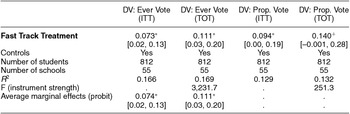
Raw turnout differences between the treatment and control groups indicate that individuals assigned to the Fast Track program in childhood turned out at a rate approximately 6.6 percentage points higher than the control group (treatment = 26.2, control = 32.8; p ≈ .04). Model estimates provided in Table 1 support this basic comparison. These indicate that assignment to the Fast Track treatment (ITT) increased turnout by 7.3 percentage points above the control group (95% confidence interval [CI]: [0.02, 0.13]). The TOT indicates that individuals exposed to Fast Track turned out to vote in at least one of the federal elections held during 2004–2012 at a rate 11.1 percentage points higher than the control group (95% CI: [0.03, 0.20]).
Fast Track’s Impact on Voter Turnout

DV = Dependent Variable; Prop.= Proportion; ITT, intent to treat; TOT, treatment on the treated; *, p ≤ .05; +, p ≤ .10. Notes: The 95% confidence intervals are displayed below the coefficients. These are based on cluster robust standard errors that adjust for the treatment being at the school level and the potential for heteroskedasticity (results unchanged with multilevel models). Control coefficients are reported in the Online Appendix. Controls include race, gender, age, socioeconomic status, whether the child has a sibling, whether the child has a male present in the home, whether the child’s parents are married, and site and cohort fixed effects. For those in Washington, vote history was only available after 2006. F is the test statistic for instrument strength. (The analogous χ2 statistic for the joint hypothesis of the instruments being equal to 0 is shown for tobit models.) Columns 3 and 4 report a tobit specification for the proportion of elections voting (nine categories, truncated at 0 and 1). Probit specifications report average marginal effects.
When I use the proportion of elections voting as the outcome, the results are larger still and slightly less precise, yet still statistically significant. Individuals assigned to the Fast Track program vote at a predicted rate of 9.4 percentage points higher than those in the control group (95% CI: [0.0004, 0.19]; p = .049), with those fully exposed voting at a predicted rate 14 percentage points higher (95% CI: [0.00, 0.28]; p = .052). If I use an ordered logit or a two-part hurdle model, the results are similar, showing that the program was particularly effective at moving individuals from never voting to voting in at least one election. These and other robustness checks can be found in Section 8 of the Online Appendix.
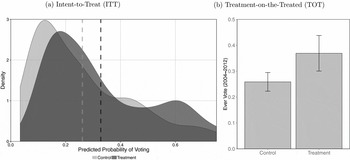
Figure 1 provides two visualizations of these estimates, with the first panel (a) showing the ITT and the second (b) the TOT. As can be seen, the estimates of Fast Track’s impact are statistically distinct from zero at the 95% significance level. Moreover, the point estimates are substantively meaningful. When benchmarked with turnout levels in the control group, the estimates represent about a 28% (ITT) to 42% (TOT) increase in baseline participation rates. Three things should be noted about the size of this effect. First, although the point estimate is sizable and is statistically distinct from zero, the 95% confidence intervals do not allow us to totally rule out smaller effects. Second, it should be kept in mind that this subject pool was particularly disadvantaged—having a low propensity to vote at baseline. The reader should keep in mind that it is possible that there could be diminishing returns to programs like Fast Track—that in more advantaged populations the turnout effects could be smaller.Footnote 14 Even if this were the case, however, the effects would be important, helping to perhaps narrow stubborn resource-based gaps in voter turnout. Finally, Fast Track’s effect on turnout is similar—albeit slightly larger—to other childhood school programs that target disadvantaged populations. Indeed, the confidence intervals for the raw mean difference in turnout for Fast Track (6.6 percentage points) overlap with the similar mean differences from the Perry Preschool program (5.6 percentage points) provided by Sondheimer and Green (Reference Sondheimer and Green2010, see their Table 2).Footnote 15
Fast Track’s Impact on Voter Turnout

All of that said, the Fast Track effect remains important. Taken together, these results solidify the point that the Fast Track program that targeted psychosocial skills in childhood was effective at increasing voter turnout in adulthood. This result provides strong evidence that early life interventions targeting psychosocial skills can substantially move participation downstream. Such a result finds meaning given that previous research has focused on what happens to citizens in adolescence and adulthood. Such a finding is also meaningful because of the population in which it was observed (children of low-socioeconomic parents who were identified as being high risk). Given the normal exclusion of voters with the attributes of the Fast Track participants from the electorate (e.g., Wolfinger and Rosenstone Reference Wolfinger and Rosenstone1980; Leighley and Nagler Reference Leighley and Nagler2013), this result has important implications for how we think about ameliorating low (i.e., bringing in more voters who under the counterfactual would not have voted) and unequal (i.e., drawing these gains from low-propensity citizens) rates of voter turnout.
POTENTIAL MECHANISMS
Although the design employed here is not perfectly suited to explore individual mechanisms, I am able to offer some insights about the channels through which Fast Track potentially mobilized its participants—be it through psychosocial skills or some alternate path. To do so, I estimate mediation models that allow for interdependence among multiple mediators, following the approach suggested by Kohler et al. (Reference Kohler, Karlson and Holm2011).Footnote 16 These models allow me to explore what proportion of the treatment effect is explained by improvements in observed psychosocial skills or other alternate factors. Although these mediation models have value, they should be viewed as descriptive due to the inherent difficulties with unobserved mediators (Green et al. Reference Green, Ha and Bullock2010).
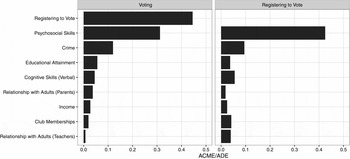
The results from these mediation models are shown in Figure 2. These provide clarity as to what was likely not behind Fast Track’s impact on turnout. First, Fast Track’s effect does not appear to be due to enhanced social status (as measured by marital status and social memberships). Although social status is strongly related to voter turnout, the Fast Track intervention did not alter this outcome. Further, the mediation models suggest that more traditional individual resources were also not behind Fast Track’s effect. The mediation estimates for income represent only 2.7% of the average direct effect (ADE), a comparatively small amount. Fast Track may have increased educational attainment some, and as such, this resource may have played a role in the program’s effect on turnout (about 5.6% of the ADE). Still, this by no means explains Fast Track’s entire effect. Likewise, the mediation models suggest that cognitive skills were unlikely behind Fast Track’s effect—with these accounting for only about 4.5% of the treatment effect. Finally, it may be tempting to argue that Fast Track’s effect is explained by the fact that children in the program simply received a lot of attention from adults. The mediation analyses show that this too is unlikely. Survey measures of subjects’ perceptions about the attention they receive from adults are included in the mediation models, and they explain no more than 4% of the treatment effect.Footnote 17 In total, these results suggest that Fast Track’s effect was about more than improving social status, individual resources, and cognitive ability, or simply providing increased attention from adults.
Fast Track’s Potential Mechanisms

Instead, the results suggest that Fast Track’s effect likely largely came from the bundle of psychosocial skills the program improved. The mediation models show that improvement in students’ measured psychosocial skills explains approximately 31.2% of the treatment effect. (Depending on the combination of measured psychosocial skills used, this number rises to approximately 52% of the total effect explained.Footnote 18 ) The size of this mediation estimate is consistent with previous work exploring the mediators of Fast Track’s impact on crime (Sorensen and Dodge Reference Sorensen and Dodge2016). Moreover, these mediation estimates are much larger than any of the other possible channels. If we think of voting as a two-step process—with the first step being registering to vote and the second being actually voting—Fast Track’s effects on registration explains about 44.5% of the effect on voting (see the first mediator shown in the left panel of Figure 2). In addition, observed psychosocial skills explain about 42.5% of the increase in registration (see the right panel of Figure 2). Among individual skills, the strongest mediators are general self-efficacy, empathy, and ability to controls one’s emotions and behavior (see Table A6 in the Online Appendix).
Still, a significant amount of the treatment effect remains unexplained, suggesting that there may be other unmeasured psychosocial skills of importance or downstream consequences from targeting psychosocial skills in childhood that drove this effect. For instance, it appears that some of the increase in turnout can be attributed to the fact that participants spent less time in prison. The mediation estimates represent about 8 to 12% of the average treatment effect—one of the larger individual mediation estimates. It is important to note, however, that Fast Track’s reduction of criminal behavior has been shown to be attributable, in large part, to upstream improvements in participants’ psychosocial skills (Sorensen and Dodge Reference Sorensen and Dodge2016).
These results suggest that the development of psychosocial skills played a large role in driving the Fast Track program’s effect on turnout. It appears that those who develop the general ability to control their emotions, motivations, thoughts, and behaviors, and to work in group settings, are more likely to target those skills in productive, mobilizing ways throughout their lives. In short, children who develop psychosocial skills early on are more likely to be set on a path toward active civic participation in adulthood.
CONCLUSION
In this article, I provided evidence that childhood programs targeting psychosocial or noncognitive abilities—the individual skills involving self-regulation and sociability not captured by cognitive ability—have a substantively meaningful effect on adult voter turnout. This result has important implications for our understanding of political participation. It suggests that what happens to children early in their lives can have a long-lasting impact on their rates of participation in adulthood. This finding suggests a reorientation of political socialization studies toward early childhood—a previously neglected critical period in the development of participatory predispositions.
Such reorientation should go beyond simple measures of cognitive ability. In the past, political scientists from many fields have focused narrowly on cognitive ability—from topics as diverse as civic participation (e.g., Verba et al. Reference Verba, Schlozman and Brady1995) to the formulation of political attitudes (e.g., White Reference White1968)Footnote 19 to even how people respond to political surveys (Gooch and Vavreck Reference Gooch and VavreckForthcoming). Although some observational work has started to explore the implications of psychosocial attributes (e.g., Condon and Holleque Reference Condon and Holleque2013; Fowler and Kam Reference Fowler and Kam2006, Reference Garmann2007; Hillygus et al. Reference Hillygus, Holbein and Snell2016; Uhlaner Reference Uhlaner1989), this work has been conducted in isolation. The results in this article suggest that psychosocial attributes should be viewed as part of the same taxonomy of attributes. Future work would do well to expand our understanding of how this bundle of attributes influences various political processes.
The results outlined here also have meaningful policy implications. They suggest that the specific childhood programs that schools implement—including those targeting individual psychosocial skills—appear to impact civic participation many years later. Further, they show that psychosocial attributes important for voting are not innate or immovable, but are instead malleable or teachable. At present, there is a major controversy in education circles surrounding how much attention should be given to helping children develop psychosocial skills (Farrington et al. Reference Farrington, Roderick, Allensworth, Nagaoka, Keyes, Johnson and Beechum2012). The results presented here add support to reforms that target these skills—providing evidence that psychosocial skills have benefits beyond those identified previously. This result is important, given that a common criticism of policies that encourage these skills is that they are prohibitively expensive. As as engagement in democracy is considered to be a critical mission of the public education system (Ravitch and Viteritti Reference Ravitch and Viteritti2001), the civic externalities documented here may help justify these costs. More generally, in a landscape of stubbornly low and unequal rates of voter participation and small estimates for many mobilization efforts, this finding should give policymakers and advocates for higher levels of civic participation from a more diverse electorate renewed hope and direction.
Still, much work remains to be done. In many ways, this work represents the first step in understanding the importance of psychosocial skills for political participation. For example, this intervention has focused its attention primarily on a group of relatively disadvantaged individuals. Given this group’s perpetually low rates of political participation (Leighley and Nagler Reference Leighley and Nagler2013), this focus is warranted. Future work would do well to also consider how well psychosocial interventions affect the broader population. Similarly, it would be beneficial for future research to formally explore what period in the life course psychosocial programs are most effective. More work also remains to be done to more narrowly evaluate the costs and benefits of the specific components of psychosocial programs and to explore empirical relationships between individual psychosocial skills and how they interact with political behavior.
That said, this article has documented that pursuing this agenda may provide quite fruitful. Expanding our view to include psychosocial attributes should help increase our understanding of why some people vote whereas others do not.
SUPPLEMENTARY MATERIAL
To view supplementary material for this article, please visit https://doi.org/10.1017/S0003055417000119





Comments
No Comments have been published for this article.