Representative Julia McClune Emery created the first known women's caucus, the Connecticut Order of Women Legislators (OWLS), in 1927 (National Order of Women Legislators Records). At that time, 14 women were serving in the state house (5%) and 1 in the state senate (3%) (Cox Reference Cox1996). While Emery would go on to create a national organization of women legislators, the next state women's caucus would not be created until 1972 in Maryland. Here, Senator Rosalie Abrams, with her colleagues, formed a women's caucus in direct response to overt sexism experienced by some women legislators, including the appointment of Delegate Pauline Menes as “Chairman of the Ladies' Rest Room Committee” by Speaker of the House Thomas Hunter Lowe (Sorenson Reference Sorenson2000). Women in other states have created caucuses to achieve various objectives ever since, some with policy as a priority and others more collegially focused. Qualitative studies have uncovered the variety and origin stories of some of these groups (Mahoney Reference Mahoney2013; Mueller Reference Mueller and Flammang1984), but no systematic quantitative investigation has determined the conditions under which women's caucuses emerge nationwide. In this article, we seek to fill that gap utilizing a comprehensive dataset from 1972 to 2009 to determine when and where bipartisan women's caucuses emerge.
Caucuses are significant aspects of legislative life. Cross-nationally, caucuses are vital for providing legislators with information, a highly valued resource (Ringe and Victor Reference Ringe and Victor2013). In the United States, congressional caucuses are important tools for voicing public concerns that allow legislators to express politically salient identities, signifying themselves as experts in certain legislative areas and advocates for particular constituencies (Hammond Reference Hammond1998). The Congressional Black Caucus (CBC), an identity caucus similar to women's caucuses, has been able to successfully advocate for minority voting rights (Rivers Reference Rivers2012), while over time liberalizing the platform of the Democratic Party (Tate Reference Tate2014). Research on state legislative black caucuses shows that these groups are most effective at advocating for black interests when African Americans hold leadership positions and have a larger seat share (Menifield and Shaffer Reference Menifield and Shaffer2005). Others assert that state legislative black caucuses are most effective due to their seat share and whether the legislative environment is friendly to black interests (King-Meadows and Schaller Reference King-Meadows and Schaller2006). These studies illustrate the importance of caucuses for all legislators, as well as for African Americans specifically, yet say little about women's caucuses and the conditions most favorable to their emergence. The contextual nature of black caucus strength indicates that the environment in which these organizations emerge and operate is important to evaluate.
Women's caucuses provide benefits for individual women legislators as well as for their constituents, including providing members with opportunities for information exchange, sympathetic sounding boards, the ability to distribute their workload, staff integration, image enhancement within the district, and social support (Gertzog Reference Gertzog1995). The presence of a women's caucus can increase the number of women committee chairs within legislatures, but with differences across chamber and women's proportions (Kanthak and Krause Reference Kanthak and Krause2012). Caucuses also shape policies because members of women's caucuses are more likely than others to work on women's issues (CAWP 2001). Moreover, women's caucuses can be gendered opportunity structures within legislatures, increasing women's ability to act on behalf of their constituents (CAWP 2001; Reingold and Schneider Reference Reingold and Schneider2001; Thomas Reference Thomas1991; Tolbert and Steuernagel Reference Tolbert and Steuernagel2001).Footnote 1 Caucuses function within legislatures, however, and are subject to the existing political rules therein, formal and informal. Political parties are the primary organizing mechanism of legislatures. Affiliation with a political party influences individual votes, committee assignments, leadership positions, and resource allocation (Rosenthal Reference Rosenthal1998, Reference Rosenthal2009). We argue that partisan rules and norms as institutional features of legislatures interact with gender dynamics to shape women's caucusing behavior.
This study is the first quantitative analysis of women's caucus emergence and associated institutional factors. To conduct the analysis, we generated an original dataset from interviews with legislators, staff and archivists, media accounts, and the few existing women's caucus websites. Given that the formality of these groups varies, this process required verification across multiple sources, particularly for caucuses formed in previous decades. While we use caucus formation as a dependent variable in our analysis, we anticipate that future research could utilize our efforts as explanatory variables in models of other legislative behaviors.
In 2016, there were 22 bipartisan women's legislative caucuses throughout the 50 US state legislatures. Women's caucuses are found in a diverse set of circumstances, including under Democratic or Republican Party control, and in states with high and low proportions of women legislatures. Because of the potential advantages proffered by caucuses, knowing when and where these groups emerge can indicate which legislative environments benefit women legislators. Observing women's caucuses in states as different from one another as California and Louisiana and examining data over nearly 40 years, we consider the following research question: what institutional factors are positively associated with the creation of a women's legislative caucus? We examine women's caucus creation between 1972 and 2009, and our theoretical approach considers how the presence of women matters for the creation of these groups. One approach asserts that the presence of women alone will matter for the creation of women's caucuses, which we refer to as the critical mass explanation. A second possibility, taking into consideration to the pivotal role of both gender and parties within legislatures, is that the presence of women will only affect women's caucus creation when Democrats have party control. Our statistical tests provide support for the argument that women's presence alone does not explain the creation of women's caucuses, but that partisan context matters.
Organizing legislatures around partisan identities poses inherent contradictions for legislators, who hold multiple politically salient identities, including gender, race, class, ability, and sexuality. Women legislators’ interests are multifaceted and, historically, women of both parties have found themselves in conflict with their partisan interests on many women's issues (Freeman Reference Freeman1986). Women's caucuses are unique opportunities to observe these inherent contradictions because they are the only examples of truly bipartisan, identity-based caucuses. Members of a black caucus are almost always Democrats and similarly, LGBT and Latino caucuses rarely have Republican members (e.g., California Latino Caucus 2016; California Lesbian, Gay, Bisexual, Transgender Caucus Reference California Lesbian and Bisexual2016; King-Meadows and Schaller Reference King-Meadows and Schaller2006; The New York Black, Puerto Rican, Hispanic and Asian Legislative Caucus 2016). As such, we have centered our analysis on the creation of women's caucuses examining the influence of critical mass and partisan control factors in their emergence.
Many studies within political science understand gender as a process, something that is practiced and reinscribed by individual actions and institutionalized norms throughout political systems (Duerst-Lahti Reference Duerst-Lahti2002; Hawkesworth Reference Hawkesworth2003; Katzenstein Reference Katzenstein1998). State legislatures are gendered institutions with historically male majorities that have marginalized women's participation and representation (Kenney Reference Kenney1996; Thomas Reference Thomas1994). By analyzing the circumstances under which women make a place for themselves within these institutions, our work points to potential opportunities for equalizing the gender power balance for more inclusive participation and more fair representation by and for women. By identifying the institutional context in which women legislators organize around their gender identity, we are contributing to scholarship concerned with institutional change, feminist collective action, and legislative behavior.
CREATING A WOMEN'S SPACE WITHIN A GENDERED AND PARTISAN ENVIRONMENT
Race and gender shape legislative experiences across institutions and throughout time (Barrett Reference Barrett1997; Hawkesworth Reference Hawkesworth2003; Hedge, Button, and Spear Reference Hedge, Button and Spear1996; Smooth Reference Smooth and Reingold2008, Reference Smooth2001). Legislatures are gendered institutions due to the normalization of masculine preferences and power and the marginalization of characteristics associated with the feminine (and, consequently, women themselves) (Duerst-Lahti Reference Duerst-Lahti2002; Hawkesworth Reference Hawkesworth2003; Kenney Reference Kenney1996). Because legislatures shape racial and gender identities through their practices and their policies, identifying how this process occurs is critical to ameliorating the marginalization of legislators from underrepresented groups. Identity caucuses provide an excellent opportunity to explore the ways in which institutions shape their members. How, when, and why legislators may choose to organize themselves around different identity markers tells us not only about the legislative behavior of those individuals but also about the way norms are created and enforced within organizations.
Gender norms intersect with other politically salient identities. Women's reactions to biased treatment in legislatures may be mixed due to race, political party, or personal experience influencing their likelihood to organize collectively. For example, black and white women differ somewhat in their evaluations of their own legislative efficacy, which may shape their decisions about if and how to work together (Barrett Reference Barrett1997). Likewise, Democratic and Republican women differ on how to substantively represent women (Osborn Reference Osborn2012). To compound these differences, women within a male-dominated environment can be motivated to blend in rather than attract attention to their gender difference (Kanter Reference Kanter1977). These conditions explain some of the challenges of organizing around gender.
Despite these differences, women legislators feel an obligation to represent women regardless of party affiliation, perhaps prompting them to collectivize their lawmaking efforts (Barrett Reference Barrett1997; Carroll Reference Carroll and Rosenthal2002; CAWP 2001; Dodson et al. Reference Dodson, Carroll, Mandel, Kleeman, Schreiber and Liebowitz1995; Hawkesworth et al. Reference Hawkesworth, Dodson, Kleeman, Casey and Jenkins2000; Osborn Reference Osborn2012; Reingold Reference Reingold2000; Tamerius Reference Tamerius, Duerst-Lahti and Kelly1995; Thomas Reference Thomas1994). Gertzog (Reference Gertzog2004) documents, for example, the burden representing women was for so few women in Congress in the 1970s and that creating a caucus was one way to distribute the additional labor required of them when their male colleagues continued to assume their interest and expertise regardless of its veracity. It is important that we investigate the tactics women legislators use to achieve this representation, including the creation of bipartisan women's caucuses.
Caucuses are one mechanism by which women legislators represent women. In some environments, women legislators decide that working collectively will serve their interests and determine that the benefits to organizing outweigh the potential costs. While women's caucuses are not social movements, collective action theory can help to illustrate the conditions likely to produce an organization like a caucus within an institution. Appreciating that political opportunities and resources are critical for collective action outside the state legislature, we consider the role these factors may play in opening the legislature to women's organizing.Footnote 2
Feminist institutionalists take structural characteristics and the agency of legislators seriously in evaluating institutional change (Mackay, Kenny, and Chappell Reference Mackay, Kenny and Chappell2010). Mahoney and Thelen (Reference Mahoney and Thelen2010) argue that gradual institutional change is possible through a reinterpretation of existing rules by change agents and the resulting enforcement by other actors. Legislative behavior in Congress is an opportunity for rules (formal and informal) to be reimagined as Hinckley (Reference Hinckley1971) describes “Expectations about who does what and who should do what are formed and influence subsequent actions” (7). Differences between both formal and informal political opportunity structures (e.g., leadership attitudes toward bipartisanship or time allotted during session for meetings) as well as actors’ perceptions of the malleability of these structures play a role in the success of a social movement (Banaszak Reference Banaszak1996). For example, scholars have identified gendered opportunity structures for suffragettes’ ability to win the vote (McCammon et al. Reference McCammon, Campbell, Granberg and Mowery2001) as well as women legislators’ entrance into party leadership (O'Brien Reference O'Brien2015). We argue that differences in institutional flexibility and legislators’ perceptions of that mutability are what may create an opportunity in some legislatures for a women's caucus to emerge. When women legislators perceive permeable gender and partisan norms and are armed with the right resources, a women's caucus is likely to emerge. In this analysis, we seek to identify the specific conditions under which this gender reconfiguration can occur in state legislatures.
POLITICAL OPPORTUNITIES
Political opportunities are those moments in which shifts “render the established political order more vulnerable or receptive to challenge” (McAdam, McCarthy, and Zald Reference McAdam, McCarthy and Zald1996, 8). McCammon et al. (Reference McCammon, Campbell, Granberg and Mowery2001) take this concept further and consider the gendered opportunities (or shifts in gender relations) that combined with political shifts enabled suffragists to be successful. Within this analysis, we consider those moments or conditions that may shift dynamics within legislatures to the advantage of women interested in establishing organizations that highlight their gender—signifying it as politically significant and legislatively legitimate. These conditions include women's seat share in the legislature, Democratic Party control, low party competition, and the presence of a black caucus.
Women's Presence
An obvious political opportunity for a women's caucus is the increased number of women serving in state legislatures. Without potential members, there is little need or opportunity for an organization. Further, women in skewed organizations (where women make up 15% or less of the population) are pressured not to draw attention to themselves (Kanter Reference Kanter1977). Because they are already marked as different by their gender, they seek invisibility to hide from increased public performance pressures. They want to be acknowledged for their competence not their uniqueness as women. However, legislators’ perceptions that women are more likely to work on women's issues, more likely to work across the aisle, and to be more collaborative in general would suggest that women's caucuses would be a likely consequence of women's presence in the legislature (CAWP 2001).
The validity of a connection between women's numbers in a legislative body and subsequent changes in policy or process is much debated (Beckwith Reference Beckwith2007; Bratton Reference Bratton2002; Childs and Krook Reference Childs and Krook2006, Reference Childs and Krook2009). Some scholars have argued that women may need to meet a “critical mass” of representation prior to achieving political change (Beckwith Reference Beckwith2007; Holman Reference Holman2014; Kanter Reference Kanter1977). Thus we suggest the following critical-mass hypothesis:
H1:
Women's legislative caucuses are more likely to emerge as more women serve in the state legislature.
Research on backlash corroborates the theory that women's presence may contribute to the creation of a women's caucus. Women in legislatures are more likely to experience backlash to their presence when it reaches beyond tokenism (15%) and threatens the gender balance of power (Kathlene Reference Kathlene1994). Their moderate numbers are accompanied by devaluation by male colleagues (Kanthak and Krause Reference Kanthak and Krause2012) and exclusion from powerful committees (Heath, Schwindt-Bayer, and Taylor-Robinson Reference Heath, Schwindt-Bayer and Taylor-Robinson2005). These negative consequences may serve as motivation for women to increase their power by banding together (Thomas Reference Thomas1994).
For example, expanding on previous research by Rosabeth Moss Kanter (Reference Beckwith1977), Beckwith (Reference Beckwith2007) hypothesizes that in legislatures with fewer than 15% women, caucuses are less likely to emerge because of the pressure to conform to masculine norms. In legislatures with greater than 15% women, Beckwith (Reference Beckwith2007) hypothesizes the creation of more women's caucuses. Alternatively, in legislatures with large numbers of women, with percentages higher than 30%, she argues that legislators may not feel a need for an organization based on gender. Kanthak and Krause (Reference Kanthak and Krause2012) identify a coordination problem as women's numbers increase but do not delineate precise thresholds. As a result, we also evaluate whether there is a curvilinear relationship between women's representation and the formation of a caucus.
Political Party
As the primary organizers of state legislatures, political party shapes all kinds of legislative behavior including, we argue, women's organizing strategies (Squire and Moncrief Reference Squire and Moncrief2010). Political demands made by women's organizations outside of Congress in the 1970s instigated the development of the CCWI at the national level (Gertzog Reference Gertzog2004; Hammond Reference Hammond1998). Members of Congress felt pressure to respond to the newly salient women's issues to which outside groups were calling attention. The lack of response from traditional legislative mechanisms like committees and political parties provided the impetus for women to create an alternative—although the decision to organize was not an easy or automatic one. Gertzog (Reference Gertzog2004) details the stops and starts along the way to a women's caucus at the Congressional level and the nearly fatal blow dealt with the Republican takeover in the House in 1994. This narrative at the national level indicates that party control of government is critical for understanding the success of women's caucuses.
To understand the emergence of women's caucuses, it is important to consider the role of party as a direct mechanism for success (or failure) of caucuses and as a predictor of the types of women elected to office. In 2016, 60% of women in state legislatures were Democrats, and the Democratic Party has framed itself as the party most responsive to “women's issues.”Footnote 3 Historically, however, both parties have evolved on women's issues. For example, Freeman (Reference Freeman1986) notes that in 1972, opposition to the Equal Rights Amendment was not based on partisanship and that it was not until 1984 that the Republican Party officially removed support of the ERA from its platform. Since then, however, the Republican Party, beyond the lack of women's representation and a sometimes-perceived hostility toward women's issues, has been less tolerant of the expression of competing political identities beyond party (Crowder-Meyer and Lauderdale Reference Crowder-Meyer and Lauderdale2014; Freeman Reference Freeman1986). As a result, a strong Republican Party can depress women's cohesion (Osborn Reference Osborn2003). For us, Democratic Party control and its openness to identity politics signals to women legislators that legislatures under this regime are open to identity caucus creation, making women's caucuses likelier to emerge when Democrats control the legislature.
Additional political opportunities for women's caucus emergence include the openness of the legislature to alternative organizing, including party competition and the presence of black caucuses. Under high party competition, party leaders may encourage strict party discipline, discouraging women from fragmenting their legislative efforts between party goals and the sometimes-competing goals of women's caucuses (Aldrich and Battista Reference Aldrich and Battista2002; Snyder and Groseclose Reference Snyder and Groseclose2000). Thus, women's caucuses ought to be less likely to exist in states with greater party competition. Further, the presence of a black caucus may signal to women that the legislative environment is friendly to group-based organizing, whereas black women legislators bring their experience within the black caucus to bear on the formation of a women's caucus.
Resources
Resource availability is related to group formation in general (Edwards and McCarthy Reference Edwards, McCarthy, Snow, Soule and Kriesi2004) and to the emergence of legislative caucuses in particular (Hammond Reference Hammond1998). For scholars of state politics, resource availability is measured by legislative professionalism, a score that considers the capacity of legislative bodies to act (Squire Reference Squire2007). The related research shows a complicated relationship between legislative professionalism and the experience of women in the legislature. On the one hand, women in professionalized legislatures are more likely to work on legislation that advocates women's interests (Carroll and Taylor Reference Carroll and Taylor1989), which suggests that more professional legislative bodies would encourage the formation of a women's caucus. On the other hand, legislative professionalism tends to produce masculine norms, which may discourage women from forming caucuses (or in some instances, as in Maryland, prompt them to do so) (Rosenthal Reference Rosenthal1998; Sorenson Reference Sorenson2000). Ultimately, we expect that women's caucuses are more likely to emerge in professionalized legislatures because they will have the resources necessary to help them launch the groups, which are heavily time- and staff-dependent.
Dynamics of Organizing within Institutions
Many institutional features work in tandem to shape legislative behavior and women's legislative behavior in particular (Katzenstein Reference Katzenstein1998; Kanthak and Krause Reference Kanthak and Krause2012; Osborn Reference Osborn2012). We sought to determine which combination of these factors creates the most favorable conditions for women's organizing. We expected that women's numbers in the legislature in concert with political party control are likely to be the most important because of the centrality of political parties to legislative norms. Although we predicted that women's increased presence motivates the creation of an organization, having the numbers is not likely to be enough in an institution that is largely controlled by political parties. Women's organizing is more likely to result in the creation of a women's caucus in legislatures when the previously identified opportunities and resources are available. Specifically, women's caucuses are more likely to emerge in some places rather than others because legislative norms relating to appropriate gender and partisan behavior (like creating a bipartisan women's caucus) vary according to certain institutional features. These institutional features are what shape the political opportunities and resources available to legislators considering caucusing.
The decision to create a women's caucus is complicated by women's marginalization within state legislatures. Unlike the decision to create a black caucus, wherein the majority of members would be of one party, women's party identification is more diverse, complicating their ability to find common ground despite their shared gender identity. Likewise, the pressure to conform to legislative norms and not highlight their difference from their male colleagues would, in some environments, be intense. These factors are not consistent over time or place, however.
Recently, scholars have called for a more nuanced approach to understanding women's presence and their impact on legislatures indicating that more is not always better (Bratton Reference Bratton2002; Crowley Reference Crowley2004) or that women's presence in conjunction with other factors may prove more explanatory (Beckwith Reference Beckwith2007; Carroll Reference Carroll, O'Neil and Gidengil2006). Kanthak and Krause (Reference Kanthak and Krause2012) point out, for example, that women may face a coordination problem even as their numbers increase due to their historical presence in the minority. Further, Bratton (Reference Bratton2002) suggests that institutional culture, including majority party, is probably more important than women's number in the legislature. Moreover, Osborn (Reference Osborn2012) shows that political party impacts how women state legislators define women's interests and, more importantly, that party control of government affects whether women come together, coordinating their legislative behavior based on a shared gender identity. In other words, a feminist institutional hypothesis would suggest that certain characteristics make legislatures more open to women organizing around their gender identity. We, therefore, expected Democrats to be more receptive to women acting as women than are Republicans. This expectation can be restated as follows:
H2:
Women's caucuses are more likely to form when more women serve in the legislature, as long as Democrats have party control.
DATA AND METHODS
Dependent Variable
Historically, caucuses have been understood as “voluntary associations… which seek to have a role in the policy process … with standard organizational attributes: a name, a membership list, leadership, and staffing arrangements” (Hammond, Mulhollan, and Stevens Jr. Reference Hammond, Mulhollan and Stevens1985, 583). Knowing that women's caucuses in the states take a variety of forms that do not always maintain a membership list or staff, we define a women's caucus as a bipartisan, institutionalized association of legislators who seek to improve women's lives. By “institutionalized,” we require an identifiable leader that would be recognized by potential members, and we consider attempts to improve women's lives broadly, including efforts on behalf of women constituents through legislation or more informal mechanisms, as well as efforts to improve the lives of women legislators themselves.
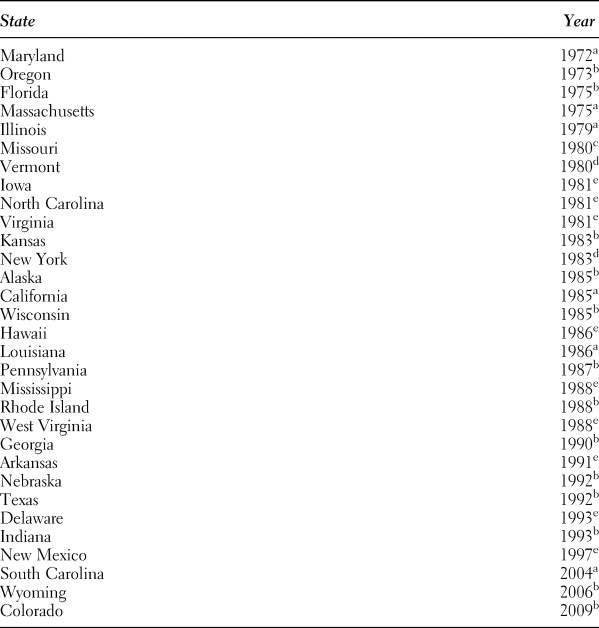
Between 1972 and 2009, 31 women's caucuses emerged that fit our criteria.Footnote 4Table 1 indicates the year of caucus emergence in each state.
Chronological Order of the Emergence of Women's State Legislative Caucuses

Note: For more information on sources see Appendix.
a The date was acquired from the caucus website.
b The date was acquired from a person familiar with politics in the state.
c The date was acquired from a scholarly source.
d The date was acquired from state government.
e The date was acquired from the Center for American Women in Politics (CAWP).
Maryland was the first state to create a caucus in this era, doing so in 1972, the same year as passage of Title IX. An additional four caucuses formed in the 1970s, and in the 1980s, nearly half of the women's caucuses were formed (16), by far the most of any decade. Seven more caucuses formed in the 1990s—including two in 1992, the Year of the Woman—and the remaining three emerged in the 2000s, ending with Colorado in 2009.
Several sources were consulted to ascertain when women's caucuses emerged. In a handful of cases, women's caucuses had websites that provided data on their emergence. The Center for American Women and Politics newsletter News & Notes provided the caucus creation date for many states. In other instances, state legislators, both former and current, were consulted to determine when women's caucuses emerged. We also relied on data from state archivists, state legislatures, and scholarly works. In summary, our goal was to determine the earliest date by which a women's caucus was created in a state.Footnote 5
These phenomena are very difficult to document because not all states require caucuses to register, and determining when an official launch has occurred requires extensive qualitative research. Documenting when a caucus has died or has become inactive may be even more difficult to measure. As such, we are limited in the types of tests we can run to assess the systematic nature of women's caucus formation. However, to date, our data and analysis are the most comprehensive accounting of the establishment of women's caucuses in the 50 states.Footnote 6
Independent Variables
Our statistical models included two measures of women's presence in state legislatures. We included a measure of the proportion of women in the legislature, as well as a measure of the total proportion of women squared to test the possibility of a curvilinear relationship between women's presence and caucus formation. Although caucuses are unlikely to emerge in states with too few women to organize, it is just as likely that a state with larger numbers of women in office may feel a caucus is unnecessary. Our data on women's presence in state legislatures came from a few sources. All of the data on the number of women state legislators from 1975 onwards were courtesy of the CAWP, while data for the years prior to 1975 came from Cox (Reference Cox1996). The Book of States provided data on legislative chamber size.
Our measure of legislative professionalism came from two sources. Squire (Reference Squire2007) provided the data from 1979 onwards, and King (Reference King2000) provided the data for the prior years.Footnote 7 Data on whether Democrats held a majority of seats in the state legislature came from Klarner (Reference Klarner2013b) with states coded as “1” if Democrats held a majority of seats in the legislature, and all others coded as “0.” To measure party competition, the Ranney Index was used, and these data were obtained from Klarner (Reference Klarner2013a).Footnote 8 Finally, data on the presence of state legislative black caucuses were obtained from Clark (Reference Clarkforthcoming).
The emergence of a women's caucus can be viewed statistically as an event, hence our choice of event history analysis. When creating the dataset, all states were included until a women's caucus emerged, at which point the state dropped out of the dataset. For instance, Florida's women caucus was created in 1975, so the Sunshine State contributed observations from 1972 to 1975 but none thereafter. Conversely, a women's caucus did not emerge in the era examined in Kentucky, so the Bluegrass State contributes an observation every year. We employed two models, both of which were logistic regressions with robust standard errors that were clustered by state and included a lowess function of the baseline hazard rate.Footnote 9 One model includes the proportion of women in the state legislature and Democratic control of the state legislature as separate variables, while the second model includes an interaction term to measure the effect of women's presence on caucus creation when Democrats have party control.Footnote 10
There are multiple ways to specify event history models, and we chose to use logistic regression analysis given its ease of interpretation. That said, a shortcoming of logistic regression analysis is that it assumes a flat baseline hazard, or that the odds of an event occurring are the same across time. This assumption may be unwarranted and, if incorrect, indicates the presence of model misspecification. To that end, our statistical models included a lowess function of the baseline hazard rate to account for duration dependency.Footnote 11 We clustered robust standard errors by state to address a lack of independence between observations, following Buckley and Westerland (Reference Buckley and Westerland2004).Footnote 12
RESULTS
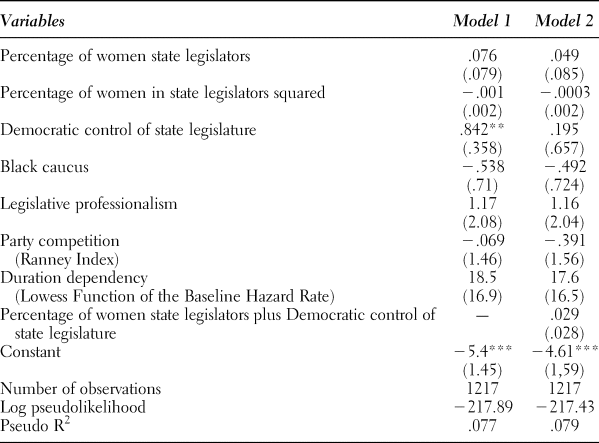
The results of our statistical analysis can be seen in Table 2.
Predicting the Creation of Women's Caucuses

Note: Table entries are estimated coefficients of a logistic regression model, and robust standard errors are in parentheses.
*p ≤ .10, ** p ≤ .05, and *** p ≤ .01.
The first model indicates that the only significant predictor of women's caucus emergence is party control of the legislature. When Democrats control the state legislature, women's caucuses are more likely to form than when Republicans control the state legislature. However, no other variable exercises a meaningful influence on whether and when these organizations are created, including the proportion of women present in the state legislature alone, showing no support for H1.
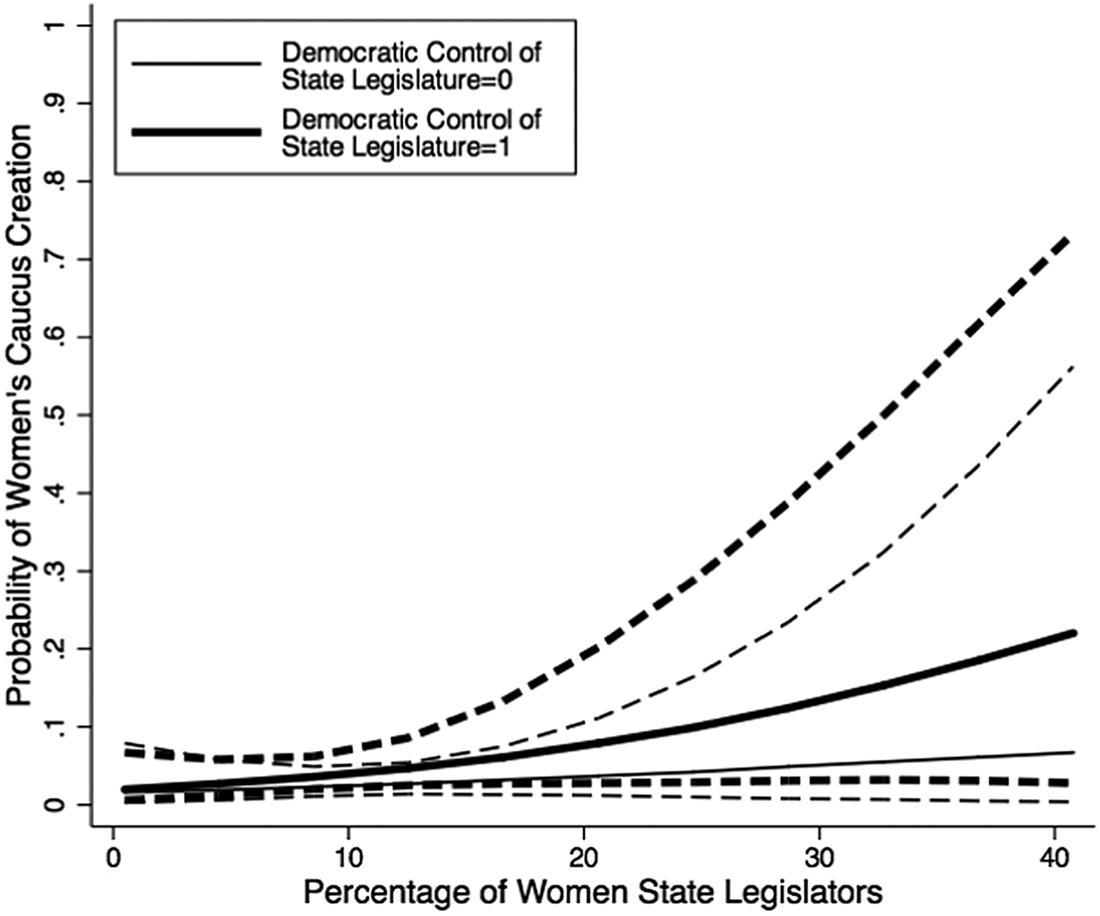
Model 2 evaluates the effect of women and Democratic control of the legislature on women's caucus creation, providing a test of H2. Interpreting interactive hypotheses is difficult, so we created a figure to depict the findings (Kam and Franzese Reference Kam and Franzese2007). The figure is based on all other variables being held at their mean values, except for the proportion of women in the legislature squared, as it is dependent upon the proportion of women in the legislature. The dashed lines represent 95% confidence intervals, and the darker lines illustrate the results for when Democrats control the state legislature.
As shown in Figure 1, when Republicans have control of the state legislature, the proportion of women has virtually no impact on whether a women's caucus emerges. Conversely, when Democrats control the state legislature, women's caucuses are more likely to form as the proportion of women serving in that body increases. The minimum value in our dataset of the proportion of women serving in the state legislature is .5%, and at this point, there is a 2% chance that a women's caucus emerges. When the proportion of women increases to 10%, then the chances that a women's caucus emerges doubles to 4%. Once women comprise 20% of a state legislature, there is an 8% chance that a women's caucus is present. There is a 13% chance that a women's caucus emerges when women comprise 30% of a state legislature, and when women are 41% of the state legislature—the highest value observed in our dataset—then a women's caucus has 22% chance of forming. In other words, in state legislatures controlled by Democrats, as women make up a larger percentage of state legislators there is a greater chance that a women's caucus forms.Footnote 13 No other variables within our models exercised a meaningful influence on the emergence of these organizations.
Predicting the creation of a women's caucus based on the interactive relationship between the percentage of women state legislators and democratic control of the legislature.

To show the robustness of our findings, we considered alternative ways to specify our models of women's caucus creation. Cox proportional hazards models are considered the gold standard of duration models (see Box-Steffensmeier and Jones Reference Box-Steffensmeier and Jones2004), and we specified two of these models, one with an interaction term and one without. However, we found that the proportional hazards assumption was not met, making it inappropriate to employ this model for our analysis.Footnote 14
We also analyzed the creation of women's caucuses varying the states that were “at risk.” It may be that women must comprise a specific percentage of the state legislature before they choose to create a caucus. We established the following cutoff points: 5%, 10%, 15%, and 20%. The models with the 5%, 10%, and 15% cutoff points are the same: there appears to be no variable that accounts for the creation of women's caucuses. The findings from the model with a 20% cutoff are worth noting. Unlike our findings from Table 2, it appears that a nonlinear relationship exists between party control and the proportion of women state legislators.Footnote 15 We interpret these findings with caution, however, as they are based on only 19 positive cases of women's caucus emergence and only 343 observations. This is compared to the 31 positive cases and 1,243 observations from the results depicted in Figure 1 and Table 2.
After running a Cox proportional hazards model and varying the states at risk to create a women's caucus, we remain confident that employing logistic regression and including states regardless of their gender composition were the correct choices. That said, these results also suggest that quantitative analyses may only partially account for the political phenomena that undergirds the emergence of women's caucuses.
OPTIMAL CONDITIONS FOR GENDERED ORGANIZING WITHIN LEGISLATURES
Women's ability to organize, consolidate power, share information, and act collectively has implications for their own experience within institutions and the quality of representation their constituents receive. Gender is not just an identity of legislators; it is a structure of expectations and behaviors that shape legislators’ decisions and their opportunities to legislate. Women's own gendered identity and the gendered environment of the legislature is likely to affect their decision whether to organize as women and their ability to do so successfully. Women legislators must make the decision to caucus or not by evaluating the costs and benefits of such a decision. These evaluations include many of the institutional factors we examined here. Although we did not find evidence for many of our expectations, we believe that the institutional variables we analyzed here are a part of the decision-making calculus of the caucus creators along with the available resources and frames to motivate participants. In fact, these additional considerations may work in tandem with Democratic Party control and women's numerical presence in ways further qualitative research may uncover.
Our findings engage the critical-mass debate within gender and politics research, which questions the validity of assuming that women legislators in certain numbers will have a particular effect without considering the context within which those women are acting (Beckwith and Cowell-Meyers Reference Beckwith and Cowell-Meyers2007; Celis et al. Reference Celis, Childs, Kantola and Krook2008). Like Osborn (Reference Osborn2012) and Swers (Reference Swers2002), we acknowledge the gendered consequences of political party in legislatures, and our work indicates not only that women's membership in political parties influences their legislative behavior but also that party control of an institution does so as well. By considering multiple institutional factors that might influence the emergence of women's caucuses, including the role of political party, we aimed to avoid the traps identified by critical-mass critics in explaining when and where women are able to represent women. Appreciating the gendered consequences of party control adds to the literature on gendered institutions and dispels the gender neutrality of common legislative concepts.
Despite the challenges to organizing, both among women legislators and from external actors and forces, women are still attempting to create a space for themselves in some state legislatures. Although women's caucuses have existed for decades and women's numbers in state legislatures have stagnated, these organizations continue to emerge under the right conditions. As scholars have recently pointed out, we find that institutional conditions, like Democratic control of the legislature, affect the creation of women's caucuses and thus influence women's ability to govern once elected (Beckwith Reference Beckwith2007; Childs and Krook Reference Childs and Krook2006, Reference Childs and Krook2009). Our findings are important for understanding when caucuses comprised of other underrepresented groups are created. For instance, Clark (Reference Clarkforthcoming) finds that black caucuses are likelier to emerge when Democrats hold more seats and when more blacks serve in the state legislature. However, his study shows that these two variables exert an independent effect on the emergence of black caucuses. Finding that parties control conditions whether women's caucuses are created provides additional evidence for the importance of recognizing the differences that exist among underrepresented groups in American politics.
Research on women's caucuses does not suffer from a dearth of theoretical and practical puzzles. For instance, once created, how do caucuses maintain themselves over time? What causes a caucus to disband? Future research should address these questions, and the answers would greatly contribute to our understanding of the role gender plays in collective action within institutions. Also, we did not address what effect these groups have for constituents. While Mahoney (Reference Mahoney2013) suggests that variations in women's caucuses might explain the mixed results in the research thus far on their effectiveness, in our analysis we did not undertake the question of which institutional factors contribute to the creation of one type of women's caucus or another. While political party factors seem to be obvious explanations, more research is necessary to fully understand why women's caucuses take different forms and vary in mission and priorities. Finally, as Beckwith (Reference Beckwith2007) suggests and Mahoney (Reference Mahoney2013) found through case studies, the number of first-term women legislators may affect whether a women's caucus forms in state legislatures and should be included as a variable when that data is available.
Feminist institutionalism seeks to understand how formal and informal rules shape behaviors and power (Kenny Reference Kenny2007). This analysis of when and where women's caucuses emerge identifies the legislative opportunity structures correlated with the emergence of women's caucuses. In so doing, we have illustrated how legislative norms shape women's ability to organize around their gendered identity. For individual legislators, women's caucuses are a way to gain social support within a majority-male space, create tactical relationships with colleagues, and increase their access to information. As representatives, caucusing is a way to highlight their representation of and identification with an important constituency. Understanding where women legislators can gain these advantages is important because it has consequences for women's status within the legislature and substantive policy outcomes for all constituents.
SUPPLEMENTARY MATERIAL
To view supplementary material for this article, please visit https://doi.org/10.1017/S1743923X18000806