Introduction
Perilla mint is an erect, herbaceous annual originating in eastern Asia (Nitta et al. Reference Nitta, Lee and Ohnishi2003; Zheng et al. Reference Zheng, Wu, Ding, Binion, Fu and Reardon2004). Also known as beefsteak plant or Chinese basil, this monotypic genus has a history of use in the culinary, medicinal, and ornamental markets. Today, perilla mint has naturalized throughout much of the eastern United States and poses a health risk to livestock as a noxious weed in forage systems.
A member of the Lamiaceae, or mint family, perilla mint may grow to heights of 1.5 to 1.8 m but usually reaches an average height of 0.6 m at maturity (Burrows and Tyrl Reference Burrows and Tyrl2001). Its opposite, simple leaves are branched from a square stem and are coarsely serrated, often with a purple tinge. Like others in the mint family, the leaves of perilla mint are highly aromatic when crushed. Perilla mint is a self-pollinating species whose indeterminate inflorescences appear during late summer and consist of small white or purple flowers along terminal or axillary spikes (Burrows and Tyrl Reference Burrows and Tyrl2001). Zeevaart (Reference Zeevaart1969, Reference Zeevaart1985) noted specifically that plants become photosensitive at the four-leaf-pair stage and typically begin to flower 18 to 20 d after the summer solstice. This occurs in approximately mid- to late July for U.S. populations. Plants are prolific seeders upon maturity, often producing one to four granules of seed per nutlet (Yu et al. Reference Yu, Kosuna and Haga1997). Seed from cultivated varieties used for culinary and medicinal purposes ideally germinate in 15 C/23 C night/day temperatures (Zhang et al. Reference Zhang, He, He, Yu, Du and Hu2010) and up to a constant temperature of 25 C (Masumoto and Ito Reference Masumoto and Ito2010). In Arkansas, ideal temperatures initiate plant growth in June or July and may occur in both xeric and mesic soil conditions (Covington Reference Covington1969; Williams Reference Williams2007).
Because phenotypic plasticity allows this plant to populate a wide range of habitats, it successfully establishes colonies in all natural ecoregions of its geographic range (Daehler Reference Daehler2003; Williams Reference Williams2007). Stand populations are often dense and can be found in semi-shaded wooded understories, along open-wooded streams, and in damp swales (Burrows and Tyrl Reference Burrows and Tyrl2001). Along pasture edges, perilla mint’s invasiveness increases competition for beneficial forage species, especially during seasons of limited rainfall.
Throughout the plant’s reproductive phase and during periods of environmental stress, its toxicity is believed to increase (Burrows and Tyrl Reference Burrows and Tyrl2001; Nice et al. Reference Nice, Johnson and Shelton2010; Peterson Reference Peterson1965). Environmental conditions that decrease the availability of desirable forage or force livestock to spend more time in shaded areas increase the risk of exposure to this plant. Increased palatability is likely even after POST herbicide treatments, because of the wilting of plants (Anonymous 2015; Steckel and Rhodes Reference Steckel and Rhodes2007). Many states have reported considerable cattle deaths due to volatile compounds that accumulate after ingestion (Nice et al. Reference Nice, Johnson and Shelton2010; Petersen 1965). Therefore, though control measures are critical, equally important is to exclude livestock from infested areas until perilla mint plants are completed desiccated.
Few studies have been conducted pertaining to the control of perilla mint with herbicides. Extension publications and bulletins cite the effectiveness of cultural practices like hand-pulling and mechanical mowing (Scott et al. Reference Scott, Barber, Boyd, Selden, Norsworthy and Burgos2017). POST control from herbicides that contain 2,4-D, aminopyralid, dicamba, glyphosate, picloram, and triclopyr have also been effective (Green et al. Reference Green, Witt and Martin2006; Rhodes et al. Reference Rhodes, Main, Sims, Hayes, McClure, Mueller and Brown2010; Russell and Byrd Reference Russell and Byrd2015; Russell Reference Russell2016). Additionally, Rhodes et al. (Reference Rhodes, Main, Sims, Hayes, McClure, Mueller and Brown2010) found that 2,4-D, 2,4-D+ aminopyralid, aminopyralid, and 2,4-D+dicamba provided approximately 80% to 90% control when applied late spring to early summer.
Currently little to no published data exist to document the effectiveness or proper timing of PRE herbicides for control of perilla mint. Therefore, it is important to promote an understanding of environmental conditions that encourage seed germination—specifically temperature requirements for perilla mint emergence in the southeastern United States—so as to improve management recommendations. The objectives of this research were to evaluate the efficacy of PRE and POST herbicides for perilla mint control and to determine the optimal range of day/night temperatures for germination of this species.
Materials and Methods
POST Experiment
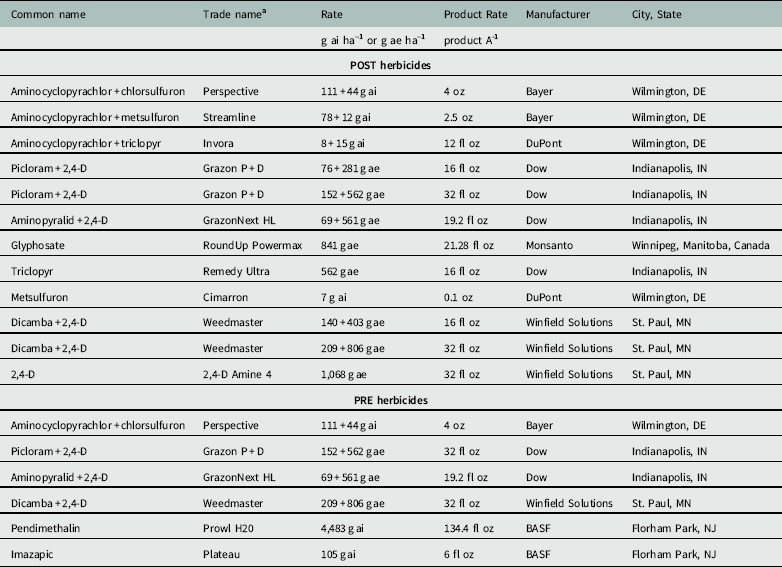
In 2014 and 2015, three replications of 10 herbicide formulations were applied to a dense stand of perilla mint in a pasture in Noxubee County, Mississippi (32.94 N, 88.76 W). A randomized complete block design was established on a highly disturbed, Ruston fine sandy-loam soil with a pH of 5.4 and 1.6% organic matter. At the time of applications in mid-August 2014, plants were at the late vegetative to early reproductive stage and approximately 46 to 61 cm tall. The repeat study was initiated in late June 2015 when plants were at the vegetative growth stage and approximately 30 to 45 cm tall. Herbicide treatments and application rates evaluated are shown in Table 1. A nontreated control was included for comparison. All treatments except glyphosate received 0.25% v/v nonionic surfactant (Induce, Helena Chemical Co., Collierville, TN). Treatments were applied with a CO2-pressurized backpack sprayer equipped with four TeeJet XR8002VS nozzles (Spraying Systems Co., Wheaton, IL) calibrated to deliver 130 L ha–1 spray volume. Control was visually evaluated at 2-wk intervals until 56 d after treatment (DAT). In 2015, visual injury was also evaluated at 70 and 94 DAT. Effective control was based on plant injury and overall health relative to the nontreated control, where 100% control was equivalent to complete plant death. Inflorescences from perilla mint plants outside the treated field study were collected October 14, 2014 and later cleaned and stored at 4 C for future tests.
Herbicide rates and formulations applied in the field experiments.

a All POST treatments except Roundup-Powermax included a 0.25% v/v nonionic surfactant.
PRE Experiment
In 2016 and 2017, four replications of six herbicide formulations were applied to soil in locations where dense populations had been observed the prior year (Table 1). On March 17, 2016, the study was established on a highly disturbed Smithdale-Lucy soil (32.94 N, 88.76 W) with a pH of 6.2 and 1.3% organic matter. On April 10, 2017, treatments were applied to a Ruston fine sandy-loam soil (32.94 N, 88.76 W) with a pH of 5.8 and 1.8% organic matter. Treatments were arranged in a randomized complete block design and applied with a CO2-pressurized backpack sprayer equipped with four TeeJet XR8002VS nozzles (Spraying Systems Co., Wheaton, IL) calibrated to deliver 130 L ha–1 spray volume.
Both sites had an emerged stand of wheat (Triticum aestivum L.) and annual ryegrass [Lolium perenne L. ssp. multiflorum (Lam.) Husn.], approximately 20 to 25 cm tall, that had been planted following tillage the previous fall. At the time of herbicide application in 2016, perilla mint seedlings had not emerged. To reduce competition from the winter grazing mixture, 0.23 kg ae ha–1 glyphosate was included in each treatment. Within 48 h after treatment application, approximately 1.3 cm of precipitation occurred on the treated site. Herbicide efficacy was evaluated 113 and 141 DAT.
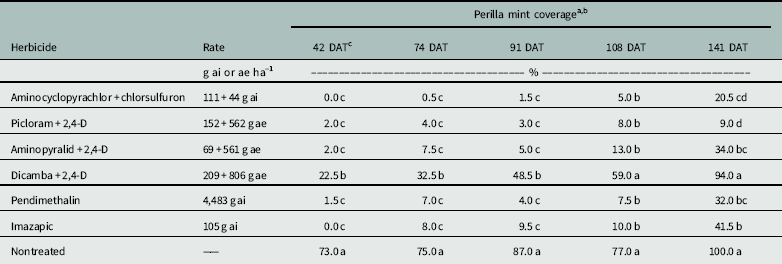
In contrast to 2016, perilla mint seedlings had emerged with the majority of visible plants at the two-leaf growth stage, and overseeded wheat and ryegrass was approximately 30 cm tall when treatments were applied in 2017. The rate of glyphosate in each treatment mix was increased to 1.26 kg ae ha–1 compared to the previous study because of the increased height of wheat and ryegrass and lack of adequate control in 2016. Approximately 1.3 cm of rainfall occurred 24 h after application to incorporate PRE herbicides. Herbicide efficacy was evaluated 42, 74, 91, 108, and 141 DAT in 2017. At each evaluation date, perilla mint control was measured as the percent of live plants counted in a 1-m2 mapping frame composed of 25 sub-squares (Forestry Suppliers, Jackson, MS). The frame was randomly placed twice per plot, and the number of sub-squares that contained live perilla mint plants was recorded. Therefore, the fewer squares that contained live plants indicated improved control.
Seed Germination Experiment
Seed from the aforementioned source were collected on October 14, 2014, cleaned with a no. 20-mesh sieve, and stored in a capped glass vial at 4 C until used for germination tests. Two germination studies were conducted, one in 2015 and one in 2017. The elapsed time between the date of seed collection and initiation of the first and second germination studies were 4.5 and 35.5 mo, respectively. Four replications of 30 seeds were placed in petri dishes (8.9 cm diameter) on a single layer of no. 1 Whatman filter paper (GE Healthcare, Buckinghamshire, UK). Night/day temperature regimes consisted of 10/15 C, 15/20 C, 20/25 C, 25/30 C, and a constant 22 C. A 12-h photoperiod was held constant across all tests. Seeds were kept moist throughout the duration of the experiment with a 3.25 g L–1 fungicide solution (Halt systemic, Ferti-Lome. Voluntary Purchasing Groups Inc. Bonham, TX) mixed with water. Seeds were considered to have germinated when the radicle protruded through the seed coat. Numbers of germinated seeds were recorded every other day until 4 d had passed with no additional germination. The numbers of germinated seed from each observation were converted to the percent of total seeds (30) and accumulated over each day. Results are presented at 4, 8, 12, 16, 20, and 24 d after initiation.
Statistical Analysis
Collected data from all studies were analyzed for variance by PROC GLM in SAS (2008) and tested for both main treatment effects and year-by-treatment interactions. When the treatment effects were significant, means were separated by Fisher’s LSD test with an observed significance level of P=0.05. When significant interaction occurred between years, data were presented by year. Models from the POST and PRE studies evaluated herbicide efficacy, whereas the germination study tested for the effect of temperature.
Results and Discussion
POST Experiment
2014 Field Trial
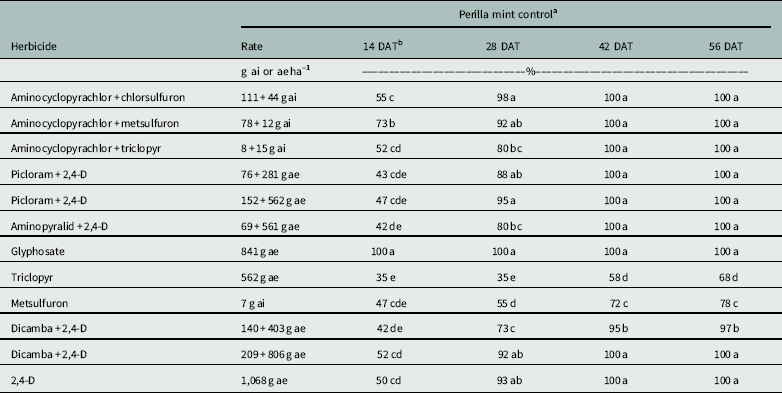
Treatment-by-year interactions were significantly different (P<0.0001); therefore, data were presented by year. Glyphosate was the most effective herbicide treatment, as 100% perilla mint control was observed 14 DAT. By 28 DAT, aminocyclopyrachlor+chlorsulfuron, picloram+2,4-D, 2,4-D, 209+806 g ae dicamba+2,4-D, and aminocyclopyrachlor+metsulfuron provided >88% control of perilla mint, which was equivalent to control with glyphosate. At the 42- and 56-DAT evaluations, complete control (100%) was achieved by every treatment, except the lowest dicamba+2,4-D rate, metsulfuron, and triclopyr. Although these three treatments provided less control than all other treatments, efficacy ranged from 58% to 95% 42 DAT. Additionally, perilla mint control with these treatments increased between the 42- and 56-DAT evaluations (Table 2).
Control estimates of perilla mint following POST herbicide applications on August 19, 2014.

a Means within a column followed by the same letter are not significantly different according to Fisher’s protected LSD test at P≤0.05.
b Abbreviation: DAT, days after treatment.
2015 Field Trial
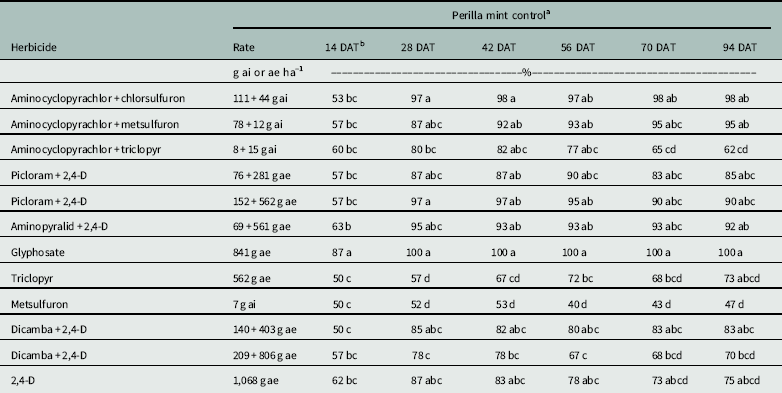
As in 2014, glyphosate provided the quickest response with 86% control 14 DAT. By 28 DAT, glyphosate provided 100% control, which was greater than aminocyclopyrachlor+triclopyr (P=0.0160), 209+806 g ae dicamba+2,4-D (P=0.0097), triclopyr (P=<0.0001), and metsulfuron (P=<0.0001). By 42 DAT, both glyphosate and aminocyclopyrachlor+chlorsulfuron provided highest control (>98%) and were significantly greater than 209+806 g ae ha–1 dicamba+2,4-D (P=0.0233 and 0.0349), triclopyr (P=0.0010 and 0.0016), and metsulfuron (P<0.0001 each) that had 78%, 67%, and 53% control, respectively. Each of these three herbicides, triclopyr, 209+806 g ae ha–1 dicamba+2,4-D, and metsulfuron, resulted in lower control than glyphosate (100%) 56 DAT (Table 3). By this evaluation period, treatments with >76% control were just as effective as glyphosate for control of perilla mint. Dicamba+2,4-D at 209+806 g ae ha–1, aminocyclopyrachlor+triclopyr, and metsulfuron resulted in less than the 73% control 94 DAT (Table 3).
Control estimates of perilla mint following POST herbicide applications on June 26, 2015.

a Means within a column followed by the same letter are not significantly different according to Fisher’s protected LSD test at P≤0.05.
b Abbreviation: DAT, days after treatment.
Results from both years indicate the most effective treatments for season-long perilla mint control were aminocyclopyrachlor+ chlorsulfuron or metsulfuron, at least 76+281 g ae ha–1 picloram+2,4-D, aminopyralid+2,4-D, and glyphosate. Each of these treatments provided >90% control through 56 DAT. Results from the 56-DAT (2014) and 94-DAT (2015) evaluation were most notable and representative of practical recommendations for season-long control. Field observations following herbicide applications revealed treated perilla mint entered a wilted state until approximately 28 DAT. In these situations, researchers suggest livestock removal (Anonymous 2015; Steckel and Rhodes Reference Steckel and Rhodes2007), especially if palatability increases and other desirable forages are limited. All herbicides listed, with the exception of aminocyclopyrachlor blends, are labeled for broadleaf control in forage grasses. Nonselective glyphosate is labeled for broadcast applications to pastures at rates of 315 to 433 g ha–1 prior to forage green-up, or spot applications, not to exceed 10% of the total pasture area, at rates up to 2,553 g ha–1.
PRE Experiment
2016
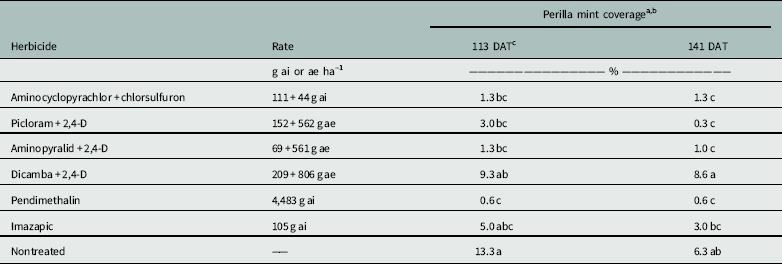
Treatment-by-year interactions were significantly different (P<0.0001); therefore, data were presented by year. By 113 DAT, wheat and annual ryegrass had matured, but yellow foxtail [Setaria pumila (Poir.) Roem. & Schult.], along with a few perennial broadleaves, had emerged in the experimental area. Measurements of perilla mint control were made at two observation times, 113 and 141 DAT, to determine effectiveness. By 113 DAT, pendimethalin provided the greatest control of perilla mint with <1% plant occurrence, followed by aminocyclopyrachlor+chlorsulfuron, and aminopyralid+2,4-D (both 1.3%), and picloram+2,4-D (3%), respectively (Table 4). Perilla mint cover of the nontreated plots at 113 DAT was 13%. An evaluation 28 d later, at 141 DAT, revealed these four herbicide treatments were still most effective for perilla mint control. Dicamba+2,4-D and imazapic exhibited no greater control than the nontreated control during each evaluation (Table 4).
Influence of preemergence (PRE) herbicides on perilla mint plot coverage following application on March 17, 2016.

a Means within a column followed by the same letter are not significantly different according to Fisher’s protected LSD test at P≤0.05.
b Percent coverage was determined using a 1-m2 mapping frame composed of 25 sub-squares, where the number equals the mean number of sub-squares that contain live perilla mint plants sampled twice per plot.
c Abbreviation: DAT, days after treatment.
2017
Yellow foxtail density in the experimental area during the summer of 2016 study was the most likely cause of the year-by-treatment interaction. Significant differences were observed between herbicide treatments at each evaluation date with respect to percent perilla mint cover. All treatments, except dicamba+2,4-D, provided effective perilla mint control with populations suppressed below 2% plot coverage by 42 DAT. Although dicamba+2,4-D significantly reduced the perilla mint stand (22%) compared to nontreated control plots (73%) (P<0.0001), residual control dissipated by 42 DAT (Table 5). Shaner (Reference Shaner2014) indicated dicamba leached from the weed seedling emergence zone within 3 to 12 wk after application in humid environments, and the half-life was only 4.4 d in loam soils. This also demonstrates the long period of perilla mint seed germination.
Influence of preemergence (PRE) herbicides on perilla mint plot coverage following application on April 10, 2017.

a Means within a column followed by the same letter are not significantly different according to Fisher’s protected LSD test at P≤0.05.
b Percent coverage was determined using a 1-m2 mapping frame composed of 25 sub-squares, where the number equals the mean number of sub-squares that contain live perilla mint plants sampled twice per plot.
c Abbreviation: DAT, days after treatment.
Levels of differential herbicide activity remained the same through 91 DAT, where the most effective treatments suppressed perilla mint below 10% coverage. At 74 DAT, fluazifop at 0.21 kg ai ha–1 was broadcast to all plots to suppress warm-season grass competition. By 108 DAT, warm-season grasses were controlled and the density of perilla mint remained below 13%. The most effective treatments for residual perilla mint control were aminocyclopyrachlor+chlorsulfuron (5%), followed by pendimethalin (7.5%), picloram+2,4-D (8%), imazapic (10%), and aminopyralid+2,4-D (13%), respectively.
By 141 DAT, there was no significant difference in control between aminocyclopyrachlor+chlorsulfuron and picloram+2,4-D, where perilla mint covered only 20.5% and 9% of plots, respectively. Picloram+2,4-D also exhibited better visual control (84%) and decreased overall plant coverage more than pendimethalin, aminopyralid+2,4-D, and imazapic (data not shown). There was no difference in perilla mint control between dicamba+2,4-D and the nontreated control, with respect to both visual control and perilla mint coverage. Previous authors reported perilla mint could reach heights of 175 cm (Burrows and Tyrl Reference Burrows and Tyrl2001); however, at this final evaluation in late August, plants in the bloom stage measured 219 cm tall in open sunlight with basal stem diameters of 3.8 cm.
Overall, the infestation of broadleaf weeds was minimal in 2017 compared to the 2016 study, despite grass control from the higher initial glyphosate application rate and fluazifop application. Considering the results from 2 yr of evaluation 141 DAT, applications of picloram+2,4-D and aminocyclopyrachlor+chlorsulfuron most consistently provided the highest level of control and greatest reduction in perilla mint coverage. Although not as effective as picloram+2,4-D and aminocyclopyrachlor+chlorsulfuron, pendimethalin and aminopyralid+2,4-D, provide moderate PRE control of perilla mint.
Seed Germination Experiment
2015
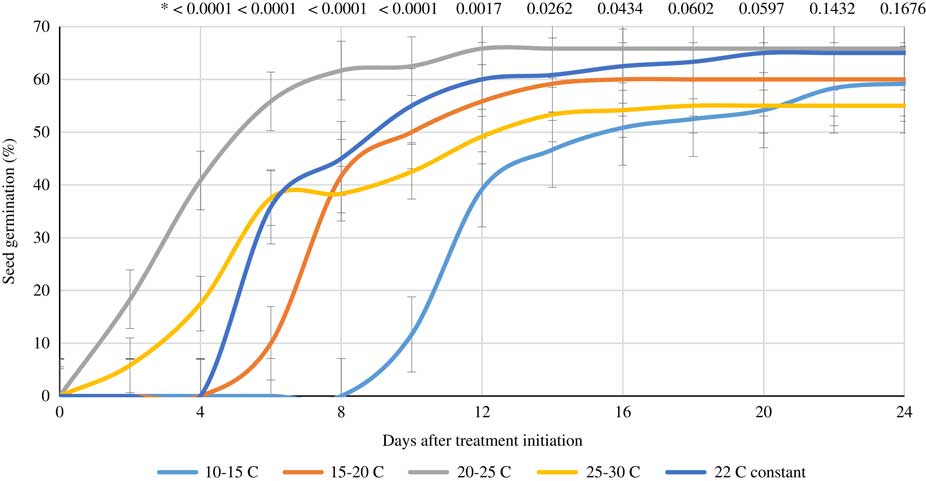
Significant interaction occurred between year (P=0.0002) and year by evaluation date (P≤0.0001); therefore, data were analyzed and presented separately by year. The effect of various temperature regimes on perilla mint seed germination was significant 4, 8, 12, and 16 d after treatment initiation (Figure 1). The greatest mean seed germination occurred in a temperature range of 20 to 25 C and was most significant at days 4 and 8 (41% and 62%, respectively), indicating the quickest germination response by temperature. Under these temperatures, 93% of the total germination occurred within the first 8 d. Between days 8 and 20, there were no differences in mean seed germination at 15 to 20 C, 20 to 25 C, or 22 C constant. By the conclusion of the experiment 24 DAT, there were no differences between temperatures with respect to mean seed germination. As a result, under the lowest of these temperature regimes (10 to 15 C), seed germination may be delayed for at least 24 d and may germinate as soon as 4 to 8 d in 20 to 25 C temperatures. Additionally, when mature seed were maintained at 4 C for 4.5 mo, mean seed germination reached 61% across all temperature regimes by 24 DAT.
Cumulative perilla mint seed germination as affected by temperature in 2015. *P values indicate significance among temperature regimes within each evaluation date, P≤0.05. Error bars represent standard error of the mean for each evaluation.

2017
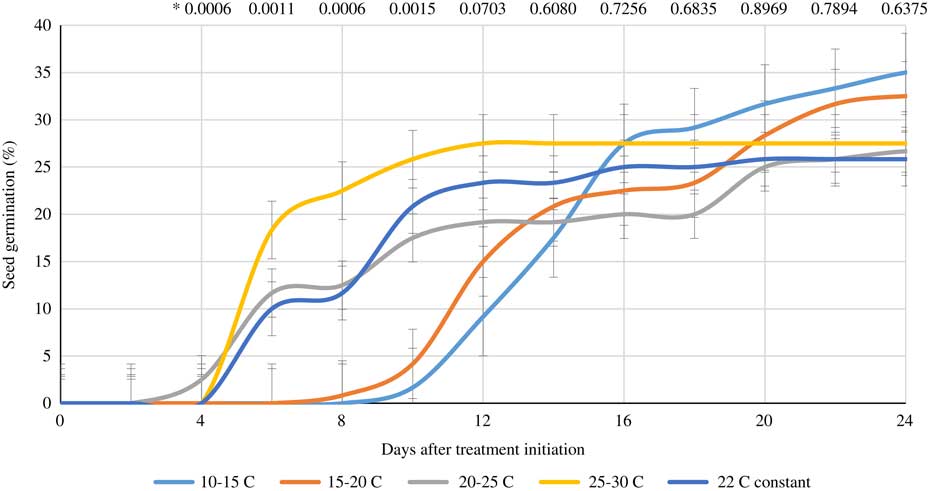
The effect of various temperature regimes on perilla mint seed germination was significant through 10 d after treatment initiation (Figure 2), as opposed to differences through 16 d in the 2015 study. Temperature regimes of 20 to 25 C caused the quickest seed germination at day 4 (2.5%), but between days 6 and 14, the greatest seed germination occurred at the 25 to 30 C regime. By the 12th day, seed in 25 to 30 C had reached a maximum germination of 27.5%. At this date, both 25 to 30 C and 22 C constant regimes caused a significantly higher germination percentage than those in 10 to 15 C temperature regimes (P=0.0092 and 0.0354, respectively). From 14 to 24 DAT, there were no differences between any temperatures with respect to mean seed germination. Additionally, when seeds were kept at 4 C for 35.5 mo, mean seed germination across all temperature regimes reached 30%, a 51% reduction in seed viability in 31 mo of storage (data not shown).
Cumulative perilla mint seed germination as affected by temperature in 2017. *P values indicate significance among temperature regimes within each evaluation date, P≤0.05. Error bars represent standard error of the mean for each evaluation.

With adequate moisture, perilla mint seed is capable of germination in a range of night/day soil temperatures from 10 to 15 C/25 to 30 C. Due to the large window of ideal seed germination conditions, soil temperature data suggests that the aforementioned PRE herbicides must be applied and activated before these temperatures occur. Temperature must be closely monitored to determine the optimum time to apply PRE herbicides for perilla mint control.