Aortic stenosis (AS) is caused by age-related calcific degeneration of the aortic valve (Reference Vahanian, Alfierib and Al-Attara1). Initially, cases are asymptomatic but, from the point that symptoms first develop, there is rapid progression and if left untreated survival estimates are low (2–3 years) (Reference Vahanian, Alfierib and Al-Attara1). Therefore, managing AS effectively and efficiently is a priority for health systems with increasing healthcare costs and longer life expectancy.
Traditional treatment for AS involves conventional surgical aortic valve replacement (AVR), which reduces symptoms and improves survival. In patients without significant comorbidities, AVR is associated with a low operative mortality (Reference Leon, Smith and Mack2). However, patients with severe AS are often elderly with significant comorbidities which may increase operative risk, complicate post-operative recovery and independently influence subsequent morbidity and mortality even after successful surgery. As a result, over 30 percent of patients with severe symptomatic AS are not considered suitable for conventional surgery (Reference Leon, Smith and Mack2). These patients have traditionally been managed with drugs and in some cases balloon valvuloplasty. While these treatments may provide short-term relief of symptoms, they offer no improvement in mortality (Reference Bonow, Carabello and Chatterjee3).
Transcatheter aortic valve implantation (TAVI) is a less invasive treatment for patients with severe AS, whereby a bioprosthetic valve is mounted on a catheter and is inserted percutaneously, usually from the femoral artery, and passed to the diseased aortic valve where it is implanted (Reference Leon, Smith and Mack2). Patients considered at too great a risk to undergo AVR (inoperable patients) could potentially benefit from a less invasive valve procedure such as TAVI. Since the first use of TAVI in man in 2002, the annual number of procedures has been increasing, particularly for these inoperable patients (Reference Cribier, Eltchaninoff and Tron4). Despite this increase, evidence surrounding the effectiveness and cost-effectiveness of TAVI is limited and within the UK, approval for TAVI procedures is under review. In England and Wales, NICE Interventional Procedure Guidance (Number 421, 2012) has recently approved the use of TAVI for inoperable patients providing details are entered into the UK Central Cardiac Audit Database (5). In Scotland, the Scottish Health Technologies Group advice statement (Number 005/11) does not currently recommend TAVI for routine treatment of patients with AS (6). However, following the recent approval in England and Wales, the Scottish Government have committed to reviewing this position (7).
This study uses a probabilistic decision analytical model to determine the expected cost-effectiveness of TAVI compared with medical management for patients with severe AS who are deemed inoperable, the uncertainty surrounding the decision and the potential worth of further research to inform this decision in the future. In addition the study presents a re-analysis following the recent publication of data concerning the long-term outcomes associated with TAVI. This updated iteration reflects the evolving evidence base, as is prevalent in novel technologies such as TAVI.
METHODS
The analysis presented here uses a decision analytic model to assess the long-term cost-effectiveness of TAVI compared to medical management. The model involved two main elements, a short-term decision tree which covered the first month following commencement of treatment and a longer-term Markov model which covered the period from 30 days to death. This enables a comprehensive mapping of the disease pathway, which is sensitive to mortality and morbidity outcomes.
Short-term Modeling of the Procedures
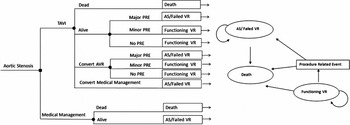
The initial 30 days from commencement of treatment, including the procedure, is modeled using a decision tree (Figure 1). Patients are eligible for TAVI or medical management. For those receiving TAVI, there is a risk of death during surgery. Those who survive the procedure could experience procedure related events (either major or minor) or be event free. Major procedure related events, for example valve thromboembolism or myocardial infarction, are assumed to have longer-term impacts on health, costs and utility. Minor procedure related events, for example pacemaker implantation or vascular events, are assumed to result in only short-term impacts on health, costs and utility (i.e., just within the 30-day period covered by the decision tree). In addition, there is a risk of major disabling stroke associated with the TAVI procedure which attracts costs but in terms of utility impact is assumed to be equivalent to death (i.e., utility = 0). There is also a chance that the procedure is not delivered, in this case patients may convert to AVR or the procedure may be aborted altogether with patients receiving medical management only. Where this occurs the outcomes are assumed to be equivalent to, and incur in the same proportions as, the treatment actually received. Patients receiving medical management are assumed to receive appropriate medical care, in the form of medication and in some cases balloon valvuloplasty, but no other valve procedure. These patients have a risk of death during the initial 30 days, as at any time, and those who survive move to the persistent AS state of the Markov Model.
The decision tree model.

Long-term Modeling
A Markov Model is used to model the longer-term (Figure 1). There are three states in the Markov Model: functioning valve replacement, persistent AS, and death. Outcomes from the initial 30 days (as presented on the decision tree) determine the state in which patients enter the Markov model. Each cycle is 12 months in duration and the model is run until all the patients have died. TAVI patients entering the model in the functioning valve state (i.e., those receiving a procedure and not experiencing a stroke or major procedure related event) are at risk of death from natural causes or a late major event. These late major events may be fatal (moving them to the death state) or nonfatal but resulting in longer-term impacts on health (moving them to the persistent AS state). TAVI patients may also experience a late minor event which does not impair health into the future but incurs a short-term cost and impact on utility. Patients in the persistent AS state (i.e., those who did not receive a procedure or who have experienced a major event) are at risk of death, assumed to be higher than for those in the functioning valve state, to reflect the impact on health.
Data Sources
Where possible the parameters employed in the model are informed by the results from the first randomized controlled trial for TAVI (PARTNER) undertaken between 2007–11 across twenty-five centers in Germany, Canada, and the United States. Cohort B of the PARTNER trial specifically focused on patients, considered to be at too high a risk for conventional valve replacement (Reference Leon, Smith and Mack2). Three hundred and fifty-eight patients were randomly assigned to either TAVI or medical management. The evidence from PARTNER (cohort B) provides an insight into the morbidity and mortality associated with both TAVI and medical management for severe, inoperable patients.
A review of the published literature revealed additional papers reporting results from registries and case series for valve replacement (Reference Webb, Pasupati and Humphries8–Reference Aupart, Mirza and Meurisse16). Where data were not available from PARTNER (cohort B), evidence from this literature was used as appropriate.
Transition Probabilities
Where data to estimate transition probabilities were not available in PARTNER (cohort B), evidence was synthesized from the literature to populate the transition probability parameters in the model. This was done simply by summing the number of cases experiencing each event across the studies reporting each event and taking this as a proportion of the total number of patients involved in the relevant included studies (Supplementary Table 3, which can be viewed online at www.journals.cambridge.org/thc2013066).
Using evidence from PARTNER (cohort B) or other literature (as detailed above) the following transition probabilities were estimated for the short-term model (Supplementary Tables 1, 2, which can be viewed online at www.journals.cambridge.org/thc2013066). For patients receiving TAVI, 1 percent converted to AVR; 2 percent converted to medical management and 7 percent died within 30 days. Thus, approximately 90 percent of patients allocated to TAVI actually received the procedure, of these 18 percent had a major procedure related event and a further 5 percent had a major stroke. Of the remaining patients, 58 percent had minor procedure related events. For patients receiving medical management, the probability of death was 4 percent in the short-term.
The PARTNER (cohort B) results (Reference Leon, Smith and Mack2) indicated a 20 percent absolute mortality reduction after 12 months and higher quality of life outcomes from TAVI relative to medical management in inoperable patients, despite the relatively high incidence of procedural events. Beyond 1 year, there was no information on natural mortality amongst surviving patients. As such, age/sex adjusted natural mortality rates were applied within the model with an additional adjustment of 1.5, chosen to represent the higher than average risk of death amongst patients undergoing valve procedures. For patients in the persistent AS state of the model surviving beyond 1 year, the life expectancy was assumed to be approximately 3 years, equating to a transition probability of 0.33 (Reference Legrand, Beckers and Fastrez17).
The point estimate and uncertainty surrounding each of the transition probabilities were incorporated into the model through the assignment of beta distributions specified from the total number of patients experiencing each event and the number at risk of each event.
Costs
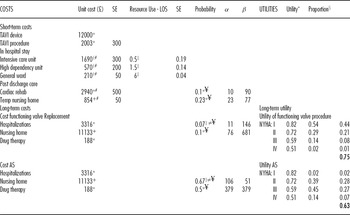
The cost analysis included estimates for the following resources: TAVI and AVR devices (the latter is included to cost the conversions) and procedures; length of stay; hospitalizations and other costs incurred with procedure related events (Reference Leon, Smith and Mack2;Reference Gehlot, Mullany and Ilstrup13;Reference Yan, Cao and Martens-Nielsen18–Reference Netten20). To calculate the costs associated with each of the states in the Markov model, the annual number of hospitalizations was estimated using hospitalization rates per NYHA class (Reference Ahmed, Aronow and Fleg21) and multiplied by the proportion of patients in each NYHA class per state taken from PARTNER (cohort B) (Reference Leon, Smith and Mack2). In addition, medication costs were added to calculate the cost of the functioning valve replacement and AS states. The costs associated with the short and long-term models and the associated parameters and ranges for the probabilistic analysis are reported in Table 1. Normal distributions were applied to the length of stay parameters and beta distributions were applied to the probability of requiring post discharge care and/or future hospitalizations/nursing home care. The costs of the procedure related events were determined from the unit costs associated with each event and a weighting representing each event as a proportion of the total events. Normal distributions were applied to the costs of treating procedure related events based on central limit theorem.
Cost and Utilities per State

Note: *(31) †(31-33) +(20) ‡(2) ≠estimated using hospitalisations by NYHA class from (21) ^(22) #Normal Distribution applied ¥Beta Distribution applied §Dirichlet
Utilities
The disutilities associated with procedure related events were estimated in a similar manner to the costs, using weights to give the overall disutility. Normal distributions were applied to the disutility values associated with the procedure related events.
A simplifying assumption was made that disabling stroke was equivalent to death in terms of utility (i.e., utility = 0). The utilities associated with persistent aortic stenosis and functioning valve procedure (Table 1) were calculated based on the estimated utility by NYHA class as per Maliwa et al. (Reference Maliwa, van der Heijden and Bots22) applied to the proportion in each NYHA class as per PARTNER (cohort B) (Reference Leon, Smith and Mack2). A Dirichlet distribution (a multinomial version of the beta distribution) was applied to the proportions in each NYHA class to allow for uncertainty. In addition, a short-term disutility of 0.0035 for 6 weeks was applied to TAVI to account for the impact associated with the initial procedure (Reference Rao, Aziz and Panesar23). For those who were converted to AVR, this short-term disutility was 0.012 for 13 weeks (Reference Rao, Aziz and Panesar23).
ANALYSIS
The evaluation was undertaken from the perspective of the UK NHS. A Monte Carlo simulation with 10,000 iterations was used to propagate the uncertainty in the individual model parameters, reflected by the assigned probability distributions, through the model to produce a distribution of expected costs, expected life-years and expected quality-adjusted life-years (QALYs) associated with each treatment. The mean values of these distributions were used to calculate the incremental cost-effectiveness ratio (ICER) in terms of the expected incremental costs associated with TAVI compared to Medical Management per incremental QALY gained. Cost-effectiveness acceptability curves (CEACs) were used to consider the uncertainty surrounding the cost-effectiveness of the procedure by plotting the probability that each procedure is cost-effective against a range of ceiling thresholds (Reference Briggs, Claxton and Sculpher24).
To date, there are limited data on the long-term health outcomes associated with TAVI. Commentaries (Reference Webb and Cribier25) suggest that the data, that exist from trials and registries published to date, relate to older generations of devices employed at centers some of which were relatively inexperienced with delivering the devices at the time. It is suggested that both of these shortcomings may have contributed to the high rate of procedure related events associated with TAVI and that outcomes may be improved in future studies. A scenario analysis was therefore conducted to analyze the impact of improvements in the rates of procedure related events on the cost-effectiveness of TAVI.
A Bayesian Value of Information analysis (VoI) was used to investigate whether there was potential value in collecting additional evidence. The Expected Value of Perfect Information (EVPI) investigates what society would be willing to pay to eliminate all the uncertainty surrounding the coverage decision. This is calculated as the difference in the net benefit of the decision made with perfect information and that made on the basis of current information (Reference Briggs, Claxton and Sculpher24). As information is non-exclusive, the overall EVPI for a population can be estimated (Reference Briggs, Claxton and Sculpher24). In the UK, the annual number of patients presenting with severe AS deemed ineligible for surgery has been estimated at 2,750. The Expected Value of Perfect Parameter Information (EVPPI) investigates the potential value associated with collecting further information about specific parameters or groups of parameters. The EVPPI estimates the value of eliminating the uncertainty surrounding particular parameters in the decision model and is calculated as the difference between the expected value with perfect and current information about particular parameters (Reference Briggs, Claxton and Sculpher24). Here the value of acquiring perfect information was considered for five representative groups of parameters. Group one included all of the short-term probabilities following TAVI (mortality, probability of procedure related events, etc); group two considered short- and long-term probabilities following TAVI; group three considered resource parameters for the TAVI procedure, group four considered utility parameters for the TAVI procedure and group five considered the parameters in all of the four groups together.
RESULTS
The model revealed a 14 percent reduction in all-cause mortality following TAVI (compared to medical management) at the end of year 1. The results of the cost-effectiveness analysis for inoperable patients suggested that TAVI was both more costly (£28,061 versus £12,176) and more effective than medical management (1.63 versus 1.19 QALYS and 2.54 versus 2.24 life-years gained). The ICER is estimated as £35,956 per QALY gained (95 percent confidence interval £24,768, £65,103), which is marginally above the level usually considered cost-effective in the UK (£20,000–£30,000 per QALY) (Reference McCabe, Claxton and Culyer26).
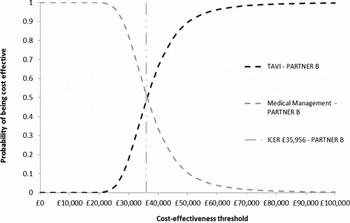
The uncertainty in the estimates suggests that there was no uncertainty surrounding the existence of benefit associated with TAVI (TAVI generated more QALYs than medical management) although there was uncertainty surrounding the extent of the differences in effects. In addition, there was no uncertainty with respect to the existence of differences in costs, with TAVI being more expensive than medical management (driven by the cost of the TAVI device) although there was uncertainty surrounding the extent of the difference in costs (driven by the uncertainty surrounding the probability of procedure related events). The uncertainty in the extent of the incremental costs and incremental effects translated into uncertainty regarding the cost-effectiveness of TAVI, as demonstrated on the CEAC (Figure 2). At a ceiling ratio of £30,000 per QALY, the probability that TAVI was cost-effective was estimated to be 18 percent, while for a ceiling ratio of £40,000 per QALY, the probability that TAVI was cost-effective increased to 66 percent.
Cost-effectiveness acceptability curves.

Scenario Analysis
The scenario analysis found that if the procedure related events associated with TAVI were reduced by 25 percent, the cost-effectiveness of TAVI would fall to £23,642/QALY with an associated probability of being cost-effective of 83 percent (at a ceiling ratio of £30,000 per QALY).
Value of Information Analysis
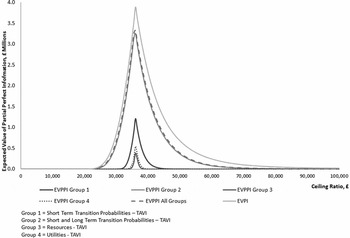
The EVPI associated with the decision between TAVI and medical management for inoperable patients ranged from £1 to £319 per patient over the range usually considered cost-effective in the UK (£20,000–£30,000 per QALY). This translated into a population value of £1,316-£852,253 per annum for the inoperable population in the United Kingdom (over the same range of cost-effectiveness) (Figure 3). The EVPI provides a maximum value for the return on further research for this population group and thus provides an upper bound on the potential value for additional research in the UK context.
Expected value of partial perfect information.

In this study, the EVPPI was estimated for five groups of TAVI parameters. The EVPPI analysis revealed (Figure 3) that the potential value in collecting further information about the four groups of parameters considered together (i.e., group five) was estimated to be £682,083 for the UK population for 1 year at a ceiling ratio of £30,000/QALY. The EVPPI for a single group was greatest for the group of short and long-term transition probabilities for TAVI (including mortality): at a ceiling ratio of £30,000/QALY the EVPPI was estimated to be £612,343 for the UK inoperable population for 1 year.
Incorporating Recent Evidence Concerning Late Outcomes
Evidence on the outcomes associated with TAVI is evolving requiring frequent re-analyses to ensure decisions are based on best available data. Decision models such as presented here can be used iteratively to facilitate this process. Since the publication of the PARTNER results, evidence has been published (Reference Bleiziffer, Mazzitelli and Opitz27) that supports previous commentaries (Reference Webb and Cribier25;Reference Schaff28) about the longer-term benefits for TAVI patients. Using an iterative process the model presented here was updated to incorporate the evolving evidence (Supplementary Table 4, which can be viewed online at www.journals.cambridge.org/thc2013066). This updated analysis suggests a 31 percent reduction in all-cause mortality associated with TAVI at the end of year 1, compared to medical management, which diminishes thereafter. TAVI remains more expensive (£30,121) and more effective (1.58 QALYs) than medical management but with an ICER ~£19,000/QALY which falls within the level usually considered cost-effective in the UK. At a threshold of £30,000/QALY there is no uncertainty surrounding this decision and very little additional value associated with collecting further information for this patient group.
DISCUSSION
Using evidence from the first clinical trial of TAVI (PARTNER [cohort B]), and evidence from the literature, the model considered the cost-effectiveness of TAVI compared to medical management amongst UK patients with severe AS considered to be ineligible for surgery. The economic evaluation revealed that TAVI was both more costly and more effective than medical management, but that TAVI was not cost-effective for these patients at the level usually considered reasonable in the UK (£20,000–£30,000 per QALY). The EVPI analysis for this inoperable population in the UK indicated that further research would be worth a maximum of £852,253 (at £30,000 per QALY). The EVPPI results suggested that, despite the publication of the results of PARTNER (cohort B), uncertainty remained particularly concerning early all-cause mortality, the probability of major procedure related events, and the probability of death from late procedure related events. The results of the scenario analysis suggested that if the rate of procedure related events associated with TAVI were reduced in the future, TAVI could be considered cost-effective.
The results of the cost-effectiveness analysis presented here are similar to those of Reynolds et al. (Reference Reynolds, Magnuson and Wang29), which were published after this analysis was performed and employed PARTNER (cohort B) evidence only. While the ICERs from the two analyses are similar (< £40,000/QALY), Reynolds et al. (Reference Reynolds, Magnuson and Wang29) concluded that TAVI was cost-effective. This is attributable to the higher cost-effectiveness threshold (£44,000/QALY), considered by Reynolds et al. (Reference Reynolds, Magnuson and Wang29).
TAVI has an evolving evidence base which is acknowledged in the iterative nature of the analysis presented here. Upon publication of new evidence on longer-term TAVI outcomes, the model was updated and TAVI was found to be cost-effective compared with medical management for inoperable patients using the best, currently available evidence.
There are several limitations to the modeling presented in this report. The model necessarily provides a stylized version of the complexities of everyday clinical practice in this challenging patient group. In particular, the comorbidities for patients with higher operative mortality risks are likely to increase over time, and this has not been explicitly modeled. In addition, to simplify the modeling required, stroke was assumed equivalent to death in terms of utility, although the short-term costs of stroke are incorporated.
Notwithstanding these limitations, it is clear that TAVI has the potential to offer significant benefits to patients who are deemed ineligible for AVR. Incorporating evolving evidence through the re-analysis of the model demonstrated that TAVI can be considered cost-effective for this patient group on the basis of the best, currently available evidence. The revised VOI analysis demonstrates there is little value in commissioning additional research for this patient group; however, as the evidence base is still evolving, continued collection of data on TAVI outcomes is advisable. One means of collecting evidence on a routine basis is through the UK TAVI registry, which records outcomes for all patients receiving TAVI at UK centers and for which early results on all patients have been published (Reference Moat, Ludman and de Belder30). These data could potentially provide further evidence on the longer-term outcomes following TAVI in the UK at a low marginal cost relative to the costs of commissioning a new clinical trial for this patient group. Such a data collection strategy is incorporated into the recently revised NICE guidance (5), whereby all TAVI procedures for inoperable patients are to be recorded.
CONCLUSION
This study sought to investigate the cost-effectiveness of TAVI compared to medical management for the treatment of severe symptomatic AS in patients deemed ineligible for surgery in the UK. Like other novel technologies, TAVI has a developing evidence base concerning its long-term effectiveness. This presents a challenge in estimating cost-effectiveness in a demanding healthcare environment, where resources are scarce and coverage decisions are required simultaneous to evidence generation. Nonetheless, this model has incorporated the best evidence, as it became available, surrounding the cost-effectiveness of TAVI versus medical management for inoperable patients with severe AS. The initial analysis revealed that TAVI was not cost-effective for this patient group although there was potential merit in collecting additional evidence on specific elements of the decision, such as the probability of procedure related events. As longer-term evidence became available it was incorporated into the model. This revised analysis demonstrated TAVI was cost-effective for inoperable patients although there was no value in commissioning further new research. Continual collection of evidence via the Registry, as per the NICE guidance, ensures that up to date evidence is available to inform any future decisions regarding TAVI in this patient group.
SUPPLEMENTARY MATERIAL
Supplementary Table 1: www.journals.cambridge.org/thc2012066
Supplementary Table 2: www.journals.cambridge.org/thc2012066
Supplementary Table 3: www.journals.cambridge.org/thc2012066
Supplementary Table 4: www.journals.cambridge.org/thc2012066
CONTACT INFORMATION
Aileen Murphy, BComm, MEconSc, (aileen.murphy@ucc.ie), Department of Economics, University College Cork, Cork, Ireland
Elisabeth Fenwick, BA, MSc, PhD, Health Economics & Health Technology Assessment, University of Glasgow, Glasgow, United Kingdom
William D. Toff, BSc, MD, FACC, FESC, FAHA, Department of Cardiovascular Services, University of Leicester, Leicester, United Kingdom and NIHR Leicester Cardiovascular Biomedical Research Unit, Leicester, United Kingdom
Matthew P. Neilson, PhD, Health Economics & Health Technology Assessment, University of Glasgow, Glasgow, United Kingdom
Colin Berry, BSc, PhD, FRCP, FACC, Professor, Glasgow Cardiovascular Research Centre, Institute of Cardiovascular and Medical Sciences, Glasgow, United Kingdom
Neal Uren, MD(Hons), FRCPE, Edinburgh Heart Centre, Royal Infirmary of Edinburgh, Edinburgh, United Kingdom
Keith G. Oldroyd, MD(Hons), FRCP, Professor, West of Scotland Regional Heart & Lung Centre, Golden Jubilee National, West of Scotland Regional Heart & Lung Centre, Glasgow, United Kingdom
Andrew H. Briggs, BSc (Hons), MSc (York) MSc (Oxon) DPhil (Oxon), Professor, Health Economics & Health Technology Assessment, University of Glasgow, Glasgow, United Kingdom
CONFLICTS OF INTEREST
Aileen Murphy, Elisabeth Fenwick and Andrew Briggs report an unrestricted education grant to their institution from Pfizer. William Toff is the Chief Investigator for the UK TAVI trial for which a grant is pending from the NIHR and has had travel expenses covered from Medtronic. The other authors report no potential conflicts of interest.