The power to hurt is bargaining power. To exploit it is diplomacy – vicious diplomacy, but diplomacy.
(Schelling Reference Schelling1966: 2)INTRODUCTION
Guerrilla movements and civil militias have come to occupy centre stage in violent conflicts in sub-Saharan Africa (see for example Bøås & Dunn Reference Bøås and Dunn2007; Francis Reference Francis2005). Most history-writing on modern African military movements either has a post-modern/New War slant, highlighting the combination of modern equipment and traditional organisation (a ‘tribal mode of warfare’), or describes African rebel movements as sectarian. However, modern African military movements are seldom analysed as strategic military actors. Yet it is clear that rebel movements and militias are military in their setup and should, at the very least, be assessed within a military framework in order to gauge their military capacities. Such a perspective renders new and important insights into armed conflicts in Africa. This article tracks a unit of the Sierra Leonean Army (SLA) as it first establishes a military government, the Armed Forces Revolutionary Council (AFRC), then turns into a proper guerrilla movement, the West Side Boys (WSB), subsequently transforms into a government militia, and then finally splits into two parts, one reintegrated into the army, and the other irrevocably erased from the scene of national politics.
This article is grounded in the politics of a military economy. The WSB was one of several military actors in the Sierra Leonean civil war (1991–2002). A splinter group of the army, and then more specifically of the AFRC, it emerged as a key player in 1999–2000. In most Western media accounts, it appeared as nothing more than renegade, anarchistic bandits, chronically drugged or intoxicated, cross-dressers, devoid of any trace of long-term goals.Footnote 1 By contrast, we aim, in this article, to explain how the WSB used well-devised military techniques in the field; how their history and military training within the SLA shaped their notion of themselves and their view of what they were trying to accomplish; and, finally, how military commanders and politicians employed the WSB as a tactical instrument in a larger map of military and political strategies.
This article therefore places the WSB in a strategic military and political context, and argues that the WSB understood their role in a strategic game, and knew how they could play a decisive part in achieving strategic goals. We show how the WSB used extreme violence and unorthodox appearance as military tools. We suggest that violence entwined with the exotic, the occult and the apparently dangerous was employed to make the enemy apprehensive, and to impose the WSB's will upon him even before actual combat. The WSB purposefully created self-images of ultra-violent anarchy in order to shape the battlefield and to deter the enemy, without even fighting them. It is thus, to use Schelling's distinction between brute force and coercion/compellence, a form of coercion (Ring Reference Ring and Brehmer2005: 91).
FRAMING THE WEST SIDE BOYS
Henrik Vigh (Reference Vigh, Christiansen, Utas and Vigh2006) has suggested that social navigation is the movement within a social environment. ‘It represents the phenomenon of engaging in a terrain, which at the same time engages you, or, in a more kinetic perspective, moving within an element, which simultaneously moves you.’ Social navigation and the creation of one's own space in a situation such as the war in Sierra Leone can take unconventional turns, especially if people position themselves as outside the social, or existing in a social vacuum, with limited means and without future.Footnote 2 Merely to be part of a movement with broader social and political implications may be viewed as sufficient reason for satisfaction, as a former child soldier in the SLA suggests: ‘I was part of something that took me seriously’ (Beah Reference Beah2007b: 36). It is equally important to understand the emotional ties that the WSB had with their commanders. The WSB created a relatedness (Carsten Reference Carsten2000) that mimicked other social relationships, such as a less hierarchical structure like a football team, creating a space where young people were given social roles that they had rarely experienced but had learned to crave, roles they maintained and sometimes fought over. Furthermore, being part of the group developed into a way to survive in the general security vacuum of the war zone: ‘those with the power to kill are the only ones with the power to protect’ (Hoffman Reference Hoffman2006: 14; see also Richards Reference Richards2005b; Utas Reference Utas2003). The frequent changeover from one military unit to its antagonist, rather than adhering to ethnico-political factions, is testimony to the individualistic social navigation of soldiers in the Sierra Leonean civil war.Footnote 3 Ultimately, this should be seen as a feature of wartime navigation, and as an indication of the extreme navigational skills that it takes to survive in a war zone. These characteristics of the WSB and other factions in the Sierra Leone civil war are, we argue, neither unique nor ‘new’, as is proposed in much of the media and the ‘new war’ literature, but should rather be seen as falling within the continuity of the history of warfare.Footnote 4
Military groups – armies, militias and rebel movements – carve out alternatively organised spaces in topographies of contested sovereignty, or in an oligopoly of violence (Mehler Reference Mehler2004), and thus form relative sovereign bodies (Hansen & Stepputat Reference Hansen, Stepputat, Hansen and Stepputat2005). They specify their own patrolled space in relation to the state and its perceived citizenry. We call these ‘actions for military navigation’, and seek to show how social and military navigation are interrelated. Social navigation by the individual soldier, such as looting on the highway, or the emic notion ‘to fearful oneself’,Footnote 5 may, if strategically organised, turn into military navigation in relation to politicians, economic strongmen, and peace-keeping/security forces in a wider militarised landscape. The meaning of strategy in this article is straightforward: on the one hand it is the bridge between politics and tactics, while on the other hand it also fills the gap between ends and means.
Inspired by the dynamic concept of social navigation, we push the analysis a step further by looking at larger military movements in the terrain of war in order to talk about military navigation, thereby moving beyond the classic problem of structural permanence in military strategies/tactics. It is only by combining social navigation with military tactics and strategies that we are able to unravel the logic of a militia like the WSB. We suggest that the same applies to other military movements, although at times less obviously. The common view of military agency is from a hierarchical viewpoint, where strategy is the highest level, with other levels being tactics, fighting techniques (what soldiers do), and operations, i.e. how the military is used to achieve military goals (what military units do) (Gray Reference Gray1999: 17ff., 38, 95). Thinking about strategy in this way doesn't help us if we want to investigate real-life aspects of war where strategy and subjects are not fixed. The flaw in the customary use of strategy as the only tool in war studies is that it provides a static, chessboard-like take on reality that does not allow for a variety of semi-sovereign actors.Footnote 6 This article argues that military strategy should be seen as a trajectory, and from a non-hierarchical point of view (Certeau Reference Certeau1984: xviii–xix, 34ff.).
The strategic interface, or the space for manoeuvre, in Sierra Leonean politics is one of state-influenced networks of control – what Bayart calls l'état rhisome (Reno Reference Reno1995: 23) – where the juncture of economic accumulation and political authority forms the basis for both the state proper and an informal ‘shadow state’ (ibid.: 6). Such political space is based on unequal status and personal contacts, and on mutually beneficial protection and services (see for example Bledsoe Reference Bledsoe1990; Fanthorpe Reference Fanthorpe2001; Howard & Skinner Reference Howard and Skinner1984; Richards Reference Richards1996). The rhizomic state is thus compromised by actors within the state and its ambit exploiting affiliations such as locality, kinship and economic networks, as pointed out by Reno (Reference Reno1995). It is here, we argue, that the WSB could chisel out strategic room for military navigation in relation to other military, political and economic actors in the Sierra Leonean conflict. Finally, in l'état rhisome, the WSB was not just a military navigator in itself but also a useful tool for politicians. The WSB was encouraged and managed in a way that benefited sections of the political elite.
THE SIERRA LEONE CIVIL WAR
Sierra Leone became independent in 1961. Its post-colonial political history is dominated by two political parties: the Sierra Leone People's Party (SLPP), which ruled between 1961 and 1967 (and again between 1996 and 2007); and the All People's Congress (APC), which ruled between 1968 and 1992 (and was re-elected in 2007), with three military governments in between (1967–8, 1992–6, and 1997–8). Siaka Stevens, APC leader and the country's president between 1968 and 1985, turned Sierra Leone into a one-party state, and reigned in distinctive cold-war style with internationally ‘accepted’ institutionalised forms of state/civilian violence and mismanagement of government funds. The APC's abuse of power paved the way for both the rurally based Revolutionary United Front (RUF) and two ‘urban’ military governments, the National Provisional Ruling Council (1992–6) and the Armed Forces Revolutionary Council (1997–8). RUF was originally composed of a small group of Libyan-trained soldiers backed by Charles Taylor and his National Patriotic Front of Liberia (NPFL) in neighbouring Liberia, and by Blaise Campaoré, President of Burkina Faso.Footnote 7 At the same time, the Sierra Leone government trained and armed the Liberian guerrilla group ULIMO, which not only fought in Liberia but also became the Sierra Leone government's most efficient tool against the RUF rebels during the early part of the war.Footnote 8
In 1992, a group of junior officers toppled the APC government and selected the young Captain Valentine Strasser as their leader. The resulting NPRC government failed both politically and militarily to end the war, although they employed international mercenaries (Gurkhas/Executive Outcomes). In 1996, NPRC handed over power to an elected SLPP government. Despite peace agreements, the war in the interior parts of the country dragged on. A partial reason for RUF's maintained strength was their discovery that controlling diamond areas meant direct access to arms from a number of international traders.
From early in the war, the Sierra Leonean army was deeply involved in factionalism and political manoeuvring.Footnote 9 The NPRC was formed by junior officers originating from Daru and Kenema barracks,Footnote 10 some of whom were loyal to the then oppositional SLPP. By contrast, other military units based in the south-western Bo, Pujehun and Bonthe districts appeared early in the war to side with the RUF rebels. The Sierra Leone army's rampant culture of making deals with political and economic interests (such as RUF) was acknowledged under the label ‘sell game’ (see for example Keen Reference Keen2005).Footnote 11 The AFRC coup on 25 May 1997Footnote 12 that toppled the SLPP government headed by Tejan Kabbah (elected democratically just over a year earlier) was led by junior officers, predominantly from Freetown, many of whom had served as personal bodyguards to ministers in the previous NPRC government.Footnote 13 Although not directly loyal, the AFRC had political sympathies and ties with the APC. A large proportion of the AFRC had northern roots or were of Western Area origin (Bangura Reference Bangura2000: 555), and directed their support in the political sphere to former president Momoh.
AFRC invited RUF into the government in a bid to end the war.Footnote 14 AFRC/RUF ruled for eight months before the exiled Kabbah government, the West African peace-keepers (Economic Community of Western African States Monitoring Group or ECOMOG), urban militia and rural Civil Defence Forces managed to muster enough resources and coordinate a structured counter-strike.Footnote 15 AFRC and RUF were forcefully expelled from Freetown and retreated into the interior of the country, mainly to Kailahun, Kono and Koinadugu districts. A large group of the Kailahun-bound soldiers ended up as refugees in Liberia.Footnote 16 Civilians in Freetown believed to be AFRC collaborators were victims of serious reprisals. The toppled president and AFRC leader Johnny Paul Koroma fled to Kailahun, but was subsequently taken and kept prisoner by RUF, until he was delivered to Charles Taylor in Liberia. It was from the remaining AFRC units in Kono that the WSB was formed.
THE WEST SIDE BOYS: LIFE AND HISTORY
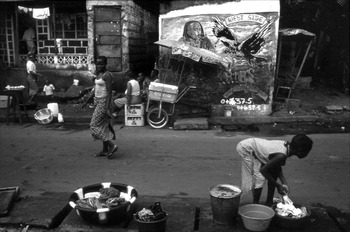
Most AFRC soldiers in Kono were from the military barracks in Freetown, while the WSB leadership largely originated from Wilberforce village. Many of the WSB were sons of soldiers and thus grew up in the Wilberforce Barracks. A partial explanation for the name ‘West Side Boys’ was their background in the Western Area, the small peninsular district with Freetown as capital. Moreover, many had been based at the barracks in Western Freetown (chiefly Wilberforce but also Juba, Cockrill). The main reason for the ‘West Side’ name was however the music of the American rapper Tupac Shakur.Footnote 17
It was during their time in Kono, in early 1998, when AFRC loyalists were based in Tumbodu, north of the provincial headquarters Koidu,Footnote 18 that the West Side name started to spread, originally as ‘West Side Niggaz’. The commander of the D Company, or the ‘Dark Angel Battalion’, Junior Lion, was fond of Tupac's music, and his musical interest spread across to the other units. According to one commander of Dark Angel:
So when we were in the camp we just wanted to listen to Shakur music. So we went singing ‘West Side’ and go on ‘ah-ah-ah-ah’ [like the background fill-in in many rap songs]. So all the other soldiers they made the name famous. So we began to plait our hair and behave like American boys. If you go to some towns in the interior you will see West Side Niggaz written on the walls. It was only when the government put charges against us that they started to call us West Side Boys. We called ourselves West Side Niggaz, yes [he says the words slowly, as if tasting them with full satisfaction]. So when we later formed the camp [in Okra Hills] we said this is the West Side Camp – because this is the Western Area. (Interview in Freetown, March 2006)
The face of Tupac Shakur on a West Side Boys mural in Brookfields area, down-town Freetown. Courtesy Danny Hoffman.

The mythology of the group also drew comparisons between Tupac's own move from the American East Coast to the West Coast, and their own journey from the east of the country to their ‘native’ West Side. That their base in Okra Hills later was at the west side of a Sierra Leonean battlefield, controlled by RUF on the north and east sides and Civil Defence Force (CDF)/Kamajor on the south side, was a coincidence that only served to strengthen the name. It would take almost a year before WSB became the official name of an independent military actor on the Sierra Leone stage.
ECOMOG overran AFRC/RUF forces in Kono district in April 1998. After being ousted from the diamond fields of Kono, AFRC troops began a roving hit-and-run existence in the interior.Footnote 19 Although revenge was apparently the leaders' main motive for atrocities on the civil population and destroying infrastructure (Koroma n.d.: 4), it also appears to have been part of their military navigation. Extreme violence transformed into strategy for this small, ill-equipped group of soldiers. Within months, the Kono group rejoined other AFRC soldiers, chiefly a group moving down from Koinadugu district under the leadership of S. A. J. Musa, a former NPRC minister, and moved in classic rebel manner from village to village, avoiding the main roads and towns, sustaining themselves from attacks on civilians and simultaneously building an aura of fear and ruthlessness around themselves. Drawing ever closer to Freetown, they started to attack military targets in order to obtain arms for a new assault on Freetown. Their strategy was anything but random. Within months, they went from a largely unequipped, dispersed group, spread over a wide area, to a force that could, and in fact did, take Freetown.Footnote 20 In January 1999, they re-entered the capital.Footnote 21 Bangura (Reference Bangura2000: 563) describes the violence not as random but rather as highly strategic.
AFRC soldiers kept partial control over the town for about a month, but did not have the military capacity to establish themselves firmly. When on 15–16 February 1999, reinforced ECOMOG troops together with SLA, CDF and civil militias went on the offensive and chased the occupiers out of the city, AFRC soldiers and their RUF colleagues massacred civilians and set as many buildings as possible ablaze in the eastern part of town. This second AFRC exodus from Freetown, the first being January 1998, signalled the end of AFRC, but also the birth of the WSB proper. The WSB was to become a semi-sovereign body in Sierra Leonean politics over the next twenty months. As the Truth and Reconciliation Commission (TRC 2004, 2: 53) documents point out, ‘in the wake of the devastating events in Freetown in January 1999, soldiers coalesced afresh around commanders with whom they had become allied or associated during the fighting. The most notable new sub-faction to emerge out of this trend was the splinter group known as the West Side Boys’. Squeezed between ECOMOG and other loyal forces in control of the Freetown peninsula, and RUF maintaining their Makeni stronghold, former AFRC troops under the leadership of Ibrahim ‘Bazzy’ Kamara set up their base behind Okra Hills in Magbeni and Gberi Bana. The base became known as ‘West Side Camp’, the ‘West Side Jungle’ or simply ‘West Side’. As one junior WSB commander explained, ‘West Side Boys became our name in Magbeni in 1999, but it was already there with us from the time of Johnny Paul [Koroma]’.
West Side Boys navigations
Although forced off the road, the WSB did not merely stumble back into the bush. In our interviews with WSB soldiers, they state that this time around they did not want to run all the way to the backwaters of Kono, but rather stayed in some proximity to Freetown.Footnote 22 The base was chosen after strategic reading of the map and environment by commanders ‘Bazzy’ and Hassan ‘Bomblast’ Bangura. The location was ideal for control, protection and launching attacks. Okra Hills is one of the most important strategic locations in Sierra Leone.Footnote 23 For the WSB, it was ideal for at least three different reasons: (1) to control Freetown militarily (military position); (2) to control the economy – trade, travel and transport (economic position); and (3) to ensure force build-up and escape routes (back-up position).
Regarding the military position, former WSB soldiers took us back to West Side Base in October 2005. On the highway, they showed us the main position for ambushes at the bottom of a fairly steep slope that carries the road up over Okra Hill. The WSB had dug furrows into the tarmac that cross-cut the entire road, and these forced all vehicles to slow down to a moderate speed, while the slope upwards prevented rapid acceleration. By controlling the road, with checkpoints Camp Cambodia and Combat Camp along the way, the WSB ensured that their base could quickly be alerted, and soldiers deployed, if a large troop of enemy soldiers approached. Especially from the Freetown side, attackers would have to arrive over the Okra Hills, and would thus be visible to the WSB. About eight kilometres off the main road, the village of Magbeni served as first base of the WSB – including, among other things, a vehicle park and also the logistics camp (the G4). The second base was at Gberi Bana about two kilometres upriver in the Rokel Creek but on the opposite side, making it extremely difficult for attackers to mount an efficient strike. Here, for obvious reasons, the senior commanders all had their houses. The WSB virtually took over Gberi Bana.Footnote 24
Looting sprees in the area and ambushes of vehicles on the road together made up what the WSB called ‘food-finding missions’. The economic position of Okra Hills was ideal. Any transport of goods from the interior to Freetown had to pass through the virtual eye of a needle controlled by the WSB.Footnote 25 The main ambush location with its furrow and the sloped terrain reduced the speed of vehicles to a virtual standstill. As most transport vehicles were overloaded, any effort to speed through the gate was hopeless. Control of the highway was however, partial, rather than total. Although Camp Cambodia on the road (with about fifty soldiers posted there), Combat Camp at Masumana junction (manned by about twenty-five soldiers), and a checkpoint in the vicinity of the ECOMOG checkpoint outside Masiaka combined to give the WSB an excellent overview, they lacked the resources or motive to act forcefully all the time.Footnote 26 Furthermore, a policy of ambushing and looting every passing vehicle would have threatened their presence, as it would have forced the Government of Sierra Leone, ECOMOG and later the United Nations Mission in Sierra Leone (UNAMSIL) to remove them from the area. The control of rural–urban trade was another element in WSB military navigation, while the opening and closing of the road at Okra Hills was used strategically in relation to government and RUF rebel forces.
The WSB did not just wield military control over a demarcated area, but also had strong organisational ties with other military and economic groups in the vicinity and beyond. Organised ‘trade’ in arms, medicine, and drugs for looted goods and diamonds was routine, as pointed out by one WSB commander: ‘The Nigerian ECOMOG commander in Robat [one General Tanko] exchanged drugs and guns and was willing to buy everything from our “food finding missions”, especially diamonds.’ Yet such trade coexisted with looting missions of the same force, as the story of an attack on a newly arrived Malian ECOMOG unit in nearby Port Loko demonstrates. The Malian troops were ‘novices to the ground’, and therefore an easy target. Aided by information from within the Nigerian section of ECOMOG, the WSB carried out a successful ‘food finding mission’ on the Malians and carried away large quantities of military and other supplies.
Nothing indicates that lack of arms and ammunition ever hindered any action of the WSB. On the contrary, ambushes and looting sprees kept supplies of arms and ammunition at the desired level.Footnote 27 Trade also played an important role in logistical support with the ‘food finding missions’ largely funding the trade in medical supplies, food and drugs. In addition to illicit partnerships from within ECOMOG, a range of traders – from large-scale Lebanese diamond tradersFootnote 28 and transport owners, to drivers and petty traders – bought looted goods (including diamonds), or obtained permits to travel through WSB territory and in that manner helped to establish Okra Hills as an alternative trading hub for some time. In fact, a high-profile Freetown drug trafficker, a woman of Nigerian origin, partly resided in Okra Hills: ‘Mamy Hadja had a deal with Bazzy. She dealt with drugs but also brought food and medicine. She would go to town every third day’ (Junior commander).
The sustained popularity of AFRC among street youth in Freetown meant that the WSB could access more troops if needed. Furthermore, the location fed the WSB with a steady re-supply of arms and ammunition. Military personnel and supply thus made Okra Hills a favourable back-up position as well. The location of the bases in Magbeni, situated on the river, and Gberi Bana, on the adjacent side, ensured perfect escape routes in the directions of Port Loko and Lungi into territory almost entirely without roads. It would be hard for any force other than a proper rebel force to attack or ambush from the other side of the Rokel River, while military control of the highway made any surprise attacks from that side highly unlikely.Footnote 29
The West Side Base was established gradually, with new people arriving over an extended period of time, both from Makeni and from Freetown. The soldiers seldom arrived alone, but brought with them families, wives, girlfriends, children and other dependents. AFRC had a large support base among certain groups of urban, socially marginalised youth, many of them transformed into self-styled soldiers. Among the rank and file were also ex-convicts who were freed alongside their own soldiers from Pademba Road jail both during the coup in May 1997 (Johnny Paul Koroma and others), and during the 6 January fighting (including commanders such as Tito and Tina Musa, the wife of SAJ Musa). Their status as criminals meant that they could not easily head back to Freetown to join Kabbah's new army as many of the other ex-junta soldiers did (Keen Reference Keen2005: 233).
WSB soldiers talk about ‘adopting families’ and ‘catching young boys’ to carry food and ammunition. After some time, many of the younger ones were incorporated in the military structure. Young boys and girls attached themselves, or were forcefully attached, to WSB soldiers and carried out diverse tasks in the household or simply became incorporated in the military structure – armed with AK 47s, but only a trace of military guidance. At the time we travelled with the former WSB soldiers to Okra Hills we met a young boy in one of the villages who came running up to one of the WSB soldiers. He was clearly very happy to see the former soldier again. The former soldier later explained that this youngster was one of his ‘boys’, who had been with him throughout his time at Okra Hills. The soldier had in fact brought the boy along as he left for Freetown and had even put him into school. But when his money was finished he sent him back to his family in the village. This case clearly points to some of the complexities in the recruitment of child soldiers, taking us beyond the force/no force distinction. It also demonstrates that the WSB were present in the area not simply as a brutal intruder.
Some of the youngest WSB soldiers formed a Small Boys Unit (SBU), numbering about a hundred, although ‘SBU’ appears to have been more of a common label for the youngest soldiers than a regular unit. The WSB took up residence in houses abandoned by civilians escaping Gberi Bana and Magbeni, with Bazzy and the senior commanders living in the largest houses of Gberi Bana. Significantly, the WSB social structure is discussed in terms of ‘extended family’ or relatedness based on social marginality, contained in the emic expression ‘youth’. The WSB viewed themselves as part of a ‘youth revolution’, where they fought to take power from a gerontocratic and patronage-based elite. As such, the WSB goal was to be free from gerontocratic inequality, and so they modelled their way of organising on the relative equality of the football team.Footnote 30 Youth status and the alternative, youthful, father figure of the ‘coachie’ coincided with that of the commander, while the power structure was modelled on military rank obtained through individual skills in the battlefield rather than on age.
Above, we have seen how images and ideals of the American rap artist Tupac Shakur were used to create a group mythology and common solidarity in a ‘me against the world’ fashion.Footnote 31 In a similar manner, the WSB used Sierra Leonean history to motivate soldiers. For instance, the geographic location of the West Side Camp became historically weighted. The earlier NPRC military junta (1992–6) had invested symbolically in Sierra Leonean history by drawing parallels between the new military leadership and heroes from national history (Opala Reference Opala1994). One of these was Bai Bureh, a son of Port Loko district who fought bravely against the British in the Hut Tax War, arguably ‘the most important revolt against British rule in the colonial era’ (ibid.: 199). When the WSB settled in Gberi Bana/Magbeni, they established an understanding that it was here that the final battle took place between Bai Bureh and the British colonial forces.Footnote 32 In this eclectic fashion, the WSB created a mythical bricolage of Tupac-righteousness, Bai Bureh nationalism and their own current predicament of marginalisation, in order to inject a wider historical and moral cause to their project as military navigators.Footnote 33
Drugs were used as another navigatory tool. The WSB themselves never hid the fact that most fighters, including the leadership, used drugs in abundance: crack cocaine,Footnote 34 heroin that is smoked, called brown-brown, Ephedrine and Diazapam, nicknamed top-up.Footnote 35 Locally grown marijuana was so frequently used that it was not even viewed as a drug proper. The WSB themselves point out that drugs were mainly used ‘recreationally’, rather than in battle (see also interview in Keen Reference Keen2005: 232).
Individuals used drugs to ease tensions related to their dangerous livelihoods but, as Keen (ibid.: 231) has pointed out, ‘drugs were often manipulated in a calculating way’. Drugs were used in the military navigation both to enable soldiers to act courageously and ultra-violently, and also to make them relax in such an extreme setting of fear and death. Drug use thus enhanced the WSB's image as randomly murderous and brutal rebel soldiers. By contrast, however, it is important to acknowledge cases when WSB soldiers avoided violence, by ‘being righteous’, as one put it. First, it indicates that a moral consciousness was not entirely lost; that an awareness of right and wrong, good and bad, was still present. Second, it also reflects military discipline, going by soldiers' accounts of abstaining from looting raids, attacks or killing the enemy because they had not been commanded to do so. It is obvious that the group's leadership utilised their training as soldiers. We should remember that some of the senior WSB commanders had been personal bodyguards in the NPRC government, trained in Ghana. Furthermore, some of our informants had been trained in Sierra Leone camps by Executive Outcomes. One junior commander talked about one of his seniors this way: ‘Bomblast was a strategist; he used code words, detailed orders, and organisation with subsections. He was a real commander.’
WSB soldiers point out how they were organised in military units and structured attacks as a formal army would. ‘We had the same chain of command as in the army, and the brigades had sub-groups called Charlie and Delta’, recalls a junior commander. Similarly, another commander says: ‘The brigades had sub-groups, the Charlie and the Delta – first moving and the other covering fire’. The battles in which the WSB engaged had been screened by the leadership to ensure that they contributed to the overall goal of carving out space in the power structure and the political reality of Sierra Leone.
The WSB made good use of a variety of communication means and, through close personal relations and advanced commander/soldier networks, WSB members were able to travel widely through ECOMOG/UNAMSIL checkpoints into Freetown and to RUF-held areas. A range of communication devices, chiefly two-way radios, made this easier.Footnote 36 Equipment was either given to the WSB by various parties or acquired by means of ambushes: ‘Communication radios were looted; we took them from the Nigerians. We had a signal group; we channelled them to our own channel and used it. We use some of them to monitor them [ECOMOG/UNAMSIL]. If they attacked us we would know.’
Radios were used to coordinate ambushes, but also to receive orders from high ranking officials, both of the WSB and other forces. Many were not based in Okra Hills but in other locations. Radios were also used for negotiations with government and peacekeepers, and as such represented negotiating space and power for the WSB. Furthermore, the WSB used radio communications to gather intelligence by intercepting ECOMOG radio traffic, apparently on a regular basis. That they talk about a proper ‘signal group’ further proves their military grasp of communication strategies.
A necessary ingredient of the WSB's military navigation was their connectedness to a political outside; networking was intense even from the bush.Footnote 37 Such communication and negotiation were an integral aspect of their daily social navigation and, at the unit level, formed part of a military navigation through army/political networks. Many of the WSB's initial leaders shared a background in the Sierra Leonean military, and the close cooperation that resulted was one of the main reasons why the WSB was able to function as well as it did. A former junior commander of the WSB states that ‘Bazzy was the main commander, and he even took orders from Sankoh during the time when Johnny Paul was kept by Mosquito’. While this appears absurd at face value, as the WSB were enraged by the fact that Sankoh had taken Johnny Paul Koroma, their former leader, hostage, it is an important reminder of the complex dynamics of politics inside Sierra Leone's intricate shadow networks.
Yet, if the WSB were keen to participate in the networks of political Freetown, this ‘structure’ was slightly more hesitant to include the WSB, as became clear when the Lomé peace accord (signed in July 1999) reached Okra Hills, and the WSB found out that WSB/AFRC was not even mentioned in the text: ‘The peace accord document came to Okra Hills but we found no reference to ourselves, it was only RUF, RUF, RUF. We then decided to begin taking hostages. [Abdulai] Koroma wrote the first document to the government regarding the hostage taking.’Footnote 38
The WSB make a direct link between their exclusion from the agreement and their strategic use of hostage-taking. Already, before settling at Okra Hills and becoming WSB proper, the WSB had taken hostages but, after the peace accord, hostage-taking became part of a new communication strategy, signalling that they were in a position to create serious damage to the government and to the continued peace process and that, unless a proper dialogue was initiated, they would do just that. Hostage-taking thus formed the aspect of the WSB's military navigation strategy that eventually brought some of them back into the army, and others back into the centre of Sierra Leone politics. Moving forward in the history of the WSB, we will see the pivotal role of patron–client politics in the decision for the core of the WSB to leave Okra Hills, and how that strategic move proved crucial to the final outcome of the Sierra Leone civil war.
West Side Boys: the later history
Johnny Paul Koroma, the former strongman of AFRC, returned to Freetown on 3 October 1999, at the same time as the RUF leader Foday Sankoh.Footnote 39 There, Koroma was somewhat ironically installed as the head of the Commission for the Consolidation of Peace (CCP), the main body charged with implementing the Lomé peace accord. Koroma constructed a personal security detail including the top leadership of the WSB from Okra Hills. The WSB core thus had the opportunity to return to Freetown. The Juba Hill residence of J. P. Koroma became in most senses a base for his ‘informal’ military faction (TRC 2004, 3A: 364).Footnote 40
Other personnel were brought in as Johnny Paul's security detail and posted in Juba at Johnny Paul's residence. These people were given state allowances. Inner circle were Five Five, Gullit, Bazzy [head of security], Sammy [Kargbo], George Adams. Even if twenty-four persons were employed [including Junior Lion] about fifty persons stayed at Juba Hills; most of them came from Okra Hills.Footnote 41
The exodus of senior commanders – that is, the military trained elite of the group – left a power vacuum in the WSB at Okra Hills, and even before Koroma arrived in Freetown the power tussle was on. Eventually, Foday Kalley emerged as the WSB leader. The relationship between the WSB and RUF remained tense, with clashes in both Lunsar and Makeni reported in local media in late October (Awoko 22.10.1999).
From mid November 1999, ECOMOG, the West African peacekeeping force, was aided by a UN force, United Nations Mission in Sierra Leone (UNAMSIL).Footnote 42 The military boost to the peacekeeping force initially stalled activities in the Okra Hills region. The WSB became involved in the Disarmament, Demobilisation and Reintegration (DDR) campaign process; large numbers began demobilising. Newspapers recorded the surrender of about 1,000 soldiers in January 2000 (Independent Observer 5.1.2000), and the ‘release’ of a group of child soldiers the subsequent month (Awoko 3.2.2000). Despite the peace accord and UNAMSIL, the demobilisation was brought to a halt by the reappearance of the RUF as a threat to Freetown. Johnny Paul Koroma, along with the WSB elite, navigated the situation wisely, regaining power and recognition in the political topography of Freetown (cf. Keen Reference Keen2005: 264). Their resurfacing as a partner to the government was noted in a parliamentary debate in early April, with MPs pointing out the strategic importance of the WSB in Okra Hills in safeguarding Freetown from the advancing RUF (New Tablet 7.4.2000).Footnote 43 And in May a combination of CDF (chiefly Kamajors), SLA and the WSB was used to halt a rapidly progressing RUF between Okra Hills and Waterloo (Keen Reference Keen2005: 264). The WSB were thus rather abruptly rearmed by, and battled to protect, the very government they had fought against for the past three years. Meanwhile, matters became equally heated in Freetown.
President Kabbah and his government, growing increasingly afraid of an RUF attack on Freetown in combination with a coup threat, finally pardoned the very military that had earlier ousted them from power.Footnote 44 With Johnny Paul Koroma as their leader, the Government of Sierra Leone (GoSL) made the WSB part of an ‘ad-hoc state security force’ (TRC 2004, 3A: 448) that within days of its formation moved on Foday Sankoh and other RUF/RUFP elements in Freetown. Starting on 6 May, WSB units ‘arrested’ RUF/RUFP strongmen in town. ‘In a statement made over state radio on Sunday [May 7] former AFRC junta leader Lieutenant-Colonel (Rtd.) Johnny Paul Koroma called Sierra Leone Army soldiers to prepare to defend Freetown against a possible RUF attack.’Footnote 45 On the same day, Koroma organised a ‘peace rally’ at the national stadium calling upon all SLA to march against the RUF. A majority of those present at the so-called ‘peace rally’ were soldiers or ex-soldiers from Freetown (TRC 2004, 3A: 385). After the ‘rally’, a smaller meeting for the new ‘peace task force’ took place (ibid.: 389). Doubtless, a lot of negotiation and strategic planning had preceded the ‘peace task force’ that Koroma formed jointly with Kamajors and police of the Special Security Division. It also appears that the ‘peace demonstration’ the following day, planned by civil society groups, was used as a vehicle to rout RUF one last time. Already in the late evening and night between 7 and 8 May, WSB units under the command of Five Five started rounding up central RUF elements in town. The WSB imprisonment of several of the main commanders severely limited the strategic capacity of the available RUF forces around Sankoh. Remaining RUF leaders took refuge at the Sankoh residence on Spur Road. The WSB and others in the ‘peace task force’ were rearmed from stores of the SLA. Despite names such as ‘peace rally’ and ‘peace task force’, very little indicated any effort towards peace.
The ‘peace demonstration’ on 8 May 2000 started in central Freetown; along the long walk to Western Freetown, numerous civilians joined in, with large numbers of WSB soldiers among them. The enraged crowd reached Spur Road and Sankoh's residence, throwing rocks, the small UNAMSIL guard post outside Sankoh's house panicked, and finally RUF security in the compound began to give fire into the crowd.Footnote 46 This was the signal for the ‘peace task force’ (joint WSB, SLA and Kamajors), who had surrounded the compound. Their massive fire power soon overcame the RUF and left many dead or wounded. Sankoh and a small group of senior officers and politicians, however, managed to escape, only to be captured days later. The incident signalled the beginning of the end for RUF and, somewhat ironically, the same was true for the WSB, which had now reached the point they had aimed for – return to Freetown and re-acceptance as part of the military force. WSB soldiers kept the city under siege for days with repeated looting raids and violence.
The SLA, the WSB and the Kamajors collaborated to form a force of at least one battalion in strength. The TRC (2004, 3A: 457, 459) states that the official government side made clear military and strategic use of the WSB in the conflict. For instance, the WSB were called in, by radio, from Okra Hills to join in the 8 May battle on the government side as a provisional ‘peace task force’, armed by SLA on direct orders from the very top of the GoSL. They were given all necessary logistical support, including vehicles, from military stores and began to move out to Newton on the evening of 8 May. Some WSB soldiers had remained in the Waterloo–Okra Hills area to fight off attacking RUF; they now joined in and pushed RUF soldiers back beyond Masiaka and eventually all the way to Lunsar.Footnote 47 Clearly, the WSB played a vital role in the protection of Freetown, both within the city and by preventing the larger RUF force from entering the city.
The Kabbah government used the WSB to protect strategically important locations. Likewise, the WSB and their leader Koroma skilfully navigated both the political and the security/military scene by swiftly shifting alliances. The TRC points out how the Kabbah administration steered Koroma and the WSB in order to deliver the final blow to the RUF. What the TRC does not mention, because it does not believe it was the case, is that Koroma may have been involved in a more direct sense, as the one who informed Kabbah that the RUF onslaught on Freetown was part of a planed takeover from within Freetown. Several of the commanders loyal to Bazzy believe that, a few weeks earlier, Bazzy, Five Five and Gullit had been approached by top RUF elements who wanted them to influence Koroma to merge with Sankoh in a combined coup. They went on to state that although Koroma had an interest in getting rid of Kabbah once more, he was not willing to let Sankoh become president. Koroma also believed that UNAMSIL was too strong to take on at the current stage. According to one of Bazzy's commanders:
He [Koroma] had much respect for the military powers [capacity] of UNAMSIL. He joined Kabbah and informed him that he could use his WSB forces to protect the government. This is what happened in the messy May 7 and 8 demonstrations and the following havoc. So in this case WSB fought alongside CDF and the loyal SLA, first showing power in Freetown and later making RUF withdraw from Masiaka.(Interview in Freetown, March 2006)
Already in late May,Footnote 48 the WSB/SLA/Kamajor coalition broke up after a key battle for the RUF stronghold Lunsar (TRC 2004, 3A: 460). The reason, according to Keen (Reference Keen2005: 284), was that ‘West Side Boys fighters turned their guns on their ostensible allies among government troops during a battle for another town, Lunsar: significantly the dispute was apparently about rank, with the West Side Boys wanting to keep the grand ranks, including “brigadier”, that they awarded themselves in the bush'. Keen is suggesting that Koroma failed to control the WSB, yet it is more likely that by then the remaining WSB had lost its political usefulness to the government, while for Koroma it turned into a problem that he swore he had nothing to do with. The military navigators had gone, leaving the WSB as a shell of its former self. Key commanders, such as Bazzy and Bomblast, and their trained and loyal soldiers, returned to the city to reap the benefits of their success and start their journey towards reintegration into the army, city hierarchy and DDR programmes.Footnote 49 By June 2000, only the ragtag remnants continued to hold the Okra Hill base, and they slowly returned to the habit of ambushing vehicles on the road, including humanitarian assistance and UNAMSIL convoys, setting up checkpoints all the way to Masiaka.
Elements of the WSB reportedly also went on sprees of armed robberies in and around Freetown, and WSB wives and girlfriends were arrested when they went shopping in Waterloo (Independent Observer 22.7.2000). The government issued an ultimatum to convince the remnant WSB to disarm and be screened for training for the new army. However, they hid in the Okra Hills area and refused to comply with the government's demands. In addition, UNAMSIL received indications that the group might have considered joining RUF to attack UNAMSIL. To pre-empt such an attack, UNAMSIL launched a military operation on 22 July to remove illegal checkpoints, and clear the Okra Hills area of armed groups.Footnote 50 On 3 August, a Colonel Rambo turned up at the demobilisation centre in Lungi with 88 men (Awoko 3.8.2000). The large number of demobilising soldiers spurred even more to lay down their arms. However, in the middle of the month, the WSB Okra Hills leader Foday Kallay started to execute soldiers who attempted to disarm.Footnote 51 The hot-headed Kallay, now at the head of an armed group without any political or strategic purpose, was soon to take the last, fatal, step in the history of the WSB. Ironically, it is only during their final weeks of existence that the WSB became known to the world. ‘They spoiled our name’, stated one of the original members of the WSB whom we interviewed.
On 25 August, eleven British soldiers somewhat mysteriously left the highway and turned down towards the Magbeni base and were captured by the WSB. Although the WSB had a successful history of hostage-taking, Kallay was not a great strategist or military navigator and the political context that had nurtured the WSB was no longer in place. Playing a final ‘all in’ with an odd hand against the best competition so far could only end in a disaster. After all negotiations failed, Britain sent in some of their elite forces in order to free the hostages. ‘Operation Barras’ took place in the early hours of 10 September. British troops attacked with Chinook helicopters, freed the hostages, and finally destroyed the West Side Boys' base.Footnote 52 Over the following days, the Gbethis, a local CDF, cleaned up the area and thereby closed the chapter on the WSB.
CONCLUSION: ‘MAKING THE BUSH INSECURE’
The use of extreme violence; fighting in hot pants, women's clothes and wigs; and staged acts of madness, among other unorthodox methods, have been seen as proof of both the primitivity and the anarchy of the WSB. In this article we have shown that in fact the WSB leadership came from educated urban settings, often from military families in western Freetown. Many had previously been commanders in the SLA and, in some cases, among the inner circle of the AFRC government. Some had been trained at military academies in Ghana, while others had received elite training by the private security company Executive Outcomes during the early part of the war. Other commanders had no formal military training before the war, but grew up in or in the vicinity of military barracks. From early on, they had been socialised into military thinking, carrying out semi-military tasks for the army. The WSB leadership were thus clearly military in terms of organisation and leadership style. In this vein, we have argued that the WSB systematically used extreme violence, acts of madness and perceived anarchy, in order to instil fear and respect in the enemy. In fact, the WSB coined two specific terms in this regard: the collective action was called ‘making the bush insecure’, and the individual one to ‘fearful yourself’, as a WSB commander born in Freetown from an upper middle-class family explains:
You use Liberian slang, you get a lot of beard, you plait [your hair], you fearful yourself, you know eh? You pull your clothes, wear hot pants and people will know that it is bush he comes from – he is different from those in town. So when you stand up and open fire the people will be afraid. Pa-pa-pa-pa. Yes, you will fearful yourself, so people will say this bad man; I am afraid of him. As you see our car people will say: ‘ah – this is the West Side Boys. They have arrived – they are fearful.’ They will know when we come down from the West Side because they will see a lot of fearful old tubes and old things and so-so fearful weapons. We don't dress correct. We wear combat uniforms; we wear t-shirts; all kinds of dressing. We fearful ourselves, in that way when you see our bushiness you will be afraid.(Interview in Freetown, March 2006)
To ‘fearful yourself’ is a spectacle that cannot easily be linked to the military use of brute force, in Schelling's (Reference Schelling1966) vocabulary; it relates rather to alternative pre-battle ‘diplomatic’ techniques of coercion/compellence that build on negotiations between groups (Ring Reference Ring and Brehmer2005: 91). Discussing coercive diplomacy, George and Simons (ibid.: 93) propose that military violence of coercive purpose should only be used in order to demonstrate what will happen in case negotiations fail.Footnote 53 We suggest that, if we look at the military navigation of the WSB through the prism of coercive diplomacy, we can understand their plunging into extreme forms of violence. The small military unit of the WSB had little possibility to use brute force. Their manpower was limited and their military equipment negligible. With the exception of military training – their knowledge of military tactics and their military organisation – they could not stand up against any of the other military actors on Sierra Leonean soil. However, by positioning themselves strategically in the military and economic geography of Sierra Leone (i.e. the Okra Hills area), and by using alternative, but equally classic, military techniques such as ambushes, kidnappings, looting, maiming and random killing, they navigated into the position of a coercive actor in Sierra Leone's diplomatic drama. Their skills in violence permitted them to do so because ‘violence, we must remember, does not depend on numbers or opinions, but on implements, and the implements of violence … like all other tools increase and multiply human strength’ (Arendt Reference Arendt1970: 53).
Military navigation in the Okra Hills area propelled the WSB back into the real politics of Sierra Leone; their most successful coercive military navigation was the use of violence during the May 2000 incident. Their acts of ‘making the bush insecure’ kept other military actors at bay as the massive spectacle, rather than direct violence, demonstrated their strength. This coercive exercise also made their return and reintegration into Freetown and the army inevitable as President Kabbah's government, out of respect and fear, had little choice but to once again involve them militarily and politically. Yet the WSB was a transient phenomenon, as both its social and military navigation was very much contingent upon the political conditions that Sierra Leone offered during its brief existence. When Foday Kallay and the remnants of the WSB kidnapped the British troops, they no longer had the capacity as military navigators, and their coercion in the field proved too weak to yield any political bargaining power. To return to the quotation from Schelling at the very beginning of this text: the remnant WSB still had the means to hurt but no longer the diplomatic capacity to exploit that damage. The political environment had changed, leaving Kallay and his troops at the mercy of other military navigators.