INTRODUCTION
How do we measure religious violence? The fervency of religious belief and identity formation associated with sectarian affiliation are commonly invoked when describing the determinants of religiously inspired violence. Conflict environments in Afghanistan, Iraq, and Syria are commonly utilized to show how deep religious cleavages within populations and societies have contributed to the level of intra-state violence. However, religiously inspired violence and persecution also affect states not experiencing large-scale civil unrest or intra-state conflict. Incidents of discrimination between Hindus in India, violence directed at Muslims in the United States, and attacks on non-Muslims in Indonesia illustrate that religiously inspired violence can occur under conditions where state capacity and democratic governance is robust. Given that religiously inspired violence and persecution is something that impacts a wide-range of states, understanding and measuring its underlining factors is important in explaining how religion is harnessed to generate violence and persecution.
This study is particularly focused on the generation of new data to attempt the measurement of religious violence using new methodological approaches and data sources not previously utilized. Previous attempts to measure religious violence in a systematic context have concentrated on coding U.S. State Department International Religious Freedom reports, examination of governmental policies, and other sources to measure incidents of religious violence and persecution or utilizing existing datasets on armed conflict or civil war/terrorism (Fox Reference Fox2004; Grim and Finke Reference Grim and Finke2007; Svensson Reference Svensson2007; Toft Reference Toft2007; Henne Reference Henne2012; Grim, Skirbekk, and Cuaresma Reference Grim, Skirbekk and Cuaresma2013; Vüllers, Pfeiffer, and Basedau Reference Vüllers, Pfeiffer and Basedau2015; Reference Svensson2013; Fox Reference Fox2017; Basedau et al. Reference Basedau, Fox, Pierskalla, Strüver and Vüllers2017; Reference Basedau, Pfeiffer and Vüllers2016; Svensson and Nilsson Reference Svensson and Nilsson2018) These previous attempts provided state-level data of the levels of religiously motivated violence in states examined by the U.S. Commission on International Religious Freedom or where civil conflict was occurring, but due to data limitations have some difficulty in providing more fine-grained measures of specific acts of violence that may have a religious motivation. In particular, some key details were missing regarding the determination of what actors are involved from a victim or perpetrator perspective and accounting for varying levels of intensity/acts of religiously motivated violence. This study builds upon previous attempts at measuring religious violence with particular attention to the creation of more fine-grained indicators to increase our theoretical and empirical understanding of acts of violence tied to religious motivation. Specifically, this project provides a preview of the utilization of natural language processing (NLP) to generate event data associated with reported incidences of religiously motivated violence.
Given this focus, this study's contribution to the literature has theoretical, empirical, and methodological implications. From a theoretical standpoint, we are interested in determining what range of violent actions are tied to religious motivations. We identify four categories of religious violence: threats to physical integrity, threats of sexual violence, threats to personal property, and threats of discrimination/dignity. We argue that religiously motivated violence should be conceptualized as a measure that has distinctive dimensions that account for acts of violence that are both lethal and non-lethal in character in order to better capture variation in intensity. We think it is important to capture these different dimensions since certain actions, for example murder, are qualitatively different than actions such as attacks against personal property, which may be more prone to occur due to less severe legal sanctions. Similarly, we are also interested in identifying which types of actors engage in religiously motivated violence since different actors may exhibit characteristics that make them more prone to be either perpetrators or victims of religious violence. In short, we are interested in opening the “black box” and examining a range of potential violent acts that may be motivated by religiosity and identify specific actors involved from a perpetrator or victim perspective.
In addition, from an empirical standpoint, we are not only interested in providing a new source of data for measurement, but also in demonstrating the utility of this data by testing it using an established relationship between religious violence and electoral competition. Specifically, there is a large literature regarding the ways in which political elites manipulate religiosity for political and economic self-interest. In particular, some have argued that religious violence occurs as a consequence of electoral competition. Political elites that face increased electoral competition utilize religious appeals to mobilize their supporters for electoral gain (Djupe and Grant Reference Djupe and Grant2001; Wilcox and Sigelman Reference Wilcox and Sigelman2001; Chhibber and Shastri Reference Chhibber and Shastri2014) However, these elite's heightened appeals to religious identity and tradition can have a knock-on effect that leads to increased social tensions and possibly to the outbreak of religious violence, since the fervor of religious appeal is not easily controlled or managed. In short, political elites utilize appeals to religion for electoral purposes, which have the unintended consequences of increasing sectarian or social tensions that can lead to the outbreak of violence in the regions where electoral competition was fierce. We hope to utilize these arguments as a validity test for the new data we generate by examining incidences of religiously motivated violence in national as well as state elections in India from 2000 to 2015. Given this, our analysis is not focused on the testing of causal mechanisms associated with the relationship between religious violence and political competition, but rather determining the utility of the new data collected on reported incidents of religious violence generated from media reports.
Our findings are similar to other studies examining the relationship between religious violence and electoral competition. Specifically, we find that the degree of electoral competition in national elections influences the propensity for religious violence. We also find similar results when examining the outcome of state elections in India during the same time period. Our results suggest that areas that experience more political competition also recorded more instances of religious violence after controlling for known predictors of the outcome of interest. We interpret these results as a validity test of our data collection approach that harnesses NLP that is different than previous attempts to measure religious violence. In addition to confirming previous findings associated with electoral competition and religious violence, we also find evidence that different types of religious violence are sensitive to increased levels of political competition. Specifically, violent acts associated with the threat of physical harm (assault, torture, disappearances, and killing/murder) that are religiously motivated increase in areas where political competition intensifies. In addition, our examination of the actors involved in religious violence indicates that political parties tend to be reported as perpetrating religious killings, and that a majority of victims associated with religious killings are associated with scheduled castes and dalit status, which may be an indicator of within-group religious violence.
Finally, this project is also focused on exploring new methodological approaches in how religious violence might be analyzed. Specifically, this study utilizes machine-coded event data to examine incidences of religious violence by parsing Indian and international media sources to generate more fine-grained measures of religiously motivated violence as well as to identify potential actors involved in these activities. Using text analysis based on machine-coded event data is beneficial to this study since it allows for the usage of data sources that had not been tapped previously in the study of religious violence, allows for this concept to be measured at the sub-national level, and captures non-lethal acts of violence that have a religious motivation. Given this discussion, this study is focused on examining the relationship between electoral competition and religiously motivated violence utilizing new data sources and techniques from India as a test case.Footnote 1
Before we provide a more detailed description of the data collection and findings, we first need to provide a better understanding of the concept of interest, religious violence, and of the relevant scholarship associated with this topic, paying particular attention to how our measure of religious violence differs from other similar attempts and the impact that religion can have on electoral competition. The section that follows the literature review provides a description of the data and the findings from the empirical analysis. The conclusion provides a summary of the findings regarding the relationship between electoral competition and religious violence as well as some discussion regarding future research avenues.
RELIGIOUS VIOLENCE
Important Concepts
Before examining arguments within the literature regarding the relationship between religious violence and electoral competition some discussion of key concepts is needed. Specifically, the term religious violence needs some clarification with particular attention provided to its conceptualization and operationalization. Violence is associated with the use of force, typically involved in a dispute or conflict (Brück et al. Reference Brück, Justino, Verwimp and Avdeenko2010, 18–19). In addition, numerous scholars have discussed the need to differentiate between the motivating factors for various forms of violence that occur, (political, ethnic, etc.). This is partly associated with the need to identify root causes of outbreaks of violence, but also because the intensity of violence may vary based on the underlying grievance with which it is associated (Fearon and Laitin Reference Fearon and Laitin2003; Davenport and Stam Reference Davenport and Stam2009; Brück et al. Reference Brück, Justino, Verwimp and Avdeenko2010; Verpoorten Reference Verpoorten2012). The motivating factor behind the religious violence is triggered by attachment to the sectarian identity or religious traditions and/or symbolism (Juergensmeyer and Kitts Reference Juergensmeyer and Kitts2011, 1–3). In short, for the purposes of this study, religious violence is defined as the use of force or coercion that is primarily motivated by attachment to a specific religious identity, traditions, and/or symbolism. From this perspective, religious violence is identified when there is a reported religious incompatibility between the perpetrator who initiates a violent act and victim who experiences it. This definition of “religious” is consistent with previous attempts to measure religious violence in a systematic fashion (Toft Reference Toft2007; Svensson Reference Svensson2007; Reference Svensson2013; Vüllers, Pfeiffer, and Basedau Reference Vüllers, Pfeiffer and Basedau2015). Nevertheless, it is important to note that the term “religious” itself may have inherent biases and the labeling of something as “religious”, violence or otherwise, may be susceptible to political and social manipulation (Hurd Reference Hurd2015, 117). Hurd argues that we should reexamine the legitimacy of the use of “religious” as a category of explanation due to the inherent politicization of religion itself (Hurd Reference Hurd2015, 115–118). Given these concerns, we utilize the term religious violence for this study cautiously and view violence as occurring as a consequence of political manipulation of spiritual belief and religious identity rather than any notion that primordial fault-lines may exist between different religious groups or belief systems that lead to conflict. However, this leads to the question of how the concept of religious violence has been operationalized for this study.
Our attention now turns to show how our approach to the measurement of religious violence differs from previous attempts at measuring this concept. Earlier studies focused on the measurement of religious violence can be grouped into two different categories; religion as a peripheral or primary factor in the context of civil war/armed conflict, and religion as a motivating factor associated with communal violence. The former examines religious violence in the context of intra-state violence by combatant actors, while the latter takes a broader viewpoint and attempts to capture religiously motivated violence that is communal in character and perpetrated by those not classified as domestic challengers to the state. Previous work associated with Toft (Reference Toft2007); Svensson (Reference Svensson2007; Reference Svensson2013); Svensson and Nilsson (Reference Svensson and Nilsson2018); Basedau, Pfeiffer, and Vüllers (Reference Basedau, Pfeiffer and Vüllers2016); Henne (Reference Henne2012) tend to build on existing datasets associated with armed conflict or civil war that views religion playing an instrumental role in the context of civil war and armed conflict. These scholars tend to focus on whether religious incompatibility and/or grievance were a primary factor in driving the behavior of actors involved in armed conflict. Alternatively, other scholars have taken a broader approach to the measurement of religious violence with a particular emphasis on the coding of violent events that are more communal in nature that does not involve armed actors that are party to civil war or armed conflict. Studies conducted by Grim and Finke (Reference Grim and Finke2007); Vüllers, Pfeiffer, and Basedau (Reference Vüllers, Pfeiffer and Basedau2015); Fox (Reference Fox2017); Basedau et al. (Reference Basedau, Fox, Pierskalla, Strüver and Vüllers2017); Grim, Skirbekk, and Cuaresma (Reference Grim, Skirbekk and Cuaresma2013) provide a good example of this approach through their utilization of coded U.S. State Department Religious Freedom reports, examination of governmental policies, and other sources to measure incidents of religious violence and persecution.
While these approaches provide a useful starting point to examine religious violence in a systematic context, they have some limitations. Mainly, in most of these studies (Fox Reference Fox2017 being an exception), the manner religious violence is operationalized makes identification and measurement of non-lethal acts of violence very difficult, especially in the context of religiously motivated sexual assault. The practical implications for measurement being the inability to distinguish between violent acts such as murder, assault, or property damage that are tied to either religious identity, traditions, or symbolism. In addition, most of these studies (except for the aforementioned Basedau et al. Reference Basedau, Fox, Pierskalla, Strüver and Vüllers2017 and Fox Reference Fox2017) cannot account for variation in religious violence at the sub-national level, which has the effect of not being able to distinguish whether bouts of religious violence in specific states are regional in nature.
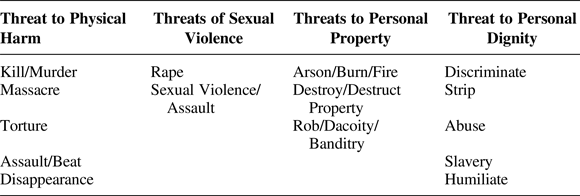
Given this situation, we approach religious violence from a perspective that identifies distinct dimensions to attempt to disaggregate and understand different levels of intensity. Utilizing typologies associated with the literature on intra-state conflict and repression we identify four distinct dimensions of religious violence: threats to physical integrity, threats of sexual violence, threats to personal property, and threats of discrimination/dignity (Davenport and Stam Reference Davenport and Stam2009, 9, 18). Table 1 below provides a breakdown of the different dimensions of religious violence we identify and what specific violent or coercive actions serve as constitutive elements of those dimensions. We argue that this conceptualization of religious violence is appropriate given that some violent actions may entail greater social costs or legal penalties that discourage their wide-spread utilization. In addition, the destruction of property and inflicting bodily harm on an individual are fundamentally different acts, so a measurement strategy that can disaggregate these actions is useful. For example, the destruction of personal property typically garners less attention and legal sanction from authorities than murder, so it is important to capture this qualitative difference when attempting to measure religious violence since some perpetrators may be inclined to engage in the destruction of property but are deterred from engaging in actions that lead to bodily harm due to the potential for more severe consequences. In addition, given established arguments that religious violence is a consequence of political or social manipulation of religious identity, it is important to distinguish between different acts of violence since specific actions may have a lower threshold or be more susceptible to manipulation.
Dimensions of Religious Violences

Literature Review
There have been previous attempts to measure religious violence in a cross-sectional systematic context. Some scholars focus on organized armed combatants or religious violence in the context of civil war. Toft (Reference Toft2007) is one example of this approach. She examines 42 cases of religious civil war from 1940 to 2000 with a focus on testing the impact of religious outbidding on civil war dynamics (Toft Reference Toft2007). Svensson's work also examines religious violence in the context of armed conflict but focuses on a different unit of analysis with a dyadic approach, includes conflicts whose intensity may not meet the threshold for classification as a civil war, and also examines whether there may be regional effects with a concentration on the North Africa–Middle East region (Svensson Reference Svensson2007; Reference Svensson2013). In particular, Svensson and Nilsson (Reference Svensson and Nilsson2018) introduce the Religion and Armed Conflict (RELAC) dataset, which provides indicators for the causes, dynamics, and resolution of religious conflicts that cover the years 1975–2015. In addition, some examine the relationship between religion and civil war/armed conflict in more regional settings. For example, Nordås (Reference Nordås2014) examines how religion impacted aspects of conflict intensity and duration for armed conflicts that occurred in the Ivory Coast and Ghana.
Other scholars have taken a broader approach to the measurement of religious violence, with a particular emphasis on the coding of international religious freedom reports produced by the U.S. State Department and other relevant sources. Grim and Finke examine U.S. State Department International Religious Freedom reports generated in 2003 for 143 countries. Their data mostly focuses on aspects of religious freedom, but they also provide opportunities for testing explanations for religious violence and persecution dealing with a religious marketplace/economies and clash civilization perspective (Grim and Finke Reference Grim and Finke2007). Vüllers et al. utilize a similar approach with an expansion of the temporal scope of the analysis to include reports spanning from 1990 to 2010 as well as other sources while focusing on 130 countries in the developing world with an emphasis on dynamics associated with inter-religious networks (Vüllers, Pfeiffer, and Basedau Reference Vüllers, Pfeiffer and Basedau2015). Other benefits to a broader approach that can capture religious violence that has communal characteristics can be seen in Fox (Reference Fox2017), which illustrates the ability to both capture elements of societal violence and the potential state policies associated with religion that may be the root cause for religiously motivated violence to occur. An examination of Basedau et al. (Reference Basedau, Fox, Pierskalla, Strüver and Vüllers2017) provides a good illustration of the benefits of trying to capture aspects of religious violence at the sub-national level since this study utilizes a group-based unit of analysis that allows for the empirical testing to move beyond the state-level and capture how variation between different religious groups may influence the prospects for religious violence.
We build upon these previous studies mentioned here and earlier in a number of different ways. Specifically, we examine different source materials to generate our observations for religious violence with the utilization of media reports associated with religiously motivated violence. This provides source data from country-specific sources, which may be better positioned to capture more nuanced dynamics associated with religiously motivated violence that State Department reports or data associated with civil wars and armed conflicts have difficulty detecting. Some have argued that the utilization of media reports that can account for event data on a daily basis needs to be more fully explored for analysis of international conflict data (King and Lowe Reference King and Lowe2003). In addition, this approach allows for the future incorporation of non-English language sources to generate observations of religiously motivated violence as well as account for the potential impact that different data sources may have (Schrodt and Analytics Reference Schrodt and Analytics2016). We also utilize a different methodological approach when measuring religiously motivated violence. Specifically, we utilize NLP to analysis text sources to identify both victims and perpetrators associated with religiously motivated violence. In addition, this allows us to disaggregate the different types of violent acts (murder, assault, rape, etc.) that were discussed earlier. We would argue the ability to account for various levels of intensity of religiously motivated violence is of particular importance since it is likely that the threshold for participation in violent acts varies based on the likely legal and social sanction associated with involvement. Finally, the approach we utilize allows for us to capture religious violence at both the state and sub-state level, which can provide added theoretical leverage on potential causal mechanisms that trigger acts of violence tied to religion. Given these potential benefits, we utilize a test-case of reported acts of religious violence in India from 2000 to 2015 to highlight the usefulness of this approach and its potential to collect data on religious violence in across-sectional context.
Given the proposed benefits of approaching the measurement of religious violence in relation to previous attempts our discussion now moves to utilizing an established relationship to test the utility of the data that we collect. Specifically, we are interested in utilizing the relationship between electoral competition and religious violence to determine the validity of the data we have collected. This is partly because we think that causal mechanisms associated with elite manipulation of religious identity are a strong predictor of the potential for incidents of religious violence to be recorded. More importantly, focusing on the relationship between electoral competition and religious violence facilitates the examination of variation in sub-national units in regards to the propensities for religious violence to be reported that may be masked by only examining state-level data.
The literature associated with religious violence is both large and exhibits wide-variation in regards to arguments for why some states/societies experience more religiously motivated violence than others. Some have focused on the role of specific religious traditions usually attributing pacifying or aggressive tendencies to specific sectarian beliefs (Huntington Reference Huntington1997, 70; Fish Reference Fish2002, 29–36; Kedourie Reference Kedourie2013, 5–6, 21–22). Others have highlighted the role of modernization and secularization in generating social tensions that lead to incidences of religiously motivated violence (Inglehart and Welzel Reference Inglehart and Welzel2005, 61–64, 73–75; McBride Reference McBride2008; Mendieta Reference Mendieta2011; Wilson Reference Wilson2011; Casanova Reference Casanova, Shah, Stepan and Toft2012). Juergensmeyer (Reference Juergensmeyer2008) is a good illustration of this type of argument since it sees the outbreak of religious violence tied to a rejection of secular nationalism rather than a revival of religious fundamentalism. Finally, there are numerous arguments that see religious violence as a function of democratic equality either from a perspective associated with religious regulation (Fox Reference Fox2007; Grim and Finke Reference Grim and Finke2007; Reference Grim and Finke2010; Fox and Rynhold Reference Fox and Rynhold2008; Brathwaite and Bramsen Reference Brathwaite and Bramsen2011) or religious tolerance (Trigg Reference Trigg2007, 12–13, 22–24; Toft, Philpott, and Shah Reference Toft, Philpott and Shah2011, 124–125). Asal et al. (Reference Asal and Avdan2017) is a good reflection of this type of argument since they find that gender inequality and bouts of state repression are more likely to explain outbreaks of violence in comparison with religious ideology. While these explanations provide an understanding of relevant scope conditions related to religious violence and persecution, they also highlight the potential of dynamics that involve the manipulation of spiritual belief and religious traditions by elites for political, economic, or social gain can have on the potential for religious violence to occur.
The examination of our test-case of India indicates that this dynamic of elite manipulation is of particular concern and might be present and operating in the context of Indian electoral politics (Varshney Reference Varshney1993; Reference Varshney2003; Ludden Reference Ludden1996; Wilkinson Reference Wilkinson2006). For example, in December 1992, anti-Muslim riots in India's Uttar Pradesh state led to the deaths of thousands of Muslims by Hindu extremists. These attacks were precipitated by the destruction of the Ayodhya Mosque, which had been the center of an ongoing dispute between Hindu and Muslim communities. Numerous observers and official reports at the time noted that both state authorities and the public at-large were participating in numerous acts of religious persecution and violence based on sectarian tensions between the Hindu and Muslim segments of the population (Van der Veer Reference Van der Veer1994, 2–7). During this bout of communal violence and others that have occurred after, many reports have also noted that in addition to numerous acts of religious violence and intolerance towards Muslims, in other parts of India the persecution and discrimination of Christians and Hindus perceived to be of lower caste membership was publicly acceptable.Footnote 2 Numerous observers and scholars mentioned previously attribute these outbreaks of religious violence not only to long-standing grievances and animosities between different religious groups but viewed the political environment, especially the nature of electoral competition, being an influential factor in the outbreak of religiously inspired violence. This is because elites utilize the religious belief and fervor of their potential supporters to increase political participation and further their support and chances for electoral victory (Djupe and Grant Reference Djupe and Grant2001; Wilcox and Sigelman Reference Wilcox and Sigelman2001, 524–435). Political elites exert influence as movement actors who frame important issues for their potential supporters, and utilize their authority and/or popularity to make overt religious appeals to potential supporters that create or strengthen identic ties that mitigate cross-cutting cleavages within their support base (Chhibber and Shastri Reference Chhibber and Shastri2014, 3–4). Violence occurs as a consequence of mobilization based on sectarian identity or appeals to religious tradition or symbolism since the dynamics of religious demagoguery are hard to control once unleashed.
Given this dynamic, our study utilizes the relationship that exists between religious violence and electoral competition that is discussed in the literature to test the utility of our data collection approach with some predictions associated with this argument. Specifically, since political elites recognize that making religious appeals to potential supporters can lead to electoral success (Campbell and Monson Reference Campbell and Monson2008), we predict that areas that experience increased levels of competition should also have a corresponding increase in the number of incidents of religious violence recorded. Hyp. 1 can be stated as:
Hypothesis 1: Recorded incidents of religious violence should increase in areas where political competition is the strongest.
In addition, we also make a prediction regarding how mobilization from political competition impacts the level of religious violence that is recorded in a given area. Numerous studies have observed that religious appeals by political elites have the potential to boost political participation of their potential supporters (Macaluso and Wanat Reference Macaluso and Wanat1979). To test the validity of the data, we should observe not only higher levels of reported violence in areas that experience more intense political competition but find an increase in political participation due to elite efforts to mobilize supporters along religious lines in areas that experience increased levels of religious violence. Our second hypothesis to be tested can be stated as:
Hypothesis 2: Recorded incidents of religious violence should increase as voter turnout increases.
These predictions should allow us to determine the viability of our data collection approach given the arguments concerning religious violence being a consequence of political competition. In short, if the observations in our data are recording incidents of religious violence then we would expect that when it is utilized to test an established relationship of interest in the literature that similar results as previous studies should be recorded. The next sections discuss our research design, data, and findings. However, we should note some important theoretical clarifications. Specifically, we do not claim that the supporters (or potential supporters) of political elites that utilize religious identity or symbolism to rally supporters follow blindly any leader that utilizes demagogic appeals to religion. Rather we argue that it is likely that the use of religious identity to mobilize political support may be salient only to specific religious or social groups (Smith and Walker Reference Smith and Walker2012). One unintended consequence of this could be that elites that utilize religious identity or symbolism to mobilize their supporters may instead mobilize the opposition due to fears of the overt sectarian appeals being promulgated, resulting in increased incidents of religious violence and conflict (Garretson Reference Garretson2014). In addition, some have argued that in democratic societies like India, increased religious violence is a function of conflicts between those who want society to be more religious and those who want to keep it secular, which could be an indication that fear of the loss of the salience of religion in politics, not greater inter-communal competition is driving religiously motivated violence (Fox Reference Fox2015).
While this study's focus on the literature associated with the relationship between religious violence and political competition is to exhibit the utility and validity of our data collection approach it should be noted that numerous scholars have identified various potential mechanisms regarding how religious violence is influenced by aspects of political competition or the context it operates in. One potential mechanism involves how political institutions are configured within the state. Specifically, Lerner (Reference Lerner2013) notes that religiously motivated violence may be tied to the structure of national constitutions, which can be configured to provide incentives for violent conflict between different sectarian groups within a state. From this perspective, religious violence is a consequence of elite manipulation due to the specific configuration of political institutions that influence the electoral environment. A similar argument can be found in Satana, Inman, and Birnir (Reference Satana, Inman and Birnir2013) which focuses on the nature of governing coalitions and finds that inclusion in governing coalitions and the propensity for engagement in political violence are tied to the religious compatibility between the minority group and the dominant religion in the state (Birnir and Satana Reference Birnir and Satana2013; Satana, Inman, and Birnir Reference Satana, Inman and Birnir2013). Another potential logic for how religious violence is a consequence of political competition involves the social environment. Specifically, some have argued that religious social networks exert influence on the political behavior of religious supporters and may lead to violence when these networks advocate violent action (McKenzie Reference McKenzie2004). Others focus on how the nature of political competition can impact social institutions associated with education, which increases the potential of religious violence to occur (Antal Reference Antal2008). This perspective on the social environment views elite manipulation of religious belief and identity having the consequence that participation in violent acts becomes socially acceptable within one's community, which erodes the barriers for collective action.
In addition, it is possible that violence directed at specific religious groups might have nationalistic overtones. Specifically, Thakur (Reference Thakur2013) notes that the political system may be utilized for violence directed at religious minorities. He argues that violence may not be a reflection of religious animosity, but rather is a consequence of incompatible perceptions of nationalism and national identity that marginalizes religious minorities and makes them susceptible to communal violence and discrimination (Thakur Reference Thakur2013). For the purposes of this study, we view religious violence as a consequence of elite manipulation of religious identity and not a claim that specific religious traditions or those who have fervent spiritual beliefs are in some way more prone to violence or animosity towards followers of different religious traditions. This discussion illustrates that many scholars have noted a relationship between religious violence and political competition. Given this established relationship, our focus is not to test a proposed causal mechanism but to compare the results we find when testing this relationship as a validity test for the data collected using NLP as a methodological approach to the measurement of religious violence.
RESEARCH DESIGN AND DATA
To test the hypotheses regarding the impact of political competition on religious violence and illustrate the utility of NLP as a data collection methodology, we conduct a statistical analysis of elections in India from 2000 to 2015. The unit of analysis is the state-election year, which accounts for all of the states in India that held national and state elections in the years listed.Footnote 3 India was selected as a test case to determine the probability of our argument and utility of the data collected because it exhibits distinctive variation on both the dependent and explanatory variables associated with the relationship of interest: political competition and religious violence. In addition, India also exhibits a large degree of variation on potential alternative explanations associated with religious violence with factors tied to the social environment and institutional configuration of particular interest. Nussbaum (Reference Nussbaum2009) notes:
In talking about India…There is probably no nation more internally diverse than India. [It has] twenty-two official languages, over three-hundred languages that are actually spoken, major religious groups including Hindus (with many different regional cults), Muslims, Christians (Protestant and Catholic, and each of these stemming from several different European origins), Parsis, Buddhists, Jains, Sikhs, [and] a small number of Jews. [In addition], Regional differences are immense, (Nussbaum Reference Nussbaum2009, 7)
Nussbaum points out that India's diversity provides a fertile testing ground for our data given the degree of variation with respect to our explanatory and control variables. However, we want to emphasize that this study is not focused on the particularities of Indian electoral dynamics, but rather our empirical analysis focuses on the relationship between religious violence and political competition more generally, utilizing India as a test-case.
Our empirical analysis is divided into three different elements. We first try to determine what is the relationship (if any) between political competition and religious violence using the data we have collected. To do this we run a statistical analysis of national and state elections that occurred in India from 2000 to 2015 utilizing a generalized least squares (GLS) estimator with random effects and panel corrected standard errors for omitted variable bias and auto-correlation respectively. Next, we are interested in determining whether political competition influences the occurrence of specific types of religiously motivated violence; threats regarding physical harm, sexual violence, property damage, and dignity. We run another set of models that examine national elections in India from 2000 to 2015 utilizing a GLS estimator again with fixed effects and panel corrected standard errors. Finally, we are interested in evaluating the actors involved in religiously motivated violence (both victim and perpetrator), which we examine by providing some figures associated with records of attacks that were religiously motivated. Simply stated, we want to have a better understanding of who is committing different acts of violence and who are the potential victims in danger. Our primary dependent variable is the number of incidents of religious violence that were reported in a given Indian state for the years 2000–2015.Footnote 4 The variable was constructed utilizing text analysis of English language media reports from Indian and international sources.
It is important to note that the use of media reports to generate conflict-related event-data can lead to potential biases in the recording of instances of potential violence. Davenport and Ball highlight that the focus on collective violence as the unit of analysis and examination of a specific type of violence tends to introduce potential bias by not accounting for violence directed at the individual level as well as failing to capture a full range of potential non-lethal violent acts (Davenport and Ball Reference Davenport and Ball2002, 438439). We address these arguments by examining a range of violent acts mentioned previously as well as focusing on violent acts (both lethal and non-lethal) that are committed against individuals. We also compare our event-counts of religiously motivated killings to those generated from a different source (U.S. State Department Religious Freedom Reports) to determine whether data generated from media sources exhibit reporting bias. We also try to account for potential bias in the use of media sources by controlling for the level of cell-phone coverage since some have argued that cell-phone coverage may lead to overreporting of events since there is an increase in available information in areas where cell phones are more prevalent (Weidmann Reference Weidmann2016). Finally, our approach to data collection is consistent with arguments regarding approaching the collection of conflict-related data in a systematic fashion, with an eye towards transparency, and the utilization of automated data collection techniques (Salehyan Reference Salehyan2015).
Dependent Variables
Religious Violence Event Data
In recent years, a fairly massive change has developed in the event data community (Beieler et al. Reference Beieler, Brandt, Halterman, Schrodt, Simpson and Alvarez2016). However, despite the importance of religious violence, it is remarkable that existing empirical studies on the topic have been limited. We believe that one potential reason for the lack of relevant empirical analyses may be due to the coarseness and the lack of comprehensive data on religious violence events. Compared to other topics in the field of study such as international conflicts which have a variety of event data, to date, existing data of religious violence event data have been more limited. For example, the Correlates of War Project data was founded in 1963 and has assembled the dataset on the incidence, events and the extent of inter-state and extra-systemic war from 1816 to 2010 (Palmer et al. Reference Palmer, D'Orazio, Kenwick and Lane2015). Another example would be the International Crisis Behavior (ICB). The ICB project contains 455 international crises, 35 protracted conflicts, and 1,000 crises actors from the end of the World War I through 2007 (Wilkenfield et al. Reference Wilkenfield, Hewitt and Gurr2012). These examples of conflict data have been a standard for international conflict scholars, but in comparison, there is no comprehensive religious violence event data. In particular, humans are capable of providing high-quality gold standard cases for reference purposes and human coding was the standard method to generate event data in the topic, but it is extremely laborious and human capabilities have their limits as researchers cannot be counted on to do this task with sufficient speed and accuracy. In this section, we propose a new approach to the collection of religious violence event data. In order to adequately measure religious violence, we need to collect information associated with religious violence to generate event data organized in a manner that highlights “Who” did “What” to “Whom” (and “Where”).
Developments in open source NLP such as Stanford CoreNLP (Manning et al. Reference Manning, Surdeanu, Bauer, Finkel, Bethard and McClosky2014), PETRARCH (Schrodt, Beieler, and Idris Reference Schrodt, Beieler and Idris2014) allow for more accurate content extraction from each sentence and support text analysis in multiple languages. Stanford CoreNLP includes tools like part-of-speech (POS) tagger, named entity recognizer (NER), parser, coreference resolution system, sentiment analysis, and bootstrapped pattern learning tools. It has a flexible and extensible interface and facilitates the application of linguistic analysis tool from the text. PETRARCH (A Python Engine for the Text Resolution And Related Coding Hierarchy) is an NLP tool to produce machine-coded event data. Utilizing this approach, we attempt to create our own religious violence event data using media reports as our source material. With the development of open source NLP tools, we can have more accurate content extraction from each sentence and support text analysis in multiple languages.Footnote 5
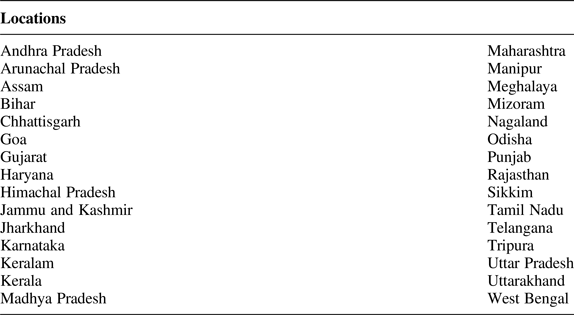
Data Sources: We collect data (raw documents) from newspaper articles. We constructed a list of all the state territories in India from 2000 to 2015 in order to identify the possible location of religious violence (see appendix for the full list). Second, we use the LexisNexis Academic news database, which houses a comprehensive news database comprised full-text documents from more than 3,000 newspaper publications from around the world.Footnote 6 In addition, to locate all the relevant news sources, we made sure to include Indian newspaper sources such as India Times, Hindustan Times, etc. from 2000 to 2015. Using this source material we conducted a keyword search utilizing variations of “religion” and “violence” This search yielded about 20,500 articles.
Parsing Texts
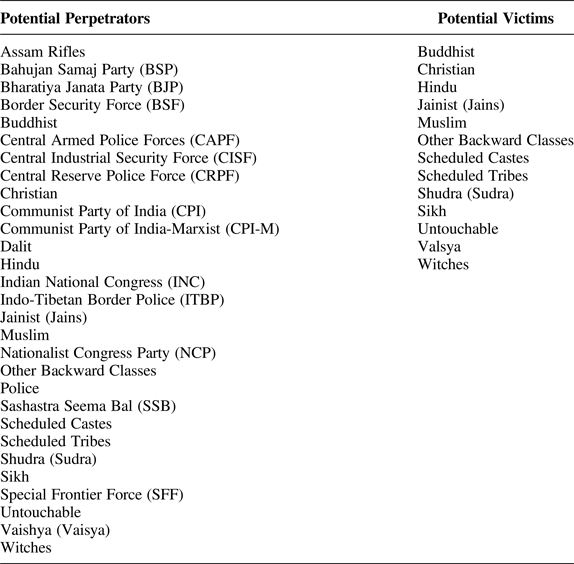
Who/Whom: The unit of analysis of the actors (source of a religious violence event) could include individuals, groups, organizations, and all generally recognized states, etc. We use a list of political entities such as Bahujan Samaj Party (BSP), Assam Rifles, Special Frontier Force, Police, etc. The actor list also includes victims (targets of a religious violence) such as Shudra/Sudra, Dalit, etc. (see Appendix C for full list)
What: We created our own dictionary because we are interested in a very specifically defined form of violence (religiously motivated violence) and we wanted to categorize different types of violence based on its intensity (Halterman Reference Halterman2017). We construct action indicators that consists of recorded instances of specific types of religious violence (kill, murder) as well as aggregated indicators of all-types of violence that fall into the dimensions of religious violence (physical harm, sexual violence, property damage, or dignity) discussed previously (see Table 1 above for the full dictionary list).
When: The date that the event occurred is assumed to be the date of the newspaper report unless specified otherwise in the text. Thus, extracting the dates has two parts. First, we extract the date from the sentence that includes religious violence event directly. Second, if not, the event date codes come from the report date.Footnote 7
Where: We used Stanford NER for identifying the location (which is based on Conditional Random Fields trained on newspapers). However, we were interested in local areas in India, so we generated our own list of locations, which consisted of the 29 states of India. As in the case of the date, we extract the location from the sentence that includes mention of a religious violence event directly, if not the event location is from the location mentioned in the report. In other words, when the location is not directly present in a given sentence, that is, the location is sometimes buried deep within a more complicated and lengthy article, we extract the most commonly occurred location name in the news reports. This approach to geo-location is consistent with other studies that utilize automated text analysis (Halterman Reference Halterman2017).
Parsing Process: With the hand-crafted actor, action, location dictionaries for coding religious events, first we identify all occurrences of these event words from the raw corpus. After that, we parse the raw documents with the Stanford CoreNLP Parser to identify the subject and object of each of these event mentions. These subjects and objects are noun phrases. For the actions, we search for all the action words and their variations by paying attention to verb phrases as well as noun phrases. In particular, we use dependency parsed output in order to determine the syntactic relationship between actors, actions, and objects. This approach is quite useful because it could also handle a little more complicated sentence. For example, “The law and order situation in Manipur had deteriorated due to the killing of a PLA activist by Assam Rifles on 11th July, 2004.” In this sentence, we extract, (“Assam Rifles”: Actor), (“PLA activists”: Object), (“killings”: Action), (“Manipur”: Location), (“11th July, 2004”: Date). (See appendix for the fully parsed outputs.) And we aggregate all the event data yearly.Footnote 8
Explanatory Variables
Our main explanatory variable of interest is an indicator for the difference in vote share for the two top vote-winning parties in a given Indian state for national and state elections that took place from 2000 to 2015.Footnote 9 This is a count variable constructed by taking the difference between the percentage of the vote for the two top performing parties in the Indian states covered in our sample. Indian electoral results from the Electoral Commission of India were utilized to construct the indicator.Footnote 10 In addition, we include other potential indicators of political competition to ensure that our results are not biased by choice of indicator. We construct two dummy variables to indicate whether there were three parties that were competitive or if an independent candidate was one of the top two vote winners during the elections we examined. Also, we included an indicator for whether one (or both) top vote winners were a regional party with no national standing. These indicators were included to provide a more holistic snapshot of political competition in the elections, we examined since the competitiveness of independent candidates and regional parties, as well as intense competition between more than two parties, are good proxies for capturing a competitive electoral environment. In addition to indicators associated with political competition, we also include an indicator for turnout given the predictions associated with hypothesis 2. This is a count variable indicating the percentage of the population that voted of the total eligible population. All explanatory indicators were collected for both national and state elections.
To ensure we are accounting for potential alternative explanations, we also include a number of control variables in our models related to religious violence. We add a number of demographic variables relating to the religious make-up of the states we examine; specifically, the percentage of the population associated with the following religious groups; Hindus, Muslims, Christians, Sikhs, Buddhists, and Jains.
In addition, we also construct variables that provided the percentage of the population that is designated as being part of a scheduled caste or tribe as well the percentage of the population that belongs to a minority religious group. These controls are added to account for the possibility that some element of religious demography is the driving dynamic associated with incidences of religious violence. Religious demography is also important to capture when identifying the determinants of religious violence and persecution because of its potential to prevent religious cleavages from formulating that can facilitate the formation of religiously based grievance and discrimination. Smith (Reference Smith2009) states:
The relationship between majority size and minority trust can be characterized as one in which the minority group perceives their minority status as a lack of incentive for leaders to capture their vote or support… Any group that does not capture [support] is of little consequence [to] those in power or seeking to gain power…Because their support as a group is inconsequential they are likely to have less faith in the [political] system itself, (Smith Reference Smith2009, 32–33).
In addition, we wanted to account for the possibility that deep-seated social grievances or historical legacies of animosity held by segments of the population could be impacting the level of religious violence in the election years we observed. To this end, we include an indicator of the number of communal riots in the Indian states we observe. This is a count variable derived from Varshney and Wilkinson that records the number of communal riots in India from 1950 to –1995 (Varshney and Wilkinson Reference Varshney and Wilkinson2006). We also try to account for potential reporting bias associated with the use of media reports, so we have added a control for the level of cell-phone coverage in each Indian state contained in the dataset (Salehyan Reference Salehyan2015). The results with the cell-phone coverage control are included in the appendix with the other supplemental regression tables and the inclusion of this variable does not change the results reported.
FINDINGS
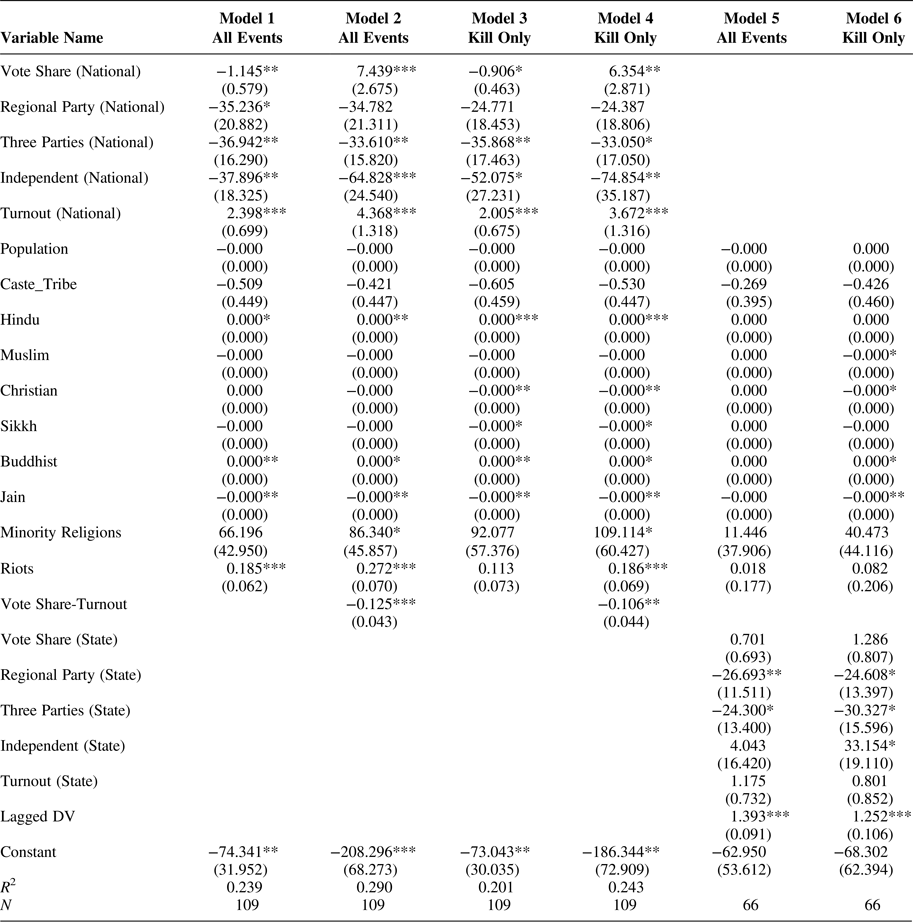
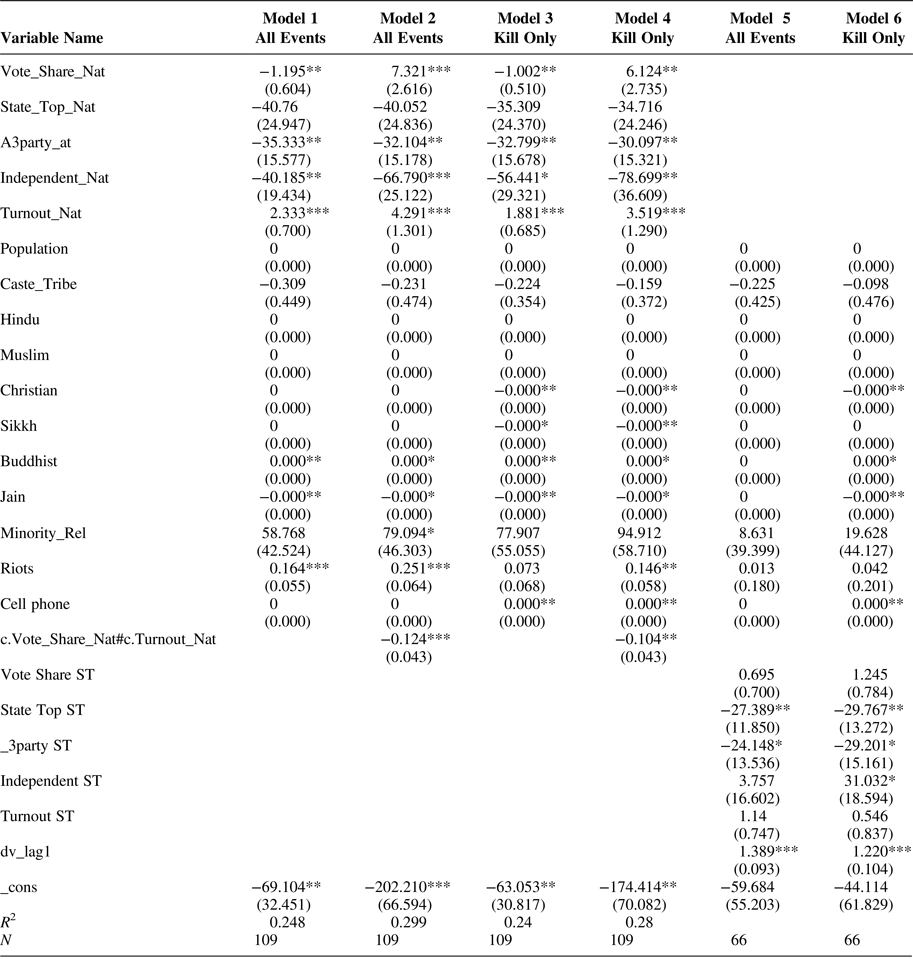
The findings from our first statistical analysis that tests our data using a relationship between political competition and religious violence can be found in Table B2 below in Appendix B. Our empirical analysis provides plausible support for the notion that increased levels of political competition influence the degree of religious violence that occurs. The results from that analysis can be found in Figure 1 below. Models 1–4 consist of an analysis of all national elections in India from 2000 to 2015. Models 5–6 are an analysis of state elections in India from 2000 to 2015. The results from models 1–4 indicates that all things being equal, as the difference in vote share decreases incidents of religious violence increase. Model 1 shows that vote share exhibits a statistically significant negative relationship with the count variable for incidents of religious violence at the 5% level. In addition, other indicators of political competition also show statistical significance at the 5% level in the expected direction. We also find that if there are more than three parties that are competitive or if an independent candidate is competitive than the number of incidents of religious violence decrease. These results would seem to provide plausible support for hyp.1 that increases in political competition result in more reported incidents of religious violence. We also find support for hypothsis 2 that increases in turnout should correspond to increased levels of religious violence being reported. Model 1 indicates that all things being equal, increases in voter turnout also correspond to higher incidences of reporting of religious violence. Model 2 introduces an interaction term for vote share and turnout since we wanted to try to test elements of the causal mechanism associated with the relationship between political competition and religious violence. Specifically, since we would expect that the use of religious appeals by elites to mobilize supporters should lead to increases in turnout then we should also expect that some interactive dynamic exists between turnout and the intensity of political competition. Our results from Model 2 are very similar to our previous results with the interaction term and other indicators of political competition (three parties and independent candidates being competitive) exhibiting statistical significance at the 5% level. These results are consistent with other findings that have been discussed previously, which provides support with regards to the data collection approach used in this study.
Coefficient Plots for Model 1– 6.

In Models 3–4, we were interested in determining whether there was a relationship between political competition and the most extreme acts of religiously motivated violence. In particular, we wanted to see if our results changed if we only accounted for the number of incidents that involved killing/murder being reported. The results are unchanged from Models 1–2 with both the indicator for vote share (Model 3), the interaction term (Model 4), and indicators for three parties and independent candidates being competitive all displayed statistical significance in the expected direction. The results from Models 1–4 examining national elections in India would seem to provide support for our contention regarding the utilization of NLP to create event-data associated with religious violence.
For Models 5–6 we were interested in determining whether the result we found for national elections were similar when comparing with elections held at the sub-national level utilizing the new data collected.
Models 5–6 consist of the same indicators included in the previous analysis applied to state elections, with the dependent variable being the number of incidents reported associated with religious violence and our explanatory indicators for political competition and turnout for state elections in India from 2000 to 2015. Unlike our results for national elections, the results from our analysis indicate that the difference in vote share does not exhibit a statistically significant relationship with reported incidents of religious violence when examining the context of state elections. However, we do find some of our secondary indicators for the political competition are operating as predicted. Specifically, whether regional parties are a top vote winner (Models 5 and 6) along with the indicators for three parties and the independent candidate being competitive (Model 6) exhibits a statistically significant relationship. These results would seem to indicate that when regional parties are the top vote winners and three parties as well as independent candidates are competitive in state elections in India than reported incidents of religious violence decrease. This provides some marginal support for hypothesis 1 in the context of state elections, but we find no evidence of our prediction regarding turnout associated with hypothesis 2. Given this situation, we interpret the results from Models 5–6 with caution since the results exhibited some ambiguity. At this time it is inconclusive whether the relationship we observed between political competition and religious violence in the context of national elections is operating at the state level. However, these findings are consistent with previous studies associated with Indian electoral politics (Wilkinson Reference Wilkinson2005, 13–14), and they provide plausible support for our argument that the utilization of NLP to generate event-data can yield benefits especially in trying to capture the dynamics of religious violence at the sub-national level.
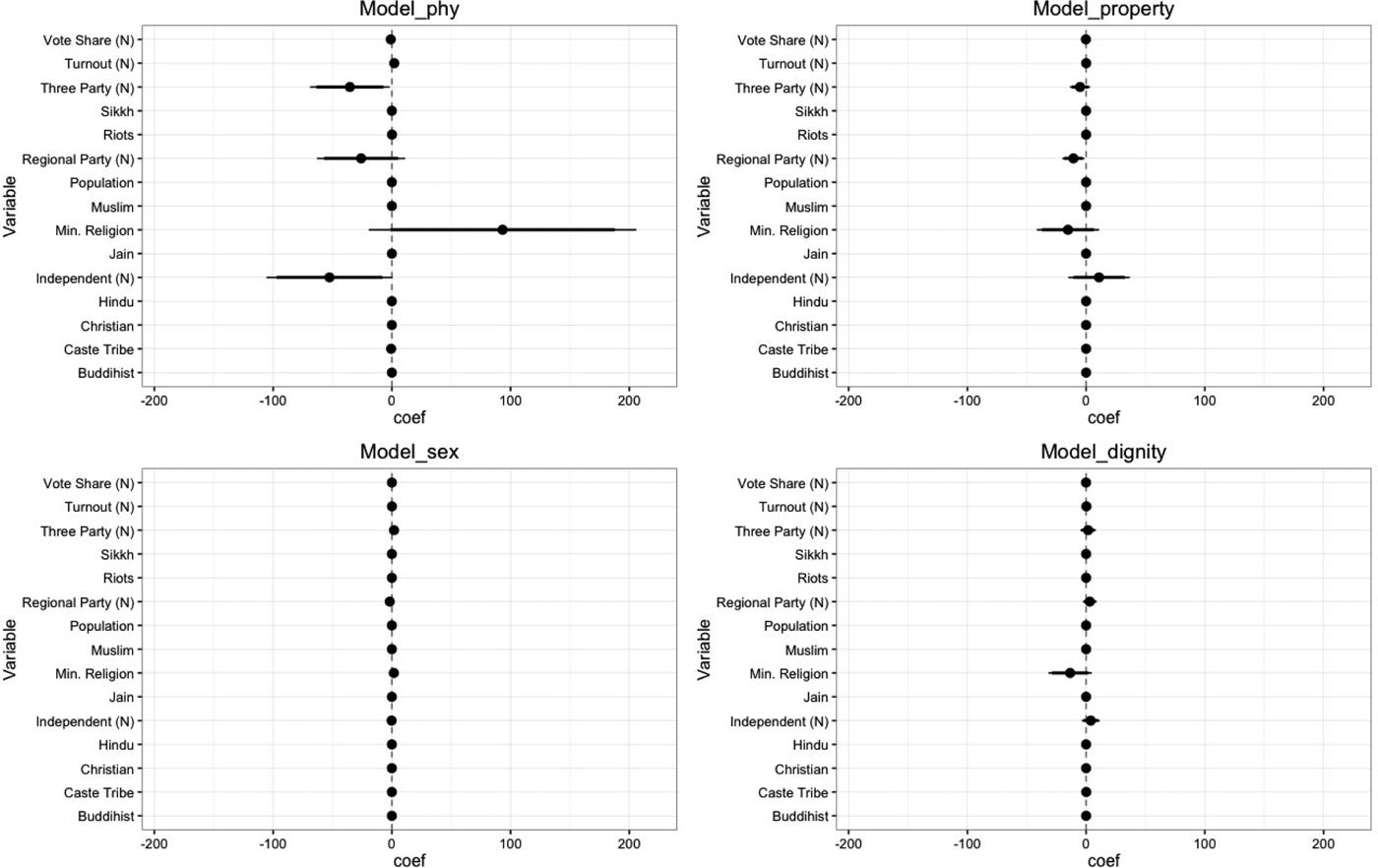
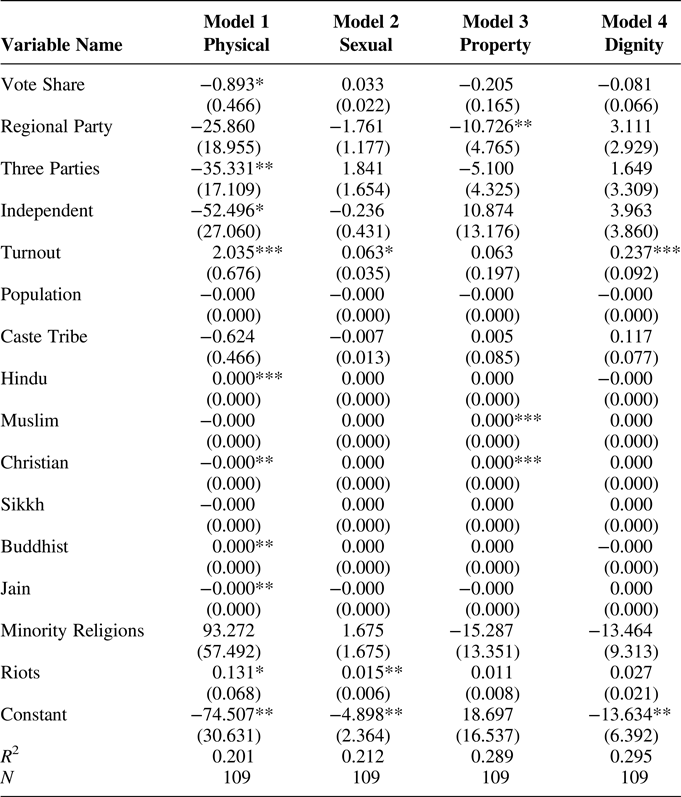
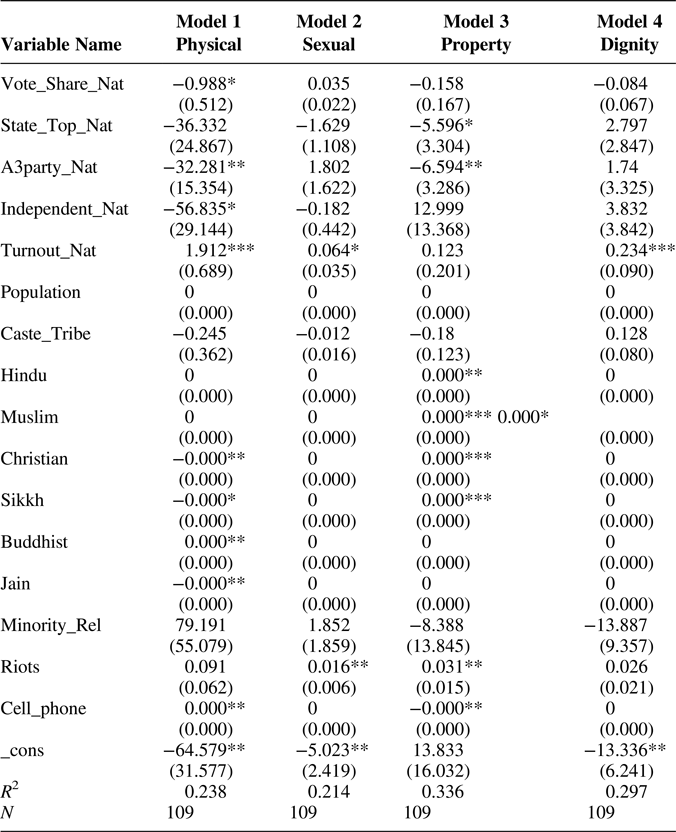
We next analyze the data we have collected in regards to utilizing NLP to capture a wider variety of violent acts associated with religiously motivated violence. We are particularly interested in determining whether political competition has any influence on the intensity of religiously motivated violence. Specifically, we utilize our indicators for political competition to see if they have any influence on the specific dimensions of religious violence identified in Table 1 during national elections; threats to physical harm, threats of sexual violence, threats to personal property, and threats associated with dignity/discrimination. Table B3 in Appendix B and Figure 2 below contains the results of our analysis and we find that political competition seems to influence acts that fall into the dimension of threats to physical harm. The model representing the physical dimension of religion violence indicates that all things being equal, religiously inspired assaults, murders, torture, and disappearances increase when political competition increases. The results from this model are consistent with our predictions regarding political competition and turnout influencing the level of religious violence as well as the results from our earlier analysis. However, we do not find conclusive evidence that political competition influences acts of religiously inspired violence that would fall into the other categories associated with sexual violence, property damage, or threats to one's dignity. This could be due to underreporting of these types of actions since media attention might be drawn to the most high-profile incidents that represent religious violence. It could also be a function of specific societal traditional or norms that treat public discussion of gender or sexuality as taboo, which can be especially relevant in the context of sexual violence (Leatherman Reference Leatherman2011, 21–22, 73–76). Nevertheless, despite the ambiguity of some of our results, we believe that this provides some support for the idea of approaching the conceptualization of religious violence from a multi-dimensional perspective and illustrates some of the benefits of the data collection approach utilized for this study.
Coefficient Plots for Dimensions of Violence.

We also test the validity of data by comparing the counts of religiously motivated killings to data collected utilizing other sources. This is to account for the possibility that the results we have reported may be associated with the specific data collection approach utilizing NLP rather than illustrating an established relationship that is found in the literature. We utilize data collected from U.S. State Department International Religious Freedom reports for India for the years 2000–2010 (Vüllers, Pfeiffer, and Basedau Reference Vüllers, Pfeiffer and Basedau2015). We find that our results associated with religious killings generated from English language media reports in India correlate to results collected utilizing the religious freedom reports at the 0.517 level. There were some discrepancies in specific years (2010 being a year of particular note), but there were also some close similarities. Specifically, for the years 2001, 2002, and 2004 the change in the event-counts was 20, 25, and 10%, respectively. We see these results as another way to indicate that the data we have collected is actually producing observations of religiously motivated violence and provides more support for utilizing NLP to generate event-data associated with religiously motivated violence.
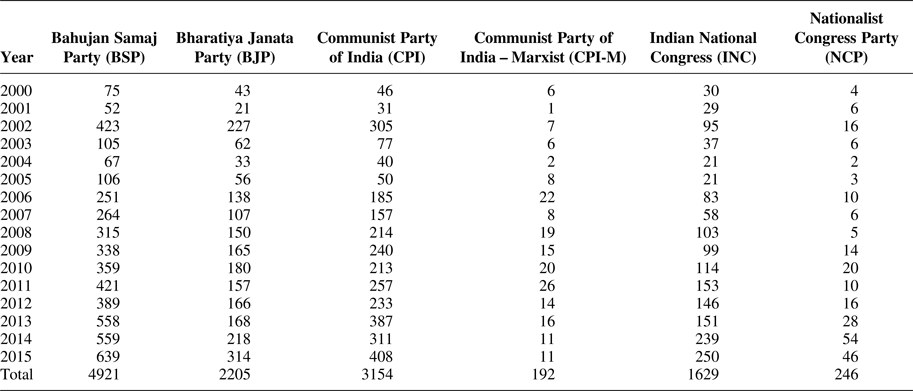
In addition to understanding the level of intensity associated with religious violence, we were also interested in illustrating the benefits of our data collection approach when it came to the nature of the violence with respect to the actors involved. Specifically, we examine the most egregious acts of violence (killing/murder) with attention paid to actors involved as perpetrators and victims. In short, we were interested in determining which actors were being killed or doing the killing from our collected media reports. Table 2 below contains our breakdown of actors associated with religious killings from a perpetrator standpoint. Our analysis identified five major political parties as actors involved in perpetrating religious killings. Specifically, both the BSP and Bharatiya Janata Party (BJP) accounted for 40% and 18% of the recorded killings attributed to religious motivations in our collected sample. Given that these parties’ platforms explicitly consist of appeals to religious identity this finding is consistent with the arguments mentioned previously regarding the relationship between political competition and religious violence. In addition, this finding is interesting since it highlights how religious violence is being driven by dynamics associated with both intra-group and inter-group religious tensions. This is because the BSP utilizes religious identity associated with caste, while the BJP utilizes overt appeals to Hindu nationalism. Further investigation of these issues may be warranted since violence directed within religious groups may exhibit different characteristics or mechanisms than the violent conflict that occurs between members of different religious groups. However, these findings provide some insight into how event-data generated utilizing NLP can yield added benefits not captured by other measurement strategies.
Perpetrators of Religious Killing (events)

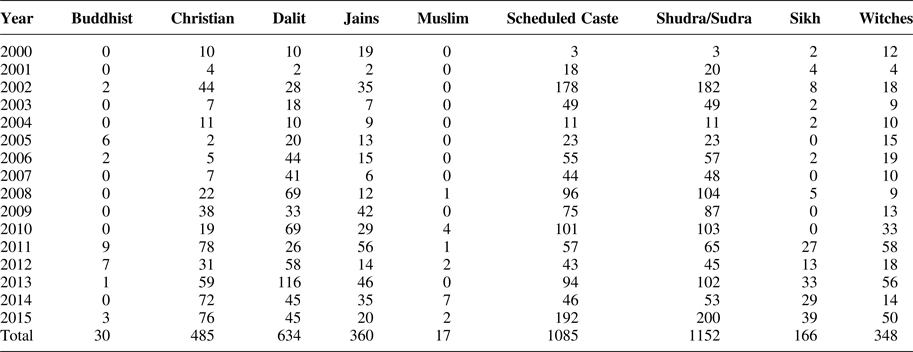
We also are interested in better understanding who the victims are when it comes to religiously motivated killings. Table 3 below provides a breakdown of the actors identified as victims of religiously motivated killings. Specifically, it shows that approximately 67% of the reported victims of religiously motivated killings in our sample were associated with the terms dalit, scheduled caste, and Shudra/Sudra. This would seem to indicate that a large majority of the reported victims of religiously motivated killings in Indian English language media reports from 2000 to 2015 consists of intra-group religious violence not a conflict between religious groups. We should note that some caution needs to be utilized in our interpretation of these results since it is very possible the limited sample of media sources we were able to examine does not consist of the entire universe of potential cases of religiously motivated killings from either a perpetrator or victim standpoint. In addition, it is also possible media reports associated with violence within and between religious communities is considered politically or socially sensitive and susceptible to underreporting, censorship, or other reporting biases. Nevertheless, the findings that we do have to indicate another added benefit when using NLP to generate event-data associated with religiously motivated violence since it may provide insights and the ability to examine media and other types of bias associated with the reporting of this type of violence. Further investigation and data collection is warranted to fully explore these dynamics in more detail.
Victims of Religious Killings (events)

CONCLUSION
To summarize, our findings help illustrate the potential benefits associated with the use of NLP to generate event-data associated with religiously motivated violence. In particular, our empirical tests found similar results to previous studies associated with the relationship between electoral competition and religious violence, which provides some validity to the different methodological approach in the measurement of this concept. Specifically, we found that levels of religious violence being reported increase when both political competition and turnout increase. Furthermore, we also found that specific types of religious violence seem to be influenced by increased political competition. In particular, threats of physical harm that included assault, torture, disappearances, and murder were likely to increase when political competition intensified. Finally, we also examined evidence that identified actors involved with religiously motivated killings and found that political parties that constructed their support around religious identity were more likely to have reported involvement with religiously motivated killings. Conversely, we also found that the victims of religiously motivated killings in India from 2000 to 2015 represented violence associated with intra-group rather inter-group dynamics. In short, these results demonstrate the potential utility of the data collection methodology we employ.
An important empirical implication of this study is the need for further attention to the conceptualization and measurement of the concept of religious violence. Future research associated with these issues should concentrate on viewing religious violence as a continuous variable that may have distinct dimensions that exhibit various outcomes based on the level of political competition as well as determine if concerns regarding measurement validity are relevant to the labeling of specific bouts of political violence as religious in nature (Hurd Reference Hurd2015, 115–126). We also believe there is an important methodological takeaway associated with this study. Specifically, that the use of automated text analysis of media and other print sources to create observations of specific types of political violence that is tied to religious identity may prove useful in generating more theoretical leverage to determine the dynamics and mechanisms associated with how political competition induces bouts of religiously motivated violence. Future research associated with this topic looks to include other countries into the collected sample to expand our scope of analysis from both a cross-sectional and longitudinal perspective as well as incorporating the examination of non-English language media sources.
This study and its findings have highlighted the need for further refinement of our understanding and measurement of the causal factors associated with religious violence with particular attention given the relationship between political competition and religiously inspired violence and persecution. One only needs to look at places such as Syria, Iraq, Myanmar, India, Indonesia, and a host of other countries that experience high levels of religious persecution or sectarian conflict to realize that the investigation of this topic is not only timely, but needed given some of the contemporary challenges in the international system. The sooner we understand the dynamics driving religious violence the closer we are to a solution to avoid its most negative effects.
Appendix A
LOCATIONS
Indian States Included

PARSED OUTPUT EXAMPLE
The law and order situation in Manipur had deteriorated due to the killing of a PLA activist by Assam Rifles on 11th July, 2004.
Part-of-Speech Tag
The/DT law/NN and/CC order/NN situation/NN in/IN Manipur/NNP had/VBD deteriorated/VBN due/JJ to/TO the/DT killing/NN of/IN a/DT PLA/NNP activist/NN by/IN Assam/NN Rifles/NN on/IN 11th/NNP July/NNP, 2004/CD.
Named Entity Recognition
The law and order situation in  $\overbrace {{\rm Manipur}}^{{\rm Location}}$ had deteriorated due to the killing of
 $\overbrace {{\rm PLA}}^{{\rm Org}}$ activist by
 $\overbrace {{\rm Assam Rifles}}^{{\rm Person}}$ on
 $\overbrace {{\rm July 11, 2004}}^{{\rm Date}}$.
Penn Tree

Dependency
det(situation-5, The-1)
compound(situation-5, law-2)
cc(law-2, and-3)
conj:and(law-2, order-4)
compound(situation-5, order-4)
nsubj(deteriorated-9, situation-5)
case(Manipur-7, in-6)
nmod:in(situation-5, Manipur-7)
aux(deteriorated-9, had-8)
root(ROOT-0, deteriorated-9)
xcomp(deteriorated-9, due-10)
case(killing-13, to-11)
det(killing-13, the-12)
nmod:to(due-10, killing-13)
case(activist-17, of-14)
det(activist-17, a-15)
compound(activist-17, PLA-16)
nmod:of(killing-13, activist-17)
case(Rifles-20, by-18)
compound(Rifles-20, Assam-19)
nmod:by(deteriorated-9, Rifles-20)
case(July-23, on-21)
compound(July-23, 11-22)
nmod:on(Rifles-20, July-23)
amod(July-23, 2004–25)
Appendix B
See Tables B1–B3.
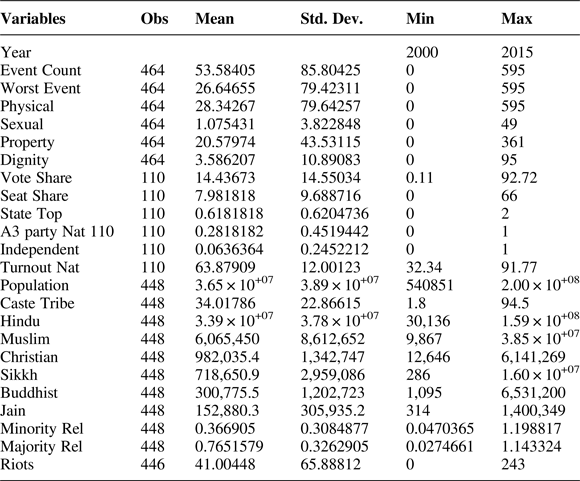
Summary Statistics

Regression Results for National and State Elections with all events and kill only DVs

Regression Results for Impact of Political Competition on Dimensions of Religious Violence

Appendix C
See Tables C1–C3.
List of Potential Perpetrators and Victims of Religious Killings

Dimensions of Violence with Cell Phone Control

Event Count and Killings with Cell Phone Control