Indwelling urethral catheters (ie, Foley catheters) provide an essential service for many patients; however, catheter use is associated with both infectious and noninfectious complications,Reference Saint, Trautner and Fowler1 and increased morbidity and healthcare costs.Reference Kennedy, Greene and Saint2 One of the most effective methods of preventing complications is to ensure that catheters are used appropriately and are removed promptly when no longer necessary.Reference Meddings, Rogers, Krein, Fakih, Olmsted and Saint3 In the United States, ~60% of ICU patients have a urethral catheter, with 94% meeting appropriate indications.Reference Greene, Fakih and Fowler4 In Japanese ICUs, we found increased catheter prevalence at 76%, with only 54% of meeting an appropriate indication.Reference Kuriyama, Takada and Irie5 To reduce unnecessary urethral catheter use in Japanese ICUs, we conducted a multimodal interventional study to facilitate daily assessment of catheter need and to promote prompt removal when no longer appropriate.
Materials and Methods
This interventional study using a before-versus-after design was conducted in 5 ICUs from 4 Japanese community-based, tertiary-care hospitals. During the pre- and postintervention phases, we assessed urethral catheter point prevalence in adult patients and the proportion of catheters with an appropriate indication. Hospital physicians or research nurses served as the study observers. Daily urethral catheter presence was assessed for each patient on each unit for 1 week per month. The indications for use as determined by both the observer and the patient’s nurse were also collected. The 2009 Healthcare Infection Control Practices Advisory Committee (HICPAC) Guidelines Reference Gould, Umscheid, Agarwal, Kuntz and Pegues6 provided the list of indications considered appropriate for urethral catheter use. This study occurred in 3 phases: the preintervention phase (August 2015–March 2016), the intervention phase (April 2016–June 2016), and the postintervention phase (July 2016–March 2017). Specific months of participation varied by unit.
The intervention used a multimodal approach including education on published guidelinesReference Gould, Umscheid, Agarwal, Kuntz and Pegues6,Reference Meddings, Saint and Fowler7 and use of tools to promote appropriate catheter use. Unit nurses were required to attend a lecture about appropriate use of urethral catheters. Measuring hourly fluid balance in the critically ill is a commonly overused indication due to varied interpretations of being critically ill.Reference Kuriyama, Takada and Irie5 The Ann Arbor Criteria for Appropriate Urinary Catheter Use provides a clearer definition of urethral catheter use in critically ill patients, highlighting appropriateness when hourly measurement of urine volume is required to inform treatment.Reference Meddings, Saint and Fowler7 Previously, we found that “immobility” was confused with immobilization required as part of treatment.Reference Kuriyama, Takada and Irie5 Thus, we emphasized differentiating between immobilization required as part of treatment and immobility. Alternatives to indwelling urethral catheters were promoted. Posters listing appropriate indications for urethral catheter use were placed in each ICU, and staff were encouraged to use a published checklistReference Saint, Kaufman, Thompson, Rogers and Chenoweth8 during team rounds or at the patient’s bedside to discuss whether the indication for the indwelling urethral catheter was still considered appropriate. When no longer indicated, the ICU team recommended catheter removal to the primary physician caring for the patient.
The study protocol was approved by the institutional review board of each participating hospital.
Statistical analysis
Primary outcomes were (1) the proportion of patient days during which a urethral catheter was placed and (2) the proportion of catheter days with an appropriate indication. Descriptive statistics were calculated for all variables. We used χ2 tests to assess differences in the outcome variables in the preintervention phase compared to the postintervention phase. A 2-sided P value <.05 was considered statistically significant. The data analysis was performed with SAS version 9.4 software (SAS Institute, Cary, NC).
Results
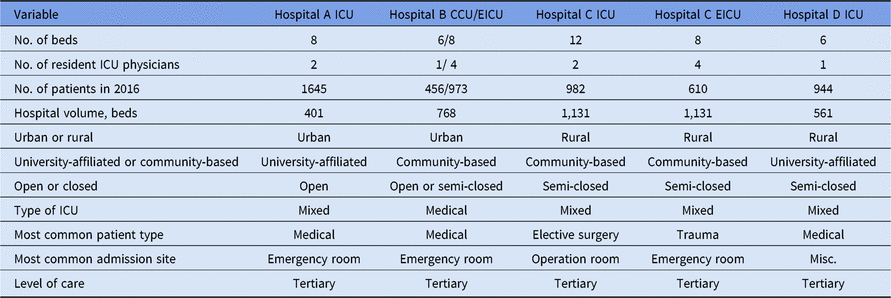
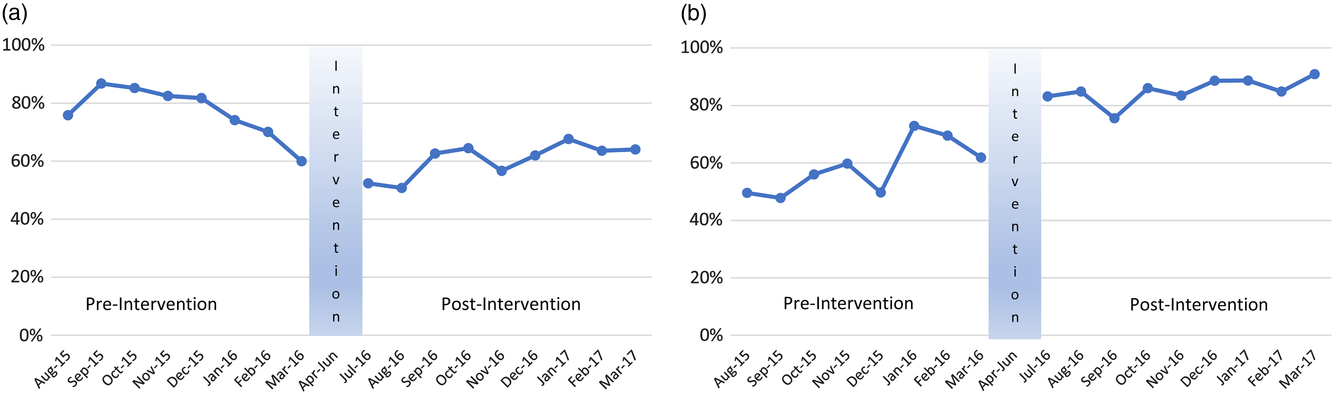
Descriptive information about each participating ICU is listed in Table 1. In total, 1,306 patient days were assessed for indwelling urethral catheter prevalence before the intervention, and 1,871 patient days were assessed during the postintervention phase. Prevalence over time is displayed in Fig. 1a. The urethral catheter point prevalence rate significantly decreased by 18% (95% confidence interval [CI], 15%–21%; P < .001) from 79% before the intervention (1,034 catheter days and 1,306 patient days) to 61% after the intervention (1,141 catheter days and 1,871 patient days) (Appendix Table 1 online).
Characteristics of the Participating Intensive Care Units

Note. ICU, intensive care unit; CCU, coronary care unit; EICU, emergency intensive care unit.
aHospital B ICU was a combined unit that included both coronary care ICU beds and EICU beds using shared nursing staff.
(a) Indwelling urethral catheter point prevalence all units by month before and after intervention. (b) Proportion of appropriate indwelling urethral catheters all units by month before and after the intervention.

Urethral catheter appropriateness increased after the intervention (Fig. 1b). In total, 57% of the preintervention catheter days were deemed appropriate (589 of 1,034 catheter days). Appropriateness increased by 28% (95% CI, 24%–32%; P < .001) to 85% postintervention (973 of 1,141 catheter days) (Appendix Table 2 online). The effect of the intervention in individual hospital units varied (Appendix Fig. 1 online).
The most commonly cited appropriate indication for catheter use was the need for accurate input and output monitoring in critically ill patients (by 61.7% of nurses and 59.9% of observers), which increased from the preintervention phase (ie, 45.7% of nurses and 37.0% of observers). Monitoring input and output for non–critically ill patients was the most frequently cited inappropriate indication (by 6.0% of nurses and 9.1% of observers); however, this proportion decreased compared to the preintervention phase (ie, 14.8% of nurses and 21.0% of observers).
Discussion
We found that after implementation of a multimodal approach focusing on appropriate use of urethral catheters, urethral catheter use decreased by 18%, while appropriate use of urethral catheters increased by 28%.
Avoiding unnecessary urinary catheter use is key to catheter-associated urinary tract infection (CAUTI) prevention as highlighted by the conceptual model of the “lifecycle of the urinary catheter.”Reference Meddings, Rogers, Krein, Fakih, Olmsted and Saint3 CAUTI prevention programs that prompt urinary catheter removal have proven effective inside and outside the ICU.Reference Huang, Wann and Lin9,Reference Knoll, Wright and Ellingson10 Our intervention targeted 2 phases of the urinary catheter lifecycle: raising awareness of existing urinary catheters (step 2); and prompting catheter removal (step 3). This led to the reduction of unnecessary urinary catheter use in our study, which is consistent with previous studies.Reference Meddings, Rogers, Krein, Fakih, Olmsted and Saint3 Our multimodal intervention included 2 additional aspects specific to ICU settings. First, we used a more specific definition for appropriate use of a urethral catheter to monitor input and output of critically ill patients.Reference Meddings, Saint and Fowler7 By using this more specific definition, the use of urethral catheters in the critically ill was optimized, resulting in greater consistency between nurses and observers in identifying critically ill patients. Second, we emphasized the difference between appropriate use of catheters for prolonged immobilization required for treatment versus inappropriate use for immobility. Consequently, the inappropriate use of urethral catheters for patient immobility decreased by 7.6%.
We previously found that urethral catheter use was higher and appropriate use was lower in Japanese ICUs compared to US ICUs.Reference Greene, Fakih and Fowler4,Reference Kuriyama, Takada and Irie5 After the intervention, the prevalence of urethral catheters (61%) and proportion used for appropriate indications (85%) was similar to rates found in US ICUs. Unlike the United States, healthcare worker awareness of nosocomial infection prevention practices in Asia is low.Reference Kuriyama, Takada and Irie5,Reference Huang, Wann and Lin9 Our findings demonstrate that a simple multimodal intervention is feasible to improve urinary catheter use in Japanese ICUs.
Our study had several limitations. First, all participating ICUs were teaching, tertiary-care hospitals and might have included higher-acuity patients requiring more urethral catheter use than patients found in nonteaching hospitals. Second, the definition of being critically ill was not clearly set in the preintervention phase, which might have resulted in an overestimation of the proportion of urethral catheters with an appropriate indication. Third, the Hawthrone effect, with the presence of the observer, may have impacted the healthcare workers’ behavior. Fourth, we did not measure CAUTI rates in our study.
In conclusion, we implemented a multimodal intervention in Japanese ICUs that included education about the appropriate use of urethral catheters and the use of a checklist during rounds to promote daily assessment of catheter need. Our multimodal approach successfully reduced the prevalence of indwelling urethral catheters while facilitating more appropriate use of urethral catheters.
Acknowledgment
The authors thank the International-Ann Arbor Safety Collaborative (http://i-aasc.org/) and David Ratz for statistical support.
Financial support
No external funding was received to conduct this study. Internal support for this project was provided by Dr Kuriyama, the VA-UM Patient Safety Enhancement Program, and the VA Ann Arbor Healthcare System.
Conflicts of interest
The authors declare no conflicts of interest related to this article.
Supplementary material
To view supplementary material for this article, please visit https://doi.org/10.1017/ice.2019.258