Introduction
Annually, music festivals attract millions of spectators world-wide, often to remote locations with limited existing health care infrastructure in the host community. While most festival goers have a safe and enjoyable experience, the large volume of attendees combined with festival-specific risk factors can lead to serious illness, injury, and even death.Reference Grant, Nacca, Prince and Scott 1 – Reference Turris and Lund 3 Patients at music festivals may require medical attention for a variety of reasons, including minor wounds, fractures, intoxications, environmental exposures, major trauma, or other medical illness or injury that may or may not be directly attributable to festival-related activities.Reference Hutton, Ranse, Verdonk, Ullah and Arbon 2 – Reference Lund and Turris 4 In this setting, the resources available to medical staff may be limited, as care is typically provided in medical tents or other temporary health care facilities with limited access to advanced diagnostics, including laboratory testing and imaging. This can limit the on-site medical team’s ability to provide definitive care, which makes patient disposition challenging, and can result in an increased percentage of patients transferred to hospital (PPTH).
Large festivals also have the potential to burden the health services in the host communities as patients may need to be transferred for additional diagnostics, management, and monitoring. This impact has previously been described using the analogy of a vortex and ripple.Reference Lund, Turris and Bowles 5 The vortex refers to a mass-gathering event drawing services inward from surrounding communities to service the unmet needs. The ripple refers to the disruption of regional services beyond the local geography of an event, caused by the addition of an event population above and beyond the usual baseline level of service in that community.Reference Lund, Turris and Bowles 5 Although previous efforts to characterize the impact of mass gatherings on the health care resources of host communities have been made, evidence-based consensus on specific strategies to mitigate this burden are still an area of research interest.Reference Lund, Turris and Bowles 5
Pemberton Music Festival is held annually (2008, 2014-2016) in Pemberton, British Columbia (BC), Canada, a rural community of approximately 5,000 year-round residents located 150km north of Vancouver, BC. 6 Pemberton has a small, six-bed community health clinic that operates 8:00am to 10:00pm daily with a Family Medicine physician on-call, basic laboratory testing, and x-ray department. There are no ultrasounds, computerized tomography (CT) scans, or inpatient facilities. The 2016 festival attracted a cumulative attendance of approximately 180,000 paying attendees plus support staff, volunteers, and vendors over the five days of the festival. During its peak, the Pemberton Festival grounds had a population of over 40,000, an eight-fold increase in population over the community’s baseline. For perspective, during the festival weekend, Pemberton’s population was approximately equal to the 10th largest city in the Province. 7 This drastic surge in population highlights the importance of comprehensive, multi-stakeholder, pre-event planning to manage the predictable and life-threatening clinical presentations faced by the on-site medical team to help prevent over-use of local health care infrastructure.
In recent years, the use of Point-of-Care Ultrasound (POCUS) has expanded across many medical specialties and has become a core element of the practice of Emergency Medicine. In contrast to consultative sonographic investigations performed by ultrasound technicians and then later interpreted by radiologists, POCUS can be performed by any trained clinician and provides an immediate look into underlying anatomy and pathophysiology.Reference Moore and Copel 8 In recent years, the body of literature surrounding the use of POCUS has grown substantially, and its use has been described in a host of different settings, including the emergency department (ED) and hospital wards, prehospital environment, on the battlefield, in rural and remote settings, during expedition medicine, as well as aboard the International Space Station.Reference Kirkpatrick, Brown and Crickmer 9 – Reference Arntfield and Millington 15 Currently, POCUS is regularly used to assess for intra-abdominal bleeding, fractures, soft-tissue foreign bodies, ocular pathology, hemothorax and pneumothorax, intrauterine pregnancy, deep vein thrombosis, pericardial effusion, and procedural guidance.Reference Sippel, Muruganandan, Levine and Shah 13 – Reference Shekelle, Pronovost and Wachter 16
This study provides a detailed description of the use of POCUS at a remote, multi-day music festival and discusses how its use impacts patient care as well as broader health care resource utilization. This research explores how POCUS may help improve emergency response at mass gatherings and potentially reduce the effect mass gatherings exert on their host community.
Methods
This prospective observational study was approved by the University of British Columbia Research Ethics Board (REB; Vancouver, BC, Canada).
A recruitment email outlining the study was sent to physicians scheduled to work during the festival. Most of the physician study participants were either practicing emergency physicians, or residents in a recognized Emergency Medicine or Family Medicine training program. This was followed by an in-person interview to obtain informed consent prior to their first shift. At the time of consent, a structured survey was administered by a co-investigator (RP or CS) to determine the physicians’ previous experience with POCUS. Physicians self-reported as novice, intermediate, or advanced sonographers. Novice sonographers were defined as those clinicians with introductory-level training who used select scans occasionally in their regular clinical practice. Intermediate sonographers were defined as those clinicians comfortable with a large number of scans and who regularly integrated POCUS into their practice. Advanced sonographers were defined as those clinicians that had extensive training in ultrasound, some with fellowship specialization, and for whom POCUS was an integral part of their day-to-day practice.
Once on-site, a handheld GE Healthcare V-Scan Dual Probe (linear and phased array probes; GE Healthcare; Fairfield, Connecticut USA) was available for use by all physicians on-duty in the main medical tent, at their discretion. Upon completion of any scan on patients aged 16 or older, study physicians were approached by a research assistant and encouraged to complete a structured survey investigating pre- and post-POCUS diagnosis, the indication for scanning, which scans were performed, pertinent findings, and how POCUS impacted the diagnosis, management, and disposition of patients (Supplementary Figure 1; available online only). Fields for free-text comments were also provided and physicians were encouraged to elaborate on their answers.
Data were input and analyzed using Microsoft Excel 2013 (Microsoft Corp.; Redmond, Washington USA), and descriptive statistics were reported using number and proportion, where appropriate.
Results
In total, 17 of the 24 (71%) physicians working at Pemberton Music Festival 2016 consented to be part of the study and reported their experience with POCUS as follows: nine novice sonographers, six intermediate sonographers, and two advanced sonographers.
At the festival, the estimated cumulative attendance was approximately 180,000 attendees (30,000 - 40,000 per day). A total of 2,689 patients were treated by medical staff on-site (patient presentation rate per 1,000 attendees = 14.9), 686 of whom were treated in the main medical tent where POCUS was available for use. In total, POCUS was used on 28 different patients: five by novice sonographers, 11 by intermediate sonographers, and 12 by advanced sonographers.
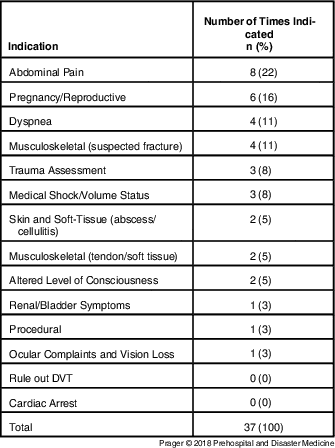
Table 1 highlights the indications for POCUS. The most common ultrasound indications were abdominal pain, gynecologic complaints, dyspnea, and musculoskeletal, respectively. While there were only 28 patients, a total of 37 indications were documented as some patients had multiple indications.
Indications for POCUS at Pemberton Music Festival

Abbreviations: DVT, deep vein thrombosis; POCUS, point-of-care ultrasound.
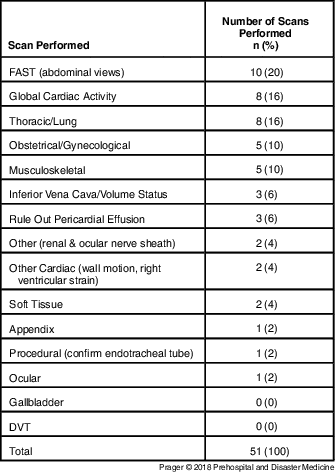
Table 2 describes the POCUS scans performed by the study physicians. The Focused Assessment with Sonography in Trauma (FAST) exam, global cardiac activity, and lung ultrasound were the most commonly performed scans, respectively. Multiple scans were performed on the same patient as per the discretion of the study physician.
Specific POCUS Scans Performed by the Study Physicians

Abbreviations: DVT, deep vein thrombosis; FAST, Focused Assessment with Sonography in Trauma; POCUS, point-of-care ultrasound.
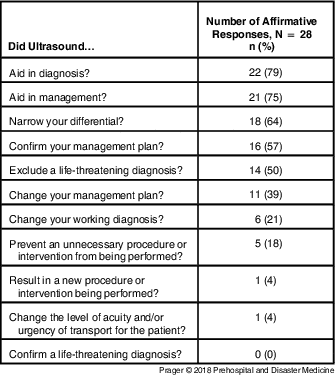
Table 3 illustrates the impact of POCUS on both diagnosis and management. In 22/28 cases (79%), POCUS was reported to aid in diagnosis, narrowing the differential diagnoses in 18/28 (64%) cases. Its use actually changed the working diagnosis in 6/28 (21%) cases. Its use changed the management plan in 11/28 (39%) of the patients.
Reported Impact of POCUS on the Diagnosis and Management of the 28 Enrolled Patients

Abbreviation: POCUS, point-of-care ultrasound.
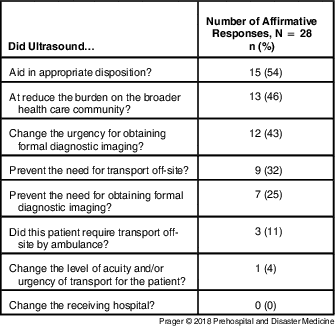
Physicians were surveyed on the perceived impact that POCUS had on reducing broader local health care utilization (Table 4). They reported that POCUS reduced the impact on the host community health resources in 13/28 (46%) cases and prevented the need for ambulance transport to a higher level of care in 9/28 cases (32%). As eight patients were transferred off-site, and POCUS was reported to prevent transfer in nine cases, the projected number of transfers without POCUS available would have been 17. Thus, the projected PPTH would be 17/686 (2.5%) of those patients treated in the main medical tent. The actual PPTH with POCUS on-site was 8/686 (1.2%) resulting in an absolute risk reduction of 1.3% or relative risk reduction of 53% with the use of POCUS. The festival’s cumulative transfer-to-hospital rate was 0.044 per 1,000 attendees.
Impact of POCUS on Patient Disposition and Local Community Health Care Resources

Abbreviation: POCUS, point-of-care ultrasound.
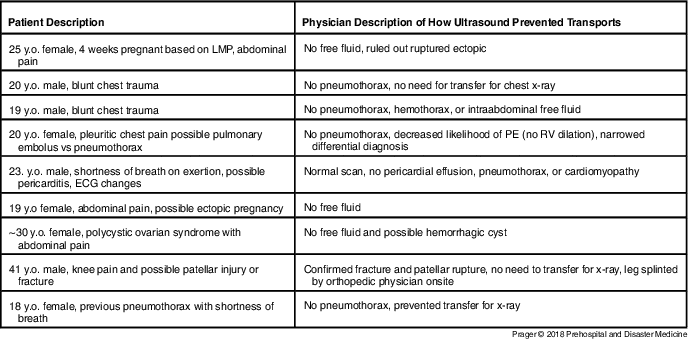
A description of the specific cases where the use of POCUS prevented transport is outlined in Table 5. These cases included ruling out pneumothorax, intra-abdominal bleeding, cardiac pathology, and to confirm a fracture that otherwise would have needed an x-ray.
Specific Cases Where POCUS Use Prevented Transfer Off-Site, as Reported by Study Physicians

Abbreviation: POCUS, point-of-care ultrasound.
Discussion
Impact on Patient Care
Currently, POCUS use in hospitals has expanded in recent years and is an integral part of the diagnostic arsenal for many acute care and Emergency Medicine physicians.Reference Kirkpatrick, Brown and Crickmer 9 – Reference Sippel, Muruganandan, Levine and Shah 13 The medical tent at a large music festival provides a range of medical care that is similar to a community ED, and the indications for POCUS in the study were similar to those encountered in an ED.Reference Whitson and Mayo 14 In the hospital, POCUS has well-established parameters, and a large body of experience in refining diagnostic and management decision making.Reference Whitson and Mayo 14 , Reference Arntfield and Millington 15 Considering the similarities between a medical tent and ED, literature supporting POCUS use in the ED is certainly relevant to a music festival setting. Furthermore, at a remote music festival where additional challenges face clinicians, including limited resources, suboptimal lighting, high levels of ambient noise, and a large proportion of intoxicated patients, it is not surprising that physicians reported POCUS to aid in diagnosis and management in the majority of cases it was used.
The two specific clinical scenarios that physicians reported POCUS to be most valuable were when there was a concern for pneumothorax or occult intra-abdominal bleeding. These life-threatening conditions can be difficult to diagnose with history and physical exam alone, but they can be accurately diagnosed with POCUS.Reference Fleming, Bird, Ratnasingham, Sarker, Walsh and Patel 17 – Reference Alrajab, Youssef, Akkus and Caldito 20 In the cases where pneumothorax or intra-abdominal bleeding were of concern, physicians reported that a negative scan made them feel comfortable observing patients on-site, thus preventing an urgent transfer to definitive care in the rural host community, or a further transfer to an urban center. Both the FAST exam and pleural ultrasound are taught in many introductory POCUS training courses, suggesting that the benefit from having ultrasound on-site is available to all trained clinicians, not simply experts.
In this study, there was a wide range of self-reported experience with POCUS. The majority (82%) of the POCUS scans performed at the festival were done by the minority of clinicians (47%) who identified themselves as intermediate or advanced POCUS practitioners. This result may indicate that the novice POCUS clinicians found ultrasound less valuable than more experienced clinicians. Alternatively, novice clinicians’ workflow may not include POCUS as a standard tool compared to those who are more experienced and facile with it. Another explanation may be that novice clinicians are less confident in accepting POCUS as definitive, and thus directly transfer patients for definitive imaging without the use of POCUS. Despite this discrepancy, clinicians with all levels of experience endorsed ultrasound as a valuable tool in refining the diagnosis, management, and disposition of patients.
Impact on Local Resources
Mass gatherings of any size have the potential to burden multiple domains of host community resources, including emergency health care, emergency response services, sanitation, food services, and transportation.Reference Lund, Turris and Bowles 5 These effects extend beyond the immediate vicinity of a given event, and can impact nearby municipalities, regional infrastructure, and in some cases, surrounding provincial/state or even national resources. Transfer of the most acute or unstable patients, or those requiring more definitive diagnostics or management is inevitable, but any attempt to prevent unnecessary transfers off-site is nonetheless important.
The use of POCUS at Pemberton Music Festival was reported to prevent nine transfers off-site. This represented an impressive reduction in transfers considering only eight patients in total were transferred off-site during the duration of the festival. At the festival, the nearest hospital with inpatient facilities is approximately 90-minutes away by road, and the nearest trauma center is two hours by road and at least 35 minutes one-way flight time via helicopter. These distances mean that transfer of an acute patient may require a nurse or physician escort in addition to a paramedic crew, potentially taking away limited resources from the remote festival venue. Furthermore, with only two to three ambulance crews on-site at any given time, transport of even one patient increases the overall risk should another emergency happen during their absence.
More generally, physicians reported that POCUS reduced the broader health care resource utilization in 46% of cases where it was used. This was accomplished through preventing transfers off-site and reducing the need for additional imaging, or unnecessary procedures. As POCUS machines continue to become more portable and less expensive, this modality could prove to be an important measure to reduce downstream health care costs in patients presenting at mass gatherings.
Limitations
Although this research represents an important first step for studying POCUS at mass gatherings, there are some notable limitations. Firstly, the results were based on self-reports of physicians, and due to technical limitations, images were not saved for further review. As well, there was no follow-up of the study patients, making it difficult to determine whether the decision making surrounding POCUS was clinically sound. Furthermore, there may have been an observer effect (Hawthorne Effect) as physicians knew research was underway, perhaps leading them to respond more favorably, as has been reported during research in other acute care settings.Reference Zinman, Bethune, Camfield, Fitzpatrick and Gordon 21 , Reference Campbell, Maxey and Watson 22 Moreover, although physicians were reminded to complete data collection forms, research assistants were only present 18 hours per day and some cases where POCUS was utilized may not have been captured. Finally, the population was small and represented a convenience sample, potentially introducing selection bias and limiting generalizability to other mass gatherings.
Conclusion and Future Directions
The use of POCUS at Pemberton Music Festival 2016 was reported to improve diagnosis and management of patients, and also to reduce broader health care resource utilization with an absolute risk reduction for the PPTH of 1.3% (relative risk reduction of 53%). Further research is required to fully characterize the role of POCUS at other mass gatherings, and a future study with patient follow-up and saved ultrasound images would ensure decisions being made using POCUS are clinically sound.
Acknowledgements
The authors would like to thank GE Healthcare for kindly donating a V-Scan Dual Probe Portable Ultrasound Machine for use during the festival.
Author Contributions
All listed authors contributed to the study design, data analysis, and manuscript composition.
Supplementary Materials
To view supplementary material for this article, please visit https://doi.org/10.1017/S1049023X18000821