Introduction
Coffee production is the backbone of the economy of many developing countries in the tropics (ICO, 2003), and it ranks among the most valuable agricultural commodities in the world (Labouisse et al., Reference Labouisse, Bellachew, Kotecha and Bertrand2008). Two species of coffee, arabica coffee (Coffea arabica L.) and robusta coffee (Coffea canephora Pierre) (Rubiaceae), are cultivated on a commercial scale. Global coffee production is about 131.25 million bags (ICO, 2011). Coffee production has nearly doubled since 1970 (FAO, 2000).
Although several insect species have been recorded as pests of coffee in Asian countries, only some are of economic importance (Le Pelley, Reference Le Pelley1968; CCRI, Reference CCRI1998, Reference CCRI2003). Xylotrechus quadripes (Chevrolat) (Coleoptera: Cerambycidae), the coffee white stemborer (CWSB), is the most serious pest of arabica coffee in some Asian countries (Kunhi Kannan, Reference Kunhi Kannan1925; Le Pelley, Reference Le Pelley1968; Visitpanich, Reference Visitpanich1994a; Rhainds et al., Reference Rhainds, ChinChiew, MoLi and Gries2002). Le Pelley (Reference Le Pelley1968) briefly reviewed the status and bioecology of various pests of coffee including the CWSB. It has consistently been a major threat to arabica coffee cultivation in Asia and information on CWSB available in different sources limited. Here we discuss the advances made in our understanding of the bioecology, status, behaviour, chemical ecology, natural enemies and integrated pest management (IPM) of the CWSB. Finally, we discuss the need for undertaking new lines of research for an effective management of the pest.
Distribution, host plants and economic damage
The CWSB was first reported in India in 1838 (Le Pelley, Reference Le Pelley1968). The borer is distributed in some Asian countries (i.e. Burma, China, Java, Nepal, Sri Lanka, Thailand and Vietnam) (Le Pelley, Reference Le Pelley1968; Gahan, Reference Gahan1906; Hayashi and Makihara, Reference Hayashi and Makihara1981; Chien, Reference Chien1989; Visitpanich, 1992a; Rhainds et al., Reference Rhainds, Warndorff, PhangKok, ChinChiew and Gries2001a; YouSheng et al., Reference YouSheng, ZhongXi, SongLin, DingAn, QingHui and Hua2002). Although the CWSB does not occur in South Africa (Hanks, Reference Hanks1999), the African coffee white stemborer Monochamus leuconotus (Pascoe) (Coleoptera: Cerambycidae) was erroneously quoted by Schoeman (Reference Schoeman1990) as X. quadripes, a misidentification that has been referred to by some successive authors (Hall et al., 1998; Venkatesha and Seetharama, Reference Venkatesha and Seetharama1999a; Jayarama et al., Reference Jayarama, Venkatesha, D'Souza, Seetharama, Srinivasan, Naidu, Hall and Cork2000).
Coffea arabica is the most preferred and principal host plant of the CWSB. Rarely, the CWSB attacks weak robusta coffee plants and Coffea liberica Hiern (CCRI, Reference CCRI2003). Although widely cultivated, the CWSB does not normally attack robusta as its stem and primary branches are much thicker and harder, due to which the larvae do not survive well, and as its bark is smoother, the females do not prefer to lay eggs on it and/or the eggs are more exposed to predation. The host range of the CWSB is narrow, and it is found in some alternative wild host plants, i.e. Cudrania javanensis Trecul (Moraceae); Gardenia spp., Ixora coccinea L., Randia dumetorum L., Randia spinosa (Thunb.), Wendlandia myriantha How and Psilanthus bengalensis (Heyne ex J.A. Schult) Leroy (all Rubiaceae); Jasminum dispermum Wallich and Olea dioica Roxb. (both Oleaceae); Oroxylum indicum L. (Bignoniaceae); Rhus semiciliata L. (Anacardiaceae); Pterocarpus marsupium Roxburgh (Fabaceae); Premna pyramidata Wall ex Schauer (Verbenaceae); Trema orientalis (L.) (Cannabaceae); Canarium sp. (Burseraceae); and Tectona grandis L. (Lamiaceae) in Asia (Duffy, Reference Duffy1968; Santosh et al., Reference Santosh, Sreenath, Vinod Kumar, Seetharama and Jayarama2011). CWSB rarely breed in standing O. dioica and P. bengalensis or in the dry logs of T. grandis; however, these alternative host plants do not allow a large-scale multiplication of the pest (CCRI, Reference CCRI2003). As many of the natural host plants of CWSB in its native region are Rubiaceae, the borer gradually may have evolved on the most suitable arabica coffee in some Asian countries.
The yield loss caused by the CWSB due to the uprooting of infested trees in India varies from 2.3 to 12.5% when integrated management tactics are applied and from 17.8 to 20% with heavy infestation (Subramaniam, Reference Subramaniam1934). Studies have indicated an infestation of 6.6% in lowland and 9.7% in hilly areas (Shylesha and Veeresh, Reference Shylesha and Veeresh1995). The level of borer incidence is related to the age of the plants, with a maximum infestation of 8.3% observed in old plants and only 0.7% in very young plants in India (Shylesha and Veeresh, Reference Shylesha and Veeresh1995). In Vietnam, average yearly crop losses caused by the CWSB are about 7% (Caresche, 1938).
The economic importance of the CWSB is greatest in India as it is a major producer of arabica coffee in Asia (Machia, Reference Machia1999). Arabica and robusta coffee are equally planted over a total area of about 350,000 ha (Raghuramulu and Naidu, Reference Raghuramulu and Naidu2005). A majority of growers consider the stemborer as a major threat to arabica coffee. Crop losses can reach up to 93.6% in some plantations when timely management is not implemented (Basavaraj et al., 2005).
Economic losses caused by the uprooting of stemborer-infested plants at the rate of one plant per ha result in a total loss of about US $642,585 annually in India (Radhakrishnan et al., Reference Radhakrishnan, Ramaiah and Bhat1987; Naidu, Reference Naidu1997). In India, over nine million trees are destroyed each year because of CWSB infestation, costing around $40 million annually for replacement and loss in production (Hall et al., Reference Hall, Cork, Phythian, Chittamuru, Jayarama, Venkatesha, Sreedharan, Kumar, Seetharama and Naidu2006). Venkatesha (2010) reported the annual loss due to the CWSB in India as $17.5–26 million.
Life history and biology
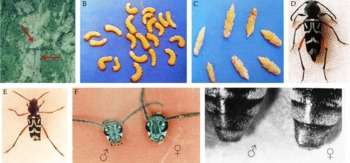
Eggs are elongate oval in shape and milk white when first laid, later becoming slightly yellowish. They are 1.25–1.28 mm long and 0.46–0.5 mm wide (Fig. 1A) (Subramaniam, Reference Subramaniam1934; Le Pelley, Reference Le Pelley1968; Visitpanich, Reference Visitpanich1994a; Seetharama et al., Reference Seetharama, Vasudev, Kumar and Sreedharan2005). The mature larva is yellowish with a dark brown head capsule, cylindrically segmented and apodus, and it measures 7–25 mm in length and 2.3–5 mm in width (Fig. 1B) (Le Pelley, Reference Le Pelley1968; Visitpanich, Reference Visitpanich1994a). The pupa is pale yellow with free appendages (Fig. 1C), and it measures 12–19 mm in length and 2.3–6 mm in width (Le Pelley, Reference Le Pelley1968; Visitpanich, Reference Visitpanich1994a).
Xylotrechus quadripes: (A) eggs, (B) larvae, (C) pupae, (D) female beetle, (E) male beetle, (F) head region of male and female beetles and (G) posterior abdomen of male and female beetles in ventral view. (A colour version of this figure can be found online at: journals.cambridge.org/jti)

The adult is slender, elongated and black, with grey pubescence on the head, thorax and abdomen; the white markings are characteristic of the CWSB (Fig. 1D, E) (Le Pelley, Reference Le Pelley1968; Waller et al., 2007). Both sexes have distinct raised markings on the head (Fig. 1F) (Gahan, Reference Gahan1906). In the past, CWSB adults were sexed based on their body size, marking on the head and the relative length of the hind femora to the elytra (Le Pelley, Reference Le Pelley1968). As these morphological characteristics are not similar in a population (Venkatesha and Seetharama, Reference Venkatesha and Seetharama1999b), adults can be best sexed perfectly based on the shape and size of the last segment of the abdomen. In the ventral view, the last abdominal segment of female beetles is long and tapered with a semicircular tip, whereas it is short and broad with a slight rectangular tip in males (Fig. 1G). In addition, the last segment of the abdomen is slightly longer than that of the preceding segment in females, but these two segments are almost equal in males. The mean length of male and female beetles is 11.8 and 13.5 mm, respectively (Venkatesha and Seetharama, Reference Venkatesha and Seetharama1999b; Seetharama et. al., 2005).
Eggs hatch in 3–15 days under different climatic conditions (Subramaniam, Reference Subramaniam1934; Le Pelley, Reference Le Pelley1968; Visitpanich, Reference Visitpanich1994a). CWSB larvae pass through five instars in India and six instars in Thailand, and complete their development in about 70 days on the dry stems (Visitpanich, Reference Visitpanich1994a; Seetharama et al., Reference Seetharama, Vasudev, Kumar and Sreedharan2005). The larval developmental period is about 120 days in standing plants in the field (Seetharama et al., Reference Seetharama, Vasudev, Kumar and Sreedharan2005). When the larva is fully grown, it tunnels towards the surface of the stem and cuts a small circular disc below the bark for adult emergence, and then returns to its chamber and pupates. Eclosed adults remain in the pupal chamber for 3–7 days and emerge through an exit hole (Le Pelley, Reference Le Pelley1968; Visitpanich, Reference Visitpanich1994a). The developmental period of the pupa is about 30 days on the living plants, while it is only 9 days on dry stems (Sekhar, Reference Sekhar1958; Le Pelley, Reference Le Pelley1968; Visitpanich, Reference Visitpanich1994a; Seetharama et al., Reference Seetharama, Vasudev, Kumar and Sreedharan2005). Under field conditions, the life cycle of CWSB in India takes 1 year (CCRI, Reference CCRI2003). However, depending upon the age and size of the plants, the life cycle of CWSB can vary from 142 to 390 days in the field (Visitpanich, Reference Visitpanich1994a; Veeresh, Reference Veeresh1995; Seetharama et al., Reference Seetharama, Vasudev, Kumar and Sreedharan2005). Within 2.5–7 months, the borer completes its life cycle faster on drying/dried coffee stems (Subramaniam, Reference Subramaniam1934; Pattabhiraman, Reference Pattabhiraman1983; Visitpanich, Reference Visitpanich1994a; Seetharama et al., Reference Seetharama, Vasudev, Kumar and Sreedharan2005). CWSB quickly complete their development on dry stems probably because of depleting nutrients. The life cycle of CWSB is 257 days on an artificial diet (Raphael et al., 2005). Further work on an artificial diet is needed for the successful mass rearing of CWSB to enable more studies on the bioecology of the pest and the rearing of its natural enemies. The mean hatching rate of CWSB eggs is 78%, and mortality is high during the first and second larval instars compared with subsequent larval stages (Visitpanich, Reference Visitpanich1994a). Gravid females readily oviposit in an inverted container placed on a coarse paper sheet in the laboratory (Seetharama et al., Reference Seetharama, Vasudev, Kumar and Sreedharan2004a).
In India, CWSB has one generation per year (Le Pelley, Reference Le Pelley1968), but it has two generations in China (Kung, Reference Kung1977). Such differences may be related to host plant provenances and environmental conditions. Based on the duration of the life cycle of CWSB in India, there may be two generations in a year, indicating the need for further studies. The sex ratio is 1.63:1 (female/male) on the dry stems in Thailand (Visitpanich, Reference Visitpanich1994a) and 1:1.22 in the field in India (Subramaniam, Reference Subramaniam1934); on an artificial diet it is 1:1.18 (Raphael et al., 2005). Such differences between studies may be associated with the quality of nutrition and environmental conditions. The average longevity of CWSB is 29 and 24 days for females and males, respectively (Linsley, Reference Linsley1959; Visitpanich, Reference Visitpanich1994a).
CWSB could be reared on cut stems in the laboratory (Gowda et al., Reference Gowda, Venkatesha and Bhat1992). The number of CWSB eggs laid on the cut stems of C. arabica, C. canephora and C. liberica varies significantly (Venkatesha et al., Reference Venkatesha, Bhat and Seetharama1995a). Also, the fecundity and longevity of these beetles is significantly lower than that of natural populations (Venkatesha et al., Reference Venkatesha, Bhat and Seetharama1995a) and enhanced under higher humidity (Le Pelley, Reference Le Pelley1968; Visitpanich, Reference Visitpanich1992b).
Behaviour
CWSB larvae, while tunnelling inside the stem, cut the hard wood into powdery dust and feed on some portion of the fine powder. The faecal pellets of the larva and the dust are used to fill the tunnel; thus, the tightly packed tunnel protects the larva from its natural enemies (Gowda et al., Reference Gowda, Veeresh, Krishnamoorthy and Venkatesha1991; Visitpanich, Reference Visitpanich1994a).
The mating behaviour of CWSB has been studied in the laboratory (Venkatesha et al., Reference Venkatesha, Bhat and Seetharama1995b). Adults mate and lay eggs usually the same day or 1 day after their emergence (Le Pelley, Reference Le Pelley1968; Venkatesha et al., Reference Venkatesha, Bhat and Seetharama1995b). Laboratory experiments show that vision plays no role in mating, but the antennae are needed for courtship and mating. Veeresh (Reference Veeresh1995) reported that females attract males for mating; however, according to Venkatesha et al. (Reference Venkatesha, Bhat and Seetharama1995b), males attract females. CWSB females occasionally mount on conspecific females (Venkatesha et al., Reference Venkatesha, Bhat and Seetharama1995b; Veeresh, Reference Veeresh1995), which is linked to the evolution of a reproductive behaviour in which females approach their mates (Iwabuchi, Reference Iwabuchi1987). Most mating occurs between 09.00 and 12.00 h, and 15.00 and 17.00 h (Venkatesha et al., Reference Venkatesha, Bhat and Seetharama1995b; Seetharama et al., Reference Seetharama, Vasudev, Kumar and Sreedharan2004b). The incidence of mating varies on the main stem, branches, fruits and leaves of coffee plants (Seetharama et al., Reference Seetharama, Vasudev, Kumar and Sreedharan2004b).
Females deposit their eggs on the scaly bark of the main stem and the thick primary branches of coffee plants (Subramaniam, Reference Subramaniam1934). Eggs hidden in the bark are not easily accessible to any natural enemies (Venkatesha, Reference Venkatesha1999). The majority of eggs are deposited during 12.00–16.00 h in bright sunlight on the main stem rather than on the primary branches. Rarely, adults show intermittent egg-laying and mating activities (Seetharama et al., Reference Seetharama, Vasudev, Kumar and Sreedharan2004b). Females lay 50–103 eggs singly or in a small group of 1–10 (Subramaniam, Reference Subramaniam1934; Visitpanich, Reference Visitpanich1994a). The pre-oviposition period is 2 days and in captivity, the oviposition period is about 9 days (Le Pelley, Reference Le Pelley1968; Visitpanich, Reference Visitpanich1994a). CWSB females deposited a maximum number of eggs on the stems baited with coffee sawdust/conspecific larval frass compared with untreated stems (Rhainds et al., Reference Rhainds, Warndorff, PhangKok, ChinChiew and Gries2001a). This is probably because adults are attracted to volatiles from coffee plants/frass.
Nature of damage
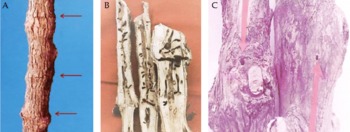
CWSB larvae produce galleries in the main stem and primary branches, and sometimes tunnel their way into the main root; consequently, the damaged plant withers, showing yellowing and wilting symptoms (Subramaniam, Reference Subramaniam1934; Rhainds et al., 2002). After tunnelling by a larva under the bark region for about 2 months, a ridge develops on the surface of the stem (Fig. 2A), which is as an external symptom of borer attack. Larvae tunnel in all directions in the stem, and each larva tunnels separately without interfering with the other (Fig. 2B). The severity of damage depends on the size of the larval population. An exit hole in the stem (Fig. 2C) indicates the completion of the life cycle of the pest. Some infested plants survive for a long period, but produce empty fruits (Subramaniam, Reference Subramaniam1934; Thanomthin, 1988; Visitpanich, Reference Visitpanich1989). About 84% of adults emerge from the main stem, and 16% from the roots (Visitpanich, Reference Visitpanich1994a). The empirical model of XinWen and RongPing (Reference XinWen and RongPing1997) indicates a random spatial distribution of the borer on coffee plants.
Coffee stems showing the symptoms of Xylotrechus quadripes attack: (A) borer ridges, (B) borer tunnels and (C) borer exit holes. (A colour version of this figure can be found online at: journals.cambridge.org/jti)

Flight periods
The flight (emergence) period of CWSB varies in different countries, probably because of different climatic conditions. CWSB has two flight periods in India (Subramaniam, Reference Subramaniam1934): the pre-monsoon flight period begins in April and extends to the end of May, and the post-monsoon flight starts from the end of September until the end of December or the middle of January (Sekhar, Reference Sekhar1958; Kung, Reference Kung1977). A small number of beetles also emerge before or after these flight periods (Reddy and Bhat, Reference Reddy and Bhat1987). In Vietnam, a large number of beetles emerge during May–July in the hot season, and a small number during February–March and November–December (Caresche, 1938). In China, CWSB has three peak emergence periods per year, i.e. in May, October and December (RongPing et al., Reference RongPing, XinWen and Zhong-Ning1997; YouSheng et al., Reference YouSheng, ZhongXi, SongLin, DingAn, QingHui and Hua2002). Maximum infestation occurs during the October–November flight season in India (Le Pelley, Reference Le Pelley1968) and during February–March in Vietnam (Caresche, 1938).
Sex pheromones
Male CWSB produce a sex pheromone compound (Venkatesulu et al., Reference Venkatesulu, Krishnamoorthy Bhat, Bhaskara Reddy and Ramaiah1986; Sreedharan and Karan-Singh, Reference Sreedharan and Karan-Singh1987). Hall et al. (1998) reported the identification of (S)-2-hydroxy-3-decanone as the major component of the male sex pheromone of CWSB from India. Rhainds et al. (Reference Rhainds, ChinChiew, King, Gries, LiZhen and Gries2001b) confirmed this finding in males from China. Analyses of volatiles from male X. quadripes of Indian origin by gas chromatography linked to electroantennographic (EAG) recording from a female beetle antenna showed three male-specific components comprising more than 90% of the volatiles, two of which elicited EAG responses (Hall et al., Reference Hall, Cork, Phythian, Chittamuru, Jayarama, Venkatesha, Sreedharan, Kumar, Seetharama and Naidu2006). The major EAG-active component was identified as (S)-2-hydroxy-3-decanone (I). The second component was identified as 3-hydroxy-2-decanone (II). The minor component that elicited an EAG response, present at 7% of the amount of I, was identified as (S,S)-2,3-dihydroxyoctane (III). 2-Hydroxy-3-octanone, 2,3-decanedione, 2-phenylethanol and octanoic acid were also identified in volatiles from male beetles. (S)-(I) was attractive to male X. quadripes in laboratory bioassays, but the addition of (S,RS)-(III) at 10% of I reduced attractiveness (Hall et al., Reference Hall, Cork, Phythian, Chittamuru, Jayarama, Venkatesha, Sreedharan, Kumar, Seetharama and Naidu2006). In field trials in India with sticky, cross-vane traps, (S)- and (RS)-(I) attracted CWSB males and the addition of (S,S)-(III) at 10% of I reduced attractiveness (Hall et al., Reference Hall, Cork, Phythian, Chittamuru, Jayarama, Venkatesha, Sreedharan, Kumar, Seetharama and Naidu2006). Bioassay experiments using the male synthetic pheromones show that (S)-2-hydroxy-3-decanone is a potential compound for female attraction (Jayarama et al., Reference Jayarama, Venkatesha, D'Souza, Seetharama, Srinivasan, Naidu, Hall and Cork2000; Venkatesha et al., Reference Venkatesha, Jayarama, Hall, Cork, Seetharama, D'Souza, Srinivasan and Naidu2001; Hall et al., Reference Hall, Cork, Phythian, Chittamuru, Jayarama, Venkatesha, Sreedharan, Kumar, Seetharama and Naidu2006).
Pheromone traps have been used for trapping CWSB females in the field (Jayarama and Venkatesha, 1995; Cork and Hall, Reference Cork and Hall1998; Hall et al., 1998; Jayarama et al., Reference Jayarama, Venkatesha, D’-Souza, Naidu, Hall and Cork1998; Vinod Kumar et al., 2000). Although small numbers of CWSB males were also trapped in field trials, numbers were not significantly different from those in unbaited traps. Thus, the pheromone of CWSB must be considered as a sex pheromone similar to those in other Xylotrechus spp. (Hall et al., Reference Hall, Cork, Phythian, Chittamuru, Jayarama, Venkatesha, Sreedharan, Kumar, Seetharama and Naidu2006). A sticky, white cross-vane trap is effective in trapping the beetles. The efficacy of the lure is higher in polyethylene vials than in sachets (Vinod Kumar et al., 2000). As CWSB causes already significant damage at very low densities, trapping of CWSB beetles can be effective in bringing down the pest incidence in the field. Moreover, trapping of females directly reduces the extent of oviposition and subsequent larval damage. According to Hall et al. (Reference Hall, Cork, Phythian, Chittamuru, Jayarama, Venkatesha, Sreedharan, Kumar, Seetharama and Naidu2006), further studies on trap design and other pheromone components of CWSB, i.e. 2-hydroxy-3-octanone and 2,3-decanedione, are needed for improved trapping of the beetles.
According to Rhainds et al. (Reference Rhainds, ChinChiew, King, Gries, LiZhen and Gries2001b), the pheromone-based trapping of females does not seem to be a viable strategy in managing the borer infestation in China as CWSB female beetles are not directly attracted to the pheromone source because of the complex mating behaviour, i.e. attraction of potential mates by both sexes, repeated landing of a female next to a male, males dashing to a nearby female, rejection of mating attempts by females, post-mating female guarding by males and size-dependent mating success of males. However, in India, pheromone traps can successfully control the female beetles (Jayarama et al., 2007). Although the behaviour of the beetles from both China and India is similar, larger plantation area and greater CWSB population density in India may have contributed to a higher pheromone trapping of females when compared with China (Rhainds et al., Reference Rhainds, ChinChiew, King, Gries, LiZhen and Gries2001b).
Natural enemies
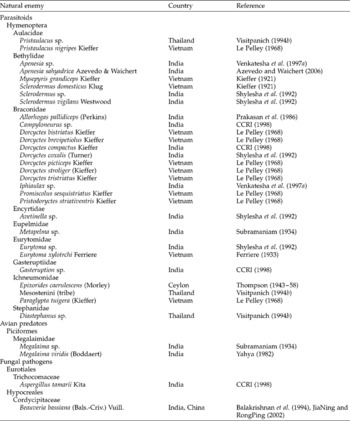
Twenty-eight species of parasitoids, two species of general avian predators and two species of fungal pathogens have been recorded as the natural enemies of CWSB (Table 1). Some mass-reared parasitoids released in Vietnamese coffee plantations are not effective in bringing down the borer incidence (Le Pelley, Reference Le Pelley1968). Allorhogas pallidiceps (Perkins) (Hymenoptera: Bracondiae) caused 78.3% parasitism in some areas in India (Prakasan, Reference Prakasan1987). The hymenopteran ectoparasitoids Apenesia sp. (Bathylidae) and Iphiaulax sp. (Braconidae) caused 0.08 and 0.4% natural parasitism on the full-grown grubs of CWSB, respectively (Venkatesha et al., Reference Venkatesha, Seetharama and Sreedharan1997a). Apenesia sp. has been subsequently described as Apenesia sahyadrica Azevedo & Waichert (Azevedo and Waichert, Reference Azevedo and Waichert2006). Augmentative field releases of laboratory-reared A. sahyadrica in the field caused 20–100% parasitization of CWSB larvae (Seetharama et al., Reference Seetharama, Kumar, Sreedharan and Vasudev2008). Allorhogas1 pallidiceps, Apenesia sp. and Iphialaux sp. are frequently encountered in India (Seetharama et al., 2002a, Reference Seetharama, Kumar and Sreedharanb; Venkatesha, 2005). In Thailand, Pristaulacus sp. (Hymenoptera: Aulacidae) caused 18.1–35.0% parasitism and seems to be the most important species for the biological control of CWSB (Visitpanich, Reference Visitpanich1994b). An egg parasitoid, Avetinella sp. (Hymenoptera: Encyrtidae), recorded as a natural enemy of CWSB caused 2.2% parasitism in India (Shylesha et al., Reference Shylesha, Veeresh and Siddegowda1992).
Natural enemies of Xylotrechus quadripes

No specific predator of CWSB has been recorded so far. Subramaniam (Reference Subramaniam1934) recorded a predatory bird, blue barbet Megalaima sp. (Megalaimidae), as a natural enemy of CWSB. The small green barbet Megalaima viridis (Boddaert) excavates CWSB larvae from dead coffee branches (Yahya, Reference Yahya1982; Veeresh, Reference Veeresh1995).
Two entomopathogenic fungi, Beauveria bassiana (Bals.-Criv.) Vuill. (Balakrishnan et al., Reference Balakrishnan, Sreedharan and Bhat1994) and Aspergillus tamari Kita, have been recorded as natural enemies of CWSB larvae (CCRI, Reference CCRI1998). Beauveria bassiana-inoculated CWSB larvae are killed successfully in the laboratory (JiaNing and RongPing, Reference JiaNing and RongPing2002; Balakrishnan and Sreedharan, Reference Balakrishnan and Sreedharan2006). As larval and pupal stages of CWSB are well protected in the closed tunnel in coffee stems, use of any larval/pupal parasitoids, predators and pathogens as biocontrol agents may not be highly successful. However, employing an effective egg parasitoid/predator/pathogen may be useful against CWSB.
Integrated management
A wide range of control tactics and IPM have been practised to manage CWSB (Le Pelley, Reference Le Pelley1968; CCRI, Reference CCRI1998, Reference CCRI2003; Sreedharan and Kumar, Reference Sreedharan and Kumar2001).
Cultural method
Shade has a beneficial influence in the control of the borer (Venkatesha, Reference Venkatesha1999; CCRI, Reference CCRI2003). Coffee grown under optimum shade is much less attacked as CWSB beetles prefer to oviposit in bright sunlight (CCRI, Reference CCRI2003). Shade is also recommended in Vietnam to reduce the borer incidence and thus Vernicia montana Lour. (Euphorbiaceae) was considered as the most suitable shade tree, as it sheds its leaves during September–October when the coffee plants need more light (Caresche, 1938). However, more shade may increase the incidence of fungal coffee diseases and the coffee berry borer Hypothenemus hampei (Ferrari) (Coleoptera: Curculionidae) in Asian countries as observed in African and South American coffee plantations (Beer et al., Reference Beer, Muschler, Kass and Somarriba1998). The main stem and primary branches should not be exposed while pruning the coffee plants and a low canopy shade should be established with Erythrina subumbrans (Hassk.) Merr. (Fabaceae) and Grevillea robusta A. Cunn. ex R. Br. (Proteaceae) trees to check the borer incidence (Rao, Reference Rao2004). However, coffee farmers usually remove shade to increase crop yield, thereby increasing the borer incidence (Venkatesha, Reference Venkatesha1999). Optimum shade management is a major constraint due to non-availability of skilled workers for lopping of shade trees (Venkatesha, 2010).
Mechanical methods
The hand-picking of CWSB beetles was practised for several years (Kunhi Kannan, Reference Kunhi Kannan1924). However, hand-picking is not effective unless all farmers in a locality practise the method (Subramaniam, Reference Subramaniam1934). Identifying, uprooting and destruction of borer-infested plants before the start of the flight period based on the presence of the borer ridges on the main stem and thick primary branches is an important mechanical method of CWSB control. The plants that show borer ridges are uprooted and destroyed. As the borer breeds faster in drying stems, uprooted stems should be burnt immediately to kill the pest stages, otherwise the pest completes its development and emerging adults reinfest the plants (Subramaniam, Reference Subramaniam1934; Pattabhiraman, Reference Pattabhiraman1983). Nevertheless, farmers who store uprooted plants for later use as firewood worsen the borer problem (Chacko, Reference Chacko1976; Venkatesha et al., Reference Venkatesha, Seetharama and Sreedharan1997b). As an alternative method, uprooted stems can be submerged in water for 7–10 days to kill the developmental stages of CWSB and, later, these stems can be used as firewood (Venkatesha et al., Reference Venkatesha, Seetharama and Sreedharan1997b; Venkatesha, Reference Venkatesha1999). The plants that show borer ridges may not harbour live larvae because of the death of young larvae while tunnelling. Uprooting of such productive plants will have a negative impact in plantation management (Venkatesha, Reference Venkatesha1999). To overcome this problem, borer-infested plants can be cylindrically covered with a nylon net before the start of the flight period to prevent the escape of emerging beetles, and the crop can be harvested from these plants as long as they are productive (Venkatesha, Reference Venkatesha1999). As emerging beetles die inside the net, this method will remarkably bring down the CWSB population in the field.
An important measure practised against the CWSB is making the surface of the main stem and thick primary branches smooth before the beginning of the flight periods by scrubbing the bark using a coir fibre glove/coconut husk to prevent the females from laying eggs in the scaly bark (Bhat et al., Reference Bhat, Ramprasad and Gowda1992). Eggs and young larvae are removed along with the scaly bark in the smoothening operation. Many farmers practise this method, as it is highly effective in borer management (Subramaniam, Reference Subramaniam1934; Venkatesha, Reference Venkatesha1999). Stem smoothening causes no adverse effect on the physiology of coffee plants, but deep scrubbing will injure the plants, and these plants may wilt during the hot season (CCRI, Reference CCRI1998). Yet stem hand scrubbing is very labour-intensive, thus the need for mechanization of this task.
Chemical control
Insecticides and miscellaneous substances applied to the stem to kill eggs and young larvae as well as to repel egg-laying adults of CWSB are not effective (Le Pelley, Reference Le Pelley1968). A coal tar distillate (10%) slightly reduced the borer infestation (Kunhi Kannan, Reference Kunhi Kannan1924). Sodium arsenate in an emulsion of wood tar distillate caused 60% larval mortality, but it damaged the plants (Subramaniam, Reference Subramaniam1934). Among various insecticides tested against the CWSB, only a hexachlorocyclohexane (HCH 50 WP 1% a.i.) application on the stem and primary branches remarkably reduced the pest attack (Sekhar, Reference Sekhar1964). HCH usage in borer control has not affected the beverage quality of arabica coffee (D'-Souza et al., Reference D’-Souza, Venkataramaiah, Bhat and Ali1970). Swabbing of the main stems and primary branches with Lindane (γ-HCH) 20EC at 1300 ml or HCH 50 WP at 4 kg in 200 litres of water during the CWSB flight periods has been practised for several decades in India (CCRI, Reference CCRI1996). As HCH was banned in India in 1997, only Lindane has been used until recent years (Venkatesha and Seetharama, Reference Venkatesha and Seetharama1999a).
Some systemic insecticides injected into the stem did not kill the tunnelling larvae of CWSB (Reddy et al., Reference Reddy, Venkatesulu and Bhat1989). Swabbing of DDT, Parathion E 605 and Demeton E1059 is ineffective (Kung, Reference Kung1977; Chacko, Reference Chacko1978; Pattabhiraman, Reference Pattabhiraman1983; Venkataramaiah and Rehiman, Reference Venkataramaiah and Rehiman1989). Some botanical insecticides, lime or bitumen applied to the stem killed the first-instar larvae of CWSB for 22–35 days, while with organic insecticides (chlorphyriphos, lindane and endosulfan), it was for 77–83 days in the laboratory (Venkatesha and Seetharama, Reference Venkatesha and Seetharama1999a). A lime (10% in water) application on the stem provides some protection against the CWSB in the field as it fills the crevices on the stem and thus prevents the beetles from egg deposition (Vinod Kumar et al., Reference Vinod Kumar, Seetharama, Balakrishna, Irulandi and Jayarama2009).
Laboratory trials show that chlorpyriphos is more effective against eggs, while carbosulfan is more effective against the fifth-instar larvae, and both chlorpyriphos and carbosulfan are effective against adults (Seetharama et al., Reference Seetharama, Vasudev, Kumar and Sreedharan2004c). Chlorpyriphos is more effective and less hazardous than Lindane, and it is recommended for stem application during the peak emergence periods of CWSB (Vinod Kumar et al., Reference Vinod Kumar, Seetharama, Balakrishna, Irulandi and Jayarama2009).
Host plant resistance
Attempts have been made to develop resistant arabica cultivars against the CWSB (Srinivasan and Ramachandran, Reference Srinivasan and Ramachandran1997; Ram, Reference Ram2005). CWSB causes less damage in some arabica coffee selections in India. A new arabica cultivar in India, Chandragiri, shows a good yield potential and a high tolerance to the CWSB (Jayarama, Reference Jayarama2007). The drooping branches of Chandragiri plants cover the entire main stem and act as a barrier against borer attack (Jayarama, Reference Jayarama2007). To control the CWSB, development of resistant arabica cultivars could be an ideal research in the future.
Future prospects for the effective management of CWSB
(1) Potential future options in borer management would be fungal pathogens and parasitic nematodes that can survive on the coffee stem for a long period under shaded conditions and attack the first-instar larvae of CWSB in the bark region.
(2) A better option would be developing borer-resistant arabica cultivars (Ram, Reference Ram2008). Developing antixenosis and antibiosis characteristics in arabica coffee cultivars through both breeding and recombinant methods to deter egg deposition, larval tunnelling and development will go a long way in CWSB management.
(3) Research is needed in a range of areas for better management of CWSB. For example, more refined temperature threshold studies and demographic parameters on CWSB would be useful for modelling potential outbreak under different climatic conditions. Overall, an improved understanding of the population ecology of CWSB at low densities would be helpful for controlling the borer in different agro-climatic regions.
(4) Systematic studies on crop loss estimation and cost-effectiveness of pheromone control are needed to improve CWSB management.
(5) The combination of kairomones and pheromones has greatly enhanced the attraction in several wood-boring cerambycids (Pajares et al., Reference Pajares, Álvarez, Ibeas, Gallego, Hall and Farman2010). Hence, studies on the blend of host plant volatiles and CWSB pheromones may be useful for effective mass trapping of the beetles.
Conclusions
Published information on CWSB indicates that we still need improved management methods for an effective control of the pest. CWSB control by synthetic insecticides poses risks as CWSB flight periods coincide with the pre- and post-monsoon rains, resulting in the wash off of insecticides (Venkatesha, Reference Venkatesha1999). Moreover, large-scale insecticide applications kill the natural enemies of CWSB and those of other pests as well (Venkatesha, 2005). In addition, any synthetic pesticide usage in global coffee production is discouraged because of demand for toxic-free coffee. Although the pheromone trapping of female beetles seems to be useful, coffee farmers are not that enthusiastic to adopt the technology because of the high density of traps (25 per ha) needed (Jayarama and Vinod Kumar, Reference Jayarama and Vinod Kumar2009); moreover, many find it cumbersome to handle the sticky traps. CWSB pheromone traps are target specific; however, a large number of other important insects in the food chain and insect pollinators are attracted to the white traps and killed, which may adversely affect biodiversity and create an imbalance in the coffee ecosystem. Because the cultural control of CWSB mainly depends on a large number of skilled workers for stem smoothening and the identification of borer-infested plants, the meticulous implementation of borer management tactics is often not possible because of the non-availability of such skilled workers.
Despite the intensive research efforts, for more than one and a half centuries, CWSB has consistently been a serious threat to arabica coffee cultivation in Asia. Researchers in different Asian countries have been working on CWSB in isolation. Hence, there is a need for combined and co-ordinated research to develop better and sustainable CWSB management strategies. Although it is an extremely difficult pest to control, the borer could be managed by the meticulous practice of IPM tactics in which stem scrubbing and covering the pest-infested stem with a nylon net are the safest and the most effective control methods. Governments of Asian coffee-producing countries should provide adequate funds to conduct research on CWSB, which should include novel aspects mentioned in this review, and technology transfer for the better implementation of IPM programmes.
Acknowledgements
M.G.V. expresses his gratitude to the Central Coffee Research Institute, Chikmagalur District, Karnataka, India, where he had previously worked on CWSB for about a decade. The authors thank anonymous reviewers for critically reviewing the manuscript.