


Rates of mental health problems among Australian adolescents have increased at an alarming rate over the past decade (Australian Bureau of Statistics, 2018a, 2018b). Mental health problems negatively affect how a person thinks, feels and behaves, and may or may not be part of a diagnosed mental health disorder (Sawyer et al., Reference Sawyer, Arney, Baghurst, Clark, Graetz, Kosky, Nurcombe, Patton, Prior, Raphael, Rey, Whaites and Zubrick2001). Mental health problems can have profound impacts on wellbeing and functioning, yet young people with mental health problems often delay or avoid seeking professional help (Lawrence et al., Reference Lawrence, Johnson, Hafekost, Boterhoven de Haan, Sawyer, Ainley and Zubrick2015; McGorry & Purcell, Reference McGorry and Purcell2009; Mission Australia & Black Dog Institute, 2017).
Seeking help for mental health problems is critical for preventing the development and progression of mental health disorders (McGorry & Mei, Reference McGorry and Mei2018). Although definitions vary, help-seeking can be thought of as ‘an adaptive coping process that is the attempt to obtain external assistance to deal with a mental health concern’ (Rickwood & Thomas, Reference Rickwood and Thomas2012, p. 180). External assistance or ‘help’ for mental health concerns can be sought from ‘formal’ sources (e.g., psychologists and doctors) and ‘informal’ sources (i.e., teachers, family and friends).
Help-seeking for mental health problems during adolescence, when a majority of associated disorders emerge, has the capacity to generate better outcomes than intervention at any other time in the lifespan (Access Economics, 2009; Catania et al., Reference Catania, Hetrick, Purcell and Newman2011; Littlefield, Reference Littlefield2008; ReachOut Australia & Mission Australia, 2018). Early intervention is the key to achieving successful mental health outcomes, reducing suicide rates and reducing the burden of mental disorders (Access Economics, 2009; Catania et al., Reference Catania, Hetrick, Purcell and Newman2011; Littlefield, Reference Littlefield2008; ReachOut Australia & Mission Australia, 2018).
Unfortunately, around one in three (34.9%) adolescents with mental health problems fail to seek professional help (Lawrence et al., Reference Lawrence, Johnson, Hafekost, Boterhoven de Haan, Sawyer, Ainley and Zubrick2015). Research has consistently found that male and female adolescents show a strong preference for informal sources of help, such as friends and parents, over formal sources, such as psychologists and doctors, irrespective of their age, gender and residential location (Mission Australia, 2018b; Rickwood et al., Reference Rickwood, Deane, Wilson and Ciarrochi2005). However, females consistently report greater intentions to seek help from informal sources, such as friends and teachers, and familiar formal sources, such as school psychologists, than their male counterparts, while males report greater intentions to seek help from mental health community agencies and general practitioners (Australian Institute of Family Studies, 2017; Mission Australia & Black Dog Institute, 2017; Ratnayake & Hyde, Reference Ratnayake and Hyde2019). While males and females report similar levels of actual help-seeking behaviour in early adolescence, studies have indicated that males become less likely to actually seek help than their female counterparts as they increase in age (Lawrence et al., Reference Lawrence, Johnson, Hafekost, Boterhoven de Haan, Sawyer, Ainley and Zubrick2015; Rickwood et al., Reference Rickwood, Deane, Wilson and Ciarrochi2005).
Barriers to help-seeking
Research indicates that there are a range of attitudinal and practical barriers that prevent adolescents from seeking professional help and contribute to gender differences in help-seeking behaviour. Poor mental health literacy has been identified within the literature as a key barrier to help-seeking in this population (Gulliver et al., Reference Gulliver, Griffiths and Christensen2010) where help-seeking is the outcome of improved mental health knowledge. Mental health literacy (MHL) was first defined by Jorm et al. (Reference Jorm, Korten, Jacomb, Christensen, Rodgers and Pollitt1997) as knowledge and beliefs about mental disorders that aid their recognition, management or prevention. This definition has since been updated to encompass six attributes where help-seeking is specifically outlined as a factor; these attributes include the ability to recognise mental health disorders, identify risk factors, know how to seek and obtain mental health information, obtain knowledge of prevention, and identify the best treatments and resources available as well as how to access this support (Jorm, Reference Jorm2015). Recent research has identified the importance of advancing developmentally appropriate frameworks of mental health literacy in children and young people as traditional definitions are developed from research with adult populations (Bale et al., Reference Bale, Grové and Costello2018; Riebschleger et al., Reference Riebschleger, Grove, Cavanaugh and Costello2017). Such research has advanced the conceptualisation and understanding of specific mental health needs of youth, their wellbeing and help-seeking behaviours. Recent research by Bale et al. (Reference Bale, Grove and Costello2020) has proposed a new framework for mental health literacy in children. The model identifies six themes that encompass recognising changes in mental health, help-seeking actions, supports available, mental health influences, coping and resilience, and attitudes (Bale et al., Reference Bale, Grove and Costello2020); the researchers highlight that the actioning of help-seeking by young people is impacted by knowledge of how to access support.
Research indicates that adolescents often do not have adequate knowledge about what health services are available and how to access them (Jorm et al., Reference Jorm, Korten, Jacomb, Christensen, Rodgers and Pollitt1997; Rickwood et al., Reference Rickwood, Thomas and Bradford2012). They can also have difficulty appraising their distress levels as normal or abnormal. Perceived and self-stigma and embarrassment consistently emerge in the literature as prominent barriers to help-seeking for mental health problems (Gulliver et al., Reference Gulliver, Griffiths and Christensen2010; Rickwood et al., Reference Rickwood, Deane, Wilson and Ciarrochi2005). Associating help-seeking for mental health concerns with being a sign of personal weakness is well established in the literature, particularly among men and individuals residing in regional areas (Kõlves et al., Reference Kõlves, Milner, McKay and de Leo2012; Reavley & Jorm, Reference Reavley and Jorm2012). A lack of accessibility to mental health services is another prominent barrier to help-seeking by adolescents (Gulliver et al., Reference Gulliver, Griffiths and Christensen2010). Even if a young person fully intends to seek help, services must be available, affordable and accessible by transport and a person must have time to access it, if help is to actually be sought. To improve help-seeking intentions and actual behaviour, it is important that the way in which such barriers interact is well understood.
Models of help-seeking
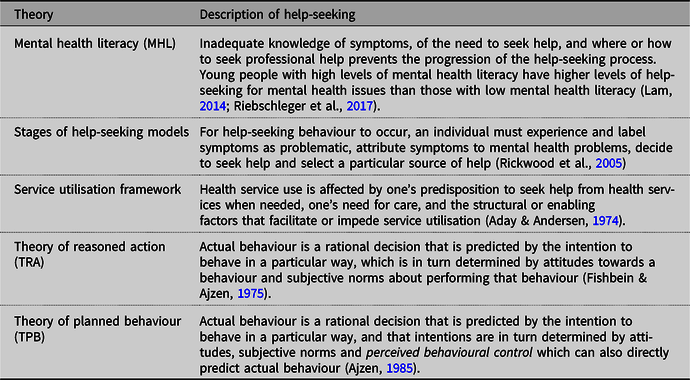
Applying existing theories of help-seeking to adolescent help-seeking behaviour can provide greater insight into how these factors interact to influence the help-seeking process. Help-seeking literature has relied heavily on several major theories of behaviour to explain the help-seeking process; these are summarised in Table 1.
Main Theories Relevant to Adolescent Help-Seeking

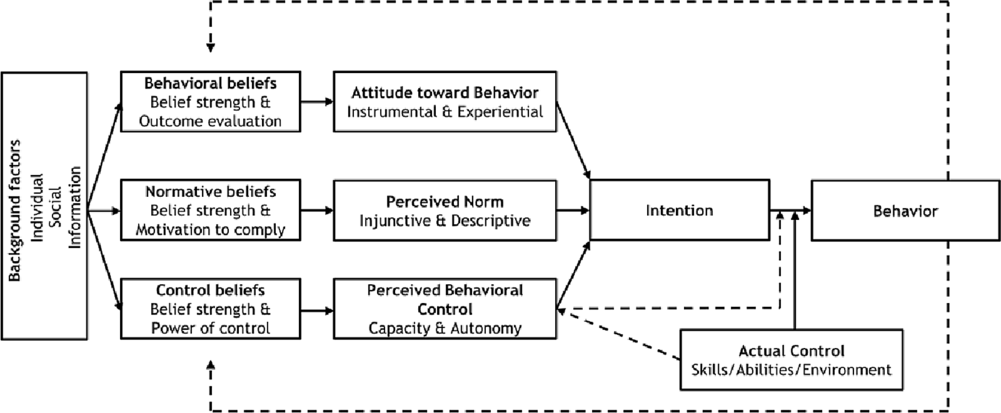
A criticism of guiding models and frameworks of help-seeking is that they do not adequately incorporate several key determinants of help-seeking behaviour or reflect the dynamic nature of the help-seeking process, and therefore much of the process remains unexplained (Murray, Reference Murray2005). In some models, important factors impacting the help-seeking process (e.g., practical access to services and mental health literacy) are ignored or considered as external influences on the model (Ajzen & Fishbein, Reference Ajzen and Fishbein1980; Fishbein & Ajzen, Reference Fishbein and Ajzen1975; Rickwood et al., Reference Rickwood, Deane, Wilson and Ciarrochi2005). One model that could potentially address these limitations is the reasoned action approach (RAA; see Figure 1; Fishbein & Ajzen, Reference Fishbein and Ajzen2010).
Reasoned action approach. From Predicting and Changing Behavior: The Reasoned Action Approach, M. Fishbein & I. Ajzen, © Reference Fishbein and Ajzen2010, Psychology Press. Reproduced by permission of Taylor & Francis Group.

The RAA is the latest of Fishbein and Ajzen’s behaviour models (Ajzen, Reference Ajzen, Kuhl and Beckmann1985; Fishbein & Ajzen, Reference Fishbein and Ajzen1975). As represented in Figure 1, it proposes that attitudes influence intentions by mediating the relationship between background factors (e.g., knowledge) and intentions. Additionally, unlike any of the previously applied frameworks, the RAA allows for consideration of the way in which actual control influences the translation of help-seeking intentions to behaviour (Fishbein & Ajzen, Reference Fishbein and Ajzen2010).
The current study
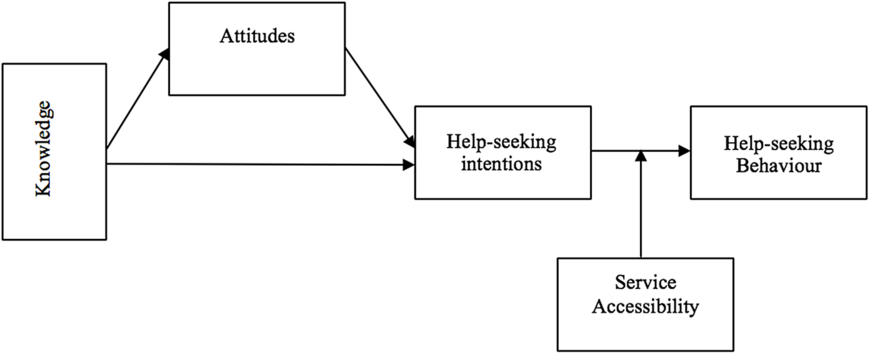
Investigating the relationship between mental health knowledge and help-seeking attitudes (the two key components of mental health literacy), service accessibility, help-seeking intentions and help-seeking behaviours will contribute to current understanding of how barriers influence the help-seeking process and guide interventions to improve help-seeking behaviour; see Figure 2.
Application of the reasoned action approach (adapted from Fishbein & Ajzen, Reference Fishbein and Ajzen2010) to help-seeking for mental health concerns.

Guided by the RAA, the present study aimed to examine possible differences in help-seeking determinants, help-seeking intentions and behaviours reported by male and female adolescent students. It was predicted that female students would report greater mental health literacy (knowledge and attitudes) towards mental health problems than male students. It was also hypothesised that there would be no gender difference between overall help-seeking intentions and behaviours, but female students would prefer to seek help from informal sources than their male counterparts. The current study also examined the relationship between mental health knowledge and attitudes, service accessibility, help-seeking intentions and actual help-seeking behaviour. It was hypothesised that mental health attitudes would mediate the predictive relationship between knowledge and help-seeking intentions. It was also predicted that help source accessibility would moderate the relationship between help-seeking intentions and actual help-seeking behaviours among students with an identified mental health concern.
Method
Participants
Participating schools were recruited via mail invitation and convenience sampling. Three schools were recruited, including a government co-educational school in inner Melbourne (high SES location), an independent girls’ school in inner Sydney and an independent co-educational school in regional New South Wales (both independent schools were fee-paying). All schools deliver universal wellbeing programs and employ wellbeing support staff; for example, psychologists, counsellors and/or wellbeing coordinators. In total, 172 Grade 10, 11 and 12 participants took part in the study. The sample consisted of 111 females and 61 males, ranging in age from 15 to 17.5 years (M = 16.02, SE = .05); 95.3% of participants were located in urban areas, 81.4% of participants reported being born in Australia, while 8.1%, 5.8% and 4.7% of participants identified being born in Asia, Europe or other continents respectively; 1.7% of participants identified as Aboriginal or Torres Strait Islander, and 3.5% of participants identified as international students.
Procedure
Ethical approval for this study was obtained from the University of Melbourne Human Research Ethics Committee and permission to conduct the study was obtained from the relevant state department of education and school principals. Parents/guardians and students were provided with a Plain Language Statement (PLS) that described the nature and purpose of the research, and signed consent was obtained from both students and parents/guardians. Student assent was also required before students progressed through the online survey. All participants required access to a computer, tablet or smartphone to complete the survey hosted by Qualtrics. The survey included four questionnaires and lasted approximately 15–20 minutes. A prompted response procedure was used to minimise the potential for skipped questions, and participants were required to complete and submit the survey in one sitting.
Materials
Participants were required to complete an online survey battery hosted by Qualtrics. The survey lasted approximately 15–20 minutes and included four questionnaires which measured mental health literacy (MHL), help service accessibility, help-seeking intentions and help-seeking behaviours.
Mental Health Literacy Scale
MHL was assessed using the 35-item Mental Health Literacy Scale (MHLS; O’Connor & Casey, Reference O’Connor and Casey2015). Participants were asked to indicate on a 5-point Likert-type scale the extent to which they agreed or disagreed with 15 statements relating to mental health knowledge and 20 statements relating to mental health attitudes. The MHLS, overall, has acceptable test-retest reliability r(69) = .797, p < .001, and good internal reliability, with a reported Cronbach’s alpha of .87 (O’Connor & Casey, Reference O’Connor and Casey2015). For the current sample, the attitudes and knowledge subscales demonstrated good and questionable degrees of internal consistency, with Cronbach’s alphas of .87 and .65, respectively. It has been argued that instruments that have a questionable alpha can still prove useful if they assess a broad range of knowledge (Berger & Hänze, Reference Berger and Hänze2015; Schmitt, Reference Schmitt1996).
Service Accessibility Questionnaire
Help service accessibility was assessed using the Service Accessibility Questionnaire (SAQ), which was developed specifically for this study, guided by questions included in ReachOut and Mission Australia’s (2018a) Youth Survey. Participants were asked to indicate on a 5-point Likert-type scale the extent to which they agreed or disagreed with three statements relating to service affordability, transport and timing (‘I could not afford to get professional help even if I wanted to’; ‘I don’t have transport to get to a service’; ‘Even if I wanted to, I wouldn’t have time to get professional help’). Participants were also asked to select mental health services (e.g., school psychologist, family doctor) available to them. For the current sample, the SAQ demonstrated acceptable internal consistency with a Cronbach’s alpha of .71.
General Help Seeking Questionnaire
Intentions to seek help were assessed using the General Help-Seeking Questionnaire (GHSQ; Wilson et al., Reference Wilson, Deane, Ciarrochi and Rickwood2005). Participants were asked to indicate on a 7-point Likert-type scale the likelihood they would seek help for personal or emotional problems and suicidal ideation from sources listed. The GHSQ has excellent test-retest reliability (r = .92; Wilson et al., Reference Wilson, Deane, Ciarrochi and Rickwood2005) and good internal consistency with a Cronbach’s alpha of .85. For the current sample, the GHSQ demonstrated acceptable internal consistency with a Cronbach’s alpha of .79.
Actual Help-Seeking Questionnaire
Help-seeking behaviour was assessed using the Actual Help-Seeking Questionnaire (AHSQ; Rickwood & Braithwaite, Reference Rickwood and Braithwaite1994). Participants were asked to identify whether they had or had not sought help for personal or emotional problems from a list of informal sources (e.g., parent, friend, teacher) and formal sources (e.g., mental health professional, doctor or phone help line) by providing a ‘yes’ (1) or ‘no’ (0) response, and then describing the problem. Only participants who described having experienced personal or emotional problems over the past 4 weeks received a score for formal help-seeking and informal help-seeking on the AHSQ.
Data analysis
All analyses were carried out using SPSS Version 25. Prior to analysis, data were examined for violations of normality and homogeneity of variances. Chi-square tests of association revealed no significant differences between group characteristics on any of the relevant analyses. One-way analyses of variance (ANOVAs) were conducted to investigate the effects of gender on knowledge, attitudes, service accessibility and help-seeking intentions within the full sample, and formal and informal help-seeking behaviour among those who reported a recent mental health concern. Independent sample t tests were used to investigate the gender differences in help-seeking intentions from specific help sources. Process regression analysis was used to investigate the way in which factors related to one another (Hayes, Reference Hayes2013).
Results
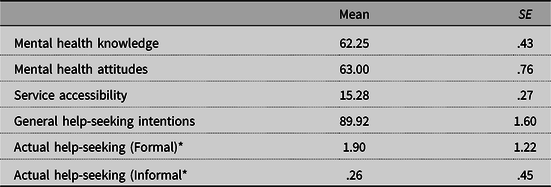
There were no significant main effects of gender on any of the outcome variables, ps > .08. (See Table 2 for mean scores and associated standard errors.)
Means and Standard Errors of Outcome Variables

Note: *Means and standard errors were obtained from subsample of students with reported mental health concern.
Gender differences were identified for source and problem type in regard to help-seeking intentions. The results revealed that females (M = 5.61, SE = .14) were more likely to indicate they would seek help from friends for personal and emotional problems than their male counterparts (M = 5.08, SE = .22), t(170) = 2.13, p = .04, d = .34. Similarly, females (M = 5.64, SE = 1.35) were more likely to report that they would seek help from a mental health professional for personal and emotional problems than males (M = 5.11, SE = .22), t(170) = 2.14, p = .03, d = .34. Males indicated significantly greater intentions to seek help for suicidal ideation from a general practitioner (M = 5.05, SE = .25) than their female counterparts (M = 4.23, SE = .20), t(170) = 2.53, p = .01, d = .43.
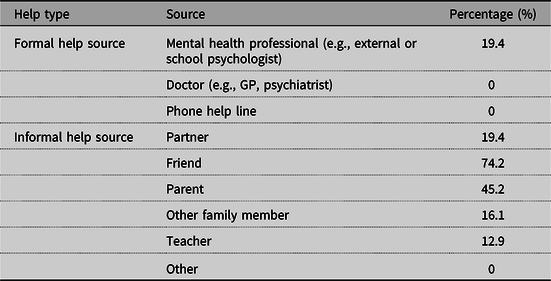
In total, 18.6% of students in the total sample reported seeking help for a mental health concern. Of these students, 87.1% and 19.4% sought help from at least one informal or formal source of help, respectively. See Table 3 for a breakdown of help-seeking behaviour amongst students that identified experiencing a recent mental health concern.
Percentage of Students With Recent Mental Health Concern Who Sought Help From Formal and Informal Sources

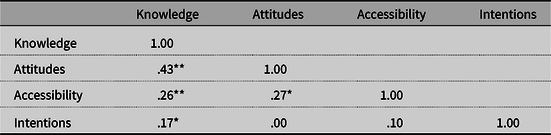
Pearson correlation coefficients revealed a statistically significant, moderate correlation between knowledge and attitudes and knowledge and accessibility within the full sample, ps < .01 (see Table 4). There was also a significant, weak correlation between knowledge and help-seeking intentions and attitudes and accessibility, ps < .05.
Correlations Between Variables for All Participants

Note: **p < .01, *p < .05.
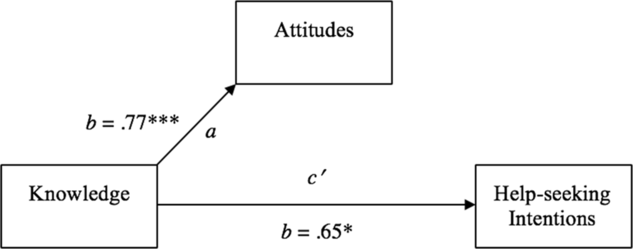
As shown in Figure 3, path regression analysis revealed that knowledge was a significant, direct predictor of both attitudes, b = .77, t(1,170) = 6.21, p < .001 (a), and help-seeking intentions, b = .65, t(1,170) = 2.06, p = .04 (c′). However, attitudes did not significantly predict help-seeking intentions, p = .95, and did not mediate the relationship between knowledge and intentions. Together, the direct effect of knowledge and indirect effect of knowledge via attitudes, did not significantly predict intentions, F(2,169) = 2.55, p = .08, R 2 = .03.
Path analysis — Knowledge, attitudes and help-seeking intentions.

Regression analysis indicated that within the subgroup of students who reported experiencing a recent mental health concern, neither help-seeking intentions or accessibility significantly predicted levels of formal help-seeking, and accessibility did not moderate the relationship between intentions and formal help-seeking, ps > .15. The results also indicated that accessibility did not moderate the relationship between help-seeking intentions and actual formal or total help-seeking behaviour, ps > .09.
Discussion
The present study aimed to examine gender differences in the mental health knowledge and attitudes, help-seeking intentions and help-seeking behaviours of adolescents. The study revealed no significant differences between the mental health knowledge and attitudes, overall help-seeking intentions or formal help-seeking behaviours for male and female students. Recent broad-scale studies have found the level of help-seeking intentions and preference for informal sources of help to be similar for young males and females in their early teenage years (Australian Institute of Family Studies, 2017; Mission Australia & Black Dog Institute, 2017). This trend is reflected in the current study.
In relation to specific type of help source, females in the present study reported being significantly more likely to seek help from their friends than males, which is consistent with recent findings within the help-seeking literature (Australian Institute of Family Studies, 2017; Mission Australia & Black Dog Institute, 2017). Interestingly, in the current study, male students reported greater intentions to seek help from a doctor for suicidal ideation than female students. This is consistent with findings from a recent study that examined help-seeking intentions in Australian high school students (Ratnayake & Hyde, Reference Ratnayake and Hyde2019). The authors found that male students were more likely to report intentions to seek help from a doctor or general practitioner for personal and emotional problems and suicidal ideation than female students. These findings indicate a male preference for dealing with mental health issues in a more private or medical manner (e.g., through consultation with a medical practitioner), which is consistent with the Mission Australia and Black Dog Institute (2017) report in which males indicated a preference to seek help from community agencies.
Interestingly, only around one fifth of students who identified having sought some sort of help for a recent mental health concern reported seeking that help from a formal source. Such a pattern is consistent with research that shows adolescents have a strong preference for informal sources of help (such as parents or friends) irrespective of their age and gender (Mission Australia, 2018b; Rickwood et al., Reference Rickwood, Deane, Wilson and Ciarrochi2005). The level of formal help-seeking within this population is relatively low in comparison to recent figures from the Australian Child and Adolescent Survey of Mental Health and Wellbeing (Lawrence et al., Reference Lawrence, Johnson, Hafekost, Boterhoven de Haan, Sawyer, Ainley and Zubrick2015). This survey found that 65.1% of Australians aged 12–17 with mental disorders sought formal help in the previous 12 months. As the current study did not measure students’ actual mental health status, it is not possible to ascertain whether students’ mental health problems were diagnosable conditions that may necessitate professional help. It could also be reasoned that high levels of informal help-seeking and school-based resources such as wellbeing programs and structures in place in the participating schools may have reduced the need for formal help-seeking within this population. In other words, students had access to internal support resources as a result of wellbeing programs within the school thereby potentially reducing the need for formal help-seeking.
The second aim of this study was to examine the relationship between mental health knowledge and attitudes, service accessibility, help-seeking intentions and help-seeking behaviour. In the current study, knowledge was a significant predictor of variance in overall help-seeking intentions. This provides partial support for the RAA (Fishbein & Ajzen, Reference Fishbein and Ajzen2010). The RAA extends upon the theories of planned behaviour and reasoned action by adding background factors (e.g., knowledge) as determinants of intentions to perform a behaviour like help-seeking (Ajzen, Reference Ajzen, Kuhl and Beckmann1985; Fishbein & Ajzen, Reference Fishbein and Ajzen1975, Reference Fishbein and Ajzen2010). The current results provide further support for the importance of mental health knowledge (a key construct within mental health literacy) in improving help-seeking intentions (Hart et al., Reference Hart, Morgan, Rossetto, Kelly, Mackinnon and Jorm2018; Lubman et al., Reference Lubman, Berridge, Blee, Jorm, Wilson, Allen, McKay-Brown, Proimos, Cheetham and Wolfe2016). While the findings indicate that knowledge is indeed important in predicting help-seeking intentions, in the current study only a small portion of the variance in help-seeking intentions was predicted by knowledge and attitudes. This reflects the complexity of the help-seeking process and highlights the importance of considering a variety of factors when designing future research and developing interventions (Damghanian & Alijanzadeh, Reference Damghanian and Alijanzadeh2018; Fishbein & Ajzen, Reference Fishbein and Ajzen2010).
Interestingly, in the current study, attitudes did not significantly predict help-seeking intentions, nor mediate the relationship between knowledge and intentions, as was hypothesised. This is inconsistent with the RAA and behaviour models before it, and past research that has linked negative help-seeking attitudes with low help-seeking intentions (Andrews et al., Reference Andrews, Issakidis and Carter2001). However, the current study’s results are consistent with prior research among Australian university students with moderate to severe symptoms of distress and the results of a study of 778 adolescents located in rural New South Wales. Both studies found that negative attitudes towards help-seeking did not significantly account for variation in help-seeking intentions (Rughani et al., Reference Rughani, Deane and Wilson2011; Vogel & Wester, Reference Vogel and Wester2003). However, in the adolescent sample, the perceived benefits of help-seeking were significantly associated with help-seeking intentions, which is consistent with research conducted in young adult populations (Rughani et al., Reference Rughani, Deane and Wilson2011; Vogel et al., Reference Vogel, Wester, Wei and Boysen2005). This suggests that attitudes towards the usefulness of professional help may play a more important role than attitudes towards mental health problems in predicting intentions (Rughani et al., Reference Rughani, Deane and Wilson2011). Future research should investigate the role played by specific types of attitudes held by adolescents in predicting help-seeking intentions.
In the current study, intention to seek help did not predict formal help-seeking behaviour among those students who identified having experienced a recent mental health concern. While there is limited research on actual help-seeking behaviour within adolescent populations, such results are in contrast to past research with adults that has consistently indicated that intentions are a significant predictor of actual help-seeking behaviour (Armitage & Conner, Reference Armitage and Conner2001; Bitman-Heinrichs, Reference Bitman-Heinrichs2017). Additionally, service accessibility did not predict actual formal help-seeking or influence the relationship between intentions and actual behaviour as hypothesised. It is likely that service accessibility assessed in this study better represents perceived accessibility rather than actual accessibility. This may have been confounded further by the inclusion of a nonclinical population.
Overall, these findings contribute to current knowledge on the relationship between key variables that influence the adolescent help-seeking process. In particular, it provides further support for the important role of mental health knowledge in predicting the help-seeking intentions of adolescent students (Hart et al., Reference Hart, Morgan, Rossetto, Kelly, Mackinnon and Jorm2018; Lubman et al., Reference Lubman, Berridge, Blee, Jorm, Wilson, Allen, McKay-Brown, Proimos, Cheetham and Wolfe2016). It also provides support for the most recent version of Fishbein and Azjen’s (Reference Fishbein and Ajzen2010) health behaviour models, the RAA, which built upon previous models by proposing that intentions are predicted by background factors such as knowledge (via attitudes). This has implications for psychology practitioners and schools in developing targeted interventions towards improving mental health literacy specifically knowledge, with the aim of improving help-seeking intentions and hopefully behaviours.
Mental health attitudes did not predict help-seeking intentions or mediate the relationship between knowledge and intentions in the current study, which suggests that the relationship between attitudes and help-seeking is complex and may depend on the type of attitude being measured (Rughani et al., Reference Rughani, Deane and Wilson2011; Vogel & Wester, Reference Vogel and Wester2003).
Limitations
The current findings must be considered within the context of the study limitations. First, while 172 students participated in the study, only 31 students were eligible to be included in regression analyses examining the relationship between help-seeking intentions and behaviours, which resulted in minimal power to detect an effect. Second, as the current study did not measure participants’ current mental health state, it was not possible to ascertain whether students’ mental health problems were severe enough to require formal help-seeking. Third, as the current study used a nonclinical sample, participants may not have had a solid understanding of true service availability. Thus, in this sample, service accessibility may have been a measure of perceived service accessibility rather than actual accessibility of services. Actual service accessibility may have a greater impact on the translation of help-seeking intentions to behaviours in a population that requires more targeted intervention from a mental health professional. Assessing actual service availability using more objective measures like financial means and student-psychologist ratios when examining the translation of intentions to behaviours in nonclinical populations would be worthwhile. Further, it is important to note that participants were predominantly recruited from well-resourced schools that were either fee-paying or located in higher socioeconomic areas, therefore the sample is not considered representative of the general adolescent population.
Conclusion
Seeking help for mental health concerns is critical for improving wellbeing and preventing the development of mental health disorders. However, many adolescents with mental health problems fail to seek professional help, preferring to seek help from informal sources such as friends and family due to a variety of barriers such as poor mental health literacy. This has implications for schools and highlights the importance of upskilling informal help sources such as friends and parents to respond to adolescents with concerns, and of educating gatekeepers like teachers on mental health and disorders to support adolescent referral and engagement with formal help sources when needed (Australian Institute of Family Studies, 2017; Mission Australia & Black Dog Institute, 2017; Rickwood et al., Reference Rickwood, Deane and Wilson2007). Given the preference for informal help-seeking, schools can also play a role in ensuring students have access to up-to-date mental health resources to support awareness and early identification of concerns.
In the current study, knowledge about mental health issues predicted students’ intentions to seek help, providing support for the RAA (Fishbein & Ajzen, Reference Fishbein and Ajzen2010) to help-seeking behaviour and interventions that focus on teaching mental health literacy to adolescents. This highlights the importance of school wellbeing programs incorporating mental health literacy skills and, in particular, development of mental health knowledge to promote better help-seeking behaviour of young people. It would be advisable for schools to review their wellbeing policies and practices to ensure that mental health literacy is embedded in wellbeing curriculum, given the identified link between knowledge and positive help-seeking behaviour. Future research should focus on validating the current study’s findings with larger samples, samples in areas of less advantage and with clinical populations, and should also examine the interplay between other elements within the RAA framework, such as other individual characteristics, perceived behavioural control and actual control. Such research will guide the development of interventions aimed at encouraging help-seeking behaviour, improving mental health outcomes and reducing the prevalence of mental disorders among Australian adolescents.