Introduction
Suicide is widely recognized as a significant public health problem. It is currently the 15th most common cause of death worldwide, accounting for an estimated 804,000 deaths in 2012 (World Health Organization, 2014). Older adults constitute the fastest growing population segment worldwide. By 2025, it is estimated that there will be 1.2 billion people in the world aged 60 years and over, and by 2050, two billion (World Health Organization, 1999). Older adults have a higher risk of suicide than other age groups, with men at higher risk than women (Conwell et al., Reference Conwell, Duberstein and Caine2002; O'Connell et al., Reference O'Connell, Chin, Cunningham and Lawlor2004; Centre for Addiction and Mental Health 2010). Risk factors associated with suicidal behavior in older adults include mental disorders – most notably depression; physical factors – chronic illnesses and disabilities; and social factors, such as bereavement and social isolation (Conwell et al., Reference Conwell, Duberstein and Caine2002; Dong et al., Reference Dong, Chang, Zeng and Simon2015). Non-fatal self-harm (with or without suicidal intent) is the one of the strongest predictors of suicide, and the older the person who has self-harmed the greater the risk of subsequent suicide (Owens et al., Reference Owens, Wood, Greenwood, Hughes and Dennis2005; Murphy et al., Reference Murphy2012). Additionally, suicide attempts are often of greater determination and lethality in older adults, reflecting a diminished physical resilience and greater isolation (Conwell et al., Reference Conwell, Duberstein and Caine2002).
Despite the rates of suicide and the high lethality associated with suicidal behavior in older adults, research on preventive interventions in this age group is sparse. There are a number of possible reasons contributing to this paucity of the literature, including lower numbers of suicide and non-fatal self-harm in older people compared to younger age groups, and the greater likelihood that self-harm will be fatal due to physical frailty and isolation (Conwell, Reference Conwell2014).
The risk factors for suicidal behavior can be approached at individual, group, or population level. These approaches include: universal interventions – targeted at the general public; selective interventions – targeted at groups or individuals with an elevated risk due the presence of known risk factors; and indicated interventions – targeted at high-risk individuals with early symptoms or behaviors (National Research Council and Institute of Medicine, 2009). Strategies employing these approaches have been used for other age groups. It remains unclear what strategies exist and are effective specifically targeting older adults. We identified one previous review in this age group (Lapierre et al., Reference Lapierre2011) that examined interventions aimed at suicidal elderly persons with a focus on depression screening and decreasing isolation. However, it did not follow strict Preferred Reporting Items for Systematic Reviews and Meta-Analyses (PRISMA) guidelines (Moher et al., Reference Moher, Liberati, Tetzlaff, Altman and Grp2010) and had searches conducted in 2009. It is therefore timely and necessary to undertake a review of all interventions (universal, selective, and indicated) aimed at preventing suicidal behaviors in older people, using robust methodology, and asking a more focused research question.
Objectives
The objectives of this systematic review are to
-
1. Identify, systematically review, and synthesize published articles describing interventions to prevent suicidal behavior (suicide, attempted suicide, and self-harm without suicidal intent) and reduce suicidal ideation in older people
-
2. Evaluate the effectiveness of these interventions
Methods
Search strategy
This systematic review was conducted in compliance with the PRISMA guidelines (Moher et al., Reference Moher, Liberati, Tetzlaff, Altman and Grp2010), and adhered to Cochrane recommended key stages of a systematic review (Higgins and Green, Reference Higgins and Green2011).
Five electronic databases – MEDLINE, EMBASE, PsycINFO, Web of Science, and Cochrane Central Register of Controlled Trials (CENTRAL) – were systematically searched for relevant publications using a search strategy (Appendix I) developed in MEDLINE and adapted for use in each of the other databases. Subject and keyword searches were conducted using a range of terms representing “older adult,” “suicide,”, “suicidal behavior,” “prevention,” and “intervention.” Searches were limited to the international literature published in English between the inception of the aforementioned electronic databases and 1 April 2016. We also reviewed the reference lists of included studies and contacted experts in the field for any unreported or on-going trials. All search results were saved on the electronic reference management software, EndNote (version X7).
Criteria for considering studies for the review
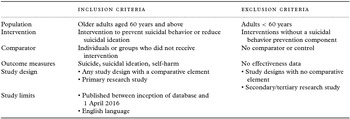
Studies included into this review reported effective data about interventions delivered to older adults to prevent suicidal behavior or reduce suicidal ideation. The complete inclusion and exclusion criteria can be seen in Table 1.
Inclusion and exclusion criteria

Selection of studies for inclusion in the review
A two-stage screening process was undertaken by two independent reviewers (CO & EST). First, both reviewers screened titles and abstracts to identify potentially eligible publications against inclusion and exclusion criteria. Where a decision could not be made or there was a disagreement as to eligibility, the citation was passed to the second stage. In the second stage, both reviewers independently assessed full texts of eligible studies to identify studies to be included in the review. Both reviewers also examined the reference lists of all included studies to identify other potentially eligible studies, and their citations traced using the Web of Science database. Any disagreements at either stage were resolved by consensus or were referred to a third expert reviewer (AJ).
Quality assessment
The quality of included studies was assessed using two quality assessment tools – the Cochrane Collaborations’ tool for assessing risk of bias in studies (Higgins and Green, Reference Higgins and Green2011), and the quality assessment checklist created by Jinks et al. (Reference Jinks, Cotton and Rylance2011), to reflect the breadth of study designs assessed.
The Cochrane Collaborations’ risk of bias tool is a domain-based evaluation, well suited for the assessment of quality in randomized trials. It assesses seven specific domains in each included study: (1) Sequence generation, (2) Allocation concealment, (3) Blinding of participants and personnel, (4) Blinding of outcome assessment, (5) Incomplete outcome data, (6) Selective outcome reporting, and (7) Other sources of bias. For each of these domains, a judgment of “low risk,” “high risk,” or “unclear risk” of bias was assigned relating to the risk of bias within each entry.
Jinks’ quality assessment checklist assessed eight different criteria, and awarded one point for each criteria met, with a possible maximum score of eight points. This assessment checklist is better suited to assessment of observational studies.
Two reviewers (CO & EST) independently assessed the quality of all included studies. Any disagreements were resolved by consensus or referred to a third reviewer (AJ).
Data extraction
Two reviewers (CO & EST) independently extracted data using a pre-piloted data extraction form adapted from the Cochrane Collaborations’ handbook (Higgins and Green, Reference Higgins and Green2011). For all included studies, data were extracted on general information (authors, title, year of publication, country, publication details), study characteristics (study design, participants, intervention details, outcome measures), study details (aims and objectives, recruitment details, inclusion/exclusion criteria, sample size calculations), as well as additional data on suicide mortality and suicidal behavior. Both reviewers compared all extracted data and resolved any disagreements by discussion. Any disagreements that remained unresolved were referred to a third reviewer (AJ). Included studies were reported according to setting delivered.
Data analysis and synthesis
This review employed a narrative synthesis approach (Popay et al., Reference Popay2006) to describe interventions to prevent suicidal behaviors and reduce suicidal ideation in older people, their delivery and use, and there efficacy. We considered the use of meta-analysis to synthesize quantitative findings related to effectiveness; however, due to significant heterogeneity as well as variability of the measuring scales in the included studies, it was not possible to undertake a valid meta-analysis.
Results
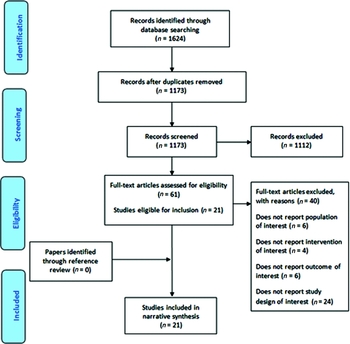
A total of 1,624 citations were identified through electronic database searching of which 21 articles met the criteria for inclusion in the review. The study selection process is shown in Figure 1.
PRISMA flow diagram.

Characteristics of included studies
Of the 21 included articles of 19 studies, six were randomized controlled trials (RCTs), while the remainder comprised of quasi-experimental studies (n = 7), controlled before and after (CBA) studies (n = 2), prospective cohort studies (n = 2), case-control studies (n = 2), decision analysis (n = 1), and a study with cohort and retrospective analysis of data components. Seven of the articles evaluated studies undertaken in Japan, six in USA, two in Italy and Israel, and one each in Australia, Hong Kong, France, and Germany. The characteristics of the included studies can be seen in Table 2.
Characteristics of included studies

The mean age for the included studies was 75.9 years, while the majority of study participants were female (65.2%). Five studies reported the ethnicities of study participants – the majority being White (75.3%). Interventions were either universal (n = 8), selective/targeted (n = 10), or indicated (n = 3).
The included studies were conducted in three major study settings:
Primary care-based studies (n = 4): Four RCTs evaluated primary care-based interventions aimed at reducing a range of suicidal behaviors in older adults (Bruce et al., Reference Bruce2004; Unutzer et al., Reference Unutzer2006; Alexopoulos et al., Reference Alexopoulos2009; Almeida et al., Reference Almeida2012).
Clinical-based studies (n = 6): Six studies evaluated treatment interventions – pharmacotherapy (n = 3) (Aizenberg et al., Reference Aizenberg, Olmer and Barak2006; Barak et al., Reference Barak, Olmer and Aizenberg2006; Cougnard et al., Reference Cougnard, Verdoux, Grolleau, Moride, Begaud and Tournier2009) and psychotherapy (n = 3) (Konradt et al., Reference Konradt, Hirsch, Jonitz and Junglas2013; Kiosses et al., Reference Kiosses, Rosenberg, Mcgovern, Fonzetti, Zaydens and Alexopoulos2015; Gustavson et al., Reference Gustavson, Alexopoulos, Niu, Mcculloch, Meade and Arean2016), aimed at preventing a range of suicidal behaviors.
Community-based studies (n = 11): Eight studies evaluated community-based multilevel programs aimed at preventing suicide in areas with high suicide rates (Oyama et al., Reference Oyama, Koida, Sakashita and Kudo2004; Oyama et al., Reference Oyama2005; Oyama et al., Reference Oyama, Fujita, Goto, Shibuya and Sakashita2006a; Oyama et al., Reference Oyama, Goto, Fujita, Shibuya and Sakashita2006b; Oyama et al., Reference Oyama2006c; Oyama et al., Reference Oyama2010; Chan et al., Reference Chan2011; Ono et al., Reference Ono2013). Three published articles evaluated the impact of community-based telephone counseling programs on older adults at risk of suicidal behaviors (De Leo et al., Reference De Leo, Carollo and Dello Buono1995; Fiske and Arbore, Reference Fiske and Arbore2000; De Leo et al., Reference De Leo, Buono and Dwyer2002). Two of these described a prospective cohort study evaluating the impact of the Tele-Help/Tele-Check service on suicidal behavior in an elderly population (De Leo et al., Reference De Leo, Carollo and Dello Buono1995; De Leo et al., Reference De Leo, Buono and Dwyer2002).
Quality assessment in included studies
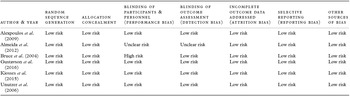
All of the included RCTs (n = 6) were judged to be of low risk of selective bias, attrition bias, and reporting bias, according to the Cochrane Collaboration's “Risk of Bias” tool (Higgins and Green, Reference Higgins and Green2011) (see Table 3). All the included RCTs were of low risk of performance bias except for the studies by Bruce et al. (Reference Bruce2004) and Almeida et al. (Reference Almeida2012). All of the included RCTs were of low risk of detection bias except for Almeida et al. (Reference Almeida2012).
Risk of bias table – RCTs only (n = 6)

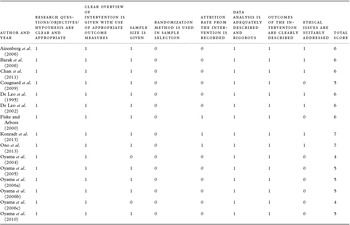
According to Jinks’ quality assessment checklist (Jinks et al., Reference Jinks, Cotton and Rylance2011), the quality scores of the observational studies (n = 15) ranged from four to seven, with no study achieving the maximum score of eight points (Table 4), since all scored zero for randomization. All studies scored full marks for clear and appropriate research questions/objectives, clear overview of interventions, and clear description of outcome measures. All studies scored full marks for sample size except for one study that did not report sample sizes (Oyama et al., Reference Oyama, Koida, Sakashita and Kudo2004).
Quality assessment checklist – non-RCTs (n = 15)

Study findings
Primary care-based interventions
Four included RCTs evaluated interventions undertaken in primary care settings and directed at either primary care physicians or primary care populations (Bruce et al., Reference Bruce2004; Unutzer et al., Reference Unutzer2006; Alexopoulos et al., Reference Alexopoulos2009; Almeida et al., Reference Almeida2012). Three articles presented outcomes for two large multicenter studies that utilized collaborative care strategies – the PROSPECT study (Prevention of Suicide in Primary Care Elderly: Collaborative Trial) (Bruce et al., Reference Bruce2004; Alexopoulos et al., Reference Alexopoulos2009), and the IMPACT study (Improved Mood Promoting Access to Collaborative Care Treatment) (Unutzer et al., Reference Unutzer2006). The fourth article evaluated a clinician-based intervention targeted at the primary care physicians of elderly patients (Almeida et al., Reference Almeida2012).
The PROSPECT study: This multi-center study aimed to reduce suicidal ideation and depression severity in elderly depressed primary care patients by utilizing a collaborative care model whereby depression care managers collaborated with physicians to help recognize depression, offer education about treatment options, administer psychotherapy, closely monitor depressive symptoms, and provide appropriate follow-up. The results of this study showed a decline in raw rates of suicidal ideation in the intervention group at four, eight, and twenty-four months post-intervention (see Table 2). Among patients with major depression, a greater number achieved remission in the intervention than the usual care group post-intervention.
The IMPACT study: similar to the PROSPECT study, the IMPACT study aimed to reduce suicidal ideation in depressed older primary care patients by utilizing a collaborative care model that included a depression care manager working in the patient's primary care clinic to support the patient's regular primary care clinician. The results showed that intervention subjects had significantly lower rates of suicidal ideation than controls at 6, and 12 months and even after intervention resources were no longer available at 18 and 24 months (Table 2).
The DEPS-GP trial (Depression and Early Prevention of Suicide in General Practice) (Almeida et al., Reference Almeida2012) evaluated the impact of a clinician-based education intervention and practice audit on the prevalence of depression and self-harm behavior in a sample of elderly primary care patients. Primary care physicians were the target of the intervention, which consisted of three components: (1) printed educational material about the assessment and management of depression and self-harm behavior in later life, (2) practice audit of 20 active patients with detailed personalized audit feedback, and (3) newsletters outlining progress of the study. The results showed that the relative effect of the intervention on self-harm behavior (suicidal ideation/attempt) over 24 months was significant. Older adults treated by physicians assigned to the intervention group were 10% (95% CI, 3–17%) less likely than those assigned to the control group to experience the composite primary outcome (self-harm behavior or clinically significant depression).
Treatment interventions
Pharmacotherapy
Three studies – two case-control studies (Aizenberg et al., Reference Aizenberg, Olmer and Barak2006; Barak et al., Reference Barak, Olmer and Aizenberg2006) and one decision analysis (analysis of extracted data) (Cougnard et al., Reference Cougnard, Verdoux, Grolleau, Moride, Begaud and Tournier2009) – assessed the effects of clinical treatment of psychiatric disorders for suicide prevention in older adults.
In order to assess the effects of exposure to psychotropic drugs on suicide attempts, Aizenberg et al. (Reference Aizenberg, Olmer and Barak2006) analyzed the records of elderly patients suffering from Bipolar Affective Disorder (BAD) who were admitted to a mental health center. Using a case-control study design, the index group comprised all patients who had attempted suicide in the month prior to admission, while the control group was elderly patients suffering from BAD matched for sex and age who had not attempted suicide prior to the present hospitalization. Records were assessed over a ten-year period and reported a significantly greater number of patients who had a history of a suicide attempt in the index group compared to controls (7/16 vs. 2/16; p = 0.039). In the index group only two subjects had been receiving both an antidepressant and a mood stabilizer while in the non-suicidal controls there were 7/13 (54%) who were exposed to this combination (p = 0.047). The study was limited by a small sample size, non-standardized treatments, and retrospective data.
Barak et al. (Reference Barak, Olmer and Aizenberg2006) assessed the effects of exposure to antidepressants in elderly patients suffering from major depressive disorder (MDD). The index group consisted of patients suffering from MDD who were hospitalized following a suicide attempt while the control group comprised the next admission of elderly patients suffering from MDD, matched for sex and age who had not attempted suicide within one month prior to hospitalization. As with Aizenberg's study, records were analyzed over a ten-year period and reported that the proportion of patients exposed to antidepressants was significantly greater in the control group, than in the group of patients who had attempted suicide (58% vs. 42%, OR 1.94 (95% CI: 1.1–3.4), p = 0.019).
Cougnard et al. (Reference Cougnard, Verdoux, Grolleau, Moride, Begaud and Tournier2009), using a decision analysis method, estimated the number of suicides prevented or induced by antidepressant drug treatment (ADT) in elderly patients diagnosed with major depression. Results showed that, ADT would prevent 32.3% of suicides in depressed subjects over one year in comparison to no-ADT (n = 629/100 000 in ADT; n = 930/100 000 in no-ADT), corresponding to 30% of all suicides in this age group. Findings remained unchanged when gender or self-harm history was taken into account.
Psychotherapy
Three studies – two RCTs (Kiosses et al., Reference Kiosses, Rosenberg, Mcgovern, Fonzetti, Zaydens and Alexopoulos2015; Gustavson et al., Reference Gustavson, Alexopoulos, Niu, Mcculloch, Meade and Arean2016) and one quasi-experimental study (Konradt et al., Reference Konradt, Hirsch, Jonitz and Junglas2013), evaluated the effectiveness of behavioral interventions in reducing suicidal behavior in older adults with major depression and/or other disabilities.
Gustavson et al. (Reference Gustavson, Alexopoulos, Niu, Mcculloch, Meade and Arean2016) tested the hypothesis that Problem Solving Therapy (PST) was more effective than Supportive Therapy (ST) in reducing suicidal ideation in older adults with major depression and executive dysfunction. Intervention and control participants received 12 weekly sessions of PST and ST, respectively, and were assessed at baseline, 12 weeks, and 36 weeks for suicidal ideation. Results showed significantly greater reductions in suicidal ideation in older people who received PST at both 12 weeks (OR: 0.50, Z = −2.16, p = 0.031) and 36 weeks (OR: 0.50, Z = −1.96, p = 0.05) after treatment. People who were single were less likely to show improvement in suicidal ideation (OR: 2.5, Z = 2.10, p = 0.036) and disabled participants were more likely to show improvement (OR: 1.05 per unit increase in WHODAS, Z = 2.03, p = 0.042). At 36 weeks, there was a significant effect for age (OR: 0.57 per decade, Z = −2.59, p = 0.01), with those who were younger being less likely to be suicidal at 36 weeks.
Kiosses et al. (Reference Kiosses, Rosenberg, Mcgovern, Fonzetti, Zaydens and Alexopoulos2015) examined the effects of Problem Adaptation Therapy (PATH) and Supportive Therapy for Cognitively Impaired Adults (ST-CI) in older adults with major depression and dementia. Both treatments were found to have comparable reductions in suicidal ideation in participants after 12 weeks (time: F [1, 95.8] = 10.06, p = 0.0020). However, there was no significant difference on the course of suicidal ideation between PATH and ST-CI (time by treatment interaction: F [1, 95.8] = 0.75, p = 0.3897).
Konradt et al. (Reference Konradt, Hirsch, Jonitz and Junglas2013) investigated the efficacy of humor therapy on older patients with major depression, and reported improvements in suicidal tendency in both intervention participants as well as controls who received no treatment (main effect: F = 21.65, p < 0.001).
Telephone counseling programs
Three published articles evaluated community-based telephone counseling programs (De Leo et al., Reference De Leo, Carollo and Dello Buono1995; Fiske and Arbore, Reference Fiske and Arbore2000; De Leo et al., Reference De Leo, Buono and Dwyer2002). Two of these describe a prospective cohort study evaluating the impact of the Tele-Help/Tele-Check service on suicidal behavior in an elderly population (De Leo et al., Reference De Leo, Carollo and Dello Buono1995; De Leo et al., Reference De Leo, Buono and Dwyer2002). The large scale Tele-Help/Tele-Check intervention illustrates the potential of increased social support combined with a crisis service. In these studies, vulnerable older people were referred to the service by their primary care physician or social worker. The intervention involved twice-weekly telephone support from a trained professional and the provision of an alarm connected to a 24-h response network. Results showed that significantly fewer deaths occurred among elderly service users than expected – after four years (1 vs. 7.44; standardized mortality ratio = 13.44%; χ 2 = 2.54, d.f. = 1, p < 0.05, 95% CI = 0.3% to 74.8%); and after 11 years (6 vs. 20.86; standardized mortality ratio = 28.8%; χ 2 = 10.58, d.f. = 1, p < 0.001). The service was found to have performed significantly well for elderly females (n (observed) = 2; standardized mortality ratio = 16.6%; n (expected) = 12.03; χ2 = 8.36, d.f. = 1, p < 0.001).
Fiske and Arbore (Reference Fiske and Arbore2000) used a CBA study design to evaluate a community agency (the Centre for Elderly Suicide Prevention – CESP) designed specifically to prevent suicide in the elderly people. Outcome measures were depression, hopelessness, and life satisfaction (the life satisfaction index is a global measure of wellbeing including suicidal behavior). Results showed a significant reduction in hopelessness among clients but no changes in depressive symptoms or life satisfaction.
Community-based multilevel programs
Eight studies evaluated community-based multilevel programs aimed at preventing suicide among the elderly in areas with high suicide rates. All eight studies were conducted in East Asia – seven of these were quasi-experiments conducted in Japan (Oyama et al., Reference Oyama, Koida, Sakashita and Kudo2004; Oyama et al., Reference Oyama2005; Oyama et al., Reference Oyama, Fujita, Goto, Shibuya and Sakashita2006a; Oyama et al., Reference Oyama, Goto, Fujita, Shibuya and Sakashita2006b; Oyama et al., Reference Oyama2006c; Oyama et al., Reference Oyama2010; Ono et al., Reference Ono2013), while one was a Hong Kong study with a cohort component and a retrospective analysis of data (Chan et al., Reference Chan2011).
Six of the quasi-experiments evaluated the effectiveness of community-based prevention programs against suicides among the elderly in various rural Japanese towns. The intervention received was multi-faceted incorporating: education, gatekeeper training, depression screening, group activities, and referral for treatment when appropriate. The collective results showed significant reductions in the risk of suicidal mortality over time in intervention areas, particularly among elderly females (see Table 2).
Ono et al. (Reference Ono2013) examined the effectiveness of a universal community-based multimodal intervention program aimed at preventing suicide and suicide attempts. Results showed significantly lower incidence rates of suicide attempts in the elderly requiring admission to an emergency ward (RR = 0.35, 95% CI 0.17–0.71, p = 0.004).
Chan et al. (Reference Chan2011) evaluated the effectiveness of a two-tiered multifaceted (treatment of depression, gate keeper training, aftercare for suicide attempters, and care management) Elderly Suicide Prevention Programme (ESPP) on the suicidal behaviors of older adults in Hong Kong. Results showed a significantly reduced rate of suicide in the intervention group compared to controls (1.99% vs. 7.58%; p = 0.028).
Discussion
Summary of key findings
This review found few evidence-based studies aimed at preventing suicidal behavior and reducing suicidal ideation in older adults. The strongest evidence was for reduction in suicidal ideation associated with primary care-based depression screening and management programs. Two large multisite trials – IMPACT and PROSPECT, investigated collaborative and supportive components of care in depression among older patients and encouraged cooperation with taking medication. In both cases, they also examined the use of psychological therapies, in particular problem-solving and interpersonal psychotherapy. The primary care setting is a good opportunity for suicide prevention intervention, as most suicides are known to have had contact with a primary care physician within a month of death (Mann et al., Reference Mann2005). Primary care offers the possibility of suicide prevention through improved recognition and detection of depression along with the optimization of depression management through collaborative care.
Evidence for other effective interventions, namely pharmacotherapy and psychotherapy, telephone counseling for vulnerable older adults, and community-based programs incorporating education, gatekeeper training, depression screening, group activities, and referral for treatment was also identified but less robust.
Findings in relation to previous research
Our review found very few evidence-based prevention studies focusing on suicide and suicidal behaviors in the elderly people. This finding, which is in keeping with a previous review (Lapierre et al., Reference Lapierre2011) and a consensus statement from an international expert panel (Erlangsen et al., Reference Erlangsen2011), appears to be a consequence of the lack of attention paid to suicide research in older adults – a phenomenon that has been widely reported by various authors (Pearson and Brown, Reference Pearson and Brown2000; Conwell et al., Reference Conwell, Duberstein and Caine2002; O'Connell et al., Reference O'Connell, Chin, Cunningham and Lawlor2004; Ciulla et al., Reference Ciulla2014). Reasons that have been given for this paucity of research include: the low base rate of suicide in older adults (Conwell et al., Reference Conwell, Duberstein and Caine2002), the attitude that an older life is less valuable than a young life (Pearson and Brown, Reference Pearson and Brown2000), and the greater likelihood that self-harm will be fatal due to physical frailty (Conwell, Reference Conwell2014).
Lapierre et al. (Reference Lapierre2011) identified 19 studies with an empirical evaluation of a suicide prevention or intervention program focusing on older adults. Only 11 of these met the inclusion criteria for our review despite the commonalities in theme. The first reason for this is that Lapierre et al. (Reference Lapierre2011) included depression as an outcome measure whereas we included only studies where suicidal behavior or suicidal ideation was reported as an outcome in comparison to a control group. We therefore evaluated more robust evidence using valid outcomes in a more focused research question. Second, the Lapierre review was conducted in 2009 and published in 2011, hence our review identified six studies that were published after this time period.
This review found interventions for preventing suicidal behaviors in older people in four main areas: (1) Primary care-based depression screening and management programs, (2) Treatment interventions (pharmacotherapy and psychotherapy), (3) Telephone counseling for vulnerable older adults, and (4) Community-based multilevel programmers incorporating education, gatekeeper training, depression screening, group activities, and referral for treatment. These interventions differ from those found to be effective for prevention of suicide in other age groups. A systematic review of interventions for prevention of suicide in university students and students in other post-secondary educational institutions found that effective interventions were classroom-based instruction, means restriction, and gatekeeper training (Harrod et al., Reference Harrod, Goss, Stallones and Diguiseppi2014). These differences appear to be linked with the etiology and risk factors for suicidal behaviors in both age groups. For instance, depression and social isolation are key predictors of suicide in older age groups. The effective interventions mentioned above work by addressing these risk factors through screening/treatment for depression and reduction of social isolation in vulnerable older adults.
Despite the paucity of preventive intervention research for suicidal behavior in the elderly people, this review found good quality evidence of the effectiveness of primary care-based collaborative depression care management interventions. To our knowledge, PROSPECT and IMPACT are the only two large scale studies to employ the collaborative depression care model approach in this age group. However, a systematic review on suicide prevention strategies (Mann et al., Reference Mann2005) and a consensus statement from an international expert panel (Erlangsen et al., Reference Erlangsen2011), both confirm the effectiveness of collaborative care models for prevention of suicidal behavior and recommend its use.
Treatment interventions for suicidal behavior in older adults reported variable findings. Pharmacotherapy with antidepressants was found to be effective for reducing suicide mortality in elderly patients with depressive disorders. This finding is in keeping with those of Lapierre et al. (Reference Lapierre2011), which reported resolution of suicidal ideation in elderly patients after 12 weeks of depression treatment. In contrast, a review on pharmacological interventions for self-harm in adults (Hawton et al., Reference Hawton2015a) found no significant treatment effect for newer generation antidepressants but very low quality evidence for the antipsychotic flupenthixol. Consistent with Lapierre's review, all evidence in support of pharmacotherapy for reducing suicidal behavior in older adults was of low quality.
Psychotherapy using CBT approaches provided inconclusive evidence of its effectiveness for reducing suicidal ideation and suicidal tendencies. These findings are in contrast to those reported in a study (Heisel et al., Reference Heisel, Duberstein, Talbot, King and Tu2009) in which older adults at risk of suicide showed significant reductions in suicidal ideation following a 16-week psychotherapy session. A meta-analysis (Tarrier et al., Reference Tarrier, Taylor and Gooding2008) showed that behavioral therapies are effective at reducing suicidal ideation and behaviors in adult populations, when compared with minimal treatment or treatment as usual. A review evaluating interventions for self-harm in younger age groups, found no significant treatment effect for CBT-based psychotherapy (Hawton et al., Reference Hawton2015b).
The implementation of community-based depression screening programs incorporating education, gatekeeper training, group activities, and referral for treatment, provided some evidence of its effectiveness at reducing suicide in older adults. These findings are in agreement with those of a meta-analysis (Oyama et al., Reference Oyama, Sakashita, Ono, Goto, Fujita and Koida2008) combining results of five Japanese quasi-experimental studies, which showed a reduced risk of suicide among older adults, particularly among older females. All of the studies in the meta-analysis were conducted in Japan. To our knowledge, there are no other similar studies conducted outside of East Asia.
Strengths and limitations of this systematic review
The strengths of this systematic review include the use of a systematic approach to identify, review, and synthesize data in line with PRISMA guidelines (Moher et al., Reference Moher, Liberati, Tetzlaff, Altman and Grp2010) and to strengthen the rigor and transparency of the study, and the use of a wide search strategy incorporating electronic database searches, review of reference lists, and expert consultation. We only included studies with designs incorporating a comparative element, and our outcome measures were directly related to suicide and suicidal behaviors. The quality of included studies was assessed using two quality assessment tools well suited for either RCTs or non-RCTs.
This review is limited by the inclusion of studies published only in English language.
As well as suicide, attempted suicide, and self -harm, we included suicidal ideation in our review. There is a good rationale for this. Suicidal thoughts might be the first step in a pathway that culminates in completed or attempted suicide. In the World Mental Health Surveys, the probability of reporting any suicide attempt among those with lifetime suicidal ideation was 29% (Nock et al., Reference Nock2008). A similar proportion of those with suicidal thoughts surveyed in the British Adult Psychiatric Morbidity Survey (APMS) also reported a lifetime suicide attempt (Bebbington et al., Reference Bebbington2010), although an upper age of 74 years limits the generalizability of the findings of this survey to older populations. The APMS highlighted the strong relationship between individual elements of suicidality (tiredness of life, death wishes, suicidal thoughts, attempted suicide, and self-harm), with the strongest relationship being between suicidal ideation and attempted suicide. Suicidal thoughts are more common than a history of attempted suicide across all age groups (McManus et al., Reference Mcmanus, Hassiotis, Jenkins, Dennis, Aznar, Appleby, McManus, Bebbington, Jenkins and Brugha2016), therefore examining suicidal thoughts allows a smaller sample size in intervention studies to achieve sufficent statistical power. Most importantly, from a clinical perspective, identifying suicidal ideas is a key component in the treatment of an older person at risk of suicide.
Strengths and limitations of included studies
All of our included studies had clear objectives and outcome measures. The majority had large sample sizes and adequate duration of interventions. Except for the studies reporting primary care-based interventions, our included studies were of relatively low quality.
Some included studies had overlapping population groups which could influence the weight given to their findings. In the PROSPECT study, Alexopoulos et al. (Reference Alexopoulos2009) reported on a sub-group of the same population as the earlier study, Bruce et al. (Reference Bruce2004) in its analysis. Similarly, the analysis in the Tele-Help/Tele-Check study by De Leo et al. (Reference De Leo, Buono and Dwyer2002) contained a subset of subjects from De Leo et al. (Reference De Leo, Carollo and Dello Buono1995).
Across several studies, suicidal ideation was measured using different measuring scales. This makes it impossible to undertake a valid meta-analysis evaluating the effectiveness of interventions on this outcome. In addition, some studies relied on self-reported data about suicidal ideation and suicidal behavior that were not externally validated.
All included studies were conducted in high income countries; therefore, the findings from this review may not be generalizable to low and middle income countries. Similarly, the studies describing community-based multilevel programs were all conducted in East Asia, and findings may not be generalizable to other regions.
There may be issues relating to program implementation, whereby interventions developed in one setting may fail to replicate in others. This could be due to differences in healthcare systems, as well as cultural differences, including attitudes towards older people.
Implications for research and practice
The evidence in support of all but the primary care-based interventions in depression is of relatively low quality and therefore well-designed high quality larger trials are needed to further evaluate the effectiveness of interventions in the domains where the evidence is of lower quality. This would be particularly important for the brief psychological therapies such as problem solving, mindfulness-based and cognitive behavioral psychotherapies. In addition, a few research questions remain to be answered. First, what particular aspects of multi-faceted interventions are most effective; whether individual or group-based interventions are more effective; whether suicide prevention methods effective for younger age groups, such as means restriction (Joffe, Reference Joffe2008), are effective in older adults; and finally what barriers prevent the recognition and management of suicidal behaviors in the elderly.
Most of the evidence identified related to primary care populations or communities with known high suicide rates in older people. Older people admitted to general hospitals have frequent co-morbid depression that is often unidentified (Royal College of Psychiatrists, 2005), and there are also high rates of recent general hospital admission in suicide in the elderly (Heikkinen et al., Reference Heikkinen, Isometsa, Aro, Sarna and Lonnqvist1995; Dennis, Reference Dennis2009). Depression screening and management in the general hospital setting therefore is worthy of greater attention and research.
Less is known currently about the association between suicidal ideation and behavior in older people compared to younger age groups. More research is therefore required to further explore this association, as well as the development of more reliable and valid measurement scales. This is of particular pertinence as older people who die by suicide express suicidal thoughts less frequently than younger people (Conwell et al., Reference Conwell, Duberstein, Cox, Herrman, Forbes and Caine1998). In addition, research approaches that shorten the time from intervention development to dissemination and practice need to be developed.
Conclusions
Multifaceted interventions directed at primary care physicians and populations were found to be effective at preventing suicidal behavior and reducing suicidal ideation. Treatment interventions, telephone counseling, and community-based programs targeting at-risk elderly individuals in the community show promising results but are less robust. Most programs addressed risk predictors like depression, which may have a bigger impact on suicidal behaviors in older adults. Interventions attending to depressed elderly individuals seemed to succeed through their personalized treatment, and close follow-up, ensuring optimal management and relapse prevention planning. More well-designed trials are however, needed to demonstrate successful interventions as most studies addressing prevention of suicidal behaviors in the elderly people are of low quality.
Conflict of interest
None.
Description of authors’ roles
A. John and M. Dennis conceived the study. All authors contributed to the study design. C. Okolie, E. Simon Thomas, and A. John screened studies, quality assessed and extracted data. All authors interpreted study findings. C. Okolie drafted the manuscript. All authors commented on the paper and agreed the final version.
Appendix I – Search strategy
-
1. older adults.mp. [mp=ti, ab, hw, tn, ot, dm, mf, dv, kw, nm, kf, px, rx, ui, tc, id, tm]
-
2. geriatric.mp. [mp=ti, ab, hw, tn, ot, dm, mf, dv, kw, nm, kf, px, rx, ui, tc, id, tm]
-
3. old age.mp. [mp=ti, ab, hw, tn, ot, dm, mf, dv, kw, nm, kf, px, rx, ui, tc, id, tm]
-
4. elderly.mp. [mp=ti, ab, hw, tn, ot, dm, mf, dv, kw, nm, kf, px, rx, ui, tc, id, tm]
-
5. 1 or 2 or 3 or 4
-
6. suicid*.mp. [mp=ti, ab, hw, tn, ot, dm, mf, dv, kw, nm, kf, px, rx, ui, tc, id, tm]
-
7. suicidal behavior.mp. [mp=ti, ab, hw, tn, ot, dm, mf, dv, kw, nm, kf, px, rx, ui, tc, id, tm]
-
8. suicidality.mp. [mp=ti, ab, hw, tn, ot, dm, mf, dv, kw, nm, kf, px, rx, ui, tc, id, tm]
-
9. suicidal ideation.mp. [mp=ti, ab, hw, tn, ot, dm, mf, dv, kw, nm, kf, px, rx, ui, tc, id, tm]
-
10. self-harm.mp. [mp=ti, ab, hw, tn, ot, dm, mf, dv, kw, nm, kf, px, rx, ui, tc, id, tm]
-
11. parasuicide.mp. [mp=ti, ab, hw, tn, ot, dm, mf, dv, kw, nm, kf, px, rx, ui, tc, id, tm]
-
12. attempted suicide.mp. [mp=ti, ab, hw, tn, ot, dm, mf, dv, kw, nm, kf, px, rx, ui, tc, id, tm]
-
13. 6 or 7 or 8 or 9 or 10 or 11 or 12
-
14. suicide prevention.mp. [mp=ti, ab, hw, tn, ot, dm, mf, dv, kw, nm, kf, px, rx, ui, tc, id, tm]
-
15. intervent*.mp. [mp=ti, ab, hw, tn, ot, dm, mf, dv, kw, nm, kf, px, rx, ui, tc, id, tm]
-
16. prevent*.mp. [mp=ti, ab, hw, tn, ot, dm, mf, dv, kw, nm, kf, px, rx, ui, tc, id, tm]
-
17. 14 or 15 or 16
-
18. (randomized controlled trial or randomized controlled trial or random allocation or double blind method or clinical trial or control group or evaluat* or intervent* or comparative study or case-controlled study or longitudinal study or quasi-randomized study or quasi-randomized study).mp. [mp=ti, ab, hw, tn, ot, dm, mf, dv, kw, nm, kf, px, rx, ui, tc, id, tm]
-
19. 5 and 13 and 17 and 18
-
20. limit 19 to English language
-
21. limit 20 to human