Retroactive digitization of the printed corpus reveals patterns of social evolution and political manipulation. Prior to the introduction of online search, examining the etymology of a political term helped social theorists extrapolate the historical trajectory of a political concept. Now we have tools for quantitative examination of such hypotheses. Using four case studies, I demonstrate the utility of word search dynamics in shedding light on the evolution of long-debated political phenomena. A triad of etymological explorations by Richard Koebner motivates the first three cases.
In a series of papers published between 1949 and 1951, Richard Koebner, a historian of political thought, examined the evolution of three political concepts through time: despot and despotism in relation to the French Revolution, imperialism and economic imperialism in relation to the rise of the British colonial rule in the late nineteenth century, and finally the emergence of a consensus on Western civilization following the First World War. Koebner's life trajectory itself was shaped by systematic manipulation of discourse. As a German-Jewish academic, Richard Koebner was a victim of the Nazi suppression and censorship campaign in the 1930s.
Richard Koebner's unique trilogy provides a platform for demonstrating the utility of online data. Using search results, I test Koebner's original hypotheses, which were derived merely from historical etymology and theoretical inference—long before digitization and online search became a reality. In the following sections, I first examine his findings on three case studies using online search techniques in the digitized corpus made available on Google Ngram Viewer.Footnote 1 Then I turn to censorship as a prime example of discourse manipulation; finally, I outline ways in which online tools provide venues for detecting censorship. I argue that history of political thought can benefit from empirical investigations of the printed corpus, now increasingly available online.
THE SEMANTICS OF POLITICS
A reciprocal relation exists between a political term and the political concept associated with it. First, the prevalence of a political term, for example, “imperialism,” can facilitate aggregation of certain political attributes and hasten political mobilization for or against it; second, as derivatives of real-world politics, words can serve as indicators of the underlying political phenomena of an era. The history of a word's usage through time exhibits the political evolution of the referent concept (Koebner and Schmidt Reference Koebner and Schmidt2010). It has been argued that the historical transformation of politics prior to the Enlightenment provided a language of politics that was distinct from the previous political nomenclature (Viroli Reference Viroli1992).
The printed corpus of a language is an aggregate barometer of the issues important to readers as well as the authors. Whereas the ascendance of an issue in the printed discourse can be closely tied to its cultural significance, the linkage between concrete political parameters and the word use frequency is more nuanced. Consider the Chinese unprecedented economic growth in the past two decades. During this time, the discussion of a rising China became mainstream, prompted policy debates, and induced political action (Chestnut and Johnston Reference Chestnut and Johnston2009). Did the use of the word “rising China”Footnote 2 track the economic and political developments? An examination of the Chinese gross domestic product (GDP) as an indicator of the Chinese economic growth from 1990 to 2008Footnote 3 in relation to the frequency of the term “rising China” in the English corpus in Google's Ngram viewerFootnote 4 shows a correlation factor of 97.7%.Footnote 5 This means the dynamics of the use of “rising China” closely reflected the change in the Chinese GDP. However, before the explosive growth of the Chinese economy, between 1980 and 1990, the same correlation factor was only 62.3%. Clearly, the cultural ascendance of the concept rising China is closely linked to the Chinese GDP's fast growth. The same comparison with the Chinese military expansion replaced for the GDP would not yield similar results, pointing at the economic nature of the Chinese rise during the past two decades. The ascendance of China is a robustly debated part of the current political discourse. The vast coverage of the topic allows for an accurate and collective tracing of the Chinese economic indices. When an issue is widely discussed, the collective wisdom (Landemore and Elster Reference Landemore and Elster2012) of the public sphere closely follows the ebb and flow of concrete economic and social parameters. This particular mechanism would not occur unless the term is widely used as an emblem for a robust and ubiquitous debate.
If written words are entangled with the associated political concepts, then the traces of such words, their ascendance and fall, give a clue to the nature, emergence, and extinction of a political practice. A study of the frequency of the use of a political term in a representative sample of the written corpus is particularly helpful when the objective of the study is to identify the dynamics of historical emergence, decline, and comparative significance of a political concept. In the following section, I exploit this observation in order to explore the evolution of a number of political phenomena in the past three centuries. Using data from Google Books repository (Michel et al. Reference Michel, Shen, Presser-Aiden, Veres, Gray, Team, Pickett, Hoiberg, Clancy, Norvig, Orwant, Pinker, Nowak and Lieberman-Aiden2011), I examine the correlations between the frequency of word use and political practice. I show that a parameter as simple as the annual frequency of use gives clues into the emergence of a political signifier or its decline. I also outline techniques for identifying an inflection point in the historical transformation of a phrase through time.Footnote 6
Although Google Ngram Viewer provides a revealing window to the evolution of political concepts, several issues should be taken into account. The new version of the collection covers around 6% of all books ever published in eight languages (Lin et al. Reference Lin, Michel, Lieberman-Aiden, Orwant, Brockman and Petrov2012). It constitutes around 5 million English books chosen based on “the quality of their OCRFootnote 7 and metadata.”Footnote 8 The criteria for selection based on such technicalities mitigates concerns regarding selection bias. The increasing percentage of coverage eventually solves selection issues altogether. Furthermore, while the coverage is incomplete, using the dynamics of word frequency use, instead of absolute values, helps further ameliorate selection bias.
In the following, four case studies demonstrate the potentials of word search in political scientific inquiry. For the first three cases, using quantitative tools, I replicate Richard Koebner's historical analyses pertaining to despotism in relation to the French Revolution, imperialism in relation to economic imperialism, and Western civilization. The last case study is an examination of censorship using similar techniques.
“Despotism” and the French Revolution
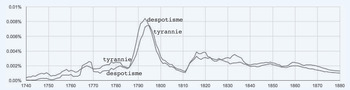
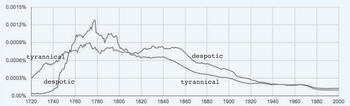
According to Koebner, in the eighteenth century, the words “despote” and “despotisme” experienced a revival among the French writers. Whereas the word “despoteia” in ancient Greek primarily referred to the relation between the head of the household and the other family members—including slaves—Aristotle used the term “despotic” to describe a type of absolute tyranny, different from kingship and aristocracy and common among barbaric nations. However, Aristotle's terminology was not adopted by the Romans. They tend to translate the name of the despotic category to terms such as “dominatus” instead of “despoteia” (Koebner Reference Koebner1951b). When Thomas Hobbes restored the Aristotelian taxonomy of governments, the term experienced a revival (c.f. Chapter XX of Leviathan). The same classification found its way to Montesquieu's The Spirit of the Laws. Absolute power as a taxonomy was divided into two main categories: legitimate monarchy and despotic dominion (Montesquieu [1748] 1989). Montesquieu does not share the ambivalent, if neutral, Hobbesian references to despotism (c.f. The Laws, Book 3, Chapters 8 to 10). For Montesquieu, despotism is an abominable type of tyranny, mostly common among Asiatic nations (Koebner Reference Koebner1951b). According to Koebner, the ascendance of the French revolutionary fervor against a type of monarchy they saw as unacceptable has much to do with the revival of “despotism”. The word portrayed the monarchy as an archaic and brutal practice that had to be suspended. The viral dynamics of the new use of the term despotique surprised writers of the era (Koebner Reference Koebner1951b). Was Koebner correct in his claims about the rising importance of the categories despotique and despotic during the anti-crown upheavals of the late eighteenth century in Western Europe? Figure 1 confirms the verity of Koebner's hypothesis. “Despotisme” did move to prominence during the second half of the eighteenth century, overtaking the term “tyrannie” just before the French Revolution. A similar pattern, albeit to a lesser degree, is discernible during the later restorations of the monarchy during Louis XVIII and Louis Philippe I's reign. An examination of the evolution of the frequency of the use of the terms “despotic” and “tyrannical” in the English corpus, shows a similar pattern in the late eighteenth century, see figure 2. Interestingly enough, the term “despotic” makes an appearance in the United States Declaration of Independence, written in 1776:
“… when a long train of abuses and usurpations, pursuing invariably the same Object evinces a design to reduce them under absolute Despotism, it is their right, it is their duty, to throw off such Government, and to provide new Guards for their future security.”
Frequency of Word Usage “despotisme” and “tyrannie” from 1740 to 1880 in the French Corpus
Source: Google Ngram Viewer goo.gl/x38rj

Frequency of Word Usage “despotic” and “tyrannical” from 1720 to 2000 in the English Corpus
Source: Google Ngram Viewer goo.gl/TV5KD

British “Imperialism” or “Economic Imperialism”?
In another piece, “The Concept of Economic Imperialism,” Koebner explores the connection between imperialism and economic imperialism through a study of the etymology of the term “imperialism” as well as the politics of economic expansion in the late nineteenth century British Empire. The economic origins of imperialism were a matter of a partisan debate since the publication of Hobson's widely influential Imperialism: A Study in 1902. The Marxist adoption of Hobson's thesis that economy and not nationalism made the Empire, set the stage for the debate in the first half of the twentieth century. However, the more recent discussions of imperialism during the decline of the British Empire after the Second World War, emphasized nationalist pride among the colonized nations. The unraveling of the colonial world hinged on nationalistic sentiments, not economic calculations (Louis Reference Louis1999).
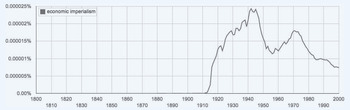
Koebner notes that the term “imperialism” is a comparatively recent neologism. It was used in English first to describe the Second French Empire; 20 years later it was used to refer to Disraeli's foreign policies (Koebner Reference Koebner1949). An examination of the history of the use of the word “imperialism” during the past two centuries from Google Ngram Viewer in figure 3 shows that Koebner was indeed right, and in fact quite accurate in his extrapolations. The word started to emerge in the English corpus around the middle of the nineteenth century. But was Koebner correct in ascribing a major economic component to the emergence of imperialism and colonial rule? What is the connection between imperialism and economic imperialism? An examination of figure 4 shows that the use of the term “economic imperialism” soared during the second decade of the twentieth century, but unlike “imperialism” its frequency peaked in the 1940s. Next I show that the discussion of the two terms in relation to each other changed in the mid-twentieth century.
Frequency of Word Usage “imperialism”, from 1800 to 2000 in the English Corpus
Source: Google Ngram Viewer goo.gl/iAt0T

Frequency of Word Usage “economic imperialism,” from 1800 to 2000 in the English Corpus
Source: Google Ngram Viewer goo.gl/gc79Q

Temporal Segmentation of Discussion on a Topic, A Case Study
Figures 3 and 4 illustrate the evolution of the use of the two terms “imperialism” and “economic imperialism.” One venue for examining the connection between the two concepts imperialism and economic imperialism is to find the correlation between the usage frequencies of the two terms “imperialism” and “economic imperialism.” Assuming that the two comparisons are highly connected—and this is an assumption that I will return to later in this section—correlation between the discussion of the two terms can hint at a tangible correlation between the two political concepts.
The correlation between the frequency vectors for the two terms is an indicator of the similarity in the temporal evolution of the two concepts. Using annual data from Ngrams depicted in figures 3 and 4 the correlation factor between the two vectors—for vectors v and w it is v·w/∥v∥∥w∥—is 0.8904, showing a significant similarity between the two frequency profiles through the past two centuries.Footnote 9 However, assuming that the discussion of “economic imperialism” in relation to “imperialism” has been at least bipolar, with an economic tinge at the beginning and a nationalistic connotation at the end, one should be able to find the inflection point when the nature of the discussion shifts. To do so I define the following as the inflection point, v 1k = [v1v2 ··· v k], vectors' length equal to T, and ⟨v 1k, w 1k⟩ = v1k·w1k/∥v∥∥w∥,
 $$
K = \arg \mathop {\min }\limits_k \left( {\left\langle {v_1^k ,w_1^k } \right\rangle - \left\langle {v_{k + 1}^T ,w_{k + 1}^T } \right\rangle } \right)
$$
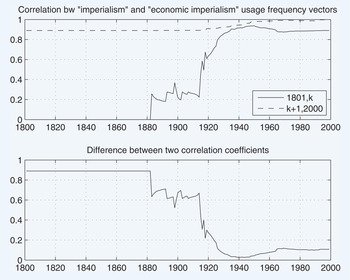
Minimizing the argument in equation (1) ensures the disparity between the temporal alignment of the two topics before and after the inflection point, K, is the least. If there are two modes of evolution of the topic (“imperialism”, “economic imperialism”) before and after the inflection point, K, then the inflection point gives an estimation of when the discussion of the pair of terms decidedly shifted in nature. Figure 5 depicts the two correlation terms ⟨v 1k,w 1k⟩ and ⟨v k+1T,w k+1T⟩ for “imperialism”, “economic imperialism” as well as their difference. The difference is minimized at year 1941. In fact, the two smallest numbers are from 1941 and 1943. Whereas the correlation factor between the two vectors associated with “imperialism”, “economic imperialism” during the entire 200 years is 0.8904, the correlation between the two frequency profiles before and after 1941 is 0.9190 and 0.9458, respectively. This means breaking off the two vectors v 18012000 and w 18012000 (for “imperialism”, “economic imperialism”) to two distinct parts in 1941 minimizes the difference between the two correlation factors, meanwhile it generates profiles before and after 1941 that are both more correlated than the original profile associated with the full 200 years.Footnote 10
 $$
\left\langle {v_{1801}^{2000} ,w_{1801}^{2000} } \right\rangle = 0.8904,\left\langle {v_{1801}^{1941} ,w_{1801}^{1941} } \right\rangle = 0.9190,\left\langle {v_{1942}^{2000} ,w_{1942}^{2000} } \right\rangle = 0.9458
$$
It is easy to see that the same procedure can be generalized for topics with more than two terms—in which one needs to define a mutual distance parameter among the temporal profiles—and discussion eras more than two—where one has to find more than one temporal border point.
Segmentation of the Debate on the Topic (“imperialism”, “economic imperialism”)

Discussion
The preceding calculations give the Second World War as the inflection point in the discussion of “imperialism” in relation to “economic imperialism.” This is no coincidence. The Second World War was the beginning of the final unraveling of the British Empire (Jeffrey Reference Jeffrey1999). In that sense, the plausibility of the stylization is confirmed by a historical fact. Those who pushed the process of decolonization used a language of nationalism (Louis Reference Louis1999) quite distinct from the economic implications of the imperial ambitions in the early twentieth century. Note that Koebner published his study in 1949, at the beginning of a wave of British disengagement with its former colonies. The fact that the results of the calculations coincide with a historical event, which is a turning point in the history of colonialism, is intriguing. It confirms the plausible connection between the concepts (imperialism, economic imperialism) and the frequency profile (“imperialism,” “economic imperialism”).
The Origins of “Western Civilization”
In a third study Koebner examines the concept of “Western civilization” (Koebner Reference Koebner1950–1951a). According to Koebner, when there is a common consciousness in relation to “the values of public and private life,” a mutual understanding transcending national borders is created (Koebner Reference Koebner1950–1951a). He identifies the First World War as the point of inception of such an idea. How plausible are his extrapolations?
One way of gauging the common conscience of a culture is to study the printed corpus. The discussion of a topic in books gives a clue about the ascendance and creation of a concept and its significance. Frequent use of a term in the printed heritage is a sign that the topic has become a matter of public debate and communal deliberation. If a concept is important enough for authors to discuss, then the rise in its implementation frequency is a signal of a shaping agreement over its significance, either positive or negative. In that sense, Ngrams provide a useful tool for testing the validity of the third set of Koebner's hypotheses.
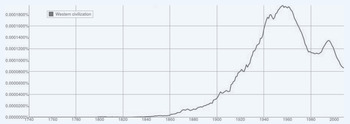
An examination of figure 6 shows that, unlike what Koebner argues, common agreement on the concept of “Western civilization” started to take hold and rise to prominence around the middle of the nineteenth century, not during the First World War, although the First World War years show a steep climb in the comparative volume of the discussion pertaining to the term “Western civilization.”
Frequency of Word Usage “Western civilization” from 1740 to 2008 in the English Corpus
Source: Google Ngram Viewer goo.gl/7xoLg

CENSORSHIP AND THE DIGITAL TRACE
Systematic censorship also comes to the light as representative samples of the printed corpus are digitized and made public online. Political regulations against certain authors and topics leave traces in online data. Widespread irregularities in the printed discussion of a topic or the published bibliography of an influential figure can help detect schemes of suppression and censorship. For example, Michel et al. (Reference Michel, Shen, Presser-Aiden, Veres, Gray, Team, Pickett, Hoiberg, Clancy, Norvig, Orwant, Pinker, Nowak and Lieberman-Aiden2011) calculate quantitative measures demonstrating suppression of the works by a tally of blacklisted authors between 1933 to 1945 in the German corpus. Recently King, Pan, and Roberts (Reference King, Pan and Robertsforthcoming) show how the patterns of censorship in the Chinese blogosphere can give clues to the intentions and future actions of the Chinese government. Online search data provides tools for detecting trends, irregularities, and disruptions.
I reviewed Richard Koebner's etymological work on three political concepts in the light of novel online tools. Koebner's life itself was deeply marked by political censorship and suppression of ideas. Barred from academic teaching in 1933, after the passing of Civil Service Restoration ActFootnote 11 by the Nazi regime, he chose to leave his native city of Wroclaw for Jerusalem and spent the last years of his life in London.
In the following section, I adopt an etymological disposition similar to the first three case studies in the previous section, and supplement historical insights with data from Google Ngram Viewer.
Detecting the “censor”
Censorship is often defined in the forms of suppression of free speech, regulation of the press, and limitations on the right to assembly. As such its traditional definition is closely linked to the idea of control. Similar to the word “despot” analyzed earlier “censor” bore different connotations at its inception. For four centuries, from 443 B.C. to 22 B.C., the Romans maintained censorship, a magisterial position on par with consuls and governors (Cicero [54 B.C.] 1998). Censors oversaw the census operation and acted as the empire's bookkeepers. According to Cicero who reported on the duties of censors in the last years of the Roman Republic in The Republic and The Laws (Book III), censors are to keep a census of the population, oversee the public projects of the state, and track abuses and deviations in the Senate. It was only a matter of time before censors' responsibilities were extended to policing the realm of public mores. By the beginning of the sixteenth century, printing had become a burgeoning industry. Alongside the advent of publication, and to counter the Protestant Reformation, censorship was prevalent for religious reasons (Zeisel Reference Zeisel1984). However, the revival of censorship in modern times coincided with the birth of the modern nation-state in the late eighteenth century and separation of the private and the public. The state apparatus became responsible for administering the public realm. Intermediate spaces, such as Habermas' beloved coffeehouses (Habermas Reference Habermas1991), could not survive these social transformations. It was an unanticipated turn of events, as many French revolutionaries, including Abbé Sieyès and Mirabeau, were themselves independent pamphleteers (Popkin Reference Popkin1990). Nevertheless, post-revolutionary politicians were simply too familiar with the implications of such activities not to regulate them. The novel public sphere was born out of the idea of the state as the arbiter of the public.
Between 1800 and 1810, soon after the formation of the First French Republic and accompanied with the emergence of the printed media as a means of mass communication, censorship was recast as one of the functions of the new French empire. Novel censorship rules were put in place, bans on glorification of other cultures—specifically English cultural products—and romance novels were established (Rose Reference Rose1918). An imperial imitation and the classicist revival of state control, this time over printed media, created a new tradition of centralized monitoring system.
A century later, when Russian revolutionaries took over the Duma in February 1917, one of their first actions was to allow the publication of a sole newspaper, with its headquarters in the Duma, and supervised by the authorities, to “prevent the spreading of fantastic rumors” (Historical New York Times, 17 March 1917). Censorship in the times of social uprisings continues to negate the expected. During a visit to Iran in fall 1978 as a journalist reporting for the Italian paper, Corriere della Sera, Foucault noted the impact of a voluntary two-month strike staged by major Iranian newspapers: it activated subterranean communication networks that were immune to public supervision and independent of state apparatus (Afary and Anderson Reference Afary and Anderson2005). He noted “If the Shah is about to fall, it will be due [mainly] to the cassette tape. It is the tool par excellence of counterinformation.” Later, during the Egyptian uprising of 2011, the blanket disruption of the Internet and mobile communications on January 28, 2011, set similar decentralization and proliferation processes in motion (Hassanpour Reference Hassanpourforthcoming).
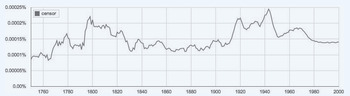
Figure 7 depicts the usage profile of the word “censor” in the past two and half centuries. One could map the semantic evolution of censorship to the historical milestones during the same period. It takes off immediately after the French Revolution and during the Napoleonic empire, peaks around the time of World Wars in the twentieth century, rises during the Cold War, and tapers off in the two decades after the late 1960s. Assuming that a rise in the frequency of “censor” in the discourse corresponds to higher levels of censorship, the frequency profile in figure 7 implies that during the past 100 years, the height of the state control over the press, and the resulting practice of censorship, coincided with the two World Wars and their aftermath.
Frequency of Word Usage “censor” from 1750 to 2000 in the English Corpus
Source: Google Ngram Viewer goo.gl/qqyWG

NEW OPPORTUNITIES AND TECHNICAL CAVEATS
Digitization of text have opened venues for the analysis of political concepts by linking frequency and topic evolution to political developments. I explored three examples of such analyses in the context of three questions put forward and answered in turn by Richard Koebner circa 1950. I showed that new tools can be used to test the validity of etymological claims about the history of political phenomena. Censorship and manipulation of public opinion is another fertile ground for online text analysis. Hence, the utility of search analysis using a representative corpus is twofold: not only it can reveal irregularities, such as suppression of an author or a topic, it can also give clues about the historical evolution of a political concept.
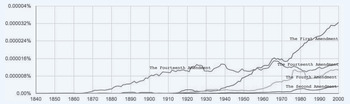
However, new possibilities should not distract from caveats. Two are apropos here. First, digitization of text is a cumulative process, and the digitized corpus from the early years (here before 1800) are often incomplete and scant. There will be major difficulties in tracing material from the early years of publication, or even before the invention of the printing press. In addition to such logistic difficulties, there are conceptual hurdles: words are sometimes used in ways that do not convey the same single concept as the one intended in the analysis. Identical words can refer to different concepts. For example, “the first amendment” can refer to a document different from the US Constitution. This does not pose a major problem to the profile presented in figure 8, because the Ngram Viewer search is case sensitive. Differentiating “The First Amendment” from “the first amendment” helps resolve the ambiguity.
Frequency of Word Usage for Four Amendments of the U.S. Constitution from 1840 to 2000 in the English Corpus
Source: Google Ngram Viewer goo.gl/TlJTg. Note the rising number of referrals to the First Amendment.

The historical corpus is growing and more and more material will be included. However, there is a limit to the extent of coverage in the sixteenth and seventeenth centuries. The issue of false referrals can also be mitigated using a combination of words that are widely known to represent a political, legal, or historical concept. For example, it is unlikely that “The French Revolution” refers to events other than The French Revolution. For words that are not as distinct, one could introduce more words to the temporal search, allowing for the discussion of a more precise topic instead of an ambiguous word.Footnote 12