Each year in the United States, ~53,000,000 outpatient surgical procedures and 46,000,000 inpatient surgical procedures are performed.Reference Fields1 Each of these procedures involves contact by a surgical instrument with a patient’s sterile tissue. A major risk of all such procedures is the introduction of infection.Reference Rutala and Weber2 Failure to properly sterilize surgical instruments may lead to transmission via these instruments.Reference Rutala and Weber2,Reference Alfa3
Most medical and surgical devices used in healthcare facilities are made of materials that are heat stable and thus are sterilized by heat, primarily steam sterilization (SS).Reference Rutala and Weber2 However, since 1950, more medical devices and instruments have been made of materials (eg, plastics) that require low-temperature sterilization (LTS). Ethylene oxide gas (ETO) has been used since the 1950s for heat- and moisture-sensitive medical devices. Within the past 30 years, a number of LTS systems (eg, hydrogen peroxide gas plasma [HPGP], vaporized hydrogen peroxide [VHP], hydrogen peroxide plus ozone) have been developed and are being used to sterilize surgical and medical devices.Reference Rutala and Weber2,Reference Rutala, Weber, Bennett, Dolan and Blaser4
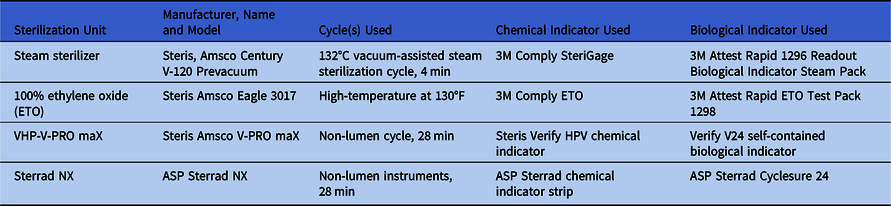
In this study, we compared the microbicidal activity of LTS technologies (ie, VHP, ETO, HPGP) to SS in the presence of salt and serum (Table 1).Reference Alfa, DeGagne, Olson and Puchalski5 The addition of salt and serum simulates inadequate cleaning of instruments prior to sterilization.Reference Alfa, DeGagne, Olson and Puchalski5 To our knowledge, no studies in the peer-reviewed literature have evaluated the microbicidal activity of vaporized hydrogen peroxide, and none has compared 4 of the 5 sterilization technologies currently available in the United States.Reference Rutala and Weber2,Reference Rutala, Weber, Bennett, Dolan and Blaser4–Reference Rutala and Weber6
Sterilization Technologies, Cycles and Indicators Used to Assess the Microbicidal Activity of Low-Temperature Sterilization Technologies to Steam Sterilization

Methods
Brushed stainless steel discs (1 cm in diameter, 0.7 mm in thickness) were used as carriers (Muzeen and Blythe, Winnipeg, Canada). The test organisms (Pseudomonas aeruginosa ATCC 27853, Escherichia coli antibiotic-sensitive clinical isolate, Staphylococcus aureus ATCC 6538, and vancomycin-resistant Enterococcus [VRE] ATCC 51299) were grown overnight on trypticase soy agar with 5% sheep blood and then used to make a 0.5 McFarland in RPMI 1640 media (~0.65% salt, RPMI media with ATCC modification, Thermo Fisher Scientific, Waltham, MA) containing 10% fetal calf serum (FCS, Gibco, Gaithersburg, MD).Reference Alfa, DeGagne, Olson and Puchalski5Mycobacterium terrae ATCC 15755 (1011 CFU/mL) was taken from frozen stock and made into a fine homogenous suspension using a tissue grinder. Serial dilutions were then made to produce a 108 CFU/mL suspension using RPMI media containing 10% FCS. Bacillus atrophaeus (Thermo Fisher Scientific) and Geobacillus stearothermophilus spore (Thermo Fisher Scientific) inoculums were made with commercially prepared spore suspensions of ~106 spores/0.1 mL. In making these inoculums, 900 µL of the spore suspensions were mixed with 900 µL RPMI 1640 media and 200 µL 10% FCS, with a final salt concentration of 0.29%. The Clostridioides difficile spores from a frozen suspension were used to make the inoculum containing 10% FCS and 0.52% salt. The presence of viable C. difficile spores was verified before use with a malachite green spore stain, and each suspension was tested according to the Association of Official Analytical Chemists hydrochloric acid protocol.7
A 10 µL inoculum of each test suspension containing from 4 × 10⁴ to 3 × 10⁶ test organisms was inoculated in the center of 42 sterile stainless-steel carriers and not dispersed. The carriers were allowed to dry for 1–2 hours in a biological safety cabinet (Labgard, Class II, Type A2, Plymouth, MN). The 42 carriers were divided into 4 sets of 10 carriers, 1 set of 10 carriers for each of 4 sterilizers tested, and 2 control carriers for calculating the viable inoculum per carrier the day of the experiment and 24 hours later (ie, after the ETO cycle). After drying, each set of 10 carriers was labeled with the organism and the sterilizer to be tested and placed on a sterile petri plate. The bottom half of the petri plate was placed in the sterilization pouch according to the manufacturer’s guideline for the sterilizer tested, being cautious not to disturb the carriers. Appropriate chemical (each load) and biological indicators (ie, at least daily for SS and LTS) were used to monitor the sterilization process. With 2 exceptions (C. difficile spores and steam; M. terrae and steam), each organism and sterilizer were tested in triplicate at a minimum, and each replicate contained 10 carriers.
There were no sterilizer indicator failures during the test runs. For example, all chemical indicators demonstrated the appropriate color change indicating the “process” was completed and the biological indicators were negative. The carriers were brought to Central Sterile Processing and were processed in the test sterilizers in an empty load. The sterilizers tested are shown in Table 1. Preventive maintenance was performed on the sterilizers as prescribed by the respective manufacturer.
Once processed through the sterilizer, each carrier was aseptically transferred to 10 mL trypticase soy broth in the biological safety cabinet. The tubes were examined daily, and positive tubes were subcultured to verify the test organism. All tubes were incubated for 7 days at 37°C except the M. terrae and C. difficile. The C. difficile carriers were placed in thioglycollate broth medium, and M. terrae carriers were placed in 7H9 broth supplemented with oleic acid, albumin, dextrose, and catalase to enhance growth. Quantitations for M. terrae were performed using 7H11 agar and were taped to prevent desiccation, and all Mycobacterium broth and plates were incubated at 37°C for 21 days. The C. difficile quantitations were plated to sheep blood agar, and all plates and broths were incubated anaerobically using the Pack-Anaero Anaerobic Gas Generating System (Mitsubishi Gas Chemical) at 37°C for 48–72 hours.
To determine whether the presence of salt or serum or both interfered with the VHP, 30 replicates were processed with the stainless-steel carriers in the presence of salt or serum or both using S. aureus and G. stearothermophilus spores.
We used the Fisher Exact test (2-sided) to compare the inactivation frequency between the different methods of sterilization.
Results
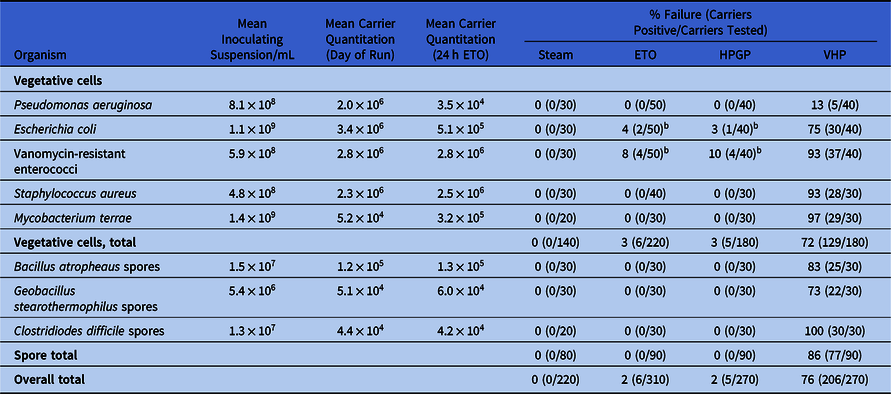
Steam sterilization killed all the test organisms (P. aeruginosa, E. coli, vancomycin-resistant Enterococcus, S. aureus, B. atropheaus spores, G. stearothermophilus spores, C. difficile spores, and M. terrae) inoculated on the stainless-steel carriers in the presence of salt and serum with no failures (0 of 220 replicates) (Table 2). Similarly, the ETO and the HPGP sterilizers were capable of inactivating the test organisms on stainless-steel carriers with a failure rate of 1.9% for both (ie, 6 of 310 for ETO and 5 of 270 for HPGP) (Table 2). Although steam had no failures compared to both ETO and HPGP, which demonstrated some failures for vegetative bacteria, there was no significant difference comparing the failure rate of steam to either ETO (P > .05) or HPGP (P > .05). The VHP system failed to inactivate all the test organisms in 76.3% of the tests (206 of 270) (Table 2). On vegetative bacteria (P. aeruginosa, E. coli, VRE, S. aureus, and M. terrae), VHP had a failure rate of 71.7% (129 of 180), and with the spores (B. atropheaus spores, G. stearothermophilus spores, and C. difficile spores), VHP had a failure rate of 85.6% (77 of 90). The failure rate of VHP was significantly higher than the other technologies evaluated for both vegetative bacteria (P < .00001) and spores (P < .00001).
Comparative Evaluation of the Microbicidal Activities of Sterilization Technologies in the Presence of Salt and Seruma

Note. ETO, ethylene oxide; HPGP, hydrogen peroxide gas plasma; FCS, fetal calf serum; ND, not done.
a To simulate inadequate cleaning, the inoculum for the vegetative bacteria contained 10% FCS and 0.65% salt but 10% FCS and 0.29% salt for the spores B. atropheaus and G. stearothermophilus; and 10% FCS and 0.52% salt C. difficile spores
b Runs with ETO and HPGP failure of vegetative bacteria had higher carrier quantitation (day of run) than the mean carrier quantitation for the other runs and that organism (ie, 4.07 × 10⁶ vs 2.54 × 10⁶ for VRE; 8.30 × 10⁶ vs 2.40 × 10⁶ for E. coli).
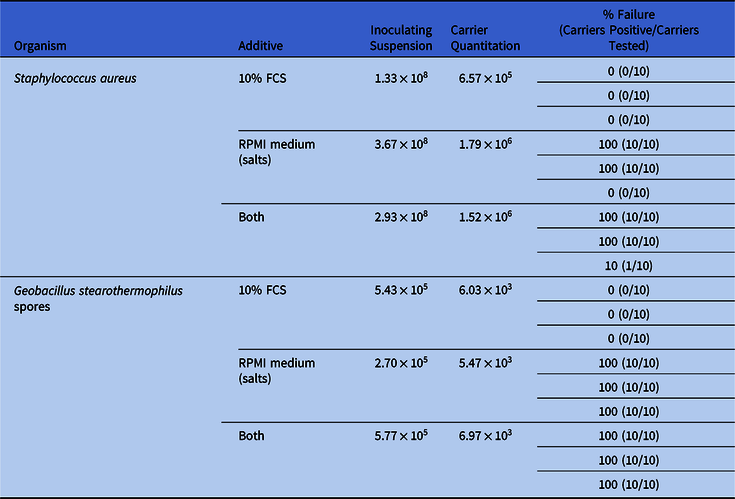
When the impact of salt and serum were independently assessed using VHP technology, it was found that salt, not serum, had the most significant effect on sterilization failure (Table 3). When the S. aureus and G. stearothermophilus spores were tested with 10% FCS only, complete inactivation occurred. The RPMI salts (alone or combined with FCS) significantly interfered with the sterilization process for S. aureus (ie, 41 of 60, or 68% failure) and G. stearothermophilus spores (ie, 60 of 60, or 100% failure).
Ability of Vaporized Hydrogen Peroxide to Inactivate the Microbial Load on Stainless-Steel Carriers in the Presence of Salt or Serum or Both

Note. FCS, fetal calf serum.
Discussion
Sterilization technologies are essential for instrument reprocessing in healthcare facilities. Cleaning, or the removal of visible soil (eg, organic and inorganic material) and microbial contaminants from objects and surfaces, precedes sterilization. Cleaning should consistently and reliably remove and/or reduce the organic and inorganic materials before sterilization to avoid interfering with the effectiveness of sterilization and to ensure a sterility assurance level (SAL) of 10−6.Reference Rutala and Weber2–Reference Rutala, Weber, Bennett, Dolan and Blaser4,Reference Jacobs, Wang, Gorham, Roberts and Rutala8 The criticality of cleaning was reconfirmed by Alfa et alReference Alfa, DeGagne, Olson and Puchalski5 in a classic study that evaluated various LTS technologies and showed sterilization failure in the presence of salt, serum and lumen test units. Given that organic material and salts are known to influence the sterilization capacity of LTS technologies,Reference Alfa, DeGagne, Olson and Puchalski5,Reference Jacobs, Wang, Gorham, Roberts and Rutala8,Reference Diab-Elschahawi, Blacky, Bachhofner and Koller9 we investigated the impact of inadequate cleaning and salt or crystalline residues on the efficacy of the sterilization technologies used in the United States. One LTS technology cleared in the United States for medical and surgical instruments, a hydrogen peroxide-ozone sterilizer, was not evaluated in this study because it was not available at UNC Health Care. A simulated use and clinical in-use study employing this technology was recently published by the manufacturer.Reference Molloy-Simard, Lemyre, Martel and Catalone10
The literature contains a paucity of information on the comparative microbicidal activity of the sterilization technologies cleared by the Food and Drug Administration (FDA) for sterilizing medical and surgical devices.Reference Alfa, DeGagne, Olson and Puchalski5,Reference Jacobs, Wang, Gorham, Roberts and Rutala8–Reference Kanemitzu, Imasaka and Ishikawa12 For example, no studies in the peer-reviewed literature have compared 4 sterilization methods used commonly in US healthcare facilities, and only a few studies have evaluated 3 sterilization technologies.Reference Alfa, DeGagne, Olson and Puchalski5,Reference Rutala, Gergen and Weber11,Reference Kanemitzu, Imasaka and Ishikawa12 To our knowledge, no studies in the peer-reviewed literature have evaluated the microbicidal activity of the FDA-cleared VHP sterilizer (Table 1) used for sterilization of medical and surgical instruments. Our results evaluate the comparative efficacy of 4 sterilization techniques using stainless-steel carriers in the presence of salt and serum. The results illustrate that steam sterilization is the most effective and has the largest margin of safety, followed by both EO and HPGP and lastly, VHP.Reference Rutala, Gergen and Weber13 Steam sterilization is the most robust sterilization process and the least affected by protein, salt, and lubricants.Reference Rutala, Gergen and Weber13 The reason that ETO and HPGP had failures with vegetative bacteria but not spores is not clear, but these failures could be attributed to the lower salt concentration for spores (0.29%) than vegetative bacteria (0.65%) or to higher microbial load (see Table 2). VHP has a significantly narrower margin of safety in killing vegetative bacteria and spores in the presence of a salt and serum challenge. These findings support the findings of Alfa et alReference Alfa, DeGagne, Olson and Puchalski5 for ETO and HPGP on the effect of salt and serum on sterilization efficacy.
The findings regarding the robustness of steam sterilization should not be used to suggest that cleaning is unimportant for steam sterilization. In contrast, the data demonstrate how important cleaning is prior to sterilization because salt and organic matter left on instruments can interfere with sterilization. These results, and those of other investigators,Reference Alfa, DeGagne, Olson and Puchalski5,Reference Diab-Elschahawi, Blacky, Bachhofner and Koller9,Reference Kanemitzu, Imasaka and Ishikawa12,Reference Rutala, Gergen and Weber13 highlight the importance of real-time monitoring methods prior to sterilization that are reliable and validated and that assess the effectiveness of cleaning that is predictive of microbial contamination, infection risk, and/or an SAL of 10−6.Reference Rutala, Kanamori, Sickbert-Bennett and Weber14 Current assessment tools (eg, visual, adenosine triphosphate [ATP]) are not predictive of microbial contamination or infection risks. Investigators have demonstrated that visual assessment and ATP lack the sensitivity required to ensure effective decontamination.Reference Lipscomb, Sihota and Keevil15,Reference Alfa, Fatima and Olson16
In the experiments with VHP, salt was the factor that significantly impaired the sterilization outcome because carriers inoculated with organisms (ie, S. aureus and G. stearothermophilus spores) and 10% FCS alone were sterile (ie, 0 of 60). Several investigators have shown that spores and bacteria occluded inside salt crystals were very resistant to LTS technologies.Reference Alfa, DeGagne, Olson and Puchalski5,Reference Doyle and Ernst17,Reference Alfa, DeGagne, Olson and Hizon18 Alfa et alReference Alfa, DeGagne, Olson and Hizon18 found that salt was the principal compounding factor that interfered with ETO sterilization; similarly, salt was the principal component that interfered with VHP. This interference may be due to the crystalline matrix or salt crystals impeding the penetration of the sterilant to the spore.Reference Doyle and Ernst17,Reference Alfa, DeGagne, Olson and Hizon18 A study conducted in 1967 demonstrated that protection of organisms by crystalline material was not limited to LTS technologies but also applied to moist and dry heat.Reference Abbott and Cockton19 In this evaluation, we considered factors that can interfere with sterilization such as salt, organic matter, and a concentrated inoculum (not dispersed), and we used stainless-steel carriers, which allowed direct exposure of the microbes to the sterilant. Complex medical (eg, lumens [length, diameter], scratches, and crevices) and surgical instruments (eg, lumens [length, diameter], hinged instruments, and robotic instruments) would represent a greater challenge to sterilization. Thus, LTS technology will need to be optimized to achieve an SAL of 10−6 (eg, an adapter supplying an additional source of hydrogen peroxide) for complex, lumened instruments such as endoscopes.Reference Rutala, Kanamori, Sickbert-Bennett and Weber14,Reference Okpara-Hofman, Knoll, Dürr, Schmitt and Borneff-Lipp20 Other factors can affect the sterilization process: different salts, carriers, microbial load, device design (eg, hinges), restrictive flow (eg, sharp bends, blind lumens), construction materials, and type of simulated soil.Reference Rutala, Gergen and Weber11,Reference Kanemitzu, Imasaka and Ishikawa12 The impact of naturally occurring build-up biofilm on medical and surgical instruments and whehter these materials could be a source of microorganisms that increases the risk of sterilization failure and infection needs to be better understood.Reference Alfa3
In summary, our findings demonstrate the limitations of sterilization technologies. The results illustrate that the organic and salt challenges used in this investigation had no effect on SS, had minimal effect on ETO and HPGP, but significantly impaired VHP. Clearly, an SAL of 10−6 was not consistently achieved under these experimental conditions. These findings reinforce the need for meticulous cleaning and reliable and validated cleaning monitoring methods that are predictive of infection risk.
Acknowledgments
We thank Mary L. Walton and Paul Byers for technical assistance.
Financial support
This study was supported by UNC Health Care.
Conflicts of interest
W.A.R. is a consultant to Advanced Sterilization Products (ASP) and has received an honorarium from 3M. All other authors report no conflicts of interest relevant to this article.