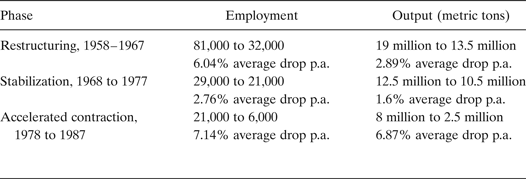
This article illuminates the long-running chronological course of deindustrialization and its complex political and social dimensions. Literature on North America emphasizes that deindustrialization, while punctuated by sudden and catastrophic local effects from the 1970s onward, had deeper roots in business investment and policymaking from the 1950s or earlier.Footnote 1 Literature on Scotland, while sometimes preoccupied chronologically with the deleterious macroeconomic impact of Margaret Thatcher's Conservative governments (1979 to 1990),Footnote 2 likewise focuses on the gradual nature of industrial contraction across the twentieth century.Footnote 3 In the coalfields the core elements of deindustrialization—employment and outputFootnote 4 —were observable from the late 1950s, although not in a linear way, as Table 1 shows. The phased nature of this process, with three distinct periods of restructuring, stabilization, and then accelerated contraction, can be explained by several linked factors: greater mechanization and concentrated operations in a limited number of larger pits from the mid-1950s to the late 1960s; the development of alternative employment opportunities, chiefly during the early and mid-1960s; the miners' political response from the late 1960s to the 1970s to the first phase of closures, when they actively resisted further shrinkage; and finally the reassertion of managerial authority in the early 1980s as the miners' bargaining power eroded.
Phases of Deindustrialization in Scottish Coalfields, 1958–1987

Source: Miles K. Oglethorpe, Scottish Collieries. An Inventory of the Scottish Coal Industry in the Nationalized Era (Edinburgh, 2006), 20, Figures 3.8 and 3.9.
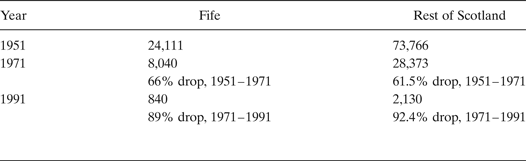
The analysis is shaped by developments in the County of Fife, where 320,000 people—six percent of all Scots—lived in 1971.Footnote 5 Important things can happen in small places, as Alessandro Portelli shows in his study of the eastern Kentucky coalfields of Harlan County, where population peaked in the mid-twentieth century at around 70,000.Footnote 6 Harlan and Fife share similar histories. Rapid growth from the 1890s to the 1910s in each county gave way to hardships in the 1920s and 1930s. “Modernization” after the Second World War brought greater security for some miners but diminished overall employment; deindustrialization then accelerated from the 1980s, with resultant poverty and social problems.Footnote 7 Fife was the dominant post-1945 Scottish coal region, but its experience was distinct rather than unique. Table 2 shows that the timing and speed of coal's contraction in employment terms were relatively uniform throughout Scotland. In Fife in 1991 coal employment was 3.48 percent of the 1951 total; in the rest of Scotland in 1991 it was 2.89 percent of the 1951 total.
Male Employment in the Coal Industry in Fife and the Rest of Scotland, 1951, 1971 and 1991

Sources: General Registry Office (hereafter GRO), Edinburgh, Census 1951 Scotland. Volume IV: Occupations and Industries (Edinburgh, HMSO, 1956), Table 13; GRO, Edinburgh, Census 1971 Scotland. Economic Activity: County Tables, Part II (Edinburgh, HMSO, 1975), Table 3; GRO for Scotland, 1991 Census. Economic Activity. Scotland (Edinburgh, HMSO, 1994), Table 11.
The phased nature of coalfield deindustrialization was shaped by public policy decisions, mediated by moral economy arguments. The moral economy of the eighteenth-century English crowd, memorably identified and analyzed by E. P. Thompson, was composed of plebeian customs and expectations that were transgressed by employers and traders in a period of rapid economic and social change.Footnote 8 Slightly different moral economy arguments emerged in the UK after the Second World War, both rationalizing and resisting industrial restructuring, articulated from a variety of perspectives by competing economic actors. These included policymakers, who tended from the mid-1940s to the early 1970s to popularize economic arguments in moral terms.Footnote 9 Employment Policy, the 1944 white paper that shaped postwar economic strategy, established the government's duty to maintain “high and stable” levels of paid work, but with the important moral proviso that this commitment obliged employees to move between sectors as existing positions became redundant, or new modes of activity offered greater scope for growth.Footnote 10 Reciprocity arguments—such as enjoying the right to work in exchange for accepting the duty to be flexible—were frequently restated. The Labour government's 1965 National Plan defended the contraction of the coal industry as a means of releasing resources, including manpower, for utilization in higher growth assembly manufacturing. A key problem was conceded: mining job losses would be concentrated in Scotland, along with northeast England and south Wales, where operations were comparatively less efficient than other coalfields but different forms of industrial employment scarcer.Footnote 11 Miners in these areas were consequently more likely to mobilize against pit closures with moral economy arguments of their own, insisting that coal jobs should not be forfeited in their localities until provision was made for alternative work and generally resisting financial incentives to move to the more “profitable” Yorkshire, Nottinghamshire, and the English Midlands.Footnote 12
Moral economy arguments were not abstracted from the contours of class relations and authority. The extent of working-class power in industrial societies after 1945 has been exaggerated. Workers in the UK enjoyed greater collective strength from the 1950s to the 1970s than they did in preceding or following decades but, as was broadly the case in the United States as well,Footnote 13 this was based on favorable economic and labor market conditions that enabled miners in Scotland to push their managers—and policymakers—to accept moral economy approaches to coalfield jobs. But, as will be shown in this article, when market conditions deteriorated in the second half of the 1970s, and worsened further in the 1980s, the moral economy framework was abandoned and then attacked by coal industry management as well as a thoroughly anti-trade union UK government.
In moral economy terms, pit closures had to satisfy two requirements: the agreement of workers and their representatives and the guaranteed economic security of the men affected, through transfer to nearby pits or local provision of comparably paid, alternative employment. Policymakers responded to this pressure. New industrial sectors were established in the Scottish coalfields, including Fife, in the 1960s, and younger pits—with large reserves and mechanized operations—were developed. As a result, the coalfields experienced both deindustrialization and reindustrialization, with the growth of mechanical, electrical, and then electronic engineering concerns, where substantial numbers of women were also employed. Moral economy arguments then helped to stabilize coal jobs and production during the second phase of deindustrialization, from 1968 to 1977, as the growth of alternative opportunities slowed. In the third phase, from 1978 to 1987, moral economy approaches were directly challenged with closures and job cuts, despite workforce opposition and rapidly rising unemployment, with the “retreat” of multinational assembly firms.Footnote 14
This analysis is divided in two parts. The first focuses on the initial phase of deindustrialization, including new employment opportunities. The pressures weighing on moral economy arguments in the second and third phases of deindustrialization are then examined, culminating in the 1984–1985 strike. The article uses, in recast form, a limited body of evidence drawn from participant interviews that appeared in the author's recent book on the strike.Footnote 15 The bulk of the data, drawn from government, industry, and union archives, is being published here for the first time, in support of an original analysis of the longer history of deindustrialization in the coalfields of Scotland.
Deindustrialization and Reindustrialization, circa 1947–1967
Coal production in Scotland increased slightly after the Second World War, stabilizing near 22 to 23 million metric tons per annum from 1948 to 1955. Output gradually dropped from 1951, although employment did not peak until 1956–1957.Footnote 16 The industry had been nationalized in 1947 by the UK Labour government. Nationalization had several aims, but perhaps two predominated: economic rationalization, with the state-controlled National Coal Board (NCB) directing investment that would have been unlikely under existing private ownership; and social justice, with improved work conditions and rewards.Footnote 17 Collective bargaining was entrenched, with union density close to 100 percent, and worker representatives negotiating various issues at the national, area, and pit levels, including production and work organization.Footnote 18 There were tensions, however, sometimes arising from the retention of prenationalization management staff.Footnote 19 Eric Clarke, general secretary of the National Union of Mineworkers Scottish Area (NUMSA) during the 1984–1985 strike, began his working life in Midlothian, shortly after nationalization. He recalled in 2009 the indignity of waiting after work to collect wages from an office window at Lady Victoria Colliery in Newtongrange, and the haughtiness of managers, including ex-army officers, who “talked aboot goan on leave when they wir goan on their hoalidays.”Footnote 20
The realization of social justice was constrained in other ways, as NCB Scottish Divisional managers from the late 1950s concentrated operations in larger and younger pits, particularly those that were best suited to mechanization.Footnote 21 This led substantial numbers of men and families to move, generally from west to east, typically from Lanarkshire to Fife. The NCB portrayed this positively, highlighting the advantages of stable employment and modern housing in Fife,Footnote 22 and underestimating the ruptures of extended family separation and community abandonment.Footnote 23 Strains were evident also in “receiving” communities, where migration exacerbated housing shortages. In Lochore in central Fife, for instance, where the NCB held a small stock of housing, miners' representatives recurrently complained that “strangers” or “outsiders” were being accommodated before “local lads.”Footnote 24
Managerial attention to production targets, meanwhile, led to a major wave of closures. This strategy was pursued with particular vigor by the NCB in the 1960s, under the chairmanship of Alf Robens, responding to coal's declining share of the growing electricity-generation market, from 73.7 percent in 1960 to 46.6 percent in 1970. Total production dropped from 200 million to 150 million metric tons.Footnote 25 In Scotland the problems to come were signaled by a large unofficial strike in 1959 following the announcement that Devon Colliery in Alloa would close. This important episode illuminated the terms of the moral economy approach to coalfield deindustrialization after employment's 1956–1957 peak. The NCB proposed redeploying the 653 workers at neighboring pits if possible, but many demurred, having recently left Lanarkshire.Footnote 26 Their disquiet was shared by the 25,000 miners across Alloa, Stirlingshire, and Fife who struck work in protest.Footnote 27 This embarrassed leaders of the largest mining union, the NUMSA. Its president, Abe Moffat, pressed local union representatives to persuade the Devon men to resume work on the promise of further talks about the pit's future.Footnote 28 NCB officials postponed the closure until March 1960, enabling the entire workforce to be redeployed locally, without redundancies.Footnote 29
The union's insistence on local redeployment was a core dimension of the coalfield moral economy framework, especially as mechanization intensified. The proportion of coal power loaded in Scotland increased from a quarter in January 1960 to two-thirds in April 1964, and job losses—through retirement or voluntary exit—mounted.Footnote 30 In August 1962 the NCB sought to close Aitken and Mary, two large pits in central Fife that employed more than 1,300 men.Footnote 31 Operations at Aitken, where employment peaked at 1,439 in 1956, had been scaled down in 1959, with 174 men transferred,Footnote 32 mainly to Comrie and Blairhall, ten miles away in west Fife. Aitken had been losing money in 1959, but the NCB's internal discussion had a different emphasis. Comrie's mechanized growth required additional manpower resources, which Aitken's contraction could supply.Footnote 33 In 1962 the NCB managers were more candid, telling union representatives that they wanted to divert workers to pits where mechanized production would be more fruitful.Footnote 34 The men accepted the transfers, and Aitken closed in February 1963,Footnote 35 but Mary was reprieved, because of union pressure, until 1966. Union representatives emphasized moral economy arguments, pushing the NCB to defer closures until alternative employment was established locally.Footnote 36 “We had to get these factories into Scotland,” said Alex Moffat, elected NUMSA president in 1961 as successor to his brother Abe, referring to the desired growth of assembly goods manufacturing.Footnote 37
The crucial issue for NUMSA, in other words, was deindustrialization. This was a broader worry in Scotland, which a widening cross-party and cross-class movement attributed to defects in the structure of policy-making within the UK. A “democratic deficit” argument was emerging, with Scottish employers and trade unionists arguing that UK policy privileged interests that were disproportionately present in southern and central England, notably finance and consumer goods, and disadvantaged those in Scotland, particularly steel and shipbuilding.Footnote 38 The debate in Scotland was complicated, however, by the desire—shared by the miners—that consumer goods industries be encouraged. The relationship between the growth of some economic activities and the contraction of others is complex. In Scotland it was thought that consumer goods could grow and mitigate the contraction of the “heavy” industries: coal, metals, and shipbuilding. New industries were established in Scotland in greater volume in the 1960s, but this arguably accelerated heavy industry shrinkage. Some in the policymaking debate sought this end. “Deindustrialization does not just happen,” wrote Bluestone and Harrison, in their 1982 study of United States plant closures. It was usually the result of political and business decisions, consciously made.Footnote 39 In Scotland, capital and human resources were deliberately diverted from the heavy industries and into assembly goods, to secure greater economic growth. This was achieved principally through adjustments to “regional policy” via incentives—mainly capital investment grants—offered to businesses that moved to areas of new population or to older settlements experiencing slower growth. These incentives were significantly increased, “sixteen-fold in real terms” from 1962–1963 to 1969–1970.Footnote 40
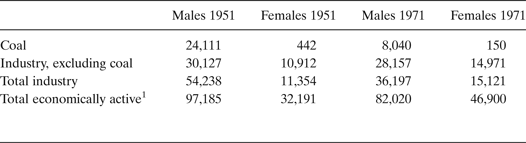
New jobs duly arose in consumer goods—electronics, principally, along with electrical goods and clothing—and many provided by overseas firms, chiefly from the United States.Footnote 41 These afforded new opportunities for women as well as men, in or near the coalfields of Ayrshire, Lanarkshire, the Lothians, and Fife. The new jobs were often unskilled or semiskilled and characterized by substantial workplace tensions.Footnote 42 These changes altered employment in the coalfields. UK population census data on industrial employment in Fife is shown in Table 3.
Industrial Employment in Fife, by Gender, 1951 and 1971

1All those “gainfully employed” or pursuing employment, including those officially recognized as unemployed.
Sources: GRO, Edinburgh, Census 1951 Scotland. Volume IV: Occupations and Industries (Edinburgh, 1956), Table 13; GRO, Edinburgh, Census 1971 Scotland. Economic Activity: County Tables, Part II (Edinburgh, 1975), Table 3.
The relative importance of industrial employment other than coal increased for men, from 31 percent in 1951 to 34.3 percent in 1971. “Traditional” forms of industrial employment also waned among female workers, notably in textiles, which engaged 13.4 percent in 1951 but just 5.3 percent in 1971. The big developments were in engineering, clustered around Glenrothes in central Fife, one of five New Towns established in Scotland after 1945 to relieve overcrowding in Glasgow and encourage the growth of new industry.Footnote 43 Glenrothes developed initially to house the families of a projected 2,500 employees at a major new pit, Rothes, which opened in 1957 but closed in 1962 owing to geological difficulties and extreme flooding.Footnote 44 Other employers were attracted through regional policy.Footnote 45 Workers traveled daily to the town's factories from the central Fife coalfield and settlements to the east. Glenrothes grew in population, and high concentrations of manufacturing activity were established by 1971, when roughly 65 percent of men's jobs and 55 percent of women's jobs were in industrial categories. One-third of the town's economically active women were employed in electrical engineering, which employed 8 percent of economically active women in Fife overall.Footnote 46
This change in industrial employment, by sector and gender, broadens our understanding of deindustrialization, at least in the Scottish coalfields. In Fife, the number of economically active persons in all industry categories fell from about 65,000 in 1951 to 51,000 in 1971, and the approximate proportion of these persons who were female increased from one in six to two in seven. Total employment, moreover, remained stable, with increased female economic activity more or less compensating—in numerical terms—for reduced male economic activity. This made colliery closures more tolerable during the “restructuring phase” of deindustrialization, particularly as union and management officials commonly argued that this would revivify coal. Alex Moffat wrote in December 1965 that although thirty-three of Scotland's seventy-four pits were likely to close soon, only thirteen of these were less than forty years old, and seventeen were near “exhaustion.” The NCB's Scottish Director, Ronald W. Parker, was given space in the union's paper to present his own moral economy arguments, emphasizing that major pits were being opened or expanded in each main coalfield area, with jobs for those wanting to stay in the industry.Footnote 47 This is worth emphasizing: even in Lanarkshire, the old territorial core of the Scottish industry that was shrinking markedly after 1947, there was major redevelopment at the Bedlay and Cardowan collieries to the north-east of Glasgow. At the latter, this included a new shaft, to increase daily output by eighty percent.Footnote 48
This restructuring came at the cost of jobs lost with the closure of smaller pits, typically situated in established mining villages. Coal production ended altogether in the mid-1960s in central Fife, which had already experienced the brunt of deindustrialization, its workforce shrinking from 11,000 in 1956 to 2,400 in 1965 at an average loss of 7.8 percent per year, exceeding the Scottish-wide average of 6 percent per year. Parker characterized the central Fife pits as “heavy losers” that had to close, starting with Glencraig, the biggest employer.Footnote 49 Union representatives initially resisted this, restating the core prerequisites for closure: comprehensive, local redeployment,Footnote 50 and new industry jobs.Footnote 51 There were important prospects on both fronts. First, the 1965 National Plan pledged to enhance regional assistance to stimulate manufacturing in areas of Scotland affected by coal's contraction.Footnote 52 Scottish officials at the Ministry of Labour duly indicated to the NCB that 6,400 additional jobs could follow in Fife in the next three years, 2,300 explicitly “for males.” Second, new collieries were being developed in east and west Fife, with the build-up of manpower now being radically accelerated. Employment at Seafield, in east Fife, ten miles from the central Fife settlements, would more than triple in sixteen months—from 783 in March 1966 to 2,600 by July 1967.Footnote 53 NUMSA officials were slightly skeptical about this, emphasizing the difficulties of transport, with buses trundling around the old villages before journeying to Seafield. Alf Robens, hosting talks on Glencraig in London, said sufficient numbers of buses would be utilized to prevent meandering journeys. Parallel arrangements would bus men a similar distance westward, where Solsgirth and Castlehill, both new pits, and Bogside, older but substantially redeveloped, would service a massive coal-burning power station at Longannet from 1968.Footnote 54 NUMSA officials, expanding their moral economy definition of “local” to encompass these daily journeys, calculated that 95 percent of the Glencraig men would be redeployed, mainly at Seafield or the Longannet pits, and accepted the closure.Footnote 55
Stability and Crisis in the Coalfields, circa 1967–1987
The moral economy framework was threatened by the closure of Michael Colliery in east Fife, following a disastrous fire that killed nine men in September 1967.Footnote 56 At that time, Michael was the largest pit in Scotland, employing 2,193, with large reserves of coal that were being profitably mined. NCB Scottish Divisional officials planned to resume production within fifteen months of the fire at a cost of £4 million, retaining 1,500 men.Footnote 57 But NCB officials in London overruled that decision, closing Michael on the grounds that other pits could meet the falling demand for coal.Footnote 58 This conclusion was contested by the workforce, which emphasized the pit's profitability and extensive reserves.Footnote 59 In this case, the moral economy requirement that closures be negotiated was violated, although union pressure preserved the men's financial security. Half were employed in other pits, mainly nearby; around a quarter, those 55 and over, received early retirement and their pensions; and the remainder left the industry voluntarily, taking jobs elsewhere.Footnote 60 Michael was, moreover, a distinct case; other closures were managed with worker compliance, although union activism remained important. When the NCB closed Blairhall, in west Fife, in 1969, NUMSA officials ensured that roughly 450 men got jobs at the Longannet pits of Solsgirth and Castlehill, prized for their longer prospects.Footnote 61 This was especially important for the 111 transferred very recently, during the central Fife run-down.Footnote 62
Thirteen pits were shut down in Scotland in 1968, but Blairhall was one of only two in 1969, setting the trend for the second phase of deindustrialization. There was a single closure in 1970 but none in 1971; three closed in 1972, then four in 1973, one in 1974, three in 1975, one in 1976, and none in 1977.Footnote 63 This resembled the pattern across Britain, where the rate of closures slowed from forty-six in 1966–1967 and fifty-one in 1967–1968 to nineteen in 1969–1970, six in 1970–1971, three in 1971–1972, and eight in 1972–1973.Footnote 64 There are two explanations for this stabilization. First, restructuring had taken effect. What remained were relatively new, larger, and recapitalized collieries where scale economies made production more viable. Second, restructuring stimulated important political changes, the most notable being increased workforce support for “militant” trade unionism and sterner resistance to deindustrialization. While closures were tolerated in the 1960s in moral economy terms, miners resented the relative shrinkage of the industry in Scotland, from 10.1 percent of output and 12.2 percent of manpower in 1957 to 8.7 percent of output and 10.2 percent of manpower in 1972.Footnote 65 NCB policy was, moreover, guided by UK public spending and macroeconomic priorities, depicted by miners' leaders as distant from the communities affected in Scotland. This was especially evident with the closure of Michael, announced in November 1967 as the UK Labour government published Fuel Policy. This white paper envisaged the further diversification of the energy supply, with coal's share reduced from fifty-eight percent in 1966 to thirty-four percent in 1975, suggesting a further halving of employment in coal. NUMSA officials vehemently protested,Footnote 66 with echoes of the “internal colonialism” arguments developing in the United States, where the wealth of some regions, mainly in the north and far west, was linked to the poverty of others, such as the Appalachian coalfields.Footnote 67 Parallels are also evident in responses to deindustrialization in Canada, understood in some labor circles there, as in Scotland, in colonial terms, with US multinationals closing plants in Ontario to preserve jobs in Michigan or Illinois.Footnote 68 Michael McGahey, elected NUMSA president in 1967, argued persistently for changes in governance within the UK to produce a greater emphasis in public policy on Scotland's distinctive economic and social needs. He persuaded the Scottish Trades Union Congress to campaign for a Parliament in Edinburgh that could be used politically to reverse the lost employment effects of deindustrialization.Footnote 69
Generational changes were apparent in this political shift. The Moffats and their peers had direct experience of intensely fought class conflict, having been black-listed after the 1926 General Strike and not employed again until the late 1930s.Footnote 70 Understandably they welcomed nationalization in 1947 and measured conditions thereafter against the struggles of the past. McGahey respected his elders, especially Abe Moffat,Footnote 71 and shared their Communist party politics. So it would be an exaggeration to liken the generational transition in the Scottish coalfields too closely to the position in the United States, where mining union officials who had fought their employers prior to the Second World War grew complacent in the 1950s and 1960s and, consequently, faced a militant response from their members.Footnote 72 But McGahey, along with Lawrence Daly—an ex-Communist on the left of the Labour party who was elected NUMSA general secretary in 1965—was supported by younger miners who gauged their lives against the rising material conditions and expectations of the “affluent” society rather than the privations of the 1920s and 1930s.Footnote 73
McGahey and Daly were able, despite their substantial political differences, to cooperate closely, united by their moral economy defense of jobs, and attained a larger territorial profile in the coal industry. Daly served as NUMSA general secretary for three years and was then elected—by the miners of England and Wales as well as Scotland—general secretary of the NUM in 1968, principally because of his opposition to closures.Footnote 74 McGahey was narrowly defeated in the 1971 election for NUM president but won the vice-presidency in 1973.Footnote 75 The revived militancy of the Scottish miners had been further illustrated by major unofficial wage strikes in 1969 and 1970, and the official six-week strike across England, Wales, and Scotland in January and February 1972. This gained the miners a substantial wage increase, arresting the decline of their earnings against those of other manual workers which had accompanied deindustrialization.Footnote 76 The NUMSA leadership remained combative, even as the rate of closures decelerated, and miners made wage gains. McGahey understood that this stabilization was ambiguous, resulting from reduced growth in assembly manufacturing.Footnote 77 The slowing of the industrial economy and fuller emergence of alternative energy sources, notably gas and nuclear power, were reflected in the early maturation of employment at the major collieries where production had commenced or been bolstered through redevelopment in the 1960s. At Seafield, employment peaked at 2,400 in 1970,Footnote 78 below the volume anticipated by the NCB in 1966,Footnote 79 and peaked around Longannet at Bogside in 1971, Castlehill in 1972, and Solsgirth in 1975. In Midlothian employment in the big units peaked at roughly the same time: in 1970 at Bilston Glen and 1971 at Monktonhall, while at Ayrshire's largest pit, Killoch, it was earlier, in 1965.Footnote 80
Economic slowdown was certainly visible in Fife, and this troubled UK government officials. Special incentives for attracting new industry to Glasgow and its environs, usually top priority for policymakers worrying about unemployment-related social unrest, were extended to Glenrothes,Footnote 81 where new businesses were providing fewer jobs than anticipated. Burroughs Machines, the US computer manufacturer, operated from 1971 in a £4 million factory provided by the UK government.Footnote 82 The firm, like other US multinationals operating in Scotland, regarded unions as “a necessary evil,”Footnote 83 and proposed recruiting 1,000 workers,Footnote 84 but by the end of 1974 employed only 270 men and 160 women. When Burroughs eventually left Glenrothes in 1982, it had a workforce of just 400.Footnote 85 The stagnation of assembly goods reinforced the importance of coal. A national wage dispute in 1973–1974 contributed indirectly to a change of emphasis at the NCB. The Conservative government, facing the national dispute that threatened its anti-inflationary economic strategy, called a general election, but lost. The Labour government elected in its place published Plan for Coal, in partnership with the NCB and coal industry unions. This was a program of investment deemed necessary following the oil crisis of 1973, which revived coal as the price of its main rival escalated.Footnote 86 Plan for Coal stimulated growth in Scotland, where 1975 was the highest production year since 1968, although closures were still obtained after consultation, such as Valleyfield in west Fife, in 1978.Footnote 87
This position was radically altered after 1979, when the third phase of coalfield deindustrialization commenced in earnest. The key political change was the election of Thatcher's Conservative government, which characterized coal as a high cost drain of consumers' and taxpayers' money and a prisoner of trade unionism.Footnote 88 Union pressure, it was argued, had inhibited job-reducing productivity “improvements,” especially in the 1970s.Footnote 89 Plan For Coal was abandoned, superseded by the 1980 Coal Industry Act, which envisaged the ending of state subsidies by 1983–1984.Footnote 90 In pursuit of greater cost control, the government in 1982 appointed the Monopolies and Mergers Commission (MMC), whose responsibilities included monitoring nationalized industry, to examine the NCB. The MMC report concluded that production should be reduced by ten percent, necessitating the closure of the least “economic” pits, to make annual savings of £300 million. This explicitly threatened the industry in Scotland, where all pits were shown to be working at a loss.Footnote 91 The MMC analysis was based, however, on highly problematic financial data provided by the NCB. Performance could be interpreted as varying according to investment, so the “best” pits were those with the greatest level of capital support,Footnote 92 and NCB calculations of production costs included expenditures arising from past activities, such as compensation for subsidence, pensions to retired employees and payments to redundant miners. The MMC report also set aside social costs: “non-production” entailed redundancy payments plus unemployment maintenance, along with lost multiplier effects.Footnote 93
NCB management in Scotland nevertheless embraced the Thatcher and MMC analysis, developing a muscular anti-union strategy in pursuit of radical cost reduction. Albert Wheeler, area director from 1980, closed pits despite workforce opposition, starting at Kinneil in West Lothian in December 1982. An attempt to defend the pit through strike action across Scotland foundered. “Miners did not live in isolation,” McGahey told the NUMSA executive in August 1983, “and their morale had been affected by four million unemployed” [in the UK]. He was reflecting on events at Cardowan, the last pit in Lanarkshire, where workers voted by a ratio of three to two to accept closure, along with redundancy or transfer.Footnote 94 The latter was still an option for some, but differed substantially from the redeployments of the 1960s, which were intraregional, like those from central Fife to Seafield. The Cardowan men were contemplating a daily round-trip of eighty-plus miles to the Longannet pits, adding a minimum of three hours to their seven-hour shift.Footnote 95 Union representatives were fighting on another front, resisting management attacks on workplace representation and consultation, which provoked several pit-level disputes. Further closures were threatened, and roughly half of Scotland's miners were in dispute with management before the national strike commenced on March 12, 1984.Footnote 96
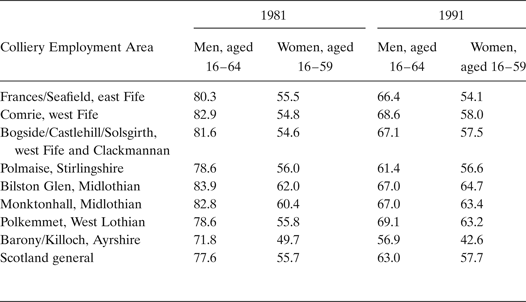
The strike was initially solid in Scotland, except at Bilston Glen, where production resumed in June. Commitment weakened in Ayrshire in November and then crumbled in January 1985. Solidarity began to waver at Monktonhall and Polkemmet in West Lothian in December and in east Fife in February, but in west Fife and at Polmaise in Stirlingshire it was nearly universal until the national resumption of work in March 1985. There are material and moral explanations for this pattern. Of central importance was the role of women. In Fife especially, partly reflecting Communist tradition, women had a relatively esteemed political position. This has to be emphasized. Women were not supporting their men but leading the defense of community resources, the pits, and jobs threatened by NCB management and government policy. Women were also able to lower the cost of striking through their wages as workers. In this respect the industrial changes of the 1960s were important, with women gaining employment in assembly goods manufacturing as coal contracted. But women did not enjoy equal levels of esteem or opportunity throughout the coalfields. Table 4 shows colliery-level patterns of male and female employment in 1981 and 1991. The data are derived from the local authority areas where collieries were situated. Female job numbers in Ayrshire were lower than coalfield and broader Scottish averages, elevating the relative cost of striking, and male chauvinism was apparently more pronounced there than in other coalfield territories.Footnote 97 Table 4 also demonstrates that deindustrialization accelerated after the strike, with a diminution especially of male employment.
Persons in Employment, Part-time and Full-time Combined (percentages), by Colliery Employment Area in Scotland, 1981 and 1991

Sources: Registrar General Scotland, Census 1981 Scotland. Scottish Summary, Volume 2; Report for Central Region. Volume 1; Report for Fife Region. Volume 1; Report for Lothian Region. Volume 1; Report for Strathclyde Region. Volume 1; GRO for Scotland, 1991 Census. Report For Scotland, Part 1, Volume 1; Central Region, Part 1; Fife Region, Part 1; Lothian Region, Part 1; Strathclyde Region, Part 2.
The loss of male jobs was a feature of coalfields elsewhere in the 1980s and 1990s, as Portelli's study of Harlan County and Tim Strangleman's analysis of Durham, in northeast England, demonstrate.Footnote 98 In all colliery areas in Scotland male employment dropped markedly from 1981 to 1991, by a median of fourteen percentage points. The bottom row in Table 4 illustrates the broad nature of this problem, which is further evinced by the falling share of industrial categories in employment across Scotland: 45 percent in 1951 and 40.4 percent in 1971, but just 26.7 percent in 1991. The general trend was exemplified in Fife, where the number of men in employment fell from 86,480 in 1971 to 72,350 in 1991. Female employment rose in the same period, from 49,440 to 59,090, but industry's share of these jobs dropped from 32.2 percent to 16.5 percent. So women's jobs were concentrated in lower paid services, and this negative effect on household incomes was compounded by gender pay inequality.Footnote 99 The dwindling of alternative industrial employment accentuated the difficulties as closures accumulated across Scotland, on economic grounds: two in 1986, three in 1987, two more—Seafield and Frances in east Fife—in 1988, and another four in 1989 and 1990. Deep mining in Scotland ended ten years later.Footnote 100
These closures are remembered in moral economy terms. Union activists and officials, interviewed in 2009, talked about the abandonment of substantial, workable reserves. These belonged to “the people” and “the communities” and were worth many hundreds of millions of pounds sterling. In “sterilizing” these valuable public assets, industry managers and UK government ministers were irresponsibly destructive, and even criminally negligent.Footnote 101 This regret, and anger, is compounded by the painful economic and social consequences of lost industrial employment. Analysis of multiple deprivation data from 2006—one generation on from the third, accelerated phase of deindustrialization—indicated that problems were especially pronounced in the ex-mining communities of Ayrshire, Fife, and Lanarkshire.Footnote 102
Conclusion
Deindustrialization, it has been demonstrated here, is neither a linear or politically neutral economic process. Employment grew in Scottish coal after the Second World War, peaking in 1956–1957. Three distinct phases of deindustrialization followed. First, there was restructuring from 1958 to 1967, when output fell by twenty-nine percent and employment more than halved. Small pits closed, with operations concentrated in larger and mechanized pits. Second, there was relative stabilization from 1968 to 1977, when contraction of employment and output slowed, and few pits closed. Third, from 1978 to 1987 there was accelerated reduction, with closures on contested “economic grounds,” and job losses in the face of union and workforce opposition, pushed through by industry management in the post-1979 political context of anti-unionism and Thatcherism.
The phasing of this deindustrialization, and especially the post-1985 rundown, is significant. Deindustrialization was no accident in the Scottish coalfields, to paraphrase Bluestone and Harrison, but the consequence of decisions made by industry managers and the UK government. Closures were sought by policymakers in the first two phases of deindustrialization, from the 1950s to the 1970s, in pursuit of greater economic growth. Workers were “released” from coal and other labor-intensive industries, for deployment in capital-intensive enterprises, notably assembly goods manufacturing, which had greater potential for adding surplus value. Deindustrialization in these decades was managed with reference to moral economy arguments, articulated chiefly as a collective working-class response to deindustrialization. Closures and job losses were negotiated, with economic security prioritized. In Fife, closures were delayed in the early 1960s while new pits were built up; other industries developed around Glenrothes through regional policy. As the growth of alternatives stagnated after 1967, the pace of deindustrialization in coal slackened, and there was even an investment spurt in the remaining pits, triggered partly by the oil crisis of 1973–1974.
Moral economy arguments were rejected by industry management and government in the third and final phase of deindustrialization. Closures were enforced against workforce opposition, amidst radically declining industrial activity. Opportunities for redeployment were scarce and less attractive than in the 1960s or early 1970s when organized labor had enjoyed some purchase over public policy. Closures after 1979 reflected a change in the balance of class forces in the UK, and in this sense deindustrialization was deliberately willed. Eliminating unionized and regulated coalfield jobs was part of Thatcherism's core strategy, narrowing the organizational and social basis of the working class. It is important to be clear about this when contemplating the future, as well as the history, of deindustrialization. Mine or plant closures and job losses are not inevitable. They can be managed in different ways, according to the balance of forces in the struggle between labor and capital, as they were in the coalfields of Scotland from the 1940s to the 1990s.