Profiting from intense and fruitful musicological research conducted during the last two decades in Greece, the present study will try to draw the picture of what was happening in nineteenth-century Greek musical life as regards the active local composers, their aesthetic options and the reception of their music by an ever-developing public. This picture will prove to be quite at variance with what was believed by the advocates of the so-called ‘national school’ and was taught until recently through some noticeably similar appendices, specifically written to accompany textbooks on the general history of music translated into Greek. In fact, the very central point of interest of early twentieth-century nationalist composers was but a marginal preoccupation in nineteenth-century Greek society, which was striving to integrate into the European world. The Occidental orientation of cultural and artistic life in the young Christian kingdom that originated from a violent struggle against the Ottomans, was felt to reiterate a process typical of all previous phases in Greek history.
After the fall of Constantinople in 1453, the Western-leaning course that had been pursued until then by the late Byzantine civilization was not interrupted, but was reduced in the Greek-speaking lands that still remained outside the Ottoman state and beyond its influence. The most significant part of these lands – Venetian-held Crete – actively participated in the movement usually called the Renaissance. Aside from noteworthy painters and poets from that era, Crete had at least one important composer of polyphonic music to boast of: Frangiskos Leondaritis (1518–1572), who was active in his birthplace and also in Venice and Munich.Footnote 1 A plethora of documents bears witness to a developed state of musical activity in Crete,Footnote 2 which was interrupted following the Ottoman conquest of the island in 1669. The attendant – albeit slow-paced – development of the Ionian Islands was manifest musically through operatic performances that began in 1733 at the San Giacomo theatre in Kerkyra (Corfu). It was there that, about half a century later, the comic opera Gli Amanti Confusi, o sia Il Brutto Fortunato (1791) was staged, a work now lost that was created by Stefanos Poyiagos – the first well-known local composer.Footnote 3 As for a number of composers with Greek names who have been found to have lived as members of Greek communities abroad – such as Daniel Carolides in Bohemia and Greek–Venetian Michele Stratico in Ragusa – understandably their national identity had been contested by the areas in which they matured and rose to artistic prominence.
If one accepts that modern Greece was born during the period that began with the 1821 Revolution and ended ten years later with the assassination of Governor Ioannis Capodistria, then the Chiot scholar Konstantinos Nikolopoulos (1786–1841) should perhaps be recognized as the new state's earliest composer. Nikolopoulos, who had settled in Paris at the beginning of the second decade of the nineteenth century, devoted his multifarious activities to preparations for what ended up as the Greek War of Independence and to propagandizing the Greek cause during the course of the struggle. As an activist, Nikolopoulos, who had studied under François-Joseph Fétis, composed a number of patriotic songs and cantatas. These were created in the post-French Revolution musical idiom that ranged between Catel and early Berlioz,Footnote 4 which was typical of the France of the day. The impact of these works, however, did not surpass the purpose for which they had been composed; consequently, it is Nikolaos Chalikiopoulos Mantzaros (1795–1872),Footnote 5 a Corfiot student of Poyiagos, who has been regarded as the leading contender for the title of ‘patriarch of modern Greek music’. Mantzaros had become active as early as 1815, composing a series of short works in Italian for the San Giacomo theatre. These youthful arias, scenes and cantatas moved along the lines of a musical style parallel to that of his contemporary Rossini, in the tradition of Cimarosa, Paër and Mayr. The last work of this genre was entitled Aria Greca (1827) and today holds the distinction of being the earliest known piece for voice and orchestra to use the modern Greek language.
The Corfiot composer's acquaintance with the Zakynthian poet Dionysios Solomos (1798–1857), who had settled in Kerkyra in 1828, led him to seek a ‘national’ musical style, based on the setting to music of what could be referred to as ‘artistic’ Greek poetry (in essence, this meant Solomosian poetry). This was to be achieved through the use of austere melodic lines and, at the same time, polyphonic forms, especially the fugue, which, according to Mantzaros, helped actualize the ‘law of unity’ (‘legge dell’ unità’) and embodied that which was aesthetically ‘high’.Footnote 6 Such definitions and views, evidently rooted in German Idealism, can be found scattered throughout his educational and theoretical works, and in particular in his only published Rapporto, a discussion of works by Monsigny and Grétry.Footnote 7 On the other hand, it was the successive setting to music of Solomos’ lengthy poem Hymnos eis tin Eleftherian [Hymn to Liberty] that would prove to be a beneficial testing ground for these principles; these particular attempts would not cease to preoccupy the composer from 1828 until his final years. Aside from an early first version – whose simplicity sought to spread the patriotic poem to the widest Greek circles possible – at least two other different versions of the entire poem set to music have survived, as have several free-standing attempts to set verses of the poem to music, all of which were based on a multigrade and variform use of polyphonic techniques and morphological models.Footnote 8
Unfortunately, Mantzaro's solemn dedication to polyphony, his preoccupation with writing on issues of music theory and his prolific teaching activity only resulted in giving him the reputation of a ‘scholar’, theoretician and teacher rather than composer, whose sole work ultimately to remain known was the first verses of the first setting to music of Hymnos eis tin Eleftherian, later established as the official national anthem of Greece.
The relatively recent revival of interest in the figure of Mantzaros and the concomitant musicological study of his manuscripts has led to the amassing of data that calls for a radical revision of the negative side of the judgement concerning his work. On the other hand, any serious reassessment of Mantzaros’ work cannot but confirm the positive aspects of the judgement related to his oeuvre; as a theoretician, the Corfiot teacher left behind work that was original and significant; and, as an educator he furnished numerous composers – who would become active in Greece until almost the end of the nineteenth century – with their musical foundations. In fact, two of his students would come to play an extremely important role on the professional music education scene in Athens, prior to the establishment of the Athens Conservatory in 1871: The Italian Raffaele Parisini (c. 1820–1875) and the Corfiot Dimitrios Digenis (1807–1880). Around 1840 the two settled in the Greek capital, and it appears that they put less time into composing than into providing private and public music education. The first composer selected to head the administration of the Athens Conservatory was Alexandros Katakouzinos (1824–1892), who had initially been a student of Digenis and who will be discussed later in this essay.
Finally, as concerns the attempts made by Mantzaros to lay the foundations for a national musical style atop what, in practice, proved to be a musically impracticable and unworkable Hegelianism and upon musical techniques that appeared to be historically outmoded, it is a fact that these would prove to remain beyond the interests of his pupils. Instead, they turned towards the predominant current of Italian opera (and, in particular, towards the version established by Verdi), the historical themes cultivated in France and in Italy, the phenomena of descriptive music and musical realism and verism, as well as the new questions set by Wagnerian theory and practice. In the same European musical setting the demand for a musical nationalism that was being continuously expanded geographically found its most appropriate response in folklorism (a musical child of Herder's idea that the popular song constitutes the seal of the identity of the nation to which it belongs), as exhibited through the successive appearances of ‘national music schools’, particularly in the peripheral areas of Europe throughout the entire second half of the nineteenth century.
The earliest known Greek manifestations of such ‘musical Herderism’Footnote 9 has been located by Kostas Kardamis, in the form of an announcement published in the Corfiot newspaper Patris [Fatherland], on 23 April 1849. The writer was Iosif Liberalis (1820–1899), a student of Mantzaros. He was the son of Domenico Liberalli, the Italian bandmaster of the British Garrison in the Ionian Islands, and brother of Antonios Liberalis (1814–1842), who had also studied under Mantzaros. The published text announced the forthcoming printing of a fantasia for piano, based upon Greek Demotic melodies, by Milan's Lucca publications. In order to secure subscriptions, the writer invoked a plea to the patriotism (the ‘ethnism’) of the Greeks, underscoring the aesthetic – but implying the national – intentions of his compositional options:
The present writer, having studied national music for quite a long time, had necessarily to draw his attention to those inimitable beauties provided by the spontaneous and naïve gushing of Greek genius although remaining in a natural state. Accordingly, he has collected the loveliest of the virginal songs of the nation and from these themes a varied fantasia for piano has been developed.
The advertised work must have been the rhapsodic Xypnima tou klefti [The Awakening of the Klepht], which was published under the French title Le Réveil du Klepht by Lucca editions and was discovered by Giorgos Leotsakos. In this masterly piece, whose model had evidently been Liszt's Hungarian Rhapsodies, Liberalis employed folkloric melodic material but systematically avoided those elements that diverged most from the common European musical language of the period and which, for precisely that reason, came to be considered emblems of ‘Greekness’ by the late ‘national school’ of the early twentieth century. Its features included the melodic interval of the augmented second and the asymmetric rhythms, the most characteristic being the kalamatianos [Kalamatan] dance rhythm in a 7/8 metre. On the contrary, he provides major and minor scales with certain typical ‘modal’ degrees, which he forms through traditional harmonic and melodic means: The ‘dorian sixth’ (as a degree of the descending melodic minor), the ‘mixolydian seventh’ (as a note of a tonicized dominant of the subdominant) and the ‘lydian fourth’ (as a sharpened transitional note leading to the fifth degree of the scale, upon a major tonal chord).
A few months after the Corfiot publication, another related music event that took place in Zakynthos became known in Athens as well, thanks to a report published under the headline ‘Erga kai Imerai’ [‘Works and Days’] in issue 45 (1 July 1849) of the magazine Efterpi [Euterpe]. According to the article, which was signed by the well-known Athenian scholar and journalist, Konstantinos Pop, using the pen name Gorgias, on 28 May 1849 the Zakynthian public was given the opportunity to view the premiere of a scene ‘from the lyrical drama O Markos Botzaris [Markos Botsaris] written in Greek by Mr Lagouidaras, music by compatriot Mr F. Domeneginis’. Frangiskos Domeneginis (1809–1874), a Zakynthian pupil of Mantzaros, took part in the last battles in the struggle for Greek independence and later became a protagonist in the Heptanesian (of the seven Ionian Islands) Radical Movement, which was against British protection and in favour of the union of the Ionian Islands with the Kingdom of Greece. This long-standing patriotic engagement of the composer found expression through the themes selected for both his operas and his music, which contained melodic folkloric references. As the Pop article emphasized, ‘this piece opens through a slow (andante) languorous melody, reminding of the Greek musical manner’ and, after describing the plot of the scene performed at that concert, the text went on to conclude with an exhortation: ‘Everyone lauded Mr Domeneginis’ idea as lovely and noble. It is practically the first time a compatriot has attempted such a musical composition, and there is a great desire that this genius composer will continue from this lovely beginning.’ This urging was similar to another that had been published in Italian in the Gazzetta degli Stati Uniti dell’ Isole Ionie in 1827, which, following the presentation of the Aria Greca, had called upon Mantzaros to continue what it deemed a successful initiative, to compose in the Greek language.Footnote 10 The central difference between the two pleas is indicative of the difference in the historical conditions that framed them: In the midst of the Revolution of 1821, musical nationalism could content itself with the setting to music of poems written in the language of the people struggling for national and state formation; in the other instance, there was the demand on the part of the administratively established and now independent nation for the accretion of the territories outside the state inhabited by Greek-speaking populations (and the cognate irredentist demand of these populations for liberation and union with the ‘motherland’) – and this was able to be expressed musically solely through the coupling of patriotic themes with a folklorism that was explicitly or implicitly of a ‘Herderian’ coinage.
We do not know if this coupling was realized through this particular work by Domeneginis or through other operas of the same title composed by Iosif Liberalis and Nikolaos Tzannis-Metaxas (1825–1907),Footnote 11 a Kefalonian student of Mantzaros, who were inspired by Markos Botsaris, the protagonist of the heroic defence and fall (1826) of Messolonghi. One can only suspect this, based solely upon the dates given as to when the first performances took place,Footnote 12 since the scores of these and other contemporary compositions with themes culled from more recent history must be considered lost. The phrase ‘It is practically the first time a compatriot …’ in the Pop article implies that the ambiguity concerning antecedence had already existed from that period, and that the Efterpi writer had knowledge of other works with kindred themes penned by ‘non-compatriot’ – that is, foreign – composers.Footnote 13 On the other hand, the prospect that these ‘patriotic’ compositions were either piecemeal scenes (perhaps even scenes of theatrical prose with incidental musical accompaniment and/or interluding arias, hence the emphatic priority of the name of the poet Lagouidaras in the 1849 report), or works in the form of a cantata without stage presentation, partly explains the fact that the younger of these composers, who created complete operas with ‘patriotic’ librettos and folkloric borrowings, has been considered the first Greek operatic composer.Footnote 14
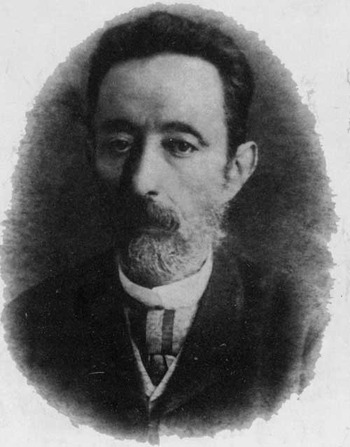
Born in Zakynthos, Pavlos Carrer (1829–1896) began his artistic career immediately following advanced music studies in Milan (the question remains whether he was a former pupil of Mantzaros). From the first three typically Romantic operas he composed in Italy prior to his return to Zakynthos (1857) and his subsequent artistic activity in the broader Greek area (Dante e Bice, 1852, Isabella d’ Aspeno, 1853, La Rediviva, 1854), through his neoclassically inspired Marathon-Salamis (1886), one can follow the musical maturation of a composer who orientated his style from the bel canto models (Donizetti, Bellini) to the late Verdian manner, with the gradual assimilation of certain elements of the French operatic genres (opéra-comique, grand-opéra), including a more sophisticated orchestration. This development, however, was combined with a persistence in coupling ‘patriotic’ themes with folklorism, which characterized the greater part of his middle operatic production: Markos Botzaris (1858), Kyra Frossyni, i mia ekdikissis tou Pasa [Kyra Frossyni, or Pasha's Vengeance] (1868) and Despo, i Irois tou Souliou [Despo, the Heroine of Souli] (1875).
Pavlos Carrer. The National Library of Greece, Athens

At the level of musical technique and poetics, the coupling of historical narrative and local musical references remained within the framework of a typical Orientalism in the mid- to late nineteenth century. Folkloric elements comprised a part of the music drama spectacle, along with the libretto, sets and costumes, and were not incorporated into the musical means of narration, into the musical language, which, in its general form, remained inside the typical tonal idiom of the day. On the other hand, the folkloric musical rhetoric, whenever it participated in the narration of the plot, was integral and complete. Carrer not only employed the interval of the augmented second as a symbol of local folk music tradition, but also extended it to the parameters of harmony, texture and orchestration, so as to craft an evident local colour. In Kyra Frossini, for example, the Ottoman element was symbolized by an outmoded ‘alla turca’ style, whilst developing the Greek element in a sometimes complex way within the above parameters. In Act Two of the opera, the Verdian (in technique and expression) recitative and cavatina of the heroine is presaged by an instrumental preludio, in which the trisemitone clarinet solo transports us in space and time to pre-Revolution Epirus, while the concomitant ‘Eastern’ melody played by instruments in octaves atop a rhythmic open-fifth drone, opens up to us a little window on Ali Pasha's harem. But the poetic idiom itself also participates to various degrees in this complex re-enactment of what was geographically and historically close – the Demotic-like language of the poem ‘O Yero-Dimos’ [‘Old Man Dimos’] by Aristotelis Valaoritis also helping a unique and indirect trisemitone in the setting to music (sixth minor degree, fifth, fourth sharpened, fifth, third minor). All of these come together to create sufficient enough reason for the homonymous song by Carrer – which was later incorporated as an aria in the opera Markos Botzaris – for many decades thereafter to be considered an authentic Demotic melody, which the Zakynthian composer had simply harmonised and orchestrated. As for the short work Despo, the fact that in the manuscript of the score it is described as a ‘One-Act Greek Opera’ is owed (at least as far as the middle characteristic attributed to it is concerned) not so much to its patriotic theme as to its Greek libretto penned by poet Antonios Manoussos. Carrer had knowledge that language remained a basic criterion of indigenousness, and that was why, although the librettos of the first two works in his informal trilogy were in Italian, thus facilitating the staging of these operas by the only available Italian companies, they were also made available in Greek translation. In addition, Despo, which was intended to be presented by the students at the Athens Conservatory as part of their musical education (and quite possibly of the national education of the operatic public), permitted him to complete the coupling, adding the original Greek text to the patriotic theme and to the indigenous folkloric references – perhaps more extensive in this case than in his two previous ‘national’ operas.
Carrer's failure to have Despo included – even temporarily – in the educational repertoire of the only Greek conservatory at the time, besides the probable official reasons, was certainly indicative of the wariness of Greek society concerning a radical – for the age – platform for musical nationalism. The attempt at the formation of a contemporary European state was unbreakably linked to the demand of the recently established Greek bourgeois class – which had been formed, to a significant extent, by repatriated Greeks from abroad – to enjoy the same cultural goods as those enjoyed by the ruling classes of the urban centres of the West, and similar art forms that were being cultivated in Western Europe, without significant divergences. The early (1840) text by Konstantinos Paparrigopoulos, in which opera was argued to be the most perfect art form and whose cultivation in the newly established Greek state was projected as an urgent need,Footnote 15 was directed at an audience that was informed about current affairs in European music. Thus, around that same time, in an educational textbook on poetic grammatology intended to be used by students at the Gymnasium (secondary school) of Hermoupolis in Syros, the conservative pedagogue Georgios Serouios made reference to something well known so as to teach something unknown, writing that ‘Pindar could be considered the Paganini or Rossini or Bellini of his time’.Footnote 16 Three decades later, again in the capital of Syros (which was a cradle of modern Greek industry, shipping and integrated commercial transport at the time), the doctor and amateur musician (flautist and composer) Ioannis Foustanos published in book form some of his reviews that had appeared in the daily press of Hermoupolis, in which, among other things, he discussed topical issues related to musical aesthetics (music and nature, harmony and melody, differences between French and German music, Wagnerism), deeming that he was contributing to the effort to confront the main – as he believed – problem of music in the Greece of that day: the distancing of the public from the repertoire ‘of truly serious music’ and its funneling ‘to the light and ephemeral type [of music]’.Footnote 17 Indeed, it is worth mentioning that for this particular initiative he received ‘heartfelt congratulations’ from Carrer.Footnote 18
Thus, during the half century when the developing society of the newly established Greek state was being channeled towards ‘truly serious music’ – as perceived by the West European culture to which this society had wished to be reconnected from its establishment – the presence or absence of local Greek colour was of minimal interest to the music public. There were, in fact, two reasons why it cautiously faced the sporadic folkloric colourings of the patriotic works of certain Ionians, and especially those of Carrer. The first had to do with the fact that these borrowed elements more generally characterized the musical elements of the East and not those of Greek Demotic song exclusively – this fact is not suppressed by the anonymous Zakynthian music critic of Domeneginis’ Markos Botzaris, when he lauds the composer for ‘[his] inspiration in the pathetique style, which Oriental music always presents as a Greek feature’.Footnote 19 The anonymous critic, who published an extensive review of a performance of the eponymous opera by Carrer that took place in the capital of Syros at the end of 1866,Footnote 20 suggested a second reason for wariness concerning folkloric loans, before also making reference to the disputed Greekness of the loan source. Specifically, he emphasized (a) the incompatibility of the two music systems (of the more popular ‘Oriental’Footnote 21 and the more artistic ‘Occidental’), which at times compelled singers to diverge from what was considered a ‘natural’ vocal rendering of an aria; and, (b) the presence, in the borrowed folkloric material, of foreign (meaning Turkish) musical elements that were incompatible with the ethos of ‘genuine’ Greek popular tradition in both a broader sense and specifically in terms of music. Thus, despite Carrer's example (acceptable, even with reservations), and in spite of the emphasis that had been placed by the first ‘national’ schools in the European periphery outside Greece, the Oriental-style traditional music was kept out of the artistic repertoire; this was irrespective of whether the music being heard in Greek theatres and salons (but also performed by the more popular wind and mandolinata bands) was imported or locally created.
The small temporal distance between the patriotic works by Carrer and the historical events that inspired them did, however, impart an objectively realistic nature to these ‘national’ operas, and this increased with the continuation of the struggle for liberty in areas under Ottoman occupation, such as Crete. This objective realism was supported by the intentional use of ‘national’ music references that operated simultaneously as a realistic musical set and as a powerful psychological tool for the emotional involvement of the listener in the action represented. The staging of Markos Botzaris in Hermoupolis, which provided the anonymous commentator with the opportunity to criticize the popular music admixtures, operated as an inspirational psychodrama for the Cretan refugees, who had just fled their homeland with serious physical and mental wounds, and as an effective means of propaganda for the procurement of local volunteers in the island's struggle. Moreover, it was only natural that this first patriotic opera by Carrer could not be presented in Athens, because the living veterans or the relatives of fighters from 1821 considered that the figure of Markos Botsaris would thus be promoted at the expense of the posthumous fame of the other leaders of the struggle.Footnote 22
In reality, the social and historical identity of the Ionian Islands (which shared a common path with the developments in Western Europe, a more clear-cut social stratification and social conscience and enjoyed a tradition in political and class struggles) helped the related – and occasionally synonymous – European currents of naturalism, realism and social art to appear in the Heptanese as well, and particularly in opera. In the case of Carrer, a ‘realistic’ reading of his patriotic works is most justified, as these artistic trends appear to have influenced his overall operatic creation. Fior di Maria, ovvero I Misteri di Parigi, his ‘serious melodrama’ (‘melodramma serio’, as he referred to it), which was written between August and December 1867, was based on the great realistic (and even socialist, thanks to Marx's references to it) novel by Eugène Sue; on scattered pages of other of his works there are freestanding points with original naturalistic musical imagery, the most characteristic perhaps being the case of the orchestral ‘Eisagogi perigrafiki: to Ximeroma’ [‘Descriptive Introduction: The Dawn’], from Act Three of the opera Marathon–Salamis. Finally, the two forms of programme music (the original imagery and the symbolic use of quotations) were brought in so as to musically illustrate a real story with a projected political character, in a ‘historical tragic melodrama’ (‘melodramma storico-tragico’) that Carrer composed two years after the Paris Commune. Maria Antonietta (1873) brought to the operatic stage the French queen of the same name (a taboo figure for opera until then and for some decades to follow), as well as the three protagonists of the Revolution of 1789 – Danton, Marat and Robespierre – revealing a mood less romantic and more realistic and/or early veristic, which is expressed through the nature and the use of musical symbols. The very extensive Overture, in which the most important (and in this case most symbolic) musical elements of the opera proper are exhibited – in accordance with the model created by the mature Verdi – constitutes an eloquent symphonic poem that has no need for a philological ‘programme’ to tell its tale. The drum solo at the beginning and the funeral march that comes to join it conjure before the very eyes of even the most unsuspecting of listeners the terrible silhouette of the guillotine; the expressive and hurtful theme of the violoncello that follows inescapably enlivens in the imagination a tragic female figure. The slightly varied melody of the Marseillaise, which is introduced unexpectedly, operates as a historical–geographical indicator perhaps more effectively than in Tchaikovsky's 1812 Overture. Finally, the frenzied concluding dance, with its lively rhythm and its inventive orchestration, sweeps a wildly elated crowd, indifferent to the tragic fate of the heroine, onto the already carved-out roads of the musical fresco.
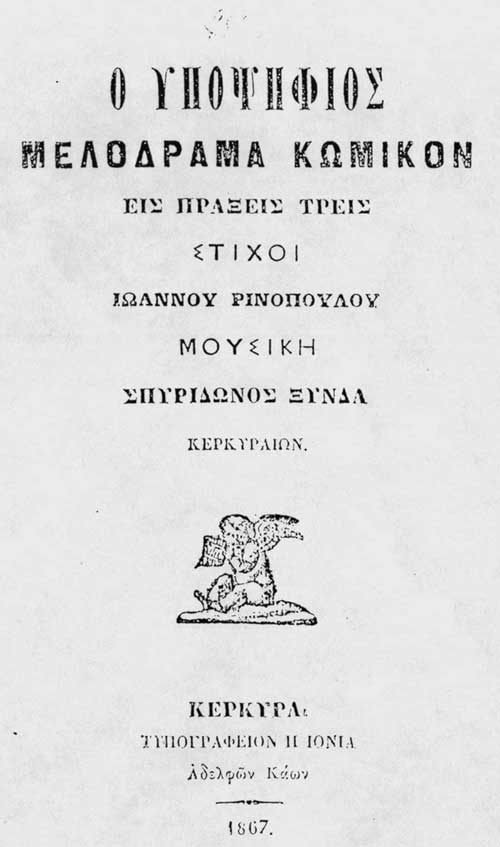
However, the most typically realistic and socially-orientated work – which in fact has elements in places that refer the listener to a verism that is avant la lettre – bears the signature of another Ionian composer and guitarist, a student of Mantzaros, who was born in Kerkyra and died in Athens blind, forgotten and penniless. O Hypopsifios [The Candidate] (1867) by Spyridon Xyndas (1810–1896) quickly surpassed in fame all of his other operas, which have not survived (among them Anna Winter, which was created in 1855 with Xyndas giving operatic form to the Dumas story The Three Musketeers).
The frontispiece of Spyridon Xyndas' 1867 opera, O Hypopsifios [The Parliamentary Candidate]. Corfu Reading Society

This reputation is owed mainly to the fact that this was the first complete Greek opera with a libretto originally written in Greek (and, indeed, using Demotic language) and the first to be performed by Greek singers and orchestral musicians. However, in the main it is a naturalistic depiction of the Greek society and political reality of the day, situated in the microcosm of the Heptanese periphery; that is, it shows the intensification of the agrarian problem, the further evolution of radicalism into a movement of social contest, the establishment of the phenomenon of petty political corruption and clientele relationships between voters and their parliamentary representatives. The use of elements of the Ionian linguistic idiom in a satirical libretto, flowered with social messages, the musical excerpts from local Heptanesian or Epirotic melodic elements (it is worth noting – in the case of the second – the use of the interval of the augmented second) or rhythms and the use of original or simulated instrumental combinations (zournas and tambour or oboe and bass-drum), representative of the popular outdoors, all elevated Hypopsifios to the status of a true veristic opera, prior to the conventional crystallization of the genre. The work may be considered a first and original example of socialist opera, in which verses like the following are heard for the first time in a European opera house:
Till when will we the desolate
be derelicts, tormented.
Till when will we labour
and remain hungry.Footnote 23
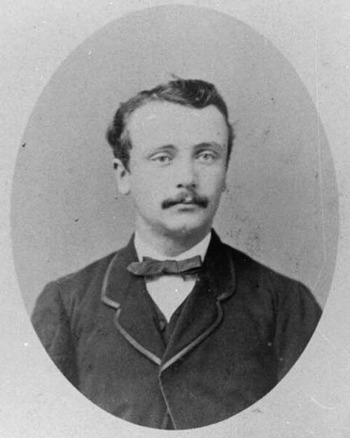
Entirely different was the contribution to Greek musical realism of a younger Heptanesian. It is to the Ithacan composer Dionysios Rodotheatos (1842–1892) that we owe three works of descriptive music (the Rhapsodie: Idée Allégorique and the symphonic poems Lo Cid and Atalia), which comprise the earliest surviving Greek compositions of purely symphonic music, dating to approximately the early 1870s, a time when this genre was rare in Italy, the country where the composer had studied. Mantzaros’ lost Sinfonia alla tedesca (1830), which, according to Domenicos Padovan (1817–1892) ‘did not fall short of the famous Beethoven symphonies on any terms’Footnote 24 was likely used by the composer as an introduction to his symphonic work Te Deum, while Padovan's surviving Sinfonie, probably dating to the 1830s, follow the form and the style of one-part operatic overtures, like the one Padovan composed for his overtly Italian-style opera Dirce, figlia di Aristodemo, from 1857. An undated Symphony by Tzannis-Metaxas also belongs to the same stylistic and formal category; its clearly newer manuscript of the score for wind instruments provides internal indications that the original work must have been a sinfonia for orchestra.
The only known photograph of Dionysios Rodotheatos. General State Archives-Archives of Corfu

With Rodotheatos’ symphonic works we enter a new era. Besides the usual musically descriptive means – which he handles with exceptional ingenuity and effectiveness (for example in the depiction of the battle in the third part of Lo Cid) the composer has recourse to the systematic use of ‘leading motifs,’ which, in one of his manuscripts, he enumerates at the beginning of the score, in a kind of index. The French title of his Rhapsody and the French writers Corneille and Racine, from whom he had gained the inspiration for Lo Cid and Atalia respectively, could lead us to the justifiable assumption that the model for the characterizing motifs of the Ithacan composer was the idée fixe by Berlioz and not Wagner's leitmotif, had his interest in Wagnerism not been declared by the composer himself.Footnote 25 It is likely that this interest began from the time of his studies in Milan (following his earlier studies in Naples), where there were open channels of musical information and influences with the German-speaking countries. It is, however, a fact that the music and ideas of Wagner had constituted a continuously expanding theoretical discussion in Greece (at least in Kerkyra, Hermoupolis and Athens), as early as the start of the 1870s, which is also the same time, as already noted, that Rodotheatos’ symphonic poems have been dated to. However, these same works have no evident Wagnerian influences in melody, harmony or orchestration. It is likely that these were eclectic compositions, in which the initial Italian underlying layer (apparent mainly in the melody) fuses, in an organic manner, elements of French and broader German music Romanticism, leading to a style both unified and personal.
The truth is that German music was late to permeate the Greek stage and to influence Greek composers. Though sporadic elements of such an influence are met as far back as in Mantzaros the pluralist, Alexandros Katakouzinos (whose name was mentioned earlier, next to the names of the composers/educators Digenis and Parisini) must be regarded as the first exponent of a German style in Greece. Following his basic music education in Athens, he had continued his studies in Vienna and, perhaps, in Paris in the intervening period. After living in the then Russian city of Odessa – a city with a large Greek community and rich musical activity – for nine years, he returned to Greece in 1871, where he assumed – among other things – the artistic direction of the Athens Conservatory. In the surviving Overture of the opera Aretusa di Atene (the rest of the work, as well as two more operas that he appears to have composed, have not been found) influences from the works of Mozart and Schubert are evident, so that in the year of the staging of the work in Odessa (1861), which was also likely the year of its composition, Aretusa appeared already quite outmoded. A poem by Katakouzinos (‘Hymnos eis ton Theon’ [‘Hymn to God’]) was set to music by Macedonian composer Dimitrios Lalas (1844–1911), who was 20 years his junior and had studied in Munich prior to becoming a student (probably) and collaborator of Wagner.Footnote 26 In 1877, Lalas left Germany and, following a brief stay in his place of birth and in Constantinople, settled in Turkish-held Thessaloniki, where he taught music for the three decades that followed, until his death. His manuscripts were lost during World War One, along with the vessel that had been transporting them from Thessaloniki to Italy, where they were to be published. The expected Wagnerian influences, as well as some elements that make reference to late Mahler, are easily detected in his 12 surviving choral songs, which could have come to represent the most typical Greek Romantic music of the nineteenth century had there not existed the works of the last – chronologically-speaking – German-trained composer, Dimitrios Lialios (1869–1940). This Patran composer also studied in Munich, where, in the main, he practised his music career. Among his 130-plus works, one meets, for the first time in the history of Greek music, typical forms of chamber music. At the opposite end, his extensive symphonic compositions (which at times exceed one hour in duration) include rhapsodies, symphonic poems, symphonic songs – but no symphonies or concertos. The genre, the size and the quality of his works deserve a much more extensive and analytical reference, but the majority of these exceed (both stylistically and typologically) the timeframe of the present study, crossing over the threshold of the twentieth century, a century in which Greek composers would turn from opera to absolute musical genres which spoke the German musical dialect with greater faculty and eloquence.
Substantially and chronologically, the last important Greek composer of the nineteenth century was the first significant graduate of the Athens Conservatory – the Corfiot Spyridon Filiskos Samaras (1861–1917). He represents, first and foremost, the final synthesis of the realistic elements that have been discerned, with selective references to Xyndas, Carrer and Rodotheatos; that is, realism of plot and its narration, use of descriptive musical techniques and symbolic citations, and application of leading motifs to symbolize characters. Having continued his studies in Paris with Delibes, Samaras was able to assimilate significant elements of French music – particularly Bizet and Massenet – and transfuse them with the late post-Verdian style of Italy, which he aimed towards so as to gain reputation. This combination of the two separate traditions also comprises the basic contribution of the Greek composer to the shaping of Italian verism, a contribution that materialized particularly through operas based upon a realistic (in the broadest sense) libretto. These were, in the main, La Martire (1894),Footnote 27 which was viewed as provocative and at whose heading the composer placed an excerpt from Zola (‘La vie, la vie toujours et partout, même dans l'indéfini du chant’),Footnote 28 and, to a lesser extent, Flora Mirabilis (1886) and Lionella (1891). However, Samaras attempted in Rhea (1908) an integral synthesis of naturalistic, realistic and symbolic references to extra-musical images, situations and figures. This is an opera whose libretto is found in diametric opposition to verism, as it attempts to re-mould an imaginary Greek space–time (Latin-held Chios of the 1400s, in which supposedly the revived Olympic Games are being held) that plays host to a story of amorous passion and jealousy recalling the operas Tristan und Isolde, Otello and Pelléas et Mélisande. In Samaras’ work, the Greek athlete Lysias, who defeats his Saracen opponent in a marble stadium and is applauded by a multinational public, is in love with Rhea, the spouse of the Genoan governor. The Venetian brigadier Guarcha, who is also in love with her, persuades the governor to marry his daughter to Lysias and threatens Rhea that he will expose her if she does not succumb to his proposals. Lysias decides to abandon the island and Rhea prepares to follow him. Their plan collapses, however, because Guarcha suddenly appears and fatally stabs Lysias, while Rhea dies after inhaling the poison she has in her ring, a gift too from Guarcha.
Aside from the musical depicting of night and dawn in the third act, Samaras employs a fixed leading motif to recall Guarcha, while for Lysias he uses modal scales that make reference to his Greek origin. One must add to these depictive means musical excerpts such as the Olympiakos Hymnos [Olympic Anthem] that he composed for the first modern Olympic Games (in Athens in 1896), which is heard in its entirety in orchestral form in the Overture to the opera and in excerpts in the main part, as well as four Greek Demotic melodies. The incorporation of this folkloric material is facilitated by the general modality of the work and through the presence of innovative features (whole-tone scale, sporadic traces of bitonality). The symbolism of the excerpts is evident: The Olympiakos Hymnos accompanies the transport of the revival of the Olympic Games to medieval Chios, while the Demotic songs are directly connected to what takes place, mentally commenting upon it through the verses that these songs had in their original vocal form. The question that is raised, however, concerns the musical necessity of such loans of disputable effectiveness; how could, then, a foreign audience perceive the relationship between an unknown melody, without words, with the related points of action? And were the Greeks familiar with the missing verses of the excerpts? The answer lies in the changes that appeared from the time of the substantial decline of folklorism at the end of the 1870s until its rebounding with clearer Herderian characteristics at the start of the twentieth century.
The social and ideological ‘upgrading’ of Demotic song and the recognition of its potential usefulness for the creation of a musical idiom with more apparent ‘national’ characteristics was slow in coming and was realised thanks to the restoration of an integrated narrative of the Greek historical past; the ‘ideology of continuation’ argued that the two traditional types of music that were cultivated in Greece – the music of the Eastern Orthodox Church and Demotic song – preserved ‘genetic’ features of ancient Greek music, and the growing current of antiquity-worshipping that became stronger around the end of the nineteenth century resorted to these two types as an attempt to revive the glorious – but lost – musical past. Thus, at the same time as when Carrer was composing his neoclassical swansong Marathon–Salamis, which was relieved of almost any trace of folkloric reminders, two minor musicians were composing music for the meticulous theatrical revival of ancient tragedies, presented according to the ancient Greek model: Ioannis Sakellaridis (1853–1938), a student of ecclesiastical music and creator of a European-style harmonized version of traditional chants, and Georgios Pachtikos (1869–1916), a collector of Demotic melodies and a writer advocating the historical relationship between these melodies and the music of classical antiquity.Footnote 29 These artistically mediocre attempts stood one step before the appearance of a second wave of musical nationalism, of a Herderian-type ‘national school’. The realization of this step would have to await the disastrous Greco-Turkish War of 1897 and the introversion which would lead to an explicably – and for some more chauvinist – nationalism of the early twentieth century.
In this new cultural setting, two Ionian composers assumed the task of responding to the demands of the times: The Corfiot Georgios Lambelet (1875–1945), the scion of a large family of musicians, who in 1901 published an extensive article on the creation of a ‘national’ music based entirely on the folk musical tradition (melodies, scales, rhythms),Footnote 30 while the Kefalonian Dionysios Lavrangas (1860–1941) attempted to apply these principles to a symphonic work he entitled Proti Elliniki Souita [First Greek Suite] (1903). Finally, in the same year as the first performance of Samaras’ ‘Greek’ opera Rhea, Manolis Kalomiris (1883–1962) temporarily returned from Kharkhov in Russia in order to present a concert of his compositions, thus preluding his future activity as head of the so-called Elliniki Ethniki Scholi [Greek National School] in music.Footnote 31 His definitive repatriation in 1910 marked the beginning of a new era in the history of Greek music, but, at the same time inaugurated in a quasi-conscious and systematic devaluation of what had happened in all aspects of Greek musical life up to 1900.