Introduction
Insomnia, commonly defined as a persistent difficulty initiating or maintaining sleep, is the most prevalent sleep problem among older adults and increases substantially with age (Ancoli-Israel and Ayalon, Reference Ancoli-Israel and Ayalon2006). There is a strong relationship between insomnia and depression, with higher levels of insomnia being associated with greater depression severity (Manber and Chambers, Reference Manber and Chambers2009). Historically, insomnia was believed to have been primarily a symptom or natural consequence of depression (McCall et al., Reference McCall, Reboussin and Cohen2000). Recent data, however, demonstrate that insomnia often precedes the onset of depression among older adults (Perlis et al., Reference Perlis2006). Although an increased level of insomnia has been found to predict depression severity, the psychological mechanisms underlying this relationship are unclear and require further exploration. Two psychological variables that may influence the pathway from insomnia to depression are dysfunctional beliefs about sleep and hopelessness. The term psychological in this context represents an older adult's thoughts, attitudes, and beliefs about sleep and hopelessness (Beck and Steer, Reference Beck and Steer1988; Morin, Reference Morin1993).
Cognitive conceptualizations of insomnia suggest that older adults with higher levels of insomnia often experience a stronger endorsement of dysfunctional beliefs about sleep (e.g. Morin, Reference Morin1993; Ellis et al., Reference Ellis, Hampson and Cropley2007). Harvey (Reference Harvey2002) in her cognitive model of insomnia proposed that individuals who have higher levels of insomnia tend to be preoccupied about their sleep and about the daytime consequences of not getting enough sleep. This excessive negatively toned cognitive activity activates both autonomic arousal and emotional distress. Cognitive arousal triggers selective attention and monitoring of internal and external sleep-related threat cues. These processes can mislead the individual into overestimating the extent of the perceived sleep deficit, and individuals with persistent difficulties initiating or maintaining sleep develop rigidly held dysfunctional beliefs about sleep (Harvey, Reference Harvey2002). Although Harvey's research suggests that insomnia severity influences beliefs about sleep, more research is required to explore whether higher levels of insomnia predict inflexible sleep beliefs among older adults.
An important psychological construct emerges from the Harvey (Reference Harvey2002) cognitive model of insomnia that could enhance the understanding of how unhelpful sleep-related cognitions relate to depression. This construct involves the concept of hopelessness. Individuals who possess a high sense of hopelessness believe that they cannot control circumstances in their lives and tend to experience a pervasive negative bias about the future (Beck and Steer, Reference Beck and Steer1988). The concept of hopelessness is central to older adults who experience rigidly held dysfunctional beliefs about sleep. The relationship between insomnia, unhelpful sleep beliefs, and hopelessness was first investigated by Morin et al. (Reference Morin, Stone, Trinkle, Mercer and Remsberg1993). Results of Morin et al. showed that older adults with insomnia endorsed stronger beliefs about the negative consequences of insomnia, expressed more hopelessness about the fear of losing control of their sleep, and experienced more helplessness about its unpredictability compared with participants without insomnia. Surprisingly, few studies have expanded upon the Morin et al. finding to investigate whether dysfunctional beliefs about sleep predict hopelessness among older adults. While the Harvey (Reference Harvey2002) cognitive conceptualization of insomnia did not explicitly discuss this relationship, it becomes evident from the cognitive model how older people with insomnia problems could develop a sense of hopelessness via strongly held dysfunctional beliefs about sleep.
Several examples can be drawn from the research of Morin et al. (Reference Morin, Stone, Trinkle, Mercer and Remsberg1993) and Harvey (Reference Harvey2002) that demonstrates how hopelessness could result from strongly held sleep-related beliefs. For instance, older people with higher levels of insomnia who selectively attend and intensely monitor their environment are likely to increase the chance of detecting ambiguous cues (e.g. getting up during the night to go to the toilet) that can then be misinterpreted (e.g. “I mustn't have slept well last night”), leading to misperception of other daytime events (e.g. “I won't be able to cope today”). The unhelpful interpretation of seemingly minor events could occur numerous times during the day and night. Consequently, unpleasant experiences are likely to build up over time because the dysfunctional beliefs remain unchanged or disproved, which could possibly contribute toward an increased sense of hopelessness.
The Harvey (Reference Harvey2002) cognitive model of insomnia was heavily influenced by Beck's cognitive theory of depression (e.g. Beck, Reference Beck1976). Beck's theory illustrates how hopelessness could further mediate the relationship between unhelpful sleep beliefs and depression. Beck proposed that individuals who experience intense negative thoughts (e.g. “I can't fall sleep”) are likely to develop an increased sense of hopelessness, which in turn predicts higher levels of depression. More recent hopelessness theories of depression (e.g. Beck et al., Reference Beck, Weissman, Lester and Trexler1974; Abramson et al., Reference Abramson, Metalsky and Alloy1989) that have built on Beck's research suggest that a pessimistic explanatory style (sense of hopelessness) should be predictive of depressive symptoms over time, and should mediate the relationship between negative cognitions and depression. The relationships between negative cognitions, hopelessness, and depression have strong theoretical support and evidence has shown that individuals with negative cognitive styles are vulnerable to developing increased hopelessness, and increased levels of hopelessness heighten the risk of future depression (e.g. Beck et al., Reference Beck, Weissman, Lester and Trexler1974; Alloy et al., Reference Alloy, Abramson, Whitehouse, Hogan, Panzarella and Rose2006). Although cognitive-based theories of depression provide a theoretical structure that helps explain how rigidly held dysfunctional beliefs about sleep could predict greater depression severity via increased levels of hopelessness, research needs to be conducted to empirically validate this pathway.
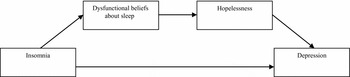
To date, no study has investigated how insomnia influences depression among older adults from a psychological perspective. The first aim of the current study was, therefore, to test a model that explored whether dysfunctional beliefs about sleep and hopelessness mediated the relationship between insomnia and depression. As shown in Figure 1, it was hypothesized that insomnia would predict depression, both directly and indirectly, via dysfunctional beliefs about sleep and hopelessness.
Hypothesized path model.

A second aim of the study was to explore whether the hypothesized path model was invariant according to whether or not participants were likely to have obstructive sleep apnea (OSA) and/or restless legs syndrome (RLS). OSA and RLS were chosen as the comorbid sleep conditions ahead of other sleep problems for two reasons. First, OSA and RLS commonly co-occur with insomnia among older adults (Edinger, Reference Edinger2003; Smith et al., Reference Smith, Sullivan, Hopkins and Douglas2004), and second, individuals with OSA and RLS have been found to exhibit greater levels of insomnia, dysfunctional beliefs about sleep, and depression compared with individuals without these conditions (Edinger, Reference Edinger2003; Smith et al., Reference Smith, Sullivan, Hopkins and Douglas2004). Theoretical models (e.g. Beck, Reference Beck1976; Abramson et al., Reference Abramson, Metalsky and Alloy1989) also acknowledge that individuals with more complex problems (e.g. comorbid conditions) are at a greater risk of interpreting situations from an unhelpful perspective, which could consequently increase their chance of developing an increased sense of hopelessness. Since the majority of older adults are often excluded from insomnia-based studies due to having a comorbid sleep disorder (Stepanski and Rybarczyk, Reference Stepanski and Rybarczyk2006), the results from this analysis will add valuable knowledge to the comorbid insomnia field.
Methods
Participants
The initial sample consisted of 218 Australian older adults aged between 65 and 96 years (M = 74.22, SD = 7.61), including 115 females (53%) and 103 males (47%). A total of 171 participants completed a measure of depression three months after the completion of the initial questionnaire package. These participants comprised the final sample. The final sample was also aged between 65 and 96 years (M = 73.94, SD = 7.78), and included 90 females (53%) and 81 males (47%). Participants were recruited from retirement villages throughout Victoria, Australia. Participants were not recruited from nursing homes. Retirement villages are estates built for retired older adults who live independently in their own home. Most people who live in retirement villages are fully functioning citizens who require little to no assistance with daily living. Since the participants were able to complete the questionnaire and function independently within their own homes, it was assumed that the participants’ cognitive abilities were intact. In addition, no exclusion criteria were utilized in the study to increase the chance of obtaining a more accurate representation of the older adult community.
Materials
Demographic information for age, gender, relationship status, education level, sleep/mental disorder status, sleep/mood medication use, and physical health was collected. Physical health was explored with two items: “Please circle your current level of physical health: Very Poor, Poor, Average, Good, Very Good” and “Do you have any chronic medical conditions? Please circle Yes or No.” Participants were also asked “Have you been diagnosed with a sleep disorder by a doctor?” and “Have you been diagnosed with a mental health problem by a doctor?” Participants were finally asked about their medication use, “Are you taking medication that influences your sleep and/or mood? Please circle Yes or No.”
The Insomnia Severity Index (ISI; Morin, Reference Morin1993; Bastien et al., Reference Bastien, Vallieres and Morin2001) is a self-report instrument measuring the participant's perception of his or her level of insomnia. The ISI assesses the subjective symptoms and consequences of insomnia, as well as the degree of concerns or distress caused by those difficulties during the previous two weeks. Its content corresponds in part to the diagnostic criteria of primary insomnia (American Psychiatric Association [APA], 2000). The ISI comprises seven items assessing the severity of sleep onset and sleep maintenance difficulties (both nocturnal and early morning awakenings); satisfaction with current sleep pattern; interference with daily functioning; ability to notice the level of sleep impairment; and degree of distress or concern caused by the sleep problem. Each item is rated on a five-point scale (0 = none, to 4 = very). Total scores range from 0 to 28, with higher scores representing more severe levels of insomnia. The ISI was found to be a reliable measure of insomnia severity in the current sample (Cronbach's α = 0.91).
The Dysfunctional Beliefs and Attitudes About Sleep 10-Item Scale (DBAS-10; Espie et al., Reference Espie, Inglis, Harvey and Tessier2000) was administered to assess maladaptive thoughts, attitudes, attributions, and beliefs about sleep (e.g. “I must get eight hours of sleep to feel refreshed and function well during the day”). Espie et al. redeveloped this measure into a shorter version of 10 items from the original 30-item DBAS scale of Morin (Reference Morin1993). Participants completed each question using a 10-cm visual analog scale, anchored with strongly disagree and strongly agree. Added together, the 10 item responses provide the final DBAS score. Total scores range from 0 to 100, with higher scores representing more rigid or stronger levels of dysfunctional beliefs and attitudes about sleep. The DBAS-10 was found to be a reliable measure of dysfunctional beliefs about sleep in the current sample (Cronbach's α = 0.88).
The Beck Hopelessness Scale (BHS; Beck et al., Reference Beck, Weissman, Lester and Trexler1974) is a self-report instrument which entails 20 true–false statements designed to assess the degree to which an individual holds negative beliefs about the future over the previous week. Each of the 20 statements scored 0 or 1 with the total being calculated by summing the pessimistic responses for the 20 items. For example, a participant that answers “True” to the following question, “My future seems dark to me,” would score 1 point and represent a pessimistic response. The total BHS score ranges from 0 to 20, with higher scores reflecting higher levels of hopelessness. The BHS was found to be a reliable measure of hopelessness in the current sample (Cronbach's α = 0.79).
The Snoring Tiredness Observed Pressure Scale (STOP; Chung et al., Reference Chung2008) is a recently developed self-report tool used to screen for OSA. It contains four yes/no items that help distinguish between people that are at high risk of OSA, and people that are at low risk of OSA. Each question relates to a major symptom of OSA. For example, the first item of the measure assesses snoring, “Do you snore loudly (louder than talking or loud enough to be heard through closed doors)?” Participants that answer “Yes” to two or more items are considered to be at high risk of OSA, and participants that answer “Yes” to less than two items are considered to be at low risk of OSA. When compared with polysomnogram diagnostic analysis, the STOP scale was considered a sound screening tool for predicting the likelihood of OSA (Chung et al., Reference Chung2008). The STOP scale was found to be a reliable measure of OSA likelihood in the current sample (Cronbach's α = 0.73).
The Restless Legs Syndrome Questionnaire (RLSQ; Allen and Earley, Reference Allen and Earley2001) is a brief four-item self-report measure of RLS. The RLSQ helps differentiate between participants that are more likely to have RLS compared with participants who are less likely to have RLS. Those who answer “Yes” to all of the following four items are likely to fulfill the diagnostic criteria for RLS as set by the International RLS Study Group (Walters, Reference Walters1995). For example, the first item of the measure assesses leg discomfort, “I experience a desire to move my legs, which is usually associated by discomfort or disagreeable leg sensations.” Participants who answer “Yes” to all four items are considered to be likely to have RLS and participants who do not answer “Yes” to all four items are considered less likely to meet the criteria for RLS. The RLSQ has been found to be a reliable and valid screening tool of RLS (Allen and Earley, Reference Allen and Earley2001). The RLSQ was found to be a reliable measure of RLS likelihood in the current sample (Cronbach's α = 0.91).
The Centre for Epidemiologic Studies Depression Scale (CESD; Radloff, Reference Radloff1977) is a 20-item self-report questionnaire used to assess depression during the previous week (e.g. “I felt lonely”). Participants responded to each item using a four-point scale, where 0 = rarely or none of the time (less than one day), to 3 = most or all of the time (5–7 days). When collating the responses, four items are reverse scored. In this study, item 11 “My sleep was restless” was omitted to reduce the chance of item overlap with other sleep measures. The CESD was found to be a reliable measure of depression severity in the current sample (Cronbach's α = 0.90).
Procedure
Approval to conduct the study was granted by the University of Ballarat Human Research Ethics Committee. Face to face recruitment was carried out by attending community group meetings within the retirement villages. Potential participants were informed that completing the questionnaire would help improve the understanding of sleep and mood among older adults, and were provided with a written statement detailing the research. Participants completed the self-report questionnaire package, which included the ISI, DBAS-10, BHS, STOP, and RLSQ. The questionnaire package had been counterbalanced into 20 different versions prior to distribution to control for order effects. At completing the questionnaire package, participants were asked if they were willing to complete a measure of mood three months later. Participants who chose to participate in the follow-up study were mailed out a second written information document, the depression measure (CESD), and a reply-paid self-addressed envelope to post back the CESD to the Principal Researcher. A measure of depression three months after the initial questionnaire was collected to provide a longitudinal element to the data analysis.
Three hundred questionnaire packages were dispersed of which 218 were returned fully completed, a response rate of 73%. Of the 218 participants that completed the first questionnaire, 171 returned the measure of depression, a follow-up response rate of 78%. Participation in the study was voluntary and informed consent was given by participants reading the consent document and then indicating their consent to participate by returning the completed questionnaire. Participants were not reminded to complete the questionnaire and they did not receive any rewards or compensation for participating in the study.
Data analyses
Data obtained from the questionnaire packages were entered using SPSS for Windows Version 17. The data were screened to ensure that statistical analyses could be completed (Tabachnick and Fidell, Reference Tabachnick and Fidell2001). Means and standard deviations were calculated for ISI, DBAS, BHS, and CESD, and correlations between measures were conducted. No multicollinearity was found between measures. The path model was tested using Mplus Version 5.1 (Muthén and Muthén, Reference Muthén and Muthén2007). The path analysis used the maximum likelihood estimation method with the variance – covariance matrix. This method of estimation employs maximum likelihood parameter estimates with standard errors and a mean-adjusted χ2 test statistic that are robust to non-normality (Yuan and Bentler, Reference Yuan, Bentler, Sobel and Becker2000). The current study evaluated model fit using χ2, root mean square error of approximation (RMSEA), standardized root mean square residual (SRMR), comparative fit index (CFI), and Tucker Lewis index (TLI) values (Hu and Bentler, Reference Hu and Bentler1998). The invariance of the path model was explored among participants who were likely and unlikely to have OSA and/or RLS using the statistical method recommended by Byrne (Reference Byrne1998). The data analyzed for this study were not part of a larger research project.
Results
Demographic information
Most participants were married (58%) and had completed secondary school (56%). The majority of participants reported having good (35%) or average physical health (35%), and approximately half of the sample reported having a chronic medical condition (48%). Eighteen percent reported that they had been diagnosed with a sleep disorder, and 12% reported that they had been diagnosed with a mental disorder. Forty percent indicated they were taking medication that could have influenced their sleep and/or mood. Almost two-thirds of the sample (60%) wanted to improve their sleep, and 39% of participants wanted to improve their mood.
Comparison between completers and non-completers of the depression measure
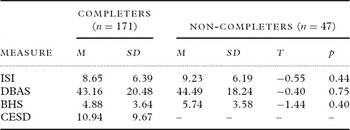
Of the initial sample that completed the questionnaire package (N = 218), 47 participants did not complete the measure of depression three months later, which left a final sample of 171 participants. An Independent Samples t-Test demonstrated that the mean age was not significantly different between each group, t (216) = −1.05, p = 0.27. In addition, χ2 tests indicated that there were no significant differences for demographic variables between completers and non-completers. As shown in Table 1, mean scores on measures did not significantly differ for participants who completed the measure of depression from participants who did not complete the measure of depression.
Descriptive information of measures for participants who completed the measure of depression and for participants who did not complete the measure of depression

Note: ISI = Insomnia Severity Index; DBAS = Dysfunctional Beliefs and Attitudes About Sleep Scale; BHS = Beck Hopelessness Scale; CESD = The Centre for Epidemiologic Studies Depression Scale.
Correlations
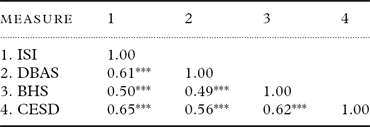
Correlation analyses were conducted to investigate the relationships between variables. As shown in Table 2, higher levels of insomnia were related to more rigid sleep beliefs and greater levels of hopelessness and depression. Stronger levels of dysfunctional beliefs about sleep were associated with high levels of hopelessness and depression. Finally, a higher sense of hopelessness was related to greater depression severity.
Correlation matrix of the final sample (N = 171)
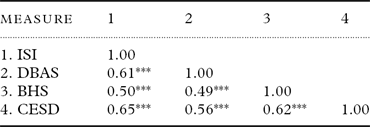
Note: ISI = Insomnia Severity Index; DBAS = Dysfunctional Beliefs and Attitudes About Sleep Scale; BHS = Beck Hopelessness Scale; CESD = The Centre for Epidemiologic Studies Depression Scale.
***p < 0.001.
Path analysis
For participants who completed the measure of depression, fit indices for the hypothesized path model were as follows: χ2 (2) = 20.97, p = 0.01, CFI = 0.93, TLI = 0.79, SRMR = 0.07, RMSEA = 0.23, RMSEA 90% CI = 0.15–0.33. The CFI and SRMR indices indicated an acceptable fit, however, the χ2, TLI, and RMSEA indices indicated a poor fit. Overall, fit indices for the hypothesized model indicated that the model was a poor fit.
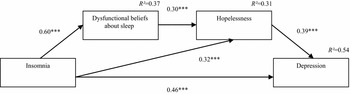
As recommended by the modification indices, a direct path from insomnia to hopelessness was added to the model. The fit indices of the revised path model, as depicted in Figure 2, were as follows: χ2 (1) = 5.91, p = 0.02, CFI = 0.98, TLI = 0.90, SRMR = 0.02, RMSEA = 0.16, and RMSEA 90% CI = 0.05–0.30. Four out of the five fit indices indicated that the revised path model was a very good fit. Although the RMSEA was considered a poor fit, RMSEA is less preferable to assess the model fit in studies with sample sizes below 250 (Hu and Bentler, Reference Hu and Bentler1998). No further modification indices were recommended and this model was accepted as the final model. Figure 2 demonstrates the standardized path estimates for the revised path model.
Revised path model. ***p < 0.001.

Path analysis allows the examination of both the direct and indirect effects within the model (Baron and Kenny, Reference Baron and Kenny1986). Direct effects were represented by single straight arrows from one variable to another. As shown in Figure 2, all paths within the model were significant. There was a significant direct effect of insomnia on depression. Results indicated that there was partial mediation, as the indirect path from insomnia to depression via dysfunctional beliefs about sleep and hopelessness was significant, r = 0.09, p = 0.01. In addition, the indirect path from insomnia to depression via hopelessness was significant, r = 0.13, p = 0.01. The revised path model represents a partially mediated model.
Testing the revised path model for invariance
Participants were divided into two groups based on the scoring criteria suggested by the STOP (Chung et al., Reference Chung2008) and RLSQ (Allen and Earley, Reference Allen and Earley2001) scales. Of the 171 participants that completed the measure of depression, 87 were likely or at high risk of having OSA and/or RLS, and 84 were unlikely or at low risk of having OSA and/or RLS.
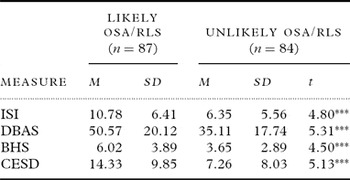
The means and standard deviations for measures of participants who were likely and unlikely to have OSA and/or RLS who completed the depression measure are shown in Table 3. As shown in Table 3, the mean scores of each measure were significantly higher for participants who were likely to have OSA and/or RLS compared with participants who were unlikely to have OSA and/or RLS.
Descriptive information for participants who were likely and unlikely to have OSA and/or RLS on all measures

Note: ISI = Insomnia Severity Index; DBAS = Dysfunctional Beliefs and Attitudes About Sleep Scale; BHS = Beck Hopelessness Scale; CESD = The Centre for Epidemiologic Studies Depression Scale.
***p < 0.001.
Table 4 shows the test for invariance between the likely OSA/RLS group and the unlikely OSA/RLS group. As shown in Table 4, there was no significant difference between the χ2 values for the two groups when all paths were constrained to be equal. This indicates that the model was non-invariant for likelihood of having a comorbid sleep disorder.
Tests for invariance between the likely OSA/RLS group and the unlikely OSA/RLS group

Discussion
The primary purpose of the current study was to test a psychological path model that explored whether dysfunctional beliefs about sleep and hopelessness mediated the relationship between insomnia and depression among older adults. It was hypothesized that insomnia would predict depression, both directly and indirectly, via dysfunctional beliefs about sleep and hopelessness. The results of the first path analysis indicated an overall poor model fit. Consequently, a revised model, which included one additional direct path from insomnia to hopelessness, was tested. Results indicated an excellent model fit, with all paths in the model being significant. The model was considered a partial mediation model, as the relationship between insomnia and depression remained significant after the inclusion of the mediating variables.
Consistent with previous research and theory (Beck, Reference Beck1976; Morin et al., Reference Morin, Stone, Trinkle, Mercer and Remsberg1993; Harvey, Reference Harvey2002), the path model demonstrated an indirect pathway between insomnia and depression via dysfunctional beliefs about sleep and hopelessness. This means that older adults with higher levels of insomnia were more likely to endorse strongly held maladaptive sleep cognitions, such as “I have no control over my ability to sleep.” The model indicated that having higher levels of insomnia and endorsing more rigid maladaptive sleep beliefs predicted an increased sense of hopelessness. Greater levels of hopelessness were, in turn, associated with more depressive symptoms.
The path model has practical implications for both medical and psychological professionals who work with older adults. Educating healthcare practitioners about the psychological pathway from insomnia to depression could enhance the assessment and understanding of these common co-occurring conditions. This increased knowledge, for instance, could translate into general practitioners conducting more vigorous sleep assessments with their older patients. If persistent insomnia problems became evident, general practitioners could refer to a psychologist or sleep physician, since these older adults likely present a greater risk of developing depression partly due to unhelpful sleep beliefs and increased sense of hopelessness. The path model could also inform healthcare providers’ (e.g. psychologists) explanation of the psychological pathway from insomnia to depression to older adults. This formulation would assist adults presenting with higher levels of insomnia gain insight into how their thinking processes influence their mood.
The analysis involving the comorbid sleep conditions adds new knowledge to the comorbid insomnia literature. It was found that there was no significant difference in model fit between older adults who were likely to have OSA and/or RLS and older adults who were unlikely to have OSA and/or RLS. Furthermore, results showed that despite participants who were likely to have OSA/RLS reporting higher levels of insomnia, dysfunctional beliefs about sleep, hopelessness, and depression compared with participants who were unlikely to have OSA/RLS, the relationships between variables were the same for both groups. Therefore, the path model was applicable to all participants, regardless of their likelihood of having a comorbid sleep disorder.
There has been little research that has investigated why older adults with comorbid sleep conditions experience more problems with insomnia, dysfunctional sleep cognitions, hopelessness, and depression. One possible explanation could surface from cognitive theories of hopelessness and depression (e.g. Beck, Reference Beck1976; Abramson et al., Reference Abramson, Metalsky and Alloy1989), which propose that individuals with more complex problems have increased opportunities of interpreting situations from a negative perspective, thereby increasing their risk of sleep and mood disturbance. The findings of Smith et al. (Reference Smith, Sullivan, Hopkins and Douglas2004) also suggested that the combination of OSA and insomnia increases daytime tiredness and consequently could make these people more vulnerable at developing maladaptive sleep beliefs and a sense of hopelessness. Future research is clearly required to explore why individuals with comorbid sleep disorders report more problems with insomnia, sleep beliefs, hopelessness, and depression.
The path model provided a framework that future studies can build from to continue improving the understanding of how insomnia influences depression. For instance, people with insomnia often undertake certain behaviors (e.g. napping, alcohol use, withdrawing from activities) that unintentionally exacerbate their sleep problems (Harvey, Reference Harvey2002). As a result, including a behavioral sleep element to the path model may provide more information about how insomnia relates to depression. In addition, older adults often experience more physical health problems compared with younger adults (Crimmins, Reference Crimmins2004), and studies report that increased levels of insomnia were related to poorer health (Taylor et al., Reference Taylor, Lichstein and Durrence2003). Consequently, incorporating a physical health component could make the model more specific to an older adult population. Finally, it has recently been proposed that the relationship between insomnia and depression could be reciprocal (e.g. Manber and Chambers, Reference Manber and Chambers2009). Future studies could, therefore, test whether a psychological pathway is also evident from depression to insomnia.
Although the current study offered a preliminary psychological explanation of how insomnia relates to depression, the results should be viewed in light of some methodological limitations. The heterogeneous nature of the sample meant that a number of additional factors (e.g. psychiatric comorbidities, past/present treatments, etc.) could have influenced the results. On the other hand, testing a longitudinal path model among a realistic community sample of older adults was one of the study's strengths. It is suggested that future studies recruit older adults from different sample groups and housing types to investigate whether the current results can be generalized to the wider older adult community. The study was also limited by reliance on self-report measures, and the path analysis design could not assess causality. Further, participants were described as having OSA/RLS due to the sole reliance on self-report measures. Hence, the terms “likely” and “unlikely” were applied to describe these groups. In addition, the participants’ level of cognitive functioning was not formally assessed. Ideally, future studies should validate the results by collecting data from multiple methods (e.g. polysomnogram, diagnostic interview, sleep diary) and conducting a brief cognitive screen (e.g. Mini-Mental State Examination) to assess for possible impairments. The use of the DBAS-10 scale among a community sample was another limitation. It is preferable to use the full DBAS scale (Morin, Reference Morin1993) in research among people with insomnia. Future studies should test whether the psychological pathways from insomnia to depression differ among insomnia severity subgroups, and consider specific DBAS items that may be more critical at differentiating people with insomnia from normal sleepers (Carney and Edinger, Reference Carney and Edinger2006; Ellis et al., Reference Ellis, Hampson and Cropley2007).
In conclusion, the current study is the first study that offers a psychological explanation of how insomnia influences depression among a realistic community sample of older adults. Despite its methodological limitations, the path model indicated that an older adult's beliefs about sleep and sense of hopelessness were important psychological factors that helped explain how insomnia related to depression. This model provides a valuable platform for studies to build from and also inform future treatment studies that target insomnia and depression.
Conflict of interest
None.
Description of authors’ roles
P. Sadler conceptualized the study, collected the data, and wrote the paper. S. McLaren and M. Jenkins assisted with designing the study, data analysis, and revising the manuscript.