On September 1, 1987, José Gomes Pimenta addressed the National Constituent Assembly (Assembleia Nacional Constituinte, ANC; 1987–88) charged with writing a new democratic constitution for Brazil. Pimenta was not an elected member of the assembly. Rather, he was a former construction worker from an industrial suburb of Belo Horizonte in Minas Gerais state, a labor leader and state congressman who had been imprisoned and had his political rights taken away during Brazil's 21-year civil-military dictatorship (1964–85).Footnote 1 Pimenta identified himself as “a simple worker” who on behalf of working people had come “to defend effective popular participation of the people” in the making of Brazil's post-dictatorship constitution. He emphasized that the new constitution would have an enormous impact on the material lives of working-class Brazilians like the miners in his home state, who suffered from dangerous working conditions and poor pay.
Far from symbolic, Pimenta's evocation of popular participation underscored the stakes of his presence that day. He made the case for an emenda popular or popular amendment, signed by 35,000 Brazilian citizens and sponsored by grassroots movements, labor unions, and professional groups. By virtue of clearing a 30,000-signature threshold, the sponsoring organizations behind the amendment had won the right to defend it in front of the assembly. In total, the 122 popular amendments presented would receive around 12 million signatures. In his defense of popular amendment PE-56, Pimenta stressed that everyday Brazilians “wanted to contribute with their work, with their intelligence, with their organizations to the strengthening of democratic institutions” in the nascent New Republic.Footnote 2 Indeed, his amendment was one of three that sought to install permanent mechanisms for direct democracy in Brazil's new constitution, later baptized as the “Citizen Constitution” (Constituição Cidadã).
Emphasizing popular participation represented a strategic choice for the broad, diverse coalition that had pushed for democratization during the dictatorship years. That emphasis helped energize grassroots movements to exert maximum pressure on a constituent assembly largely controlled by former civilian allies of the dictatorship and conservative politicians. Popular participation, moreover, united a heterodox coalition whose component groups often disagreed about strategy and aims. Consciousness of these limitations extended to their hopes for the new constitution itself. As educator Tomaz Wonghon put it in his defense of popular amendment PE-49, for a right to public education, “We do not believe that it is possible to make, by way of the Constitution, a social revolution in this country. However, the National Constituent Assembly is a privileged space to create mechanisms that permit social advancement.”Footnote 3 As a means and an end, the push for popular participation reflected a choice to concentrate limited energy and resources on making Brazil a more equitable democracy.
The popular amendments offer a look at the underexplored history of popular participation in the Brazilian transition to democracy after the end of authoritarian rule in 1985. Indeed, the popular amendments were an extraordinary experiment, virtually unheard of in the global history of constitution-making up to that point. By way of the popular amendments, citizens could directly participate in the constitution-making process, ostensibly on equal grounds with elected members of the Constituent Assembly.
Yet, their very existence seems a contradiction. In contrast to their counterparts elsewhere in the Southern Cone, Brazil's military presidents took extensive measures to maintain a veneer of constitutional legality so as to legitimize their rule. The military pushed a constitution through a Congress purged of much of the political opposition in 1967, only to unilaterally overhaul it in 1969 and rule through a series of arbitrary Institutional Acts (Atos Institucionais). This constitutional framework remained largely in place even after the formal return to democratic rule in 1985. While social scientists examined with great interest the broad awakening of civil society during the 1970s and 1980s, the persistence of this framework is among the factors that have led an influential literature to characterize Brazil's as the epitome of a “conservative” transition amid the wave of transitions from authoritarian to democratic rule that swept Latin America at the end of the twentieth century.Footnote 4 Conversely, scholars acknowledge that while conservative politicians exerted significant control over the political dimensions of the Citizen Constitution, its social provisions and expansion of rights give it a fundamentally social democratic character as well.Footnote 5
As this article argues, the popular amendments evidence that the civic awakening during democratization in the 1970s and 1980s countered the authoritarian constitutionalism of the dictatorship with a constitutionalism grounded in popular participation. Scholars have generally characterized constitutionalism as a doctrine in which constitutions pose limits to state authority, prohibit arbitrary acts by the government, and protect fundamental rights.Footnote 6 By insisting on popular participation as a founding principle of Brazil's democratic constitution, the former dictatorship-era opposition imagined a constitutionalism in which Brazilian citizens would check state overreach and prevent arbitrary rule—one that would not simply protect rights but expand them. Popular participation became both the means and end of contesting the lingering legacies of authoritarianism, without which a truly democratic Brazil could not emerge. Thus, this article shows that beneath the surface of even the most “conservative” of the democratic transitions in Latin America swirled undercurrents of radical possibility.
A key contention of this article, moreover, is that popular participation became the focus of this anti-authoritarian constitutionalism precisely because of the diversity of the dictatorship-era opposition. With the end of formal military rule in 1985, it was an open question whether the already fractious dictatorship-era coalition of labor unions, progressive sectors of the Catholic Church, professional organizations, leftist and communist political groups, urban and rural grassroots movements, student movements, and social movements representing Afro-Brazilians, Indigenous people, women, disabled people, and LGBTQ+ people, among others, would hold together. Alongside a wide array of social rights and mechanisms for direct democracy, this diverse coalition used the popular amendments to articulate a constitutionalism more cognizant of race, ethnicity, gender, disability, place, and other differences. As such, this article ties what scholars have alternately termed the inclusive, inclusionary, or multicultural turn in late twentieth-century Latin America to the struggle against the legacies of authoritarianism.Footnote 7 To be sure, marginalized groups had long mobilized identity to make such claims.Footnote 8 But by situating such claims within the broader fight for popular participation through the popular amendments, these movements heralded a shift in which struggles over the contours of democracy increasingly came to revolve more overtly around issues of race, gender, sexuality, and disability as the country moved into the twenty-first century.
What measures did the popular amendments propose? Who composed them? And what is the significance of this exercise in popular constitution-making? The measures proposed in the popular amendments ranged as widely as the groups who submitted them. Broadly, a progressive coalition of groups backed amendments that protected labor rights and instituted new social rights, welfare programs, and mechanisms for direct democracy. Moreover, Indigenous, Afro-Brazilian, disabled, and women's groups demanded measures that addressed racialized, gendered, and ableist exclusions from full citizenship. Other groups proposed measures on the role of the state in the economy, against nuclear power, for and against the creation of new states, on the rights of children and the elderly, and on religious education, to name a few.Footnote 9 Ultimately, the popular amendments meaningfully contributed to the expansion of rights, welfare programs, and mechanisms for direct democracy, not least through making citizen-initiated laws (leis de iniciativa popular) a permanent part of Brazil's new democracy. But this narrower view of the popular amendments, common in literature on the 1988 Constitution, elides their broader significance as conduits for the hopes and desires of large swaths of Brazilian society.Footnote 10
Recently, scholars have revealed that a wider array of actors contested the terms of democratization during Brazil's slow-motion return to democracy than an older literature focused on political elites had previously supposed, a turn reflected in other countries of the Southern Cone. Students, medical professionals, foreign academics, LGBTQ+ groups, sectors of the progressive Catholic Church, movements based in favelas and other informal settlements, and others found ways to push for democratization. However, within this rapidly expanding literature, few historical accounts have focused on how this heterogenous civic awakening shaped post-dictatorship Brazilian constitutionalism and democracy.Footnote 11 The popular amendments and the post-dictatorship constitutionalism grounded in popular participation show that grassroots struggles for democratization crossed into the formal political realm, and in doing so imbued the transition with diverse, overlapping meanings. By tracing the popular amendments from their origins in the dictatorship-era opposition to the Constituent Assembly, this article offers a look at the cumulative impact of those mobilizations on that transition itself.
At the same time, this article uses the popular amendments to broaden our conception of the democratic transitions that swept Latin America—to see them as not simply affairs conducted primarily within the confines of formal political institutions. Rather, this article reframes the transitions as moments of potential rupture in which grassroots forms of democracy and citizenship contested the legacies of authoritarian rule. Recent work has looked at the ways in which everyday people in Latin America shaped the democratic transitions through their daily lives. In her analysis of letters written to Argentina's post-dictatorship president Raúl Alfonsín (1983–89), historian Jennifer Adair complicates the very notion of democratic transitions in Latin America, arguing that they “constituted a new phase in the ongoing struggle to define the contours of democracy and citizenship, one that dominated the course of the twentieth century.”Footnote 12 The popular amendments evidence not only the continuation of various social struggles through the democratic transition in late twentieth-century Brazil, but also that from those conflicts came extraordinary experimentation with new forms of democracy.
Building on this intervention, this article analyzes the popular amendments as a mechanism for constitutionalism grounded in popular participation and as part of the discursive struggle over the meaning of Brazil's democratic transition. A rich social science literature engages with the many innovative mechanisms for participatory democracy that flourished in Brazil and across Latin America in the late twentieth century.Footnote 13 In Brazil, progressive sectors of the Catholic Church, social movements, labor unions, and leftist political parties, especially the Workers’ Party (Partido dos Trabalhadores, PT), experimented with participatory budgeting and planning processes, citizen oversight councils, participatory social welfare programs, and mechanisms for direct democracy like referendums, beginning in the 1980s. The popular amendments brought the same ideology of participatory democracy to bear on constitutional issues; the organization behind them, the Plenary for Popular Participation in the Constituent Assembly (Plenário Pró-Participação Popular na Constituinte, PPPC) emerged from the same networks and ideological ferment.
This article begins by examining the origins and significance of the popular amendments within the push for more profound democratization around the formal return to democratic rule in 1985. It then explores the campaign for popular participation in the making of Brazil's post-authoritarian constitution and the signature-gathering campaigns for the amendments. The following section surveys the diverse measures proposed by the popular amendments and the even more varied civil society groups that sponsored them. The article concludes with an examination of the impact of the popular amendments on the 1988 constitution, drawing on the oral defenses of popular amendments supported by movements for popular participation, Indigenous land rights, disability rights, and the democratization of Brazil's cities.
Popular Participation and the Conservative Transition
Constitution-making is an integral part of Brazilian politics. Since independence from Portugal in 1822, Brazil has had seven constitutions and five constitutional assemblies. Three constitutions were decreed by non-democratic means.Footnote 14 Indeed, every political transition in the struggle between dictatorship and democracy that has dominated modern Brazilian history has presaged a rewriting of the country's highest law. Until recently, however, the focus on political elites, structural questions, and outcomes has belied the importance of constitution-making as a key inflection point in political transitions, especially from the perspective of non-elite actors.
This article builds on recent works pointing to popular mobilizations around constitutions to assert a more central role for constitution-making in political transitions. Rather than a staid affair, constitution-making set a field of battle in which competing forces marshaled not only votes, but also historical narratives that made sense of the political transition in question. The popular amendments presented in the 1987–88 Constituent Assembly evolved out of the civic awakening that contested control of democratization by the military and its civilian allies during the dictatorship. For a diverse coalition of groups, insisting on popular participation parlayed that recent history of resistance into a practical way to challenge control of the political transition by conservatives and civilian politicians formerly allied to the dictatorship. More powerfully, it allowed them to contest the constitutional foundations of the authoritarian regime that persisted even after the formal return to democratic rule in 1985.
This interpretation differs in some key respects from much previous scholarship on constitution-making and political transitions in Brazil. That literature tends to frame constitution-making as a fait accompli of the elite-driven pacts that have dominated political transitions throughout Brazilian history. Indicative of this view, journalist Barbosa Lima Sobrinho, who would later speak on behalf of a popular amendment, wrote that the historical role of constituent assemblies was “just to make contemporary (contemporizar)” Brazil's legal framework, without modernizing it. According to historian José Honório Rodrigues, the post-independence 1823 constitutional assembly, for example, “negated the colonial pact, but accepted colonial conditions,” above all the persistence of slavery.Footnote 15
After the Brazilian Empire (1822–89) fell to a coup, the constitutional assembly of 1890 instituted a limited democracy.Footnote 16 As recent works have highlighted, however, diverse groups mobilized around the making of Brazil's constitutions, especially in the twentieth century. The First Republic ended with the so-called Revolution of 1930 and the installation of Getúlio Vargas, whose presidency (1930–45) would be punctuated by three constitutions. The 1934 Constitution, written by a constituent assembly, saw lobbying by activists for women's rights and organized labor, among others. In contrast, Getúlio Vargas imposed the 1937 Constitution by fiat to establish the fascist Estado Novo (1937–45). The 1946 constitutional assembly restored democracy and featured even greater popular participation as Brazil's Communist party (PCB) elected constituent deputies and rallied its grassroots affiliates during a brief window in which the party could operate legally. Constitution-making became even more salient to political transitions in Brazil after the 1964 military coup put an end to its mid-century experiment in democracy.Footnote 17
From the moment it took power on April 1, 1964, the Brazilian military displayed an unusual preoccupation with constitutional matters that would legitimize and operationalize its rule relative to its South American counterparts. On April 9, 1964, the commanders of the army, air force, and navy issued the first of 17 Institutional Acts, which declared that the “Supreme Command of the Revolution” had “committed itself to the exercise of Constituent Power.” While the act stated that “the People” were the sole possessors of the authority to create a new constitutional order, the military “represented the People and in its name exercises Constituent Power.” In this way, “the victorious revolution, as the Constituent Power, legitimates itself.”Footnote 18 By “constituent power,” the act referred to the military's authority to constitutionally form a new government to replace the one it had just overthrown. The first Institutional Act was the first in a long line of measures that would stretch the idea of constitutional rule to its limits.
As constitutional scholar Leonardo Augusto de Andrade Barbosa argues, this insistence went beyond maintaining a mere façade of constitutionalism by the military regime. Rather, “the coexistence between formal mechanisms for altering the Constitution (frequently used) and exceptional acts (the so-called Institutional Acts) opened up space for a situation in which politics looked to instrumentalize the law, making it amenable to the ‘revolutionary will’” of Brazil's military rulers.Footnote 19 In 1967, the military subsequently used Institutional Act No. 4 to craft a new constitution, which it passed through a compliant Congress. In total, the regime issued 17 Institutional Acts that functioned as constitutional amendments between 1964 and 1969, and heavily revised the 1967 constitution with Constitutional Amendment No. 1 in 1969. Perhaps the most impactful was Institutional Act No. 5 (AI-5), decreed in December 1968. AI-5 allowed the president to unilaterally disband Congress, intervene in state and municipal governments, remove any elected official from office, and suspended habeas corpus for anyone suspected of subversion.Footnote 20 In effect, insomuch as the Brazilian military left the Congress and judiciary operational, it developed an authoritarian constitutionalism whereby constitutional measures paradoxically enhanced its ability to carry out arbitrary acts and stifle opposition.
Opposition forces contested the constitutional foundations of the dictatorship from an early date. In 1971, members of the formal opposition party, the Brazilian Democratic Movement (Movimento Democrático Brasileiro, MBD), met in the northeastern state of Pernambuco, where they issued a declaration known as the “Carta de Recife.” In the wake of the repression following AI-5, the document asserted that a “free and democratic elaboration of a new juridical order for the country will only be possible with a constituent assembly, convocated in the moment in which the instruments of force currently in force” were eliminated. While the call for a constituent assembly and the revocation of AI-5 made headlines, much of the document focused on social and economic concerns such as wage devaluation, public housing, and education.Footnote 21
While ultimately unsuccessful in its demands for a constituent assembly, the Carta de Recife prefigured an emerging opposition coalition that combined calls for constitutional restoration with calls for social justice. This coalition included more traditional movements that adopted new ideologies during the push for democratization, like the “new unionism” (novo sindicalismo) of industrial labor unions in São Paulo and student movements in the wake of regime repression. It also saw the rise of new constituencies such as grassroots movements in expanding urban peripheries influenced by progressive sectors of the Catholic Church.Footnote 22
Calls for a new constitution, moreover, were buoyed by the rising tide of movements centered on issues of race, gender, sexuality, and disability. Pamphlets seized by political police from the national assembly of the Movimento Negro Unificado in Salvador in 1979, for example, demanded amnesty for political prisoners and a “freely elected National Constituent Assembly,” even as they denounced the existence of racial discrimination in Brazil—a direct repudiation of the dictatorship's insistence that Brazil was a “racial democracy.”Footnote 23 In October 1980, disparate disability groups came together in the capital to form Brazil's first national federation for the disabled with the express purpose of pushing for rights to work, transportation, education, and medical treatment.Footnote 24 Amid a flourishing feminist movement, women created the Feminist Movement for Amnesty (Movimento Feminista pela Anistia) in 1975 to demand amnesty for political exiles and prisoners, an essential element of a return to constitutional rule.Footnote 25
The surge of protests in the late 1970s and early 1980s put real pressure on the dictatorship to democratize. In particular, three events during the twilight years of the dictatorship set the stage for the battle over the post-dictatorship constitution. The first was the 1977 “Carta aos Brasileiros,” written by jurist Goffredo Telles Jr. and signed by Brazil's leading constitutional scholars and lawyers. Read from the steps of the University of São Paulo's law school, the letter stated that the only legitimate constitution was either one called by a constituent assembly or one enacted by a true revolution with participation by the people. The constitutional order imposed by the dictatorship lacked either legitimating event.Footnote 26 Moreover, in 1979, President João Figueiredo (1979–85) passed an amnesty law that allowed political exiles to return to Brazil and also revoked the hated Institutional Act No. 5. The years 1983–84 saw the largest nationwide mass protests in Brazilian history (Diretas Já!; Direct elections now!), in favor of direct election of the first civilian president, end in defeat. Instead, an electoral college selected the moderate opposition politician Tancredo Neves and regime ally José Sarney as president and vice president, respectively. The sudden illness and death of Neves before he could take office, however, catapulted Sarney into the presidency, to the consternation of the coalition behind Diretas Já.Footnote 27 With the issue of the presidency temporarily resolved, replacing the military constitution still in force dominated political life during the first few years of Brazil's democratic transition.
After its defeat, the coalition behind Diretas Já turned to pressuring the Sarney government over the issue of the constitution. In São Paulo, the Catholic Church, professional organizations, and grassroots movements launched the Plenary for Popular Participation in the Constituent Assembly (PPPC), in January 1985.Footnote 28 The group selected Francisco Whitaker Ferreira, a progressive Catholic activist who had worked on João Goulart's agrarian reform and had returned from exile just prior to the 1979 amnesty as its coordinator. As an advisor to the progressive Cardinal Dom Paulo Evaristo Arns, Whitaker worked on diverse projects in conjunction with layperson groups and on public policy issues.Footnote 29 In Rio de Janeiro, the bishop Dom Mauro Morelli and sociologist Herbert de Souza founded the Movimento Nacional pela Constituinte. Independent of these two national entities, organizations sprung up across the entirety of Brazil with the common aim of steering the constitution in a progressive direction.Footnote 30
Pressure from this coalition attempted to cast the constitutional restoration after 1985 as illegitimate if it did not include popular participation. In part, the issue was whether the new constitution would be written by Congress or an assembly elected specifically for that purpose. Echoing the 1977 “Carta aos Brasileiros,” the PPPC issued an open letter in July 1985 that argued that any constitution written by a constituent assembly elected under the military constitution would be “arbitrary and illegitimate.”Footnote 31 Notably, the letter also argued for popular participation in constitution-writing, resting the argument on historical rather than constitutional grounds. Brazilian society, it argued, had become far more “organized” since the last transition from authoritarian to democratic rule after the fall of the authoritarian Estado Novo in 1945 and the writing of the 1946 constitution. In this light, according to the PPPC letter, popular participation had become both the means and end of creating a functioning constitutionalism out of the authoritarian imbroglio of the previous two decades.
The PPPC helped orchestrate a national signature campaign and numerous caravans of protesters to Brasília to pressure Congress and the Sarney government, which opposed both a sovereign constitutional assembly and popular participation. Nonetheless, after a series of furious political maneuvers, Sarney signed a constitutional amendment to the dictatorship-era constitution that called for a constitutional assembly composed of the Congress to be elected in the upcoming November 1986 legislative elections.Footnote 32 Although this disappointed groups like the PPPC, they wasted little time, using the setback in their campaign for popular participation. As one PPPC pamphlet declared, the move was a way for Sarney to “remove the people from the discussion” of what would be in the new constitution.Footnote 33
With legislative elections approaching, the two national pro-participation organizations called a rally in Rio de Janeiro in May 1986 and elaborated a minimum platform for candidates to receive their endorsement.Footnote 34 The stakes in securing this mechanism were only heightened when the left-leaning parties most likely to support popular participation had a disappointing showing in the November 1986 elections, resulting in the Constituent Assembly being dominated by the so-called “Centrão,” a bloc of mostly right-of-center deputies.Footnote 35 Nonetheless, after a sustained lobbying campaign, pro-participation groups finally won a mechanism for direct participation in the assembly. On February 1, 1987, the National Constituent Assembly was gaveled into session by its president, Ulysses Guimarães. In the day's first session, the PPPC presented Guimarães and party leaders with their platform.Footnote 36 Likewise, the PPPC targeted Fernando Henrique Cardoso, the senator overseeing the writing of the internal rules of the Constituent Assembly, with a telegram and letter-writing campaign. Ultimately, the pressure campaign was successful. Cardoso largely adopted the PPPC's proposals for popular participation.Footnote 37
“Nós and the Constituent Assembly”
Even with this victory, effectively utilizing the popular amendments would prove challenging. Groups could not finalize the text of their amendments until mid June of 1987, when the first draft of the constitution would be published. The unprecedented nature of the popular amendments made educating the public about them a daunting prospect. Moreover, organizers would have only eight weeks to gather the required 30,000 signatures, while ensuring that each citizen signed only three amendments.Footnote 38 Given the large number of amendments that were ready to circulate, this presented an enormous problem for coordination among hundreds of civil society groups and social movements scattered across Brazil. The stakes of chaos were high: if too many groups pursued slightly different amendments, they might fail to reach the 30,000 signatures necessary. There was also the potential that groups might submit contradictory amendments. The Catholic Church, for example, planned to submit an amendment for the continued illegality of abortion, while feminist groups rallied for its legalization.Footnote 39 Nonetheless, the popular amendments became a key part of a remarkable nationwide movement in which millions of Brazilians took part in discussing and even contributing to the shaping of Brazil's new democratic constitution.
The need to coordinate signature collection led national groups to attempt to provide structure to grassroots efforts and mediate disagreements among their constituent movements. A coalition of leftist political parties, labor groups, and popular movements founded a national umbrella organization, the Articulação Nacional de Entidades para a Mobilização Popular na Constituinte, which attempted to coordinate the process of signature-gathering. The umbrella group set up a series of national events to coordinate the process, among them a launch day in June, a day for signature-gathering in July, and a day for all groups to submit their amendments in August 1987, just before the deadline.Footnote 40 At the June launch day, leaders of the Articulação navigated polemical questions such as how and when the coalition should pursue direct election of the president. In one incident, the political director of the labor federation CUT (Central Única dos Trabalhadores), Delúbio Soares, defended pushing for holding presidential elections immediately. But he then relented on the timeline for elections, stating “It's no use wanting to pass our own proposals [if] they do not have consensus.” The president of the national student association, Gisela Mendonça, cited the urgency of the moment and the need to “mobilize the people in the streets and stop the advance of the right. This Constituent Assembly, despite its faults, was the result of much struggle by the Brazilian people. We cannot give up now.” Where differences were irreconcilable between groups, the Articulação Nacional allowed groups to pursue different amendments. But like Mendonça, most of its leaders saw the need to coordinate efforts among their groups and with the grass roots.Footnote 41
To coordinate among groups and educate the public, the PPPC issued a special edition of its bulletin, “Intercarta Cidadão 30.000,” whose title referenced the required 30,000 signatures for each amendment. The first issue of “Intercarta Cidadão 30.000” spoke to the challenge of educating the public about the popular amendments, much less helping them decide which three to sign. Accompanied by a plea to copy and distribute the bulletin, the issue combined a detailed description of how the popular amendments worked with explanations of why they mattered to that moment in Brazil's democratic transition. As the bulletin explained:
This instrument will lessen the effects of the defects and imperfections of our representative democracy; our constituent deputies alone will not decide the content of the New Constitution. The population will also mobilize in the collection of signatures for the proposals that they consider necessary. With this mechanism of direct democracy, our representative democracy will undergo the questioning that it needs to perfect itself.Footnote 42
In short, the popular amendments would serve as a corrective to Brazil's unrepresentative democracy, one whose defects had been the subject of mass mobilization.Footnote 43 One pamphlet put out by the Catholic Church in São Paulo indicated the great effort that pro-participation groups went through to explain the constitution writing process. The pamphlet contained eight sections ranging from “What is a Constituent Assembly?” to “How [do I] participate in the Constituent Assembly?” followed by a group-discussion guide prompting discussants to articulate their desires for the new constitution.Footnote 44
Indeed, far from being an isolated exercise, the popular amendments emerged as part of a multifaceted nationwide campaign by hundreds of groups to educate the public while pressuring the Constituent Assembly. In Curitiba in the southern state of Paraná, a Catholic outreach organization called the Center for Urban-Rural Education (Irmã Araújo) combined its pastoral activities in support of labor unions, urban social movements, and landless rural workers with advocacy for popular participation in the Constituent Assembly, in accordance with directives from the influential organization for Brazilian bishops, the CNBB (Conferência Nacional dos Bispos do Brasil).Footnote 45 An intelligence report documented that the Irmã Araújo center held seminars and distributed materials on the popular amendments and the Constituent Assembly to its community partners, with titles like “Popular Participation: How Do We Get There?” Moreover, as the area archbishop recounted to the press, “Contact with the community happens, virtually exclusively, in [the] mass, when a majority of priests explain the campaign” for the popular amendments from the pulpit. The center facilitated signature collection for popular amendments in favor of the agrarian reform proposed by the Landless Workers’ Movement, the expansion of labor rights supported by CUT, and the amendment for continued popular participation supported by the PPPC.Footnote 46
The content of the popular amendments themselves often resulted from grassroots meetings focused on the constitution. To cite one example, a national network of women's groups led by the NGO Rede Mulher launched the campaign “Nós e a Constituinte” in 1986. Even prior to the official approval of the popular amendments, women's groups held meetings in at least eight states over the course of that year to determine the content of their petition and later, the content of a popular amendment asserting equality between women and men in the constitution.Footnote 47 On June 8, 1986, one such meeting in São Paulo brought together over 1,000 people, most of whom were working-class women from the city's southern periphery, to elaborate proposals within eight thematic working groups ranging from health, housing, and agrarian reform rights to racial discrimination and domestic violence for their popular amendment. As the text of the popular amendment PE-20 explained, the work of “hundreds of women's groups across the country” through “Nós e a Constituinte” had produced a consensus as to what gender equality meant in practice, “the synthesis of which is contained in this amendment.”Footnote 48 Rather than simply prescribe gender equality, the amendment reflected the concerns raised in meetings like the one in São Paulo, specifically citing the need for gender equality in rights to property, in treatment of the disabled, in the execution of agrarian reform, and across racial lines.Footnote 49
The public echoed the organized pro-participation campaigns with letters and suggestions written directly to the Constituent Assembly. Historian Maria Helena Versiani writes in her analysis of thousands of letters composed by everyday Brazilians to the ANC that they reinforced “the idea that it was fundamental for the Brazilian people to assume sovereignty over the process, as a condition for reconstructing the country upon a truly democratic basis.”Footnote 50 Between March 1986 and July 1987, a Senate commission launched the Diga Gente! program though which 72,719 Brazilians directly submitted recommendations using cards available at schools, post offices, and other public entities.Footnote 51 One such suggestion, from a transportation worker in Belo Horizonte, advocated for popular constitution-making through mechanisms for popular participation because they would incentivize “the people [to take part] in the practice of democracy, [and] by way of their direct participation, in the construction of the Rule of Law.” Footnote 52
After two decades of dictatorship, the physical presence of diverse groups in the capital Brasília to lobby the Constituent Assembly seemed to mark a new phase in Brazil's political history. As the thematic subcommissions elaborated their respective parts of the constitution beginning in April 1987, diverse groups made their presence known outside and inside Congress. In the Subcomissão dos Negros, Populações Indígenas, Pessoas Deficientes e Minorias (Subcommission on Black, Indigenous, Disabled, and Minoritized People), to take one example, various groups used the public audiences to shape the first draft by speaking and occupying the public galleries in boisterous fashion.
The speakers were well aware of the historic nature of their presence and the stakes in the Constituent Assembly. José Antônio de Mascarenhas of the group Triângulo Rosa remarked in his speech, “For the first time, in our country, the National Congress hears a representative of a group for homosexual liberation.”Footnote 53 Maria da Graça dos Santos of the Movimento Negro Unificado called the moment of her speech an “emotional” one for Afro-Brazilians, but cautioned constituent deputies: “If one does not recognize racism, how is that they will they know demands made against it?”Footnote 54 On behalf of the disabled movement, Benício Tavares de Cunha remarked how in the past medical professionals had spoken to Congress on behalf of disabled people, but that “I think that this is the great victory of our Movement today: to be present here, making demands, to be here participating and demanding effective action [from the Constituent Assembly].”Footnote 55 Ailton Krenak, head of the Indigenous movement's lobbying effort, used his time to explain the unique nature of Indigenous land rights. Upon taking the stand, he argued, “When we talk of Indigenous lands, we are speaking of the ‘homelands’ of the Indians, [which] cannot be characterized only by the economic significance that they might have. Indigenous territories are not the farms of Indians.”Footnote 56 As Krenak's speech demonstrated, presence in the Constituent Assembly went beyond representation to active participation in shaping the emerging constitution.
These representatives rarely came alone. On April 23, 1987, a delegation of over 50 Indigenous people that included representatives from various nations walked through the halls of Congress and met with not just the relevant subcommission but also the president of the Constituent Assembly and the leader of the assembly's largest political party, the Brazilian Democratic Movement Party (Partido do Movimento Democrático Brasileiro, PMDB).Footnote 57 As sociologist and Constituent Assembly deputy Florestan Fernandes recounted: “By various means, people of diverse social categories, professions, ethnicities, and races assumed center-stage and [took] the role of actor, of someone who speaks. An Indigenous person, a Black person, a physically disabled person, a modest teacher, emerged out of obscurity and rubbed shoulders with the notables.”Footnote 58 The pressure campaign inside the Constituent Assembly was matched by mobilizations throughout the country. Following the public audiences in meetings of the subcommission, protests occurred across Brazil in July 1987 as part of a national day of signature collection for the popular amendments.Footnote 59
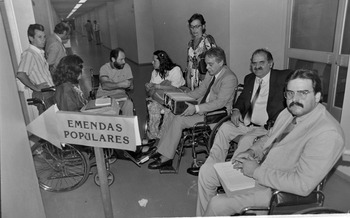
On August 13, 1987, caravans brought more than 3,000 people to Brasília for a coordinated delivery of the popular amendments, where they were received by the president of the Constituent Assembly, Ulysses Guimarães, in an often raucous ceremony (see Figures 1 and 2).Footnote 60 As with earlier engagements with the subcommissions, the full diversity of groups engaging with the Constituent Assembly was on display. For pro-participation groups, the level of engagement with the popular amendments and the Constituent Assembly among the Brazilian public evidenced a nation ready to construct democracy.
Disability Activists Submit Popular Amendment PE-86, August 13, 1987
Source: Arquivo Histórico da Câmara dos Deputados do Brasil, Fundo Assembleia Nacional Constituinte de 1987–1988, Grupo XIV–Divulgação, Série FT–Fotografias, Dossiê–6012.

President of the Assembleia Nacional Constituinte Ulysses Guimarães (standing, second from right) Receives a Popular Amendment, August 13, 1987
Source: Senado Federal do Brasil, Senado Fotos, https://www12.senado.leg.br/fotos/busca

The Popular Amendments
The 122 popular amendments accumulated over 12 million signatures and sponsorships from hundreds of groups from across Brazil. The groups behind them varied widely, from large national organizations to local groups, from socialist organizations to powerful rural landowning associations. The measures proposed in the popular amendments ranged accordingly. A survey of the popular amendments underscores that civil society eagerly took up participation in the restoration of constitutional rule in Brazil. The diversity of the constitutional remedies contained within each of the popular amendments reveals, moreover, the degree to which the constitution became enmeshed in a multiplicity of agendas that reflected both the struggles that had dominated Brazil's twentieth century and those around which political conflict in the New Republic would revolve.
The popular amendments with the most signatures reflected the wide range of issues brought forward but also their immersion in larger lobbying efforts centered around the constitution. The single amendment with the highest number of signatures, at 1.2 million, proposed rights for children, including rights “to life, a name, a family, an education, leisure, housing, [and] nutrition,” as well as to social security. The justification for the amendment explained that the objective of the national awareness campaign of which the popular amendment was a part had as its objective “to broaden and deepen the debate over the life conditions and development of children and their rights in society.”Footnote 61
Together, the two major pro-agrarian reform amendments acquired nearly 1.2 million signatures. While both were sponsored by essentially the same coalition, the difference between the two shows that constitutional concerns provoked varied approaches among backers of otherwise similar popular amendments. The first amendment, PE-52, was led by the National Confederation of Agricultural Workers (Confederação Nacional dos Trabalhadores na Agricultura, CONTAG) in collaboration with Catholic Church's rural outreach arm, the Pastoral Land Commission (Comissão Pastoral da Terra, CPT), one of the major national labor federations (CUT), and the Brazilian Association for Agrarian Reform (Associação Brasileira de Reforma Agrária, ABRA). The amendment laid out a sophisticated series of constitutional mechanisms to effect a profound redistribution of rural land, including asserting the “social obligation” of land over private property rights, setting rates of compensation, asserting the rights of Indigenous populations, and restricting the maximum size of landholdings. The Landless Workers’ Movement (Movimento dos Trabalhadores Sem Terra, MST) insisted on a second amendment, PE-53, which included additional provisions for direct participation by landless workers in matters relevant to agrarian reform (among other measures), reflecting the greater affiliation of the MST with ideologies of participatory democracy relative to the more traditional CONTAG. Ultimately, the other groups sponsored and gathered signatures for both amendments, thus preventing major infighting among pro-agrarian reform groups during the Constituent Assembly.Footnote 62
While large national organizations played important roles in sponsoring numerous amendments, local and sectoral groups with less reach used them to make their own significant contributions. Even as CUT sponsored several amendments calling for sweeping labor rights and protections, so too did unions representing oil workers from Bahia, metalworkers and small farmers in Minas Gerais, port laborers in São Paulo, and retired steelworkers from Rio de Janeiro.Footnote 63 While organized labor claimed changes to their sector or sought additional protections, other workers used the amendments to demand their inclusion in the formal workforce. Associations of domestic workers from São Paulo and Santa Catarina, for example, submitted PE-114, which would extend labor protections and benefits to them, effectively formalizing one of the largest sectors of informal labor in which working-class Black and mixed-race women predominated.Footnote 64
This dynamic extended beyond amendments dealing with labor rights. The Catholic Church acquired over one million signatures cumulatively for its amendments supporting religious freedom and education and for continuing the illegality of abortion. Spiritualists (espíritas) and practitioners of Afro-Brazilian religions put forward two amendments establishing the right to spiritual treatments in health care. The Associação Umbandista e Casa de Caridade “Pai João de Porteira e Caboclo Pena Branca,” an Umbanda center in São Paulo, was among the key sponsors of PE-33, which sought to ensure that spiritual healers like benzedeiras were not “marginalized and framed in the Penal Code.”Footnote 65
The legacy of the dictatorship loomed large in the popular amendments, especially with regard to military intervention and censorship. The União Nacional dos Estudantes, the national student association heavily targeted by the dictatorship's intelligence forces, put forward an amendment that would expressly prohibit the military from intervening in domestic affairs.Footnote 66 Moreover, dueling popular amendments highlighted how struggles over morality around which Cold War conflict in Brazil had revolved continued into the post-dictatorship period. Two popular amendments, one supported by artists and cultural workers and another by journalists, proposed constitutional measures prohibiting state censorship, “be it political or moral.”Footnote 67 In contrast, PE-84, sponsored by state censorship agents for the continuation of moral censorship, acquired more signatures than the two anti-censorship measures put together. The amendment advocated continued censorship to protect children and for the “preservation of family, religious, moral, and social values of the Brazilian people,” citing television in particular for its wide yet “indiscriminate” reach.Footnote 68
The popular amendments also evidenced an emergent right-wing coalition of religious conservatives, rural landowning interests, and politically active police associations. Four popular amendments included prohibiting abortion as a major or their sole provision; all of them received sponsorship from entities associated with the Catholic Church, signaling its conservative shift in the post-dictatorship era.Footnote 69 Police associations demonstrated high levels of political mobilization. One amendment, PE-97, supported by a coalition of teachers, civil police, and journalists from Bahia, sought to establish municipal control of police forces, declaring that the police “had been the object of militarization incompatible with their duties.” In contrast, four popular amendments supported by police associations in at least five states sought to maintain privileges enjoyed by police and stave off reform efforts.Footnote 70
Rural landowning interests led by the Democratic Association of Ruralists (União Democrática Ruralista, UDR) and the coffee-grower dominated Sociedade Rural Brasileira sponsored their own anti-agrarian reform amendment, although the 40,000 signatures they acquired paled in comparison to the 1.2 million amassed by pro-reform groups. Foreshadowing the political power that rural interests would hold in the New Republic, the only successful amendment of the six proposing the creation of new states was PE-26, backed by influential agribusiness interests. The amendment carved Tocantins out of the large but lightly populated Goiás state, an act that further skewed Brazil's Senate in favor of rural states.Footnote 71
While these groups demonstrated the capacity to mobilize growing constituencies, industrialists had a more mixed record. Amendments in favor of maintaining popular public-private vocational training and the service provision programs SESC, SENAI, SESI, and SENAC cumulatively acquired a higher number of signatures than any other subjects targeted by the popular amendments. But PE-82, which would have weakened labor rights and was supported by industrialists from Rio Grande do Sul, came under intense criticism amid news reports that employers had forced employees to sign to get over the 30,000-signature threshold.Footnote 72
Expanding rights both universal and particular received significant emphasis in the popular amendments. In accordance with its sophisticated lobbying campaign, the Sanitary Reform (Reforma Sanitária) movement sponsored an amendment establishing a right to health and a universal health care system. While medical professionals composed the public face of the movement, grassroots health movements in urban centers, above all in São Paulo's urban periphery, collected most of the signatures for the Popular Health Amendment (PE-50). By including citizen oversight councils at all levels of the public health system, the amendment reflected the coupling of social rights and participatory democracy that characterized proposals for rights expansions more generally at the Constituent Assembly.Footnote 73 Other popular amendments proposed social rights to education, childcare, housing, leisure, transportation, nutrition, and retirement pensions, as well as minimum funding levels for public health programs.Footnote 74
Alongside these proposed rights expansions, numerous popular amendments proposed rights and protections for particular groups denominated by race, ethnicity, gender, and age. The extraordinary range of groups speaks to just how widely the popular amendments were utilized: Afro-Brazilians, Indigenous people, disabled people, women, children, the elderly, incarcerated persons, and consumers all either submitted amendments or were the subject of proposed rights expansions.Footnote 75 Amid the wide range of measures proposed by the popular amendments, the expansion of rights, coupled with popular participation by marginalized groups became one of the defining experiences of the Constituent Assembly and the rationale by which the 1988 constitution would become the “Citizen Constitution.” This became particularly evident during the defenses of the popular amendments, held between August 26 and September 4, 1987, in which backers of amendments that met the signature threshold could nominate a speaker to make their case directly to the Constituent Assembly.
Participatory Democracy, Inclusive Citizenship
On October 5, 1988, Ulysses Guimarães, the president of the National Constitutional Assembly, formally baptized the final version of the constitution as the “Citizen Constitution” for its expansion of rights and its incorporation of mechanisms for popular participation. Indeed, the text of the new constitution proclaimed that the vote and direct democracy, equally, constituted the popular sovereignty (soberania popular) of Brazil's new democracy.Footnote 76 As the oral defenses of the popular amendments in August and September 1987 demonstrate, the establishment of popular sovereignty and related rights expansions stemmed not from constitutional precedent, but rather from historical arguments about the active role of the Brazilian people in constructing democracy from below. Within that paradigm, diverse groups made claims to citizenship that reflected racial, ethnic, gendered, disability, and place-based distinctions.
The oral defenses of the popular amendments were poorly attended by Constituent Assembly deputies, as were many formal sessions. However, as Deputy Lysaneas Maciel argued, the absence of legislators did not detract from the significance of the defenses. Rather, by speaking to the press, the public in the galleries, and those legislators who did attend, the speakers could force debate on issues that mattered to them and counter the behind-the-scenes dealing “in the Bank of Brazil, in the Ritz Carlton [Hotel], and in various apartments” in Brasília that threatened the potential of the constitution to affect substantial change.Footnote 77 Of the 122 amendments submitted, 83 met the requirements for a public defense in front of the Comissão de Sistematização, the central committee of the ANC. Amendments that did not meet the signature or group sponsorship requirements could still receive consideration if they were co-sponsored by any constituent deputy.Footnote 78
The arguments made in the defenses offer a window onto how the social mobilizations that accompanied Brazil's return to democracy were essential to creating legal justification for making popular participation a fundamental part of the constitution. In his defense of PE-56, which prescribed citizen oversight councils, former construction worker José Gomes Pimenta made this connection explicitly. Everyday citizens “involved in their representative entities, be they Labor Unions, associations and other popular organizations, strengthen themselves politically . . . these popular organizations fulfill the role of elementary schools of democracy and politics.” The amendment framed the Popular Participation Councils (Conselhos de Participação Popular) that would oversee every area of the state in collaboration with appointed bureaucrats as a simple “juridical recognition” of the democracy already in existence at the grassroots.Footnote 79
The defense of the PPPC-sponsored amendment, PE-21, echoed Pimenta and stressed that direct democracy would complement the election of representatives in constituting Brazilian democracy. PE-21 proposed giving citizens the permanent right to initiate both constitutional amendments and ordinary legislation provided they met certain signature requirements, among other mechanisms for direct democracy. As the legal justification submitted for PE-21 argued, the mechanisms it proposed were “entirely new in our juridical norms” but would further the collective responsibility “of all Society in the elaboration of the new Constitution and, therefore, in its legitimacy.”Footnote 80 In his defense of PE-21, jurist Dalmo de Abreu Dallari affirmed the “extraordinary interest” of the public in fulfilling this role as evidenced by their participation in the ANC, not least through the popular amendments. He emphasized, moreover, that the people would not supersede the role of the legislature. Rather, the people “feeling allied with the Parliament, its fellow worker, will be [the] uncompromising defender of its independence and [the] prerogatives that the Parliament needs.”Footnote 81 In effect, Dallari argued that this dual basis for Brazilian democracy, composed of representative and direct democracy, would protect it against a resurgence of the arbitrary and authoritarian rule that had characterized the dictatorship.
The idea that the grassroots fight for democracy had qualified the Brazilian people to play this role offered diverse groups an opportunity to make their own claims to inclusion within this emerging constitutional order. In his defense of PE-86, a popular amendment submitted by national disability rights groups, Messias Tavares de Souza framed the extension of rights and welfare benefits to disabled persons as part of the larger civic awakening during the long, slow return to democracy that had begun during authoritarian rule in Brazil: “In the decade of the 1970s, disabled people, just like Black [people], women, and other groups in civil society, resolved to organize, on the question of survival.” After recounting the extensive mobilizations of disabled rights groups around the issue of a new democratic constitution, Souza criticized the “assistentialist” and paternalistic vision of disability advanced by another popular amendment sponsored by disability groups for a minimum income for disabled persons. Souza positioned his amendment and movements as “firstly and above all, for the right to citizenship,” which he said had as much to do with the material conditions of disabled people as it did their ability to actively participate in public life: the “right to come and go” like any citizen. To illustrate his argument, Souza pointed out that he had the right to defend the popular amendment but that he could not physically access the microphone provided.Footnote 82
Groups further cemented this claim by pointing to their contributions in elaborating the constitution up to that point, allowing them to tie longer histories of struggle to the constitutional restoration then underway. Ailton Krenak defended PE-40, which established rights and protections for Indigenous Brazilians, emphasizing the active role that Indigenous people had taken in pursuing their rights and participating in the constitution-making process during the previous months. This presence, Krenak surmised, had served to reinforce for constituent deputies that Indigenous people were claiming only their original rights to their lands. Moreover, their work in the Constituent Assembly “had cast a light onto the stupidity and darkness that has been the historical relationship between the State and Indigenous needs. It has made progress in the sense of having advanced a perspective of a future for Indigenous people.”Footnote 83 In the middle of his speech, Krenak began painting his face with the jenipapo fruit in a manner traditional to Indigenous peoples in Brazil.
Krenak characterized this act as a manifestation of Indigenous culture in protest of the extreme violence with which rural landowning interests were coveting their lands, and the responsibility of the constituent deputies in protecting Indigenous peoples from that violence. As sympathetic constituent deputies commented in the debate that followed Krenak's speech, his act laid bare the fact that Brazil could not “construct a democratic country without respecting the rights of minorities.”Footnote 84
If Krenak underlined how popular participation shaped the responsibilities of the future democratic state, especially to marginalized ethnic and racial groups, those supporting the democratization of Brazil's cities through an urban reform (reforma urbana) agenda underscored the need for new formulations of citizenship so that the people could fulfill their constitutional role as active participants. The defender of PE-63, urban planner and scholar Ermínia Maricato, advocated for urgent reforms in the face of “the new Brazilian reality,” namely the mass rural-to-urban migration and the rise of megacities with large urban peripheries and informal settlements completely lacking in basic urban infrastructure and state services.Footnote 85 Dalva Stela Rodrigues Madeiro, the president of the National Confederation of Residents’ Associations (CONAM), lamented that the ANC had ignored the needs of the urban poor, but that the popular amendments offered an opportunity to call attention to questions that impacted both the “living conditions and exercise of citizenship of millions of Brazilians.” PE-115, in favor of a right to housing, addressed both issues so that all Brazilians “could enjoy their citizenship in the broadest sense, incorporating social citizenship to political citizenship, without which the very existence of democracy is threatened.”Footnote 86
In short, defenders of amendments in favor of popular participation as well as rights for particular groups and universal social citizenship laid out a vision of popular sovereignty that would undergird an expansive, participatory citizenship. Groups marginalized due to racial and ethnic discrimination or disability articulated the rights that would allow them to play the constitutional role as co-guardians of Brazil's new democracy alongside the elected legislature.
To what degree were pro-participation groups successful in implementing this vision in the Citizen Constitution? On one hand, the direct impact of the popular amendments themselves on the final text of the constitution is difficult to measure. After the defenses, the popular amendments were evaluated by the ANC's central committee, the Comissão de Sistematização. As technical staff associated with the Comissão reported, the central committee ultimately integrated some part of 43 popular amendments into the text of the constitution. This gave the popular amendments a higher success rate (35%) than amendments submitted by Constituent Assembly deputies (27%).Footnote 87 But defeat in the Comissão de Sistematização, whether partial or total, did not mean that a popular amendment or a given provision did not make it into the text of the constitution. Rather, many that were initially rejected were reintroduced later by sympathetic deputies, or were fused with existing amendments as the constitution underwent several rounds of revision over the course of 1988.
The varied, sometimes contradictory aims of the popular amendments likewise complicate an assessment of how the constitution reflected their priorities. Citizens won universal rights including health, education, housing, transportation, leisure, nutrition, unemployment insurance, and retirement, among others. Indigenous people acquired stronger constitutional rights to their lands and disabled persons significant rights supporting the exercise of active citizenship. The constitution established gender equality, made racism a crime, granted land rights to quilombos, confirmed the right to vote for illiterate people, and provided some measures for democratizing Brazilian cities. Among the biggest defeats, however, was the lack of agrarian reform in the final text.Footnote 88
Perhaps the greatest contribution of the push for popular participation was the inclusion of concepts of popular sovereignty that undergirded the idea of a “citizen constitution.” Article 1 of the constitution states that “All power emanates from the people, who exercise [it] by way of elected representatives or directly, under the terms of this Constitution.” The italicized phrase refers to the mechanisms for direct democracy included in the PPPC's popular amendment and inspired by the popular amendments themselves. Brazilian citizens would now be able to propose laws, a concept referred to as popular initiative laws (leis de iniciativa popular) on equal grounds with legislators, provided certain signature requirements were met. This basis for sovereignty is further reflected in the constitution's conception of political rights: “Popular sovereignty will be exercised by universal suffrage and the direct and secret ballot, with equal value for all, and, by the terms of the law, by means of I – plebiscite; II – referendum; III – popular initiative.”Footnote 89 This represented a remarkable shift from the arbitrary constitutional manipulations of the dictatorship. Rather, the text of the Citizen Constitution situated everyday citizens as guardians of Brazil's democratic order, a role reflected in its inclusion of direct democracy as a core component of citizens’ political rights, alongside the vote, at least in theory.
The degree to which the rights expansions contained in the 1988 constitution has translated to material realities presents a more complicated picture. The logistical challenges of popular initiative laws—the one percent of Brazilian population required as signatories exceeded 1 million people in 1990—has contributed to the use of the mechanism on only a limited basis, although the anti-corruption measures such as the Clean Slate Law (Lei da Ficha Limpa) and a major public housing fund remain significant achievements.Footnote 90 More broadly, the culture of active citizenship that the push for popular participation both fed off and fueled has become an accepted part of Brazilian political life.
Popular sovereignty, however, remains a contested space. While this article has focused on those movements affiliated broadly with the political left that fought hardest for popular participation, right-wing groups such as the anti-agrarian reform União Democrática Ruralista also participated in the founding act of Brazil's new democracy. This has had significant consequences, given the vexed nature of the 1988 constitution, riven between its expansive social democratic project of rights and welfare expansion and its deeply conservative elements. These consequences reflected in part the strategic choice of the left to focus its efforts on issues of rights and welfare at the ANC in the face of conservative strength. Leftist deputies understood that the 1979 amnesty law made achieving justice for human rights abuses during the dictatorship an unlikely event, even if they had the political force to do so.Footnote 91 The need to reconcile the progressive and conservative visions also contributed to the extraordinary length of the constitution, as did its inclusion of measures perhaps better left to ordinary law. In turn, this has promoted the judicialization of Brazilian politics, as competing factions can instrumentalize the constitution to settle political disputes.
As Tomaz Wonghon predicted, the Citizen Constitution did not cause a revolution in Brazil, but it did create mechanisms for the social advancement of its people. Popular social movements encountered significant headwinds in the 1990s: rampant inflation, the continuing conservative turn of the Catholic Church, deindustrialization, rising violence in cities, and the “NGO-ization” of certain movements, to name a few. Nonetheless, the social pact cemented by popular participation could not be undone. The Movement for Ethics in Politics (Movimento pela Ética na Política) led by sociologist Herbert “Betinho” José de Souza powerfully reprised its ethos in the movement to impeach Fernando Collor de Mello for corruption in 1992, as did the influential movement to end hunger in Brazil, the Ação da Cidadania contra a Fome, a Miséria e pela Vida.Footnote 92 Movements for Afro-Brazilians, Indigenous peoples, women, disabled persons, and favela residents, among many others, likewise grounded claims for rights and participation in politics in the new sense of cidadania or citizenship, helping place Brazil on the forefront of the “inclusionary turn” in contemporary Latin American politics. The diverse coalition behind the popular amendments had understood that the Citizen Constitution was only one step in a longer struggle. Brazil could be the egalitarian democracy that they desired—but only if its citizens make it so.
Conclusion
This article has examined the restoration of constitutional rule in Brazil through the push for popular participation in the writing of the country's post-dictatorship constitution. That effort had its roots in the long struggle for a return to democratic rule amid a dictatorship that paradoxically used constitutional measures to enhance its capacity for arbitrary and extra-constitutional actions. The persistence of that constitutional order and the lack of justice for victims of human rights abuses committed during the dictatorship—despite the broadest and most sustained social mobilizations in Brazilian history, culminating in the massive street protests of the Diretas Já campaign in 1983–84—have led some scholars to characterize Brazil's democratic transition as the most “conservative” of the South American constitutional restorations.
The popular amendments represented a concession won by pro-democracy forces within that transitional process. Accordingly, they reflected the extraordinarily heterogenous coalition that continued that effort even after the return to formal democratic rule in 1985. The variety of measures proposed in the popular amendments and the diversity of groups that engaged with the Constituent Assembly demonstrate that the constitutional restoration did not remain confined to political elites within the most rarefied of political institutions, the constitutional assembly. By tying the constitutional restoration to myriad social struggles for full citizenship, pro-democracy groups like the PPPC and marginalized Brazilians fought to make everyday citizens co-equal guardians of Brazil's nascent democracy. In doing so, they replaced the authoritarian constitutional order with one that grounded its sovereignty in the direct participation of ordinary Brazilians, even as the consolidation of that order, and therefore of Brazilian democracy, remains an ongoing struggle.
The popular amendments open new possibilities for understanding democratic transitions in Latin America by situating the restoration of constitutional rule within social struggles that spanned the twentieth century. Popular participation in the Brazilian case evidences the real impact that social mobilizations during democratization and the transitions had on the constitutional restorations: that constitutional concerns mattered significantly to everyday citizens of diverse backgrounds. Through the popular amendments, those citizens laid claim to the post-dictatorship democracy they hoped would emerge after years of instability, economic crisis, and political backsliding. Concurrently, groups of marginalized Brazilians in fighting for participation tied resistance to authoritarianism to the struggle for a democracy more cognizant of inequality along lines of race, ethnicity, gender, and disability, issues around which political conflict would more overtly revolve in the post-Cold War age.
Indeed, both the very existence of the popular amendment themselves and the far-ranging proposals contained therein evidence that beneath the surface of controlled political transitions swirled currents of radical possibility. The history of the popular amendments restores a sense of possibility to the 1980s as a decade in which a diverse, heterodox coalition won a democracy grounded in notions of popular sovereignty, even if its full realization remains elusive.
Supplementary Material
To view supplementary material for this article, please visit https://doi.org/10.1017/tam.2022.7.