Introduction
Demographic changes and changing social conditions raise questions about the everyday lives of older people who have been retired for many years but have no great need for care. In the Swedish welfare state, older people are often described as belonging to a homogeneous gender-neutral group that is either very dependent and needs care or which comprises a favoured generation, economically and otherwise. The growing number of dependent older people is said to be a problem for public funding, while the spending power of ‘the favoured generation’ attracts the attention of commerce. The fact that we live longer and that there are an increasing number of older people is seldom seen as positive. Batljan (Reference Batljan2005) pointed out that this ‘fantastic development’ had led to a discussion of the costs of elder care and hospital services focusing predominantly on very frail older people. The duration of active life in old age is also increasing. Average life expectancy at birth in Sweden is 78.4 years for men and 82.7 years for women. Senior citizens today and in the future can expect to live 20 or more years after retirement.
The increased duration of active old age and social changes are widening the differences in the conditions of ageing, but without weakening the stereotypes of what it means to be old (Daatland and Biggs Reference Daatland and Biggs2004). When people grow older they are the focus of many social expectations, only some of which correspond with actual circumstances or personal potential (Daatland and Biggs Reference Daatland and Biggs2004). Gubrium and Holstein (Reference Gubrium and Holstein2003), along the same lines, observed that we often categorise older people as sick and dependent, although later phases of life also shape experiences outside these stereotypes. Krekula (Reference Krekula2007) noted that older women are predominantly studied from a misery perspective that sees old age only as a problem, but that this does not correspond with older women's own views of their ageing. As Arber and Evandrou (Reference Arber, Evandrou, Arber and Evandrou1993) pointed out, older people, like those in all age groups, are actively creating and recreating their lives and adjusting to changing circumstances in various ways.
In Sweden the diverse life courses and experiences of older people tend to be overshadowed by simple generalisations about their living conditions and their need for help which do not mirror the great variability. Swedish research on the lifecourse and everyday lives of older women and men has been sparse, except on formal or informal care (Gunnarsson Reference Gunnarsson2002a; Öberg Reference Öberg2005). The aim of this article is to analyse and discuss how women and men aged 75 or more years construct their everyday lives and how they are experiencing ageing and old age in Sweden. It also analyses how they organise their lives and what meaning they attach to their activities. The focus of the account is their descriptions of their experiences and the meaning that they give to their everyday lives.
A previous study showed that people aged 70 or more years spend most of their time on self-maintenance and housework, watching television, reading and resting, but with considerable variations in the time spent on these activities (Horgas, Wilms and Baltes Reference Horgas, Wilms and Baltes1998). This study found that age is the strongest influence on the level of activity, and that at age 90 years and over, activity levels were lower than among younger groups. Social activities, such as talking to people, telephone calls and visiting others took up comparatively little of the day. Gender and marital status had little effect on how people spent their days, but women and unmarried persons spent more time alone and at home (Horgas et al. Reference Horgas, Wilms and Baltes1998). Another study examined social participation among people aged 70 or more years (Bukov, Maas and Lampert Reference Bukov, Maas and Lampert2002). It established that those who pursued more demanding activities, such as caring or voluntary work, were also more likely to take part in less demanding activities such as playing cards or travelling with others, but the level of participation decreased with increasing age (Bukov et al. Reference Bukov, Maas and Lampert2002). A study of older people's engagement in different types of organisations showed that about 60 per cent of adults aged 60 or more years were engaged in some kind of organisation (Arber, Perren and Davidson Reference Arber, Perren, Davidson and Andersson2002). Women were more likely than men to be members of religious organisations, and men more likely to be members of sports clubs, but many of both genders were members of other organisations and interest groups. Membership in organisations decreased with increasing age. Among those aged 80 or more years, about one-half of the sample were members of organisations; non-membership was related to poorer health and lower income (Arber et al. Reference Arber, Perren, Davidson and Andersson2002).
A longitudinal study of people aged 77 or more years living in the community compared their participation in various leisure activities in 1992 and 2002 (Agahi and Parker Reference Agahi and Parker2005). The most common leisure activities in both years were reading newspapers, walking and reading books, and that was true for all age groups and among women and men alike. There was an increase in participation in the various activities between the two dates, especially among women for whom the increase was significant. Participation in social and cultural activities (both physical and intellectual pursuits, including study circles, cultural and organisational activities, and restaurant visits) increased most strongly among women. With low education, increasing age and mobility impairments, the participation rate decreased, especially among women (Agahi and Parker Reference Agahi and Parker2005). The cited studies show common patterns. Not surprisingly, increasing age was the most important (negative) influence on participation in several organisations and leisure activities. The questions remain, however, as to how older people who do not require high levels of care spend their time and how they experience everyday life, and most importantly, how do they themselves view their everyday lives?
Theoretical perspectives and method
Studies that take as their starting point the experiences of the everyday world assume that we should try to understand the structures of society and their functioning by looking inside this everyday world. Actual lives reflect power relations and processes that organise and determine the everyday context of life and the way it is represented (Smith Reference Smith1999). Everyday life is seen as a reality interpreted by individuals and subjectively meaningful as a world with an inner context. The reality of everyday life is shared with others, and relations to other people play an important role (Berger and Luckman Reference Berger and Luckman1979). Everyday life is created constantly through people's handling of their living conditions and relations to others. It is determined by socio-economic conditions and social relations as well as experiences at different phases of the lifecourse. What people do in everyday life is often looked upon as trivial and self-evident, but trivial things also have important functions in our lives, and they influence how each person formulates a concrete life project (Ellegard Reference Ellegard, Ellegard and Wihlborg2001). The lifecourse perspective gives the opportunity to analyse different processes that affect different groups and particular experiences at different life stages, and emphasises the interplay between various life phases rather than seeing every phase in isolation. Lifecourse as a concept does not presuppose a specific theory but provides a perspective that can be the starting point for analysing ageing as a lifelong process (Arber and Ginn Reference Arber and Ginn1995; Moen Reference Moen, Binstock and George1996; Jamieson, Harper and Victor Reference Jamieson, Harper and Victor1997; Giele and Elder Reference Giele, Elder, Giele and Elder1998; Öberg Reference Öberg and Andersson2002).
The study sample
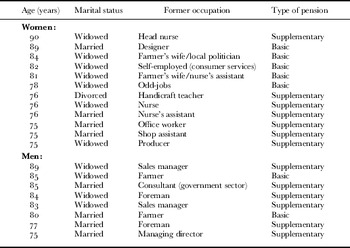
The informants were recruited by advertising in a regional newspaper that is widely read. The advertisement invited those aged 75 or more years living in their own homes to participate in the research on everyday life and ageing. Altogether 25 people replied, and 20 agreed to be interviewed (12 women and eight men). Five of those who originally replied did not take part as a result of difficulties in finding convenient meeting times or because they had second thoughts. The informants were aged between 75 and 90 years. Seven women and four men were widows/widowers, four women and four men were married, and one woman was divorced. The informants had diverse socio-economic profiles and all had been born in Sweden (Table 1). They said that they took part in the study mainly because they thought it important to challenge the general impression of older people as frail and dependent, which they thought was dominant in the mass media and in society. They simply wanted to provide evidence of lives that did not consist only of misery, and in this they thought they had something to tell.
Characteristics of the sample

The interviews and analysis
The informants were interviewed by the author on two occasions over 12 months during 2003 and 2004. The first interview was open-ended and the informants were free to tell about their lives (upbringing, adult life, everyday life and ageing). The second interview (18 persons) was thematically structured, partly to supplement information given during the first interview and partly to ask more direct questions about health, everyday life and changes that had taken place during the year. All interviews took place at the informants' homes. The duration of the interviews was between one and three-and-a-half hours. Of the two informants who did not take part in the second interview, one man had died and one woman could not be contacted. For the 18 informants who were interviewed a second time, no major change had taken place except that one woman had moved to a home for old people.
The interviews were tape recorded and transcribed in their entirety. They were read and re-read several times. First, the interviews were structured and thematically coded by life-course phase (childhood, adult life, old age). This material was presented to the informants to read and reflect on, and later re-read and coded again to identify empirical and theoretical concepts (Widerberg Reference Widerberg2002). The overall starting point was to identify how the informants were experiencing ageing and how they constructed everyday life. Two main themes were found in the interviews and coded as ‘to stay active’ and ‘to keep going’, and a sub-theme was identified, ‘to make the best of things’. Strategies in everyday life were identified, as were different meanings of the main concepts.
The findings
From a poor country to a welfare state
In the informants' narratives, the rapid development of Sweden during the last century, especially after the Second World War, is apparent. It changed from a poor country into one with an institutional welfare state (Esping-Andersen and Korpi Reference Esping-Andersen and Korpi1987). The informants were born between 1913 and 1928, at which time a large proportion of the population lived in the countryside. One-half of the informants grew up in rural areas (six women and four men) and the other half grew up in urban areas (six women and four men). Living conditions in the countryside were often quite poor and marked by hard labour, even for children. The informants who grew up in the countryside attended elementary school. At around the age of 15 years they were confirmed in the Lutheran church and started regular work. Many of the women who had grown up in the countryside emphasised that they had been unable to continue their studies even though they had wished to. At the time, being adolescent in an urban area enabled longer education, as with six women and four men in the sample. Three of the men had attended an ‘upper secondary’ school and two had gone on to university. The fourth man had studied to be an engineer by correspondence. All the women had attended ‘upper secondary’ school. Socio-economic differences among informants brought up in towns were much greater than among those brought up in the countryside.
When the informants were growing up there were many popular associations such as farmers' organisations, the temperance movement, the Free Church movement and the scouts, and many of them offered various youth activities. Almost all the informants had been members of one or more of these organisations during their upbringing. They belong to a cohort for which popular associations played an important role in many people's everyday lives. In Sweden, such organisations peaked during the 1930s and 1940s. Other characteristics of the cohort were the increasing labour-force participation among women, and benefits from the economic boom that followed the Second World War.
The men's narratives about their adult years make clear that work was an important element of their life stories; it had a central place in their lives. Two of the men had been farmers, two had been foremen in different industries, two had been white-collar workers (one a salesman), and two had held executive positions. By contrast, in the women's narratives, responsibility for children and the home figured large, but they also had worked outside the home, and all indicated that work was important. Two women had married farmers and both said they had been tied to the work with the animals, which was the woman's responsibility. One woman had later worked with a political party, and the other, at 50-years-of-age, had begun work as a nurse's assistant and for the first time in her life had her own money. The jobs held by the other rural women included shop assistant, nurse's assistant, bread seller, cleaner, seasonal worker and nurse. The women who grew up in urban areas had worked as clerks, nurse, nurse superintendent, designer, journalist and teacher, and one had been self-employed. The more highly educated women had continued working even when their children were small, while the women with less education had taken short or long breaks until the children started school. For all the women, work outside the home was important for both economic and social reasons. The four men who grew up in urban areas had had careers and were married to women who worked at home. Of the four men who grew up in the countryside, three were married to women who had worked outside the home, but not when the children were small, and one was married to a woman who had worked on the farm.
About life
The way in which a person values her or his life influences how she or he looks upon life today. In their narratives, the women used several words expressing ‘gratitude’. Several indicated that they had been lucky even if their life had sometimes been rough, others that they had been well favoured and had had a full life. One woman said that the details of her life were important: ‘it's like a necklace with pearls; it's the pearls that are the most important’. The informants like many in their cohort were grateful and satisfied, but it was mostly women who made such comments. One woman aged 78 years who had had a poor upbringing said,
I think you should be grateful and contented. I think that is lacking today, I think so. Because I used to say this: what do you want? You have enough to eat, you can pay the rent, you can buy some clothes: can it be better?
In the men's narratives there were expressions such as ‘a rich life’, ‘totally satisfied with life’, ‘happy life’ and ‘positive’. None of the men saw anything negative about life, either with what it had been or the way it looked today. One man aged 78 years said, ‘I think the best with life and the meaning in life is that I have almost all the time had a positive view of things. I have never gone around being sad.’ On looking back, the informants gave positive and contented interpretations of their lives. At the same time, the women particularly stressed that they belonged to a generation raised to be grateful, and indicated that they thought that this would change. They also said that the most important thing was to feel that you had made the best of life. At the first interview, the informants had been retired for 10 to 30 years. This means that when they described how they spent their days and used their time, there was a before and after, i.e. partly what they did at the time of the interview, and partly what they had done earlier but no more. The intensity of activities decreases when health and the body in different ways restrict what is possible. At the second interview, however, seven of the women and six of the men judged their health as good, and the other five rated their health as neither good nor bad.
To stay active
How you view life as a retired person is affected by your own lifecourse and by the ways in which society conveys messages about how we should live our lives. Many books on how to prepare for retirement stress that ‘successful ageing’ is attained by being active in different ways (Mannerfelt 1999). A Swedish government policy document on older people (Statens offentliga utredningar 2003: 91) used the World Health Organisation's definition of active ageing from 2002. To be active means to ‘be continuously taking part in social, economic, spiritual, cultural and civic topics’ (2003: 308). Overarching themes in the interviews included the need to stay active and keep going in everyday life, but they were not stable categories; what ‘stay active’ and ‘keep going’ meant was specific to the situation and how it was interpreted by the informants.
The men spontaneously pointed out the importance of being active, and stressed that it was important to keep busy throughout the day and not good to take things easy. As one aged 84 year-old said, ‘It's about doing things all the time. I think it is good not to get stuck somewhere just kind of sitting still without really trying to do something with your life.’ An 85-year-old man who had undergone extensive heart surgery said that ‘to keep going’, the most important things for him were to take at least one walk a day, to work in the garden and to read a little. The women also stressed the importance of being active and the need to keep going. As an 82-year-old said, ‘I walk a lot, use transport as little as possible, try to keep going, have morning exercises and evening exercises. You see shocking examples when people let their body go downhill’. Another woman, 90-years-old, thought it important to think of yourself as still handling your life and not being miserable and dependent. She said:
I think that you still can have a lot of fun in life. … I used to say that if I do not care about working in the garden and if I'm lazy and get help with everything, then the body withers away … then you will be in terribly bad shape and infirm and miserable. I have difficulty thinking of myself as a little miserable woman.
Everyday routines
In this section, the strategies for staying active and keeping going will be analysed by examining how the informants constructed their everyday lives. To be positive and make the best of things, which was common among the informants, is a strategy for maintaining self-esteem and control in everyday life and was an important element in how the informants constructed their daily lives. The accounts of what the days were like mentioned many different activities, such as household tasks, reading, watching TV, using the computer and gardening, as well as activities outside the home such as study circles, weaving, playing bridge, playing petanque (a French ball game) and taking part in club activities. They also met their friends or talked to them on the telephone.
Cleaning, cooking and shopping
Two women had help with cleaning from the home help services, while the other informants managed their everyday living by themselves or with help from their spouses. For several of the widowed men, cooking took up a lot of time. They liked to cook, were proud of what they did and described how they made dishes that required slow cooking; they baked bread and froze meals. As an 84-year-old said, ‘You should not need help when you are totally healthy. I am fully agile and my wife taught me how to cook rather well in the years before she passed away, so I manage well with that. I did cook a big smoke-cured loin of pork yesterday and froze a little and it is wonderful’. Another male informant made dinner every day for one of his sons, and for many years had been a member of a cookery study circle that once-a-week cooked and ate dinner together. Previous research has shown that widowers describe cooking positively and are proud that they do it well (Davidson, Daly and Arber Reference Davidson, Daly, Arber, Arber, Davidson and Ginn2003). Cleaning, however, does not particularly interest them, though it has to be done and be put up with.
The women living alone did not find cooking as pleasurable as the widowers, and it was regarded as something that had to be done. One 82-year-old woman said, ‘I am so lazy, I do not like to cook. I do it but I do not like it, it is unbearable trouble’. Many in this group bought ready-made frozen meals, were satisfied with them and found that they made things much easier. A visually impaired 76-year-old woman did say, however, ‘I cook, because I think this: if you do not cook, then you are out [finished]. I have guests sometimes so I cook, but they are simple menus’. In contrast to the others in the study, this woman saw cooking as a strategy to maintain some independence and to keep going. She chose, however, not to prepare difficult dishes and on weekdays often used frozen ready-made meals. Cleaning was not especially commented on by the female informants, and like shopping was described as a task that you have to do, except that some said they found shopping a heavy task and did not buy much on each trip.
Other activities at home
Reading the newspaper in the morning at breakfast was given ample time and seen as an important part of the daily routine. The informants also spent time reading, watching TV, making phone calls, on needlework, solving crosswords, and listening to the radio. Those who had a garden spent time there. Three women and three men had computers and used them as word processors, to surf the Internet or for genealogical searches. Some of the men spent time on philately. All these activities were important and often daily pastimes. Reading books was very important to almost all informants, both women and men, not only as a passtime but also as a way of escaping their own situation and as a source of company. One woman said that reading was her hobby, and another aged 82 years said, ‘I have books. I read books, I go to the library all the time. Then I sink into them and do not think of anything else’. One woman who listened to talking books thought that books were valuable for distraction and as company.
Activities outside the home
Many of the informants were active in various organisations, and most were members of a local pensioners' group. These organised many activities, such as study circles, bridge, petanque, bookbinding, and stick walking. Through these activities it was also possible to make new friends. The informants stressed the importance of meeting people and emphasised that it was important not to isolate yourself, even if you were disabled in some way. It was also recognised that it can be difficult to take part in certain activities if, for example, you have hearing problems. One woman with a hearing impairment did, however, continue to play bridge because the bidding was done one-by-one and the game itself was silent. Those with hearing problems found that it was often easier to meet just one person at a time. Other activities outside the home, such as taking walks, were used by the informants to keep the body in shape; this applied even for those who walked with a rollator [wheeled frame].
One man who had played in various orchestras since he was young said that he had retired and stopped playing, partly because the orchestra had disbanded, and partly because his fingers had become too stiff. He missed the music but took a sauna twice a week with a sauna group. Several women and men used to travel a lot, both before and after they had retired, but said that they no longer wished to travel because of poor health or because it was difficult to find a companion. One 84-year-old woman who had had several strokes said, ‘Now I do not dare to travel because, you do not know, you can have a stroke any time, then you ruin the trip for everyone else. Several of my woman-friends have similar problems … they say that you should not travel and destroy the trip for others’. For some informants it had been difficult to go on longer journeys because it was hard to find a partner. As an 82-year-old said:
There is no one to go with. They do not have the strength or they cannot afford it or they are ill. I hesitate to go alone. Indeed you can have a very pleasant trip but you can also be very bored as well.
Social relations
For many of the informants, contacts with children and friends were of great importance even if they did not occupy much of the average day. All the informants had children, but in general contacts depended on whether they lived nearby or had moved away. Most had contact by phone, some everyday and many at least once-a-week. Only one informant, a divorced woman, thought she had a bad relationship with her children and that they did not care about her. She never spent holidays with any of her five children, and her strategy at Christmas was to go abroad for a long period. All the informants had friends, but many had passed away. An 84-year-old man who played golf with friends twice-a-week said, ‘but my old mates have passed away, so there are new people and they do not call so often wanting me to come and play.’
Both the married women and the widows kept in frequent contact with women-friends either by phone or by meeting regularly. They described a more extensive network of friends than the men. One 82-year-old woman described how she met a woman-friend every three or four days: ‘I have a woman-friend, and we use our season tickets and travel around and look at different parts of town, and it's very nice. She has vitality and is 15 years younger than me. We travel and walk and maybe eat somewhere, have some coffee or something, but not in the evenings; I think that's a bit sad.’ Several remarked that many people had passed away. A 76-year-old said, ‘It changes and there are so many people your age that disappear. Gaps occur everywhere and you miss them. … We had been a group of friends meeting during weekends, and we still do, but we are much reduced.’ A 90-year-old woman said that none of her and her husband's friends were the same age as they were because many of their old friends had passed away, and there was a big age gap. She also pointed out that she had changed and ‘gone into herself more’ and no longer had the strength to meet her younger friends. Many of the informants pointed out that because many friends had passed away, that influenced what they themselves could do, for instance travel as has been mentioned. Taking up different activities was explicitly mentioned as a strategy to compensate for losses when friends passed away.
Discussion
This article has examined the everyday lives of women and men aged 75 or more years, a group that is often identified with the ‘fourth age’, the ‘oldest old’ or the ‘frail elderly’. Among other things, the study has confirmed that in Sweden many in this group do not have a need for extensive care, and in contrast take part in many different activities within and outside their homes. The informants had been born before the Second World War, and had lived through the creation and development of the welfare state. They had enjoyed many benefits from economic growth and state welfare, such as job creation and health care for all. The women in the study had been in the labour force for much of their adult lives, and many had started work before it was common for married women to work outside the home. In looking back, they judged their earlier life in positive terms. The informants' everyday lives were shaped by the way they sought to stay active, both physically and mentally, which was generally regarded as important. What this meant varied greatly by individual circumstances; from spending most of the day at home reading, watching TV and talking on the telephone, to being engaged every day in out-of-home activities through pensioners' and other organisations. Many of the informants pointed out the importance of ‘keeping going’ on all levels and of ‘making the best of things’. They were all still active but the activities they engaged in and the time allocated to them had changed.
Continuity and change
After the informants had retired, some had continued to work in other capacities, and some had taken up other interests – the common characteristic was that they all wanted to stay active. The women had worked outside the home, some throughout their adult lives and some with a break when their children were small. This may explain why older women in general have in recent decades shown increased activity rates in later life, as noted by Agahi and Parker (Reference Agahi and Parker2005). As the informants aged, however, things changed, many things gradually or step by step. Things that once had greatly occupied the informants were now given less time because health changes had put obstacles in the way. The informants had found new ways to keep going. Travelling is the most obvious example of something that the informants were no longer so interested in. The reason for the change was not always a functional weakness related to their own age, for a common explanation was the difficulty of finding travelling companions. An important change in the informants' lives had then been that friends had passed away, altering their social network and sources of company. A third change that several experienced was that they were no longer able to participate in organisations as in the past, for example as committee members or active helpers. Age-related losses are both internal and external and must be understood at the individual level.
For two of the men and a few of the women, a decline in health had created obstacles in daily life, but in all cases they were adamant that such obstacles should not determine their lives and make them passive or socially isolated. This requires even more changes but nonetheless continuities from earlier life were sustained. Some of their activities had had to be re-invented or re-configured. Some could not take a walk alone and had difficulties getting out, but kept in contact with friends and children by telephone and also had people visit. ‘Life goes as you want it to’, one woman said, and another woman noted that ‘you can change direction if it [your life] goes the wrong way’.
As pointed out by Clarke and Warren (Reference Clarke and Warren2007), the policy-driven conception of ‘active ageing’ takes a rather inflexible view of activity. ‘Keeping going’ means different things at different ages. This study's informants stressed that they wanted to stay active, but the concept of being active and keeping going changes over time and differs among individuals. To the informants, the main thing was to keep mentally and physically active. Being mentally active could mean being outside the home taking part in different activities in society, but it could also be reading a newspaper or watching TV, for this keeps you up with what is going on locally and globally. Reading a book or painting a picture, as an 89-year-old woman did regularly, were also important activities. Not going out does not necessarily mean being inactive. As Clarke and Warren also wrote, ‘engagement need not … be so ambitious’ (2007: 483).
Are the accounts realistic or idealised?
The informants gave largely positive pictures of both their former and current lives. The women to a great extent said they were grateful or privileged, while the men used expressions such as having had ‘a rich life’. This does not, however, mean that they had not experienced difficulties. It is a question of what a person wants to stress in her or his life story, and what conclusions she or he draws from the difficulties now and then encountered. Both sickness and death had affected the informants' lives, but a common pattern was that the informants did not see themselves as victims. Instead they actively tried to be in control of their everyday lives. Are the accounts representative or do they give a glossy picture of the reality of the informants' lives? The sampling criteria affected the results. The individuals who replied to the advertisement for informants actively decided whether to take part. It is likely that those who responded wanted to tell their life stories and believed that they had something of value to tell. Some explicitly said that they wanted to counteract the negative picture of ageing shown by the mass media. Some informants also said that they were curious about the project and were interested to take part. The inclusion criteria were that the informant should be aged 75 or more years and live at home, and nothing was said about ‘being well’. Not surprisingly, therefore, the informants rated their health as relatively good. What is revealed is of course determined by the sample, but also by the focus and questions raised by the research. The findings do not contradict the results of population studies but the in-depth interviews have deepened the understanding of the everyday lives of very old people.
Conclusions
The average life expectancy in Sweden for women aged 65 years is about 20 years and for men about 17 years (Statistics Sweden Reference Statistics2006). Many older people live healthy lives for much of this time. The conditions for life after retirement, in Sweden and other western countries, have dramatically changed during the last century, in terms of both longevity and material circumstances. It is therefore astonishing that research on the everyday lives of older people has not been more extensive and instead focuses on those who are frail. As Öberg (Reference Öberg2005) pointed out, it is important to study older people who are not dependent on home-care services to understand both what everyday life is like for many older women and men and to understand the society in which we live. The current cohort of older people has experienced radical changes in society and new circumstances for old age. The informants saw life as meaningful because they were connected in different ways with friends, kin and organisations. They wanted to stay active despite the losses they had experienced and the obstacles they faced.
Acknowledgement
The research was supported by the Swedish Research Council. The author warmly thanks all the informants for their time, for without their co-operation this study would not have been possible.