Preparedness for emergency and disaster situations is imperative to public resilience, saving lives, and avoiding or at least minimizing the grave outcomes associated with these situations. There is wide agreement that prepared populations are better adapted to cope with emergencies, endure fewer adverse consequences, and recuperate faster following them.Reference Hemond and Robert 1 , Reference Peek and Mileti 2 It is also widely accepted that in order to achieve public resilience and preparedness to a given threat, individuals should engage in household adjustment behavior.Reference Coffman 3 - Reference Patterson 6
One of the major threats to the Israeli population is the threat of armed conflicts. In recent years, the Israeli population has experienced instances of heavy rocket fire in the course of the Second Lebanon War (2006) and 3 conflicts in the Gaza Strip (2009, 2012, and 2014). In the most recent conflict with the Gaza Strip, more than 70% of the Israeli population was exposed to the threat of rocket fire. Furthermore, the latest assessments by the Home Front Command, Israel’s Civil Defense Authority, suggest that the next war could impose an even harsher reality of extensive rocket fire upon the Israeli population (up to 1000 rockets per day), perhaps even to an extent requiring mandatory evacuation or sheltering for prolonged periods.Reference Buchbut 7
In light of the above, a preparedness survey was performed in 2013 to deduce the level of household adjustment to an armed conflict in a nationwide sample of 503 Israeli households. The results of the survey revealed a medium level of preparedness among the Israeli public, with more than half of the sample performing half or fewer of the recommended household adjustments to armed conflict.Reference Bodas, Siman-Tov and Kreitler 8 Most prominent in the results of this study were the findings suggesting that the majority of household adjustments reported as being complied with were ordinary actions taken by individuals under normal circumstances, such as having a flashlight, extra food, and water or having communication and entertainment in their apartment’s protected room or space. In contrast, on the bottom of the compliance list were household adjustments specifically performed to prepare for an armed conflict, such as packing an evacuation bag with personal items and devising a family response plan.Reference Bodas, Siman-Tov and Kreitler 8
In addition, the results of the 2013 preparedness survey revealed that much of the reported correlates of preparedness behavior in the literature are irrelevant to the perception of threat and preparedness in Israel. The findings suggested that classic socio-psychological models of predicting and describing preparedness behavior, such as that devised by Paton et al,Reference Paton 9 , Reference Paton, Smith and Johnston 10 are inapt in describing preparedness patterns among the Israeli population. A more thorough analysis of the characteristics of threat perception in Israel revealed that preparedness behavior to an armed conflict in Israel is governed more by fear and appraisal of control, rather than by classic motivators such as perception of likelihood or severity.Reference Bodas, Siman-Tov and Kreitler 11
The results led the authors to suggest that there might be unique features of victimization in Israeli threat perception and preparedness behavior, resembling those of other victimized populations, such as populations chronically exposed to a given threat as suggested by Rüstemli and KaranciReference Rüstemli and Karanci 12 for the earthquake-victimized population of Turkey. In their publication from 2005, Karanci et alReference Karanci, Aksit and Dirik 13 provide additional insight into this phenomenon. The authors compared civilians who participated in earthquake-awareness-raising workshops with those who did not. They found that although risk awareness was higher among the participants, beliefs about doing something about it were not significantly different between the groups. In addition, whereas the participants in the program had engaged in significantly more preparedness behaviors, the mean values for preparedness behaviors were very low, with only 9.5% of the sample reporting being engaged in at least one behavioral category of earthquake preparedness.
Rüstemli and KaranciReference Rüstemli and Karanci 12 (p 99) proposed that “protective behavior in victimized populations is determined essentially by fear and belief in personal control rather than severity of prior experience and cognition related to the perceived severity and occurrence of future hazards.” Indeed, our previous study reported similar findings. Our previous research found that the specific characteristics of a victimized population with regards to preparedness for war, as manifested in the Israeli population, are as follows: (1) distorted perception of the threat, (2) reduced threat intrusiveness despite (perhaps due to) the chronic exposure to the threat, and (3) prevalence of denial-based coping mechanisms, procrastination in preparedness behavior, and habituation effect to the threat.Reference Bodas, Siman-Tov and Kreitler 8 , Reference Bodas, Siman-Tov and Kreitler 11
The complex nature of the socio-psychological perspective of preparedness behavior for armed conflicts in Israel calls for additional research. The purpose of this study was to expand our understanding of the association between different psychological constructs and reported preparedness behavior. The psychological constructs evaluated in this study were chosen according to preliminary studies performed in the course of deciphering the Cognitive OrientationReference Kreitler 14 , Reference Kreitler and Kreitler 15 of preparedness behavior to armed conflicts in Israel (data not published). These include (1) trait anxiety,Reference Spielberger, Gorsuch and Lushene 16 which is believed to enhance the effect of fear in governance of preparedness behavior; (2) optimism,Reference Scheier and Carver 17 which is believed to play an important role in overcoming denial-based coping mechanisms postponing preparedness behavior; (3) behavioral inhibition and activation systems (BIS and BAS),Reference Carver and White 18 2 general motivational systems underlying behavior and affect; and (4) selected ego-defense mechanisms,Reference Conte and Plutchik 19 which data suggest might have an important role in generating procrastination of preparedness behavior (data not published).
We hypothesized that correlation would be found between all the psychological constructs examined and the dependent variable of reported preparedness, and that some of these constructs can be used to predict preparedness behavior. In particular, we hypothesized that reported preparedness would be negatively correlated with trait anxiety (H1), positively correlated with optimism (H2), negatively correlated with the BIS index (H3), positively correlated with the BAS index (H4), and negatively correlated with rationalization (H5) and denial (H6).
METHODS
Sample and Procedure
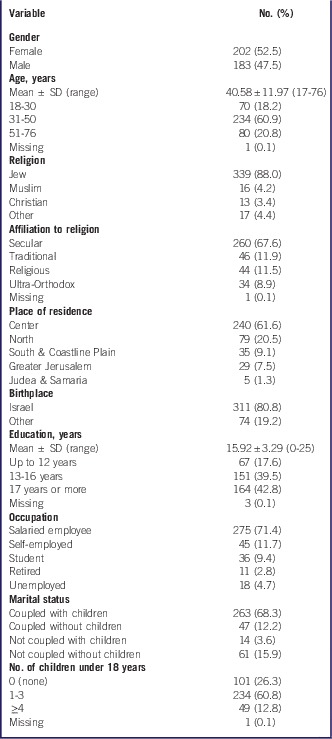
A cross-sectional study was conducted by using an Internet-based survey between January and February 2016. The survey was administered via the Google Forms (Google Inc, Mountain View, CA) platform and the Israeli online survey panel iPanel (iPanel.co.il; iPanel, Bnei-Brak, Israel). The sample included 385 participants from a diverse sociodemographic background representing the different sectors of Israeli society. The full demographic distribution of the studied sample is presented in Table 1.
Sociodemographic Distribution of the Study Population (n=385)

The choice of online survey was made in light of the multitude of statements included in the questionnaire (86 items), which are easier to administer in writing (as opposed to over the phone). The online questionnaire was spread through e-mail and social media by use of snowball sampling. Given little representation of the Arab and ultra-Orthodox communities in the final sample, we contracted iPanel, an Internet survey company, to survey these populations. The responses obtained through iPanel accounted for 61 of the total sample (30 Arab and 31 ultra-Orthodox Jews). The iPanel responses were pooled with the general results to generate one database of 385 respondents.
Tools
The tool designed for this study included several questionnaires. (1) The Preparedness Index (PI) is a score calculated as the number of action items a subject complied with out of a list of 14 preparedness actions recommended by civil defense authorities (Box 1; Cronbach’s alpha: 0.740). (2) Sense of preparedness was calculated as the mean score of answers to 3 items on a 5-point Likert scale (Cronbach’s alpha: 0.806), as follows: “to what extent are you familiar with the Home Front Command’s recommendations for armed conflicts preparedness?,” “To what extent do you feel mentally and emotionally prepared to an armed conflict?,” and “To what extent do you feel physically prepared to an armed conflict?” Subjects were asked to provide their evaluation of these items prior to reporting their actual household adjustments for armed conflicts. (3) The Trait Anxiety Inventory,Reference Spielberger, Gorsuch and Lushene 16 adapted and validated in Hebrew by Popper et al,Reference Popper, Amit and Gal 20 consisted of 20 items on a 4-point Likert scale (1, almost never; 2, seldom; 3, often; 4, almost always; Cronbach’s alpha: 0.913). (4) The Life Orientation Test,Reference Scheier and Carver 17 adapted and validated to Hebrew by Popper et al,Reference Popper, Amit and Gal 20 was utilized in this study as the optimism scale: 6 items on a 5-point Likert scale (1, very much disagree; 2, disagree; 3, indifferent; 4, agree; 5, very much agree; Cronbach’s alpha: 0.817). (5) The Behavioral Inhibition System (BIS) and Behavioral Activation System (BAS) scales,Reference Higgins 21 adapted and validated to Hebrew by UmanskyReference Umansky 22 consisted of 24 items, of which 7 items pertained to the BIS scale, 13 pertained to the BAS scale, and the remaining 4 were fillers. Items were presented on a 4-point Likert scale (same as the Trait Anxiety Inventory; Cronbach’s alpha: 0.830). (6) The Life Style Index (LSI)/ego defenses,Reference Conte and Plutchik 19 adapted and validated in Hebrew by Apter et al,Reference Apter, Gothelf and Offer 23 were adjusted to include 10 items pertaining only to denial and rationalization coping mechanisms (5 items each) presented on a 4-point Likert scale (1, never; 2, seldom; 3, sometimes; 4, almost always; Cronbach’s alpha: 0.676).
List of Action Items Recommended by the Israeli Civil Defense Authority for Household Adjustment to an Armed Conflict (in Order of Appearance in the Questionnaire)
Recommendation
R1. Identifying a safe room in the house
R2. Acquiring emergency flashlight
R3. Acquiring gas mask(s)
R4. Acquiring first aid kit
R5. Preparing communication means in safe room
R6. Acquiring radio and batteries
R7. Acquiring canned or wrapped food items
R8. Preparing entertainment solutions for lengthy stay in safe room
R9. Acquiring items for sealing the safe room (nylon sheets, tape)
R10. Acquiring bottled water (4 liters per person)
R11. Creating backup copies of important documents
R12. Acquiring a fire extinguisher
R13. Preparing an evacuation bag with personal necessities
R14. Preparing a family response plan and exercising it
Statistical Analysis
The statistical analysis of the results was performed by using SPSS version 23 (IBM Corp, Armonk, NY). The analysis included both descriptive and analytical methods, and the statistical tests were chosen according to the distribution of variables. Prior to analysis, indexes were generated and their reliability was assessed by using Cronbach’s alpha. The Shapiro-Wilk test was used to determine normal distribution of variables. Spearman’s correlation test was used to examine correlations between continuous variables. Mann-Whitney U tests were used to compare means of categorical variables. In addition, to evaluate the predictive capacity of studied constructs over reported preparedness, linear regression analysis was performed with 2 blocks on Enter mode. Only variables found to be associated with the dependent variable were introduced following negation of multi-collinearity (maximum VIF value of 2.5). The first block included demographic variables (age, continuous; number of children, continuous; gender, 2 categories; religion, 2 categories), and the second block included psychological constructs (sense of preparedness, anxiety, optimism, BIS, BAS, denial, and rationalism; all continuous). In all statistical analyses performed, a P value of 0.05 or less was determined as statistically significant.
RESULTS
The dependent variable in this study was the PI, which indicated the number of actions reported by a respondent as complied with from a list of 14 actions recommended by the civil defense authorities as household adjustments for an armed conflict (Box 1). The average number of actions reported as complied with per respondent was 6.05 (±2.92 [SD]). According to the Shapiro-Wilk test, this variable was not normally distributed in the studied sample. Spearman correlation analysis indicated that all psychological constructs examined in this study were statistically associated with this index, with the exception of the BAS. The results suggested that optimistic and rational individuals reported significantly higher levels of preparedness, whereas people scoring highly on the trait anxiety scale and those with a tendency to use denial coping mechanisms reported significantly lower levels of preparedness. In addition, the BIS was found to be significantly negatively associated with reported preparedness (Table 2).
Spearman Correlations of Preparedness Indexes and Psychological Constructs (n=385)Footnote a

a Abbreviations: BAS, Behavioral Activation System; BIS, Behavioral Inhibition System; PI, Preparedness Index; prep., preparedness.
b Correlation is significant at the 0.05 level (two-tailed).
c Correlation is significant at the 0.01 level (two-tailed).
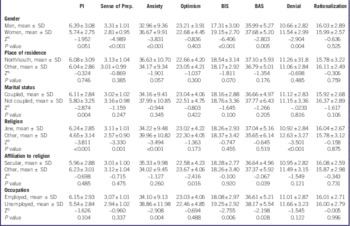
Correlation analysis of the demographic variables was performed as a preliminary step toward a linear regression analysis. The correlation analysis indicated that the older the respondent, the greater the level of preparedness he or she reported. In addition, Jewish respondents and those living with a spouse reported statistically significantly higher levels of preparedness than did non-Jewish and single respondents, respectively. Jewish respondents also reported feeling more prepared than did non-Jewish respondents. The more children a respondent had, the more he or she reported greater levels of preparedness. A trend toward a significant difference was observed for gender, with men tending to report higher levels of preparedness than women; however, this result was not statistically significant. No significant differences were observed for other demographic variables with regards to preparedness.
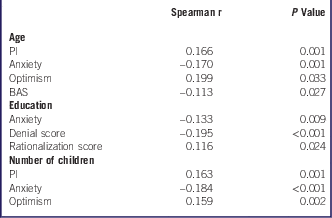
The findings of the demographic analysis also suggested that older individual scored higher on the optimism scale and lower on the anxiety and BIS scales. The more educated the respondent, the lower he or she scored on the anxiety and denial scales and the higher he or she scored on the rationalism scale. The more children a respondent had, the higher they scored on the optimism scale and the lower on the anxiety scale. Men, as opposed to women, tended to score lower on the anxiety, denial, BIS, and BAS scales. Jews, as opposed to individuals belonging to other faiths, scored lower on the anxiety and denial scales. Secular respondents reported lower levels of optimism and also scored lower on the BAS scale than did individuals more religiously observant. Employed respondents, as opposed to unemployed, reported lower levels of anxiety and scored lower on both BIS and BAS scales. Table 3 summarizes the statistically significant Spearman correlations and Table 4 the nonparametric test results.
Correlates of Age, Years of Education, and Number of Children (n=385)Footnote a

a Abbreviations: BAS, Behavioral Activation System; PI, Preparedness Index. Only statistically significant correlations are presented.
Comparison of Psychological Construct Scores Between Demographic Categories (N=385)Footnote a

a Abbreviations: BAS, Behavioral Activation System; BIS, Behavioral Inhibition System; PI, Preparedness Index; prep., preparedness.
b Z values computed by Mann-Whitney Test for nonparametric comparisons; For each variable the first category was identified as “1” and the second as “0.”
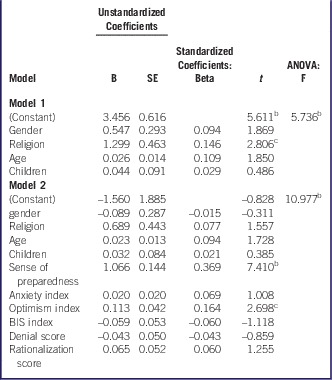
To predict the number of actions an individual will comply with, a multivariant linear regression analysis was performed. The regression included the following variables with 2 blocks on Enter mode. The first block included demographic variables found to be statistically associated with the dependent variable (PI): gender, religion, age, and number of children. The second block included psychological constructs also statistically associated with the dependent variable: sense of preparedness, anxiety, optimism, BIS, BAS, denial, and rationalism. Table 5 presents the results of the regression analysis. The findings of the multivariable linear regression analysis suggested that 22.8% of the total variance of the PI could be predicted by the included variables. The predominant variable in predicting the number of recommendations an individual will comply with was sense of preparedness (β=0.369).
Results of Linear Regression Analysis of Reported Preparedness With Associated Demographics and Psychological ConstructsFootnote a

a Abbreviations: BIS, Behavioral Inhibition System; PI, Preparedness Index. Regression performed in Enter mode with 2 blocks. The first block included demographic variables and the second block included psychological constructs. Included in the regression analysis were variables significantly associated with the dependent variable (PI). No collinearity observed between included variables (all VIF values under 2.5).
b P<0.001
c P<0.01.
DISCUSSION
The results of this study provide only partial support to our hypotheses. All psychological constructs examined in this study were in fact associated with the PI for measuring the level of reported preparedness for armed conflicts, with the exception of the BAS scale. The results support hypotheses H1, H2, H3, and H6 but refute hypotheses H4 (no significant correlation was found between reported preparedness and the BAS index) and H5 (the results suggested that contrary to our assumption, rationalization is positively associated with preparedness behavior rather than negatively).
The findings of this study suggest that individuals scoring higher on the optimism scale also report higher levels of preparedness. In contrast, individuals scoring higher on the anxiety scale report lower levels of preparedness. We also found a negative correlation between the BIS score and reported preparedness, which suggests that the more prominent the BIS in an individual the more they avoid preparedness behavior. Similarly, the more an individual tends to use denial-based coping mechanisms, the less likely they are to report higher levels of preparedness.
In addition, the results indicate that the BAS scale is not associated with reported preparedness. Effectively, this means that while the BIS is negatively associated with reported preparedness, as expected, the parallel system for behavioral activation is not positively associated with this variable. This finding serves to further highlight the complexity of the behavioral model of preparedness behavior for armed conflicts in Israel. While inhibition of preparedness behavior is prevalent, the activation of said behavior is not readily achievable, even when examined through motivational constructs directly related to activation of behavior.
The findings of this study are in line with those of previous studies performed to explore the field of emergency preparedness in Israel. In particular, prior research has shown that the Israeli population exhibits determinants of victimization in perception of the threat of armed conflicts.Reference Bodas, Siman-Tov and Kreitler 11 In other words, owing to the chronic nature of exposure to the threat of armed conflicts, Israelis have developed apathy and indifference. They have become desensitized to this threat to a point at which classic models of behavior prediction become inapt. For Israelis, the perception of the severity or likelihood of the threat is almost irrelevant with regard to their preparedness behavior. It is more the perception of fear and appraisal of control that dominate the decision-making process in one’s preparedness behavior.Reference Bodas, Siman-Tov and Kreitler 11 The results of this study support these findings. We observed a direct positive correlation between the use of denial-based coping mechanisms and procrastination of preparedness behavior. We also reported that anxiety and optimism work in opposing ways to influence preparedness behavior, in line with what can be expected with victimized populations.
Nevertheless, the findings of the current study also challenge some findings reported in the past. For example, in a study performed in 2013 to explore the level of household preparedness to armed conflicts in Israel and its correlates, an association was reported between the reported level of preparedness and place of residence.Reference Bodas, Siman-Tov and Kreitler 8 The results of that study suggested that residents of the north and south of Israel, who were under heavy rocket fire in recent years, reported higher levels of preparedness than did residents of the central parts of the country who were less exposed to the rockets threat. In the current study, we reported no significant differences between these groups. A major difference between the 2013 research and the current research is the occurrence of the July-August 2014 Gaza conflict (also known in Israel as Operation “Protective Edge”). During this conflict, 70% of the Israeli population from Haifa in the north to Be’er Sheva in the south were under rocket fire. Perhaps this “taste of war” for citizens of the central parts of the country balanced the field and caused levels of preparedness to even out across the country. If this is true, this phenomenon demonstrates the level of apathy that developed among Israelis to the threat; action was taken only when the threat became real and imminent. Even then, levels of reported preparedness remained low, with an average of 6.05 (±2.92 [SD]) actions reported as complied with per respondent out of 14 recommended actions.
Additional insights can be drawn from the results of this study. Perhaps most interesting and worth discussing are the differences found between men and women. According to the results of this study, men tended to report statistically significantly higher sense of preparedness and higher, although not statistically significant, levels of actual preparedness than did women. This finding is similar to the finding reported by Bodas et al,Reference Bodas, Siman-Tov and Kreitler 8 who found a statistically significant difference in both reported preparedness and sense of preparedness in a nationwide sample. In this study, we also found that men scored statistically lower than did women on the anxiety, denial, and both BIS and BAS scales. Essentially, this means that differences between men and women existed not only on the level of preparedness perception, but also on the level of the psychological constructs associated with that behavior. Other studies have shown similar trends. For example, Bodas et alReference Bodas, Siman-Tov and Kreitler 11 reported that men were about 60% less prone to perceive the threat of armed conflicts more severely than women. Sofer et alReference Soffer, Goldberg and Adini 24 demonstrated the tendency of Israeli men to perceive greater confidence in their preparedness level than women. The literature often tends to explain this difference between the genders on the basis of their classic roles in the familial structure, and in Israel, in particular, on the military background of men compared to women.Reference Soffer, Goldberg and Adini 24 - Reference Page, Rubin and Amlot 27 It is possible that there is some truth to this explanation; however, alternative explanations might be considered.
For instance, Greenberg and SchneiderReference Greenberg and Schneider 28 hypothesized that men and women residing in neighborhoods stressed by multiple hazards would demonstrate similar concerns about local environmental conditions as opposed to “good neighborhoods,” in which the level of environmental threat is reduced. Their study revealed that, in fact, differences in threat perception were statistically significant between men and women only in low-threat neighborhoods, but as expected, not in stressed ones.Reference Greenberg and Schneider 28 This finding suggests that in stressed conditions, ie, in which the threat is easily noticeable, differences between men and women are diminished. However, our study suggests that despite the elevated risk to the population, there remain differences between the genders. Given what we already know about the victimization characteristics present in the perception of threat in the Israeli population, perhaps reporting bias should be considered as a possible explanation for the differences reported between men and women in this and other studies performed in Israel in the context of emergency preparedness. It could be that the societal roles projected on men and women in Israel take effect in their scoring of certain psychological constructs. In particular, we should consider the differences in military service between the genders in Israel. Despite mandatory service imposed on both genders, more men than women serve in combat positions in the military. According to HerzogReference Herzog 29 (p 68): “the military [in Israel] plays an important role in constructing “manhood” identity…[gender stereotype] attitudes are intensified during army service and are further honed upon discharge.” The reaffirmation of masculine-macho culture in Israel might explain and support reporting bias in our study. It is possible that Israeli men report a lower level of anxiety than they actually experience and tend to take a looser approach in determining whether they complied with a certain task. In contrast, Israeli women might be more genuine about their actual feelings and judge more harshly whether they complied with a certain task.
Finally, the results of the multivariable regression analysis suggest that prediction of reported preparedness can be made through assessment of the sense of preparedness one reports, as well as one’s tendency for optimism. This finding is relatively surprising because it suggest that optimism is not only associated with reported preparedness but might also hold predictive power over this variable. This finding can shed additional light on the complexity of the psychological perspective of preparedness behavior to armed conflicts in Israel. It suggests that encouraging people to take a more optimistic view of life might promote their engagement in preparedness behavior to armed conflicts. Future research should explore this option as an innovative means for promotion of household adjustment to armed conflicts.
Although attitudinal variables are usually poor predictors of actual reported preparedness behavior, as also indicated in this study, we believe that the outcomes of this and other studies we performed provide an opportunity to explore new means to promote preparedness behavior. Out-of-the-box thinking is required if we wish to break through the current psychological barriers holding people back from engaging in preparedness behavior. Psychological interventions based on the knowledge acquired thus far might prove effective in reaching this goal.
Research Limitations
This study had some limitations. First, the study was based on cross-sectional data and can only indicate associations between variables rather than causality. Second, despite inclusion of different sectors of the Israeli society, the study sample was not representative of the adult Israeli population. In particular, the sample over-represented respondents who were Jewish, secular, married with children, and residing in the center of the country. As a result, overarching generalization of the findings might prove difficult. Third, the use of self-assessment scales in this study might lead to biases caused by social desirability, as discussed with the case with gender differences reported in this study. Lastly, responses to the study questionnaire were obtained through online means only. According to 2010 data of the Israeli Central Bureau of Statistics, 77.3% of Israelis over the age of 20 have access to the Internet. 30 Despite this large proportion of the population with Internet access, the conclusions of this study cannot be generalized beyond the group of Internet users.
CONCLUSIONS
The results of the current study suggest that certain psychological constructs play a role in the shaping of preparedness behavior to armed conflicts in Israel. In particular, trait anxiety and optimism appear to be substantially associated with preparedness behavior. In the past several years, a considerable body of research has been achieved regarding the preparedness for and perception of the threat of armed conflicts in Israel. The findings of these studies suggest that the patterns of preparedness behavior to armed conflicts in Israel differ from those reported for other populations and resemble those reported for victimized populations, ie, those chronically exposed to a given threat. The results of the current study help to piece together the complex socio-psychological perspective of preparedness behavior in Israel. Future research should strive to explore innovative ways to overcome the challenges associated with motivating Israelis to engage in preparedness behavior. The current study provides evidence that some psychological constructs might be suitable candidates for intervention programs aimed at increasing preparedness motivation.
Acknowledgments
This work was performed in partial fulfillment of the requirements for a PhD degree by MB at the Sackler Faculty of Medicine, Tel-Aviv University, Israel. The authors acknowledge financial support from the Department of Disaster Medicine at the School of Public Health, Sackler Faculty of Medicine, Tel-Aviv University.