

This chapter will uncover more of Arctic geopolitical dynamics by doing several things. It will lay out the argument for why, in fact, it makes sense to divide the Arctic into subregional security complexes (SRSCs) when we discuss security and geopolitics in the North. Thereafter, this chapter will take a dive into the two SRSCs that in fact make up security relations and dynamics in an Arctic setting, namely the Barents SRSC and the Beringia SRSC. This is arguably where most Arctic security interactions and practices have materialised over the last decades, but these domains are only slightly, if at all, interlinked.
Centring SRSCs
This book has so far established that when we study Arctic security dynamics, the circumpolar lens is often too broad and fails to capture the complexities and nuances of the dynamics that take place in parts of the Arctic. As particularly apparent in the previous chapter, examining US and Norwegian security practices, when we study and describe Arctic security relations, the national perspective taking into account the immediate ‘near abroad’ is often the more fruitful approach to uncover what is actually happening in terms of security and defence issues. What emerges from such a distinction is the emphasis on, and role of, geography. It is clear that the defining features that impact state security practices are size of the spatial domain in question, distance between states, and operability.
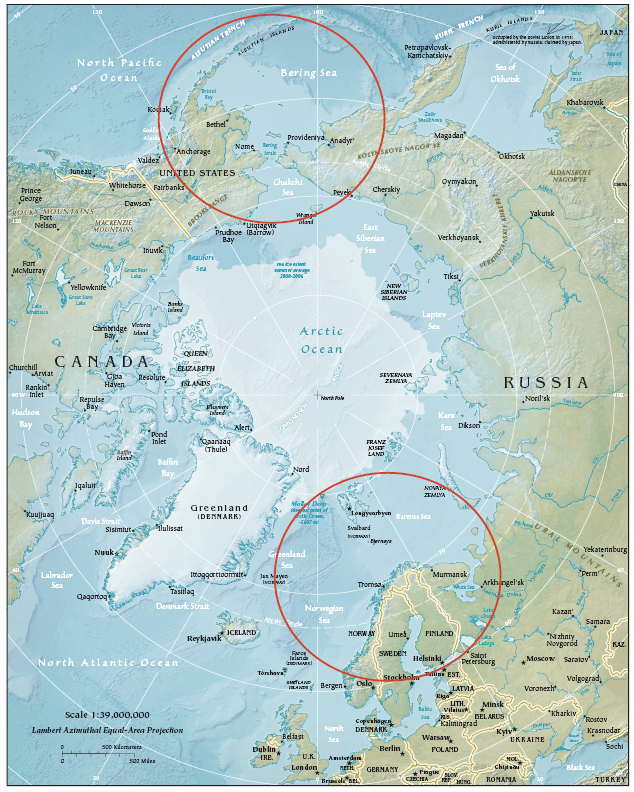
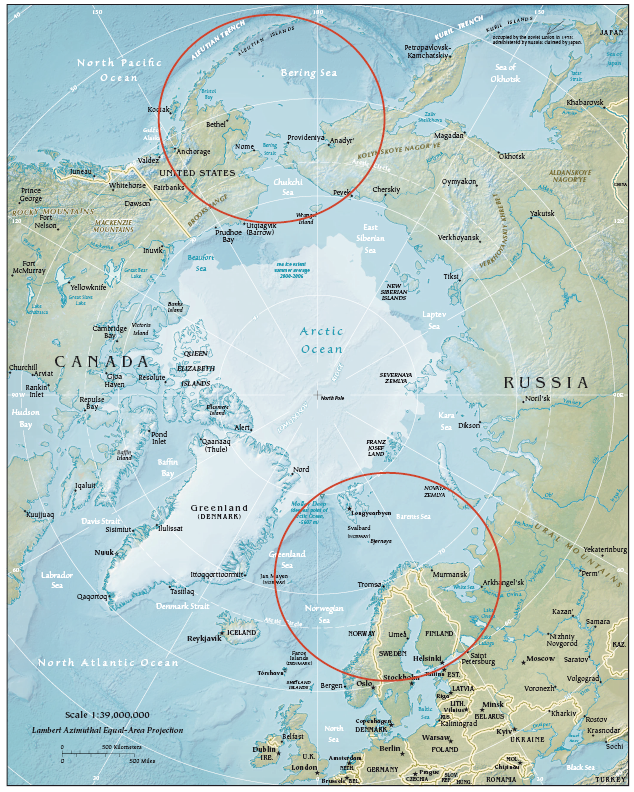
Thus, only a few Arctic issues relating to security described in Chapters 3–6 have a pan-Arctic or circumpolar effect, such as diplomacy and cooperation in pan-Arctic forums and the threat from Russian strategic forces. Instead, subregions, or SRSCs, are where security issues and practices compound. Arctic security dynamics and practices are in other words primarily grounded in Arctic SRSCs, not in the whole circumpolar region (see Figure 7.1).
Map of the Arctic, with the two subregions highlighted by circles.
Note: The location of the circles is not accidental. The European/Barents subregion is located further North than the Pacific one, basically due to different climatic conditions defining the operating areas and in turn where security practices take place.
Buzan and Wæver also highlight the importance of what they term subcomplexes: ‘Subcomplexes represent distinctive patterns of security interdependence that are nonetheless caught up in a wider pattern that defines the RSC as a whole.’Footnote 1 The idea of subcomplexes concerning the Arctic has been mooted before. Åtland hinted at this in 2007, with his examination of the European Arctic as a possible separate regional security complex. Karsten Friis (Reference Friis2021) did the same in his article ‘Analyzing Security Subregions: Forces of Push, Pull, and Resistance in Nordic Defense Cooperation’. However, both scholars do not relate these subregions to the wider notions of an Arctic region, or security region. Moreover, Wilfrid Greaves (Reference Greaves2019), in his article ‘Arctic Break Up: Climate Change, Geopolitics, and the Fragmenting Arctic Security Region’, takes a different approach, arguing that the Arctic is in fact breaking up into subregions due to both climatic and security changes. The premise was thus that the Arctic, for a brief period in time, existed as a distinct regional complex on its own, but that is now changing: ‘The result will be a circumpolar region that is less distinctly ‘Arctic’ than in the past, as the exceptional and cooperative nature of recent Arctic politics is replaced by adjacent security sub-regions characterized by different combinations of great power influence, economic nationalism and investment, environmental change, and ongoing human insecurity.’ (Greaves Reference Greaves2019)
This builds on the premise that there was an Arctic regional security complex, namely that the Arctic states’ security practices were truly intertwined, and that the region did serve – even for a brief time – as an outlet of these. Indeed, perhaps for some states such as Canada and Norway in the period from around 2005 until 2014, the spatial-political outlet for security interactions and initiatives truly was the Arctic (although they emphasised different Arctics).Footnote 2 From 2005 onwards, the Norwegian government argued that the Arctic was Norway’s ‘primary strategic foreign policy priority’ (Stoltenberg et al. Reference Stoltenberg, Halvorsen, Haga, Solberg, Djupedal, Arnstad, Kolberg, Westhrin and Meltveit Kleppa2005: 6). Similarly, Canadian Prime Minister Stephen Harper elevated the Arctic as a national priority when in office from 2006 (Dodds Reference Dodds2011; Lackenbauer Reference Lackenbauer2013b).
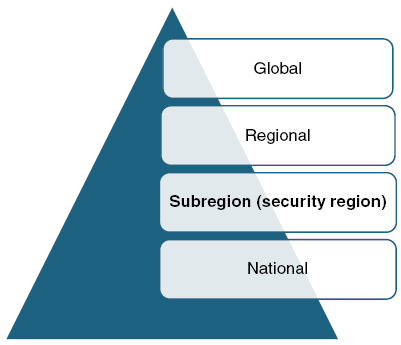
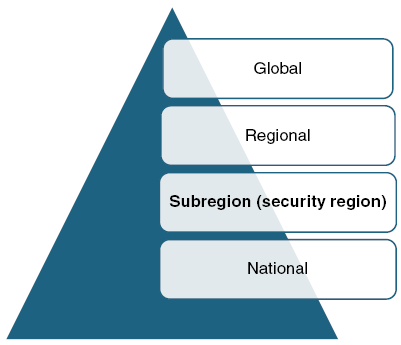
However, even then there was an explicit divergence between practices and defence and foreign policy interests, both domestically in each of those states, and between them (Østhagen, Sharp, and Hilde Reference Østhagen, Sharp and Hilde2018). Undoubtedly the Arctic (what the two states meant by that – High North and the North in their respective contexts) was central to both states and still is. But as explained in Chapters 4–6, these different Arctics did not, and still do not, sufficiently overlap to constitute a coherent region or even subregion – at least not in terms of security practices. The Arctic does not become a security region just because state leaders emphasise the importance of their respective parts of the Arctic. However, we can instead divide the Arctic into several distinct, albeit slightly overlapping, SRSCs when examining security relations. The two main ones of interest here are the Barents SRSC (or the North Atlantic SRSC) and the Beringia SRSC (or the North Pacific SRSC). This adds another layer of complexity and nuance to the three-level analysis so far employed in this book (see Figure 7.2).
A simple division into four levels makes it easier to delineate the various dynamics of the Arctic from each other, with emphasis added on the additional ‘subregion’.
What marks these SRSCs is that they are the spatial parts of the Arctic where states’ security interactions are more intense than in other parts. The geographical proximity of states is the first key variable. The second is security interactions driven by the presence of military forces for both conventional and strategic purposes. Therefore, although we might also think of the North-West Atlantic domain (Greenland, Canada, Iceland) as a third SRSC in terms of state interactions or in terms of resource management and ocean governance, it lacks the security component that is present in the other two highlighted areas. The Kingdom of Denmark, Canada, and Iceland are allies under the NATO umbrella and collaborate closely on security issues – and despite Trump’s ideas about control over Greenland, we are currently not witnessing sufficient security practices in and around Greenland to warrant a whole new subregional complex emerging.
Another candidate for a SRSC would be the territory and maritime domain in the Russian Central Arctic and Far East, stretching from Novaya Zemlya to the Chukchi Sea. This would incorporate vast parts of the Russian Arctic and the Russian maritime domain towards the North Pole. As we explored in the previous chapter, this is also a region of strategic and military importance. However, there are limited security interactions amongst states in this part of the Arctic. This is due to the remoteness and distance from nearby Arctic states, whether it is from Norway and Finland to the West, the USA to the East, or Canada and Greenland across the North Pole. We should also note that the ‘High Arctic’ – the area surrounding the North Pole – does not qualify as a SRSC in terms of security simply because there is limited state presence and activity there, and the proximity to both states’ territory and security interests is too great.
From a state security perspective, it is arguably therefore most relevant to examine the two SRSCs with the highest levels of security dynamics and related practices, the Barents SRSC and the Beringia SRSC. These two parts of the Arctic are defined by a maritime domain/sea (Barents and Bering Seas), where Russia – as the main security concern for the other seven Arctic states – is forced to interact with one or more of the other Arctic states due to geographic proximity. Moreover, the presence of the Russian strategic fleets – the Pacific Fleet and the Northern Fleet – deems both domains crucial in Russian strategic thinking and thus also requires a response from NATO countries. At the same time, the two domains are markedly different along a range of parameters.
The Barents SRSC
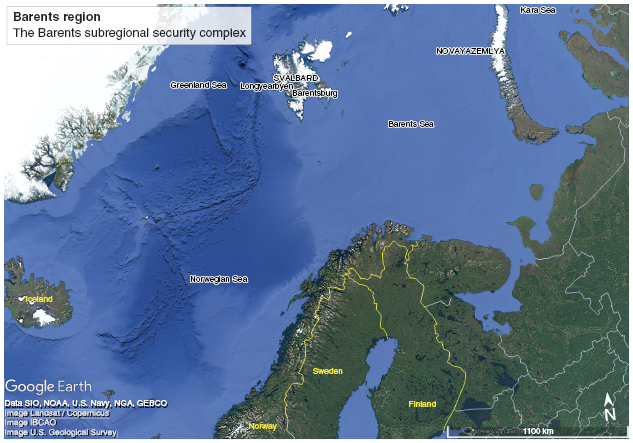
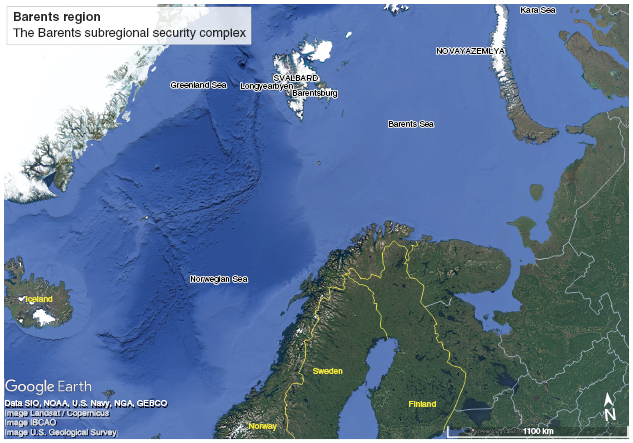
The Barents Sea is located north of the Norwegian and Russian mainland, just off the Arctic Ocean itself (see Figure 7.3). Its boundaries are set by the Svalbard archipelago (Norway) to the west, Franz Josef Land (Russia) to the north, Novaya Zemlya (Russia) to the east, and the European continent (mainland Norway and Russia) to the south. The Sea is named after the Dutch explorer Willem Barentsz, who ventured northwards in search of a sea route to Asia via the northern hemisphere in the late sixteenth century.
Image of the Barents subregion.
When looking at the North Atlantic/Barents Sea, the defining actor is obviously Russia. The Barents Sea holds strategic and economic importance for Russia for several reasons: it provides access to the Arctic Ocean as well as the Atlantic Ocean writ large as its north-western ports remain ice-free even during wintertime. As described in Chapter 4, the strategic military importance of the Kola Peninsula and this part of the Arctic cannot be underestimated for the Russian state. The other primary state in this context – in addition to Russia – is Norway. Historically, being the only northern NATO member bordering the USSR, and with its vast coastline exposed towards the Barents Sea and the Arctic, Norway plays a particularly central role in that subregion’s security dynamics.
Iceland and Greenland are also relevant; however, their limited population and lack of military assets do not infer great regional clout vis-à-vis Russia and they are located at a relative distance. Finland and Sweden are relevant too – especially after their decision to join the NATO alliance in 2022 – although a limited northern population, lack of infrastructure, and political prioritisation of the North infers less immediate significance.
In the Barents Sea domain, the change in the defence and security posture started in 2007, as Russia resumed Cold War patterns of military activity on the Kola Peninsula and then engaged in conflict with Georgia in 2008. Norway responded by, for example, launching the Core Area Initiative in NATO in 2008 and indeed had already – from 2006 – initiated the Cold Response military exercise in the North. This is the start of the contemporary tit-for-tat response and military build-up that has continued in this maritime and land domain, primarily driven by Russian military expansion. When, on 24 February 2022, Russia launched its full-scale invasion of Ukraine, previously held Western assumptions about Russian calculations and the Arctic, and especially the Barents Sea, as an exceptional or ‘low-tension’ space were questioned. In many ways these dynamics peaked in 2024 when Sweden was accepted as a NATO member, deeming the whole subregion a NATO–Russia-defined spatial domain.
The Svalbard Focal Point
The archipelago of Svalbard stands out as a specific geographic location for the importance of geography and security-related dynamics – or geopolitics – in the Barents Sea domain. A range of other cases exist, such as the land border between Norway and Russia, or the extensive 1,340 km long now-NATO border between Finland and Russia. However, Svalbard is a particularly relevant example of geopolitics, security, and state concerns, all in a SRSC. As a fibre-optic cable running from Svalbard to the Norwegian mainland was disrupted just weeks before the Russian invasion of Ukraine (Fredriksen et al. Reference Fredriksen, Pettersen, Hesla, Eriksen and Gulldahl2022), fears of hybrid activity perpetrated by Russia rose across the Arctic region, and Svalbard became a focal point for some of the renewed public concern about ‘Arctic geopolitics’.Footnote 3
Traditional geopolitical analyses focus on the relationship between geography and conflict-driven politics amongst states. In this instance, the mere presence of Russian – and previously Soviet – communities on Svalbard can serve as a case study for geopolitical rationales as manifested in human activity and physical infrastructure (Houck Reference Houck2022). Moreover, as activity has increased in the near-Arctic area because of changing geophysical conditions as well as states being eager to showcase their Arctic economic interests and research capabilities, Svalbard has become an increasingly popular topic in discussions of power politics and their manifestations – through Arctic policy documents, research stations, or geoeconomic actions.
Over time, as Norway has implemented stricter or more coordinated regulations, applying to everything from tourism to research, and limited certain types of activities that do not fall under the scope of the 1920 Treaty, some Treaty signatories have voiced discontent over specific issues (J. H. Jørgensen Reference Jørgensen2010; Pedersen Reference Pedersen2008a). Such complaints have come primarily from the USSR, and later Russia, as the only state with a sizeable population in their own communities on Svalbard (ИноСМИ 2017). These complaints have concerned Russian companies not being allowed to use helicopters for tourism; what Russia has claimed as being extensive environmental regulations and the creation of national parks; and questions concerning the alleged use of the Svalbard satellite station for military purposes (Ministry of Foreign Affairs of the Russian Federation 2020; Moe and Jensen Reference Moe and Jensen2020).Footnote 4 The Norwegian government’s response has been to focus on how Norwegian policies regarding Svalbard and the Russian population do not in fact breach the Treaty (Moe and Jensen Reference Moe and Jensen2020; High North News 2016; Wormdal Reference Wormdal2022; B. M. Pettersen et al. Reference Pettersen, Eriksen, Gulldahl, Fredriksen, Koppergård, Norstrøm and Ursin2023).
In particular, Russia has complained about Norway allegedly using Svalbard for military purposes, in breach of Article 9 of the Treaty (Tamnes Reference Tamnes, Dahl and Jensen2020). The Norwegian Coast Guard regularly docks in Longyearbyen to resupply, and the Norwegian Navy sends a frigate to Svalbard once a year to highlight Norwegian sovereignty and capacities in the area. Russia sees this as a challenge to the Svalbard Treaty – although, as already discussed, the Treaty does not hinder Norway having a military presence on or around the archipelago as long as the purpose is not ‘warlike’ (Finnset, Berg, and Rostad Reference Finnset, Berg and Louise Rostad2022). This points to the crucial difference between being a ‘demilitarised’ zone and adhering to the actual wording of Article 9 in the Treaty.Footnote 5 Russian sensitivities to the question of military activity on Svalbard relate, to some extent, to the proximity of Svalbard to the Northern Fleet on the Kola Peninsula and its strategic position for defending Arctic territory and projecting power in the GIUK (Greenland, Iceland, and the United Kingdom) and Bear (after Bear island) gaps – a point I return to below.
Similar complaints have been raised by Russia concerning the Norwegian satellite station located on Svalbard – which is the world’s largest commercial ground station (KSAT 2021) – where Russia has questioned whether the data gathered are used for ‘warlike purposes’ (B. M. Pettersen, Schaubert, and Eriksen Reference Pettersen, Schaubert and Eriksen2022). This point is difficult to prove or refute, as satellite data concerning weather and climate might be used for a range of purposes and spread to a wide range of users. Still, in 2022, Norwegian authorities denied such use of Svalbard’s satellites to a US company and a Turkish company, both of which have links to the military. Some argued that this was due to heightened Norwegian sensitivities related to Article 9 (Wormdal Reference Wormdal2022).
Beyond opposition to Norwegian policies and research coordination, it is clear that, since Russia’s full-scale invasion of Ukraine in February 2022, the Russian authorities seem more intent on reinvigorating their Svalbard presence for both symbolic and strategic purposes (Haugli and Bjøru Reference Haugli and Lohne Bjøru2023a).Footnote 6 In the aftermath, and in tandem with tense relations between Norway and Russia over a range of issues – including shipments to Svalbard in the summer of 2022 – Russia declared its wide-ranging plans for a new research station on the archipelago (Edvardsen Reference Edvardsen2023a). This turned into the larger plan that Trust Arktikugol announced to revive the abandoned settlement of Pyramiden (Nilsen Reference Nilsen2023c). What is to come of this plan is yet to be seen. The Norwegian Intelligence Service has argued that Trust Arktikugol ‘will increasingly become dependent on government transfers’ while also seeking to expand its activities in other areas beyond coal mining (Norwegian Intelligence Service 2023: 19). This is likely what is motivating Trust Arktikugol to make increasingly lofty and sweeping statements about future plans and investments, alongside an increase in applications to the Governor of Svalbard for the right to initiate new activities (Edvardsen Reference Edvardsen2023b).
Moreover, in May 2023, the Russian consul general in Barentsburg led a parade that involved a helicopter and dozens of vehicles waving Russian flags to mark the anniversary of the USSR’s defeat of Nazi Germany (Staalesen Reference Staalesen2023a). A few months later, Trust Arktikugol unlawfully erected a cross outside of Pyramiden, which was interpreted as in support of the Russian war in Ukraine (Nilsen Reference Nilsen2023b). These actions are probably as much aimed at decision makers in Moscow, to raise awareness of Russia’s Svalbard positioning, as they are meant as a challenge to the Norwegian authorities. At the same time, this must be seen as part of a larger Russian strategy that aims to both strengthen its Svalbard presence and increase pressure on Norwegian authorities, perhaps in order to force them to overreact or overreach. This is also about upholding a form of ‘strategic uncertainty’ and an escalatory approach that hopes to provoke Norway to violate the rights of third-party nationals (Østhagen, Jørgensen, and Moe Reference Moe, Dahl and Jensen2020).
Still, in response to such symbolic actions and concerns over possible tension and escalation in Svalbard, Norwegian authorities – through the Governor of Svalbard and the Norwegian Police Security Service – have increased both their presence and their openness regarding their presence (Haugli and Bjøru Reference Haugli and Lohne Bjøru2023a). While these actions and complaints from Treaty signatories do not directly challenge Norwegian sovereignty over Svalbard, the sum of complaints could amount to a larger challenge to how Norway adheres to and interprets the Treaty. This also ties into concerns that some have voiced after 2022 about the Norwegian authorities losing control over foreign activity on the islands (Haugli and Bjøru Reference Haugli and Lohne Bjøru2023b).Footnote 7 In addition, the concern has been that if Russia wanted to escalate a conflict while retaining some form of plausible deniability, it could initiate actions based on these complaints to undermine Norwegian sovereignty.
Russia looms large in all the geopolitical dimensions highlighted. Military use of the archipelago is relevant only in a scenario with a NATO–Russia conflict. Other possible adversaries in a large-scale conflict (e.g., China) are simply too far removed from Svalbard, underscoring the importance of geography in this context. There are two aspects of these security dynamics and practices that may intensify further, linking to the wider SRSC. The first is the issue of access to resources, and possible attempts by vessels from various states to claim their rights at sea, as seen with the EU in the snow crab case (Østhagen and Raspotnik Reference Østhagen and Raspotnik2018; Tiller and Nyman Reference Tiller and Nyman2017).Footnote 8 The fact that snow crabs are defined by all relevant parties as sedentary species also means that how they are managed sets a precedence for other shelf resources such as hydrocarbons and seabed minerals. The attention to oil and gas development on the shelf around Svalbard has somewhat subsided since the heyday of Norwegian Arctic oil and gas interest around 2007–2010, although that might change in the future.
Some have speculated whether the role of China – with the world’s largest fishing fleet – and potential Chinese claims to equal access to fishing rights could come into play concerning fisheries in the Arctic (Hoel Reference Hoel2023; Jonassen Reference Jonassen2023). Liu speculates that Svalbard and the surrounding FPZ could become a focal point for this interest, although China is also wary of causing a rift with Norway over the issue, as China seeks cooperative relations with Norway and portrays itself as a benign actor in Arctic affairs (N. Liu Reference Liu2021). As mentioned, in China’s Arctic Policy from 2018, the Spitsbergen (Svalbard) Treaty is referred to six times to underscore China’s Arctic rights, interest, and history, stating that ‘China maintains that all activities to explore and utilize the Arctic should abide by treaties such as the UNCLOS and the Spitsbergen Treaty as well as general international law’ (State Council of the People’s Republic of China 2018).
The second aspect in this SRSC that might be a cause for concern is a possible escalation of incidents between Russian vessels and the Norwegian Coast Guard that could get caught up in wider security concerns (Østhagen Reference Østhagen2018). Russian fishers are – per the administrative fisheries cooperation – allowed to fish in the FPZ, but the Norwegian Coast Guard is responsible for fisheries inspections and possible fines and/or arrests. However, the Russian state makes a point of not recognising Norwegian jurisdiction to inspect and arrest in these waters (A.-K. Jørgensen and Østhagen Reference Jørgensen and Østhagen2020). This has led to tense situations where Russia has threatened the use of military force to ‘protect’ the rights of its fishers (Østhagen Reference Østhagen2018).Footnote 9 The tenser the wider security relations between Norway and Russia, the greater are fears that such small-scale incidents at sea involving the Norwegian authorities and Russian fishers could escalate out of proportion (Østhagen Reference Østhagen2023d). It should, however, be noted that on a day-to-day basis, the Norwegian Coast Guard regularly inspects Russian fishing vessels without any incidents or escalation as Russia de facto accepts Norwegian jurisdiction, even if the captains of the vessels refuse to sign the inspection documents afterwards (Hønneland Reference Hønneland1999).
Complicating the matter for Norway is the fact that both fishing vessels and research vessels from Russia have access rights to Norwegian waters in the Barents Sea that are difficult to curtail. That fishers with a quota may fish in all of the Barents Sea constitutes a core pillar of the successful co-management scheme of fisheries cooperation between Norway and Russia (Hønneland and Jørgensen Reference Hønneland, Jørgensen, Heier and Kjølberg2015; Hønneland Reference Hønneland2014; Stokke Reference Stokke2022; A.-K. Jørgensen Reference Jørgensen2022). Norwegian politicians have remained wary of disrupting this regime, even after Russia’s invasion of Ukraine in 2022 (Oma Vyvial Reference Oma Vyvial2023; Hønneland and Jørgensen Reference Hønneland and Jørgensen2025).
As this Svalbard discussion showcases, these issues are part of the Barents Sea security domain which is important for Russian power projection. Russia will in all likelihood be intent on rebuilding its Arctic force posture and capabilities that have diminished through fighting in Ukraine and in response to Finland and Sweden joining NATO. As put by the Norwegian Intelligence Service, ‘Svalbard has military strategic significance for Russia, and the Kremlin will prioritise presence also in 2023, despite failing economic rationales’Footnote 10 (Norwegian Intelligence Service 2023, 19). At the same time, calling it ‘NATO’s Achilles Heel’, as James Wither did (2018), might be taking this argument too far and overestimating Svalbard’s strategic position in Russian military thinking. With a focus on security dynamics, equally central are the Barents Sea dynamics evolving as increased economic activity in this part of the Arctic takes place, most notably fisheries, shipping, and – possibly – seabed mining (Hovelsrud, Kaltenborn, and Olsen Reference Hovelsrud, Kaltenborn and Olsen2020; Ylvisåker Reference Ylvisåker2020; Hvinden and Østhagen Reference Hvinden and Østhagen2024).
Finally, a related and relevant question is whether Russian actions (or those of any other state) in the Barents Sea might trigger a collective NATO response, despite diverging legal interpretations about sovereign rights in this maritime domain – as discussed above. However, this is less relevant when discussing Svalbard’s strategic position, as there is limited strategic advantage in operating from the FPZ specifically. It is only holding Svalbard territory as a forward operating base for North Atlantic operations that would make sense in that scenario – and even that is, as mentioned, questionable due to the limited benefits of such an operation.
However, there are more lenses through which to understand Russian actions and interests in Svalbard, or the wider Barents SRSC, beyond the security-oriented or military ones that look only at defence strategies and possible hotspots for escalation. As the only other state with communities on Svalbard, and with interests in economic activities ranging from coal mining to tourism and fisheries, Russia also benefits from maintaining the status quo. The current situation on Svalbard favours Russian economic interests, as well as the wider Russian desire to ensure that regional relations in the Barents Sea remain politically stable. Scholars have thus concluded that undermining the Svalbard regime or disregarding the Treaty itself have so far not been in Russia’s interests (Todorov Reference Todorov2020a, Reference Todorov2020b; Moe and Jensen Reference Moe and Jensen2020; A.-K. Jørgensen and Moe Reference Jørgensen and Moe2023).
The Changing Nature of the Barents SRCS
In turn, what does this walkthrough of contemporary security challenges, concerns, and dynamics regarding the Svalbard archipelago tell us about the Barents SRSC? It showcases how a subregional space and related security dynamics – in this case primarily between Norway and Russia – can cluster around specific spatial objects or domains. Svalbard is unique in the sense that although it is Norwegian territory, it has a somewhat shared history between Norway and Russia, it is located close to strategic Russian forces, and it is the spatial focal point for much of the specific security concerns and tensions between Norway and Russia. Moreover, Svalbard – due to the Svalbard Treaty and its unique set-up – has led to interest from a range of non-regional actors and might – with the increased interest of countries such as India and Turkey – become a central security element in the European Arctic and thus also wider Arctic security relations.
The art of balancing Norway vis-à-vis Russia writ large has had to exercise in the Barents SRSC is about more than just deterrence and reassurance regarding foreign base policy, nuclear weapons, and military exercise activity. The balance has been about securing allied support for deterrence, while at the same time Norway’s policymakers have worked to preserve everything from Arctic cooperation forums to assessing the possibility of new measures vis-à-vis Russia to reduce the security policy tension in the North (Østhagen Reference Østhagen2023b).Footnote 11 Decades of cooperation that started during the 1990s, primarily through the Barents Euro-Arctic Council and related mechanisms between Norway and Russia, but also including Finland and Sweden, were meant to enable more stable subregional relations and foster stability and even ‘peace’ (Onsager and Stuvøy Reference Onsager and Stuvøy2022; Hønneland Reference Hønneland2012b; Leland et al. Reference Leland, Hoel, Aalto, Blakkisrud and Smith2008).
Despite its considerable military and foreign policy capacity, Norway is still relatively limited in scope when it comes to a global security outlook and non-regional entanglements. As the discussions in Chapter 5 highlighted, various governments since 2005 have pinpointed the High North as the country’s primary security interest. Regardless of that rhetorical exercise, if we look at Norway’s military positioning, expenditure, and focus, they tell the same story. Almost all of Norway’s security concerns and practices relate to its High North domain and relations with Russia in the North. In a geographical and spatial sense, this entails the shared 197 km land border with Russia, the maritime boundary and related maritime space in the Barents Sea, the surrounding airspace, and the Svalbard archipelago.
In turn, it is not the ‘Arctic’ but the immediate surroundings that have been the determinant for Norway’s security practices. As put by the Norwegian foreign, and later, prime minister: ‘Our geography defines who we are as a nation. The Barents Sea, the Norwegian Sea, the North Sea, Skagerrak, the coastlines and islands, the continental shelf, the ocean floor, the ocean depths’ (Gahr Støre Reference Støre2023a).Footnote 12 Had Svalbard been located in the South, in the North Sea between Norway and say the UK, its status as a geopolitical focal point would have been limited. For Russia, however, the Barents Sea does not constitute the primary security concern for the state, or ‘define’ what the Russian ‘nation’ is (e.g., Hønneland Reference Hønneland2016).
Although difficult to rank given the size and multiregional positioning of Russia as the world’s largest country spanning eleven time zones, it seems plausible to argue that the Barents Sea – despite its centrality for Russia’s strategic second-strike capability and nuclear triad – is conceived in a somewhat similar way to the other geographic maritime domains where Russia directly encounters a NATO state; namely the Baltic domain, the Black Sea domain, and – to some extent – the Bering Sea domain (see next section). That does not mean that this SRSC is not highly relevant for Russian security practices, but it also showcases the importance of geography and taking into consideration the different, overlapping, and/or extended conceptions of subregions and security practices across different geographic domains.
Finally, an interesting dimension of this subregion will be the role of Finland and Sweden in the future. With fewer inhabitants in their Arctic territories, and less immediate emphasis on the High North (or the Arctic) in their security and foreign policy endeavours, focus has – at least in terms of security practices – primarily been on what we can conceive of as a Baltic SRSC (Kopra and Mikkola Reference Kopra, Mikkola, Raspotnik, Østhagen, Cheltenham and Elgar2025; Khorrami and Moyer Reference Khorrami, Moyer, Raspotnik, Østhagen, Cheltenham and Elgar2025). Questions remain what Russian responses to an additional 1,340 km long NATO border with Finland, partially in the Arctic, will mean for Russian conventional military postures on the Kola Peninsula and in turn the Finnish and Swedish responses. Moreover, seeing Finland-Norway-Sweden as a joint continuum might drag focus and attention from the two NATO newcomers northwards, although this remains to be seen. Here it is equally important to analyse what the different state actors do in terms of security postures, exercises, and new base structures, as much as what the various state officials emphasise rhetorically.
The Beringia SRSC
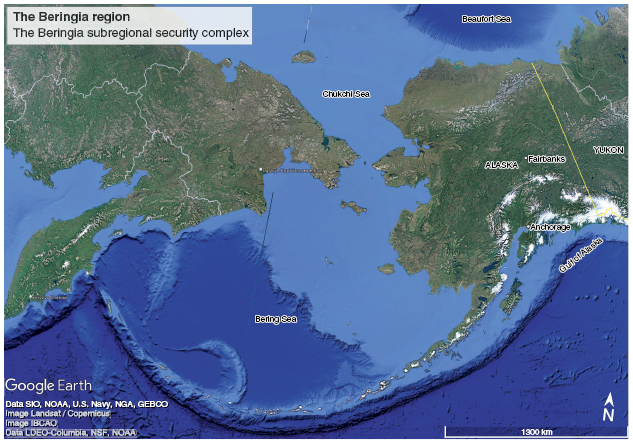
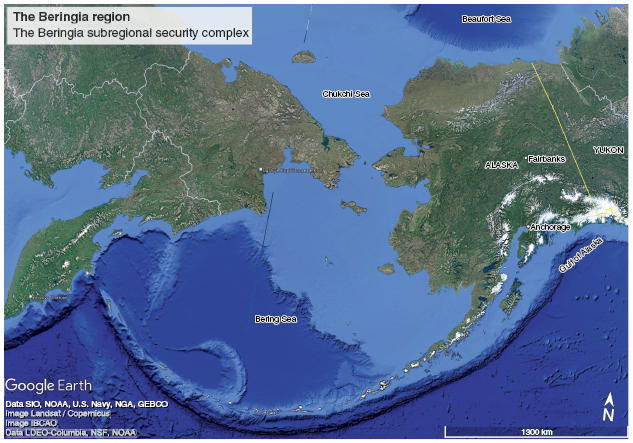
Moving to the Beringia subregion, it is defined as the land and maritime area bounded on the west by the Lena River in Russia; on the east by the Mackenzie River in Canada; on the north by seventy-two degrees north latitude in the Chukchi Sea; and on the south by the tip of the Kamchatka Peninsula (National Park Service 2023). The Bering Sea is named after Vitus Jonassen Bering, a Danish explorer in the service of the Russian Navy, who set out to explore the maritime region towards the Bering Strait in 1728. It connects to the Arctic Ocean through the Bering Strait, a narrow passage that separates the Chukchi Peninsula of Russia from the Seward Peninsula of Alaska. The USA and Russia are separated only by 4 kilometres/2.5 miles of water between the Big Diomede (Russia) and Little Diomede (USA) islands (see Figure 7.4).
Image of the Beringia subregion.
In terms of security dynamics, the level of activity in this part of the Arctic (or subarctic, since the Arctic Circle crosses just north of the Bering Strait) has been lower than the security developments seen in the Barents Sea domain. Although the USA has maintained a force presence in Alaska, it is only in recent years that the state has attracted considerable attention related to security threats. Whereas Svalbard serves as an illustration of a geopolitical dispute that might erupt further, in the Bering Sea/Strait the primary security issue in near-to-medium term is the increased Chinese–Russian security collaboration off the coast of Alaska and the related possible responses from the USA. This might further come into play given related concerns over the impact on Alaskan fishing activity and fears over the disruption of the Bering Sea/Strait maritime boundary and fisheries arrangements.
When the USA purchased Alaska from Russia in 1867, the maritime boundary in the Bering Sea/Strait area was defined, albeit without clearly determined map lines and two interpretations of the line itself, namely the rhomb line (Russia) and the geodetic line (USA) (Kaczynski Reference Kaczynski2007: 2–3; Byers Reference Byers2013). In 1990, the USSR and the USA agreed to settle the rather extensive maritime boundary in the Bering Sea/Strait; this was known as the Baker–Shevardnadze agreement (United States–Union of Soviet Socialist Republics 1990; Verville Reference Verville, Jonathan and Lewis1993).Footnote 13 This agreement stretched through the Bering Strait between Alaska and Russia and extended into the Arctic Ocean to the north, and the Bering Sea to the south.Footnote 14 The US Congress ratified the agreement in 1990; however, after the collapse of the USSR at the end of 1991, the new Russian Duma never ratified it. Although this boundary treaty is not in force, both sides have formally respected its terms (Verville Reference Verville, Jonathan and Lewis1993: 454; R. W. Smith Reference Smith and Gerald1994; Schofield Reference Schofield, Kraska and Scheiber2015). At times, Russian politicians and fishermen have criticised the agreement, arguing that it disfavours Russian fishing interests in the Bering Sea and that Russia ceded more of the formerly disputed area than the USA (Kaczynski Reference Kaczynski2007: 3).
China’s Expanding Presence
The Pacific Fleet’s base in Viliuchinsk/Petropavlovsk, on the eastern seaboard of the Kamchatka Peninsula, is eastern Russia’s closest permanent naval base to Arctic waters. It is home to Pacific Fleet nuclear-powered submarines, in addition to some surface ships. Naval operations in the Bering Strait and the Chukchi Sea by the Pacific Fleet are becoming common, adding to Russia’s Arctic presence alongside the Northern Fleet located in the European Arctic. Starting around 2020, Russian military activity in this maritime domain has increased. Russian military exercises interfering with Alaskan fishers have caused concern over the violation of US rights, as well as the fear of escalation between the fishers and the Russian Navy (M. Baker Reference Baker2020; The Associated Press 2020a).
For the first time, in the summer of 2024 Chinese and Russian bombers conducted joint operations in the Alaska Air Defense Identification Zone, albeit without violating US airspace (H. Williams, Bingen, and MacKenzie Reference Williams, Bingen and MacKenzie2024). In September 2024, coast guard vessels from both countries conducted joint operations in the same region (Xiao Reference Xiao2024). This is in stark contrast to Russia’s scepticism about Chinese naval activities a few years ago. When four Chinese vessels passed the Tsugaru Strait and circled Japan for the first time in October 2008, Russia was concerned about China’s possible advance into the Arctic Ocean (Dutton Reference Dutton2009; Kotani Reference Kotani2019). In 2010, the Commander-in-Chief of the Russian Navy, Admiral Vysotsky, warned that Russia should closely watch China, which is ‘advancing their interests very intensively, in every possible way’ in the Arctic (Faulconbridge Reference Faulconbridge2010). In 2013, the Chinese research icebreaker Xue Long attempted to enter the Sea of Okhotsk without the courtesy of notifying Russia beforehand, which resulted in a warning shot being fired.
Notably, in August 2015, the second phase of their Joint Sea 2015 exercise took place in the Sea of Japan near Vladivostok, involving over twenty ships from both nations (Gady Reference Gady2015). Afterwards, five Chinese ships appeared in the Bering Sea off Alaska. Chinese military commentators suggested that this tested China’s far sea capabilities and aimed to enhance navigational security and strategic presence in the Arctic (CCTV 2015). China’s first Arctic operation following a Russian naval exercise highlighted Russian acceptance of their presence and was seen as a political gesture.
The scale of Russian–Chinese exercises grew significantly after Russia’s invasion of Ukraine in February 2022. In September 2022, the Chinese Navy participated in the Russian Vostok 2022 exercise in the Sea of Okhotsk, marking its first use of army, navy, and air force elements in a joint exercise (X. Liu and Guo Reference Liu and Guo2022). Following Vostok 2022, Russian and Chinese navies conducted their second joint patrol in the Pacific, with Nanchang visiting the Bering Sea (X. Liu Reference Liu2022). Their presence, monitored by the US Coast Guard, included joint patrols in the North Pacific. In July 2023, China organised a first North/Joint-2023 exercise by the PLA Northern Theatre, with Russia as an invitee. Following that exercise, Russia and China conducted their third joint patrol in July 2023 (China.com 2023). During the Russian-China Joint Patrol in 2023, Russian and Chinese navy vessels passed the Sea of Japan, La Pérouse Strait, the Sea of Okhotsk, and Kamchatka Strait, sailing by Alaska and the Aleutian Islands, which triggered US security concerns (Mahadzir Reference Mahadzir2023; Murkowski Reference Murkowski2023b).
The following year, in July 2024, Chinese and Russian navies held the Joint Sea-2024 exercises in the South China Sea, focusing on anti-submarine, air defence, and anti-missile drills. They then conducted a joint Pacific patrol from south of Jeju Island through the Osumi Strait to the South China Sea. Moreover, on 25 July 2024, a joint aerial strategic patrol took place over the Bering Sea involving Russian and Chinese bombers entering the Alaska Air Defense Zone and drawing US attention (The Moscow Times 2024). Furthermore, in September 2024, Russia led its largest post-Soviet naval exercises, Ocean-2024, across several seas, highlighting its nuclear capabilities in the Arctic, with Chinese participation (Dyner Reference Dyner2024). Later that month, China organised the North/Joint-2024 exercise, lasting nearly two weeks and featuring advanced drills with major Chinese and Russian vessels (X. Liu and Guo Reference Liu2024). These naval exercises were, in other words, part of an emerging trend where Russia and China have jointly increased their operations in the North Pacific theatre and – increasingly – off the coast of Alaska, even including an airborne component in 2024.
There is also another element to this, namely the softer coast guard element. In April 2023, Russian and Chinese Coast Guards signed a cooperation agreement in the city of Murmansk, in the European Arctic, and China was invited to observe the Russian Arctic Patrol 2023 exercise (Nilsen Reference Nilsen2023a). Joint coast guard or naval operations are relatively straightforward ways for both countries to demonstrate their collaboration and send a message to the USA that it should not assume dominance in the Bering Sea. Notably, Chinese Coast Guard ships entered the Arctic Ocean for the first time in autumn 2024. For China, joint patrols in the Arctic were meant as a reciprocal response to increased US presence in the South China Sea and also to demonstrate its civilian capacities in an Arctic context (S. H. Choi Reference Choi2024). Russian Coast Guard ships conducted joint exercises and patrols in the North Pacific in September and October 2024, which was a direct consequence of the agreement signed in 2023 (TASS 2024). The Chinese Coast Guard is a paramilitary organ not formally integrated into the Chinese Navy.
As such, China views the coast guard ships as a low-level signalling tool, albeit one that increasingly deploys in order to convey power and ability to operate (S. H. Choi Reference Choi2024). This is becoming evident in the South and East China Seas, where the Coast Guard upholds and reinforces disputed Chinese claims and positions over everything from reef ownership to access to fisheries (Midford and Østhagen Reference Midford and Østhagen2024). In the words of a Chinese military commentator, Professor Shao Yonglin, ‘the Coast Guard and the Navy are completely different’ because ‘the Coast Guard patrols and enforces laws at sea’ while ‘the navy plays a role from the perspective of national security’ (CCTV 2024b). At the same time, Chinese media celebrated this as ‘not only break[ing] through your first island chain, but also sail[ing] thousands of nautical miles all the way to the Arctic Ocean after breaking through the island chain’.
These events and this increased activity started before, but increased after, Russia’s 2022 invasion of Ukraine. They have also taken place in the context of tense wider China–USA relations and when it is apparent that the asymmetry between Russia and China is shifting in favour of the latter. Still, the Bering Strait and North Pacific (Beringia) spatial domains remain distant from China and are considered to be unfamiliar operational environments. Russia plays a significant role in these drills. By inviting China closer to areas considered important for its defence and by increasing interoperability with China, the Moscow regime aims to strengthen its relations with China, while also assessing China’s growing naval capabilities (Conley et al. Reference Conley, Arts, Glaser, Berzina and Archambeau2024). Simultaneously, the signalling component here is central: Russia is obviously highlighting its ability and willingness to protect its interests in the Arctic, linked to, for example, discouraging the USA from conducting Freedom of Navigation Operations along the Northern Sea Route (Gosnell and Saunes Reference Gosnell and Saunes2024).
For China, the drills are also an opportunity to demonstrate their power projection capabilities, while at the same time supporting Russia. Additionally, China seems to want to highlight a reciprocal response regarding the South China Sea, where the USA conducts regular Freedom of Navigation Operations. For instance, the sighting of Chinese Navy vessels in the Bering Sea in 2015 was intended to serve as a signal, providing a reciprocal response to the US involvement in the South China Sea. Although the US reaction was calm, somewhat damping the intended signalling effect, China sees its operations in the Bering region as tit for tat (Pincus Reference Pincus2020).
Chinese media military analysts continue to stress that areas such as the Bering Sea are far away for China and areas that China does not understand very well. As Richard Weitz (Reference Weitz2021) observes, Russia and China seem to take turns holding maritime exercises in regions where each of them seeks to project power, including the South China Sea, Senkaku/Diaoyu Islands, and the Baltic Sea. Following this logic, the Eastern Arctic is a region where Russia is more interested in power projection. What is common among the Joint Sea exercises is that they were always conducted in several theatres. According to the China Power China-Russia Joint Military Exercises database (CSIS 2024), Joint Sea exercises have been conducted since 2012 and have not shied away from areas with maritime disputes.
Simultaneously, China is expanding its interests in the Eastern Arctic region by, for example, organising its own military exercises in the region, the North/Joint exercises. This is a significant change. China and Russia are also continuing to make slow progress on increasing interoperability. Even in 2022, there were reports of Russian cadets learning Chinese in order to improve communications (Kimura Reference Kimura2022). Furthermore, Russia and China understand that the two navies have ‘a win-win effect of making up for each other’s weaknesses’ (CCTV 2024a). China also continues its capacity building, including construction of yet another civilian icebreaker, which is about to start in 2025. China’s icebreaker fleet consists mainly of research icebreakers with limited military significance.
An Emerging SRSC
Chinese encroachments facilitated by an isolated Russia might complicate the wider Arctic security landscape in the longer term. Looking at what these developments mean for the Beringia SRSC, the relationship between Russia and the USA in this domain is obviously complex, shaped by a mix of cooperation and competition. As with the case of the Barents SRSC, geography matters. The fact that you can – although they do not share a border on land – walk between Russia and the USA, or between Asia and North America, at certain times of year, speaks to the need to manage neighbourly relations linked to everything from fisheries to maritime traffic. In this geographic domain, the two primary actors are undoubtedly Russia and the USA, although what has changed in the last decade is the involvement of China. This in turn spurs more attention to the subregion by US decision makers who would arguably not be otherwise concerned with Alaskan security issues (see Chapter 6).
Despite the political tensions between Russia and the USA – especially after 2014 – there is a history of collaboration over fisheries management, environmental protection, and maritime safety in this region. The Bering Sea is significant for both countries economically, especially in terms of fishing.Footnote 15 In the period 2021–2023, total pollock catches were in the region of 1.7–1.8 million tonnes, making it the largest single-stock fishery in the world; 66–78 per cent was taken in the US EEZ, the rest in the Russian EEZ (NOAA 2024b). Consequently, there have been forms of cooperation between Russian and US authorities, especially on the practical level between the US Coast Guard and the FSB Border Guard, even after 2014 (Østhagen Reference Østhagen2016).
For example, from around the 2010s, the USA focused on developing a well-functioning cooperative relationship with the Russian Coast Guard, as traffic in the Arctic was, and is, on the rise. Most of the traffic increase in these waters derives from Arctic shipping, or shipping to destinations in the Arctic itself, as a means of resupplying isolated coastal communities or for bringing natural resources to markets further south. Based on the desire to implement the multilateral agreements signed under the auspices of the Arctic Council in 2011 and 2013, the regional US Coast Guard authority from District 17, Juneau, Alaska regularly met with their Russian counterparts in Vladivostok. This continued despite Russia’s annexation of Crimea and initiating of conflict in Ukraine in 2014, but contact and interaction have been scaled back and – after 2022 – limited to only ad hoc contact as needed.
Although both countries have continued operating emergency services in the Bering Strait, and emergency cooperation has continued, an increased Russian military presence and shifting stocks due to climate change have worried some US fishers. Alaska’s lucrative snow crab harvest was cancelled in 2023 for the first time ever due to stock collapse, which scientists warn will become increasingly common with climate change. As many species seek cooler, deeper waters, they are likely to migrate beyond historical boundaries, with Russia already exploiting new fishing locations within its EEZ. This is likely to put further pressures on efforts to reduce overfishing, or even lead to poaching and illegal, unreported, and unregulated fishing (IUU) in this SRSC (Wenger Reference Wenger2022). China’s increased role here, also with a coast guard presence, could lead to more activity by Chinese trawlers and in turn spark conflict. The linkages between resource interests and the activities of the Chinese Coast Guard, in addition to the joint exercises between China and Russia, makes volatile fisheries relations a particularly relevant geopolitical component of this SRSC (Evans and Østhagen Reference Evans and Østhagen2023).
Furthermore, with the return of Donald Trump as US President in 2025, there were several signals coming from the White House concerning the possibility of increased collaboration between the USA and Russia in the Bering Sea/Strait domain. These hinted at resuming dialogue on for example enabling shipping through the Strait, or finding other joint ventures in the Arctic, as – assumedly – a carrot in negotiations trying to bring some form of ceasefire in Ukraine. A few months later, in August 2025, Trump and Putin met in Anchorage, Alaska, to discuss the war in Ukraine, but also ways to enable Arctic-specific collaboration going forward. The meeting did not lead to anything, but again signals not only the relevance of geographic proximity in US–Russia relations but also the distinctness of these dynamics in contrast to those in the Barents SRSC.
In essence, what a study of both this SRSC and the previous one showcases is the importance of studying the specific issues and developments that take place a level below the regional (Arctic) and the global but that constitutes more than the ‘national’. US foreign, security, and defence policies are not defined by the interactions it has with Russia and – increasingly – China in the North Pacific. It is probably not within the top five global security concerns that the USA must deal with. Neither is it likely to make the top five for China. For Russia it might. However, this domain still takes up considerable time, resources, and leads to – crucially – security practices by all the mentioned actors. The point is not to quantify which geographic domain holds the most sway in states’ security considerations. The point is that states participate in multiple geographical security domains, at a smaller scale than ‘North America’, ‘Pacific’, ‘Europe’, or ‘Arctic’.
The dynamics described here in the Bering Sea are linked to everything from fisheries management to how increased Russian–Chinese military collaboration impacts US security practices, which in turn impacts Russian and Chinese security practices, creating dynamics that have a clear regional or subregional characteristic. These dynamics are different from USA–China relations in the South China Sea, or USA–Russia relations in Northern Europe (i.e., the Barents SRSC). Therefore, they must be analysed and understood in order to improve our understanding of state behaviour in international relations, as well as the limitations posed by geography and how states practice their security dynamics in such domains.
That is not to say that Beringia SRSC dynamics are defined solely by their geographic attributes. A more accessible Bering Strait leading into the Chukchi Sea and the Arctic Ocean will not necessarily lead to more Chinese activity that triggers a US military response. Moving fish stocks in the North Pacific might lead to cooperative and innovative mechanisms to manage their fluctuations, instead of competition. And, as we return to in the next chapter, the proximity of Russia and the USA across the Bering Strait might act as an impetus for collaboration on softer issues, instead of spurring rivalry (as already showcased by the Trump overtures in Alaska in 2025). Geography matters in defining the frames and boundaries for SRSCs, which in turn are influenced by, but also influence, state action in that domain. However, it is the linkages between security concerns, geography, and the regional composition of actors and interests that make up a spatial domain in which security dynamics coalesce.

 Open access