INTRODUCTION
The fundamental ecological niche of the pathogen Batrachochytrium dendrobatidis (Bd) causing the emerging disease chytridiomycosis is unclear. The pathogen lives inside epidermal cells of amphibians and has been detected from over 500 species and in nearly every country where frogs can be found (Olson et al. Reference Olson, Aanensen, Ronnenberg, Powell, Walker, Bielby, Garner, Weaver, Fisher and Bd Mapping2013). However, the impacts of the pathogen on amphibian populations are not completely predictable, which has led to an effort by researchers to identify factors related to distribution and declines. There is increasing interest in the role of non-amphibian niches and interactions in explaining Bd distribution and pathogen associated declines, such as: saprotrophic growth, parasitism of non-amphibian hosts, and predation by invertebrates (McMahon et al. Reference McMahon, Brannelly, Chatfield, Johnson, Joseph, McKenzie, Richards-Zawacki, Venesky and Rohr2013; Searle et al. Reference Searle, Mendelson, Green and Duffy2013; Schmeller et al. Reference Schmeller, Blooi, Martel, Garner, Fisher, Azemar, Clare, Leclerc, Jager, Guevara-Nieto, Loyau and Pasmans2014). Models predict that if Bd can persist in the environment, there is an increased probability of local amphibian extinction (Mitchell et al. Reference Mitchell, Churcher, Garner and Fisher2008). The idea of a non-amphibian niche is fuelled by the numerous experiments that demonstrate the growth potential of Bd in the absence of the amphibian host, such as viability for 6 weeks post-inoculation into autoclaved pond water (Johnson and Speare, Reference Johnson and Speare2003) and short-term persistence after inoculation onto snake skin (Longcore et al. Reference Longcore, Pessier and Nichols1999).
Using highly sensitive PCR detection methods, Bd DNA has been detected on or in several non-amphibian hosts: crayfish (McMahon et al. Reference McMahon, Brannelly, Chatfield, Johnson, Joseph, McKenzie, Richards-Zawacki, Venesky and Rohr2013), feet of waterfowl (Garmyn et al. Reference Garmyn, Van Rooij, Pasmans, Hellebuyck, Van den Broeck, Haesebrouck and Martel2012) and reptiles (Kilburn et al. Reference Kilburn, Ibanez and Green2011). Bd DNA also has been detected from environmental samples at times when most frogs are dormant (Chestnut et al. Reference Chestnut, Anderson, Popa, Blaustein, Voytek, Olson and Kirshtein2014) and even in rain water samples (Kolby et al. Reference Kolby, Ramirez, Berger, Griffin, Jocque and Skerratt2015). One issue with these detection studies is that the methods are highly sensitive, cannot distinguish viable from non-viable cells, and must suffer from some rate of false positives due to contamination and non-specific PCR amplification. The majority of studies that detected Bd on non-amphibian hosts did so at very low levels. Therefore it is questionable whether these detections are biologically relevant or indicate a hypersensitivity of the method. Moreover, the presence of Bd DNA associated with a substrate or host is not convincing demonstration of infection, which is best shown by morphological methods such as histology.
In contrast to field studies, two laboratory studies have shown that Bd can induce greater mortality in crayfish and nematodes compared with sham inoculations (Shapard et al. Reference Shapard, Moss and San Francisco2012; McMahon et al. Reference McMahon, Brannelly, Chatfield, Johnson, Joseph, McKenzie, Richards-Zawacki, Venesky and Rohr2013). If these studies are accurate, they are the best evidence that Bd exists as a parasite of non-amphibian animals. The presence of non-amphibian hosts also presents an excellent opportunity to study virulence and pathogenicity of Bd genotypes using more tractable invertebrate hosts. The use of invertebrates has gained acceptance for as a more humane and expedient means of experimentation with fungal pathogens of humans (Mylonakis et al. Reference Mylonakis, Casadevall and Ausubel2007).
Here, we explore the potential of two invertebrate species to serve as model hosts for Bd infection by extending previous studies (Shapard et al. Reference Shapard, Moss and San Francisco2012; McMahon et al. Reference McMahon, Brannelly, Chatfield, Johnson, Joseph, McKenzie, Richards-Zawacki, Venesky and Rohr2013) to additional Bd genotypes and inoculation levels. Our inoculations failed to induce mortality in these hosts and resulted in a general absence of infection, which calls in to question whether these invertebrates are an important part of the Bd life cycle.
MATERIALS AND METHODS
Batrachochytrium dendrobatidis cultures and inoculum preparation
We used four isolates of two Bd genetic lineages, Bd-Brazil and Bd-GPL (Schloegel et al. Reference Schloegel, Toledo, Longcore, Greenspan, Viera, Lee, Zhao, Wangen, Ferreira, Hipolito, Davies, Cuomo, Daszak and James2012). Bd-GPL strains used were: SRS812, isolated from Lithobates catesbeianus, and JEL423, isolated from Phyllomedusa lemur in Panama, both previously used in invertebrate Bd infection experiments (Shapard et al. Reference Shapard, Moss and San Francisco2012; McMahon et al. Reference McMahon, Brannelly, Chatfield, Johnson, Joseph, McKenzie, Richards-Zawacki, Venesky and Rohr2013). We used the following Bd-Brazil strains: UM142, isolated from L. catesbeianus in Michigan, USA, and JEL648, isolated from Hylodes japi from São Paulo, Brazil.
Bd cultures were grown on 1% tryptone agar plates at room temperature for 5–7 days before each inoculation experiment. We prepared Bd inocula by harvesting zoospores in sterile water and diluting to targeted concentrations per strain for each experiment. We prepared control inoculations in the same way using tryptone agar plates without Bd.
Nematode infection experiments
We carried out nematode mortality assays following a protocol similar to that of Shapard et al. (Reference Shapard, Moss and San Francisco2012) with the same nematode and Bd strains (JEL423). All assays were conducted with five replicates of each treatment and incubated in the dark at 22 °C for 48 h. Each replicate consisted of 100 living nematodes inoculated with zoospores in 1 mL of water. We grew Nematode stocks (N2) on Nematode Growth Media (NGM: 0·3% NaCl; 0·25% peptone; 1·7% agar; 0·005% cholesterol; 25 mm KPO4; 1 mm CaCl2; 1 mm MgSO4) at 22 °C seeded with Escherichia coli (OP50). Nematodes were harvested by adding 2 mL of sterile water to plates and removing the suspended nematodes to a clean tube. Then, three aliquots (10 µL each) were examined under a stereoscope to count and classify nematodes as living, if they were motile, or deceased, if they were non-motile. We also conducted mortality assays using heat-stressed nematodes. Aliquots of nematodes were heat-shocked at 40 °C for 1·5 min and allowed to cool before being used in the experiment.
We used Bd zoospore concentrations of 3·0 × 106 zoospores mL−1 as used in Shapard et al. (Reference Shapard, Moss and San Francisco2012; referred to as low-Bd concentration treatment) and an additional treatment with a higher Bd concentration (referred to as high-Bd concentration treatment) of 6·0 × 106 zoospores mL−1. Control treatments were prepared using the same procedure but instead of the Bd pellet, 200 µL of sterile water recovered from a 1% tryptone agar plate without fungal zoospores was used. We also included heat-killed Bd and Bd filtrate as control treatments. The heat-killed Bd treatment was prepared by boiling stocks of the low-Bd concentration (3·0 × 106 zoospores mL−1) for 10 min and cooling before use. The heat-killed Bd was then centrifuged and resuspended in 200 µL for the mortality assays. The Bd filtrate treatment was prepared by filtering stocks of the low-Bd concentration through a 0·2 µm filter.
Mortality assays were conducted in 24-well polysterene cell culture plates in 1 mL total volume of H2O with approximately 100 living nematodes and 200 µL of zoospore suspension or filtrate. Penicillin and streptomycin (100 µg mL−1) were added to avoid bacterial contamination. Mortality assays were conducted with Bd-GPL strain, JEL423. Mortality was measured after 24 h of inoculation directly in the assay plates, with nematodes classified as either living or dead under a stereoscope. At 48 h after inoculation, nematodes were transferred from assay plates to a sterile NGM agar plate, and classified as either alive or dead following established protocols (Shapard et al. Reference Shapard, Moss and San Francisco2012).
Crayfish infection experiments
Our infection experiments were conducted on the same species of crayfish used by McMahon et al. (Reference McMahon, Brannelly, Chatfield, Johnson, Joseph, McKenzie, Richards-Zawacki, Venesky and Rohr2013), Procambarus alleni, the electric blue crayfish, which we purchased from Fantastic Fins (Livonia, MI). All crayfish (n = 42, mean initial mass ±s.e.: 2·52 ± 0·28 g) were housed individually in 1·1 L plastic containers, which were filled with 500 mL dechlorinated water at 22 °C and covered with perforated lids. Animals were fed organic spinach ad libitum and checked daily for mortality. Morphological measurements including weight, and the total length (telson to cheliped) were recorded for each crayfish before the experiment as well as Bd presence on the carapace as detected by diagnostic PCR.
Bd-GPL strains, JEL423 and CLFT073, and Bd-Brazil strains, UM142 and JEL648, were used for infection experiments. Crayfish were randomly assigned to one of the four Bd strains or control treatment (Table 1). We inoculated individuals with 10 mL of Bd suspension (5 × 10⁶ Bd zoospores mL−1) for a total of 5 × 10⁷ zoospores per crayfish. Crayfish in the control treatment (n = 9) were exposed to 10 mL of sterile water washed over a 1% tryptone plate without Bd. After inoculations, all crayfish were kept in their original containers without water changes for 2 weeks. After 2 weeks, animals were rinsed with DI water and swabbed externally. Then, the animals were moved into clean 1·1 L plastic containers with 500 mL fresh dechlorinated water to mimic the protocol used in McMahon et al. (Reference McMahon, Brannelly, Chatfield, Johnson, Joseph, McKenzie, Richards-Zawacki, Venesky and Rohr2013). Animals were kept in their new cages for the following 5 weeks with weekly full water changes. At the end of the experiment (7 weeks after Bd inoculation), crayfish that survived were measured, swabbed externally, and euthanized by decapitation. Gills from each crayfish were photographed, and the distance between the epithelium and the external surface of three randomly selected gills were digitally measured under a stereoscope (AxioVision) following established methods (McMahon et al. Reference McMahon, Brannelly, Chatfield, Johnson, Joseph, McKenzie, Richards-Zawacki, Venesky and Rohr2013). We tested if gill recession in P. alleni was caused by natural decomposition by measuring gill recession on eleven crayfish that were not part of the infection experiment. These crayfish were housed individually under the same conditions as the animals used in the infection experiment but without any fungal inoculation. Nine of these crayfish were euthanized and left in Bd free water for 24 h at room temperature (22 °C). After 24 h, gill recession was measured as described above. The other two crayfish were euthanized and gills were measured right away as done with the animals in the control treatment of our infection experiment.
Detection of Batrachochytrium dendrobatidis DNA on crayfish carapaces by qPCR
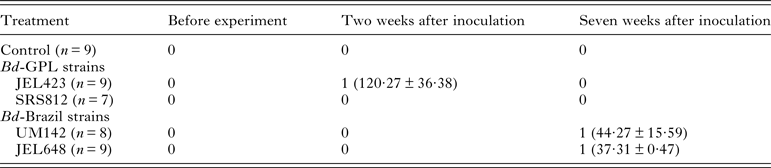
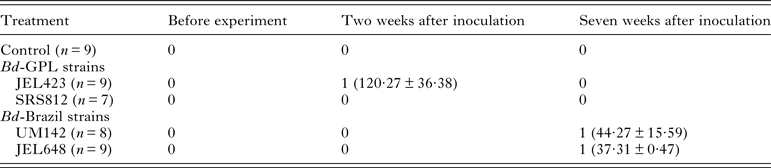
Forty-three crayfish were tested before starting the inoculation experiment, and 2 and 7 weeks after inoculation. Values are the number of animals positive for Bd detection by PCR. Values in parentheses are average zoospore load ±s.d. in Bd-positive animals.
We tested for the presence of Bd DNA on the carapace of crayfish inoculated with Bd by swabbing the entire surface 30 times with a dry rayon swab (MW113; Medical Wire). Crayfish were rinsed with dechlorinated water before swabbing. All swabs were stored at −80 °C immediately after sampling until DNA extraction was performed. DNA was extracted after soaking the swabs overnight in TE buffer to remove potential PCR inhibitors. Samples were centrifuged to form a pellet, TE buffer was removed and 40 µL of PrepMan Ultra (Life Technologies) was added. Tubes were placed in boiling water for 15 min and cooled for 2 min. Swabs were flipped over using sterilized tweezers, centrifuged for 13 min and 20 µL of supernatant was diluted 10× with sterile water for use as quantitative polymerase chain reaction (qPCR) template. Bd detection for swabs was determined using a fast qPCR low-volume method (Kerby et al. Reference Kerby, Schieffer, Brown and Whitfield2013) on a StepOne-Plus qPCR machine (Applied Biosystems). Samples were analysed in triplicate for Bd detection. Bd DNA on crayfish was confirmed if all three replicates were positive for Bd detection using qPCR. Samples that had one or two positive replicates were reanalysed following the procedures described. Then, if all three replicates of this sample were positive for Bd detection in the rerun, the individual was considered positive.
Statistical analyses
Differences in nematode mortality across treatments per time point were determined using analysis of variance (ANOVA). Post hoc Tukey's HSD tests for pairwise comparisons were conducted in the event of a significant ANOVA. We used a repeated measures general linear model to compare the morphological measurements of crayfish between infection and control treatments at the two time points (before inoculation and 7 weeks after inoculation). Wilcoxon signed-rank tests were used to compare the morphological measurements of crayfish between the two time points per treatment.
Ethical and regulatory guidelines
All experiments were carried out according to the general principles and ethical considerations for the humane treatment of animal subjects. A minimal number of animals were used to produce statistically reproducible results.
RESULTS
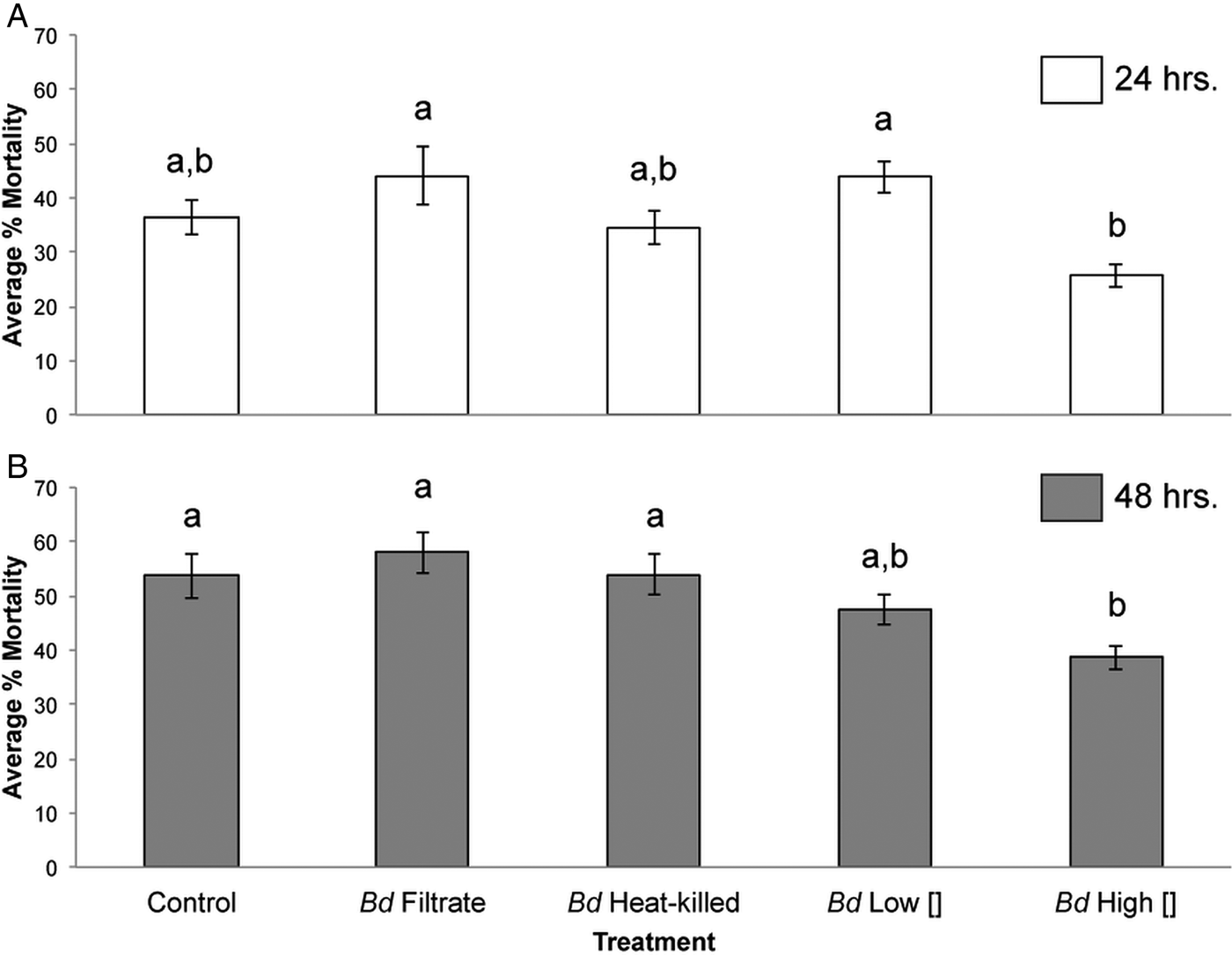
Twenty-four hours after the Bd inoculation of unstressed nematodes we found a significant effect on the percentage of mortality between treatments [one-way ANOVA, F (4, 20) = 4·81, P = 0·007]. All significant differences between treatments were due to the lower mortality in the high-Bd concentration treatment compared with other Bd treatments (Fig. 1A). After 24 h, the low-Bd concentration and Bd filtrate treatments showed a significantly higher per cent of dead nematodes than the high-Bd concentration treatment but not the control (Fig. 1A; Tukey's HSD, P = 0·011 and P = 0·001, respectively, for the high-Bd concentration treatment, and P = 0.564 and P = 0.525 for the control treatment). At 48 h post-inoculation, nematodes in the control, Bd filtrate and heat-killed Bd treatments showed a higher percentage of dead nematodes than the high-Bd concentration treatment [Fig. 1B; one-way ANOVA, F (4, 20) = 5·93, P = 0·003; Tukey's HSD, P = 0·002, P = 0·031 and P = 0·028, respectively].
Lack of increased mortality in Bd infected nematodes relative to controls. Mortality of nematodes was counted after 24 h (A) and 48 h (B). An increased percentage of dead nematodes was observed over time across all treatments. Error bars indicate standard error among five replicates. Bars sharing letters are not statistically different based on Tukey's HSD values (P < 0·05).

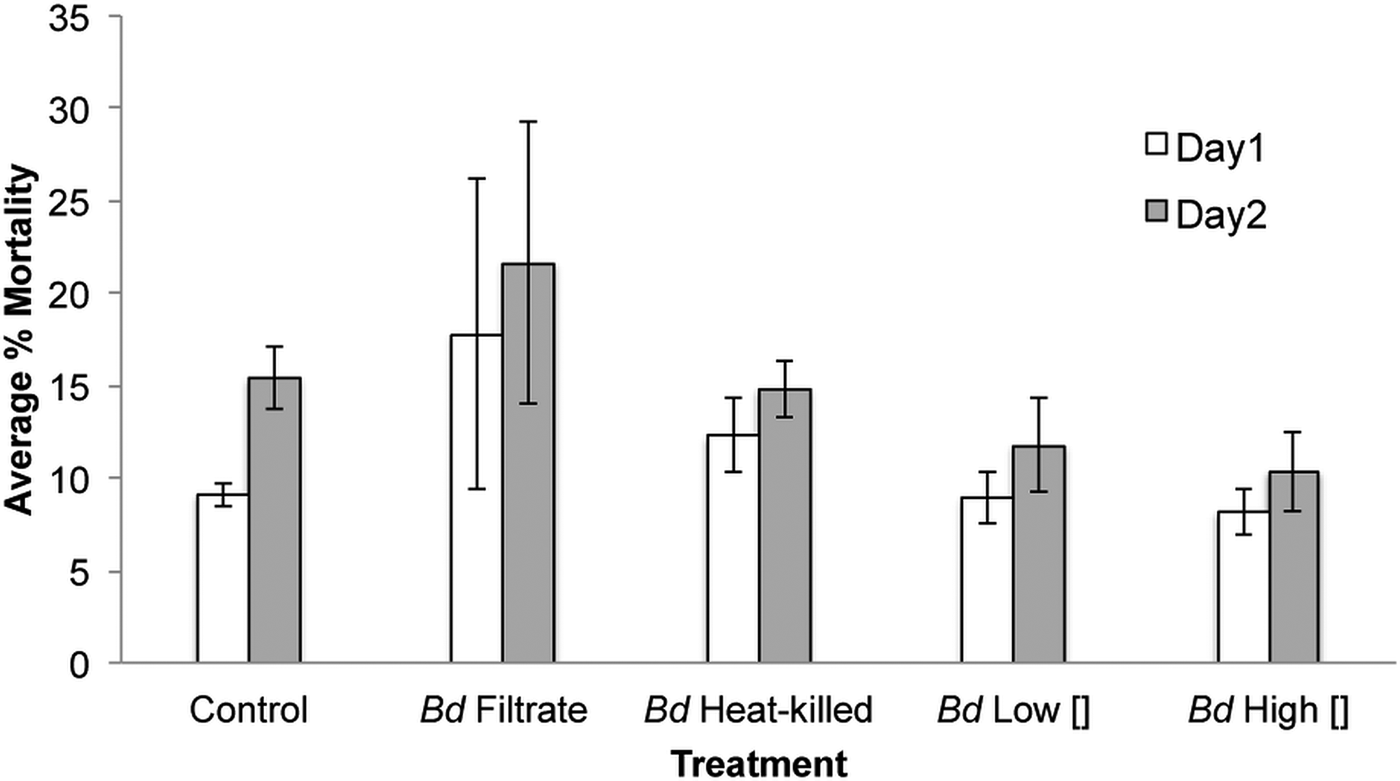
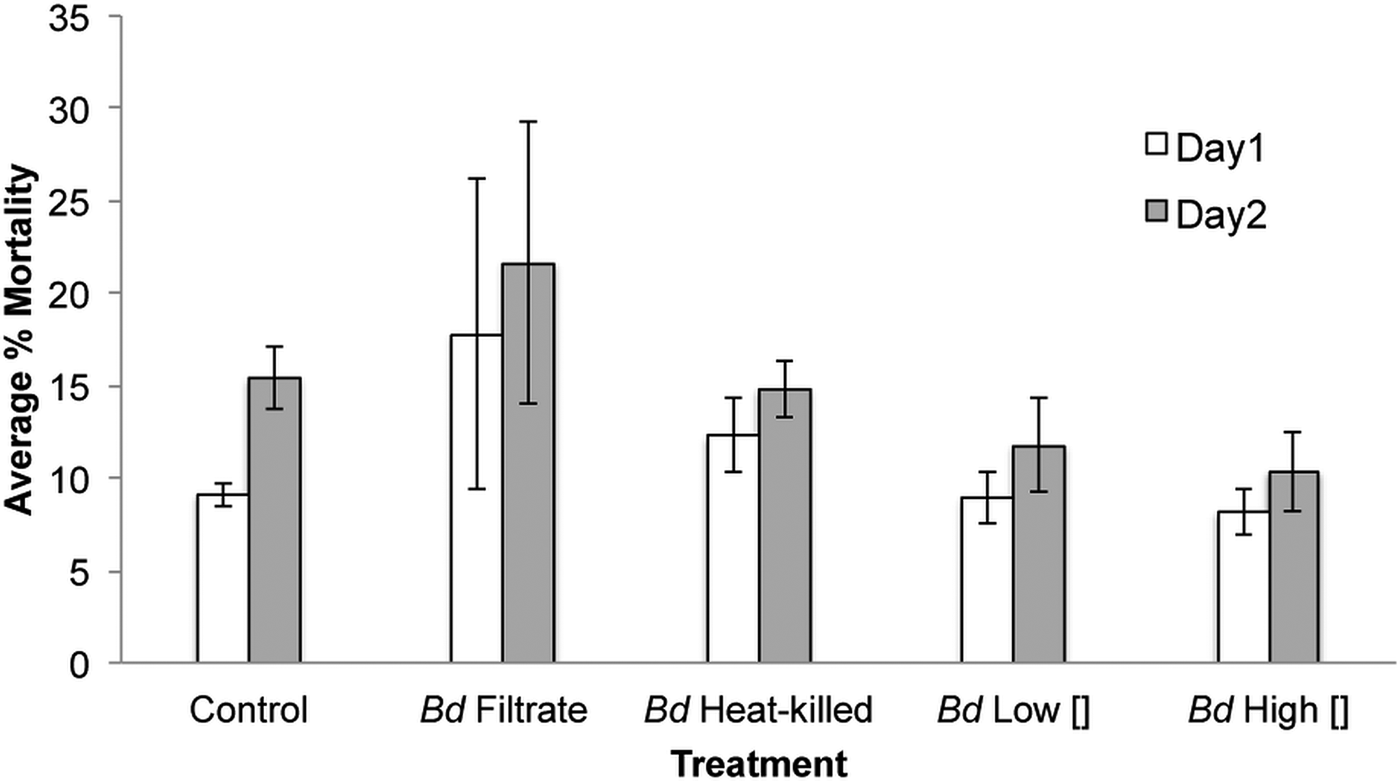
After inoculation of heat-stressed nematodes, we did not find a significant difference in the percentage of dead nematodes across treatments at 24 or 48 h [Fig. 2; 24 h: one-way ANOVA, F (4, 20) = 1·00, P = 0·430; 48 h: one-way ANOVA, F (4, 20) = 1·27, P = 0·310]. Surprisingly, we observed a higher average mortality among non-stressed nematodes (44%) than heat-stressed (13%). However, in experiments with both stressed and non-stressed nematodes, the Bd filtrate produced the highest level of mortality and the high-Bd concentration gave the lowest.
Mortality of heat-stressed nematodes following exposure to different Bd treatments. Mortality of nematodes was counted 24 h (white bars) and 48 h (grey bars) after inoculation. An increased percentage of dead nematodes was observed over time across all treatments. Error bars indicate standard error among five replicates. No significant difference was found in the average mortality across treatments.
No crayfish died after exposure to any of four different Bd strains up to 7 weeks post-inoculation when the experiment was stopped. Bd was not detected on any crayfish before inoculation. Only three crayfish were detected as Bd-positive 2 and 7 weeks post-inoculation using qPCR (Table 1). By week 2, one crayfish (2·9% of those inoculated) was Bd positive. This crayfish was exposed to a Bd-GPL strain (JEL423), and its PCR estimated load was 120·27 ± 36·38 zoospore equivalents mL−1 (average zoospores load ±s.d.). However, 5 weeks later this crayfish was negative when retested. By week 7, we detected Bd DNA from two crayfish (5·9% of the inoculated; Table 1) inoculated individually with Bd-Brazil strains (UM142 and JEL648). Crayfish in the control treatment were negative at all three time points (Table 1).
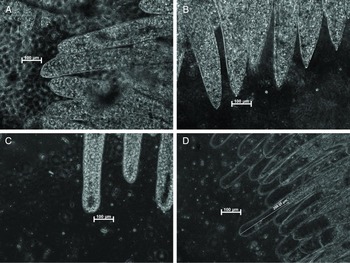
Animals in all treatments generally increased in body size and weight over time (Fig. 3). Using a repeated measures model, no significant effect of inoculation treatment was detected on crayfish weight [F (4, 37) = 0·51, P = 0·73] or length [F (4, 37) = 0·79, P = 0·54]. Gill recession was not observed in any of the crayfish used in the infection experiment including animals in the control treatment and those that were positive for Bd by qPCR (Fig. 4A and B). In addition, no gill recession was observed in the two crayfish that were euthanized and examined immediately under the stereoscope (Fig. 4C). However, eight of the nine crayfish that were euthanized and left in water for 24 h showed massive gill recession (Fig. 4D).
Procambarus alleni increased significantly in weight (A) and body size (B) between inoculation (lined boxplots) and 7 weeks after exposure (white boxplots), however treatment had no significant effect on body size and weight. Boxes represent the 75th to 25th percentiles, the line in the box is the median value, and the cross the mean. The whiskers represent the minimum and maximum values. Asterisks show statistically significant differences based on Wilcoxon signed-rank tests between individuals of the same treatment at the two time points. The gained weight of individuals in the control treatment was significantly different with an average of 0·42 g-increased weight (P = 0·0547). Crayfish exposed to SRS812 increased weight an average of 0·53 g (P = 0·0156), animals exposed to JEL423 increased weight an average of 0·61 g (P = 0·0078), animals exposed to UM142 increased weight an average of 0·38 g (P = 0·0156), and animals exposed to JEL648 increased weight an average of 0·49 g (P = 0·0039). Only animals in Bd-Brazil treatments showed a significant difference in body size change over time (Fig. 3B). Crayfish exposed to UM142 and JEL648 grew in length significantly since the beginning to the end of the experiment (P = 0·0078 and P = 0·0039, respectively).

Freshly euthanized Procambarus alleni exposed to Bd did not have gill recession, whereas animals examined 24 h after death did. (A) Gills of a crayfish that was exposed to Bd and positive by qPCR. (B) Gills of an experimental control crayfish negative to Bd detection using qPCR. (C) Gills of uninoculated P. alleni that was euthanized and observed immediately. (D) Gill recession from uninoculated P. alleni that was euthanized and left in water for 24 h.

DISCUSSION
Under the conditions employed, Bd had no negative effects on either crayfish or nematodes. Indeed Bd seemed to have a positive effect on nematode survivorship, perhaps through mycophagy, and caused no mortality or gill recession in crayfish. These results are disappointing because they suggest that the particular invertebrate hosts we studied will not be good models for virulence studies of Bd and that previous results suggesting that invertebrates are important non-amphibian hosts for Bd life cycle need to be carefully considered. The lack of Bd virulence on these invertebrates contrasts starkly with the effects of Bd on amphibians in numerous studies that demonstrate mortality at a wide range of zoospore inoculum loads and fungal genotypes (Kilpatrick et al. Reference Kilpatrick, Briggs and Daszak2010).
Unfortunately, experimental variation between laboratories was too great to achieve similar results. In an attempt to induce mortality or negative effects on our invertebrate hosts, we used inoculum loads for crayfish that were over 20 times greater than used in McMahon et al. (Reference McMahon, Brannelly, Chatfield, Johnson, Joseph, McKenzie, Richards-Zawacki, Venesky and Rohr2013) and inoculum loads for nematodes that were twice that previously used (Shapard et al. Reference Shapard, Moss and San Francisco2012). With crayfish, we observed a much lower frequency of Bd DNA detection 7 weeks post-inoculation than observed by McMahon et al. (Reference McMahon, Brannelly, Chatfield, Johnson, Joseph, McKenzie, Richards-Zawacki, Venesky and Rohr2013). Rarely (<5% of our mesocosms), however, Bd DNA was detected at up to 7 weeks on the carapace of crayfish in our mesocosms, suggesting that Bd can persist in the environment without an amphibian host. It is possible that Bd can persist modestly on the host tissue, feces or food in our low competition mesocosms. Crayfish may therefore not be an alternative host per se but may carry the fungus at low loads. The association of Bd with crayfish was recently bolstered by the finding of modest prevalence (⩽6%), though low loads of Bd across aquaculture and natural sites in Louisiana, USA (Brannelly et al. Reference Brannelly, McMahon, Hinton, Lenger and Richards-Zawacki2015). In that study, the Bd loads averaged ⩽22·17 zoospore genomic equivalents, and thus were lower than the loads we observed in our asymptomatic animals (Table 1). One difference between our study and Brannelly et al. (Reference Brannelly, McMahon, Hinton, Lenger and Richards-Zawacki2015) was that our study tested for Bd DNA on the carapace, while Brannelly et al. tested for Bd DNA in the gastrointestinal (GI) tract of the crayfish. Although McMahon et al. (Reference McMahon, Brannelly, Chatfield, Johnson, Joseph, McKenzie, Richards-Zawacki, Venesky and Rohr2013) showed histological micrographs that suggested the GI tract was a site of infection, the paper also showed that Bd DNA detection loads were similar or higher on the carapace relative to the GI tract in experimentally infected P. alleni. Their finding plus the difficulty in removing the PCR-inhibitory fecal matter from the GI tract led us to choose the carapace for screening Bd, which could have led to differences in results, particularly if crayfish are concentrators of inactive Bd because they eat amphibian skin or feces. Moreover, from our results we cannot rule out that our experimental conditions, such as differences in crayfish genotype or undetermined variables led to differences in our results and the published work (McMahon et al. Reference McMahon, Brannelly, Chatfield, Johnson, Joseph, McKenzie, Richards-Zawacki, Venesky and Rohr2013). It may also be useful to test the outcome of experimental Bd infection on additional crayfish species given that two other species (Procambarus clarkii and Orconectes virilis) are also suspected of being hosts of Bd (McMahon et al. Reference McMahon, Brannelly, Chatfield, Johnson, Joseph, McKenzie, Richards-Zawacki, Venesky and Rohr2013). However, in summary we conclude that the previous results are not readily generalizable or the methods not readily adoptable.
The extent of the ecological niche of Bd thus remains a mystery. The correlated presence of macroinvertebrates, such as crayfish (McMahon et al. Reference McMahon, Brannelly, Chatfield, Johnson, Joseph, McKenzie, Richards-Zawacki, Venesky and Rohr2013), and the negative correlation of the microinvertebrates (Schmeller et al. Reference Schmeller, Blooi, Martel, Garner, Fisher, Azemar, Clare, Leclerc, Jager, Guevara-Nieto, Loyau and Pasmans2014) with Bd presence in the field is intriguing and puzzling at the same time. Better pathology and experimental infection studies are needed to differentiate infection from a passive interaction such as mycophagy or incidental ingestion, ideally to include histopathological examination of fresh tissue. Given the ancient relationship of Bd with amphibians, shown by the discovery of a related species specific to salamanders, one certainty is that the fungus has been associated with amphibians for at least 30 million years (Martel et al. Reference Martel, Blooi, Adriaensen, Van Rooij, Beukema, Fisher, Farrer, Schmidt, Tobler, Goka, Lips, Muletz, Zamudio, Bosch, Lötters, Wombwell, Garner, Cunningham, Spitzen-van der Sluijs, Salvidio, Ducatelle, Nishikawa, Nguyen, Kolby, Van Bocxlaer, Bossuyt and Pasmans2014). Whether or not there is a saprotrophic life stage of Bd is more controversial, but would help explain is ubiquitous detection in the absence of an amphibian host.
ACKNOWLEDGEMENTS
We thank Joyce Longcore for providing some of the Bd strains and for helpful discussions.
FINANCIAL SUPPORT
This work was supported by a grant from the National Science Foundation (grant no. OISE-1159513) to T. Y. J. and a Rackham Graduate Student Research Grant from the University of Michigan to C. B. R.