English and many other languages allow some flexibility in the way main and subordinate clauses can be ordered in a complex sentence unit. However, there are a number of factors such as processing, discourse-pragmatics, and semantics that have an impact on the ordering of clauses in any given sentence. Following Diessel (Reference Diessel2001, Reference Diessel2005, Reference Diessel2008), we assume that the ordering and processing of complex sentences can be explained as a result of competing motivations between processing factors and discourse-pragmatics (i.e., givenness or newness). Studies by Diessel (Reference Diessel2001, Reference Diessel2005, Reference Diessel2008) have suggested how speakers might resolve the competition between these factors, but it is less clear when and how children acquire these different strategies and how they affect their comprehension and production of complex sentences during different stages of their language development. To our knowledge, there is no experimental study that has investigated this phenomenon from the perspective of first language acquisition. The present study aims to fill this gap by examining how these factors affect complex sentence comprehension.
ORDERING EFFECTS IN COMPLEX SENTENCE UNITS
Complex sentences contain a main and a subordinate clause. Languages such as English and German (and many more) permit main and subordinate clauses to occur in more than one position. For example, a native speaker of English can form a complex sentence either with the subordinate clause in the initial position as in (1) or with the subordinate clause in the final position as in (2):
1. When Peter came home[SUB] Mary was cooking a meal[MAIN].
2. Mary was cooking a meal[MAIN] when Peter came home[SUB].
However, studies report that speakers tend to have a preference for one order over the other (Diessel, Reference Diessel2001, Reference Diessel2005, Reference Diessel2008), depending on various factors.
In his corpus study of English adverbial clauses, Diessel (Reference Diessel2005) found that speakers have a preference for placing adverbial clauses after the main clause, whereas adverbial clauses in initial position are less frequent. He reports that 38% of the 2,034 adverbial clauses in his corpus sample occur in initial position, whereas 62% occur in final position, and suggests that this relates to processing factors in utterance planning and comprehension. He argues that the processing load for the speaker is much higher if subordinate clauses occur before main clauses in a complex sentence unit, because the speaker has to keep the subordinate clause in working memory while planning the main clause (see also Arnold, Wasow, Losongco, & Ginstrom, Reference Arnold, Wasow, Losongco and Ginstrom2000; Ferreira & Dell, Reference Ferreira and Dell2000; Wasow, Reference Wasow1997a; Reference Wasow1997b). However, different kinds of adverbials show differing patterns of use, with conditional adverbials occurring more often in preposed position than temporal adverbials that in turn are more frequently preposed than are causal adverbials (Diessel, Reference Diessel2005). Thus, the precise semantics of the particular clause plays a role. In contrast, if the main clause precedes the subordinate clause, each clause can be planned successively, which reduces the processing load for utterance planning (cf. Diessel, Reference Diessel2005, pp. 458–459). The same holds true from the hearer perspective. Processing load is higher if the hearer has to keep the whole adverbial clause unit in working memory until the link to the main clause is established (Hawkins, Reference Hawkins1994, Reference Hawkins2004). However, processing factors do not explain why speakers of English also make use of adverbial clauses in initial position. In line with Chafe (Reference Chafe1984), Ford (Reference Ford1993), Givón (Reference Givón1990), and Thompson (Reference Thompson and Tomlin1987), Diessel (Reference Diessel2005, p. 459) argues that the use of utterance-initial adverbial clauses is due to discourse-pragmatic factors: initial adverbial clauses are “commonly used to organize the information flow in the ongoing discourse; they function to provide a thematic ground or orientation for subsequent clauses.” Taking these two factors into account, Diessel (Reference Diessel2005) argues that the ordering of main and subordinate clauses is motivated by competing forces from discourse-pragmatics and processing. Processing factors are overridden by discourse-pragmatic factors in those cases in which adverbial clauses precede their main clauses (cf. Diessel, Reference Diessel2005, p. 451).
DISCOURSE-PRAGMATIC FACTORS
The present study makes use of the widely used distinction between given and new information that focuses on the degree of accessibility of referents in discourse (Allen, Reference Allen2000; Allen, Skarabela, & Hughes, Reference Allen, Skarabela, Hughes and Behrens2008; Arnold et al., Reference Arnold, Wasow, Losongco and Ginstrom2000; Guerriero, Oshima-Takane, & Kuriyama, Reference Guerriero, Oshima-Takane and Kuriyama2006; Haviland & Clark, Reference Haviland and Clark1974; Hughes & Allen, Reference Hughes, Allen, Bamman, Magnitskaia and Zaller2006; Mishina-Mori, Reference Mishina-Mori, Caunt-Nulto, Kulatilake and Woo2007; Skarabela, Reference Skarabela2006). Whereas Chafe (Reference Chafe and Li1976) and Du Bois (Reference DuBois1987) suggest three categories of givenness and newness (i.e., nonnew, accessible, and new), other researchers (e.g., Allen, Reference Allen2000; Allen et al., Reference Allen, Skarabela, Hughes and Behrens2008; Arnold et al., Reference Arnold, Wasow, Losongco and Ginstrom2000; Guerriero et al., Reference Guerriero, Oshima-Takane and Kuriyama2006; Hughes & Allen, Reference Hughes, Allen, Bamman, Magnitskaia and Zaller2006; Mishina-Mori, Reference Mishina-Mori, Caunt-Nulto, Kulatilake and Woo2007; Skarabela, Reference Skarabela2006) make a binary distinction between givenness and newness, whereby a referent is considered to be given if it occurs in the previous utterances, and new otherwise. Chafe (Reference Chafe1970) and Halliday (Reference Halliday1967) also define givenness as information that has a recoverable antecedent in memory (see also Bock & Irwin, Reference Bock and Irwin1980). In this study, we follow Arnold et al. (Reference Arnold, Wasow, Losongco and Ginstrom2000) in using a binary given/new distinction that focuses on the degree of accessibility of referents in discourse (i.e., on whether a referent has been mentioned in the previous discourse or not).
Information flow and word order
The impact of given and new information on language use has been extensively investigated by researchers from the perspective of word order (e.g., Arnold et al., Reference Arnold, Wasow, Losongco and Ginstrom2000; Birner & Ward, Reference Birner and Ward1998; Bock & Irwin, Reference Bock and Irwin1980; Bresnan, Cueni, Nikitina, & Baayen, Reference Bresnan, Cueni, Nikitina, Baayen, Boume, Kraemer and Zwarts2007; Brown, Savova, & Gibson, Reference Brown, Savova and Gibson2012; Clifton & Frazier, Reference Clifton and Frazier2004; Ferreira & Yoshita, Reference Ferreira and Yoshita2003; Kaiser & Trueswell, Reference Kaiser and Trueswell2004; Siewierska, Reference Siewierska1993) and referent encoding (e.g., Ariel, Reference Ariel1988; Du Bois, Reference DuBois1987; Gundel, Hedberg, & Zacharski, Reference Gundel, Hedberg and Zacharski1993). The bulk of studies conducted on the ordering of given and new information in sentences is concerned with processing advantages for one order over the other. There is relative agreement for the existence of the so-called given–new strategy proposed by Haviland and Clark (Reference Haviland and Clark1974). They argue that there is a processing advantage for given information occurring before new information for the hearer: the hearer has to (a) identify what is given and what is new, (b) link the given information to an antecedent in memory (i.e., information already existing in memory), and (c) link the new information to the given information in memory (see also Clark & Clark, Reference Clark and Clark1979; Levelt, Reference Levelt1989). They found evidence for this, reporting that reaction times for sentence comprehension were much faster if the information in their test sentence was linked to some information in the previous (i.e., context) sentence. When there was no direct link to the previous sentence, the reaction times were much slower (see also Clark & Sengul, Reference Clark and Sengul1979; Garrod & Sanford, Reference Garrod and Sanford1977).
The given-before-new principle was also found to have an impact on the speaker from the perspective of utterance planning. Note that these studies define “new information” either in terms of “hearer-new” (Clark & Haviland, Reference Clark, Haviland and Cohen1974; Haviland & Clark, Reference Haviland and Clark1974) or as “less recent/accessible” for the speaker (Arnold et al., Reference Arnold, Wasow, Losongco and Ginstrom2000; Prince, Reference Prince and Cole1981; Gundel, Reference Gundel and Hankamer1988) because new information cannot be considered truly “new” from the perspective of the speaker. The rationale for the given-before-new principle from the perspective of utterance planning is that, if given information precedes new information, the given information can be prepared earlier for production and gives the speaker more time to plan and produce the less available (i.e., less recent/newer) information. For example, Bock and Irwin (Reference Bock and Irwin1980) found a processing advantage for given–new over new–given sentences in the faster availability of given information compared to new information for the speaker. Arnold et al. (Reference Arnold, Wasow, Losongco and Ginstrom2000) investigated the notion of given and new information in association with syntactic heaviness (i.e., the longer the linguistic referent, the heavier it is). Their corpus data of English revealed that speakers tend to postpone newer and heavier elements and that new elements tended to be postponed even when the referents were relatively equal in length.
Ferreira and Yoshita (Reference Ferreira and Yoshita2003) found that speakers of Japanese tended to shift the order of information from new–given to given–new if the referents in the target sentence were presented in a scrambled word order (i.e., new before given). This is particularly interesting, because Japanese is a left-branching language whose speakers make use of different parsing strategies than do speakers of right-branching languages such as English (see also Diessel, Reference Diessel2001, Reference Diessel2005, Reference Diessel2008; Hawkins, Reference Hawkins1994, Reference Hawkins2004). This supports the assumption that a preference for given before new information can be considered a cross-linguistic tendency (Clark & Clark, Reference Clark and Clark1979).
The given-before-new principle has also been observed on the complex-sentence level. Diessel (Reference Diessel2005) argues that initial adverbial clauses tend to establish a link between the previous discourse and the following main clause, suggesting that adverbial clauses have particular discourse-pragmatic functions with respect to their position (see also Chafe, Reference Chafe1984; Ramsay, Reference Ramsay and Tomlin1987; Verstraete, Reference Verstraete2004). Thus, placing adverbial clauses before their main clauses may have a similar advantage in sentence processing and utterance planning as the ordering of given-before-new information seen in noun phrases in simple sentences. That is, in comprehension, initial adverbial clauses referring back to the previous discourse help the hearer to access given information very quickly and give them more time to establish a link in memory for the newer information encoded in the main clause. From the perspective of utterance planning, delaying the less accessible (i.e., newer) information encoded in the main clause gives the speaker more time to plan the utterance.
GIven and new information in children's language
There are a large number of studies focusing on how children build up a repertoire of strategies in order to express different levels of informativeness. In what follows, we give a brief summary of what has been found on the level of one-word utterances, two-word utterances, and referent encoding. However, none of these studies has investigated this phenomenon in the domain of complex sentences.
In order to discriminate between given and new information, children first need to notice a difference between them. Research suggests that infants have the ability to discriminate between new and old elements long before they start to talk (Baker & Greenfield, Reference Baker and Greenfield1988; Greenfield, Reference Greenfield1973, Reference Greenfield, Ochs and Schieffelin1979; Muir & Field, Reference Muir and Field1979). This sensitivity is also apparent once children start to talk. Baker and Greenfield (Reference Baker and Greenfield1988) found that at the one-word stage, children's single word utterances primarily encoded new or uncertain elements (cf. Baker & Greenfield, Reference Baker and Greenfield1988, p. 25) and that children only started to verbalize given elements (in combination with new elements) at the two-word stage. Moreover, children who were capable of producing two-word utterances continued to show a tendency to verbalize new information in their one-word utterances (see also Leonard & Schwartz, Reference Leonard and Schwartz1977, and Narasimhan & Dimroth, Reference Narasimhan and Dimroth2008) and to omit given elements. Baker and Greenfield (Reference Baker and Greenfield1988) argue that children might show a preference to verbalize new elements in their one-word utterances because they are lacking alternative strategies such as the use of stress or referring expressions to express different degrees of informativeness. However, children may also prefer to verbalize new elements when labeling objects, because new elements are commonly associated with moving objects whereas given elements commonly refer to static objects (cf. Baker & Greenfield, Reference Baker and Greenfield1988, p. 5; see also Lempert & Kinsbourne, Reference Lempert and Kinsbourne1985; Nelson, Reference Nelson1973). This points to the possibility that children may prefer to verbalize names of new (dynamic) objects because they catch their attention more easily than given (static) objects. It is therefore not entirely clear to what extent children are sensitive to the new–given distinction and its relation to how one talks about referents, at the one-word stage.
As children grow older, they become more experienced language users and can apply other strategies such as using stress or pronouns to label the information status of referents. For example, studies by MacWhinney and Bates (Reference MacWhinney and Bates1978) and Wieman (Reference Wiemann1976) reported that children tend to use stress to highlight new elements. However, a recent study by Grünloh, Lieven, and Tomasello (Reference Grünloh, Lieven and Tomasello2013) suggests that the use of stress to signal new information is not fully adultlike for German-speaking children who have just entered the multiword stage.
Another strategy for distinguishing the information status of referents that children seem to have some grasp of early on is the use of nominal referring expressions. In adult language, there is a cross-linguistic tendency for new referents to be encoded by lexical forms, whereas given referents tend to be encoded by pronominal forms or omitted altogether (cf. Ariel, Reference Ariel1994; Du Bois, Reference DuBois and Haiman1985, Reference DuBois1987; Givón, Reference Givón1983; Gundel et al., Reference Gundel, Hedberg and Zacharski1993). There is a large body of studies using naturalistic data that seem to suggest a sensitivity to the use of nominal versus pronominal and definite versus indefinite referring expressions in children cross-linguistically (e.g., for Inuktitut, Allen, Reference Allen2000; for German, Allen et al., Reference Allen, Skarabela, Hughes and Behrens2008; and Bittner, Reference Bittner, Leiss and Abraham2007; for English and Japanese, Guerriero et al., Reference Guerriero, Oshima-Takane and Kuriyama2006; for English and Spanish, Gundel, Sera, & Page, Reference Gundel, Sera and Page1999; and Gundel, Sera, Kowalsky, & Page, Reference Gundel, Sera, Kowalski and Page2001; for Hindi, Narasimhan, Budwig, & Murty, Reference Narasimhan, Budwig and Murty2005; for Dutch, English, and French, Rozendaal & Baker, Reference Rozendaal and Baker2008), with some studies showing relations between language-specific patterns of usage in child-directed speech (CDS) and patterns of acquisition. Experimental studies by Matthews, Lieven, Theakston, and Tomasello (Reference Matthews, Lieven, Theakston and Tomasello2006) and Salomo, Lieven, and Tomasello (Reference Salomo, Lieven and Tomasello2010) found that 3- to 4-year-old English- and German-speaking children were sensitive to how to encode given and new referents when exposed to questions of the type “What happened?” or “What is X doing?” Children tended to reply with a lexical noun when the referent had not been mentioned in the previous context, whereas pronouns or null reference were more commonly used to encode given referents (see also Graf, Reference Graf2010, for German; and Serratrice, Reference Serratrice2005, for Italian).
However, there are also studies showing that children's use of referent encoding is not fully adultlike. De Cat (Reference De Cat2011) found that French-speaking children who were 2 years, 6 months (2;6) to 3;3 were generally able to make adultlike use of definite and indefinite forms of reference when reporting picture book stories. However, errors were observed in the use of indefinite forms to refer to given information when previous reference to the entity occurred on an earlier page in the book. She attributes this to difficulties in determining what counts as “new” as a function of the visual context, rather than to a lack of knowledge of how to encode different informational forms. However, a large body of studies reveals developmental changes cross-linguistically in children's abilities to maintain discourse cohesion in narrative that signal both language-general and language-specific influences on the pattern of acquisition (e.g., for a detailed overview and study, see Hickman & Hendriks, Reference Hickmann and Hendriks1999). In addition, in a video description task, Theakston (Reference Theakston2012) found that 5-year-old English-speaking children are more likely to erroneously use pronominal forms for new referents in subject position than in object position, whereas adults reliably use lexical forms for new referents in both sentence positions. Together, these findings suggest that children only gradually learn an adultlike use of referent encoding.
Narasimhan and Dimroth (Reference Narasimhan and Dimroth2008) investigated whether 3- and 5-year-old German-speaking children have a preference for the ordering of given and new information. In an object-naming task, they presented children with two objects, one of which was new and one they had seen before. The children were then asked to label the objects. The children preferred to label the new object before the given one, in contrast with the ordering normally associated with adult speech. In order to see whether the children's labeling might be a reflection of the input, Narasimhan and Dimroth (Reference Narasimhan and Dimroth2008) also tested their caretakers on the same task. In contrast to the children, the caretakers preferred to mention given objects before new objects, thus suggesting that the children's ordering preference is not directly related to their input but rather can be considered a cognitive bias.
What these studies show is that children gradually acquire some sensitivity to different levels of informativeness but that even for simple utterances this may not be fully adultlike until relatively late in language development (e.g., beyond 5 years of age). Of interest in the current study is whether similar sensitivity to new and given information might be observed for complex sentences, because children are learning to comprehend and produce these during the same period.
DEVELOPMENTAL STUDIES OF COMPLEX SENTENCE ORDERING
Diessel (Reference Diessel2004) provides the most comprehensive (observational) study that examines the ordering of main and adverbial clauses from a developmental perspective. Although Diessel (Reference Diessel2004) considers a larger number of adverbial clauses, there is particularly detailed data for the acquisition of when-clauses. Investigating corpus data from five English-speaking children between the ages of 1;3 and 5;1, he found that children younger than 3;0 prefer to put when-clauses into final position whereas sentence-initial when-clauses occur only later; before the age of 3;0, only 6.5% of when-clauses occurred in initial position. Between 3;0 and 4;0, the number increased to 31.3% on average, and between 4;0 and 5;0 to 42.1% (cf. Diessel, Reference Diessel2004, pp. 168–169). Following Havilland and Clark (Reference Haviland and Clark1974), Diessel (Reference Diessel2004) relates this preference for final when-clauses to the two factors of processing load and discourse-pragmatics; he argues that they have a significantly greater effect in language learning children, although they are still important in adult language. With respect to processing load, he argues that children's early subordinate clauses primarily occur in final position because of greater limits on their working memory in comparison to adults. Diessel's argument (Reference Diessel2004, Reference Diessel2005) is based on Hawkins's (Reference Hawkins1994, Reference Hawkins2004) parsing theory in which the relative distance or “recognition domain” between constituents in a sentence affects ease of parsing. That is, in comprehension, if the when-clause occurs after the main clause, the main clause can be processed as an independent clause unit and the when-clause can be processed afterward, with only a short recognition domain between the main clause and the adverbial when in which the relation between the two clauses is established. In contrast, the human parser needs more time to recognize the relationship between the when-clause and the main clause in when-main orderings because the adverbial when must be kept in working memory until its relation to the main clause can be resolved, requiring greater processing resources. Diessel (Reference Diessel2005) also applied Hawkins's theory to utterance planning. That is, if the when-clause is produced in initial position, the speaker has to keep it in working memory while planning the main clause because the when-clause cannot be uttered as a separate intonation unit if it is embedded in a complex sentence. However, if the when-clause is placed in final position, the speaker can plan the two clauses successively. The main clause can be uttered as a separate intonation unit, which can function as a simple sentence (cf. Diessel, Reference Diessel2005), thus giving the speaker more time to plan the when-clause. Thus, Diessel (Reference Diessel2004) argues that children do not produce initial when-clauses before the age of 3 because their processing and working memory capacities are too limited.
Diessel's results (Reference Diessel2004) can also be related to those of Clark (Reference Clark, Ferguson and Slobin1973), who reports that children start to produce coordinate clauses before they use subordination strategies. She found that young 3-year-olds tended to produce adverbial clauses in which the adverbial clause occurred after the main clause, whereas initial adverbial clauses were only produced by the older 3-year-olds. She suggests that children start to produce coordinate clauses and main-before-adverbial clauses earlier than sentences with an adverbial-main clause order because coordinate clauses and main-adverbial orders tend to encode events in the order of their mention, whereas adverbial-main structures tend to encode events in which the order of mention and clause order do not correspond with each other. According to Clark (Reference Clark, Ferguson and Slobin1973), these latter structures make greater demands in terms of children's working memory capacities and thus emerge only later.
From the discourse-pragmatics viewpoint, Diessel (Reference Diessel2004) further argues that children might not produce initial when-clauses before the age of 3;0 because they serve a discourse-pragmatic function that is not needed in early child discourse. Their function is to establish a link to the previous discourse by enhancing discourse coherence (see also Chafe, Reference Chafe1984; Ford, Reference Ford1993; Givón, Reference Givón1990; Thompson, Reference Thompson and Tomlin1987). However, Diessel (Reference Diessel2004) suggests that, in early child discourse, children are much more likely to talk about referents that are physically present than about referents that have only been mentioned in the previous discourse. Similarly, Silva (Reference Silva1991) found that children prefer to place adverbial clauses such as when and while in initial position with increasing age (between 4;10 and 11;11) because they become more aware of their discourse-pragmatic function.
Although Diessel (Reference Diessel2004, Reference Diessel2005) attributes the low occurrence of initial adverbial clauses in children's early speech to factors from discourse-pragmatics and clause processing, he did not conduct a systematic analysis of the information status of when-clauses with respect to the previous discourse. Thus, it is impossible to determine from these corpus data the extent to which the early scarcity of when-clauses in initial position reflects processing versus discourse-pragmatic factors. Furthermore, it is not clear exactly how these factors might be expected to interact.
THE PRESENT STUDY
The studies outlined above suggest that children younger than 3;0 are already sensitive to information-structural cues at the phrasal level and that they tend to focus on new information (e.g., Baker & Greenfield, Reference Baker and Greenfield1988; Narasimhan & Dimroth, Reference Narasimhan and Dimroth2008). In contrast, in complex sentences, children are much more likely to put adverbial clauses in final position until the age of about 4;0. This suggests that, in complex sentences, processing factors might be quite strong before the age of 4;0, whereas discourse-pragmatic factors such as givenness and newness become more important at a later age. However, interpreting these findings is problematic because of the lack of control over the contexts present in naturalistic corpora. The present study focuses on the ordering of when-clauses. This clause type was chosen for a number of reasons. First, the aim was to examine clause-ordering preferences in the absence of any specific causal or ordering relation between events (as is often implied by alternative clause types such as because, so). Second, a preliminary search of the Manchester corpus (Theakston, Lieven, Pine, & Rowland, Reference Theakston, Lieven, Pine and Rowland2001) revealed that adverbial clauses such as before, after, while, and at the same time (as) are very rare in the data of the children and the input, whereas when-clauses occur relatively frequently and are thus likely to be familiar to young children. Third, when-clauses are the first to appear in children's speech positioned both before and after their accompanying main clause, and thus children are likely to have some awareness of the potential for positional variation (Diessel, Reference Diessel2004). Fourth, although when can function as a subordinate clause with close integration with its main clause, the distinction between subordinate and coordinate clauses is often not clear cut (Diessel, Reference Diessel2004; Lehmann, Reference Lehmann, Haiman and Thompson1988), and thus it lends itself to use in a context in which two events are relatively independent of each other. Fifth, children start to produce when-clauses around the age of 3 years (Diessel, Reference Diessel2004), and thus children at this age are expected to be able to indicate their comprehension of these sentences via a behavioral response. In the present study, we investigated the ordering of given and new information in complex sentences in an experimental, act-out task in which the variables of main and subordinate clause order and the informational status of the clauses were systematically varied. This allowed us to evaluate the relative influence of clause type and order, and information status on children's and adults’ comprehension of complex clauses.
The following research questions were addressed:
1. Do 3- and 5-year-old children and adults show a preference for given–new or new–given ordering in their comprehension (act out) of a complex sentence? According to the bulk of previous research, there seems to be a preference for given-before-new (e.g., Arnold et al., Reference Arnold, Wasow, Losongco and Ginstrom2000; Haviland & Clark, Reference Haviland and Clark1974; Narasimhan & Dimroth, Reference Narasimhan and Dimroth2008).
2. Do children and adults show a preference for main-when or when-main orders in their act out of complex sentences? Previous research (Diessel, Reference Diessel2004, Reference Diessel2005) suggests that children and adults prefer main-when orders.
3. Are there interactions between clause order and the ordering of given and new information? Are there any differences as a function of age? According to previous research (Diessel, Reference Diessel2005; Ramsey, Reference Ramsay and Tomlin1987; Silva, Reference Silva1991), adult speakers should show some sensitivity to the tendency for initial when-clauses to encode given information. With increasing age, children should show increasing sensitivity to the discourse-function of initial when-clauses (see Clark, Reference Clark, Ferguson and Slobin1973; Diessel, Reference Diessel2004; Silva, Reference Silva1991).
METHOD
Participants
Twenty-one typically developing 3-year-olds (M = 3;01.19; 10 males, 11 females) and 16 typically developing 5-year-olds (M = 5;01.14; 10 males, 6 females) were included in the study. All children had some level of nursery (3-year-olds) or school experience (5-year-olds). In addition, 16 adult participants (primarily undergraduate students) from the same geographical area were tested as controls. A further 11 children participated but had to be excluded from the analysis because they did not complete the session (N = 4), could not remember the actions (N = 3), did not perform the act out (N = 2), did not give any verbal response (N = 1), or due to experimenter error (N = 1). All participants were monolingual speakers of British English and were tested in the Max Planck Child Study Centre in Manchester or in their homes (2 children). All participants were tested in one testing session.
Procedure
We used an act-out method in which the child heard a prerecorded story from a speaker and then was asked to act out what s/he had just heard. To act out our test sentences, the child was presented with animal hand puppets and additional objects that s/he could use.
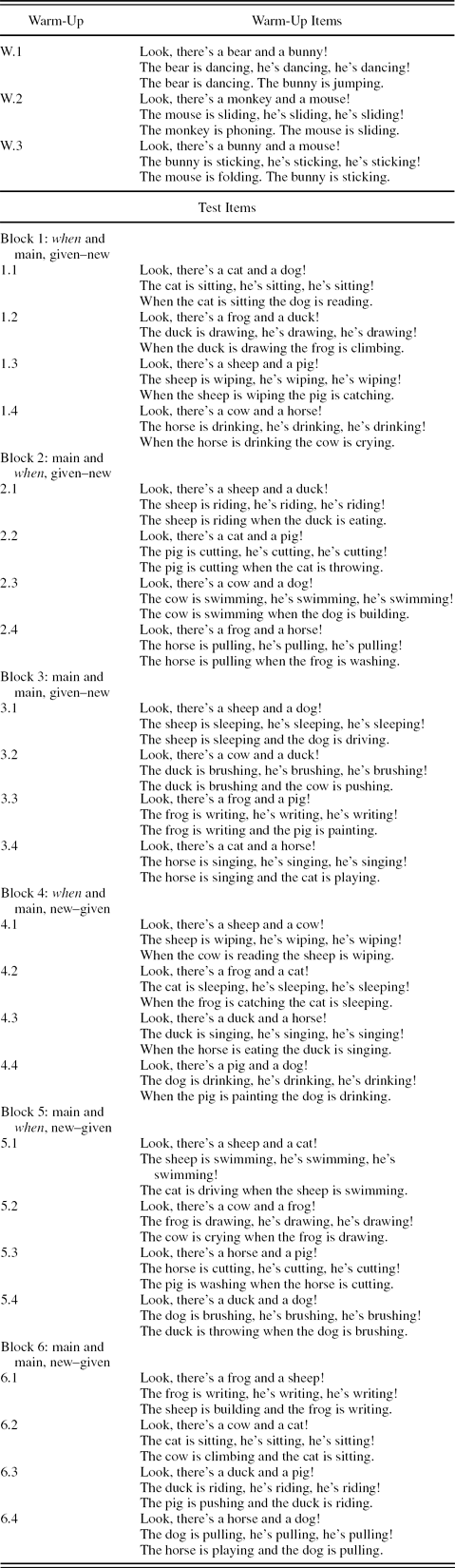
Experimenter 1 (E1) made sure that the child was familiar with the names of the animals by asking him/her to label the hand puppets that she was going to use for the act out. E1 then told the child that they were going to play a game in which they would hear a story and would then have to act out what they had heard with the hand puppets. The child was told to listen carefully and was promised a prize at the end of the game, if s/he played it well. E1 then started a warm-up session in which she and the child listened to three different stories, which they heard from a loudspeaker. The 3 sentences in the warm-up session consisted of simple unlinked sentences (e.g., The frog is jumping, The cat is running). E1 then showed the child how to play the game by first acting out the action with the hand puppet encoded by the first clause and then the action with the other hand puppet encoded by the second clause (e.g., The cat is jumping, The dog is running). To avoid any training effects on the order of act out, E1 showed the child that any order was possible with the same target sentence by playing the sentence again and acting out the actions in the reverse order. A second experimenter (E2) sat at the other end of the table and prepared the hand puppets and objects for each trial on a tray, which was pushed toward the child at the end of each story. Each act-out trial started with E1 asking the child: Can you show me what the animals did? After the warm-up session, the child was exposed to the 24 test sentences (i.e., complex sentences containing either a when-clause and a main clause or two conjoined clauses). After each trial, the child received positive feedback from the experimenter(s). For the purpose of coding and reliability checks, the child was video recorded. Adults were tested with exactly the same procedure.
Materials
The stimulus materials consisted of animal hand puppets whose names were used as protagonists in prerecorded stories that the participants heard from a speaker. The hand puppets were then used to act out what the child had heard in the story for each trial. The hand puppets’ names were selected based on parental reports of frequently used labels for animals by English-speaking children. The test sentences in the story consisted of a when-clause and a main clause or two main clauses, which were manipulated for their order (i.e., when–main, main–when, main–main) and for the information status of the action encoded by the sentences (i.e., whether the verb in the when or main clause had occurred in the story before). The selection of intransitive verbs used in the study was based on the most frequent verbs found in the Manchester corpus (Theakston et al., Reference Theakston, Lieven, Pine and Rowland2001; available on the Child Language Data Exchange System website; MacWhinney, Reference MacWhinney2000).
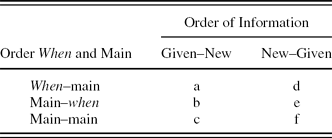
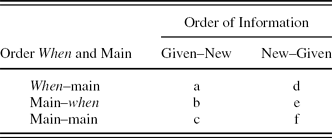
The stories that each child heard consisted of three sentences: a sentence that introduced the characters, a sentence that included the given action, and the test sentence that included the new and given action in the when- and the main clause or in the two main clauses. For example, in the new–given and main–when condition (condition e in Table 1), one story that the children heard was as follows:
Look, there's a dog and a cat!!!
The dog is pushing, he's pushing, he's pushing.
The cat is washing when the dog is pushing. [TEST SENTENCE]
Variable-level combinations for order of information and order of when and main clause
Because 24 test sentences were used, each child heard 24 different stories. All test sentences and the stories in which they were embedded were prerecorded by a native speaker of (British) English. To avoid a sequential or causal interpretation, the test sentences were produced under a single intonation contour and had no pauses between the main and the subordinate, or between the two main clauses.
Conditions
The test sentences consisted of a when-clause and a main clause for which the order was manipulated (i.e., when–main or main–when). In addition, sentences involving two main clauses (i.e., main–main) were included to determine whether information structure influenced the ordering of given and new information, independently of the clause type. The clauses in the complex sentences (i.e., when- and main clause) were manipulated for their information status (i.e., given or new) to create six variable-level combinations (a–f in Table 1).
Each condition formed a test block and included 4 test sentences, that is, Block 1: 4 × given–new and when–main, Block 2: 4 × given–new and main–when, Block 3: 4 × given–new and main–main, Block 4: 4 × new–given and when–main, Block 5: 4 × new–given and main–when, Block 6: 4 × new–given and main–main. Thus, there were 24 test sentences in total. After half of the test blocks, the children were presented with a distracter task in order to maintain their motivation. Half of the participants started with the first three test blocks (i.e., Blocks 1, 2, and 3) presented in a counterbalanced order, and then were presented with the last three blocks (i.e., Blocks 4, 5, and 6), also in counterbalanced order after the distracter task. The other participants were presented with the reverse order of test blocks (i.e., a counterbalanced order of 4, 5, and 6, and then 1, 2, and 3). In addition, the order of presentation of the test sentences within each test block was randomized for each participant.
The test sentences were controlled for length to avoid ordering effects owing to syntactic heaviness (cf. Arnold et al., Reference Arnold, Wasow, Losongco and Ginstrom2000). To avoid children failing to remember the complex sentence units, all verbs in the test sentences were presented intransitively (e.g., the dog is eating/pushing/drawing) rather than transitively (e.g., the dog is eating an apple/pushing the cat/drawing a picture). However, the hand puppets were presented with additional objects so that the participants could use these objects for the act out (e.g., an apple for the test sentence The dog is eating). To control for ordering effects owing to cause–consequence patterns (e.g., The cat is screaming and the dog is running away), the test sentences did not contain actions that can be related to each other. Because of the low number of possible intransitive test verbs that are available, children received each verb twice, once within each of two different story contexts, one within the first three test blocks and a second within the last three test blocks, and the information status of the verb was changed (i.e., given verbs in the first three blocks were then used in a new condition in the last three blocks and vice versa). In order to avoid interference from the changing information status of these verbs, we introduced a distracter task (i.e., jigsaw) in between the first three story contexts and the last three. In addition, the verb combinations were randomized so that the participants did not hear the same verb pairings in the two clauses again during the second half of testing.
Coding
We coded the order in which the child acted out the actions in the test sentences (new–given vs. given–new). We then coded whether this was different from what they had heard in the test sentences. For those cases in which the child picked up one hand puppet, put it back down, and then decided to pick up the other puppet in order to complete an action, we coded only those instances in which the child performed an action with the hand puppet. Thus, picking up the toy only without performing the action was not coded as the child's preferred first action because the child might have been only interested in the toy. Because some actions (e.g., washing and wiping) were very similar to act out and the child might not have remembered the actions correctly, the experimenter asked the child what the current animal was doing while the child was performing the act out with the hand puppet (note that the experimenter started to ask for a verbal response only when the child had already started the act out). Typically, children only responded with the action (e.g., “Washing”).
RESULTS
Our main focus was on the order in which the participants acted out the information (i.e., did they change the order of information from new–given to given–new or from given–new to new–given in their act out). For purposes of reporting results, the term “order of information” is used to refer to the ordering of given and new information. We computed the mean proportion of changes in the order of information in their act outs per condition as a function of what they had heard in the relevant test sentences. To investigate whether the children's and adults’ ordering of information was a function of processing factors (i.e., clause order) or information status (i.e., given or new), we ran a 2 × 3 × 3 mixed effects analysis of variance, with two repeated measures factors: order of information (i.e., given–new or new–given) and clause order (i.e., when and main, main and when, or main and main). Age was a between-subjects factor (3-year-olds, 5-year-olds, and adults).
Figure 1 gives the mean proportion of changes in the order in which given and new actions were enacted, according to the clause order and the order of information the participants had heard in the six conditions. The statistical analysis shows that there are significant main effects for order of information, F (1, 50) = 102.126, p < .001, and clause order, F (2, 100) = 5.028, p = .008. A significant two-way interaction was found for Clause Order × Age, F (4, 100) = 5.255, p = .001, whereas Order of Information × Age, F (2, 50) = 1.655, p = .201); Clause Order × Order of Information, F (2, 100) = 2.746, p = .069; and Clause Order × Order of Information × Age, F (4, 100) = 1.323, p = .267, interactions were not significant. To investigate the nature of the significant interaction, individual analyses of variance for each age group were carried out. Bonferroni adjustments were applied to control for multiple testing. For the 3-year-olds and the 5-year-olds, there was a main effect of order of information, 3-year-olds: F (1, 20) = 36.545, p < .001; 5-year-olds: F (1, 15) = 25.042, p < .001, but no main effect of clause order, 3-year-olds: F (2, 40) = 0.986, p = .382; 5-year-olds: F (2, 30) = 1.496, p = .240, nor an interaction for Clause Order × Order of Information, 3-year-olds: F (2, 40) = 0.782, p = .464; 5-year-olds: F (2, 30) = 1.320, p = .282.
The mean proportion of changes in the order of act outs.

These data show that both 3-year-olds and 5-year-olds tended to change the order of information to given–new when they were exposed to a new–given structure in the test sentences (3-year-olds: mean proportion of changes = 0.63; 5-year-olds: M = 0.66), regardless of the clause types used. For those test sentences that already had a given–new order, the proportion of changes to new–given was much lower (3-year-olds: M = 0.36; 5-year-olds: M = 0.29). This suggests that a given–new bias might account for the order in which children enacted the test sentences, whereas clause order does not have an impact on the children's choice.
For the adults, there was a main effect of clause order, F (1.424, 21.366) = 7.536, p = .007, and of order of information, F (1, 15) = 40.474, p < .001, and a marginally significant interaction between the two variables, F (2, 30) = 3.219, p = .054. Mirroring the children's behavior, the adults changed the order of information from new–given to given–new more often (M = 0.66) than they changed the order for sentences presented in given–new order (M = 0.23). However, unlike the children, there was also an effect of clause order. Posthoc tests (Bonferroni) confirmed that the adults changed the order of information in their act outs less often for test sentences containing a when–main order (M = 0.25) than for those containing either a main–when order (M = 0.60, p = .020) or a main–main order (M = 0.47, p = .005). No differences were found between sentences containing a main–when and a main–main order (p = .601). The marginal interaction reflected the adults’ tendency to change the ordering of main–main structures from new–given to given—new at a rate similar to that seen for main–when structures. In contrast, they did not reverse the order of main–main structures from given–new to new–given, but this was a trend observed for main–when structures. This reflects the overall preference for when–main clause order. Our results suggest that the adults prefer a when–main structure over a main–when structure, regardless of the informational content.
DISCUSSION
This study investigated whether 3-year-olds, 5-year-olds, and adults are sensitive to informational (i.e., given vs. new) and structural (i.e., clause order) cues on the complex sentence level, both of which are thought to influence ease of processing, and how this is reflected in their comprehension of complex sentences, as measured by an act-out task.
The results showed that 3-year-olds, 5-year-olds, and adults all preferred to put given elements before new elements in their act out of complex sentences when they were exposed to a new–given structure in the stimulus sentences. This suggests that information structure (i.e., given and new information) has a strong impact on how both children and adults comprehend complex sentences. Note that this is a particularly strong effect because the referents were referred to with full lexical noun phrases, which could have worked to confuse the participants with respect to the information status of the referents. Clause order (i.e., the order of when- and main clause) was not found to have an effect on the children's act out of when- and main clauses. However, there was an effect of clause order for the adults tested in our study such that they changed the order of act out more often when they were exposed to a main–when structure than for when–main structures.
What accounts for the preference for given–new over new–given? As reported in the majority of studies reviewed above, the order of given before new information has some major processing advantages for the hearer. Thus, our results are in line with previous findings in the literature (e.g., Clark & Sengul, Reference Clark and Sengul1979; Garrod & Sanford, Reference Garrod and Sanford1977; Haviland & Clark, Reference Haviland and Clark1974), but they extend these findings to the comprehension of complex sentences in children.
However, our results differ from those of Narasimhan and Dimroth (Reference Narasimhan and Dimroth2008), who found that children tend to mention new elements before given elements. There are a number of possible reasons for this. For one, the present study was based on a very different design. We embedded our test sentences in a language context (i.e., story context), whereas the stimuli in Narasimhan and Dimroth (Reference Narasimhan and Dimroth2008) were presented nonverbally. Task complexity might be another factor: our task contained complex sentences, whereas Narasimhan and Dimroth's study required participants to name two objects with a simple noun phrase. There might be differences between the ordering of information in production and comprehension (note that Narasimhan & Dimroth's study was based on language production, whereas this study was based on comprehension). Finally, Narasimhan and Dimroth (Reference Narasimhan and Dimroth2008) tested information structure in isolation, whereas we tested the information status of complex sentences in association with clause order. These findings are also compatible with a large body of evidence showing that children's use of referring expressions typically follows a given–new pattern. More specifically, children prefer to use subjects that typically encode given information and objects that typically encode new information (see Allen et al., Reference Allen, Skarabela, Hughes and Behrens2008; Matthews et al., Reference Matthews, Lieven, Theakston and Tomasello2006; Salomo et al., Reference Salomo, Lieven and Tomasello2010; Serratrice, Reference Serratrice2005, Reference Serratrice2006).
Our finding that clause order had an effect on the responses of the adults but not the children requires greater consideration. The adults showed a preference for when–main (i.e., subordinate–main) over main–when (i.e., main–subordinate) ordering, regardless of information structure. It is interesting that this does not support Diessel (Reference Diessel2001, Reference Diessel2005), who found that adult speakers of English show a preference for main–subordinate over subordinate–main and a cross-linguistic tendency for main–subordinate for right-branching languages. Although Diessel's studies are based on language production (i.e., spontaneous speech), he (Reference Diessel2005, Reference Diessel2008) argues that there is also a processing advantage for main–subordinate in comprehension because the main clause can be fully processed before the subordinate clause. In contrast, if the subordinate clause precedes the main clause, the whole subordinate unit has to be kept in working memory until the main clause is processed (see also Foss & Lynch, Reference Foss and Lynch1969; Hawkins, Reference Hawkins1994, Reference Hawkins2004; Tanenhaus & Carroll, Reference Tanenhaus, Carroll, Grossman and Vance1975).
One possible line of explanation for our findings might be that the adults had certain semantic expectations about when- and main clauses. The when- and main clauses in our study were controlled for their semantics. To avoid ordering effects owing to cause-consequence patterns (e.g., When the dog is barking the cat is running), we only used complex sentences that were truly simultaneous (e.g., When the cat is jumping, the dog is eating). However, the adults might have interpreted the actions encoded by the when- and main clause as consecutive, especially given that they were asked to act out one action followed by the other (to allow unambiguous coding of their ordering of information according to clause type and information status). This might have influenced their choice of clause order. To investigate this possibility, we examined Diessel's (Reference Diessel2008) corpus data from adult speakers. Diessel's analysis showed that although the majority of when-clauses were used to express simultaneity (86%), there were also instances of consecutive events (14%). Moreover, 56% of the consecutive events had initial when-clauses in comparison with only 22% of simultaneous events. This suggests that although when-clauses are relatively infrequently used to mark consecutive events, when used in this way, the when-clause is more likely to appear in the initial position, in comparison to simultaneous events. Thus, if the adults in our study interpreted the events as consecutive rather than simultaneous, this might account for their preference for initial when-clauses. We should also bear in mind that many temporal adverbials including when can take a conditional meaning (Quirk, Greenbaum, Leech, & Svartvik, Reference Quirk, Greenbaum, Leech and Svartvik1985), and conditional adverbials appear in preposed position around 73% of the time (Diessel, Reference Diessel2005). Thus, specific interpretations of when-clauses have different implications for their preferred positioning.
Taking a developmental perspective into account, why does clause order have an impact on the adults’ comprehension of complex sentences, whereas it has no effect on the children? One line of explanation might be that children do not have sufficient exposure to when-clauses in different orders to encode both simultaneous and consecutive events at the early stages of acquisition, whereas adults are exposed to both structures and meanings much more frequently. Thus, the adults could be more sensitive to clause order in general and its relation to meaning. To see whether there is a relation between the use of when- and main clauses in the input to children and the children's performance in the current study, we coded 100 randomly selected when-clauses from CDS using the input data from the Thomas corpus (age range = 2;07.02–4;11.20; Lieven, Salomo, Tomasello, Reference Lieven, Salomo and Tomasello2009) for their semantics (simultaneous or consecutive) and position in the complex sentence unit (initial or final). First, we found that 48% of these when-clauses were initial, whereas 52% occurred in final position. Second, when-clauses were used equally often to express consecutive (51%) and simultaneous actions (49%). Third, initial when-clauses accounted for 50% of consecutive events and 46% of simultaneous events. Thus, the child had roughly equal exposure to both clause orders and both types of events. These data contrast with Diessel's adult data where there was a stronger preference for both main–when order and simultaneous events. There is also little if any relation between consecutive events and the use of initial when-clauses in the CDS, whereas this association was found in Diessel's adult data. Thus, it is possible that the difference in clause order preference between children and adults is due to a different pattern of use of when-clauses in early CDS compared to in adult language. In particular, based on this sample of CDS, children have little reason to prefer one clause ordering over another, and they are unlikely to associate initial when-clauses with consecutive events. However, because we have only examined data for one child, a detailed analysis of input data addressed to a wider range of children is needed to draw a strong conclusion. Another possibility is that the children essentially ignored the ordering of main and when-clauses in the current study. None of the clause orders was designed to have a particular semantic or discourse-pragmatic function, although it was hypothesized that they may have differing processing requirements, and children may rely on prior knowledge of their typical discourse pragmatic function. However, if the children paid attention solely to the given–new distinction and treated the two clauses as if they were stand-alone main clauses, this would result in an apparent lack of sensitivity to clause order. Under different discourse-pragmatic conditions, perhaps children would show a preference for one clause order over another.
Another possible line of explanation might be that the adults prefer initial when-clauses because they serve a particular function in discourse. Diessel (Reference Diessel2005, p. 459) argues that initial adverbial clauses in adult language are “commonly used to organize the information flow in the ongoing discourse; they function to provide a thematic ground or orientation for subsequent clauses” (see also Chafe, Reference Chafe1984; Ford, Reference Ford1993; Givón, Reference Givón1990; Lambrecht, Reference Lambrecht1994; Thompson, Reference Thompson and Tomlin1987). In so doing, the adults might have a preference for initial when-clauses because they establish a link for the main clause by providing a context clause that helps to understand how the whole complex sentence unit has to be interpreted in terms of its informational content. The children might not be sensitive to this rather complex function in discourse yet and develop this only later, or initially require the presence of more concrete discourse-pragmatic cues.
A final possible line of explanation might be a difference in the memory capacities of children and adults. Our task involved remembering both clauses in order to act them out. Adults have much better memory capacities than children. This could mean that they are better able to remember not only the information structural properties of the referents but also the particular clause types used to convey this information and integrate these two sources of information. Children may face problems in this process, which are outlined below.
The differences between the children and the adults in the current study raise the question of how children start to develop sensitivity to clause order and information structure on the complex sentence level. One possible path of development might be that children start out by using informational cues independently of processing cues. Our 3- and 5-year-old children seem to have a bias for given–new as they tended to reverse the order of actions when they were exposed to a new–given structure. Even if they remembered the clause types used to convey new and given information, they may have failed to appreciate their discourse properties and thus have discounted this source of information, showing no sensitivity to their function. Remembering the clause types might have been particularly difficult, given that the referents of both clauses were referred to with full noun phrases rather than using pronouns to refer to the given referent. Processing sentences with multiple lexical noun phrases is known to affect children's interpretation of other sentence constructions, especially when the typical usage of these constructions in CDS includes pronouns or proper nouns (e.g., for relative clauses, see Kidd, Brandt, Lieven, & Tomasello, Reference Kidd, Brandt, Lieven and Tomasello2007; for dative constructions, see Rowland & Noble, Reference Rowland and Noble2011). It might be only later (beyond the age of 5), when children have accumulated greater linguistic experience with different types of clause order, that they can establish a link between information structural-properties and clause order in order to maximize their comprehension of complex sentences. An alternative is that because complex sentence structures require heavier cognitive load, young children up until at least 5 years of age might remember the clause orders and have some understanding of their function, but they may be unable to fully integrate clause order with information-structural properties and/or transfer this information into their act outs owing to their limited processing capacities. However, the present study did not adopt any direct measure of working memory and processing capacities. Clearly further research is needed to distinguish these possibilities.
Diessel (Reference Diessel2004) suggested that processing constraints (i.e., main–when vs. when–main) might have a larger impact on children's production of when-clauses around the age of 3 to 4 years, whereas information-structural properties might become more important only later, when children start to talk in more complex ways about referents that are not present in their physical environment. If this has a similar impact on children's comprehension of when-clauses, clause order should have had a strong effect on children's act outs of the actions in our study (i.e., the children should show a preference for main–when over when–main clause order), whereas information structure should be less influential for 3-year-old children. This is not what we found, although we have to bear in mind that we cannot draw a direct link between our comprehension results and previous production studies. The fact that the children in Diessel's (Reference Diessel2004) study did not produce when–main sentences before the age of 4 years cannot be considered to demonstrate a preference for main–when clause order because it might be due to a lack of contexts in which when–main sentence types are appropriate or to a lack of appropriate input (although our preliminary corpus analysis suggests children do receive input of this type). Further research is needed to see whether there is a direct link between the complex sentence structures children hear and the order in which they are produced.
To summarize, our study suggests first that children (and adults) have a bias for given before new information in their comprehension of complex sentence units. This contrasts with a previous finding that young children prefer to verbalize new information before given information. However, it supports the general assumption that given before new information is easier to process than new before given because the human parser needs more time to retrieve new information, whereas given information can be accessed much faster (see Diessel, Reference Diessel2005; Haviland & Clark, Reference Haviland and Clark1974). It is also in line with the majority of findings from adult language studies within the domains of production and comprehension. Although the majority of studies have investigated this phenomenon on the phrase level, the present study has focused on the complex sentence level.
Second, our study suggests that it is not only information structure but also clause order that impacts on the comprehension of complex sentences for adults, whereas this was not found among the children. We suggest that this might be due to the adults having had more experience with the different clause orders and their associated semantics. More specifically, we suggest that the adults’ preference for when-clauses in the initial position might be because when–main structures in adult language are favored to mark consecutive events and to create a link between the previous context and the main clause. Children may only establish this sensitivity later in development, and their ability to integrate clause order and informational-structural properties may be limited by their processing capacity.
Our results therefore suggest that information structure is an early and important organizing principle in children's comprehension of complex sentences, but sensitivity to the more complex discourse effects of variations in clause order are not yet fully acquired by the age of 5;0. However, clearly the scope for extensive future research will be to examine these factors within other types of complex sentences. For example, it would be interesting to determine whether children's responses are similar for other kinds of clause types that carry similar meanings (e.g., and and at the same time) or to establish the effects of manipulating the extent to which the events are viewed as integrated or independent. In addition, cross-linguistic comparisons are needed to determine how these factors operate in complex sentences cross-linguistically.
Warm-up and test sentences
ACKNOWLEDGMENTS
This study was funded by a Max Planck PhD studentship (to B.J.). We thank Paul Ibbotson, Grzegorz Krajewski, Eileen Graf, Claire Noble, and Anne-Kristin Siebenborn for their comments on earlier versions of the manuscript and/or study design. Special thanks go to Mickie Glover and Anna Coates for helping with the recruitment of participants. We also thank all of the families who took part in the study.