Introduction
In numerous forums and avenues, international actors argue, shaping policies, justifying actions, or trying to persuade, convince, or otherwise compel actors to change their behaviour.Footnote 1 But why do actors make the arguments they do? Do arguments matter or are they ‘cheap talk?’Footnote 2 If they do matter, what makes one effective – what assertions, based on what references, and in what settings – make a ‘winning’ argument? While some theories focus on persuasive deliberationFootnote 3 others highlight the strategic and even coercive use of language to ‘win’ without persuasion.Footnote 4 Despite careful study on both sides, it is not clear which approach generates greater insight. Do actors argue to persuade opponents, convincing them to change their behaviour or preferences? Or do they use arguments to gain leverage and compel acquiescence or agreement?
It is this second tradition where this article focuses, highlighting the type of language used in international arguments and how certain – highly relevant and codified – legal frames are particularly useful for ‘winning’ an argument. This reflects the social nature of argumentation, where success depends on using publicly acceptable claims that compel an actor's acquiescence or agreement by denying sustainable counterarguments.Footnote 5
International law (IL), in particular, offers a valuable source of rhetoric for this purpose. This stems from its status as an agreed-upon standard with international acceptance and supposed neutrality, making it harder to bypass with political claims.Footnote 6 Legal arguments – those that frame their claims on explicit legal references – benefit from referencing these shared standards and may be harder for opponents to challenge than arguments referencing moral or political claims, which, while open to debate like legal standards, may be more susceptible to outright rejection by denying their validity or universality – in the case of moral claims – or as inherently self-interested in the case of political claims, can be open to more interpretation or debate.Footnote 7 Previous research has highlighted the value of codified IL, such as treaties, as providing a more fixed meaning, in international argumentation. More general standards, like customary international law (CIL), while not as fixed or readily identifiable, offer similar utility in arguments.Footnote 8
Still, the question remains, are all legal references equally useful? This article clarifies what makes certain arguments more successful than others by clarifying the different types of codified legal frames. In particular, this article argues that two criteria shape the success of a legal argument – the relevance – how directly the reference is connected to the debate topic – and codification – its formal status – of the legal claim.Footnote 9
This article tests the idea that constitutive IL will yield particularly successful arguments compared to other codified or general legal references, which in turn may outperform non-legal arguments. Refining previous understandings of IL and argumentation, I theorise that not all legal standards are equal but that arguments will be most successful when based on constitutive legal claims. Constitutive legal claims reference the codified legal instrument that constitutes the institution or issue area in which the debate is occurring. In doing so, this article tests an important observation of the International Court of Justice – that ‘constituent instruments of international organizations are also treaties of a particular type’.Footnote 10 By drawing insights from IL scholarship to clarify the different natures of codified legal references, this article empirically probes the relationship between the legal nature of constitutive law and its argumentative utility.
Codified legal arguments – those that are written but not directly tied to the topic under debate – are next, followed by general – or uncodified – legal claims. Non-legal claims – such as those framed on political or moral references without invoking a legal reference – may be comparatively less successful, although this article principally focuses on the types of legal arguments available to actors in international negotiations (Table 1).
Legal claims and Kampala Review Conference examples.

In short, this article explores how a particular type of legal reference – constitutive codified standards – may be uniquely valuable in international argumentation by providing actors with a clear, relevant, and useful type of rhetorical frame. Actors may still succeed in using codified and general arguments, insofar as they are sustainable and deny effective responses, but highlighting this difference helps deepen and clarify our understanding of the role of IL claims in framing arguments.Footnote 11
Testing these propositions, this article analyses three of the United States’ (US) arguments about the crime of aggression (CoA) at the Kampala Review Conference (KRC).Footnote 12 This is a useful case, as the US, a non-state party, could not depend on voting to achieve its desired outcomes. Instead, it had to either compel or persuade states to agree with it, motivating the US to create the most effective argumentative frames possible. As a materially powerful actor, the US could have exerted overt political pressure at the KRC. Indeed, it is almost certain that concerns about US power – whether explicit or implied – influenced the negotiations. However, if the US used legal frames as the rhetorical core of its arguments it calls attention to the value of these claims in international negotiations. In particular, if arguments framed on codified – and particularly constitutive legal claims – outperformed others, this calls attention to their particular legal and rhetoric nature.
To these ends, this article begins with a discussion of rhetoric in international relations, highlighting the theoretical assumptions of rhetorical contestation and strategic legal argumentation. A brief overview of the KRC follows, after which an evaluation of the discourse highlights the importance of legal rhetoric and framing in the success or failure of US arguments. These findings offer support for the assumptions of rhetorical coercion, emphasising the role of legal rhetoric, and the particular value of constitutive legal references, in international argumentation.
Rhetoric, contestation, and compellence
Despite the presence of rhetoric in international politics – in speeches and debates, public statements and private communications – there remains no universally accepted understanding of the utility of rhetoric in shaping political outcomes. For some, rhetoric may be ‘epiphenomenal’, ‘cheap talk’ which is far less important than material power.Footnote 13 Alternatively, its value may be as a coordination device, used to reveal just enough information to make an agreement possible.Footnote 14 Other rationalist approaches emphasise audience costs – that talk may not be cheap if leaders incur a cost for reneging on their public commitments.Footnote 15 Political psychologists have built on this to demonstrate the importance of framing a debate to shape public opinion and policy outcomes by creating expectations and raising the audience costs for violating previous statements.Footnote 16 However, this work underemphasises the dynamic processes of framing and focuses on the targets of the rhetoric instead of on the use of rhetoric itself.Footnote 17
While realist and rationalist approaches often minimise the importance of rhetoric, drawing important attention to the place of argumentation in creating and shaping political outcomes and creating intersubjective understandings of the question at hand.Footnote 18 These approaches focus on persuasion and consensus building as one way that norms emerge and gain influence.Footnote 19 Arguing, therefore, often implies an attempt to challenge validity claims associated with a statement to reach a ‘communicative consensus’ of their meaning and justifications.Footnote 20 These understandings place a premium on persuasion, reasoning that actors argue with a degree of sincerity.Footnote 21 And while political arguments may lack some of these ideal speech characteristics – highlighting, for example, institutional limits on who can argue and how – arguments existence and role in persuasion remain fundamentally similar.Footnote 22
A third approach strikes a balance between the bargaining of strategic action and the truth seeking of communicative action.Footnote 23 In rhetorical coercion, effective arguments are those that deny opponents the ability to make a socially sustainable response. To do this, an actor makes an argument, made of frames and implications, which is designed to be acceptable to the public and to leave the respondent no choice but to acquiesce. Coercion, or compellence, is achieved when an argument is framed in a way that is socially acceptable to the relevant audience – drawing on accepted norms and rhetorical commonplaces – and which denies opponents the rhetoric needed to make counterarguments.Footnote 24
Framing is the process of establishing the characterisations and terms underpinning the argument.Footnote 25 Frames provide the interpretation and outline appropriate behaviourFootnote 26 and are established through dynamic social acts, including the use of rhetoric.Footnote 27 Implications are the ‘next steps’ following from the frame,Footnote 28 which alternatively may be thought of as a premise and conclusion.Footnote 29 For example, a situation framed on legal grounds may imply that a new law is required, while a situation framed as a matter of public health may imply a policy solution. The first is a legal implication following from a legal frame – since the arguments frame is legal, it must imply a law-based resolution. Since rhetoric is employed deliberately, actors may use frames and implications strategically to appeal to particular audiences.Footnote 30 As long as the frame is socially acceptable its sincerity is irrelevant – it may still define the grounds of the argument.Footnote 31
The respondent may then challenge an argument's frames, implications, or both. At this stage, actors argue, deploying rhetorical commonplaces to deny their opponent the opportunity to make socially sustainable responses. Eventually, one actor may be left without sustainable responses to challenge the opposing argument and be cornered into conceding.Footnote 32 Here it is important to note that it does not matter if the argument convinces the party.Footnote 33 When an argument denies sustainable counters, it entraps the other party and leaves it unable to proceed with their preferred policy option without incurring substantial reputational costs.Footnote 34
This is possible because of the social nature of argumentation; both sides are limited by what the public – made up of the constituencies relevant to the debate – will accept. These publics, or interpretive communities, judge the soundness of an argument and its underlying claims and may refuse claims that are considered incongruent with the topic.Footnote 35 In diplomacy, for example, the immediate audience may be other diplomats, policymakers, and politicians, while a broader view might also include analysts, academics, and members of relevant professional communities. Finally, mass publics may be the outermost circle of the ‘public’ but their opinion may be ‘muted’.Footnote 36 While actors may introduce new concepts, this requires great effort on the part of the actor who must convince her audiences to accept the concepts as appropriate. Typically, actors are limited to ‘rhetorical commonplaces’ – shared topoi, which may be woven together to create new arguments.Footnote 37 However, given that the purpose of rhetoric is legitimation – actors employ rhetoric to justify or otherwise explain their behaviours – the relevant public, be that diplomats or a domestic audience – remains paramount, and the actors are limited to arguments that the relevant public will accept.Footnote 38
However, not all outcomes are equal. In cases where the claimant and opposition agree on both the frames and implications, the outcome is stable. Accepting the implications but rejecting the frames may temporarily end the contest as actors find a way to address the implications. However, contestation may resume as framing issues remain. An implication contest, the result of opponents accepting the frames while rejecting the implications, typically results in a narrower policy-focused debate. Finally, in cases where both the frames and implications are rejected the parties enter into a framing contest to determine the structure of the debate.Footnote 39 Without agreed-upon frames it is difficult to have successful policy arguments, since opposing sides will talk past each other, interpreting situations in fundamentally different ways.Footnote 40
Central to rhetorical coercion is the idea that certain rhetorical commonplaces are more acceptable and can serve as powerful argumentative tools. In international arenas, especially more formalised settings, IL is a particularly powerful source of rhetorical commonplaces.Footnote 41 This is because IL is seen as particularly legitimate rhetoric.Footnote 42 Since international law only exists through state practice – either customary or through treaty making – it, by definition, represents a shared understanding that a state has agreed to, making it harder to dismiss.Footnote 43
Additionally, legal argumentation allows actors to advance arguments with multiple levels of relevance and codification, entailing various levels of sustainability and legitimacy. Actors may invoke codified legal standards like treaties, legitimating their argument by referencing formally agreed standards. Importantly, not all codified legal claims are equal. Constitutive legal claims, codified legal standards that are directly relevant to the topic under debate, play a particular role here. While many codified standards may be connected to a debate – for example, UN Charter rules on sovereignty and non-interference may underpin many legal arguments – constitutive standards are those that are directly relevant to the debate. For example, a statute outlining a regional organisation would be a constitutive legal standard for arguments about that organisation and may have a particular role in arguments about the organisation.Footnote 44 Actors may also advance general claims by invoking uncodified legal norms, which although not codified – making it harder to point to a single fixed implication – still provide socially agreed-upon meanings. Indeed, actors are likely to make arguments combining codified and general claims.Footnote 45 This should be the case for both frames and implications – actors will frame their arguments on legal grounds, and the implications they propose should be legal as well.
I theorise that actors will have the greatest success by using the most directly applicable legal claims possible – those explicitly connected to the debate at hand. These are the constitutive rules that structure the institution or are the core legal instrument for an issue, offering actors the greatest source of socially accepted rhetoric since they are expressly connected to the debate at hand. For example, in a debate about a regional organisation, an actor may have several relevant legal resources to draw on, but the most relevant source of rhetoric would be the organisation's founding charter. In that case, all of the actors involved in the debate have – to at least some extent – agreed to the standards outlined in that document and its relevance to the topic under debate is more clearly established – and harder to counter – than other codified legal standards. Arguments based on constitutive documents are more likely to succeed as opponents may have a harder time outmanoeuvring arguments with such a direct and relevant connection to the argument at hand. While some have noted that institutionalised or codified legal commitments may be legally less demanding than more uncodified norms,Footnote 46 they strengthen their rhetorical influence by limiting possible reinterpretation, restricting possible counterarguments, and increasing the odds that an opponent will have to acquiesce.
However, while legal claims provide actors with strong commonplaces, they also increase the actor's risk of entrapment. By tying arguments to legal claims, even insincerely, the actor binds herself to a particularly strong set of frames and implications. If the actor later changes position, she may be accused of hypocrisy, incurring social costs. Accordingly, law limits a state's ability to change its argumentation in response to counterarguments.Footnote 47 This explains how the process of rhetorical coercion comes to an end – an actor becomes limited by their previous claims and is unable to continue creating new counterarguments.
Background: The crime of aggression and the Kampala Review Conference
The crime of aggression
With the concept of a CoA stretching back at least to the end of the First World War and prosecuted in some post-Second World War trials,Footnote 48 many states wanted to include the crime in the Rome Statute. However, strong opposition from states like the United States (US), the United Kingdom, Israel, and Turkey almost prevented this. Only a last-minute compromise kept the CoA in the Rome Statute, included in Article 5(1) as a crime within the court's jurisdiction but with the definition and scope to be determined later.Footnote 49
Responsibility for defining the crime first moved to the Preparatory Commission before the Special Working Group (SWG) on the Crime of Aggression was established, meeting between 2004 and 2009 to develop a definition. These meetings were noted for streamlining the negotiation process and allowing the SWG to present an almost complete definition to the KRC.Footnote 50 Indeed, by the start of the KRC, there was a consensus that only two points remained for debate – the court's jurisdiction and the possible role of the United Nations Security Council (UNSC)Footnote 51 – and many states hoped to adopt the definition with minimal changes, worrying that extensive debate would unravel the entire definition.Footnote 52
While there was broad willingness to accept the definition as proposed,Footnote 53 there was still disagreement at the KRC. Notably, US delegates voiced scepticism,Footnote 54 cautioning against rushing to a ‘premature conclusion’.Footnote 55 While the US was an observer state and could not vote, its influence at Kampala was noticeable. In particular, the US's status as a permanent UNSC member and major international actor ensured that its arguments were heard.Footnote 56 However, the US was not alone in raising concerns at Kampala. The permanent five members of the UNSC pursued a more limited definition of the CoA with a prominent role for the UNSC. A second group of states, predominantly from Latin America and Africa, supported a broader definition and the possibility of prosecutions without UNSC backing. Finally, a third group opposed a powerful role for the UNSC while also supporting a narrower definition of aggression.Footnote 57
Methodology
This article tests two hypotheses, the first being that in cases where US arguments failed to ‘win’, achieving its desired outcomes in the adopted documents, it was because the arguments relied on unsustainable frames. The second hypothesis is that frames, and their corresponding arguments, would be more successful insofar as they draw on constitutive and other codified legal claims, with constitutive frames having the greatest success. Correspondingly, frames based solely on general legal grounds would be less effective and frames based entirely on non-legal grounds should demonstrate the least success.
To test these hypotheses, this article applies the concepts of micro-discourse analysis to several US arguments. The case of US arguments at the KRC is a useful crucial and least-likely case, given the considerable material power available to the US, which should allow it recourse to more argumentative frames and modes of diplomacy. The crucial nature of the case makes it particularly useful for theory testing by presenting the most difficult set of conditions for the theory to hold.Footnote 58 Additionally, while the US participated as an observer state, delegates at the conference noted that its views were well represented and could not be ignored.Footnote 59 This may have placed the US in a position where it was even more in need of strong arguments, being unable to vote and needing to change the voting decisions of other states to obtain its desired policy outcomes. And while previous work has discussed the negotiation at the KRC,Footnote 60 the article aims to extend these understandings by elucidating the ways in which language was used, highlighting the role of framing, and emphasising the role of constitutive legal references. Finally, while we may expect the KRC to be a highly legalised environment, where one might expect legal arguments to be used, this is not unlike many international forums, which have become more legalised over the last several decades.Footnote 61 As such, this case – while perhaps nearer to an ideal type – still provides a useful case for studying the role of legal arguments in formal institutions more broadly.
Micro-discourse analysis focuses on the use of language in social settings and has a rich history of addressing the use of language in framing.Footnote 62 Micro-discourse analysis provides a framework for analysing discourse in a structured, qualitative format based on five principles. These include a holistic reading of the text, considering the speech situation and the role of the speaker, the intent of the speaker, and considering any discursive cues in how the argument was presented.Footnote 63
As a first step, public statements made by US officials before and during the KRC were collected and organised into three main arguments. This analysis is temporally limited to statements made after President Obama assumed office, to account for the significant policy changes between the Bush and Obama administrations. Whereas the Bush administration largely disengaged from the International Criminal Court (ICC), the Obama administration re-engaged, attending the Assembly of State Parties as an observer and sending a delegation to the KRC.Footnote 64 Limiting the temporal scope allows for a more coherent set of arguments to be considered. Additionally, this article is specifically interested in the role of argumentation, which necessitates a level of engagement largely absent during the Bush years.
At this stage, the observable implications of each argument – the outcomes necessary to justify supporting or disproving the hypothesis – were also established. After the arguments were categorised, micro-discourse analysis was then used to identify the types of rhetorical commonplaces used to create frames and implications. Applying the standards of micro-discourse analysis, each argument was examined within the context of rhetorical coercionFootnote 65 and strategic legal argumentationFootnote 66 but also with the assumption that not all codified claims are equal and that references to a constitutive legal standard would have even greater success. In this case, constitutive documents are the Rome Statute or the ICC's other core documents. Claims were considered codified if the claimant referenced a written treaty or legal document while general legal arguments referenced broader legal concepts or customary legal norms without explicitly mentioning a written text. Non-legal arguments were those that made appeals to other political or security-based grounds, such as political expediency or national security.
Argument effectiveness – their ability to deny opponents the rhetorical grounds to make sustainable counters and forcing their acquiescenceFootnote 67 – was determined by analysing the outcomes documents, mainly the accepted amendments, the Elements of Crimes, and the Understandings adopted by the KRC. If the adopted documents reflected the points raised in the argument the argument is considered to have been – at least to some degree – successful. It is important to note that negotiations are rarely a game of binaries and that arguments may be successful ‘in part’, with portions of the desired implications being accepted while others are rejected. Considering this, it is best to speak of gradients and to note if an argument was largely successful, partially successful, or largely unsuccessful.
The analysis is supported through the consideration of statements made by other parties at the KRC. This aids in determining how US arguments were received. In cases where US arguments failed, micro-discourse analysis was applied to these statements to determine if the failure was the result of unsustainable frames, implications, or both. Accounts of those involved in the proceedings at Kampala were also considered, giving an insight into how arguments were understood and received by those directly involved. Considering these other statements allows the points and means of contestation to be identified – demonstrating if opponents challenged the frames or implications – or both – while also demonstrating the rhetorical commonplaces employed in such arguments.
Importantly, the focus on public arguments does mean that material factors may not be fully accounted for if they were discussed in private. US delegates may have, for example, used material inducements ‘behind the scenes’ to supplement public arguments or when public arguments were not possible. An anonymous member of the US delegation, for example, indicated that the US might have used financial leverage to pursue bilateral immunity agreements if certain policies were adopted.Footnote 68 However, the fact that these claims were not made in public echoes theoretical expectations about the limitations of argumentation in international relations and shows how, at least publicly, the US was dependent on certain types of ‘acceptable’ arguments and could become entrapped by them. So, while the US may have had leverage if certain outcomes had emerged, these claims could not be used effectively in public argumentation. Still, the possibility of material claims made ‘behind the scenes’, while beyond the scope of this article, should not be discounted and may be worth further study.
Analysis
For this analysis, three major US arguments on the CoA are analysed. These arguments are:
1. UNSC: The ICC may only have jurisdiction over the crime of aggression after a UNSC determination that an act of aggression has occurred.
2. Definition: The proposed CoA lacks clarity and consensus, in part because it differs from CIL.
3. Ratification: The amendments must be ratified under Article 121(5) and can only bind states that ratify the amendments.
Highlighting these arguments is not to say that these were the only arguments the US made. However, these were the main arguments put forward at different times, at different levels of intensity, and often in conjunction with each other or with other supporting arguments.
Argument 1: UNSC
One of the main US arguments at Kampala was that the ICC could not investigate a CoA unless the UNSC determined that an act of aggression had occurred.Footnote 69 This claim was the subject of considerable debate at the KRC – while some states did agree with the US positionFootnote 70 many others were opposed to such a requirement. Indeed, the matter had been left unsettled leading into the KRC as the SWG had failed to reach an agreement. This is reflected in the final report of the SWG, which ultimately provided a range of possible ‘filters’ for ICC jurisdiction including the UNSC as well as the UN General Assembly and the International Court of Justice.Footnote 71 Ultimately, this meant that while the US argument was not without supporters it was still facing strong opposition and was far removed from the majority opinion, which disagreed with an absolute linkage between the UNSC and the CoA.Footnote 72
US delegates framed their argument on a series of legal grounds, including both constitutive and codified legal claims. In particular, the US noted that Article 5(2) of the Rome Statute required that the ICC's CoA be ‘consistent with the relevant provisions of the Charter of the United Nations’.Footnote 73 This constitutive claim was then used to undergird US arguments that the UN Charter gave the UNSC absolute authority in determining if an act of aggression had occurred. This claim was grounded in Article 39 of the UN Charter, which requires the UNSC to determine if an act of aggression had occurred.Footnote 74 These frames were then used to advance a very simple implication – there could be no ICC investigations of a CoA unless the UNSC had previously determined that an aggressive act had occurred.
However, as has been noted, this claim was already subject to disagreement before the KRC began. While there was broad agreement that a UNSC determination would authorise an investigation, there was disagreement as to possible alternative mechanisms. Three other views were advanced: some delegates favoured allowing the Pre-Trial Chamber to authorise an investigation, others preferred allowing the United Nations General Assembly (UNGA) to be able to make such a determination, and still others preferred linking an investigation to an ICJ determination.Footnote 75 Importantly, ahead of the KRC, there was a broad consensus that a determination of an act of aggression by ‘an organ outside the Court’ would not prejudice the ICC's findings.Footnote 76
At the KRC, these opposing claims were framed on a similar set of constitutive and codified legal claims while opponents also invoked additional general legal claims. Constitutively, opponents drew on the same Article 5(2) of the Rome Statute but drew in differing codified claims to frame their argument. A common argument, demonstrated by the joint statement of the African State Parties to the ICC, was that while the UN Charter gave the UNSC authority over determining an act of aggression this authority was not absolute. Instead, the UN Charter also grants the UNGA subsidiary powers regarding aggression, allowing opponents codified references to counter those made by the US.Footnote 77
More generally, many delegates framed their arguments on claims of judicial independence. Delegates from South Africa and Ecuador, for example, argued that creating a UNSC filter would interfere with the ICC's independence.Footnote 78 Other delegates argued that violating the general legal principle of judicial independence would create an unequal system within the ICC where an outside body had influence over some crimes but not over others.Footnote 79 This would, in turn, politicise the CoA in particular and the ICC as a whole.Footnote 80
These arguments highlighted the significant disagreement on the topic already present at the start of the KRC. Indeed, many delegates saw the idea of an exclusive UNSC filter – as the US advocated – as being ‘beyond serious argument’.Footnote 81 Importantly, delegates were also able to draw on the preexisting consensus that an outside body could not be binding on the court as it would present due process concerns.Footnote 82 Since this had been decided before the KRC began it meant that the idea of an exclusive UNSC filter was largely socially unsustainable. Importantly, it also meant that opposing delegates could reference the already agreed upon text in support of their arguments.Footnote 83
While the US and its supporters preserved the option of an exclusive UNSC filter for the first period of the KRC, they were unable to ‘win’ this desired outcome. However, US arguments do seem to have outperformed those favouring a role for the UNGA or ICJ, as noted by the differences between Conference Room Papers on 25 MayFootnote 84 and 10 June.Footnote 85 And the final agreement, while not providing an exclusive role for the UNSC does require the ICC first seek a UNSC determination before pursuing an investigation on its own. And while it was agreed that the UNSC retains significant power at the ICC, including being a precondition for the CoA,Footnote 86 it is clear that this outcome is less than what the US wanted and did not reflect any success of US arguments at Kampala – the requirement to first turn to the UNSC was included in the documents produced by the SWG.Footnote 87
Ultimately, even members of the US delegation realised that there was significant opposition to the idea of an exclusive UNSC filter.Footnote 88 In particular, opponents were able to invoke codified legal claims that directly challenged the US frames. While both sides drew on the same constitutive legal material, opponents were able to draw in a broader range of additional material, including general legal claims and challenging codified legal claims. At the same time, opponents began to invoke previously agreed upon text from the proposed amendment to challenge how the US implications would align with these quasi-constitutive texts. Ultimately, it appears that these counterarguments, framed using the same legal sources, played a meaningful role in challenging the US arguments. If the US wished to build its arguments on the UN Charter, it had to deal with the fact that the same document provided opponents with meaningful and effective rebuttals.
Argument 2: Definition
As well as arguing about the role of the UNSC, the US also attempted to challenge the proposed definition of the crime itself, arguing that the SWG's definition lacked ‘genuine consensus’Footnote 89 and differed from the existing CIL definitions.Footnote 90 This claim was met with considerable opposition at the KRC where the crime's definition was mostly seen as a settled. While there had been some lingering disagreements going into the KRC they had been largely set aside and the SWG had reached its definition with ‘generally strong support’,Footnote 91 with one delegate noting the ‘overall agreement … in particular on the definition’.Footnote 92 In fact, many delegates noted their acceptance of the definition as it was proposed by the SWGFootnote 93 and unwillingness to reopen discussions about the definition, seeing the topic as out of bounds.Footnote 94 This meant that the US faced considerable opposition in challenging the definition and succeeding would require significant degrees of persuasion or compellence through rhetorical coercion.
In particular, the US challenged the term ‘manifest violation’,Footnote 95 which was being used as the standard required for a violation of the UN Charter to qualify as an act of aggression.Footnote 96 The US argued that the manifest standardFootnote 97 differed from CIL definitions and could unintentionally criminalise otherwise legal uses of force.Footnote 98 As such, US delegates reasoned that a stricter standard was needed to ensure that ‘only the most serious and dangerous’ illegal uses of force could constitute aggression.Footnote 99 This claim was framed on two codified legal claims – UNGA Resolution 3314, which provided a recommended definition of aggression,Footnote 100 and the case law emerging from the Nuremberg Trials.Footnote 101 Along with these codified legal claims, the US also invoked general legal claims regarding the importance of clarity in criminal law definitions and its relationship with prosecutorial efficiency.Footnote 102 Notably, the US did not invoke any constitutive legal claims on this topic, likely a product of the fact that – as the definition was the topic of debate – there was no definition to draw on in the Rome Statute.
It is also worth noting that US arguments about the crime's definition frequently included claims that this definition could deter humanitarian intervention or similar uses of force aimed at addressing situations of severe human rights violations or atrocity crime. Harold Koh, for example, raised concerns that the proposed definition could criminalise attempts to ‘prevent war crimes, crimes against humanity or genocide – the very crimes that the Rome Statute is designed to deter’.Footnote 103 These claims may have aimed to connect the definitional question to one of the ‘object and purpose’ of the Rome Statute. In doing so, although not explicit, this argument aimed to introduce general legal principles of treaty interpretation akin to the Vienna Convention on the Law of Treaties (VCLT). For the purpose of this analysis, this invocation is treated as a general – instead of codified – legal claim since, while the concepts were invoked the claim did not directly reference the codified text. This is in contrast to US arguments about the treaty's ratification, which expressly referenced the codified text.
US delegates used these frames to imply that the definition needed to clarify that only the most egregious uses of force, accounting for the circumstances and gravity of the case, could be prosecuted. These were drawn from previous definitions of aggression, particularly from the Nuremberg Trials, which focused on wars of aggression instead of acts of aggression. Furthermore, the US argued that – given the unsettled nature of the ICC's definition and the alleged substantive disagreement – the definition could not be considered part of CIL. These implications were proposed as ‘Understandings’, which, the US argued, needed to be adopted alongside the amendment.Footnote 104
However, as was previously mentioned, many states were fundamentally unwilling to reconsider the definition at the KRC. In many regards, this made the US arguments on aggression and CIL unsustainable as the topic itself was unacceptable, regardless of its framing, as any argument must be socially acceptable by the relevant public. The rhetorical ground the US was trying to use was too close to the definition of the crime. US claims that the definition lacked consensus were further undercut by the broad acceptance of the definition, as previously noted by the SWGFootnote 105 as well as various delegates.Footnote 106
Opponents who did respond to US arguments on the definition, in particular on the distinction between aggressive wars and aggressive acts, framed their responses on CIL. In particular, opponents highlighted how the proposed amendment followed UNGA Resolution 3314's definition, which included acts of aggression.Footnote 107 While the US argument had drawn on the resolution's reference to wars of aggression, a reference that mirrored the judgements of the Nuremberg Trials, opponents still had a clear counter argument that supported the inclusion of acts of aggression.Footnote 108 The US argument that the definition could not effect CIL was broadly rejected. Jennifer Trahan, for example, noted that that the KRC did not have the authority to determine what constitutes CIL in the first place.Footnote 109
Despite challenges to its framing, the US continued to argue that the definition lacked clarity. At this point, the US had advanced a non-paper that focused on the proposed ‘manifest violation’ standard.Footnote 110 US delegates argued that previous definitions of aggression – including the Nuremberg Trials and UNGA Resolution 3314 – had focused on the most egregious acts and that the proposed definition fell short of this standard.Footnote 111 Unable to change the definition itself, US delegates moved to shape the Understandings that would be adopted alongside the amendment and would be used by the court to interpret the amendment.
Although the US's frames remained contested, some of the implications were at least cautiously accepted and two of the final Understandings are seen as representing the US arguments. These Understandings note that a determination of aggression requires ‘consideration of all circumstances … including the gravity of the acts’Footnote 112 and that a ‘manifest violation’ depended on the criteria of ‘character, gravity and scale’ all being met together.Footnote 113 Accordingly, these Understandings reflect US concerns over the definition's clarity, although the US was unable to alter the definition of the crime itself. While many of the US's frames were contested or rejected outright, US arguments do seem to have shaped some of the interpretive documents in ways suggested by US arguments and legal frames.
Argument 3: Ratification
Finally, the US put forward an argument about which process should be used to adopt the CoA amendments, thereby shaping the ICC's jurisdiction. Specifically, the US argued that the KRC must adopt the aggression amendments under Article 121(5) of the Rome Statute.Footnote 114 This would limit the ICC's jurisdiction only to states that accepted the amendments, preventing the court from prosecuting any crimes committed by the nationals of, or on the territory of, any state that did not accept the amendment. At Kampala, this claim was opposed by a significant group of states that argued that the amendments could be adopted under Article 121(4), which would mean that the amendments would enter into force for all state parties after receiving ratification by seven-eighths of all state parties. Both claims drew on Article 5(2) of the Rome Statute, which specified that the aggression amendments were to be brought into force under Articles 121 and 123. However, it did not specify which procedure under Article 121 was appropriate, leaving the matter open to debate,Footnote 115 a debate that had carried over from the SWG.Footnote 116 This lingering disagreement may have left the US in a more favourable position – while its preference lacked universal support it was firmly ‘socially acceptable’ in that it continued an existing and open debateFootnote 117 and was shared by other delegations as well.Footnote 118 Indeed, an informal ‘role call’ had found the state parties nearly evenly split on the question.Footnote 119
The US argument was framed on a series of constitutive, codified, and general legal grounds. As previously noted, both sides could draw on Article 5(2) as a constitutive standard for their claims – the article's flexibility allowed for competing interpretations as to exactly what it required – and this allowed the US to tie its claims directly to the Rome Statute. Article 5(2)'s reference to ‘amendments to Article 5 … and 8’Footnote 120 allowed US delegates to advance the implication that any other method of adoption would violate the Rome Statute. At the same time, US delegates invoked both codified and general legal claims about the prohibition of binding states to a law if they had not accepted it.Footnote 121 This claim drew on both the general legal principles of treaty interpretation as well as the codified text of the VCLT, which prohibits a treaty from creating an obligation on a non-party. Thus, the US argued, bringing the aggression amendments into force through any means other than Article 121(5) would raise grave concerns about the ICC's legitimacy. The clear implication of this argument would be that the conference would have to use the Article 121(5) procedure to bring the amendments into force and ensure non-state parties would be entirely exempted from the ICC's jurisdiction on the crime.
Opponents, however, argued that the amendments could be adopted under Article 121(4).Footnote 122 While recognising that Article 121(5) governed changes to Article 5, many states reasoned that the aggression amendment would replace – not alter – the existing Article 8. As such, it could be adopted under Article 121(4).Footnote 123 Some even argued that Article 5(2) only required that the aggression amendment be ‘adopted’ and that, as such, all that was required was a two-thirds vote of the delegations at the KRC for the amendment to come into force for all parties.Footnote 124 Both positions were framed on constitutive legal references to Article 5(2), just as the US argument was.
Proponents of Article 121(4) also argued that adopting the amendments under 121(5) would create ‘de facto … reservations’, which were prohibited under Article 120 and Article 12(1), which stated that parties accepted the ICC's jurisdiction over all crimes in the statute.Footnote 125 This point was also framed with reference to the VCLT, as reservations would be against the ‘object and purpose’ of the Rome Statute, invalidating the amendment.Footnote 126 These points were further framed on non-legal grounds, namely that Article 121(5) would undermine the ICC, resulting in a fragmented enforcement regimeFootnote 127 that would undermine the court's ability to deter acts of aggression.Footnote 128
During the KRC, some delegations attempted to create a compromise position where Articles 121(4) and (5) would be used to adopt different parts of the amendment.Footnote 129 However, this was criticised for lacking a legal basis in the Rome Statute.Footnote 130 Canada, in contrast, proposed another understanding that would only allow investigations if the UNSC made a referral or if all involved states had accepted the amendments.Footnote 131 Ultimately, the harder approach, favoured by the US, won out. A compromise suggestion, which only allowed non-state parties to be investigated under a UNSC referral and which allowed state parties the option of opting-out of the aggression amendment, was finally adopted under Article 121(5).Footnote 132
This compromise, which fully excluded non-state party nationals from prosecution without a UNSC referral, was seen as ‘a major victory for the United States’.Footnote 133 The success of US arguments here, alongside the arguments of other delegations, may reflect a successful use of legal rhetoric in negotiations. The US drew on a range of constitutive, codified, and general legal claims. While opponents raised constitutive and codified claims of their own, the idea that the law could only bind states that accepted it seems to have been difficult to overcome, grounded in broadly accepted codified and general legal frames. Opponents’ normative counterarguments, like those made by delegations from Brazil and South Africa, lacked the same legal references. While both sides employed constitutive and codified legal claims, the US may have had greater success with its range of codified legal references and their connection to general legal references as well.
Discussion
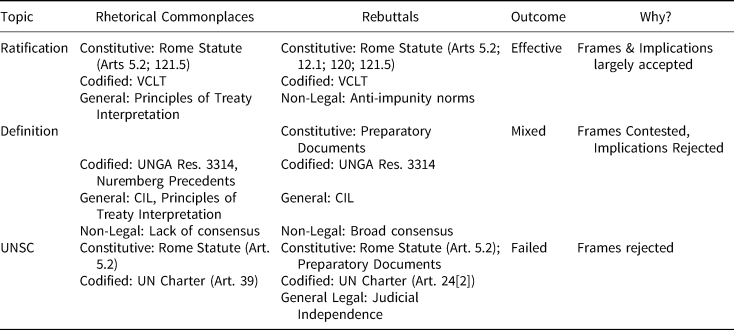
A summary of each argument – commonplaces, rebuttals, outcomes, and reasons, is included in Table 2. These findings support the hypothesis that framing contests would be the primary cause of ineffective US argumentation. In cases where the US frames were rejected (UNSC), the US failed to win any meaningful concessions. When frames were contested but not rejected the US managed to ‘win’ small concessions, falling far short of its desired outcomes, although overcoming some opposition (Definition). Finally, in the one case where the US used codified and constitutive legal framing (Ratification) the US had its greatest success, ‘winning’ its desired outcome.
Arguments and outcomes.

These results also support the legal framing hypotheses. The third argument, focused on the technicalities of jurisdiction and bringing the crime into force, had the most success while also being the argument most clearly connected to codified legal standards. In particular, the US used constitutive frames, drawn from the Rome Statute itself, which were difficult for opponents to challenge. This aligns with the expectation that constitutive claims, in this case the Rome Statute, were the most powerful rhetorical commonplaces for legal argumentation. While there were other codified legal claims available appealing directly to the ICC's founding document made it harder for opponents to dismiss the US claims as being inappropriate. Importantly, this argument may have yielded the greatest success for the US, limiting the court's jurisdiction in a way that reflected many of the US’ interests heading into the KRC.Footnote 134
The second argument, on the definition of the crime, also seemed to have particularly strong framing, drawing on longstanding texts and legal precedents that had had a long history in the development of the ICC. However, while the US invoked several codified and general legal standards, its success here was limited. Repeated reference was made to the definition being ‘off-limits’ for debate and the US found that many of its arguments here were dismissed, demonstrating the limited success of US non-legal arguments about the lack of consensus. While the US use of legal references supports the theory, the blanket rejection by many parties reinforces the important role of the public in establishing what is an acceptable and sustainable argument and further demonstrates the lack of success found by the US's non-legal arguments. Interestingly, and perhaps reflective of the legalised nature of many international forums – especially the KRC – non-legal frames appeared quite infrequently in these proceedings.
Although the US entered the KRC with significant material power, it was often unsuccessful in obtaining its desired results. While this analysis cannot account for the possibility that material claims were made behind the scenes, it is important to note that the US did not openly invoke such claims at the conference. Instead, it appears that the forum may have deterred the US from using its material advantages – for example, by tying financial or security incentives to particular outcomes – and limited its public claims to other forms of argument, especially legal. The analysis showed that in several cases the frames of the US arguments were contested and ultimately defeated by opposing arguments. The US's ability to produce socially sustainable arguments appears to have been limited at Kampala. The US's position as a non-state party may have limited the effectiveness of US arguments and strengthened arguments put forward by other actors. However, nothing about the US position should have limited the ability to construct successful arguments, which is the central component of rhetorical coercion. In fact, sources indicate that US views were considered, with no notable instances of them being downplayed,Footnote 135 a case that highlighted the influence of non-state parties.Footnote 136 While other states may not have been persuaded by the argument, a successful argument is still able to deny grounds for response. Non-membership did not limit the rhetoric available to the US, nor would it have provided an ‘out’ for other parties if the US made an otherwise compelling argument.
In a previous study, Adam Bower found that legal framing limited the coercive options available to the US and resulted in its failure to secure certain outcomes. Constrained by legal rhetoric, the US was unable to apply material arguments. Other actors were able to challenge the US arguments on stronger rhetorical grounds, as several US arguments were not sustainable in the context.Footnote 137 Specifically, arguments focusing on the definition were unsustainable as the definition was considered untouchable by most involved parties. This meant that opponents could easily dismiss these arguments and that these arguments also failed to garner significant public support. My findings may offer support for these conclusions as well. Additionally, however, my findings expand on this theory by highlighting the particular value of the most relevant and codified claims – claims made to founding documents or documents directly connected to the argument.
More broadly, the use of legal rhetoric instead of other rhetorical commonplaces shows states’ desires to couch their arguments in legal language. This is demonstrated by the frequent references to legal principles and understandings, instead of other political or normative claims, in the arguments. In the long run, however, this trapped the US into a legal argumentation, allowing opponents to counter with their legal arguments. US arguments were generally less effective than those made by opponents. Denied legal counterarguments and unable to use other forms of rhetoric, the US found itself largely unable to achieve its desired outcomes. Given that the arguments were made about legal matters to a diplomatic and legal audience the US was further limited in what claims would be sustainable, likely necessitating the use of legal commonplaces, even in cases where they were unlikely to succeed.
Conclusion
What makes an argument effective? Building on existing scholarship on the value of legal arguments, this article highlights how constitutive legal texts may be uniquely valuable in international argumentation. This stems from their unique nature in international relations – combing the specificity of codified legal references with the highest level of relevance and public acceptance to the debated topic. While codified and general legal arguments are still useful, and as the case shows are often combined with constitutive arguments, constitutive references may offer actors the strongest frames for compelling others to accept or acquiesce to an argument.
Analysing US arguments from the KRC offers support for these claims. It appears that the US had the most success framing its arguments on constitutive legal references, especially when combined with appeals to other codified and general legal references. When US claims had mixed results, this may have stemmed from opponents invoking constitutive frames of their own, allowing opponents to challenge how US interpretations and applying the constitutive references in their arguments. US arguments on the definition of the CoA further highlight the importance relevant publics – in this case, the other states involved at the KRC – in shaping the acceptable grounds of debate, a key component in rhetorical contestation. US attempts to reopen the debate on the definition were seen as out of bounds and largely rejected.
Despite material advantages, the US failed to achieve all of its goals at the KRC. Seemingly limited in the scope of its public appeals, US delegates had to frame their claims on references that were publicly acceptable and most likely to ‘win’ the resulting rhetorical contest. In keeping with previous research, arguments with legal frames, especially codified ones, seemed especially useful.Footnote 138 However, as this article demonstrates, not all codified legal frames were equally useful. Arguments framed on constitutive legal claims – both by the US and opponents – may have been uniquely valuable in providing frames that opponents had a harder time challenging, increasing the likelihood that the arguing state would ‘win’ the rhetorical contest. These findings reinforce the importance of law as a source of rhetoric in international argumentation – especially in formalised international settings, deepen our empirical understanding of the ways in which rhetoric and law may ultimately shape policy outcomes and state behaviour, and highlight the particular role of constitutive legal claims in international relations.
Acknowledgements
I would like to thank Wayne Sandholtz, Alexander Dukalskis, Kelebogile Zvobgo, Adam Bower, and Edward Gonzalez, as well as the anonymous reviewers, for their constructive feedback on this project. This article was previously presented at the International Studies Association – West Conference and I'm thankful for the feedback received there. Any remaining errors are entirely my responsibility. I would also like to thank the University of Southern California for supporting this work through the Dornsife/Graduate School PhD Fellowship in the Social Sciences and the University College Dublin School of Politics and International Relations for supporting earlier versions of this project.