The chief justice of the United States sits at not only the apex of a multileveled judicial decision-making body but also the apex of an increasingly vast administrative organization that influences federal courts and public policy. The federal judiciary commands an annual budget now in the billions and encompasses a workforce, both judicial and nonjudicial, exceeding 30,000. The courts’ complex and sizable governmental face is represented, if not controlled, by the chief justice and the judges he selects to serve on the Judicial Conference committees that set policy for the federal judiciary. The growth of the federal judiciary offers opportunities for political entrepreneurs, like the chief justice, to use the administrative structure and the incentives it creates to influence policy both internal and external to the judiciary. These committees shape how the federal courts function. As well, committees engage in interbranch contacts whose scope and nature include judicial position taking on matters of substantive legal policy. This article is the first comprehensive empirical study of appointments to the Judicial Conference committees, the criteria by which a chief justice selects committee members and committee chairs, and whether those selection criteria evidence an ideological component that suggests Judicial Conference committees can be used to forward the chief justice’s policy preferences in ways that move beyond general judicial administration.
This article exploits a newly created database of all judges appointed by the chief justice to serve on Judicial Conference committees between 1986 and 2012. The results indicate that a judge’s partisan alignment with the chief justice matters for committee service. Personal characteristics such as race, experience on the bench, and court level also influence appointments. These results suggest that the avenues available to a chief justice for shaping legal policy extend beyond his role within the Court decision-making process. Control over the administrative side of the federal judiciary, through control over Judicial Conference committee selection, membership, and participation, may also be used to advance the chief justice’s interests in ways that are not ideologically neutral.
Judicial Conference Committees
The Judicial Conference oversees the management of the federal court system aided by both the Administrative Office of the US Courts (hereafter, “Administrative Office”) and the Federal Judicial Center. The Judicial Conference is chaired by the chief justice (the only Supreme Court justice who participates). It conducts the business of the federal courts through an organization of specialized committees whose membership is appointed exclusively by the chief justice and drawn from the entire federal judiciary (Fish Reference Fish1973; Wheeler Reference Wheeler2003). These committees engage in the substantive work of the Judicial Conference and act as gatekeepers with respect to the formulation of administrative judicial policy (Fish Reference Fish1973; Tacha Reference Tacha1995; Wheeler Reference Wheeler2003)). Between 1986 and 2012, 25 standing committees served the Judicial Conference. These committees advocate for certain legislative policy positions by providing Congress with assessments of proposed legislation’s impact on the federal courts, including substantive reviews of pending criminal laws, bankruptcy statutes, and the appropriate allocation of jurisdiction between the federal and the state systems. They oversee and draft rules of procedure and evidence that govern the operation of federal civil, criminal, appellate, and bankruptcy litigation. Committees prepare and present the federal judiciary’s budgetary requests to Congress, manage nonjudicial staff and employment issues, identify additional judgeship needs, and report on court performance. Scholars studying this organizational structure are fairly uniform in their assessment that the Judicial Conference follows the conclusions and policy prescriptions reported out of the various committees (Fish Reference Fish1973; Resnik Reference Resnik2000).
The Chief Justice’s Committee Control
The chief justice has plenary power over the Judicial Conference committees’ structure and membership. He controls the number of committees, terms of service, chairs, number and appointment of members, and committee jurisdiction (Judicial Conference of the US Courts 1937, 1948, 1987; Administrative Office of the US Courts 2014). Currently, active and senior Article III judges perform the bulk of committee service. Supreme Court justices (other than the chief justice) do not serve in the Judicial Conference or on the standing committees, although they may serve on special committees. Appointment criteria are defined by the chief justice. Judges may express interest in service or recommend other judges for service by notifying the Administrative Office. Since 1987, committee service is limited to two 3-year terms per judge, with allowances for additional term extensions or committee chairperson extensions by the chief justice in “exceptional” cases (Judicial Conference of the US Courts 1987, September 27, 60).
Prior Research, Organizational Structure, and Chief Justice Power
It is well understood that administrative and organizational structures offer opportunities to influence policy outcomes and consolidate power. The chief justice’s unique position in the federal judiciary, and his potentially heightened ability to influence legal policy, primarily lies not in decision making where he is one vote of nine but rather in the accretion over time of administrative and customary powers. These include, most notably, opinion assignment, docket and case conference control, appointment power over special tribunals and panels, and—of interest here—appointments to the Judicial Conference committees (Fish Reference Fish1984; Ruger Reference Ruger2006; George and Williams Reference George and Williams2013). The consolidation of institutional power in the office of the chief justice raises concerns, since the concentration of this power is placed within the control of a single politically insulated actor (Cross and Lindquist Reference Cross and Lindquist2006; Ruger Reference Ruger2006; Pfander Reference Pfander2013).
How the chief justice wields the appointment power remains largely unstudied from an empirical stand point. The few studies conducted are suggestive of strategic behavior, but with mixed results. Ruger (Reference Ruger2007) finds evidence of conservative appointments by Chief Justice Rehnquist to the Foreign Intelligence Surveillance Act Court but notes that these appointments do not appear out of step with the general leanings of the federal bench. Stancil (Reference Stancil2010) examines the power of Judicial Conference committees from a game theoretic perspective, noting their capacity to influence substantive law through rule-making procedures. Nixon (Reference Nixon2003) concludes that political ideology influences chief justice appointments to the Judicial Conference Executive Committee.
Anecdotal evidence supports the contention that the chief justice uses Judicial Conference committee appointments in a strategic way, selecting judges who align with the chief justice’s political point of view and eschewing judges whose policies are too distant (Fish Reference Fish1973; Resnik Reference Resnik1998). Chief Justice Warren reportedly used the committee structure as a means to orchestrate and bolster his positions before the Judicial Conference, as well as to reward policy allies (Fish Reference Fish1973, 33–34, 268). Chief Justice Hughes required personal preapproval of important committee reports before submitting them to the main body, which in turn reflexively followed the committee recommendations (259). More recently, then-senator Joseph Biden commented during a Senate Judiciary Committee hearing on additional judgeships, “When it comes to playing politics and doling out patronage, the Judicial Conference has no equal that I have seen before this committee.”Footnote 1
Judicial Conference committee service provides value to the serving member. District court and special court judges fought hard to be included in both the conference and its committees (Fish 1973). Federal judges have few opportunities to distinguish themselves (Posner 1996), their salary and tenure being uniform across district and appellate levels, respectively. Committee service that differentiates a judge from her peers and provides increased opportunity to interact with the executive and congressional branches may function as a kind of judicial patronage.
Committees and Substantive Policy
Apprehensions about an organized judiciary and the chief justice using the Judicial Conference to blur lines between administrative and political matters are not new, dating back to the initial authorization of the Judicial Conference by the Judiciary Act of 1922 (Padelford 1932). Many of these concerns focus on the potential for the judiciary to influence legislative outcomes and generally are of two kinds. First, the creation of various procedural rules for the federal judiciary, a task controlled by the related rules committees of the Judicial Conference, may advance judicial self-interest, including policy preferences such as reductions in specific caseload types or litigation barriers aimed only at certain kinds of claimants (Ruger Reference Ruger2006; Stancil Reference Stancil2010; Pfander Reference Pfander2013). Second, and relatedly, there is unease with the potential effects of systemized judicial interaction with Congress under the auspices of providing advice regarding pending legislation and its impact on the federal judiciary (Geyh Reference Geyh1996, Reference Geyh2006; Cross and Lindquist Reference Cross and Lindquist2006; Resnik Reference Resnik2010). Both these points skirt a fine line between Congress’s need for relevant information regarding the judiciary’s experience with certain laws and issue-based advocacy that some scholars note create confounds for a judiciary that may also find some issues of related legislation challenged in the courts (Resnik Reference Resnik2000, Reference Resnik2010; Ruger Reference Ruger2004, Reference Ruger2006).
In the 27 years covered by this study, Judicial Conference committee members appeared before or reported to Congress over 300 times on a regularized basis, including committee member testimony on pending legislation or other legislative matters.Footnote 2 Less susceptible to definitive count are ongoing and equally regularized formal and informal contacts with congressional committees and members of Congress. The subject areas that fall under this umbrella are numerous and nontrivial. The Judicial Conference, for example, has long opposed mandatory minimum sentences for federal crimes, usually citing the need for greater judicial control over sentencing to alleviate inequitable and inconsistent outcomes (a factor that induced this type of legislation) and the costs of increased prison and supervised release populations. In keeping with this long-standing position, Judge Bell, chair of the Judicial Conference’s Criminal Law Committee, wrote Senator Leahy in 2012 advocating for the passage of the Justice Safety Valve Act of 2013, arguing that mandatory sentences “are wasteful of taxpayer dollars, produce unjust results, are incompatible with the concept of guideline sentencing, and could undermine confidence in the judicial system” (Bell 2013, 2).
The official organs of the federal judiciary consistently oppose the creation of new federal rights (Judicial Conference of the US Courts 1995; de Figueiredo and Tiller 1996; Posner 1996) or at the very least resist new federal rights not paired with substantial (and often highly unlikely) increases in judicial resources. In 2013, the conference took a strong position on pending immigration legislation expressing deep concerns about intolerable caseloads likely associated with increased enforcement mechanisms, broadened legalization and citizenship programs, and the expansion of the E-Verify program to mandate employer participation (Administrative Office of the US Courts 2013; Committee on the Judiciary 2013).Footnote 3 Immigration reform remains a contentious political issue at this writing, and no doubt legislative change will generate considerable litigation.
To round out the list, the Judicial Conference took positions on such widely divergent legislative issues as domestic violence on Native American land (September 2012), the Hague Convention (March 2011), probation officer search and seizure powers (March 2008a), prison litigation reform (September 2008b), class actions (September 2007b), wiretapping laws (March 2007a), restrictions on social security claims, diversity jurisdiction, the North American Free Trade Agreement, asbestos-related claims, habeas jurisdiction, medical privacy issues, the General Agreement on Tariffs and Trade, governmental taking of private property, and animal research (Administrative Office of the US Courts 1994, 2005; Nixon Reference Nixon2003). Since so much public policy is either created or challenged in federal courts (Olson Reference Olson1991; Kagan Reference Kagan2001), advocating restrictions on litigant access to the federal system may not be a policy-neutral endeavor (Resnik Reference Resnik1998, Reference Resnik2000, Reference Resnik2010; Stancil Reference Stancil2010). Limitations on habeas petitions to federal courts, for example, affect prisoner rights litigation and federal review of state action by transferring more power to the state courts. Curtailed review of administrative actions in social security and health care serves to bolster the quasi-judicial power of agencies.
The remainder of the article empirically examines chief justice selections to the Judicial Conference committees, discusses the results, and then concludes. The chief justice’s plenary control over committee appointments, his strategic use of other institutional powers to advance his preferences, and the anecdotal evidence all suggest that Judicial Conference committees provide another avenue for the chief justice to influence both the legal system and legal policy.
Data and Method
The research presented here employs a newly created database of all judges appointed to serve on Judicial Conference committees from all Article III judges, both active and senior status, serving on the federal bench from June 1, 1986, through December 31, 2012.Footnote 4 The data span both Rehnquist’s and Robert’s terms as chief justice.Footnote 5
Dependent Variables
The variable of interest, Selected, records whether a judge was selected to serve on any Judicial Conference committee.Footnote 6 As prior scholarship expresses concern over the impact Judicial Conference committees may have on substantive legal policy, Selected Law Committee represents selection to any of the nine committees (“Law Committees”) whose domains involve procedural rules or federal court jurisdictional matters. Outside of the Budget and Spaces and Facilities committees, these nine Law Committees are among the most active before Congress.Footnote 7 Service for multiple terms, or as a committee chair, increases opportunities to influence committee policy. In particular, when a judge is appointed to a third term and beyond, the chief justice expressly violates his own rule regarding the limits on committee service. Over Two Terms records judges selected to serve on the same committee for more than the two-term maximum articulated by the chief justice. Chair represents a judge’s selection as a committee chairperson. Law Chair represents a judge’s selection as chair for any one of the nine Law Committees. Selections were recorded as binary variables, taking the value of 1 if a judge is selected within a particular observation interval.
The unit of analysis is at the individual judge level. For the time-series analyses, a separate observation was recorded for each judge at the end of each 12-month period of service on the federal bench. For example, a judge who serves the full time covered by the data set generates 27 observations, each representing a continuous 12-month interval. This allows for analysis of the chief justice’s selection process, controlling for the pool of judges available for committee selection during each interval observed. Once a judge was selected to serve on a committee, she was removed from the available selection pool until her 3-year term of service was completed or until she left the committee, whichever date was earliest.Footnote 8 Upon death or retirement, a judge was removed permanently from the selection pool.
Party Alignment
To explore whether Judicial Conference committee appointments follow some kind of politically based preference, signaling a greater probability that selection operates as a mechanism for control over policy outcomes, each judge was assigned a partisan label (Republican or Democrat) on the basis of the party of her appointing president.Footnote 9 Chief Justice Party is a dichotomous variable recorded as 1 if the judge was appointed by a Republican president, and thus is the same party of appointment as the chief justice.Footnote 10 As a robustness check, more fine-grained measures of ideological preference were based on derivations of Poole and Rosenthal’s first-dimension Nominate Common Space Scores (Poole and Rosenthal 1997; Poole 1998, 2005).Footnote 11 Appellate and district court judicial Nominate Common Space Scores were assigned according to the method developed by Giles, Hettinger, and Peppers (2001), using norms of senatorial courtesy to assign judges a Nominate Common Space Score derived from the scores of their home state senators. The chief justice’s judicial Nominate Common Space Score was calculated by the method described by Epstein et al. (2007) in which preference points for each justice premised on changing voting patterns are transformed into Nominate Common Space Scores.Footnote 12 These various Nominate Common Space Score calculations are referred to as “Common Space Scores,” throughout the remainder of the article.
Biographical and Control Variables
With the exception of case decisions and opinions, the federal courts’ impact on policy is filtered through other institutional actors (Congress, the president, and the bureaucracy). To explore whether the chief justice takes into account preference alignment between judges and the congressional committees with the most active federal court oversight, the variable House Judiciary is the absolute value of the distance between the individual judge’s Common Space Score and the House Judiciary Committee’s majority member median Common Space Score.Footnote 13 Contact and experience with state-level elites, designed to capture a judge’s relationships with members of Congress from her state and hence potentially greater access that may benefit the judiciary, is represented by Any State, a dichotomous variable recorded as 1 for judges with prior professional experience at the state level in executive, legislative, judicial, or prosecutorial service. Similar contacts or experience within the federal system, which may represent special access to actors in the executive branch or members of Congress, are reflected in the variable Any Federal, which takes the value of 1 if the judge had prior service in either the federal legislative or executive branch, including agencies and the Department of Justice.
Biographical variables were identified for each judge in the database to control for characteristics, unrelated to ideology, which may affect the chief justice’s decision to appoint a particular judge. Biographical data, including prior work experience, seniority, gender, and race, were derived from information reported by the Federal Judicial Center. Recent scholarship on collective decision making and the Court has noted a paucity of variation in background characteristics within the federal judiciary (including race, gender, and occupational experience; Epstein, Knight, and Martin 2003). The following variables explore whether chief justice committee selection is affected similarly. Basic information on race and gender, standard controls for any population study, were included as dichotomous variables, with Female taking the value of 1 if a judge is female and Nonwhite recorded as 1 if the judge is a minority (all nonwhite judges). In addition, controls for occupational backgrounds were included. Business takes the value of 1 if a judge was in the private sector (excluding law firms but including in-house legal counsel). Appellate Clerk, a dichotomous variable, identifies all judges who, after law school, clerked on a federal circuit court of appeals. Academic is coded 1 if the judge was affiliated before appointment (either full-time or in a part-time adjunct capacity) with an institution of higher education.Footnote 14
An individual’s experience within the judicial system may also affect committee service, with the assumption that appointment decisions should favor judges who are familiar with the federal judiciary’s administrative operations. Judicial experience on the bench was calculated from a judge’s total federal judicial service in years at the end of each interval.Footnote 15 To address collinearity with variables for seniority status (discussed below) and the likely nonlinear effect of experience due to its correlation with age, experience on the bench was converted into three dichotomous variables. Low Experience is coded 1 if the judge falls in the bottom quartile of the judges available for selection in an interval. High Experience is coded 1 if a judge is within the top quartile of years on the bench. Middle Experience (25%–75%) is the reference category.
Stature within the federal judiciary may also matter to appointments. As the circuit courts sit between the federal district courts and Supreme Court in terms of workflow and importance, it may be easier for an appellate judge to differentiate herself and come to the attention of the chief justice, hence increasing selection odds. Whether a judge sits on the federal courts of appeals is represented by the dichotomous variable Appellate Judge. Judges who have elected senior status (semiretirement) may have additional time for committee service or, due to age, may be less likely to be appointed. To control for these possibilities, Senior Status takes the value 1 in any given year for all judges designated as occupying senior status. To account for the default rule that a judge may serve only a two-term maximum, the regressions control for two-term service with the variable Served Twice, which takes the value of 1 after the judge completes a second term of committee service.
Descriptive Statistics
Of the 2,015 eligible judges, 842 (42%) served on one or more of the identified Judicial Conference committees, and 297 (15%) served on one of the nine Law Committees. Multiple service terms are the norm, with 166 (20%) of the 842 selected judges serving only one term,Footnote 16 and 676 (80%) serving at least two terms. However, service beyond the two-term limit was less common, with only 310 (37%) judges serving three or more terms, a total that represents only 15% of the eligible judicial pool.
Multiple committee service is observed in 225 (27%) of the judges serving. Most of this service is not consecutive, with 138 (61%) of second committee service taking place an average of 6 years after the completion of initial service. Looking at only consecutive committee service (completion of a term on one committee and then immediate appointment to a second committee), we observe that 13 of the 24 committees studied saw roughly the same number of judges switch into a particular committee as switch out of that committee.Footnote 17 Of the remaining 11 committees, differentials between judges switching into and out of committees may be suggestive of between-committee service variability, but the numbers are simply too small to provide reliable trends.Footnote 18
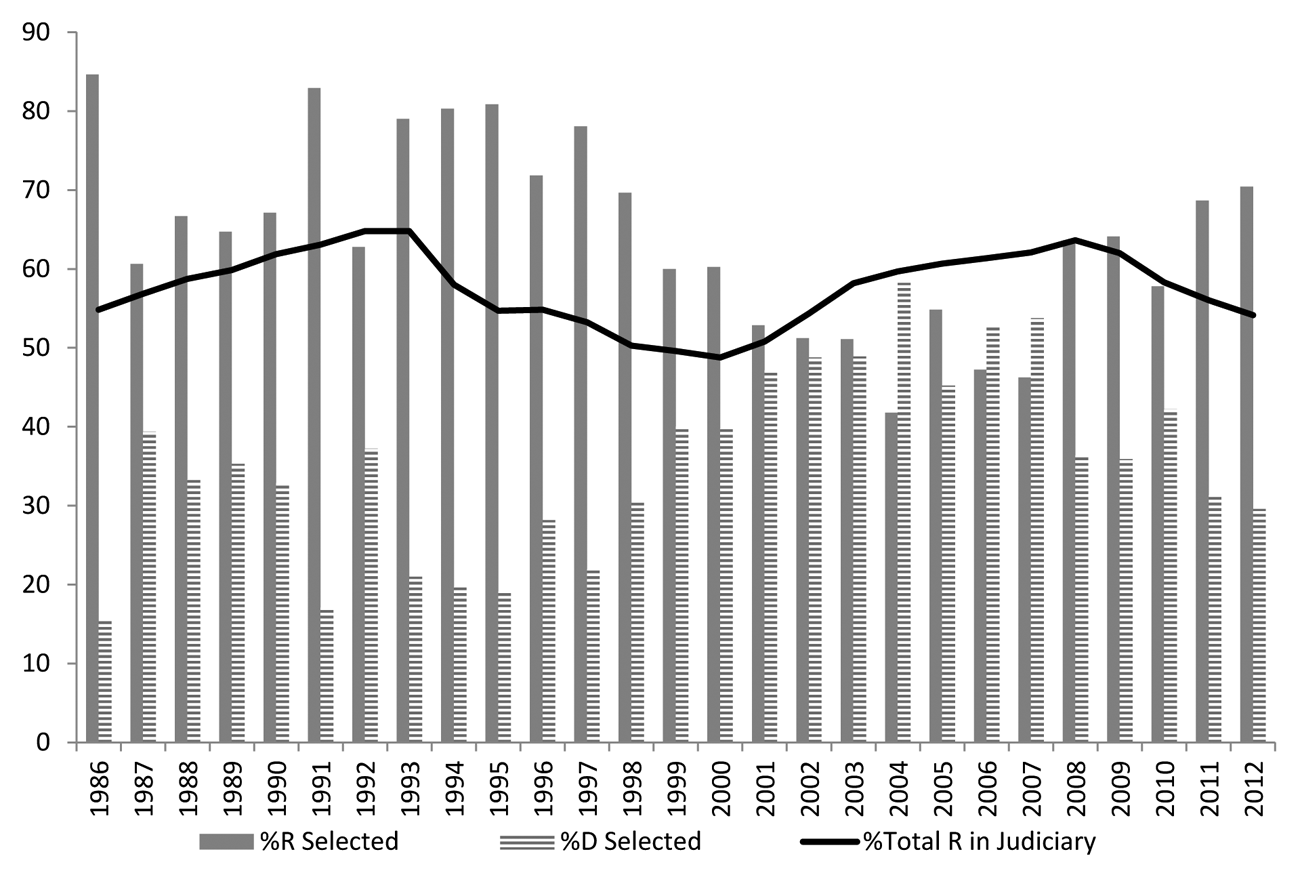
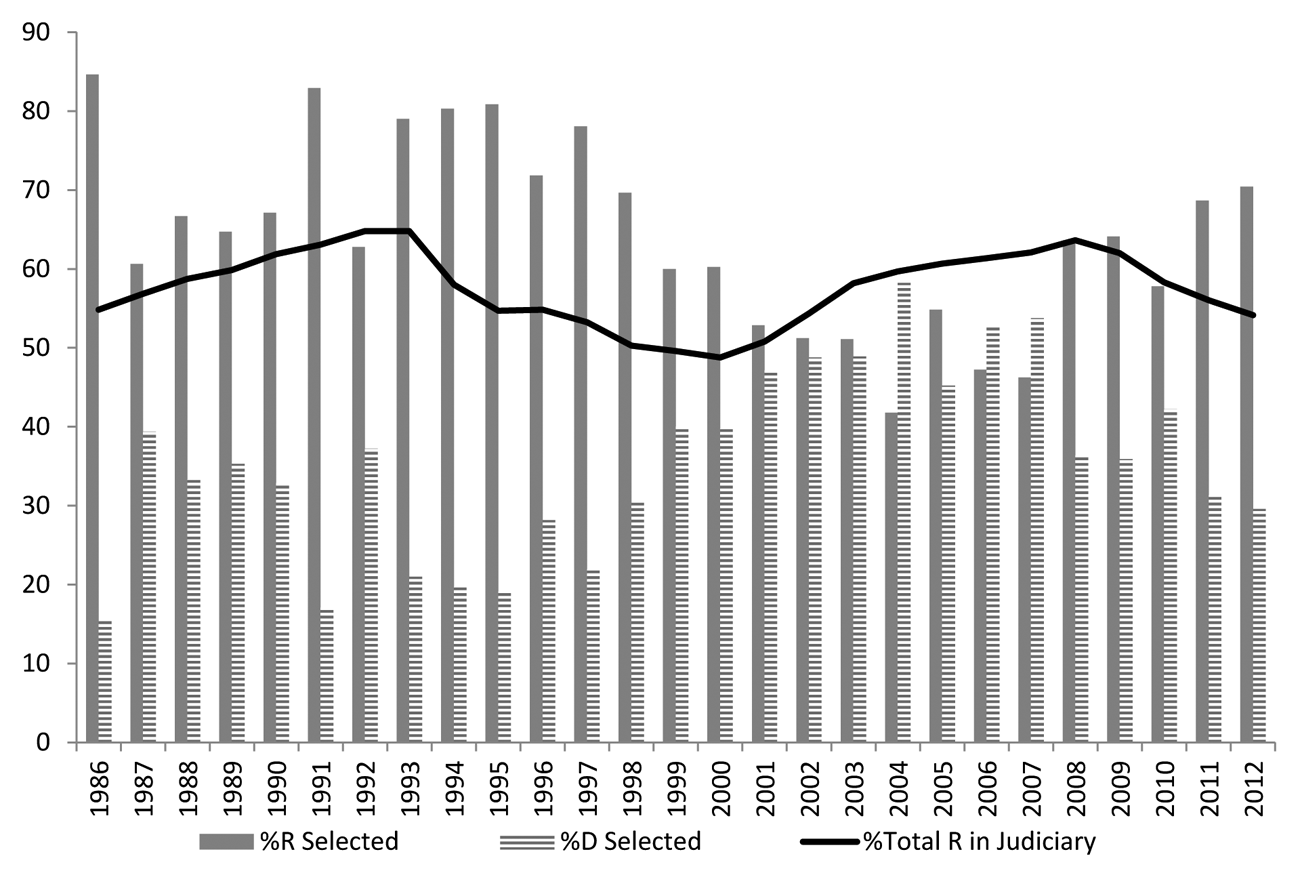
As an initial matter, it appears that party affiliation affects committee selection and composition. For each year 1986–2012, figure 1 compares the percentage of Democratic judge committee appointments, Republican judge committee appointments, and the overall percentage of Republican judges in the available judicial pool. In 18 of the 27 years studied, the percentage of Republican judges appointed to committees exceeds (often by a considerable margin) both the percentage of Democratic committee appointments as well as the overall percentage of Republicans available for committee service. For example, in 1991, 83% of committee appointments went to Republican judges, although Republicans comprised 63% of the available judiciary. In 2012, appointments were 70% Republican, drawn from a 54% Republican judicial pool. In only three years, 2004, 2006, and 2007, do Democratic appointments exceed Republican appointments.
Judicial conference committee selections (by party affiliation) compared to full Article III party composition, 1986–2012. R = Republican; D = Democrat.
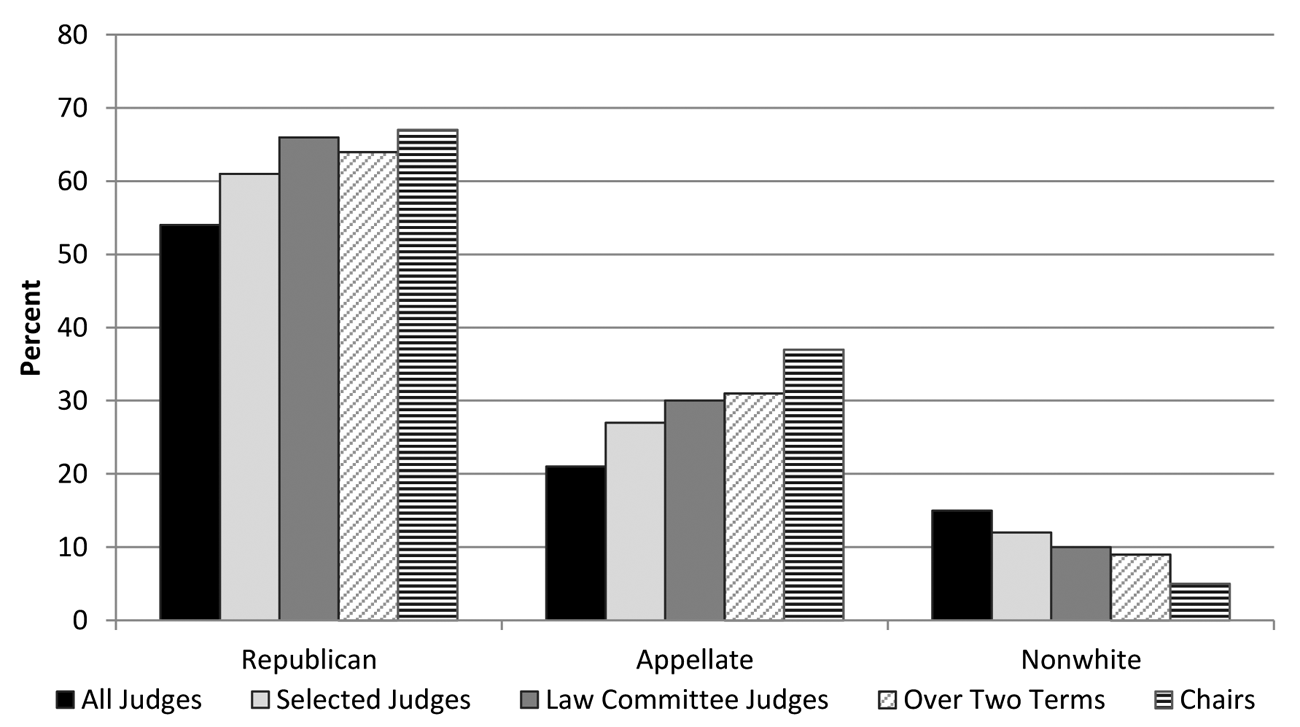
The apparent dominance of Republican judges also emerges as the analysis moves from yearly appointment patterns to the composition of key influential positions within the committee system. Figure 2 presents the percentage of Republican judges within the full judiciary pool (54%), selected to any committee (61%), selected to a Law Committee (66%), selected as committee chairs (67%), and serving beyond the two-term maximum prescribed by the chief justice (64%).
Descriptive statistics: Characteristics of all judges, selected judges, law committee judges, over two terms judges, and chairs, 1986–2012.
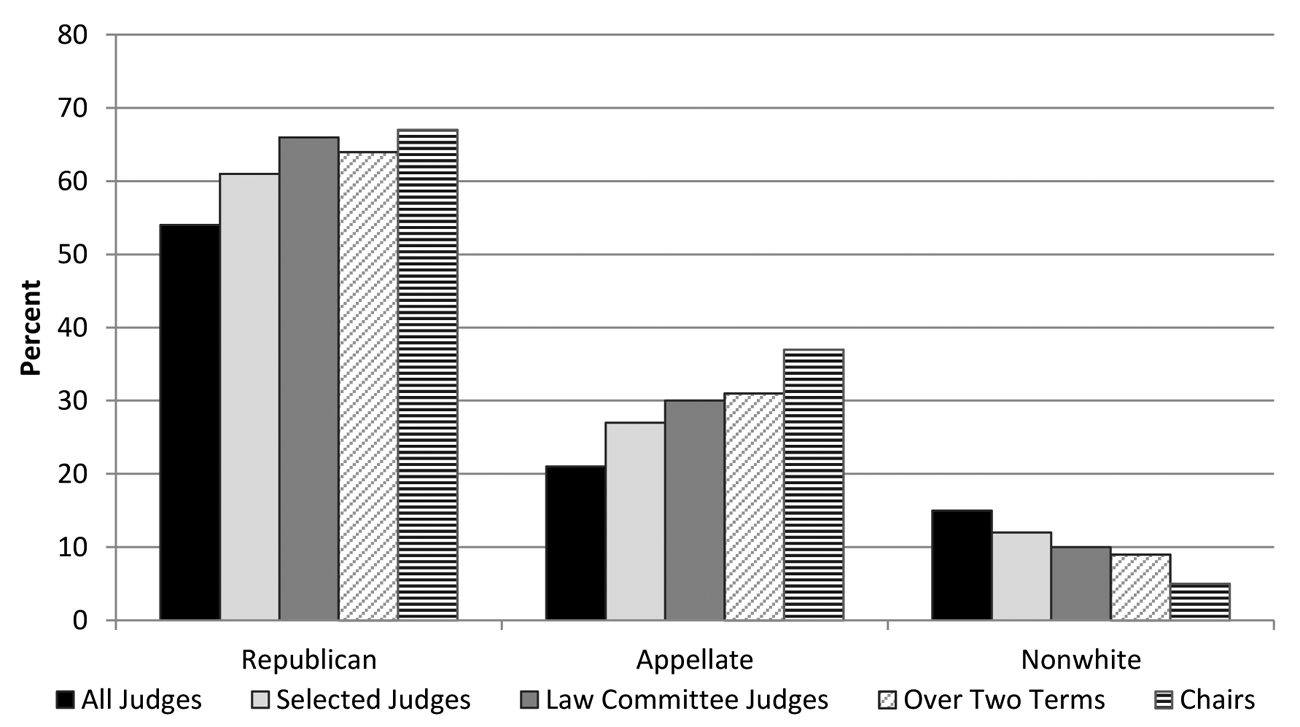
Some additional judicial characteristics warrant note. Stature, and perhaps familiarity to the chief justice, as represented by circuit court judges, also appears salient. Appellate judges are represented in proportionately higher numbers in both committee and chair service than in the general Article III population (fig. 2). Appellate judges comprise 21% of the overall judicial pool but make up 27% of the selected judges, 30% of the Law Committee selections, 31% of those serving over two terms, and 36% of the committee chair selections.Footnote 19 Figure 2 also shows that judges from racial minorities appear to be underrepresented in all facets of committee service. Nonwhite judges represent 15% of the general population but only 12% of committee member selections and 10% of Law Committee member selections. Of those selected to serve over two terms, 9% are nonwhite, and of committee chairs, 5% are minorities.
Empirical Methodology
To further examine the effect of partisan alignment on the odds of committee selection, the data were analyzed using cross-sectional time-series maximum likelihood models, the appropriate method for longitudinal analyses of dichotomous dependent variables derived from data that cover a changing population observed annually. In particular, because fewer judges receive committee appointments than judges who are not appointed in any given year (selection percentages in the majority of years studied range between 2% and 9%), the analyses use random-effects complementary log-log (cloglog) models, designed to address estimation problems caused by the left skew (due to an overabundance of zeros, or nonevents).Footnote 20 A series of models analyze the individual judge-level characteristics that affect a judge’s odds of being selected to any committee, a Law Committee, a committee chair, a Law Committee chair, or appointment beyond the stated two-term maximum.Footnote 21
The regression equation is as follows:

where i indexes the individual judge and t indexes the year of selection. Outcome is the variable of interest. In the Selected model, outcome equals 1 when a judge is selected to any committee. In the Selected Law model, Outcome equals 1 when a judge is selected to a Law Committee—any of the nine committees whose jurisdiction encompasses access to the federal judiciary or changes to legal rules (either procedural or substantive).Footnote
22
Multiple service patterns are examined in the Over Two Terms model, where Outcome equals 1 if a judge is selected to a committee and that selection represents the third (or greater) term of service. To examine service as a committee chair, in Chair and Chair Law models Outcome equals 1 if a judge is selected to chair a committee or Law Committee. Finally, controls are included for demographic information, judicial status, background experience, potential political advantage, time on the bench, and, given the two-term service rule, a control for whether a judge has already served the maximum number of terms (Served Twice).Footnote
23
The main coefficient of interest
 expresses the increase or decrease in the Outcome odds if a judge is in the same party as the chief justice.
All regressions also were conducted by replacing party affiliation (Chief Justice Party) with the Common Space Score distance (in absolute terms) between a judge and the chief justice. The substantive results do not vary from those reported below, with decreased judge–chief justice distance evidencing the same effect on selection as being a Republican appointee (and therefore aligned with the chief justice).Footnote 24 This is not surprising on several levels. First, party of appointment correlates strongly with judicial Common Space Scores. Second, judicial Common Space Scores for appellate and district judges are not derived independently from judicial case votes but are assigned on the basis of home state senators’ Common Space Scores and as such may represent no more granular a measure than party of appointment. Finally, the chief justice appoints, on average, 76 judges each year to various Judicial Conference committees. It may well be the case that from an appointer’s perspective, party is a reliable and easily used heuristic.
Results and Discussion
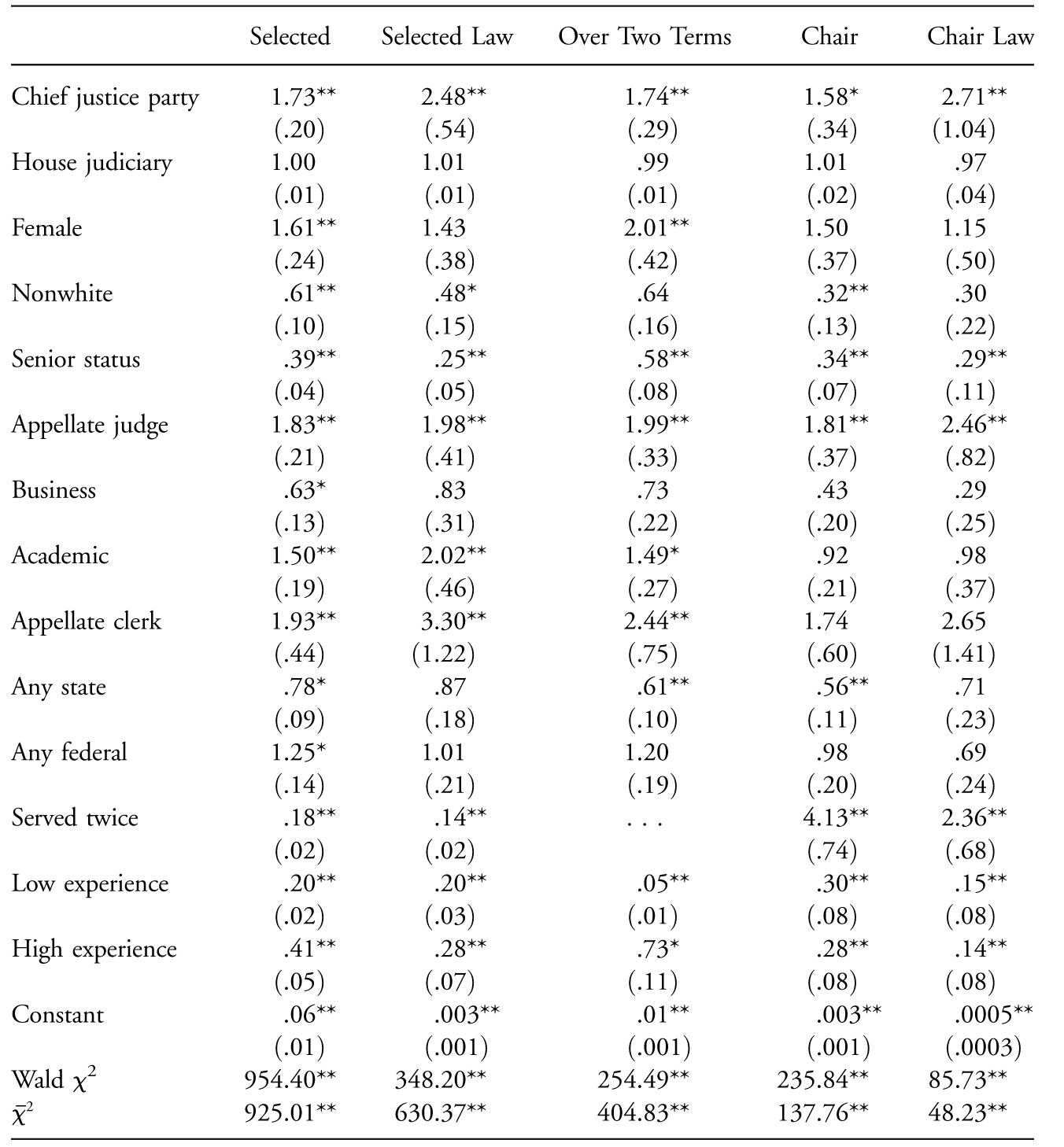
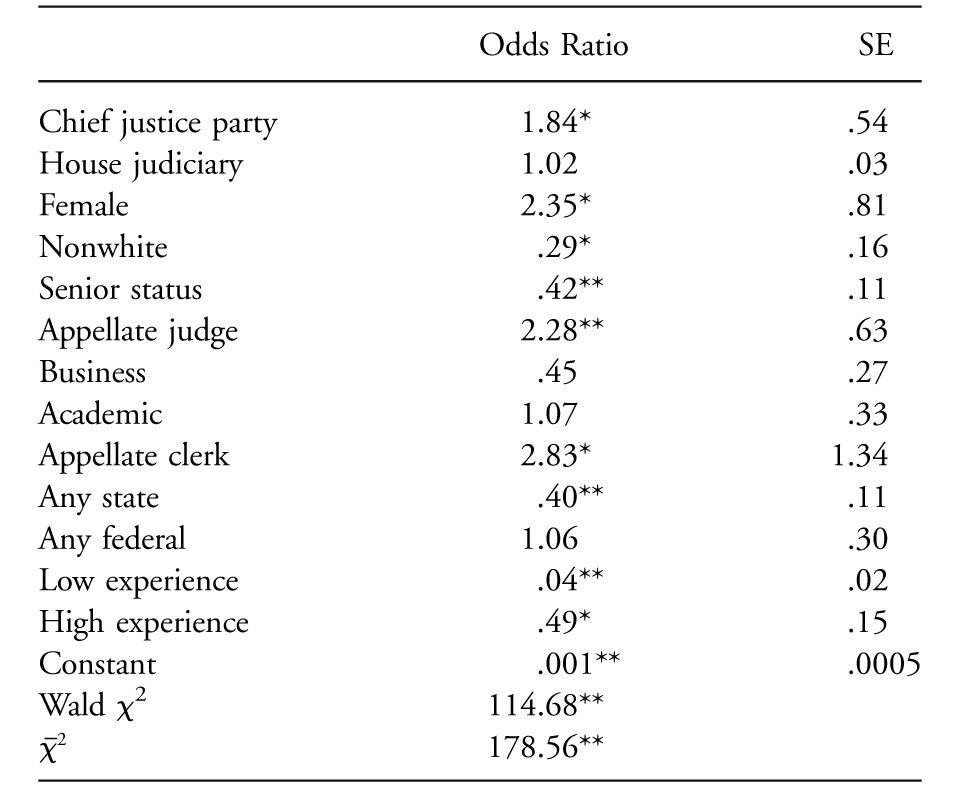
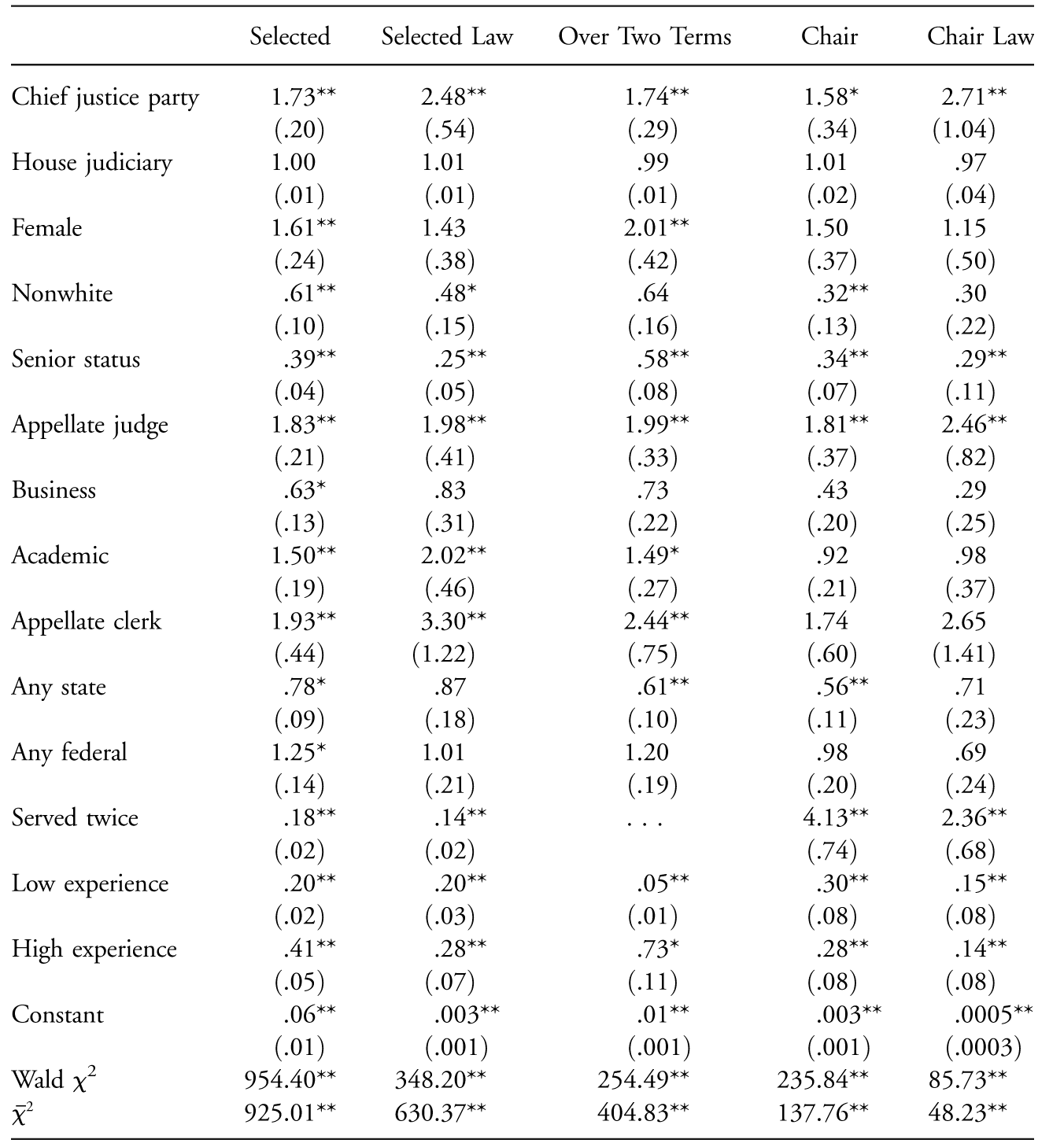
The regression results are consistent with the descriptive statistics and offer robust support for the proposition that party alignment with the chief justice matters for selection to Judicial Conference committees and positions of influence within that system. Being a Republican appointee, and the same party as the chief justice, significantly increases appointment odds in every model (table 1). Odds of being selected to any committee increase by about 73% for Republican judges, and the odds of selection to a Law Committee more than double. Republicans judges are 58% more likely to be committee chairs and almost three times as likely to chair a Law Committee. Finally, Republican appointees are 74% more likely to remain on committees beyond the two-term maximum, as compared to Democratic appointees.
Source—Judicial Conference Committee data set, 2012.
Note—Binomial maximum likelihood models fitted with complementary log log function in Stata12. Exponentiated coefficients. Served twice is not included in the Over Two Terms model due to lack of variation. N = 28,275.
* p < .05.
** p < .01.
Other Variables of Interest
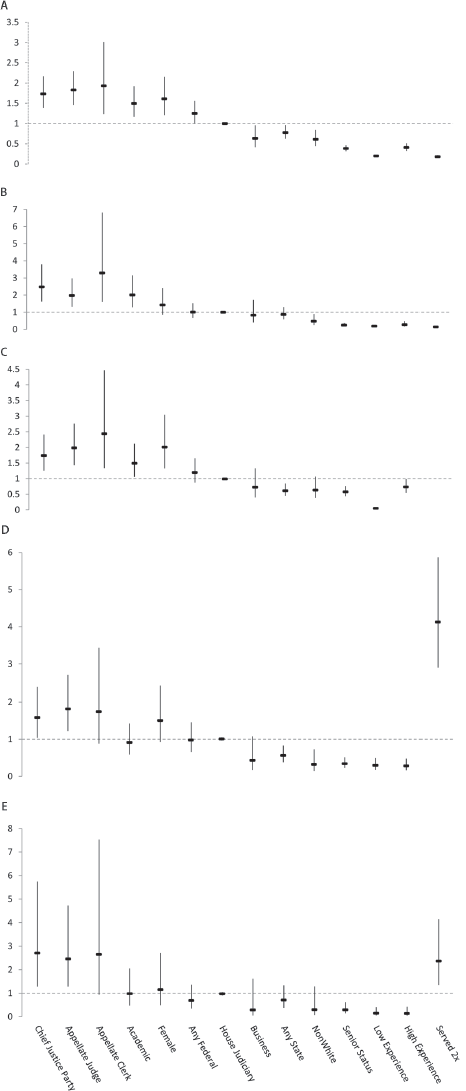
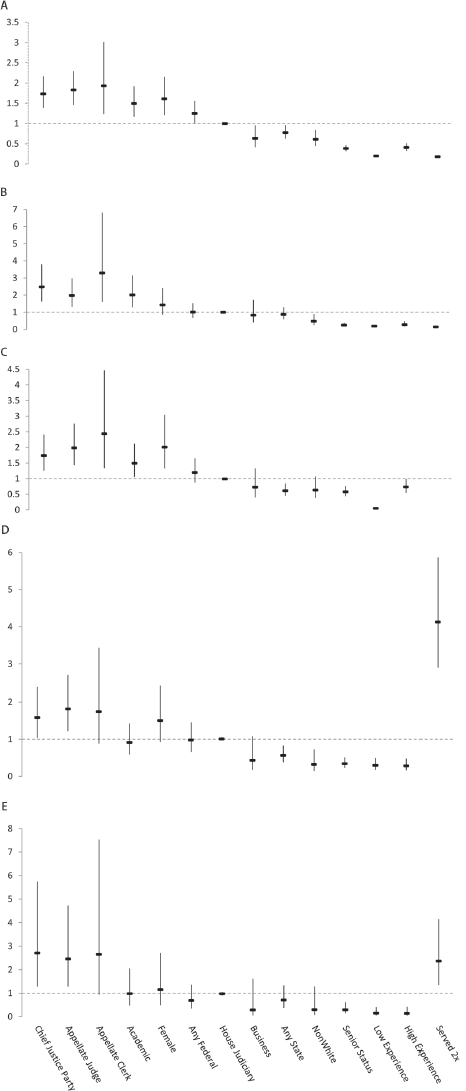
In addition to the salience of party, a number of the other variables exhibit a consistent relationship to a judge’s appointment odds and are worthy of note. Figure 3 presents these results graphically, with the variables on the X-axis and odds ratios on the Y-axis. The horizontal dashes indicate the odds-ratio coefficient for a particular variable, and the vertical lines denote the 95% confidence interval. An odds ratio of 1 represents the null, and this grid line is highlighted. This figure demonstrates a fairly uniform pattern across the five models, with roughly the same groups of variables increasing and decreasing the likelihood of appointment.
A, Selected to any committee; B, selected to a Law Committee; C, selected over two terms. D, Selected chair; E, selected law chair
Violation of the Two-Term Service Rule
As was expected, after a judge serves her two-term maximum (Served Twice), she is significantly less likely to be appointed to the same or another committee. Accordingly, Served Twice is below the null grid line in both the Selection and Law Selection models, representing a reduction in selection odds of roughly 80% (table 1; figs. 3A and 3B ). However, the model for multiple-year service (Over Two Terms; table 1; fig. 3C ) indicates that Republican judges are far more likely (74%) than their Democratic counterparts to serve beyond the two-term maximum. And when it comes to the selection of chairs, either to any committee or to a Law Committee, having served twice increases the odds of appointment by two- to fourfold (Chair, Chair Law; table 1; figs. 3D and 3E ). This suggests that the chief justice selects a group of judges for multiyear service, in contravention to the two-term limit, and then favors them for selection to positions of control within the committees.
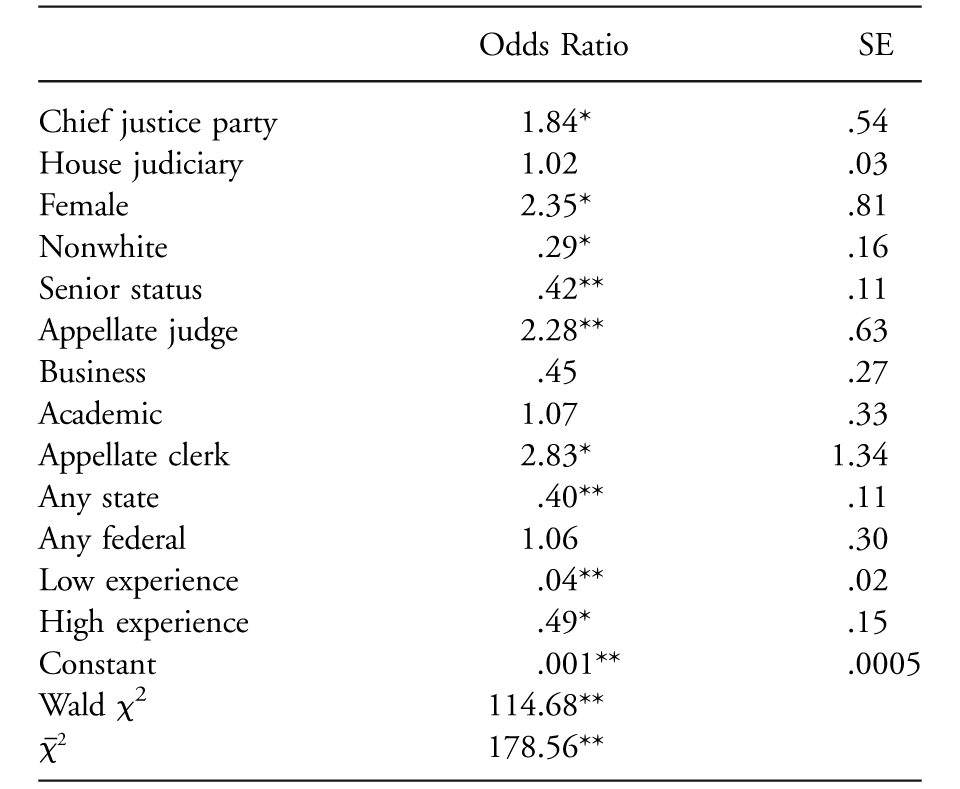
The question remains whether being a Republican appointee makes it more likely that a particular judge will receive multiple term appointments and will be more likely to serve as a committee chair. To explore this question further, an additional regression was conducted with the dependent variable coded 1 for all judges who already served two terms and in any subsequent year were appointed as committee chairs. Again, partisan alignment with the chief justice matters, almost doubling the odds that a judge will serve multiple terms and act as a committee chair (table 2).
Source—Judicial Conference Committee data set, 2012.
Note—Odds ratios. Binomial maximum likelihood model fitted with complementary log log function in Stata12. Exponentiated coefficients. N = 28,275.
* p < .05.
** p < .01.
Positive Impact on Selection
Appellate judges, like Republican judges, have significantly higher selection odds. As compared to their district court counterparts, judges on the courts of appeals are 83% more likely to be selected to any committee and 81% more likely to serve as a committee chair, are roughly twice as likely to be appointed to a Law Committee or multiple-year service, and are over two times more likely to chair a Law Committee. Republican appointment and appellate court status are the only two variables significantly positive across all five models. Academics and former appellate clerks also are more likely to serve on committees and to serve beyond the two-term maximum, lending some credence to assertions that the lack of occupational diversity on the bench extends to committee service. However, this increase in odds does not uniformly apply to committee leadership positions (table 1; figs. 3D and 3E ).
Negative Impact on Selection
Control variables for experience all behaved as expected. The chief justice is more likely to appoint judges from the midrange of experience on the bench. Low Experience and High Experience reduced the odds of appointment anywhere from roughly 30% to 95%, depending on the model, and were consistently negative across all five models. Senior status also consistently and significantly reduced appointment odds by over half in most models.
Being a racial minority reduces a judge’s odds of committee service in three of the five models.Footnote 25 Minority judges are 39% less likely to be selected to any committee, 52% less likely to serve on Law Committees, and 68% less likely to act as committee chairs. It is possible that this is a function of the relative paucity in terms of both raw numbers and time on the bench for minority judges during many of the years studied, which reflects the variation in minority appointments during different presidential terms.Footnote 26 It was not until 1997 that the percentage of minority judges in the High Experience category consistently moved out of the single digits. Given this paucity, time on the bench and minority status may interact in ways that dampen appointment (or willingness to serve). For example, minority judges at various stages of their judicial careers may find public and other external (nonjudicial) demands on their time particularly acute, and these demands may supplant time available for committee service.
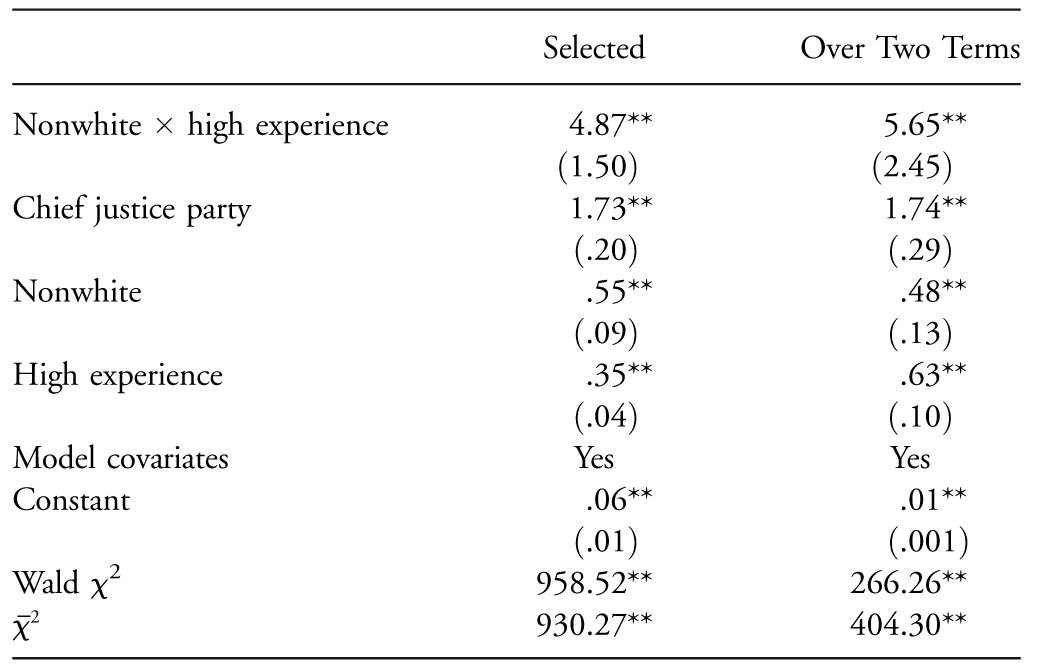
All regressions were rerun using interaction terms to determine whether the odds of committee service differed for minority judges with differing levels of experience on the bench (coded 1 if a judge was both a minority and High, Middle, or Low Experience, respectively).Footnote 27 The results show that, while race remains salient as an independent effect, and experience also remains independently significant, more experienced minority judges are more likely to serve on committees and to serve over two terms in contravention to the overall impact of long-term experience, which diminishes service odds for the selection pool (table 3).Footnote 28 While caution should be used due to analytic power issues associated with such a small number of positive observations, the ancillary regressions do support the theory that race and time on the bench matter for committee service in ways that differ from the nonminority population.

Source—Judicial Conference Committee data set, 2012.
Note—Odds ratios. Binomial maximum likelihood model fitted with complementary log log function in Stata12. Exponentiated coefficients. Interaction nonwhite × high experience not included in Selected Law, Chair, and Chair Law models due to small numbers. N = 28,275.
** p < .01.
Political Connections
While the chief justice appears to take party into account when selecting committee members and chairs, there was mixed and contrary evidence that a judge’s possible political connections make committee selection more likely. Prior experience in federal government (Any Federal) increased selection odds by about 25% for any committee service but was not significant in the other four models. Prior state government service (Any State) decreased selection odds in three of the five models by between 22% and 44%. Chief justice committee selections show little preference for committee members with political ideologies similar to the key congressional committee. The Common Space Score distance between a judge and the House Judiciary Committee majority median (House Judiciary) failed to achieve significance in any model, with coefficients functionally equivalent to the null of one.
Data Limitations
The following issues arise regarding sample representativeness. Committee service is a function to some degree of judge self-selection via recommendations and judicial expressions of interest funneled through the Administrative Office (Fish 1973; Administrative Office of the US Courts 2014). How strongly this affects the final committee composition is unstudied, as the Administrative Office data only contain committee service records, not requests to serve. Of the 2,015 judges observed, close to half engage in active committee service during the time periods studied. This number, however, is censored, as the study ends in 2012 and does not capture the full judicial life span of many judges present in the current data who may serve on committees after 2012. Whether self-selection is dispositive can be examined inferentially by looking at the number and tenure of judicial committee service (a substantial repeat cadre would tend to support self-selection theories). As an initial matter, the impact of any self-selection is moderated by existing term limits set by the chief justice that restrict committee service to two 3-year terms: 42% of the judicial pool engages in Judicial Conference committee service, yet only 15% of the judges observed serve beyond a second term. In addition, if judges self-select, there is no theoretical reason to expect Republican judges to volunteer for committee service in any greater or lesser degree than Democratic appointees (unless they do so in response to an understood norm about service and party alignment). The data show a strong relationship between party and committee service. These findings suggest, at the very least, that if some form of self-selection is in effect, it operates in a manner that aligns judges and the chief justice along apparent partisan lines, an alignment that is consistent with assertions that selection is designed to forward the chief justice’s policy preferences. Republican judges may volunteer to serve on committees more often than Democratic judges, but that choice could be due to the understanding that being Republican makes it more likely that the chief justice will select a judge for committee service. In any event, the end result is committee composition in which party alignment with the chief justice matters.
In addition, the data do not include non–Article III members, the bulk of whom are private citizens. This is due to the practical impossibility of generating a full selection population of potential non–Article III committee members (which would have to include all eligible private citizens) and collecting the relevant demographic, political, and biographical information addressed in the current study. While there is no theoretical reason to believe that a chief justice would pursue a separate appointment strategy for non–Article III committee members, basic information about committee service patterns for this group allay some concern. Across all committees, Article III judges outnumbered private citizens, magistrates, or bankruptcy judges by an average of 56 percentage points. In 14 of the 24 committees studied,Footnote 29 Article III judges comprise 80% or more of the membership. Of the remaining 10 committees, five have Article III membership between 60% and 79%. Of the remaining five committees, three are between 55% and 57% Article III judges (advisory committees on appellate rules, civil procedure, and criminal rules), and two (bankruptcy rules and evidence) were 43% and 41%, respectively. Nonetheless, as a robustness check, the Selected model was run using two separate selection populations: (a) committee selections where 80% or more came from the Article III judiciary (“80% Group”) and (b) the remaining nine committee selections (“Under 80% Group”). Using either the 80% Group or the Under 80% Group, the results did not differ in any material respect from those presented here.
Finally, because the data only include 7 years of Chief Justice Robert’s appointments, and because appointment to a Judicial Conference committee is a comparatively rare event, separate analyses of appointments by chief justice are reliable only at the broadest level: committee selection. The dynamic described in the main results, that being of the same party as the chief justice enhances the overall probability of committee selection or selection to a Law Committee, remains when the data are divided by chief justice. However, more granular analyses separated by chief justice, including appointments over two terms, as chair, or as law chair are not reliable, particularly for Roberts, given the rarity of those actions and the reduction in observations when the data are split. Separate, more detailed analyses of each chief justice’s appointment behavior will have to await further data.
Conclusion
Partisan alignment between a judge and the chief justice is a significant factor in the chief justice’s Judicial Conference committee appointments. Regardless of the type of committee service, or its longevity, Republican judges have a distinct appointment advantage over their Democratic counterparts. These findings are consistent with studies that find the chief justice uses his institutional powers (opinion assignment, conference control, docket order, specialized court appointments) to influence case (read policy) outcomes. The results support both the anecdotal evidence about Judicial Conference committees as well as early studies of the Judicial Conference Executive Committee that found ideological appointment behavior by the chief justice. Given the Judicial Conference committees’ role in crafting policy on behalf of the federal courts, these results suggest that the chief justice makes his selections with an eye toward populating the committees, and their leadership, with like-minded judges who in turn craft policies that comport with the chief justice’s preferences.
The effect of party alignment on multiple-term service and chair appointments is particularly instructive. Positions of authority in a committee and longevity of service provide added opportunities to influence policy outcomes. Multiple-term appointments violate the chief justice’s rule on committee service limits. Yet the chief justice does abrogate this rule, and when he does so, it is more likely to be in favor of a Republican judge than a Democratic one. Appointments to positions of authority within the committees follow the same pattern, with significantly higher odds of chairpersonship adhering to Republican judges.
It is possible that partisan appointment behavior could serve purposes other than just influencing committee policy. The use of political party as a method of overcoming collective action problems is well studied in the context of congressional committees. A Republican chief justice could be rewarding Republican judges with committee assignments in order to promote, advance, and generate fidelity among these judges, with an eye toward some sort of internal party cohesion in the judiciary. The purpose of this unity building may be to reinforce the chief justice’s control over the federal judiciary, by appointing like-minded judges who support, or are incentivized to follow, the chief justice’s organizational goals (as well as policy preferences). This is consistent with the history of the chief justice as an administrative entrepreneur, beginning with the implementation of the committee structure by William Howard Taft in the 1920s, evidencing a pattern of consolidated and centralized organizational control and expanded administrative autonomy for the federal courts (Fish 1984; Carpenter 2001; Crowe 2007).
The strong relationship between status as an appellate judge and committee service at all levels suggests that, in addition to populating committees (and committee power structures) with like-minded judges, the chief justice also may draw most from familiar judges. The appellate bench is not only smaller than that of the district court but also the bench through which most federal cases reach the Supreme Court (28 U.S.C. §1254). Three hundred fifty-seven appellate judges appeared in the judicial pool during the period studied, compared to 1,658 district court judges. In addition to appellate judges being fewer in number, the appeals process itself, with the circuit courts interposed between the district courts and Supreme Court, may result in an increased likelihood that appellate judges are known to the chief justice. The role of familiarity is supported inferentially by the significance of judicial time on the bench, a variable designed to capture appointments that favor some level of experience with the federal court system. New judges (in the lower 25% of judicial experience) are significantly less likely to serve in any committee capacity. In addition to less experience, these judges have had less time to distinguish themselves and become known within the judiciary (and to the chief justice). While judges with long careers on the bench (in the top 25%) also are significantly less likely to be appointed as are senior judges, it may be that selection of this group is suppressed by service willingness or assessments based on age.
A significant reduction in selection odds exists for minority judges. Interaction effects between race and time on the bench are suggestive. However, the nature and parameters of this effect are unclear, as is whether the salience of race persists across all committee types. This issue is worth additional consideration. As well, further study could examine whether appointment criteria, including experience, ideology, and self-selection, vary on a committee-by-committee basis. For example, over 90% of the subject pool engaged in prior legal practice. The contours of this professional experience, including practice-type categories (e.g., litigation, corporate finance, employee benefits), and their effect on committee service warrant study.
Finally, the available data, while covering 27 years, only examine the selection behavior of two chief justices. This is in part due to the nature of the records available from the Administrative Office. Additional empirical analyses of other chief justices’ committee selection behavior are of interest, given this study’s results. As an initial matter, however, it is important that the office of the chief justice clearly affords the power and opportunity to use specific ideological or partisan criteria when appointing Judicial Conference committees’ members.