Introduction
There is a growing awareness and interest in the mutability of artefacts in the past, particularly the practices of recycling (e.g. Joy Reference Joy2009; Foster & Jackson Reference Foster and Jackson2010; Freestone Reference Freestone2015; Pollard et al. Reference Pollard, Bray, Gosden, Wilson and Hamerow2015; Sainsbury Reference Sainsbury2019). While this has been partly prompted by the increasing emphasis on modern recycling, the archaeological record makes clear that recycling—as demonstrated by a range of alteration processes—has been practised since humans first engaged with material culture. Identifying and characterising recycling is essential in all areas of archaeology, as it may significantly alter some of our basic interpretational building blocks, namely concepts of material characterisation and provenance, value, identity, chronology and technology—the basic ‘what, when, where and how’ of archaeology. If we overlook recycling, these most basic of archaeological frameworks could be unsound. While many aspects of artefact mutability are dealt with in isolation in the archaeological literature, from Roman spoila (Kinney Reference Kinney2001) to use-wear (Crellin et al. Reference Crellin, Dolfini, Ucklemann, Hermann, Dolfini, Crellin, Horn and Uckleman2018), there is little general theoretical discussion of the motivating factors for and the implications of recycling.
The very term ‘recycling’, with its modern baggage, often creates problems of understanding. The social and economic symbolism of altering, mixing and reusing material can vary radically in different contexts. ‘Recycling’ is not a simple or monotypic process, although it is often conceptualised as a single stage in technological schematics or chaînes opératoire. Studies of the metal-production cycle, for example, often assume a simple loop, from ‘finished artefacts’ back to workshop—labelled as ‘recycling’ (e.g. Ottaway Reference Ottaway2001)—although this assumption is then often ignored in the discussion that follows. Hence, scientists and scholars have been reluctant to engage with the broad and varied concepts of mutability, whether reuse, repair or recycling. Our own experience, however, is that by engaging with these concepts, we gain a clearer lens through which to view chemical, typological and chronological data, even if the lens remains somewhat opaque. Archaeological acknowledgement of the reality of recycling as an important aspect of ancient technology provides a new, more realistic set of questions, which archaeological science can help to answer.
In this article, we present a brief discussion of different forms of mutability, with particular focus on case studies of glass from Roman/post-Roman Britain and copper alloys from the British and Irish Bronze Age. We present the varied lives of materials and the changes that they undergo between their initial manufacture into objects, to their final unearthing by archaeologists. Using partly ‘thought experiment’ and partly case studies, we aim to show how integrated archaeological and archaeometric approaches can create inroads into the history of mutable materials.
The problem of recycling
The modern mind tends to regard recycling as a straightforward activity by which similar waste objects (e.g. glass bottles or aluminium cans) are collected and returned to production centres for use as raw (recycled) material. Recycling in the contemporary world is associated with economic scarcity and related ecological concerns over waste and environmental loss. These ideas, however, underplay the complexity of present-day attitudes to reduction, reuse and recycling, and nor can they be simply transferred to thinking about recycling in the past. Here, we put forward a brief sketch of various ‘sorts’ of mutability to highlight the variety of mutations that materials can undergo and how these can be identified and characterised. We assess recycling processes as a contributor of meaning to objects and materials—the interrelationship of time, form, function and ownership.
Time, form, function and ownership
Recycling focuses attention on the interaction between form and substance through processes of alterations not just of shape and material, but also of function and ownership. ‘Ownership’ is a complex term as applied to materials in the past (cf. Earle Reference Earle2000), and is demonstrably varied across time and regions. Here, we define ownership as a socially and culturally agreed association of objects with people, whether to a single person, group or even mythical persons.
For modern recycling, time, form, function and ownership are negotiated through financial markets, directed trade and factory-based production (Pajunen & Heiskanenm Reference Pajunen, Heiskanen and Mishra2012). Meanwhile, current archaeological debates tend to discuss concepts of materiality and the biography of objects (e.g. Hoskins Reference Hoskins, Tilley, Keane, Küchler, Rowlands and Spyer2006; Hodder Reference Hodder2012; Jones Reference Jones2012). Drawing on early work, such as that of Schiffer's (Reference Schiffer1972) ‘lateral cycling’ and ‘recycling’, and Kopytoff (Reference Kopytoff and Appadurai1986) on the biography of objects, attention has been focused on paths and life histories. Archaeologists have therefore concentrated on tracing ‘distinct’, discrete objects as they accrue history and themselves become measures of change (Gosden & Marshall Reference Gosden and Marshall1999), rather than attending to the alteration and reuse of constituent material.
Recycling frequently features in archaeological approaches to the life-histories of objects and assemblages, but such issues are often neglected in scientific studies. In archaeometallurgy, for example, straightforward provenance interpretations of data, in which the final object is assumed to be from a single geological source, are common. This ‘single provenance-single production event’ technological model, however, can be critiqued from several angles. Time-depth, for example, is of key importance (Swift Reference Swift2012; Pollard et al. Reference Pollard, Bray and Gosden2014). Whether or not physical alteration occurs, there are cases where the relationship between chemistry, form and time demonstrate the movement and flow of materials through different iterations (e.g. a Roman drinking vessel used as a medieval church chalice).
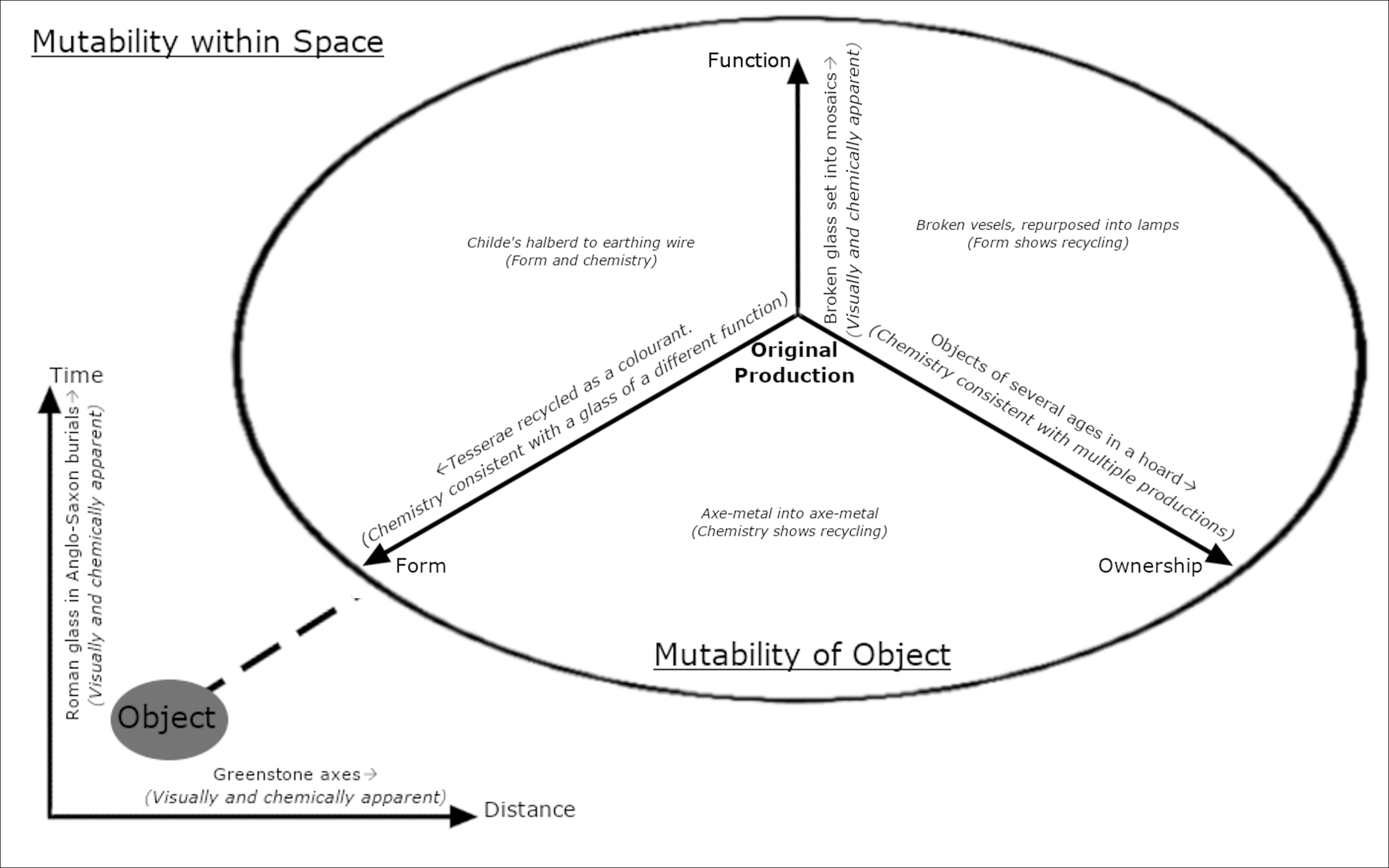
Classes of mutability can be defined by considering the alteration and interaction of form, time, context and ownership (Figure 1). Recent work has demonstrated that the scientific study of archaeological materials can add more detail to the histories and geographies of recycling, particularly by identifying chemical markers of change (see Bray & Pollard Reference Bray and Pollard2012; Pollard et al. Reference Pollard, Bray and Gosden2014; Sainsbury Reference Sainsbury, Rosenow, Phelps, Meek and Freestone2018). When we link issues of typology—the conventional means of understanding changes in form—with scientific analysis of substance, we can begin to think more dynamically about recycling.
Schematic of the complex and subtle interplay of multiple factors that can be viewed as mutability. The schematic emphasises: 1) the ubiquity and pervasiveness of ‘mutable processes’; 2) that these are layering processes, where an object can be transformed multiple times and ways; and 3) the need for collaboration on multi- and inter-disciplinary approaches to identify and understand these processes (figure by the authors).

In modern terminology, recycling means returning objects to a ‘raw’ form, so that they can be re-made as new. A broader definition, however, includes any object that has been modified from its ‘original’ or ‘prime’ shape, composition, ownership or chronological context. It can also be taken to include object forms that persist beyond their initial currency: concepts and shapes that are ‘archaic’, but which are recycled through production using ‘new material’. We prefer ‘mutability’ as a more useful umbrella term for a wide range of activities involving changes to both form and substance. Any number of economic, material or social factors can drive these processes, which thus have a range of technological and social impacts. It is by blending a series of archaeological specialisms that we can begin to unravel recycling in the past.
Through proposing a broad and contextual definition of mutability, we aim to avoid a version of the ‘presentist fallacy’ (e.g. Killick & Fenn Reference Killick and Fenn2012: 561)—specifically the dangerous assumption that modern value systems had similar meaning in the past. Explicitly, modern recycling is based primarily on economic concepts of value, global trade and energy expenditure—concepts that are often inappropriately applied to the past. Such a materially (or environmentally) deterministic definition needs extending to include the social context of recycling. Anthropological studies often stress, for example, the necessity of perpetuating the form of an object during reuse in order to retain an embodiment of spiritual power. As Swift (Reference Swift2012: 202) states, “In each case, the decision to maintain, discard, deposit or transform the object would be made in relation to the perceived value and meaning of that particular object at that specific time”. Such considerations produce different modes of ‘recycling’, in which the ‘scrap value’ of an object may not be the important factor, if it features at all. Untangling such complex material-social pasts requires the collaboration of field, research and laboratory archaeologists.
Different forms of mutability
To discuss the interaction between the mutability of objects, places and chronologies, we consider two broad categories: the first in which the form of the object is changed (recycling), and second where it is not (reuse). Although such a split grossly simplifies matters, it allows pragmatic inroads to be made through bringing together various datasets and perspectives. The first category, recycling, has been problematically used in archaeology to encompass many processes. While it is often used, for example, to mean complete destruction through re-melting (e.g. the recycling of Roman glass cullet; Silvestri Reference Silvestri2008), this is not always the case. Hence, we have chosen a broader definition: ranging from a small physical alteration with an object continuing its original function, to the complete obliteration of the original form, which then allows the material to be reused as though raw. As will be discussed, even full liquidity might not destroy or discount the ideological significance of an object's previous life.
Our definition of ‘reuse’ encompasses no physical changes beyond minor maintenance or decoration, but rather refers to change of purpose, place, owner or cultural significance of the artefact. Within such a definition of reuse, therefore, we consider the passing down of heirlooms and the opportunistic, quick recovery and exchange of discarded items.
Recycling
The general archaeological invisibility of re-melting has limited discussions of possible motivations for such practises; if the object has been completely remade into a new form or type of object through a melting step, none of the original form (with its usual typological markers) remains. By combining chemical studies with social and artefact-based archaeology, however, such recycling behaviours can be inferred and reconstructed.
Both ancient textual sources (e.g. Statius, Silvae 1.6.73–74; Mozley Reference Mozley1928; Martial, Epigrams 1.41 & 10.3; Shackleton Bailey Reference Shackleton Bailey1990; Juvenal, Satires 5.47–48; Morton Braund Reference Morton Braund2004), and archaeological and archaeological science studies (e.g. Silvestri Reference Silvestri2008; Foster & Jackson Reference Foster and Jackson2010; Freestone Reference Freestone2015) attest to the recycling of glass, and even the trading of cullet, in the Roman world. These works—both ancient and modern—indicate that commercial interests were a driver of glass recycling at the height of the Roman period. It consumes less energy to melt pre-made glass than to form fresh glass, and it is therefore less economically costly. The overwhelming majority of glass used across the Roman world was produced along the Levantine coast and in northern Egypt (Degryse Reference Degryse2014). As the cost of transport to the rest of the Empire was significant, recycling and the secondary production of glass was economically expedient.
Geochemical characterisation shows how carefully these recycling processes were organised. In the fourth century AD, colourless glass in Britain—and only colourless glass—is of an older composition, and was recycled separately from other glasses (Sainsbury Reference Sainsbury2019). While there is some evidence for colourless glass being recycled separately in the previous centuries, the base glass used in the production of coloured and colourless was the same (Freestone Reference Freestone2015). That is, the majority of glass had a very narrow chemistry, with only a small variation across all samples in any diagnostic element, implying a single, well-known production area (i.e. the Levantine coast), and it was coloured or decoloured after this first primary production. In the fourth century AD, across the Roman Empire, this base glass composition shifted, with the introduction of HIMT glass, so-called and recognised due to its higher concentrations of iron, manganese and titanium. In contemporaneous Britain, coloured glass demonstrates some of the older material being recycled with the new HIMT material, but the colourless glass contains no evidence of HIMT. It seems that very little of the freshly produced material reached Britain at all, probably because of increasing instability in Britain and the inherent dangers crossing the Channel. To maintain any stock of glass that was tainted by colourants, this material therefore had to be recycled separately. There is another strand to this in that antimony—the most effective decolourant in Roman glass—is not usually present in HIMT glass. In such glass, manganese acts as a decolourant, although studies have shown that this is far less effective (e.g. Bidegaray et al. Reference Bidegaray, Nys, Silvestri, Cosyns, Meulebroeck, Terryn, Godet and Ceglia2020), meaning that antimony glass was of a visually higher quality. The disappearance of antimony in Roman glass has long been noted, but the causes and meaning still remain a matter of debate (e.g. Paynter & Jackson Reference Paynter and Jackson2019). The reliance in Britain on recycling for colourless glass implies that the availability of glass decoloured with antimony became problematic, with recycling being the only convenient source.
While this recycling in Roman-period Britain seems to have been driven by more ‘modern’ ideas of resource shortages and trade complications, the reuse and recycling of Early Bronze Age copper-alloys in Britain highlights how social and ideological choices can drive the retention or recycling of material. Combining material science, large chemical datasets and archaeological typo-chronology allows us to identify the different treatments of metals locked into distinct categories of object. There is, for example, a stark chemical contrast between the metals used for axes, halberds and daggers that relates to the chemistry of their original mine source, but also to their social roles and people's technological choices. Towards the end of the third millennium BC in Britain and Ireland, there are two chemical patterns in the copper in common use: As, Sb, Ag, which was produced by the Ross Island Mine, County Kerry, Ireland, and As, Ni, which, at this time and context, is probably continental in origin (these are shorthands for copper that contains arsenic (As), antimony (Sb) and silver (Ag), and arsenic and nickel (Ni) as principal impurities (Bray Reference Bray, Woodward, Hunter, Bukach and Needham2015; Pollard et al. Reference Pollard, Bray, Cuénod, Hommel, Hsu, Liu, Perucchetti, Pouncett and Saunders2018)). The majority of daggers are of continental metal (As, Ni), while 90 per cent of the axes and halberds are of Irish metal (As, Sb, Ag). These are rarely mixed. The limited data that we have for early British daggers in Beaker Culture burials often show extensive use-wear, along with a distinct chemical profile compared with the rest of the metal assemblage (Bray Reference Bray, Woodward, Hunter, Bukach and Needham2015; Woodward et al. Reference Woodward, Hunter, Bukach and Needham2015). Although this requires further investigation, it suggests long periods of reuse, as daggers were originally cast in France or Spain, then entered Britain as personal objects that continued to be passed down as heirlooms (Bray Reference Bray, Woodward, Hunter, Bukach and Needham2015). Similarly, halberds with the distinctive Ross Island chemical signature show similar long histories of sharpening and then careful, ceremonial burial (O'Flaherty Reference O'Flaherty2002; Bray Reference Bray2009).
These reuse patterns clearly contrast to the recycling (complete re-melting and recasting) identified in the axe series. Published laboratory experiments, such as those of McKerrell and Tylecote (Reference McKerrell and Tylecote1972), allow us to assess the different behaviour of chemical elements during melting. Arsenic and antimony, for example, are vulnerable to oxidative loss, while silver and nickel are stable. This behaviour allows us to gauge the relative degree of re-melting that a unit of metal has undergone, compared with other objects in the assemblage or of contemporaneous manufacture. The chemical signatures of the axes, combined with their typological form, indicate the common re-melting and recasting into axes over several generations. Indeed, the Ross Island chemical signature persists in axes, with depleted arsenic and antimony, after the mine was closed due to flooding. While these elements do not deplete at a set rate, by comparing the pattern of many elements over time, this continued loss is apparent. Meanwhile, the chemical signatures of the used and worn halberds (O'Flaherty Reference O'Flaherty2002, Reference O'Flaherty2007) look relatively prime (i.e. very high arsenic and antimony). This attests to their long use, but, importantly, not episodic melting and recasting (Bray Reference Bray2009; Bray & Pollard Reference Bray and Pollard2012). Thus, the social and technological contexts of axes and halberds result in different recycling and reuse histories, which can be traced through these chemical patterns.
Alongside these examples of broad trends in material recycling or retention, we must also consider recycling undertaken for a specific purpose, whether driven by ideology, pragmatism or both. An obvious example is the recycling of deeply coloured Roman mosaic glass tiles (tesserae) for the specific purpose of giving colour to a new batch of glass. There is archaeological evidence for the selective scavenging of these tesserae from earlier mosaics (James Reference James2006), and their addition to ‘fresh’ glass batches, made apparent by the unique chemical composition of these new tiles. Tesserae are more brightly coloured than most Roman glass and are also often opacified with high levels of antimony (around 4.5 wt%). A distinction must be drawn here between antimony added in small amounts, which acts as a decolourant (approximately 1 wt%), and these high levels, which precipitate out within the glass, causing opacification. The appearance of transparent, coloured glass with elevated antimony (significantly above what is required for decolouration), such as in the church window glass at Sion (Wolf et al. Reference Wolf, Kessler, Stern and Gerber2005), suggests such an addition. While antimony can also function as a decolourant, there would be no purpose in adding high levels of an opacifier/decolourant to glass that is intended to be transparent and coloured, such as that at Sion. Experimental studies by Wolf et al. (Reference Wolf, Kessler, Stern and Gerber2005) have shown that for even the very brightest colours that appear in the Late Antique church glass at Sion, the chemistry is explained by an absolute maximum ratio of tesserae to bulk glass of 4:10 by weight. Thus, less than half the batch as tesserae are needed to colour glass. While many colourants, such as cobalt blue, seem to have been difficult for Late Antique glass-makers to source, by exploiting the significant amounts of Roman glass, they could still produce stunningly coloured objects. Sainsbury's (Reference Sainsbury2019) large-scale study of glass from Britain has shown that much fifth- and sixth-century glass, while otherwise apparently ‘freshly’ produced, was coloured using this technique. In each of these cases of recycling, the past lives of these objects would not be apparent without both a chemical analysis of the artefacts and a significant set of comparative data, as well as a large quantity of typological and chronological information.
We should also consider how recycling alters the social and economic value of the same material. The creation of beads or amulets by melting individual glass sherds or tesserae, for example, is seen both in New Kingdom Egypt and across Late Antique Europe (Henderson Reference Henderson1987; Cool Reference Cool, Wilmott and Wilson2000: 49–50; Heck & Hoffman Reference Heck and Hoffman2000; Cavalieri & Giumlia-Mair Reference Cavalieri and Giumlia-Mair2009; Nicholson Reference Nicholson and Wendrich2011; Swift Reference Swift2012). In Egypt, the contexts in which these beads are found indicate that they are low-status artefacts, even though they are made from a high-value material, whereas in Europe, using similar recycling processes, the resulting objects are found in high-status graves. Finally, Roman-period beads are made of both recycled and fresh glass, often in imitation of semi-precious gems, and were not considered to be of particularly high-status (Swift Reference Swift1999). Clearly, the value and technological sequence of glass use is not uniform across all of these periods, and each case must be examined in context.
As well as defining recycling as an object passing through a molten state, there are other processes that we should consider as ‘recycling’ rather than ‘reuse’. ‘Solid-state’ recycling, for example, is evidenced in copper that is rough-hammered and shaped. A rather traumatic example is that of the Auchnigoul Halberds. First found during ploughing by J.A. Smith in 1939, a hoard of seven or eight halberds were “picked and placed on the wall of a fowlhouse, from which they gradually disappeared until only two were left” (Edwards Reference Edwards1940–1941: 208). Gordon Childe later visited the farmer, and with Edwards's assistance, recovered two of the lost artefacts, “one buried in the muck of the fowlhouse and the other being used as an earth for a wireless set” (Edwards Reference Edwards1940–1941: 208). Analogous practices are evident in prehistory, such as the ongoing modification of greenstone axes as they were moved around Europe (Sheridan et al. Reference Sheridan, Pailler, Pétrequin, Errera, Davis and Edmonds2011: 412). Such alterations can change the appearance, function and style of objects. Glass examples include the setting of shards of broken vessel glass in Roman mosaics, such as at Casa del Torello and Casa dello Scheletro at Pompeii and Herculaneum, respectively (Sear Reference Sear1977), as well as the creation of lids for glass vessels by grozing (reshaping) of the bases of other broken vessels (Price & Cottam Reference Price and Cottam1998).
Reuse
The reuse of objects and materials has long been acknowledged in archaeological studies, but rarely as part of a larger analysis of mutability. It is often discussed under terms such as heirloom artefacts, scavenging or trade (Renfrew Reference Renfrew, Sabloff and Lamberg-Karlovsky1975; Gillings & Pollard Reference Gillings and Pollard1999; Caple Reference Caple2010). While some forms of reuse or curation are immediately apparent, such as for objects that never entered the sub-surface archaeological record (e.g. the Lycurgus cup or the Portland vase: British Museum Catalogue 1958,1202.1 and 1945,0927.1), others are more complex. An integration of archaeometric and archaeological approaches can help disentangle these scenarios. The metal or glass found in hoards or burials, for example, can show a demonstrable variety in production dates, despite sharing the same date of deposition. The Yattendon hoard (Coghlan Reference Coghlan1970; Needham Reference Needham1983: Br 8, appendix 11, R1) contains axes and a rapier, which date to much earlier than the rest of the Late Bronze Age assemblage.
Due to our understanding of chronological typology, assemblages, such as hoards, which contain objects dating from multiple different periods, are usually visually apparent. Unfortunately, glass—even in burials—is often fragmentary, meaning that typo-chronological identification is not always possible. Furthermore, some object forms are extremely long-lived and therefore relatively undiagnostic. Applications of archaeological science, however, can assist. Roman glass goes through several well-dated compositional changes that can aid in the identification of retained and reused objects in later periods. Analysis of compositional data from 4000 shards of Roman and early medieval glass from England, for example, reveals that many post-AD 450 shards demonstrate a composition that ceased production in the second to third centuries in Britain (Sainsbury Reference Sainsbury2019). For many of the shards, the compositions showed no obvious physical or chemical signs of re-melting, implying that the objects were probably directly reused. Indeed, the scavenging of glass vessels from former Roman sites is a known practice in Anglo-Saxon Britain (White Reference White1988).
Just as recycling can be motivated by multiple factors, so can reuse. Although there is a temporal gap between the Roman and Anglo-Saxon occupation at Orpington, in Kent, for example, the later burials contain huge quantities of Roman materials, some traded, some scavenged (Swift Reference Swift2012: 199). Grave 2 contained an early fourth-century continental Roman glass bracelet, while the rest of the assemblage indicates deposition post-AD 450. Once again, this highlights the complexity of concepts of ownership and time in the past. The presence of Roman objects in Anglo-Saxon graves is well known, and is more thoroughly discussed elsewhere (e.g. White Reference White1988; Eckardt & Williams Reference Eckardt, Williams and Williams2003). In the Anglo-Saxon world, there was a practical and talismanic interest in earlier material, and a strong connection to idealised ‘ancestors’ (Hunter Reference Hunter1974; Bradley Reference Bradley1998; Caple Reference Caple2010). The veneration of barrows or the placement of Roman artefacts in Anglo-Saxon graves clearly indicates that such reuse was motivated by more than simple scarcity or pragmatism.
While these examples are relatively straightforward, there are more abstract forms of reuse. Examples include copies of artefact forms that sometimes result in ‘skeuomorphs’, such as ceramic versions of metal shapes (e.g. McCullough Reference McCullough2014), and later revivals, such as the seventeenth- and eighteenth-century copies of Roman glassware that flourished after the rediscovery of Pompeii (Whitehouse & Gudenrath Reference Whitehouse and Gudenrath2007). Some Early Saxon coinage directly copies Roman motifs, regardless of the original meanings of such images (e.g. early gold thrymsas; Skingley Reference Skingley2014).
Reuse and repair raise the well-known philosophical problems, such as the classical ‘thought-experiment’ of the Ship of Theseus (Plutarch Theseus 23.1; Perrin Reference Perrin1914): similarly, if each pane of a stained window is slowly replaced over time, maintaining the pattern, at what point is it no longer considered a repair, but rather a new window? Does this change if the pattern is lost but the glass remains the same?
Discussion and conclusions
Artefacts are more than static indicators of production, but rather integral parts of an interconnected and ever-changing social system. As Joy (Reference Joy2009) notes, moments of transformation are deeply illustrative, whether in form, function, time or simply ownership. To identify, disentangle and interpret these shifts in the past requires a marriage of all the techniques at our disposal, particularly typo-chronological, contextual and archaeometric analyses. Here, we have sought to highlight how frequently this collaboration reveals that objects and materials in the past had long and complex re-used and recycled lives. This type of work is impossible without comprehensive programmes of artefact recording and cataloguing, and the collection of significant amounts of geological reference and comparative artefact chemical data. Both high-quality analysis of new samples—the analyses being completed with recognised standards—as well as the dissemination of freely available raw data from such analyses is vital. Online repositories and inter-laboratory collaborations should greatly benefit from our study of material processes.
The complex histories or biographies of objects and people must be engaged with on both a theoretical and a practical/empirical level. This requires an approach to archaeological science that is not an ‘archaeological bazaar’ (Pollard & Bray Reference Pollard, Bray, Chapman and Wylie2014), but a discursive interpretation of data that includes the archaeological evidence. Both analysts and specialists should generate the questions asked of material, and not only should the ‘exceptional’ artefacts be targeted for analysis. Analysts must be mindful that there are human processes that go into the creation of the data that they are measuring, and archaeologists need to be wary of simple linear interpretations of these data. This is vital in interpreting evidence from prehistory or from periods with fragmentary historical sources, such as Anglo-Saxon England. Subtle changes in the chemical character of materials, as well as context and relative date, represent biographical fragments or life events that can be stitched together. Although an exacting process, this approach avoids the traditional, simplistic assumption that underpins most provenancing programmes: that an object is drawn from a single source and is cast once.
The mutability of artefacts is intrinsically linked to ownership and identity. Even in cases with a high degree of alteration of form, in which old objects are completely melted down and recast, the old shape is entwined with the owner's choice over the new form, and the resulting shared identity. In cases where the basic artefact type is retained but the form changes, there is still complexity. The separation of ‘axe-metal’ and ‘dagger-metal’ in the Early Bronze Age implies an important ideological connection between the past and future of these objects. Was there a taboo about mixing? Was the social role and power of metal daggers so dominant that their potential as mutable raw material was not permitted or perceived? This is not to say, however, that all object transformations were considered in this way. Each archaeological cast must be studied on its own merits and based on its own data. The treatment of mixed hoards of scrap and unrelated objects that are common in the Middle Bronze Age or Roman-period glass cullet is very different to the carefully retained and protected copper daggers from millennia before. In all cases, highly mutable materials, such as glass and metal, show histories that are intrinsically linked with recycling and reuse.
In approaching recycling in the past, we must avoid presentist assumptions. The consideration of the mutability of artefacts that have no macroscopic signs of change is paramount. Although not all objects offer clear indications, it seems that nearly all materials were recycled or reused to some degree in Antiquity. This happened in a variety of different ways to fit specific social, economic, geographic or temporal environments. By recognising that this mutability can cause specific changes or inconsistencies between form, composition, context and time, we can track potential reuse and recycling. These types of study have particular consequences for how we build typo-chronological frameworks: an understanding of substance and the way that this changes is required. Typological studies need to consider the history of the materials from which objects are made, as well as their form. Through a judicious marriage of all archaeological datasets, irrespective of specialism, we can use reuse/recycling concepts to help us infer the movement, social context and the meaning of objects in the past.
Acknowledgements
The authors would like to thank the reviewers for their helpful comments, and Ian Freestone for his advice on the glass. Any remaining errors are the authors’ own.
Funding statement
This research has been supported by the Hastings Senior Scholarship, The Queen's College Oxford; John Fell Fund Award, Oxford University Press; Rakow Grant for Glass Research, Corning Museum of Glass; Leverhulme Trust (grant F/08 622/D). P. Bray was supported by the ‘Atlantic Europe in the Metals Ages’ project (AHRC grant AH/K002600/1). V. Sainsbury, P. Bray and A.M. Pollard were supported by the ‘Flow of Ancient Metal through Eurasia’ project (ERC advanced grant 670010).