Introduction
The emergence of Palaeolithic art and symbolism has long been considered as among the earliest expressions of cognitive behaviour and a major milestone in human evolution (Mellars Reference Mellars1989; Mithen Reference Mithen1996; Zilhão Reference Zilhão2007). For much of the twentieth century, Palaeolithic rock art was typically regarded as a Western European phenomenon (e.g. Leroi-Gourhan Reference Leroi-Gourhan1965; Gamble Reference Gamble and Foley1984; Mellars Reference Mellars1989; Bahn & Vertut Reference Bahn and Vertut1997), in contrast to the more geographically widespread evidence for portable art (Bahn Reference Bahn2016), personal ornaments, funerary practices and the succession of Upper Palaeolithic (c. 40–13ky cal BP) technocomplexes. The rich archaeological record of South-west Europe, and the associated scholarly attention, has fuelled the notion that Palaeolithic cave art was an exclusively Western European—and predominantly French and Spanish—phenomenon (McBrearty & Brooks Reference McBrearty and Brooks2000: 543).
Over the last 20 years, however, a number of discoveries around the globe have called into question this paradigm. Extensive research in Africa, Asia and other parts of Europe, for example, has enlarged the chronology and the geography of Pleistocene art. In particular, discoveries such as Blombos Cave in South Africa, Nawarla Gabarnmang in Australia and Leang Timpuseng in Indonesia (e.g. Henshilwood et al. Reference Henshilwood, d'Errico, Yates, Jacobs, Tribolo, Duller, Mercier, Sealy, Valladas, Watts and Wintle2002; David et al. Reference David, Barker, Petchey, Delannoy, Geneste, Rowe, Eccleston, Lamb and Whear2013; Aubert et al. Reference Aubert, Brumm, Ramli, Sutikna, Saptomo, Hakim, Morwood, van den Bergh, Kinsley and Dosseto2014), among others, have complicated the idea of a European origin for Pleistocene art. Furthermore, the discovery of Pleistocene decorated caves in the UK and Romania (Pettitt et al. Reference Pettitt, Bahn and Ripoll2007; Clottes et al. Reference Clottes, Besesek, Gély, Ghemis, Kenesz, Lascu, Meyssonnier, Philippe, Plichon, Prud'homme, Radu, Rus and Tociu2012) has called into question the notion that Upper Palaeolithic rock art was exclusive to South-west Europe.
While these discoveries have significantly modified previous assumptions on the origins of art, important gaps remain in our understanding of Pleistocene symbolism. In particular, there are entire regions that have yielded very little evidence concerning the rock art of anatomically modern humans. The Balkan Peninsula represents one of these regions; no Upper Palaeolithic rock art has been discovered in the area between the sites of Fumane in Italy and Coliboaia in Romania (Broglio & Dalmeri Reference Broglio and Dalmeri2005; Clottes et al. Reference Clottes, Besesek, Gély, Ghemis, Kenesz, Lascu, Meyssonnier, Philippe, Plichon, Prud'homme, Radu, Rus and Tociu2012)—a distance of approximately 1000km—with the exception of the non-figurative engravings at Badanj Cave in Bosnia-Herzegovina and a possible Palaeolithic painting at Selaćka 3 in Serbia (Basler Reference Basler1976; Ruiz-Redondo et al. Reference Ruiz-Redondo, Mihailovic, Kuhn, Floss and Pastoors2018). A number of hypotheses could explain this gap. It could be argued, for example, that while the Upper Palaeolithic groups in this area created symbolic objects (including portable art and personal ornaments), they did not develop a rock art tradition. Moreover, geological and environmental conditions may explain the absence of rock art in Central and Eastern Europe. In comparison to Western Europe, the lack of a well-established regional research tradition is an important factor in explaining the absence of Upper Palaeolithic rock art sites in the area. This may explain, for instance, why fewer than 50 Upper Palaeolithic sites have been discovered in the combined area of Croatia, Bosnia-Herzegovina, Serbia and Montenegro (approximately 210 000km2), whereas 235 sites have been documented in the French region of Dordogne alone (French Reference French2015)—an area 23 times smaller (approximately 9000km2). The disparity in the number of rock art sites is surprising, as the Balkans were probably one of the main routes into Europe for anatomically modern humans (Chu Reference Chu2018).
Here, we present research from Romualdova Pećina (‘Romuald's Cave’) in Croatia, which has provided the first evidence for Upper Palaeolithic figurative rock art from the Balkan region. These findings expand the geographic distribution of Upper Palaeolithic rock art beyond the limits of Western Europe, contribute to filling the ‘rock art gap’ in an understudied research area and illuminate the geographic complexity of early symbolic behaviour and its implications for understanding the Upper Palaeolithic cultural mosaic.
Materials and methods
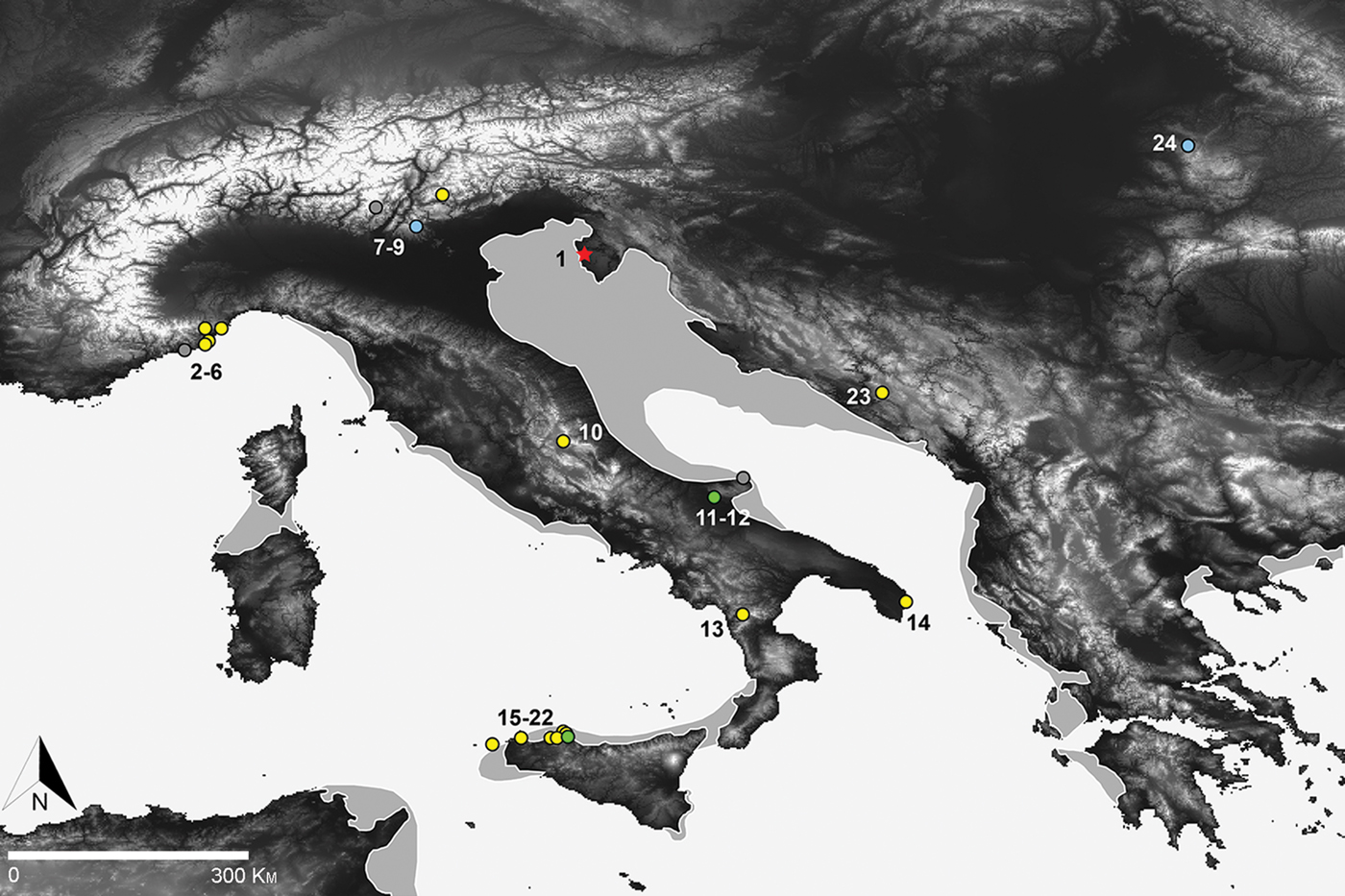
Romualdova Pećina is located on the west of the Istrian Peninsula, Croatia, on the southern shore of the Lim Channel (45.127549° north, 13.737389° east), at a height of 106m asl (Figure 1). It is a single-gallery cave, averaging approximately 5m in height and 5m in width, becoming narrower and lower towards the back of the cave. At more than 110m in length, it is the deepest cave in the region. Three different archaeological excavations were undertaken in the late nineteenth and early twentieth centuries (see Komšo et al. Reference Komšo, Cvitkušić, Janković, Janković, Komšo, Mihelić and Ahern2017). In the 1960s, M. Malez re-excavated the site and identified evidence for Bronze Age and the Early Upper Palaeolithic human occupations (Malez Reference Malez1981). Two recent projects, undertaken by D. Komšo (Reference Komšo2008) and I. Janković (Janković et al. Reference Janković, Komšo, Ahern, Becker, Gerometta, Weinstock, Barbir, Vukosavljević, Cvitkušić, Zubčić, Mihelić and Smith2017), have confirmed the existence of these two occupation levels, and also documented a lower layer, which has yielded several lithic tools that date typologically to the Middle Palaeolithic. The following stratigraphic sequence was recorded: below the topmost Bronze Age layer (3.4–3.2ky cal BP) was an approximately 1.5m-thick sequence of culturally sterile, natural layers. An underlying 0.2m-thick sequence spanning 34–31.5ky cal BP yielded the Upper Palaeolithic artefacts. Below this was another 0.4m-thick sequence of sterile layers; these sealed the Middle Palaeolithic layers, which date to at least 44.3ky cal BP. During a visit in 2010, D. Komšo discovered a number of red paintings inside the cave, and assumed them to be of Palaeolithic age. In 2017, the site was studied by the present authors as part of a systematic rock art survey in the Western and Central Balkans.
Map of Upper Palaeolithic cave art sites outside of Western Europe: blue = Aurignacian; green = Gravettian; yellow = Epigravettian; grey = undetermined. 1) Romualdova Pećina; 2) Grotta del Caviglione; 3) Grotticella Blanc-Cardini; 4) Grotta Florestano; 5) Grotta della Bàsura; 6) Arene Candide; 7) Luine; 8) Grotta Fumane; 9) Riparo Villabruna A; 10) Grotta di Pozzo; 11) Grotta Paglicci; 12) Vieste; 13) Grotta del Romito; 14) Grotta Romanelli; 15) Grotta di Cala del Genovese; 16) Grotta dell'Isolidda; 17) Grotta dei Puntali; 18) Grotta della Za'Minica; 19) Grotta Niscemi; 20) Grotta de l'Addaura I; 21) Grotta de l'Addaura II; 22) Grotta Perciata; 23) Badanj Pećina; 24) Peştera Coliboaia (figure by A. Ruiz-Redondo).

Our study of Romualdova Pećina involved several procedures. First, to examine the graphic units (including marks, signs and representations) on the walls we used three types of illumination, each with different luminosity and colour temperature (a characteristic of the visible light that expresses the colour of a light source in kelvins). We also used a handheld microscope to identify superimpositions and remnants of pigment. A Sony® A6000 camera with a Sony FE 28-70mm ƒ/3.5–5.6 OSS lens was used to photograph the paintings. Colour control and correction on the photographs was achieved using the Colorchecker® Passport chart and the Colorchecker® Camera Calibration software. The images were processed using the Dstretch® plug-in for the ImageJ® software, and digital tracings were made using Adobe Photoshop® and Adobe Illustrator®. Photogrammetric models were created in Agisoft PhotoScan® Pro. The graphic representation of the paintings was performed with the infographic methodology for recording Palaeolithic rock art (Fritz & Tosello Reference Fritz and Tosello2007). Second, a small trench was opened to search for any evidence associated with the graphic units. The excavation used arbitrary 50–100mm-thick spits, which were later classified according to their sedimentological composition. The sterile layers were dry-sieved using a 2mm sieve, while the sediment from the layers with archaeological material (except the surface layer) was recovered for laboratory processing. The entire process was carefully documented using context sheets and photography. The ochre crayon (see Results section) was observed using a 200× optical microscope. AMS radiometric dating was performed by Beta Analytic Inc. and the Oxford Radiocarbon Accelerator Unit (ORAU). The results were calibrated with OxCal 4.3, using the IntCal13 dataset (Bronk Ramsey Reference Ramsey2013; Reimer et al. Reference Reimer2013).
Results
Analysis of the rock art
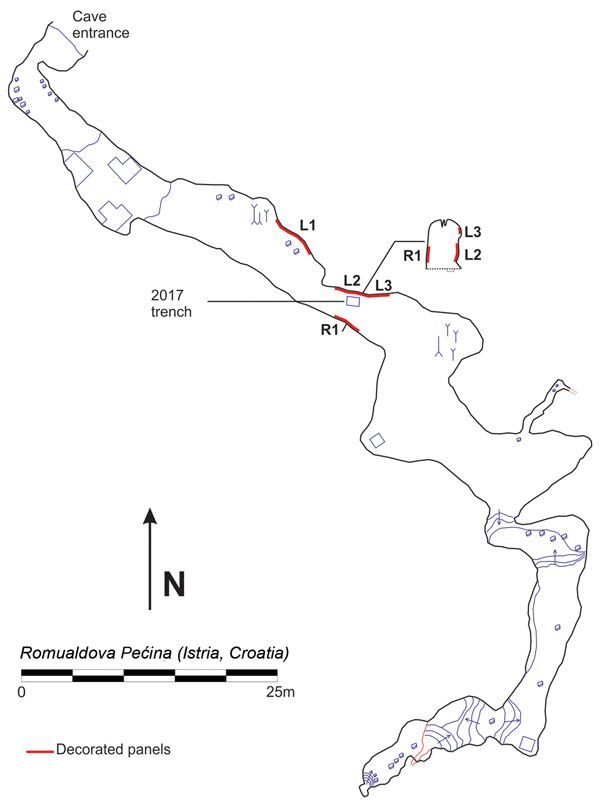
Exploration of Romualdova Pećina's walls has revealed a large decorated area located in the main corridor, between 32 and 46m back from the entrance (Figure 2). Here, 44 graphic units were identified, divided in four panels. Facing towards the back of the cave, the panels are located on both walls of the corridor: three (L1, L2 and L3) on the left side and one (R1) on the right. They were painted with red pigment; no prehistoric engravings or black paintings were found within the cave. The motifs are poorly preserved, as they were painted onto a fossil calcite layer that has, in some parts, fallen from the walls. Furthermore, uncontrolled numbers of visitors have adversely affected the paintings: modern graffiti—mostly dating to the late nineteenth and early twentieth centuries—has damaged some of the Palaeolithic motifs, as has polishing and scraping of the wall surfaces by the circulation of visitors. This state of preservation probably explains the difficulty we experienced in identifying more figurative representations. Some of the graphic units originally belonged to more complex, possibly figurative motifs, but these original images are now unidentifiable.
The layout of Romualdova Pećina, showing the location of the decorated panels (figure by D. Komšo & A. Ruiz-Redondo).

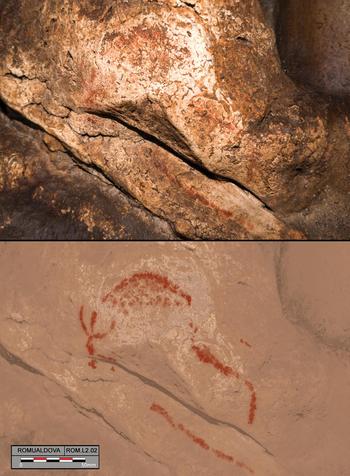
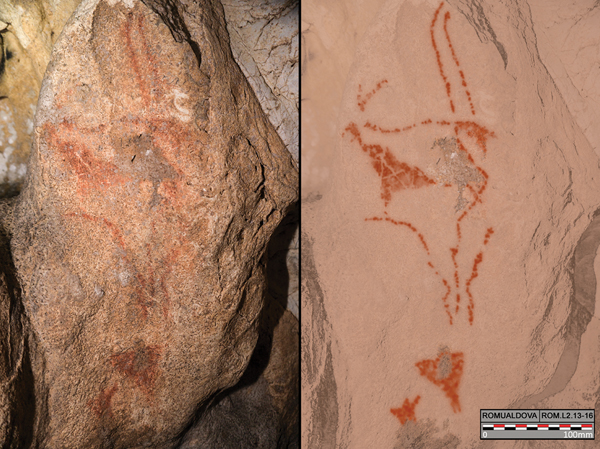
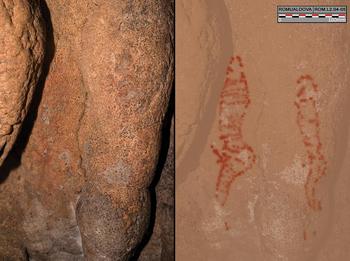
These non-identifiable images are typically catalogued as isolated dots, lines and coloured marks. Other representations—eight in total—comprise more complex motifs that we classify as ‘constructed signs’. We also identified two zoomorphic figures: a bison (Figure 3) and an ibex (Figure 4). Finally, two graphic units are tentatively interpreted as anthropomorphic figures, although the preservation is too poor for a high degree of confidence (Figure 5).
Photograph and tracing of the bison motif (graphic unit ROM.L2.02) (figure by A. Ruiz-Redondo).

Photograph and tracing of the ibex, vertical traits and triangular signs (graphic units ROM.L2.13-16) (figure by A. Ruiz-Redondo).

Photograph and tracing of the putative anthropomorphic motifs (graphic units ROM.L2.04-05) (figure by A. Ruiz-Redondo).

These four motifs represent the most interesting images at Romualdova Pećina. They are all located on panel L2, which we consider the ‘main panel’ of the cave. The surface area of the painted panel measures 6.30 × 2.05m, and includes 28 of the 44 identified graphic units. The bison, facing left, is represented by the outline of the upper body parts: the head, horns, hump and back. The image is positioned to make use of the natural relief of the cave wall, close to the left edge of the panel. Although the hump appears to have been filled originally with red pigment, the surface has been heavily polished, probably by modern visitors. The ibex is situated at the centre of the panel, facing left. The image is more elaborate than the bison: the outline is complete, with two horns and anatomical detail, including a short tail (typical of the species) and two red patches, one from the neck to the abdomen and the other on the animal's flank. A modern inscription crosses the motif (‘AI 1880’); the date, 1880, pre-dates the recognition of Altamira by 22 years (Cartailhac Reference Cartailhac1902) and helps to dispel any suggestion that the image is recent. A symbol composed of curved lines also overlaps the figure and the composition is completed with two triangular symbols (possibly vulvas) placed below the ibex. The two putative anthropomorphic figures are located halfway between the ibex and the bison. They comprise two sinuous, parallel outlines, painted in red (Figure 5). The left one is filled with horizontal lines. The ibex, the anthropomorphic figures and probably also the bison were created using a red ochre crayon.
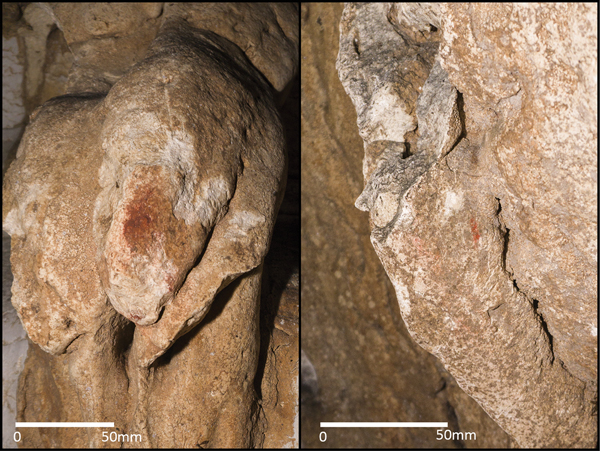
Finally, we also identified possible evidence of symbolic behaviour in the form of two intentionally broken speleothems. The fracture is certainly older than—or contemporaneous with—the paintings, as some red dots and stains were painted onto the exposed fractured areas (Figure 6).
Intentionally broken and painted speleothems, with some pigment remnants on the fractures (figure by A. Ruiz-Redondo).

The archaeological context
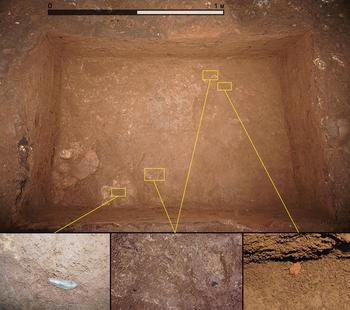
We excavated a 1.5 × 1m trench, located in front of the main panel, below the bison and the ‘anthropomorphic figures’. The trench stratigraphy was well defined. Layer 1 is a thin (approximately 40–50mm), blackish surface layer, containing numerous fragments of Bronze Age ceramics and charcoal. Layer 2 is a palimpsest of essentially sterile clay levels (between 0.2 and 0.3m thick, in total), probably produced by an unknown number of flooding events. The stratigraphy ends in a stalagmite crust (layer 3) that extends across the whole trench and includes a 0.12m-long fossil stalagmite. Upper Palaeolithic materials were recovered from atop this crust (within the base of layer 2), the most significant being a fragment of a red ochre crayon (approximately 15mm long), three small pieces of ochre, several small fragments of charcoal and a flint blade (Figure 7). The largest ochre fragment is shaped and flattened on one side, while the other sides are irregular, possibly due to breakage.
Top) archaeological context of the Romualdova Pećina rock art (trench excavated below the main panel), with the locations of the different materials; bottom, from left to right) flint blade, charcoal samples and ochre crayon (figure by A. Ruiz-Redondo).

Radiometric dates
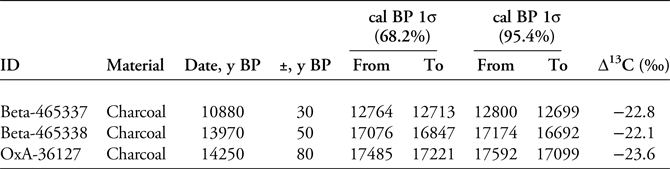
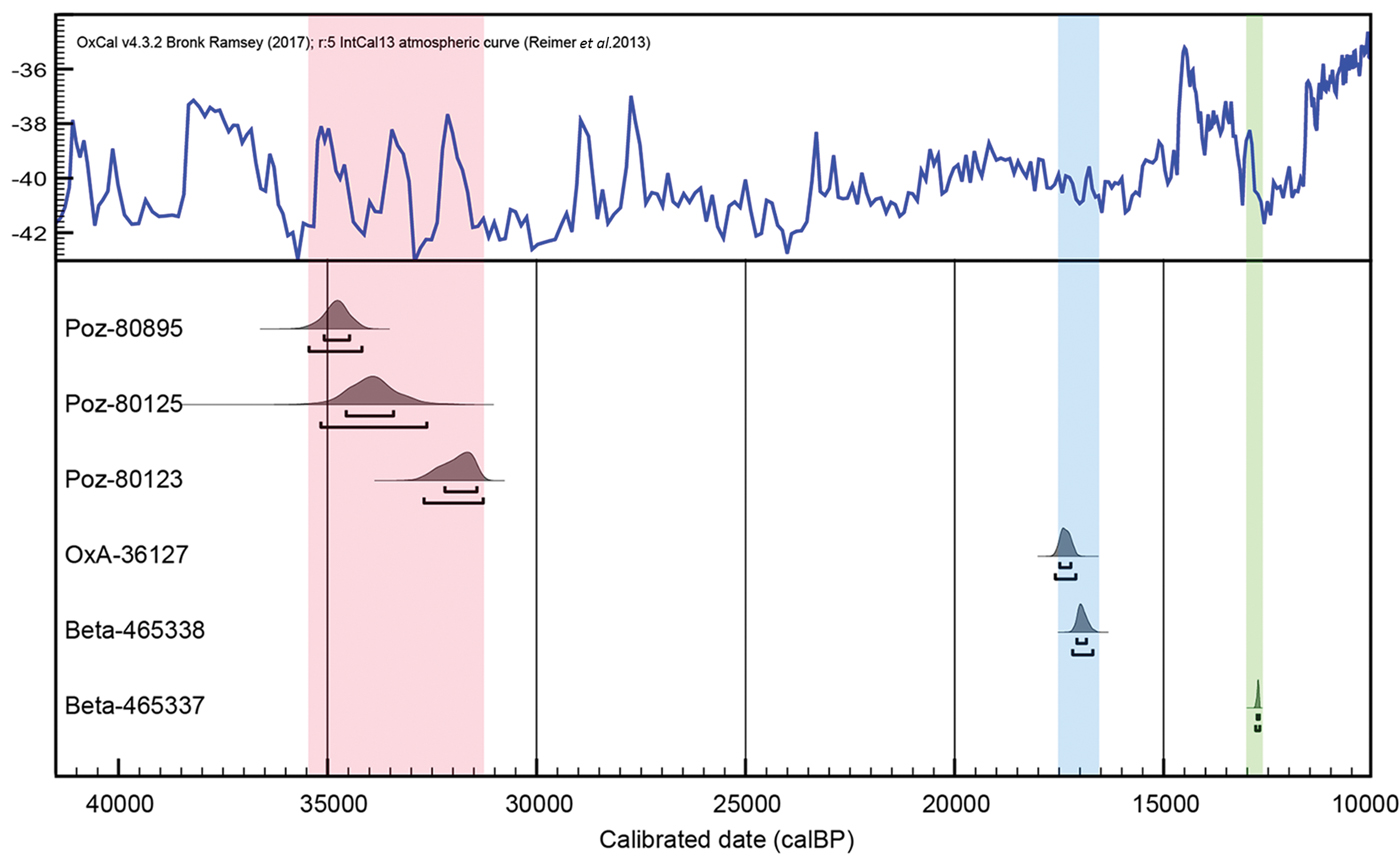
Three charcoal samples were taken from the stalagmite crust surface, two of which were dated by Beta Analytic and the third at the Oxford Radiocarbon Accelerator Unit (ORAU). Two of the resulting dates overlap at c. 17ky cal BP; the third date is more recent, c. 12.7ky cal BP (Table 1).
Radiometric determinations from the archaeological context of Romualdova Pećina, analysed by Beta Analytic Inc. and ORAU laboratories. Results were calibrated using the OxCal 4.3 software (Bronk Ramsey Reference Ramsey2013) using the IntCal13 dataset (Reimer et al. Reference Reimer2013).

Discussion
Chrono-stylistic approach
While poor preservation limits the scope of interpretation for the Romualdova Pećina rock art, several ‘Palaeolithic-style’ features are present. In particular, the painted set comprises figurative images—a bison, ibex and possibly anthropomorphs—along with geometric signs, dots and coloured marks.
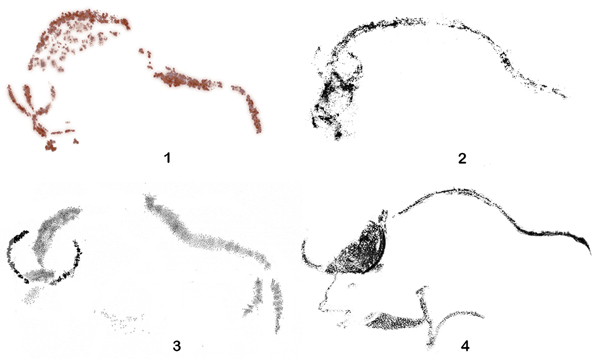
The bison is one of the most emblematic animals featured in Upper Palaeolithic rock art. Its mere presence argues for a Palaeolithic origin for the paintings, as this species was probably extinct in Southern Europe by the end of the Pleistocene, between 13.3–12ky cal BP (Cooper et al. Reference Cooper, Turney, Hughen, Brook, McDonald and Bradshaw2015). In this case, the ‘U-shaped’ horns on both sides of the head are a convention specific to the Early Upper Palaeolithic, and is found across Europe. It is common, for example, in Western European Gravettian portable art and rock art (Jaubert Reference Jaubert2008; Rivero & Garate Reference Rivero and Garate2014), and also possibly in Aurignacian cave sites, such as Chauvet and Coliboaia (Clottes Reference Clottes2001; Clottes et al. Reference Clottes, Besesek, Gély, Ghemis, Kenesz, Lascu, Meyssonnier, Philippe, Plichon, Prud'homme, Radu, Rus and Tociu2012) (Figure 8).
Stylistic parallels for the Romualdova Pećina bison motif: 1) Romualdova Pećina; 2) Peştera Coliboaia; 3) Marcenac; 4) Chauvet. The orientations of bisons 2, 3 and 4 have been modified for a better comparison (figure by A. Ruiz-Redondo).

The ibex is also commonly depicted in Upper Palaeolithic iconography, although the stylistic features of the Romualdova Pećina ibex are not found in the nearest cave sites, in Italy and Romania. The red stain covering the head and the front of the animal, however, is a classic convention found in Western European cave sites, especially those pre-dating the Magdalenian period (Garate Reference Garate2010).
The non-figurative motifs at Romualdova Pećina comprise dots, lines and coloured marks. These motifs are ubiquitous in Upper Palaeolithic rock art, and are therefore chronologically non-diagnostic. The same can be argued for the triangular signs, particularly as the Romualdova Pećina examples lack sufficient graphical conventions to be included in the ‘vulva’ category (see Robert Reference Robert2006; Bourrillon Reference Bourrillon2009). Regardless, this triangular morphology is widespread throughout Aurignacian and Magdalenian art (Bourrillon et al. Reference Bourrillon, Fritz and Sauvet2012). Of potentially more significance are the broken and coloured speleothems, which reflect a very specific and well-documented human behaviour that is almost exclusive to the Palaeolithic (Medina-Alcaide et al. Reference Medina-Alcaide, Garate, Ruiz-Redondo and Sanchidrián2018).
In summary, the stylistic evidence indicates a Palaeolithic date for the Romualdova Pećina paintings. The poor preservation and lack of chronologically diagnostic indicators (within the Upper Palaeolithic) for many of the motifs impedes further refinement of their chronology. Nevertheless, several elements, including the style of the animal figures and the possible vulva symbols, potentially link these cave paintings to the Early Upper Palaeolithic.
Archaeological context
Besides stylistic parallels, other indirect archaeological evidence can aid in establishing a chronology for the Romualdova Pećina paintings. Recent analysis of archaeological contexts immediately associated with Palaeolithic cave wall art has emphasised the importance of archaeology in determining the chronology of such art (e.g. Garate et al. Reference Garate, Bourrillon and Rios2012; González-Sainz et al. Reference González-Sainz, Ruiz-Redondo, Garate and Iriarte2013; Ruiz-Redondo et al. Reference Ruiz-Redondo, González-Sainz and Garate2017). At Romualdova Pećina, the thin stalagmite layer below the main panel appears to have been the ‘palaeo-floor’ that the ‘artist’ stood on while creating the paintings. The presence of the crayon and other ochre fragments, which probably broke off during the painting and fell onto the crust, combined with the convenient height of the paintings (e.g. 1.65m to the bison), support this hypothesis. Taken together with the depth of the art within the cave, this evidence suggests that these materials were the product of a single event, probably related to the creation of the rock art. The disparity between the radiometric dates (c. 17 vs. c. 12.7ky cal BP), the chronology of the human occupation at the entrance (c. 34–31.5ky cal BP) and the painting style (c. 39–26 ky cal BP), however, invites a number of hypotheses for dating the rock art.
Chronological hypotheses
The analyses presented above strongly support an Upper Palaeolithic date for the Romualdova Pećina paintings. The lack of contrasting evidence vs the combination of spatial, archaeological, stylistic and iconographical features of the rock art endorse this position. The current corpus of chronological data, however, is not sufficiently precise enough to produce a more accurate date. Thus, we can consider two alternative chronological hypotheses (Figure 9).
Upper Palaeolithic radiocarbon determinations for Romualdova Pećina charcoal samples: red) age range for occupation at the entrance of the cave; blue and green) age ranges for the samples taken from layer 2, in the trench immediately beneath the paintings (95.4% confidence) (figure by A. Ruiz-Redondo).

The paintings date to the Early Upper Palaeolithic (c. 34–31ky cal BP)
This hypothesis fits well with the rock art style and the human occupation located at the cave's entrance. To accept this proposition, we must assume that the archaeological evidence found in the trench below the art comprises:
1) A mix of remains deposited over a long time span—either the crust had been exposed for a long period, or the materials were size-sorted (decanted) after deposition.
2) The materials derive from a single event directly related to the creation of the art and, therefore, one or several radiocarbon samples are contaminated.
3) The materials are unrelated to the paintings.
With regard to the first possibility, the layer containing the materials (layer 2) is characteristic of a deposit produced by several clay deposition events. Such deposits within caves could develop over either a short or a long time span, and usually under wet climatic conditions (Ford & William Reference Ford and William2013). If it formed in the Early Holocene (Holocene reactivation of karst systems due to the general climate warming at the beginning of this period), the stalagmite crust could represent a ‘palaeo-floor’ during the preceding Late Pleistocene period; thus, the materials lying on its surface would comprise a palimpsest of different phases of activity during the Upper Palaeolithic. The link between the ochre and the charcoal, therefore, could be stratigraphic, rather than chronological. Regarding the second possibility, although both radiocarbon laboratories reported no sample contamination, the possibility cannot be completely discounted; the fact that two of the dates overlap may indicate the same degree of contamination in both samples. To assess the third possibility, the trench could be expanded to search for older archaeological contexts.
The paintings date to the Epigravettian (c. 17ky cal BP)
This hypothesis is consistent with two of the charcoal sample dates from layer 2, from the trench excavated immediately below the artworks. It may seem to be accurate when considering the close proximity of the charcoal samples and other Palaeolithic material (ochre fragments and the flint blade) to the paintings. A number of arguments, however, may contradict this hypothesis. The first relates to the coherence and contemporaneity of the archaeological context. If this hypothesis is accepted, we must assume that the context represents a single event and that the latest sample (Beta-465337) is contaminated. It is worth noting, however, that it is rare for contamination of a radiocarbon sample to produce an artificially older date, even more so if two samples are affected. The second argument is the lack of evidence for contemporaneous human occupation in either the cave, or in close proximity to the rock art; all the Upper Palaeolithic occupation identified in the cave dates to the Early Upper Palaeolithic (Jankovic et al. Reference Janković, Komšo, Ahern, Becker, Gerometta, Weinstock, Barbir, Vukosavljević, Cvitkušić, Zubčić, Mihelić and Smith2017). Although this argument is circumstantial, as many Upper Palaeolithic cave art sites in Western Europe have no associated evidence for habitation, it deserves to be mentioned. The final argument refers to the stylistic features of the rock art. To explain them, the existence of a new style should be proposed, different from that currently known for that time, whose characteristics might evoke other Western European Early Upper Palaeolithic art through convergence (equifinality).
Conclusion
Although the precise chronology of the Romualdova Pećina art remains unknown, its discovery represents a milestone among recent developments in the study of Palaeolithic art. This cave contains the first evidence of figurative Upper Palaeolithic rock art on the Balkan Peninsula. Hence, these paintings enlarge the geographic distribution of European rock art significantly, once again calling into question the traditional paradigm that assumes Upper Palaeolithic cave art to be a Western European phenomenon. The discovery establishes the presence of figurative rock art in South-eastern Europe, illuminating the symbolic culture of Upper Palaeolithic Balkan populations and the potential links between them and Western European groups.
While this research modifies our perception of the Upper Palaeolithic cultures that inhabited the Balkans, these advances constitute only a small step towards understanding the implications of the spread of Upper Palaeolithic rock art, and the cultural links between Western Europe and the Balkan Peninsula. The presence of Palaeolithic figurative art here raises several archaeological questions: could this art have originated independently, outside of Western Europe, or could it represent cultural diffusion from West to East? Do its particular features support the existence of close links with South-west European populations? Future research in the Balkans will contribute further information to address these questions.
Additional research at Romualdova Pećina will be conducted to refine the chronology of the rock art and determine its chaîne operatoire. In the meantime, this discovery provides new data to reignite the debate about the spread of Upper Palaeolithic parietal symbolism, and serves to emphasise the need for further archaeological exploration of long-neglected areas: the terrae incognitae of Palaeolithic rock art.
Acknowledgements
We are grateful to the Archaeological Museum of Istria for its technical and human resources and to the Natura Histrica for permission to develop this research. These results form part of the BALKARTS (Looking for the Origins of Art: BALKans Archaeological Rock arT Survey) project, which is funded by the French State within the framework of the ‘Investments for the Future’ Programme IdEx Bordeaux (reference ANR-10-IDEX-03-02). We would also like to thank the two anonymous reviewers, whose comments helped to improve this manuscript.