Introduction
Conscious and deceptive exaggeration of hearing loss is termed pseudohypacusis.Reference Rintelmann, Schwan and Blakley1 Although this label is widely accepted, several different terms have been used to define the same phenomenon, including malingering, feigning, simulated, nonorganic or functional hearing loss.Reference Rintelmann, Schwan and Blakley1–Reference James and Hinrich4 Several factors may contribute to the aetiology of pseudohypacusis. Expectation of financial compensation or some administrative benefit plays a significant role, especially in industrial workers and the military population.Reference Rintelmann, Schwan and Blakley1, Reference William, Fred, Shengguang and Louis3, Reference James and Hinrich4 On the other hand, childhood pseudohypacusis is usually attributed to a subconscious psychological defence mechanism, and is thus discussed in a different debate.Reference Pracy and Bowdler5, Reference Radkowski, Cleveland and Friedman6 The prevalence of pseudohypacusis is variable and dependent on the demographic and occupational characteristics of the group examined, ranging from 2 to 90 per cent.Reference Rintelmann, Schwan and Blakley1, Reference William, Fred, Shengguang and Louis3, Reference James and Hinrich4 Regardless of the aetiological factors, diagnosing pseudohypacusis and establishing exact hearing thresholds are time- and energy-consuming procedures for audiology clinic staff. In addition, misdiagnosis of hearing levels may result in involvement in litigation proceedings.
Several historical audiological tests have been used in detecting pseudohypacusis, including the Doerfler Stewart test, swinging story test, delayed auditory feedback (Azzi's) test and Lombard's test. Development of electrophysiological techniques has enabled the introduction of new methods with much greater reliability and accuracy. Auditory brainstem response (ABR), electrocochleography, tone decay, evoked otoacoustic emission (OAE) and sensorineural acuity level testing are ‘new generation’ tests which have been reported to be successful in the management of pseudohypacusis.Reference Rintelmann, Schwan and Blakley1, Reference William, Fred, Shengguang and Louis3, Reference James and Hinrich4 The Stenger test may be placed in between these two groups of tests. Although it was introduced by Stenger in the early 1900s and requires only a conventional two channel audiometer for testing, this test still has an important diagnostic role in the management of unilateral, profound hearing loss.Reference Rintelmann, Schwan and Blakley1, Reference William, Fred, Shengguang and Louis3, Reference James and Hinrich4, Reference Martin and Shipp7 The initial Stenger test was conducted with tuning forks, and has since been upgraded and modified. It relies primarily on the Stenger effect, that is, a sound presented to both ears is perceived only in the ear in which it is louder. Stenger test results are interpreted as negative when the hearing thresholds in the poorer ear are real, and as positive when the thresholds are faked or exaggerated. Estimating the real hearing thresholds of pseudohypacusis patients is also possible using the Stenger test.Reference Gelfand and Gelfand8 Even though it has been used for almost a century, the Stenger test's sensitivity, specificity and predictive values for unilateral pseudohypacusis have not previously been reported, to our best knowledge.
Due to Turkish national military regulations, candidates with unilateral profound or total hearing loss (i.e. a pure tone average equal to or greater than 90 dB HL) are deemed unsuitable for military service. Statutory regulations also require clinical practitioners to perform ABR testing to confirm pure tone audiometry results. Since our institution has been designated an official examining centre for hearing loss, military candidates who may potentially present with pseudohypacusis are frequently referred to us. Thus, taking advantage of our particular patient population, and accepting ABR testing as the ‘gold standard’, we investigated the efficiency of the Stenger test in detecting unilateral pseudohypacusis.
Materials and methods
The study was performed in the otolaryngology department of the Gulhane Military Medical Academy, between August 2007 and March 2008. Two hundred male candidates (mean age 22 years ± 3,4 standard deviation; range 20 to 32 years) had already been evaluated and referred to our department with questionable profound or total hearing loss. These men were enrolled in the study and underwent pure tone and speech audiometry. Speech and tonal Stenger tests were performed immediately after pure tone audiometry. The tests were performed with calibrated audiometers (Audiomed AC-40; Interacoustics, Assens, Denmark) in a sound-proof booth (Interacoustics). Earphones (TDH-39; Telephonics, Farmingdale, USA) and a bone vibrator (B-71; Radioear, New Eagle, Pennsylvania, USA) were used for measuring air and bone conduction thresholds, respectively. An audiologist who was unaware of the Stenger test results performed click ABR testing. The sensitivity, specificity and predictive values of the Stenger test for unilateral, profound pseudohypacusis were assessed, using the ABR test as the gold standard.
Stenger testing was performed immediately after pure tone and speech audiometry. Stenger testing began with presentation of a steady sound stimulus to the good hearing ear, at 1000 Hz and 5 dB higher than the threshold. The patient was asked to press the button when he heard the stimulus. Simultaneous stimuli at the same tone, beginning from 0 dB HL and increasing in 5 dB increments, were given to the poor hearing ear. Increment, by 5 dB-step was continued until the candidate ceased to respond or maximum intensity was achieved. The test was interpreted as negative when the patient continued to respond even when the stimulus to the poor ear was higher than the stimulus to the good ear, because the stimulus was perceived by the good hearing ear. If the patient chose not to respond to the test when the stimulus to the poor ear was greater than the good hearing ear thresholds, then the test was interpreted as positive, i.e. suggestive of pseudohypacusis.
After Stenger testing had been completed, auditory brainstem response testing was performed under deep sedation (induced by intramuscular injection of midazolam (50 µg/kg)). An auditory evoked potential system (Nicolet Compact Electrodiagnostic system; Nicolet Biomedical Instruments, Madison, Wisconsin, USA) was used for recordings. Silver disc electrodes recorded potentials. The positive and reference electrodes were placed on the forehead and the mastoid skin, respectively, while another forehead electrode served as a ground. Care was taken to attain an electrode impedance and an inter-electrode impedance difference of less than 5 and 1 kΩ, respectively.
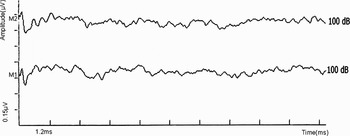
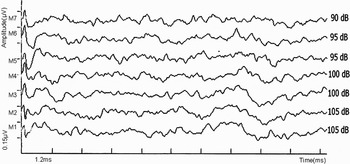
Click stimuli of alternating polarity and with a duration of 100 µs were delivered monaurally at a repetition rate of 20 per second to each ear through a tubal insert earphone (Nicolet Biomedical Instruments). A total of 1500 sweeps was averaged. Bio-electric signals were amplified 105 times and band-pass filtered over 150–3000 Hz. Analysis time was set at 10 ms. The test commenced with an 80 dB nHL stimulus. The hearing threshold calculation was based on the V wave generated by the lowest stimulus intensity. The contralateral ear was masked when necessary. Candidates with no V wave at 100 dB nHL were diagnosed as having at least profound hearing loss (Figure 1). Detection of a V wave evoked by a stimulus intensity of less than 100 dB nHL, in candidates whose pure tone audiograms were suggestive of total or profound hearing loss, was taken to indicate pseudohypacusis (Figure 2).
Auditory brainstem response trace showing no V wave at 100 dB nHL, indicating at least profound hearing loss. The x-axis presentes: time (ms: millisecond); the y-axis presents: amplitude (μV: microvolt).

Auditory brainstem response trace of a patient with pseudohypacusis, showing a V wave at 95 dB nHL. This patient's pure tone audiogram indicated total hearing loss. The x-axis presentes: time (ms: millisecond); the y-axis presents: amplitude (μV: microvolt).

Results
Two hundred candidates were referred to our institution with a possible diagnosis of unilateral profound or total hearing loss. On ABR testing, which we accepted as the gold standard, 190 (95 per cent) of the 200 candidates had a V wave which was identified only at 100 dB nHL (confirming profound hearing loss) or was not identified (indicating possible total hearing loss; since click-evoked ABR testing lacks the capacity to detect hearing reserve at low frequencies, the term ‘possible’ was used). Thus, these 190 candidates were diagnosed as having at least profound hearing loss. Stenger testing confirmed profound hearing loss correctly in 189 (99.4 per cent) of these 190 candidates.
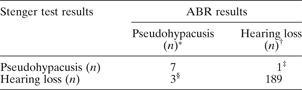
In the remaining 10 (5 per cent) candidates, a V wave was generated by a stimulus intensity lower than 100 dB nHL, as opposed to audiometry findings. These candidates were thus diagnosed with pseudohypacusis. These 10 patients had the following ABR thresholds: 95 dB nHL in two patients, 80 dB nHL in two patients, 60 dB nHL in one patient, 50 dB nHL in three patients, 40 dB nHL in one patient and 30 dB nHL in one patient. The Stenger test confirmed pseudohypacusis in seven (70 per cent) of these 10 candidates (Table I). Taking these results into consideration, the sensitivity and specificity of the Stenger test in verifying unilateral, profound hearing loss were 70 and 99.4 per cent, respectively. The positive and negative predictive values of the test were 87.5 and 98.4 per cent, respectively.
Stenger test results

For Stenger test: sensitivity = 7/(7 + 3) = 0.7 (i.e. 70%); specificity = 189/(189 + 1) = 0.994 (i.e. 99.4%); positive predictive value = 7/(7 + 1) = 0.875 (i.e. 87.5%); negative predictive value = 189/(189 + 3) = 0.984 (i.e. 98.4%). *n = 10 (i.e. 5% of study population); †n = 190 (i.e. 95% of study population). ‡Stenger test false positive; §Stenger test false negatives.
Discussion
Although there are a limited number of published studies on pseudohypacusis, this phenomenon warrants special attention in centres where patients are evaluated regarding monetary compensation claims or military service.Reference Rintelmann, Schwan and Blakley1 The prevalence of pseudohypacusis is greater in industrial workers and military staff, compared with the normal population, and practitioners caring for these patient groups should keep the condition in mind when managing hearing loss. Industrial workers may receive compensation for occupational hearing loss, and this possibility clearly motivates some individuals to feign hearing loss or to exaggerate the degree of hearing loss.Reference Barelli and Ruder9 Pseudohypacusis in a new military recruit is a strong indicator that the individual should be separated immediately from active military duty. It may be cost-effective to separate such individuals from active duty as soon as the diagnosis is made.Reference Gold, Hunsaker and Haseman10 The prevalence of pseudohypacusis is variable and dependent on the demographic characteristics of the group examined, ranging from 2 to 90 per cent.Reference Rintelmann, Schwan and Blakley1, Reference William, Fred, Shengguang and Louis3, Reference James and Hinrich4 The prevalence of pseudohypacusis in our study population, consisting of new military recruits and veterans, was 5 per cent (Table I).
An experienced clinician or audiologist may quickly suspect pseudohypacusis from informal observation of the patient before and during conventional tests. However, formal diagnosis of pseudohypacusis and objective assessment of hearing thresholds are time- and energy-consuming processes. The clinician may be alerted to the possibility of pseudohypacusis by a patient's hesitancy in responding to pure tone and speech audiometry testing, and by discrepancies between the patient's behaviour and the test results.Reference James and Hinrich4
In all physiological conditions tested by standardised, calibrated audiometric equipment, bone conduction thresholds should be better than air conduction thresholds; results to the contrary suggest pseudohypacusis.
The test–retest variability of pure tone audiometry should be 0–15 dB; greater variability should prompt suspicion of pseudohypacusis. The speech reception threshold should be consistent with the pure tone average of 500, 1000 and 2000 Hz thresholds, to within approximately 10 dB.Reference Schlauch, Arnce, Olson, Sanchez and Doyle11 Patients with pseudohypacusis tend to score better than expected for their alleged pure tone hearing losses.Reference Rintelmann, Schwan and Blakley1–Reference James and Hinrich4
The tonal acoustic reflex is elicited in normal individuals at 60 to 100 dB SPL. Pseudohypacusis should be suspected if this reflex is present at levels within 10 dB of the patient's alleged thresholds.Reference Gelfand and Gelfand12 Tonal acoustic reflex thresholds are an effective, non-behavioural tool for identifying or substantiating the presence of functional hearing loss when thresholds are 60 dB HL or more; however, acoustic reflex thresholds cannot identify functional components when thresholds are 55 dB HL or less.Reference Gelfand13
Lack of congruity between different audiological tests, even if each individual test demonstrates an objective hearing loss, may be accepted as indicating pseudohypacusis.
Although unilateral pseudohypacusis represents 28 per cent of all cases of the condition,Reference Gelfand and Silman14 several specific audiological tests have been used in the management of this entity, including the Lombard reflex test, the delayed auditory feedback speech test and the swinging story test. However, these tests provide only qualitative information and are thus no longer recommended for pseudohypacusis diagnosis. Moreover, assessing objective hearing thresholds with these tests is not always possible.Reference Rintelmann, Schwan and Blakley1–Reference James and Hinrich4, Reference Rintelmann, Schvvan and Rintelmann15
Two different physiological effects play a significant role in the management of unilateral profound or total hearing loss: the ‘shadow curve’ and the Stenger effect. If a profoundly hearing-impaired ear is stimulated at 40 dB or more above the contralateral ear's threshold, the contralateral ear perceives the stimulus. Thus, the audiogram of such an ear should show a similar pattern to the contralateral ear's audiogram, but with the threshold shifted nearly 40 dB higher. This phenomenon is known as a shadow curve, and is not seen in patients feigning hearing loss.Reference Rintelmann, Schwan and Blakley1, Reference James and Hinrich4, Reference Gelfand and Gelfand8 If the same tone is presented to both ears, the tone is perceived centrally as arising from one source (binaural fusion). This ‘fused’ tone is localised only to the ear that is better able to detect it; this phenomenon is known as the Stenger effect.
Of the tests created specifically to detect pseudohypacusis, the Stenger test is the best known. It can be used for patients feigning asymmetrical hearing loss with an interaural difference of at least 30 to 40 dB. The test relies on the Stenger effect. The Stenger test consists of presenting either a pure tone or spondee word at a level just above the threshold hearing in the better-hearing ear, simultaneously with a signal just below threshold in the worse-hearing ear, while asking the patient to respond ‘yes’ or ‘no’ regarding hearing a tone in either ear. A patient with actual asymmetrical hearing loss will respond ‘yes’, because he or she should hear the tone in their better-hearing ear, due to binaural fusion. Patients with functional hearing loss will, due to binaural fusion, hear the tone only in the worse-hearing ear, and will choose not to respond because they cannot tell that there is a stimulus above threshold in the better-hearing ear. By using these techniques, and carefully presenting the tone above threshold in the better ear while slowly increasing the tone level in the ‘bad’ ear until the patient fails to respond, the actual threshold of the bad ear can be estimated.Reference Rintelmann, Schwan and Blakley1, Reference Gelfand and Gelfand8
Boyd et al. have reported an interesting study investigating the efficacy of the Stenger test, employed in two forms to estimate genuine hearing thresholds in normally hearing volunteers simulating total unilateral hearing loss. The Stenger test was carried out in its standard form and also in a modified form, in which a phase shift was introduced between the signals delivered to the two ears, set to produce phase-induced lateralisation towards the ‘poor’ ear. The standard test estimated hearing thresholds at a mean of 13.5 dB above the true thresholds, at five frequencies from 250 Hz to 4 kHz. Hearing thresholds at the different frequencies were compared, and although thresholds were lower for the higher frequencies, the apparent effect of frequency was not statistically significant. The modified test, using a 90° phase shift, was found to enhance the test at 250 and 500 Hz (thresholds estimated at about 7 dB above true values) but not significantly at 1 kHz.Reference Boyd, Rowson and Reeves16 Although it can predict functional hearing loss, the efficiency of the Stenger test is apparently affected by interaural sensitivity differences and by the size of the functional component in the better ear.Reference Kinstler, Phelan and Lavender17, Reference Monsell and Herzon18
Otoacoustic emission tests may also play a role in the management of pseudohypacusis, but with two major drawbacks. These tests are easy and quick to perform, but test solely the integrity of the cochlea, specifically the outer hair cells. Thus, the presence of otoacoustic emissions does not guarantee transmission of neural signals to the central auditory pathways. Additionally, otoacoustic emissions are only abolished when cochlear hearing losses of up to 40–50 dB HL are present, depending on the type of emissions.Reference Durrant, Kesterson and Kamerer19 Keeping these limitations in mind, otoacoustic emissions can be used to provide actual threshold measurements when performed in combination with routine speech and pure tone audiometry.Reference Rintelmann, Schwan and Blakley1–Reference James and Hinrich4
Auditory evoked potentials provide an estimate of true hearing thresholds if a detectable evoked response is seen at a specific stimulus intensity. Auditory evoked potentials have been used to verify hearing sensitivity in pseudohypacusis cases.Reference Gorga, Johnson, Kaminski, Beauchaine, Garner and Neely20 Furthermore, the application of ABR testing is probably a potent force in motivating the patient to return to improved and even normal threshold levels through voluntary responses.Reference Sanders and Lazenby21 Auditory brainstem response testing has the advantage of not depending on the patient's state of consciousness. The presence of evoked potentials demonstrates only a synchronised neural discharge in response to noise stimuli; it does not guarantee the perception of sound. The opposite is also true; the absence of a response does not necessarily imply that a sound is not being perceived by the subject, as demonstrated by the disorders collectively known as auditory neuropathy.Reference James and Hinrich4 Click-evoked ABR thresholds result in reasonable predictions of the average behavioural thresholds at 2 and 4 kHz, thus limiting their utility in patients with functional hearing loss who have underlying high-frequency hearing loss. However, cases have been reported in which click-evoked ABR thresholds underestimated hearing loss at these frequencies.Reference Gorga, Johnson, Kaminski, Beauchaine, Garner and Neely20, Reference Coles and Mason22 In the current study, click-evoked ABR measurements were used since these generally result in well formed responses. The test also assisted in determining whether auditory neuropathy existed.Reference Gorga, Johnson, Kaminski, Beauchaine, Garner and Neely20
The assessment of sensitivity and specificity is one approach to quantifying the diagnostic ability of a test.Reference Altman and Bland23 In clinical practice, however, the test result is all that is known, so clinicians need to know how good that test is at predicting abnormality; in other words, what proportion of patients with abnormal test results is truly abnormal? In the current study, the sensitivity and specificity of the Stenger test for verifying unilateral profound hearing loss were 70 and 99.4 per cent, respectively. These findings mean that the Stenger test recognises 70 per cent of all pseudohypacusis cases as pseudohypacusis, and that it also correctly detects 99 per cent of all hearing loss cases. The positive and negative predictive values of the test were 87.5 and 98.4 per cent, respectively. The Stenger test has few false positives and false negatives; thus, a positive Stenger test is powerful enough to confirm pseudohypacusis (positive predictive value = 87.5 per cent), and it will detect 70 per cent of all pseudohypacusis cases (i.e. sensitivity of 70 per cent). A negative Stenger test result represents an effective reassurance that the patient's condition is not pseudohypacusis (negative predictive value = 98.4 per cent). The Stenger test also correctly identifies 99.4 per cent of patients with objective hearing loss (i.e. specificity of 99.4 per cent) (Table I).
• Conscious and deceptive exaggeration of hearing loss is termed pseudohypacusis
• This study evaluated the sensitivity, specificity and predictive values of the Stenger test in diagnosing unilateral pseudohypacusis
• A positive Stenger test is sufficiently powerful to confirm pseudohypacusis (positive predictive value = 87.5 per cent), and will detect 70 per cent of all cases of pseudohypacusis (i.e. sensitivity of 70 per cent)
• The Stenger test remains a relevant clinical test; it should be used in association with objective tests (e.g. auditory brainstem response testing) when indicated
The hallmark of nonorganic hearing loss is lack of inter-test consistency. The Stenger test is widely used for the evaluation of unilateral or asymmetrical pseudohypacusis, and in our opinion it is powerfully reliable. The major drawback of the test is that it requires some amount of cooperation from the patient. More difficult cases require objective electrophysiological testing to verify that a patient has functional hearing loss. Special testing may also be required to exclude specific diagnoses that may imitate pseudohypacusis. The clinician should be aware of these objective tests and apply them efficiently in order to identify or exclude pseudohypacusis.
Conclusion
Pseudohypacusis refers to conscious and deceptive exaggeration of hearing loss. Although the Stenger test has been used for almost a century in the management of pseudohypacusis, its sensitivity, specificity and predictive values for unilateral pseudohypacusis have not previously been reported, to our best knowledge. We investigated the efficiency of the Stenger test in detecting unilateral pseudohypacusis, within a particular patient population and using a conventional auditory testing battery, accepting ABR testing as the gold standard.