Introduction
Epistaxis is one of the commonest emergencies dealt with by otolaryngologists. Children suffer epistaxis much more frequently than adults; estimates of frequency vary, but it is thought that 10 per cent of the general population will experience a nose bleed in their life time.Reference Watkinson, MacKay and Bull1 The incidence of epistaxis also varies with the child's age, being reported in 30 per cent of zero- to five-year-olds, 56 per cent of six- to 10-year-olds and 64 per cent of 11- to 15-year-olds.Reference Petruson2 A study of 1218 11- to 14-year-old children found that 9 per cent experienced recurrent epistaxis. Only a minority of paediatric epistaxis episodes ever present to primary care, and fewer still reach hospital. The vast majority of paediatric epistaxis is managed by first aid in the community, either by the child themselves, or by their parent or guardian.
Epistaxis management in hospital has been extensively researched.Reference Damrose and Maddalozzo3–Reference Zvoru, Mkura, Porter and McCormick9 Epistaxis treatment in primary care has been less thoroughly investigated. Published research on first aid management of epistaxis in the community is paltry. A Medline literature search using the keywords ‘education’ ‘epistaxis’ and ‘schools’ was conducted; this search did not identify any other published paper on the management of epistaxis in educational establishments.
First aid treatment for epistaxis is well established.Reference Cleaver, Crawford and Armstrong10 The patient holds their head in a neutral position, and pressure is applied to the cartilaginous nose for at least 10 minutes. Every school in the UK is obliged by law to have a teacher trained in first aid present in the school at all times.
In light of this paucity of evidence on first aid management of epistaxis within schools, we set out to investigate this common but overlooked problem. The objective of our study was to investigate the frequency and management of epistaxis within UK schools.
Materials and methods
A postal survey of local schools in South Wales was performed, involving Cardiff County, Newport County, Monmouthshire and the Vale of Glamorgan County. Complete lists of all schools in each county were obtained from the county council websites, covering both state and public schools and including church schools and Welsh medium schools. Special needs schools were excluded. Schools were listed alphabetically; we selected for study every second primary school and (as numbers were considerably smaller) every secondary school. Selected schools were then sent a questionnaire. Schools classed as ‘infants’, ‘juniors’ or ‘primary’ were considered as primary schools. Further education colleges were considered as secondary schools.
The questionnaire was mailed to the teacher(s) with first aid responsibilities. The questionnaire is shown as Appendix 1.
The questionnaire was to be completed anonymously, and therefore did not pose any ethical problems.
Results
One hundred and fifty-seven questionnaires were mailed to 41 secondary schools (students aged 11–18 years) and 116 primary schools (students aged four to 11 years). A second, duplicate questionnaire was posted out to any schools that failed to respond to the initial questionnaire. A total of 112 completed questionnaires were returned (71 per cent response rate), 32 from secondary schools and 80 from primary schools.
The median age range of pupils in responding primary schools was three to 11 years. The median age range for pupils in responding secondary schools was 11–18 years. The mean number of pupils was 275 for responding primary schools and 1261 for responding secondary schools.
Responses were as follows.
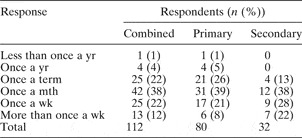
Question one, ‘How often would a nose bleed occur in school?’
Only four schools reported that epistaxis occurred less than once a term (Table I). All these were small primary schools with a mean size of 79 pupils. The mode response was ‘once a month’ in both primary and secondary schools. The median response was ‘once a month’ for primary schools, and between ‘once a month’ and ‘once a week’ for secondary schools.
Answers to question 1, ‘how often would a nose bleed occur in school?’

Yr = year; mth = month; wk = week
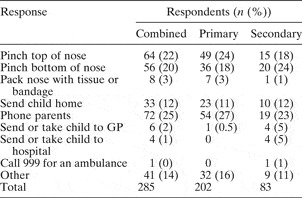
Question two, ‘What methods have you used to treat a nose bleed?’
Respondents were allowed to select multiple treatment methods. The commonest response from primary schools was ‘phone parents’, and the second commonest was ‘pinch top of nose’ (Table II). The commonest response from secondary schools was ‘pinch bottom of nose’. The option ‘phone parents’ was widely selected by both primary and secondary school respondents; many schools stated that it was their policy to contact parents if the nose bleed was prolonged.
Answers to question 2, ‘what methods have you used to treat a nose bleed?’

GP = general practitioner
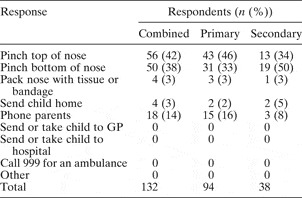
Question three, ‘Which is the method you most commonly use to treat a nose bleed?’
Respondents were asked to select just one method. Overall, ‘pinch top of nose’ was the commonest response. However, ‘pinch bottom of nose’ was only slightly less popular and, indeed, in secondary schools was the commonest response (Table III). Despite being asked to choose just one response; 14 primary and four secondary schools gave two responses, and one secondary school gave three responses. All of these extra responses included pinching the nose (either top or bottom), along with either ‘phone parents’ or ‘send child home’.
Answers to question 3, ‘which is the method you most commonly use to treat a nose bleed?’

GP = general practitioner
Question four, ‘Does the school have a policy for nose bleeds?’
Of the 32 secondary schools responding, eight (25 per cent) had a policy and 24 (75 per cent) did not. Of the 80 primary schools responding, 30 (37.5 per cent) had a policy and 49 (62.5 per cent) did not. One primary school respondent did not know if their school had a policy or not. Combining the responses for all primary and secondary schools, 34 per cent had a policy and 66 per cent did not.
Question five, ‘Do you feel confident in dealing with nose bleeds?’
All 32 secondary school respondents reported feeling confident in dealing with nose bleeds. Only two of the 80 primary school respondents reported not feeling confident in dealing with nose bleeds; the other 78 did feel confident.
Discussion
Previous research into childhood epistaxis has concentrated on two areas: predisposing factors and hospital treatment.
Damrose and Maddalozzo studied 90 children referred to a teaching hospital with epistaxis.Reference Damrose and Maddalozzo3 Some children had haematological abnormalities; 20 per cent were anaemic and 7 per cent had altered clotting parameters. Computed tomography scans were performed for 89 per cent of the children, but the authors concluded that this was not a useful investigation. Kiley et al. found coagulopathies in six of 20 children studied.Reference Kiley, Stuart and Johnson5 However, a prospective study of 36 children with recurrent epistaxis, performed by Katsanis et al. found no significant difference in coagulation parameters between patients and controls.Reference Katsanis, Luke and Hsu6
Several studies of epistaxis treatment have been performed, including two randomised trials. Guarisco and Graham found that the majority of their cases were self-limiting, caused by anterior septum bleeding, and treated acceptably by conservative management.Reference Guarisco and Graham4 Zvoru et al. found that silver nitrate cautery and emollient cream were effective in most children.Reference Zvoru, Mkura, Porter and McCormick9 Murthy et al. conducted a randomised trial comparing antiseptic nasal carrier cream and silver nitrate cautery, and found both methods to be effective.Reference Murthy, Nilssen, Rao and McClymont8 Another randomised trial compared antiseptic cream with no treatment in children with recurrent epistaxis, and found antiseptic cream to be significantly more effective than no treatment.Reference Kubba, MacAndie, Robison, O'Donnell, Robertson and Geddes7
Our study confirms the fact that epistaxis is indeed common in children. The commonest response to the question regarding frequency, in both primary and secondary schools, was that epistaxis episodes occurred monthly. On average, a secondary school in south east Wales has roughly four times the number of pupils in a primary school (mean secondary school roll of 1261 versus mean primary school roll of 275). It can therefore be inferred that primary school children are approximately four times more likely to suffer from epistaxis than secondary school children. While the commonest response to question one was monthly epistaxis, it should also be noted that a significant number of schools were treating epistaxis episodes once a week or more.
We included ‘pinch top of nose’ as a response option in the questions about epistaxis management because, from our personal experience, there is some confusion among the general public as to where on the nose pressure should be applied. First aid guidelines are clear that the inferior portion, not the superior portion, of the nose should receive pressure.Reference Cleaver, Crawford and Armstrong10 Indeed, pinching the superior part of the external nose should have no haemostatic effect. United Kingdom schools are legally obliged to have a member of staff trained in first aid on site at all times. However, despite this, the ineffective epistaxis treatment option was a remarkably popular response. When asked to pick one method of treating epistaxis, ‘pinch top of nose’ was the commonest answer among primary school respondents (46 per cent), and the second commonest among secondary school respondents (34 per cent). It would seem that, despite first aid training, teachers are still confused as to where best to apply nasal pressure.
Only 11 schools (10 per cent) had ever sought medical attention for a child suffering from epistaxis: six schools had sent or taken a child to a general practitioner, four had sent or taken a child to hospital, and only one had phoned for an ambulance. This finding lends weight to the theory that hospital and general practitioners only treat a small minority of children suffering from epistaxis. It is also noteworthy that, despite frequent mismanagement of epistaxis, with inappropriate placement of nasal pressure, further attention was rarely reported to be necessary. It would seem that epistaxis in school children is usually self-limiting, and will stop no matter how it is treated.
The majority of schools stated that they did not have a policy to deal with nose bleeds. However, many schools stated that they always informed the child's parents, either by letter or telephone, that their child had suffered a nose bleed.
• Epistaxis in school children is common
• Management of epistaxis in schools is inconsistent and frequently incorrect
• Despite this variability of management, it is rare for further medical attention to be required; rarely does a child need to be taken to hospital or to see a general practitioner
The vast majority of first aid trained teachers responding to the questionnaire stated that they felt confident in dealing with epistaxis. It would seem that even those teachers who treated epistaxis by pinching the top of the child's nose felt that they were treating the child well. Again, this would suggest the self-limiting nature of epistaxis in children; no matter how epistaxis is treated, it resolves spontaneously.
Appendix 1. Nose bleeds in schools questionnaire
Name of school: …
What is the age range for pupils enrolled in this school? …
Roughly how many pupils are enrolled in the school? …
Q1. How often would a nose bleed occur in school (please tick one box)?
□ Less than once a year
□ Once a year
□ Once a term
□ Once a month
□ Once a week
□ More than once a week
Q2. What methods have you used to treat a nose bleed (tick as many boxes as you want)?
□ Pinch top of nose
□ Pinch bottom of nose
□ Pack nose with tissue or bandage
□ Send child home
□ Phone parents
□ Send or take child to see GP
□ Send or take child to hospital
□ Call 999 for an ambulance
□ Other – please describe…
Q3. Which is the method you most commonly use to treat a nose bleed (tick one box)?
□ Pinch top of nose
□ Pinch bottom of nose
□ Pack nose with tissue or bandage
□ Send child home
□ Phone parents
□ Send or take child to see GP
□ Send or take child to hospital
□ Call 999 for an ambulance
□ Other – please describe…
Q4. Does the school have a policy for nose bleeds? Yes / No
(If yes, please briefly describe) …
Q5. Do you feel confident in dealing with nose bleeds? Yes / No