I. INTRODUCTION
Magnesium alloys are lightest among the commercially available structural metals and are considered to be important potential candidates for the application in transportation industries to improve fuel efficiency and reduce environmental pollution.Reference Friedrich and Mordike1 For magnesium alloys, considerable attempts have been made to refine the grain to improve the mechanical properties according to the well-known Hall–Petch relationship.Reference Ma, Li, Gao and Zhai2–Reference Nakada, Shiohara and Flemings4 Recently, pulsed physical fields, including electric current pulse, magnetro oscillation, and pulsed magnetic field, have been considered one of the most effective approaches to control the solidification process and refine the solidified structure.Reference Song, Li, Li and Zhai5–Reference Gong, Luo, Jing, Xia and Zhai7
Extensive studies have been carried out to investigate the effect of electric current pulse on the solidified structure.Reference Ma, Li, Gao and Zhai2, Reference Nakada, Shiohara and Flemings4, Reference Li, Ma, Gao and Zhai6, Reference Li, Ren and Fautrelle8–Reference Liao, Zhai, Luo, Chen and Gong11 Pulse electric discharging was originally applied to Sn–Pb alloy by Flemings and coworkers,Reference Nakada, Shiohara and Flemings4 and it was found that grain refinement can be achieved and that the solidified structures were modified from dendritic to global with the application of pulse electric discharging. Subsequently, Conrad and coworkersReference Barnak, Sprecher and Conrad9 found that the size of the eutectic colony in Sn–Pb alloy can be decreased with the application of high-density electric current pulse. In addition, grain refinement in pure alumina and AZ91D magnesium alloy can also be achieved under electric current pulse.Reference Ma, Li, Gao and Zhai2, Reference Li, Ma, Gao and Zhai6, Reference Yang, Zhou and Hu10, Reference Liao, Zhai, Luo, Chen and Gong11 However, application of electric current pulse on a large scale is limited because of the difficulty in the application to the melt during solidification. To overcome this drawback, a new technique using pulsed magnetic field is developed to refine the solidified structure and control the crystal orientation without contamination.Reference Zi, Ba, Cui and Xu12–Reference Li, Song, Li and Zhai14 Zi et al.Reference Zi, Ba, Cui and Xu12 first investigated the effect of strong pulsed magnetic field (SPMF) on the as-cast structure of 2024 aluminum alloy. They found that grain was markedly refined and that the amount of the equiaxed grain increased with increasing the intensity of SPMF. Subsequently, grain refinement was observed in pure alumina and austenitic stainless steel with the application of SPMF.Reference Gao, Li, Gong and Zhai13, Reference Li, Song, Li and Zhai14 Recently, Fautrelle and coworkersReference Li, Ren and Fautrelle8, Reference Li, Fautrelle and Ren15–Reference Li, Fautrelle, Ren, Gagnoud, Moreau, Zhang and Esling17 investigated the effect of strong magnetic field on the solidified microstructure of Al–Al2Cu, Bi–Mn, Al–Cu, Al–Ni, and Zn–Cu alloys. It was found that strong magnetic field can decrease the eutectic spacing, change the direction of primary dendrite arm, and destabilize the stability of the solid/liquid interface during directional solidification. In addition, magnetic field can be used to produce electromagnetic stirring and forced convection.Reference Zimmermann, Weiss and Mbaya18, Reference Biswas, Hermann, Das, Priede, Gerbeth and Acker19 However, the above grain refinement is achieved by strong magnetic field, and this kind of magnetic field is difficult to control and unsafe to utilize because of to high voltage. This limits its industry application on a large scale. Thus, more and more efforts have been devoted to develop more effective and safe techniques to refine the solidified structure.
Recently, we have developed a low-voltage pulsed magnetic field (LVPMF) technique to refine the solidified structure of metal materials. Significant grain refinement effect in AZ91D magnesium alloy and superalloy has been achieved.Reference Wang, Yang, Zhou and Tong20–Reference Ma, Li and Yang22 This suggests that LVPMF technique has a great potential to refine the as-cast structure of metal materials. In addition, it was found that the morphology of α-Mg in AZ91D magnesium alloy under LVPMF was changed from developed dendrite to fine rosette, which is beneficial to grain refinement.Reference Wang, Yang, Zhou and Tong20 On the basis of the experimental results,Reference Wang, Yang, Zhou and Tong20–Reference Ma, Li and Yang22 it can be concluded that LVPMF affects both nucleation and growth process during solidification.
However, previous works mainly focused on the optimization of processing parameters under pulsed physical fields. Up to now, effect of pulsed physical fields on the solidified structure is discussed only in terms of nucleation theory.Reference Liao, Zhai, Luo, Chen and Gong11, Reference Ma, Li and Yang21, Reference Ma, Li and Yang22 There are few reports referring to the effect of LVPMF on the growth behavior during solidification. Mechanism for the morphology change of α-Mg in Mg–Al–Zn alloy with the application of LVPMF is still not clear and needs to be further explored. Lack of the understanding of the refinement mechanism of LVPMF on the solidified structure limits the development of LVPMF and makes it difficult to get widely used in industry. Therefore, this article is to investigate the formation mechanism of the solidified structure under LVPMF and examine the effect of LVPMF on the dendrite growth behavior of Mg–Al–Zn alloy.
II. EXPERIMENTAL
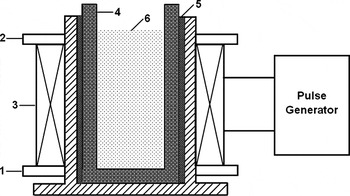
In this work, as-cast AZ 80 alloy with a composition of 8.2Al-0.54Zn-0.12Mn was used. The experimental apparatus, which consists of a pulsed magnetic field generator, a cooling water system, and a heat insulation refractory, is schematically shown in Fig. 1. The LVPMF is excited by a capacitor. In the experiments, the alloy was heated to 993 K in an electric resistance furnace under a mixed atmosphere of SF6 and CO2. The volume fraction of SF6 in the mixture is 0.2 vol.%. After stabilization at 993 K for about 30 min, the melt was immediately poured into the mold preheated to 873 and 573 K. The dimension of the graphite mold with a sieve is 32 mm in inner diameter and 140 mm in height, and 60 mm in inner diameter and 140 mm in height in the experiments without the sieves.
Schematic of the casting process using a low-voltage pulsed magnetic field (LVPMF) apparatus. 1. water inlet, 2. water outlet, 3. coil, 4. mold, 5. refractory, 6. melt.

The LVPMF was applied to the melt after pouring and last for about 5 min. The frequency of the excitation current is 5 Hz, and the voltage is 200 V in the experiments. To reveal the effect of LVPMF on the solidified structure, experiments with and without LVPMF were carried out. For macrostructure observation, the solidified samples were etched with the etchant consisting of 70-mL alcohol, 10-mL glacial acetic acid, 10-mL distilled water, and 6-g picric acid after being mechanically ground and polished. For microstructure observation, 1.0% oxalic acid reagent was used. The solidification microstructures were analyzed by optical microscopy. Grain sizes are evaluated by line intercept method in the macrostructure using SISC-IAS image software (Scientific Instrument Software Co., Beijing, China).
III. RESULTS
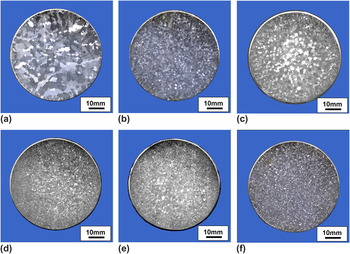
The typical as-cast macrostructures of Mg–Al–Zn alloy with and without LVPMF are shown in Fig. 2. It can be seen that the macrostructure is composed of coarse grains without the application of LVPMF, as shown in Fig. 2(a). The size of the maximum grain is 6.7 mm and the average grain size is 3.4 mm (with a standard deviation of 1.9 mm) in Fig. 2(a). The grain sizes vary greatly in the macrostructure in Fig. 2(a) without the application of LVPMF. When the LVPMF is applied during solidification, the grains are refined and more uniform, as shown in Fig. 2(b). The size of the maximum grain is decreased to 1.6 mm and the average grain size is decreased to 1.1 mm (with a standard deviation of 0.1 mm) in Fig. 2(b).
As-cast macrostructures of Mg–Al–Zn alloy. (a) Coarse grain without the application of LVPMF (the mold was preheated to 873 K); (b) fine grain with the application of LVPMF (the mold was preheated to 873 K); (c) coarse grain in the center and fine grain in the surface layer of the sample without the application of LVPMF (the mold was preheated to 573 K); (d) fine grain with the application of LVPMF (the mold was preheated to 573 K); (e) coarse grain in the center and fine grain in the surface layer of the sample without the application of LVPMF (the mold was not preheated); (f) fine and uniform grain with the application of LVPMF (the mold was not preheated).

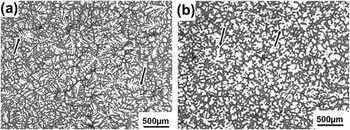
Preheating temperature of the mold has an important effect on the solidified structure of Mg–Al–Zn alloy. The grain size is markedly decreased with decreasing the preheating temperature of the mold without the application of LVPMF, as shown in Figs. 2(a), 2(c), and 2(e). When the LVPMF is applied during solidification, the effect of preheating temperature of the mold on grain size of Mg–Al–Zn alloy becomes not apparent, as shown in Figs. 2(b), 2(d), and 2(f). On the basis of the results in Fig. 2, it can be concluded that fine and uniform structures in Mg–Al–Zn alloy can be obtained with the application of LVPMF. Figure 3 shows the effect of LVPMF on the microstructure in the as-cast Mg–Al–Zn alloy. Without the application of LVPMF, α-Mg in the microstructure can be characterized by coarse equiaxed dendrite with developed branches and sharp dendrite tip, as shown in Fig. 3(a). When the LVPMF is applied, coarse α-Mg dendrite is refined, the dendrite arm is shortened, and the dendrite tip tends to be rounded, as shown in Fig. 3(b). Formation of the fine and undeveloped rosette morphology suggests that LVPMF affects both nucleation and growth processes of α-Mg dendrite during solidification.
As-cast microstructures of Mg–Al–Zn alloy. (a) Developed α-Mg dendrite with thin dendrite tip (denoted by arrows) without the application of LVPMF; (b) rosette α-Mg dendrite with rounded dendrite tip (denoted by arrows) with the application of LVPMF.

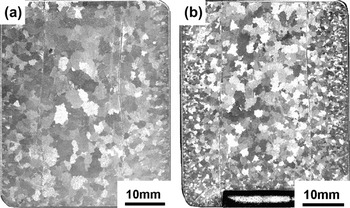
It is clear that the nucleation events mainly occur on the mold wall because of heterogeneous nucleation. Thus, both effective dispersion of the nuclei from the mold wall to the bulk melt and prolongation of nucleation time can enhance nucleation rate. Experimental results by Liao et al.Reference Liao, Zhai, Luo, Chen and Gong11 have confirmed that grain refinement in pure aluminum under electric current pulse is resulted from the dispersion of the crystal nuclei originated from the mold wall by the magnetic force. To clarify the effect of LVPMF on the solidified structure of Mg–Al–Zn alloy, a tube-like sieve (mesh 100) was placed into the mold. The sieve can prevent the nuclei outside the sieve from entering the inner of the sieve to ascertain the origin of nuclei in the center of the melt under LVPMF. The results, as shown in Fig. 4, indicate that fine grains exist outside the sieve and that coarse grains concentrate inside the sieve. This result reveals that nucleation events mainly occur near the mold wall because of heterogeneous nucleation. When the LVPMF is applied to the melt during solidification, the size of the grains outside the sieve becomes smaller, as shown in Fig. 4(b). From Figs. 4(a) and 4(b) it can be confirmed that nucleation rate is enhanced with the application of LVPMF.
Effect of LVPMF on the macrostructure of the as-cast Mg–Al–Zn alloy with a sieve in the melt during solidification. (a) The grains outside the sieve are coarse without the application of LVPMF; (b) the grains outside the sieve are fine with the application of LVPMF.

IV. DISCUSSION
A. Effect of LVPMF on nucleation
According to classical nucleation theory (CNT),Reference Christian23 formation of a nucleus with a critical size depends on the competition between the driving force (the volume free energy) and the energy barrier required for forming a new interface. The free energy barrier to form a spherical critical nucleus on a heterogeneous substrate can be expressed as

where σ is the interface energy of a new interface, 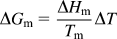 the Gibbs free energy difference per unit volume between the liquid and the solid, ΔH m the latent heat of fusion per unite volume, T m the melting temperature of the pure component, ΔT the undercooling of the melt, f(θ) a catalytic potency factor in the case of heterogeneous nucleation, and ΔG i the increase in interface energy when forming a critical nucleus. It can be also known from Eq. (1) that when forming a critical nucleus, the decrease in the volume free energy only counteracts two-thirds of the interface free energy. To form a critical nucleus, the rest one-third of the interface free energy needs to be balanced by other energies. Usually, this energy originates from the energy fluctuation in the melt. During solidification under LVPMF, an additional magnetic energy is applied, which can provide energy to form the critical nucleus. Therefore, the application of LVPMF can effectively enhance nucleation rate during solidification, which is necessary for grain refinement in the solidified structure.
The other factor that affects nucleation rate during solidification is the convection in the melt. When the LVPMF is applied during nucleation, the interaction between the induced current and the applied magnetic field will generate a magnetic force. Before the formation of the solidified shell near the mold wall, the magnetic force can accelerate the detachment of the nuclei from mold wall and disperse the detached nuclei into the center of the melt rapidly. Thus, a large number of nuclei can be produced in the bulk melt, which accounts for the origin of the nuclei in the center of the melt and the fine and uniform grains in the solidified microstructure. Joule heat can prolong the nucleation time because Joule heat can enhance the melt temperature to the temperature required for nucleation when the melt temperature is lower than the solidus temperature. The nucleation events can occur continuously for a longer time. Thus, the amount of the nuclei in the melt can be increased by Joule heat, and the generated nuclei can be effectively dispersed by magnetic force from the mold wall into the center of the melt. The combination of the two factors can refine the structures of Mg–Al–Zn alloys.
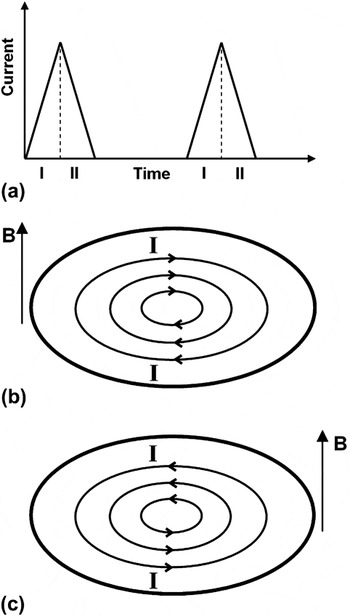
In addition, according to the law of electromagnetic induction, it is known that magnetic force in the melt varies periodically with the variation of current intensity under LVPMF. The variation of the magnetic force is schematically shown in Fig. 5. The varied pulsed magnetic force will cause vibration and convection in the melt, which can accelerate the dispersion of the nuclei formed on the mold wall. Furthermore, the vibration in the melt can make the secondary arm fall off the dendrite trunk and break up the deciduous secondary arm, which can act as the heterogeneous nucleant particle. Therefore, in terms of nucleation stage during solidification, the grain refinement of Mg–Al–Zn alloy under LVPMF may attribute to the magnetic energy, magnetic force, vibration, and Joule heat.
Schematic of the formation of vibration in the melt because of the variation of magnetic force in Mg–Al–Zn alloy with the application of LVPMF. (a) Pulsed current in the coil; (b) induced eddy current at the stage of I; (c) induced eddy current at the stage of II.

B. Effect of magnetization on dendrite growth in the diffusion layer
According to Fautrelle et al.,Reference Li, Fautrelle, Ren, Gagnoud, Moreau, Zhang and Esling17 the solute and solvent in the diffusion layer will be magnetized during solidification when a magnetic field is applied. Then a magnetic field gradient in the layer will be produced. The interaction between the difference of the magnetic susceptibility in solute and solvent and the magnetic field gradient can generate a magnetic force, which acts on the solute in the layer. The force per unit volume on the solute can be expressed as
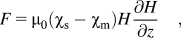
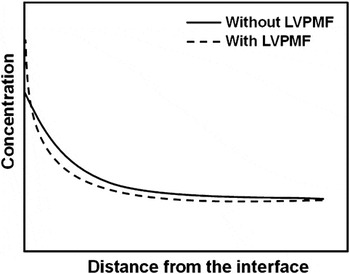
where μ 0 is the permeability of free space (4π × 10−7 Hm−1), χ s and χ m the magnetic susceptibility per unit volume of the solute and solvent, respectively, H the magnetic field intensity, and  the gradient along the solidification direction. After analyzing Eq. (2), we can conclude that in case of both χ s > χ m and χ s < χ m, the magnetic force applied to the solute is always toward the interface. This means that the solute will accumulate at the solid/liquid interface during solidification, as shown in Fig. 6. It should be noted that the analysis by Fautrelle et al.Reference Li, Fautrelle, Ren, Gagnoud, Moreau, Zhang and Esling17 is based on the assumption that the equilibrium partition coefficient of solute is less than one. When the equilibrium partition coefficient of solute is higher than one, an opposite conclusion will be drawn. This suggests that the solute at the solid/liquid interface can be transferred to the bulk melt during dendrite growth under LVPMF. For the alloy used, the equilibrium partition coefficients of both Al, 0.37, and Zn, 0.12, in Mg matrix are less than one. The equilibrium partition coefficient of Mn is almost close to one. Furthermore, the content of Mn in the alloy, 0.12 wt.%, is much lower, compared with Al and Zn. Therefore, the solidified microstructure of the Mg–Al–Zn alloy is mainly determined by the solidification characteristic of Al and Zn. Thus, only accumulation of the solutes at the solid/liquid interface will be considered here.
Schematic of the formation of the solute build-up caused by magnetization in the diffusion layer.

The accumulation of solutes at the solid/liquid interface can change the solute distribution in the diffusion layer, which affects the growth behavior of dendrite tip. According to Kurz and Fisher,Reference Kurz and Fisher24 the supersaturation, which represents the driving force for the diffusion of the solute at the dendrite tip in an alloy, can be shown as
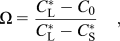
where  and
 are the liquid and solid concentrations at the solid/liquid interface, respectively, C 0 the initial composition of the alloy, and k 0 the equilibrium partition coefficient. Divided by
 , Eq. (3) can be written as
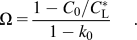
It can be inferred from Eq. (4) that the driving force for the diffusion-controlled growth is a monotonic increasing function of the liquid concentration at the solid/liquid interface during solidification. This indicates that accumulation of the solute at the solid/liquid interface can accelerate the growth rate of dendrite. On the basis of this analysis, dendrite will become developed and coarse under a magnetic field. Thus, the magnetization of the solute and solvent in the diffusion layer during solidification cannot account for the formation of the fine rosette α-Mg in the solidified microstructure. The change of α-Mg morphology under LVPMF should be caused by other factors.
C. Effect of LVPMF on dendrite growth
From Maxwell field equations, it is known that Joule heat can be generated when a magnetic field is applied to the melt. For electric resistances in series, the magnitude of Joule heat is directly proportional to the magnitude of resistance when an electric current is applied. The expression for an electric resistance can be written as

where R is the electrical resistance, ρ the electrical resistivity, L the length of the electric resistance, and S the cross-sectional area of the electric resistance. From Eq. (5), the magnitude of electric resistance increases with decreasing the cross-sectional area when the material and length of the electric resistance are given. During dendrite growth, the cross-sectional area of the dendrite tip is much smaller than the dendrite trunk. Therefore, Joule heat will concentrate on the dendrite tip during dendrite growth with the application of LVPMF. The accumulation of the heat at the dendrite tip will cause the local melting at the dendrite tip. The dendrite tip can be rounded and the radius of curvature of the dendrite tip can be increased. The radius of curvature of the dendrite tip is the most important length scale parameter, which governs the growth behavior at the solid/liquid interface and the subsequent dendrite structure. The relationship between the radius of curvature of the dendrite tip and the growth rate of dendrite can be derived through solving the diffusion equation, together with the interface stability theory.
Taking account into surface tension at the solid/liquid interface, Mullins and Sekerka25 proposed the interface stability theory by solving the diffusion equations assuming a slight sinusoidal perturbation at the interface. The change rate of the perturbation amplitude can be written as

where  , ε is the amplitude of perturbation, V the growth rate, G C the concentration gradient in the liquid at the solid/liquid interface, D L the solute diffusion coefficient in the liquid, Γ the Gibbs–Thompson parameter,
 the perturbation frequency, λ the perturbation wave length,
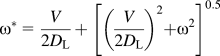 a function of ω and D L, G L the temperature in the liquid, and m L the slope of the liquidus. On the basis of Langer and Müller-Krumbhaar (LMK) marginally stable theory,Reference Langer and Müller-Krumbhaar26 the tip radius of a dendrite should be close to the shortest perturbation wave length λ. To obtain the critical stable wave length λ, the third term on the right-hand side of Eq. (6) is set to be equal to zero, giving
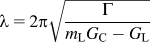 . Therefore, according to the marginal stability theory the tip radius of a dendrite can be expressed as
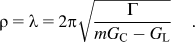
The value of G C can be obtained from the solute flux balance at the solid/liquid interface

where r is the radius of the interface. From Eq. (8), we can obtain the expression of G C as

For dendrite growth,  can be given as
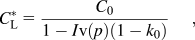
where Iv(p) is Ivantsov’s solution, and p = ρV/2D L solutal Péclet number. At dendrite growth region, temperature gradient in the liquid has little effect on the tip radius of a dendrite.Reference Trivedi27, Reference Kurz and Fisher28 Furthermore, the terms Iv(p) can be ignored due to small tip radius during dendrite growth. Substituting Eqs. (9) and (10) into Eq. (7) with G L→0 and Iv(p)→0, the relationship between the growth rate and the tip radius can be obtained as
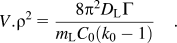
From Eq. (11), it is apparent that the product of growth rate and the square of the radius at the dendrite tip is a constant during dendrite growth. The radius of the dendrite tip and the growth rate are not independent during dendrite growth. The variation of the radius of the dendrite tip can change the growth behavior of the dendrite, which can be understood by considering the diffusion of solute during dendrite growth. It is well known that the radius of curvature of the interface has an important effect on the driving force for solute diffusion.Reference Wakai and Aldinger29 The chemical potential gradient for a spherical interface can be shown as

where Δμ is the chemical potential gradient during diffusion of a solute, M α the molar volume of α phase, γ the surface energy, and r radius of the sphere. From Eq. (12), it can be inferred that both the driving force for the diffusion of solute and the migration rate of the interface are increased with the decrease in the radius of curvature of the interface. Increase in the radius of the dendrite tip can limit the growth of the dendrite.
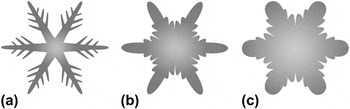
On the basis of the above analysis, it can be concluded that the melting of the local dendrite tip increases the radius of curvature of the dendrite tip and decreases the growth rate of the dendrite. Thus, the morphology change of α-Mg under LVPMF should be attributed to the change of the radius of the dendrite tip because of the accumulation of Joule heat at the dendrite tip. The schematic for the morphology change from developed dendrite to fine rosette with the application of LVPMF is shown in Fig. 7. First, the local dendrite tip is remelted, and the radius of dendrite tip is increased due to the accumulation of Joule heat under LVPMF. Then, the primary arms of the dendrite are being shortened and degenerated gradually during growth, as shown in Fig. 7(b). Finally, the morphology of α-Mg is changed to fine rosette, as shown in Fig. 7(c).
Schematic of the mechanism for the transformation of the α-Mg morphology with the application of LVPMF. (a) Developed α-Mg dendrite; (b) α-Mg dendrite with shortened and degenerated primary arms owing to the accumulation of Joule heat at the dendrite tip; (c) undeveloped rosette dendrite.

In addition, the undercooling, representing the driving force for the solute diffusion at/ahead of the solid/liquid interface, is decreased when Joule heat is generated at the dendrite tip during dendrite growth. The growth rate is decreased, and the trunks and branches are also shortened due to the decrease in melt undercooling.
V. CONCLUSIONS
Effect of a LVPMF on the solidified microstructure of Mg–Al–Zn alloy has been examined experimentally. The solidified microstructure of Mg–Al–Zn alloy can be refined under LVPMF. The refinement mechanism under LVPMF has been discussed in terms of magnetic energy, magnetic force, and Joule heat on the basis of nucleation and growth theories.
The magnetic energy can provide the essential energy, which cannot obtain from the decrease in the volume free energy, to counteract the interface energy to form a critical nucleus. The magnetic force can accelerate the detachment of nuclei from the mold wall and disperse the detached nuclei into the center of the melt rapidly. This accounts for the origin of plenty of nuclei in the center of the melt. Simultaneously, the variation of the magnetic force can cause vibration in the melt. The vibration will accelerate the dispersion of the nuclei from the mold wall into the center of the bulk melt. The vibration may also make the secondary arm fall off the dendrite trunk and break up the deciduous secondary arm, which will act as the heterogeneous nucleus. In addition, Joule heat can prolong the nucleation time and increase the amount of the nucleus in the melt.
The change of α-Mg morphology is not be caused by the magnetization of the solute and solvent in the diffusion layer during dendrite growth. The magnetization leads to the accumulation of the solute at the solid/liquid interface and increases the growth rate of the dendrite. Therefore, magnetization of the solute and solvent will result in coarse dendrite. During dendrite growth, Joule heat will concentrate on the dendrite tip owing to smaller radius of curvature. This accumulation of Joule heat can remelt the local dendrite tip. From the relationship between the growth rate and the radius of the dendrite tip, it can be inferred that the increased radius of dendrite tip can lower the growth rate of the dendrite. Thus, the trunks and branches of the dendrite are being shortened and degenerated gradually during growth, and the morphology of α-Mg is transformed from developed dendrite to fine rosette under LVPMF.
ACKNOWLEDGMENT
This work was financially supported by the National Natural Science Foundation of China (Nos. 50774075 and 51034012).