Introduction
Pigs share many characteristics with humans such as anatomy, physiology and body size and are expected to become important animal models for therapeutic cloning and xenotransplantation (Dai et al., Reference Dai, Vaught, Boone, Chen, Phelps, Ball, Monahan, Jobst, McCreath, Lamborn, Cowell-Lucero, Wells, Colman, Polejaeva and Ayares2002; Tucker et al., Reference Tucker, Belcher, Moloo, Bell, Mazzulli, Humar, Hughes, McArdle and Talbot2002). Because of this factor, in vitro maturation (IVM) of porcine oocytes and in vitro production (IVP) of porcine blastocysts are very important initial steps in the study of early embryonic development and the production of transgenic animals. Recently, the IVP of blastocysts in pigs was increased by technical improvements in several of the developmental stages (Gil et al., Reference Gil, Cuello, Parrilla, Vazquez, Roca and Martinez2010). However, the IVP rate is still inferior to in vivo embryo production, and the cloning efficiency after embryo transfer is still low (Koo et al., Reference Koo, Park, Kwon, Kang, Jang and Lee2009). To increase the rate of in vitro blastocyst formation and to improve cloning efficiency after embryo transfer, it is necessary to produce high-quality mature oocytes.
The oocyte and its surrounding cumulus cells in mammals are connected metabolically through gap junctions that serve as a unique means of entry into the ooplasm for several metabolites. Cumulus cells have a close connection with oocytes during the course of maturation. Gonadotropins, steroids and other factors from the follicle cells also interact with oocytes to provide essential support for in vivo maturation of oocytes. It is generally accepted that cumulus cells support the maturation of oocytes to the metaphase II stage and are intimately involved in ‘cytoplasmic maturation’ of oocytes, which is the capacity to undergo normal fertilization and subsequent embryonic development (Tanghe et al., Reference Tanghe, Van Soom, Nauwynck, Coryn and de Kruif2002).
Generally, in vitro culture of porcine oocytes is maintained at higher concentrations of oxygen than the in vivo environment. Increased partial pressure of oxygen generates excessive amounts of cytotoxic reactive oxygen species (ROS) and may directly affect the viability of embryos (Tatemoto et al., Reference Tatemoto, Sakurai and Muto2000). Therefore, oxygen tension during culture would be an important factor affecting both oocyte maturation and embryo development. In cattle, several studies have shown that the efficiency of oocyte or embryo culture could be improved by decreasing oxygen concentration (Takahashi and Kanagawa, Reference Takahashi and Kanagawa1998; Hashimoto et al., Reference Hashimoto, Minami, Takakura, Yamada, Imai and Kashima2000), whereas others were contradictory (Pinyopummintr & Bavister, Reference Pinyopummintr and Bavister1995; de Castro e Paula & Hansen, Reference de Castro e Paula and Hansen2007) or even showed that oxygen level had no significant effects on maturation and fertilization in vitro (Agung et al., Reference Agung, Piao, Fuchimoto, Senbon, Onishi, Otoi and Nagai2010). In mice, it was reported that a significant decrease in total cell number in blastocysts occurred as oxygen concentration increases during IVM (Preis et al., Reference Preis, Seidel and Gardner2007). In pigs, immature oocytes are commonly matured in vitro under a relatively high (20%) oxygen concentration although oxygen concentration is much lower than in the atmosphere both in the reproductive tract (Bavister, Reference Bavister1995) and follicular fluid (Knudsen et al., Reference Knudsen, Litkowski, Wilson, Guthrie and Batta1978). On the other hand, embryo culture is usually conducted in vitro under a relatively low (5%) oxygen concentration because fertilization occurs in vivo under low oxygen tension (Wright, Reference Wright1977; Fischer & Bavister, Reference Fischer and Bavister1993). In view of all these reports, it is clear that the effect of oxygen concentration during IVM or IVC is not yet fully understood.
The aim of this study was to observe porcine embryo development in terms of oocyte maturation and blastocyst formation derived from culture of these stages under different oxygen concentrations and to analyse the concomitant effects of oxygen on transcript abundance of genes related to metabolism, oxidative response, apoptosis and developmental competence in cumulus–oocyte complexes and blastocysts.
Materials and methods
Oocyte collection and in vitro maturation
Pig ovaries were collected from a local abattoir and transported to the laboratory in 0.9% (w/v) NaCl solution at 30–35°C. Follicular contents from antral follicles 3–6 mm in diameter were aspirated using an 18-gauge needle attached to a 10 ml disposable syringe. The contents were pooled in a conical tube at 39°C and allowed to settle for a few minutes. The sediment was aspirated and diluted with DPBS (Dulbecco's phosphate-buffered saline) containing 100 U/ml penicillin G (Sigma-Aldrich Corp.) and 100 mg/ml streptomycin sulphate (Sigma-Aldrich). Cumulus–oocyte complexes (COCs) with intact compact cumulus layers were selected and washed three times in TCM-HEPES medium before being transferred to a modified tissue culture medium (TCM)-199 supplemented with 10 ng/ml epidermal growth factor (EGF) (Sigma-Aldrich), 0.57 mM cystine, 0.91 mM sodium pyruvate, 5 μg/ml insulin, 1% (v/v) Pen-Strep (Invitrogen), 1 μg/ml gonadotrophin and 10% porcine follicular fluid (PFF). COCs were subsequently randomly divided into two groups, which were matured either under an atmosphere of 5% CO2 in air (M20) or 5% CO2, 5% O2 (M5). After each maturation period, oocytes were denuded from COCs by pipetting with 0.1% hyaluronidase in Dulbecco's PBS (Invitrogen) supplemented with 0.1% polyvinyl alcohol (PVA-DPBS). Then denuded oocytes and separated cumulus cells were collected for total RNA extraction.
Assessment of meiotic maturation of mature oocytes
After culture for 44 h, denuded oocytes were stained with Hoechst 33342 (Sigma-Aldrich) in DPBS. The stage of meiotic maturation was determined by evaluating for presence of the first polar body under ultraviolet (UV) light.
Parthenogenetic activation of mature oocytes and in vitro culture
At 44 h of IVM, metaphase II oocytes were activated. Denuded oocytes were equilibrated for 1 min in 0.26 M d-mannitol (Sigma-Aldrich) based activation solution, supplemented with 0.1 mM MgCl2, 0.1 mM CaCl2, and 0.5 mM N-(2-hydroxyethyl)-piperazine-N′-(2-ethanesulfonic acid), and then transferred to a chamber between two electrodes 3.2 mm apart and overlaid with activation solution. The oocytes were activated with an electric stimulus using a single direct current pulse of 1.5 kV/cm for 60 μs using a BTX Electro-Cell Manipulator 2001 (BTX Inc.). A group of approximately 20 to 30 parthenogenetically activated oocytes were cultured in 500 μl medium PZM-3 containing 0.3% (w/v) fatty acid-free bovine serum albumin (BSA) (Sigma-Aldrich) (Yoshioka et al., Reference Yoshioka, Suzuki, Tanaka, Anas and Iwamura2002). Each maturation group was further subdivided into two groups for culture at 39°C in a humidified atmosphere of 5% CO2, 5% (C5) or 20% O2 (C20), resulting in four groups (M5C5, M5C20, M20C5, M20C20). The cleavage rate and blastocyst formation rate were checked at 48 and 168 h of IVC, respectively. Thus, the experimental design was a 2 × 2 factorial, with IVM and IVC × 5% and 20% oxygen. Blastocyst for RNA extraction and assessment of quality were randomly selected as equal number in each groups.
In this study on embryonic development we used parthenogenesis rather than in vitro fertilization or somatic cell nuclear transfer to assess oocyte competence for embryonic development. The parthenogenetic activation of oocytes can be used to evaluate the developmental competence of oocytes in vitro without confounding factors from spermatozoa (Hsieh et al., Reference Hsieh, Tang, Chang, Weng, Sha, Tseng, Chang and Ju2006) and a variety of other factors introduced during in vitro procedures. Furthermore, parthenogenetic activation is relevant to cloning research, because artificial activation of an oocyte is an essential component of nuclear transfer protocols (Wang et al., Reference Wang, Wang, Yu and Xu2008).
Assessment of embryo quality
The quality of blastocysts was assessed by Hoechst staining of the inner cell mass (ICM) and trophectoderm (TE) cells according to standard procedures. Briefly, after rinsing in PZM-3 medium, blastocysts were stained with Hoechst 33342 stain for 15 min. After rinsing in PZM-3 medium, the blastocysts were mounted on a glass slide under a coverslip and examined under an inverted microscope (Nikon Corp.) equipped with epifluorescence.
Total RNA extraction, RT-PCR (polymerase chain reaction) and real-time PCR
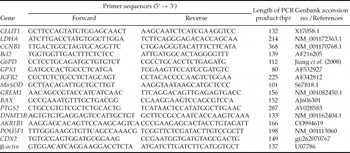
Total RNA was isolated from fresh or previously frozen (–80°C) cumulus cells, oocytes matured either at atmospheric or low oxygen concentration (M20 or M5, respectively) and blastocysts obtained from oocytes matured at atmospheric oxygen concentration and cultured at atmospheric or low oxygen concentration (C20 or C5, respectively) using the Easy-Spin™ (DNA-free) Total RNA Extraction Kit (Intron Biotechnology, Inc., Korea) according to the manufacturer's instructions, and quantified by a spectrophotometer and immediately stored at –80°C until used for RT-PCR and qRT-PCR. cDNA (complementary DNA) was produced from 1 μg of total RNA extracted from cumulus cells, oocytes and blastocyst samples, using a SuperScript™ III First-Strand cDNA Synthesis Kit (Invitrogen Life Technologies) primed with oligonucleotide-dT (18-mer) and followed by RNase H digestion of RNA, in a total volume of 20 μl as per the manufacturer's instructions. Real-time PCR was done according to the TaKaRa Bio. Inc. with little modification. In brief, all the primers were standardized by standard curve. The PCR plate (MicroAmp optical 96-well reaction plate, Singapore) was made by adding 2 μl cDNA, 1 μl forward primer, 1 μl reverse primer, 10 μl SYBR Premix Ex Tag (TaKaRa Bio. Inc.), 0.4 μl ROX Reference Dye (TaKaRa Bio. Inc.) and 5.6 μl of nuclease-free water (Ambion Inc., Applied Biosystem). For each sample, four replicates were made per plate. The wells were capped by using MicroAmp optical 8-cap Strip, USA. The plate was then vortexed (Vortex-2, Genie, Scientific Industries Inc.) and centrifuged briefly in a plate spinner (Plate Spin). Real-time PCR was performed on a 7300 Real-Time PCR System (Applied Biosystems) according to the company instructions. Primer sequences and the approximate sizes of the amplified fragments of all transcripts are shown in Table 1, which details the specific primers used to amplify RNA of glucose transport 1 (GLUT1), lactate dehydrogenase A (LDHA), glucose-6-phosphate dehydrogenase (G6PD), Mn-superoxide dismutase (MnSOD), glutathione peroxidase (GPX1), insulin-like growth factor receptor 2 (IGFR2), Bcl-2-associated X protein (BAX), B-cell lymphoma 2 (BCL2), prostaglandin G/H synthase-2 (PTGS2, also known as COX2), the M-phase promoting factor subunit Cyclin B1 (CCNB1), Gremlin (GREM1), DNA-methyltransferase 3 beta (DNMT3B), aldo-keto reductase family 1 member B1 (AKR1B1), POU class 5 homeobox 1 (POU5F1) and caudal type homeobox 2 (CDX2).
Details of primers used for quantitative reverse transcription-polymerase chain reaction

Statistical analysis
Each experiment was repeated at least four times. All statistical analyses were performed using Prism4 software (GraphPad, U.S.A.). A t-test was used for oocyte maturation and embryo development and one-way analysis of variance (ANOVA) was used to determine significant differences in data levels followed by a Bonferroni post-tests to determine statistical differences of development rate and mRNA abundance among groups. Significant differences among the treatments were determined when p-values were < 0.05. Data are expressed as means ± S.E.M.
Results
Effects of oxygen concentration on oocyte nuclear maturation
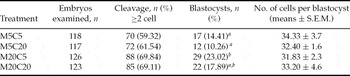
A total of about 300 oocytes were used in eight replicates to evaluate the effects of 5% vs. 20% oxygen on nuclear maturation during IVM. The first polar body extrusion rate was not significantly difference between these two groups (Table 2).
Effects of different oxygen concentrations during in vitro maturation (IVM) on the frequency of first polar body extrusion

First polar bodies were counted by Hoechst staining after a 44 h maturation in vitro.
No difference was observed between groups.
Effects of oxygen concentration on subsequent development of porcine oocytes in vitro
The number of blastocysts was significantly increased in the 5% IVC group vs. the 20% IVC group on further culture after maturation at atmospheric oxygen concentration. Moreover, the group matured under 20% oxygen and cultured under 5% oxygen (M20C5 group) displayed higher development than the other groups (p < 0.05). No differences were observed among the M5C5, M5C20 and M20C20 groups. The oxygen concentration had no effect on the first cleavage frequency or the cell number per blastocyst (Table 3). Also, blastocyst morphology or degree of expansion was not different among the groups.
Overall cleavage rate and blastocyst yield following maturation (M group) and further development in culture (C group) under atmospheric (20%) or low (5%) oxygen

Percentages are based on the number of embryos examined.
a,b Within the same column, values with different superscripts were different (p < 0.05).
COC and blastocyst relative poly(A) mRNA abundance
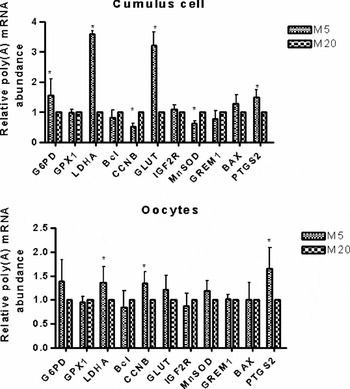
The relative poly(A) mRNA abundance of 11 genes was analysed in cumulus cells and oocytes, as shown in Figure 1. These genes were selected to analyse whether oxygen level affected biological functions essential to produce developmentally competent oocytes, such as glucose transport and metabolism, antioxidant response and apoptosis. Three of the genes analysed are related to metabolism (GLUT1, LDHA and G6PD). GLUT1, LDHA and G6PD were up-regulated in cumulus cells matured in 5% oxygen compared with those matured under 20% oxygen (p < 0.05). Two of the genes analysed are related to antioxidant response (MnSOD and GPX1). MnSOD was up-regulated in cumulus cells matured in 20% oxygen (p < 0.05). The growth factor IGFR2, proapoptotic gene BAX and anti-apoptotic gene BCL2 did not show significant differences among groups. Among genes selected for oocyte competence, the CCNB1 poly(A) mRNA content was significantly higher in cumulus cells matured under 20% oxygen, but the reverse was found in oocytes (p < 0.05). PTGS2 was up-regulated in cumulus cells and oocytes matured in 5% oxygen (p < 0.05). GREM poly(A) mRNA content showed no significant differences among groups.
Relative poly(A) mRNA abundance of 11 candidate genes related to metabolism (GLUT1, LDHA and G6PD), antioxidant response (MnSOD and GPX1), growth factors and apoptosis (IGF2R, Bcl 2 and BAX) and oocyte competence (CCNB1, PTGS2 and GREM1), in cumulus–oocyte complexes matured in vitro under a 5% or 20% oxygen atmosphere. (A) Cumulus cells. (B) Oocytes. An asterisk (*) indicates differences between groups based on a one-way analysis of variance (ANOVA) (p < 0.05).

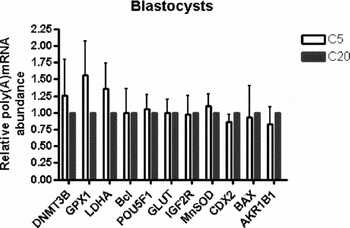
In blastocysts resulting from parthenogenetically activated oocytes, we analysed their quality in terms of transcription of additional genes (methylation: DNMT3B, blastocyst quality: AKR1B1, POU5F1 and CDX2) as well as the previously mentioned genes. No differences in mRNA abundance of these candidate genes were found among blastocysts derived from oocytes cultured under different oxygen concentrations (Fig. 2).
Relative poly(A) mRNA abundance of 11 candidate genes related to metabolism (GLUT1 and LDHA), antioxidant response (MnSOD and GPX1), growth factors and apoptosis (IGF2R, BCL2 and BAXax), methylation (DNMT3B) and blastocyst quality (AKR1B1, POU5F1 and CDX2), in blastocysts produced from cumulus–oocyte complexes cultured under a 5% or 20% oxygen atmosphere. No differences were observed

Discussion
The purpose of this study was to determine the relationship between different oxygen concentrations and maturation rate or developmental competence of porcine oocytes. Some studies of porcine in vitro maturation systems reported that low oxygen concentration during IVM or IVC had a beneficial effect (Iwamoto et al., Reference Iwamoto, Onishi, Fuchimoto, Somfai, Takeda, Tagami, Hanada, Noguchi, Kaneko, Nagai and Kikuchi2005; Kikuchi et al., Reference Kikuchi, Onishi, Kashiwazaki, Iwamoto, Noguchi, Kaneko, Akita and Nagai2002), but others indicated that is more effective for IVM or IVC (Park et al., Reference Park, Hong, Yong, Hwang, Lim and Lee2005) or even that oxygen level has no significant effects on IVM or IVC (Agung et al., Reference Agung, Piao, Fuchimoto, Senbon, Onishi, Otoi and Nagai2010). As a result, the optimal oxygen concentration is a controversial issue in porcine embryo production systems. In the present study, we evaluated quantitative changes of some genes in embryos matured under different oxygen concentrations. Oxygen level during IVM had no significant effect on oocyte maturation. However, atmospheric oxygen concentration during IVM followed by IVC at 5% oxygen significantly improved embryo development. These results suggest that the use of an appropriate oxygen tension during IVM and IVC may be particularly useful in techniques that demand highly competent oocytes, such as ICSI, SCNT and oocyte vitrification.
To evaluate the effect of oxygen concentration, the relative mRNA abundance of some genes related to embryo quality was analysed, comprising three metabolism-related genes (GLUT1, G6PD and LDHA), two genes related to antioxidant response (MnSOD and GPX1), two genes related to apoptosis (BCL2 and BAX), one related to growth factor (IGF2R), and three genes related to oocyte competence (CCNB1, PTGS2 and GREM1).
The glucose transporter GLUT1, the enzyme involved in anaerobic glycolysis, LDHA, and the enzyme that catalyses the first and irreversible step of the pentose phosphate pathway, G6PD, are important for metabolism. It was found that the poly(A) mRNA abundance of GLUT1, LDHA and G6PD were higher in the cumulus cells of COCs matured under low oxygen, implying a higher glucose uptake and an increase in anaerobic glycolysis. Most of the ATP for oocyte maturation is provided by glycolysis or imported from granulosa cells. Energy substrates required for oocyte maturation may differ under low and high oxygen. Both glucose and glutamine, alone or in combination, can support preimplantation development of pig embryos (Petters et al., Reference Petters, Johnson, Reed and Archibong1990). Glucose is metabolized equally via aerobic and anaerobic pathways, although glycolysis becomes the dominant pathway as development progresses. From this information, it is evident that pig embryos have changing metabolic needs as they develop and undergo the accompanying environmental changes such as oxygen tension.
To test possible differences in ROS production, poly(A) mRNA abundance of two genes related to oxidative response in both cumulus cells and oocytes (MnSOD and GPX1) was analysed. The results suggest differences between treatments in antioxidant response according to poly(A) mRNA abundance reflected in different oxygen levels, specifically being higher under 20% oxygen. However, no differences were found in relative abundance of the proapoptotic gene BAX poly(A) mRNA or the anti-apoptotic gene BCL2 poly(A) mRNA in cumulus cells and oocytes, suggesting no change related to apoptosis under different oxygen concentrations. ROS can induce apoptotic cell death in oocytes cultured without cumulus cells (Tatemoto et al., Reference Tatemoto, Sakurai and Muto2000). Cumulus cells may effectively protect oocytes against apoptosis caused by ROS generated by high oxygen concentration.
Finally, the relative poly(A) mRNA abundance of three genes related to oocyte competence (CCNB1, PTGS2 and GREM1) was analysed. A higher poly(A) mRNA abundance of CCNB1 was observed in cumulus cells matured under high oxygen concentration and in the oocytes under low oxygen, which may suggest a higher activity of mitosis-promoting factor (MPF). CCNB1 is the principal molecule for regulation of mammalian oocyte maturation and synthesis of CCNB1 is necessary for germinal vesicle breakdown (GVBD) induction in a normal time course. That is, oocyte is not required for the activation of MPF during the first meiosis, but that it is required for the second meiosis because of its promotion of CCNB1 accumulation (Kuroda et al., Reference Kuroda, Naito, Sugiura, Yamashita, Takakura and Tojo2004; Sugiura et al., Reference Sugiura, Naito, Endo and Tojo2006). PTGS2 mRNA abundance in human cumulus cells was higher from oocytes that developed into higher quality embryos compared with lower quality embryos (McKenzie et al., Reference McKenzie, Pangas, Carson, Kovanci, Cisneros, Buster, Amato and Matzuk2004). In a study using PTGS2 knockout mice, full cumulus expansion was not observed in ovulated COCs and in vivo fertilization was completely suppressed (Lim et al., Reference Lim, Paria, Das, Dinchuk, Langenbach, Trzaskos and Dey1997). In porcine, the expression of PTGS2 mRNA was upregulated by follicle stimulation hormone (FSH) and leuteinizing hormone (LH) during maturation period (Yamashita et al., Reference Yamashita, Kawashima, Gunji, Hishinuma and Shimada2010) and it has also been correlated with oocyte competence improvement. In the present study, a higher expression level of PTGS2 mRNA was found in cumulus cells and oocytes from COC matured under low oxygen concentration.
Expression patterns of AKR1B1, POU5F1, CDX2 and DNMT3B relevant to early embryonic development provide information to assess the quality of blastocysts derived from IVM/IVC (Ross et al., Reference Ross, Ashworth, White, Johnson, Ayoubi, DeSilva, Whitworth, Prather and Geisert2007; Bauer et al., Reference Bauer, Isom, Spate, Whitworth, Spollen, Blake, Springer, Murphy and Prather2010). Not only was total cell number without significant differences in blastocysts, but also no differences were observed in mRNA abundance of these genes or of other previously mentioned genes associated with metabolism, apoptosis and antioxidant response. These results show that although blastocyst production rate is significantly different, different oxygen concentrations during IVC had no effect on the quality of blastocysts.
During follicular development, oocyte quality is affected by communication between the oocyte and surrounding cumulus cells. Removal of cumulus cells before IVM decreases the quality of oocytes in pigs (Wongsrikeao et al., Reference Wongsrikeao, Kaneshige, Ooki, Taniguchi, Agung, Nii and Otoi2005). Therefore, cumulus cells are considered to have an important role in oocyte maturation by regulating meiotic progression and by supporting cytoplasmic maturation. However, the mechanisms by which cumulus cells improve oocyte maturation are poorly understood. In this study, poly(A) mRNA abundance of multiple genes in cumulus cells varied depending on the oxygen concentration during IVM. This means that cumulus cells play their important roles during IVM selectively under different oxygen concentrations. Under low oxygen, cumulus cells increase glucose metabolism via anaerobic glycolysis, but under high oxygen the cumulus cells increase endogenous antioxidants as protection against ROS production. Because of these beneficial effects of cumulus cells, oocytes probably could be matured in vitro with no significant difference in maturation rate regardless of oxygen concentration. But, because embryos are cultured without cumulus cells during IVC, they lack this protection in vitro and thus may be susceptible to harmful effects of high oxygen.
In conclusion, the use of low oxygen concentration during IVC significantly improves embryo development in terms of numbers, but not blastocyst quality in terms of mRNA abundance of associated candidate genes.
Acknowledgements
We thank Dr Barry D. Bavister for his assistance in editing this manuscript. This study was financially supported by grants from Korean MKE (#10033805 and #10033839) and the Research Institute for Vererinary Science.