Introduction
The importance of village poultry production in the national economy of developing countries and its role in improving the nutritional status and incomes of many small farmers and landless communities has been recognized by various scholars and rural development agencies for the past few decades (Melesse, Maak and Von Lengerken, Reference Melesse, Maak and Von Lengerken2005; Moges, Melesse and Dessie, Reference Moges, Melesse and Dessie2010; Melesse and Negesse, Reference Melesse and Negesse2011). According to CSA (2012), the chicken population of Ethiopia was estimated to be about 44.9 million heads; of which 96.5 percent are indigenous chickens indicating the significance of local chickens as potential genetic resource of the country. According to CSA (2012), the Oromia region contributes 36.4 percent of the total chicken population in the country. Even within the Oromia region majority of the chickens are found in the Arsi zone followed by the East Harerghe zone.
Indigenous chickens in Ethiopia are distributed across different agro-ecologies managed under the traditional scavenging management system indicating that they are important avian resources reared as a source of animal protein and income to many of the rural populations (Moges, Melesse and Dessie, Reference Moges, Melesse and Dessie2010). Furthermore, their widespread distribution indicates their diverse adaptive potential to the prevailing environment, diseases and other stresses. Most of the indigenous chickens have evolved through adaptation to various agro-climatic conditions. As perceived by Egahi et al. (Reference Egahi, Dim, Momoh and Gwaza2010) the indigenous chickens possess genes and special adaptations not found in other improved modern breeds.
Melesse and Negesse (Reference Melesse and Negesse2011) reported that identification and characterization of the chicken genetic resources generally requires information on their adaptation to a specific environment, possession of unique traits of current or future economic value and socio-cultural importance, which are crucial inputs to decisions on conservation and utilization. Variations in major morphological traits such as outline and feather contours, shank and ear-lobe colours, and comb types are common among indigenous chicken populations. These morphometric traits provide basis for grouping the native chickens according to their phenotypic and morphological appearances. However, as the chickens are mostly selected (naturally or by their keepers) for their adaptive traits the native chickens are quite poor in egg production performance, have longer age at maturity and extended broodiness (Moges, Melesse and Dessie, Reference Moges, Melesse and Dessie2010).
Lack of sufficient information is one of the major hindrances in the chicken improvement programmes of the country (Duguma, Reference Duguma2009; Dana et al., Reference Dana, Dessie, van der Waaij and van Arendonk2010; Melesse and Negesse, Reference Melesse and Negesse2011). The phenotypic diversity of the local chicken resources in Ethiopia in general and in Arsi Zone of Oromia region in particular is yet to be studied in detail. Thus, the present study was conducted to characterize the native chickens reared in Tiyo, Hetossa and Dodota Woredas of Arsi zone representing high-, mid- and lowland agro-ecological zones, respectively.
Materials and methods
Description of the study areas
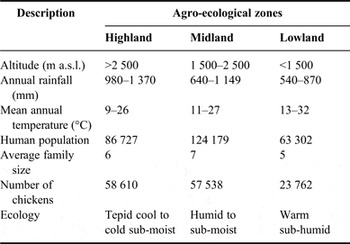
The study was conducted in three adjacent Woredas (Tiyo, Hetossa and Dodota) of Arsi zone, Oromia Regional State of Ethiopia. The woredas are located between 7°49′N and 8°30′N latitudes, and 38°57′E and 39°38′E longitudes. Arsi zone is one of the 17 zones of Oromia Administrative Region situated in Southeastern Ethiopia. According to AZADO (2011), the Arsi administrative zone contains the three major agro-ecological zones of high-, mid- and lowland at a proportion of 43.4, 27.5 and 29.1 percent, respectively. The respective altitudinal ranges for high-, mid- and lowland are <1 500, 1 500–2 500 and >2 500 m a.s.l., respectively (Table 1).
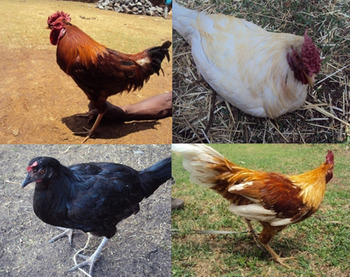
Basic plumage colours of indigenous chicken populations in Southeastern Oromia, Ethiopia. Upper left: Cock with red (Kei) plumage; Upper right: White (Netch) feathered hen with rose comb; Lower left: Tikur (Black plumage) hen with single comb and black shank; Lower right: Wosera (yellowish brown) hen with single comb and yellow shank.

Ecological and demographic characteristics of the studied agro-ecological zones.

Source: AZADO (2011).
For this study, three districts such as Tiyo, Hetossa and Dodota were purposely selected representing the three agro-ecological zones (Table 1). The Tiyo district has an estimated total land area of 638 km2 classified into 36 percent plain, 43 percent mountainous and 21 percent hilly/gorgy physical land forms, which represents the highland agro-ecological zone in the present study. The Hetossa district has an estimated total land area of 1 216 km2 classified into 65 percent plain, 20 percent mountain and 15 percent hill and gorge physical landscapes, which represents the midland agro-ecology. The Dodota district has an estimated total land area of 469 km2 comprising a physical landform of 75 percent plain, 20 percent mountain and 5 percent hill and gorge and represents the lowland agro-ecological zone.
Sampling and data collection procedures
The field survey design and data collection procedure of this study were performed according to the FAO's exploratory characterization approach (FAO, 2012). With the help of experts from the Agriculture of Arsi Zone, four rural Farmers' Kebeles (FKs) with the least chance of exotic chicken distribution outreach were purposively selected from each of the three agro-ecological zones, which have been already described herein. Then, 20 households who possess a minimum of five adult chickens of indigenous ecotypes per household were randomly chosen from each FKs. Accordingly, a total of 240 households (20 households × 4 FKs × 3 agro-ecologies) were used in the present study. Households possessing exotic chicken or their crosses in the neighbourhood were purposely excluded in the study. Closely adjoining households were also skipped to avoid the risk of sampling chickens sharing the same cock.
A structured questionnaire was designed to collect data on flock characteristics, flock composition and management practices. The interviews were conducted at farmers' houses with the assistance of agricultural extension officers. Moreover, phenotypic characterization of both qualitative and quantitative traits of local chicken populations was conducted on 600 matured chickens whose ages were approximately 36 weeks and above. This age was chosen by considering the slow maturation process of indigenous chickens to reach their adult stage and was determined by the “recalling method” of the interviewed farmers.
Qualitative phenotypic data were collected based on feather morphology, feather distribution and patterns, plumage colour, shank colour, earlobe colour, skin colour, comb and head types following the FAO's checklist for phenotypic characterization of chickens (FAO, 2012). Descriptions of comb types were based on the illustrations presented by Somes (Reference Somes and Crawford2003), Ensminger (Reference Ensminger1992) and Roberts (Reference Roberts1997).
Quantitative data on body weight, body width (the circumference of the breast region), body length (the distance from the insertion of the neck to the tail) and shank length (length of the shank from the top of the flexed hock joint to the bottom of the footpad) and shank circumference, comb length, wattle length, keel bone length, breast angle and body weight were collected from both sex groups following the FAO's descriptor for chicken genetic resources (FAO, 2012). Shank length was measured using mathematical divider and corresponding the equivalent reading by putting it on a graduated ruler. Comb, wattle and keel lengths were measured using the same instrument and converted into readings of a graduated ruler. Folded wing span, body length and body girth were measured using a tailor's graduated tape. Live body weight was measured in kilogram using a “CAMRY” hanging scale. Breast angle was measured using a goniometer with two movable arms.
Statistical analysis
Preliminary data analysis (homogeneity test, normality test and screening of outliers) was employed before conducting the main data analysis. Discrete measurements on the qualitative morphological traits of the investigated animals were analysed using the frequency procedure of Chi-square (χ 2) test. Body weight and quantitative linear body measurements were analysed using the Generalized Linear Model procedures (SPSS, 2007). Agro-ecological zones were fitted as fixed independent variables, whereas quantitative measurements were fitted as dependent variables. Means were compared using Duncan's Multiple Range Test procedure and values were considered significant at P < 0.05. Stepwise regression procedure was used to regress body weight for both sexes to determine the best-fitting regression equations for the prediction of live body weight. Regression equations were calculated and the adjusted coefficient of determination (R 2 adj) was used to establish the accuracy of the equations.
Results
Flock dynamics and productivity of indigenous chickens
The survey results indicated that the average flock size per household in high-, mid- and lowland agro-ecological zones was 10.3, 14.1 and 11.2, respectively (Table 2). The largest proportion of chicken population was thus reported from midland agro-ecological zone, which is significantly higher than others. The average number of cocks and hens were significantly higher for midland than high- and lowland agro-ecological zones.
Flock compositions of households in the studied agro-ecological zones of Southeastern Ethiopia (mean ± SE).

a,b,cMeans across a raw with different superscript letters are significantly (P < 0.05) different.
SE, standard error of the mean.
Significant difference (P < 0.05) was also observed in age at first egg among the studied agro-ecological zones. Accordingly, the age at first egg was longer for chicken in the lowland, followed by those of high- and midland agro-ecological zones (Table 3). Comparably the highest number of eggs per clutch was found in the highland, whereas it was lower for low- and midlands. The hatchability and survivability rates of chicks were similar among agro-ecological zones.
Performance of indigenous chickens in high-, mid- and lowland agro-ecological zones of Southeastern Ethiopia (mean ± SD).

a,b,cindicated values among rows for traits significantly differ at χ 2 < 0.05.
SD, standard deviation.
Phenotypic characterization
Qualitative morphometrical traits
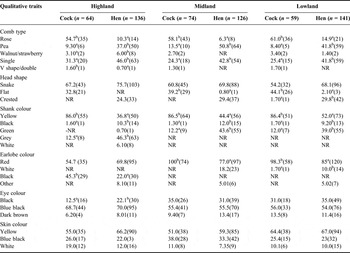
The results of the present study indicated that the majority of the observed chickens (67.2 percent) were female chickens, whereas the rest (32.8 percent) were male birds. About 55, 58 and 61 percent of the male chicken in the high-, mid- and lowlands, respectively, possessed rose combs (Figure 1). Most hens were characterized by having single and pea combs with similar proportions (Table 4). Walnut and double comb types were the least. Snake head shape was the most prominent type among both the sexes irrespective of the agro-ecological zones. The colour of the shank in cocks was predominantly yellow with the average value of about 86 percent in all agro-ecological zones. The female chickens reared in the midland were characterized by having both yellow and green shanks with similar values, whereas those in lowland possessed shanks with yellow colour followed by green and differed significantly from others. Most of the highland female birds had grey shanks (46.3 percent) followed by yellow (36.8 percent). Earlobes with a red colour were the main characteristics of studied indigenous chickens. However, about 45 percent of male birds in the highland had a black earlobe. The predominant eye colour in both male and female chickens in the three agro-ecological zones was blue black and differs significantly from other eye colours (Table 4). The main colour of the skin of both sexes was observed to be yellow followed by blue black across all agro-ecological zones.
Percentage values of some qualitative traits of indigenous chicken in high-, mid- and lowland agro-ecological zones of Southeastern Ethiopia (N = 600).

a,b,cDifferent superscripts within row indicate significant different percentages at p < 0.05.
NR, not reported; values in parenthesis indicate number of observations.
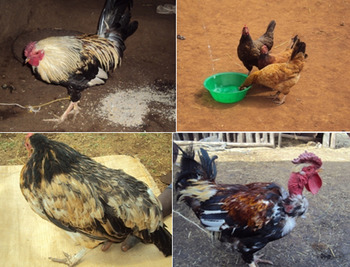
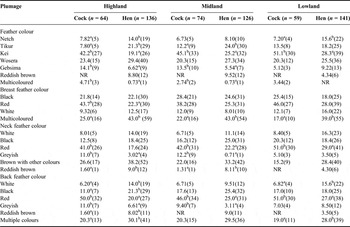
The plumage colour of the indigenous chickens in the study areas were classified into body feather, colours of their feathers of the breast, neck and back regions. The predominant body feather colour of the hens reared in the high- and midlands was yellowish brown (Wosera) followed by black (Tikur) and red (Kei), while that of the lowlands was red followed by yellowish brown plumage (Figures 1 and 2). Hens with white (Netch) body feather were observed in both high- and lowland agro-ecological zones.
Combination of various plumage colours in local chickens of Southeastern Oromia, Ethiopia. Upper left: Gebsima (greyish plumage) cock with rose comb and red ear lobe; Upper right: Reddish brown chickens; Lower left: Amorima (black and white mixtures) hen with pea comb and light green shank; Lower right: Ambesma (multi-coloured plumage) naked neck chicken.

As shown in Table 5 and Figures 1, the dominant body feather colour of the cocks was red (Kei) followed by yellowish brown (Woera) tipped with other colours. The study also indicated that the cocks reared in all agro-ecological zones had red breast feather, which was closely followed by black colour, while the hens were distinguished by multicoloured breast feathers followed by red and black colours. The dominant feather colour around the neck of the cock's was red in all agro-ecological zones, whereas that of the hens was mainly brown combined with multicolour patterns. Cocks with red back feather were dominant across all agro-ecological zones. Hens reared in the all agro-ecologies mainly possessed brown back feather mixed with other colours followed by red and black (Table 5).
Percentage values of some feather colour variables of indigenous chicken reared in high-, mid- and lowland agro-ecological zones of Southeastern Ethiopia (N = 600).

a,b,cDifferent superscripts within row and agro-ecological zone indicate significant different percentages at p < 0.05.
NR = not reported; values in parenthesis indicate the number of observations
Kei, feather with red colour; Tikur, feather with black colour; Netch, feather with white colour; Wosera, yellowish brown feather containing mixtures of yellow, red and white colours with variable proportions; Gebsima, greyish feather containing mixtures of white and black with varying shades of multi-colours
Quantitative morphological traits
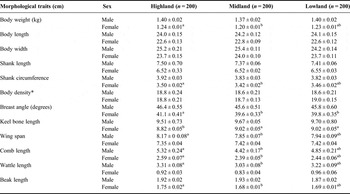
As presented in Table 6, the body weight of cocks was similar across agro-ecological zones and was generally higher than that of hens. Hens reared in the highland were heavier (P < 0.05) than those reared in the midland. The results for average body length and width, shank length and circumference and body shank length ratio for both groups of chicken were comparable across all the three agro-ecological zones. The values pertaining to the keel bone length for the hens reared also differed (P < 0.05) across the agro-ecologies with the least value being observed in the highlands, whereas it did not vary between the hens reared in the other two agro-ecologies (Table 6).
Linear body measurements of male and female indigenous chicken populations in the high-, mid- and lowland agro-ecological zones of Southeastern Ethiopia (mean ± SE).

a,bMeans within a row with different superscript letters are significantly different (P < 0.05).
*Body weight/shank length; SE, standard error of the mean.
The wing span differed (P < 0.05) in cocks reared across the high- and midland agro-ecologies, whereas the values observed in the lowland was intermediate between the two (Table 6). The results pertaining to comb length of both sex groups and wattle length for the cocks differed (P < 0.05) between the high- and midland agro-ecologies. However, the values from the lowland agro-ecology were intermediate between the two extremes. Similarly, the magnitudes for the beak length and breast angle differed (P < 0.05) for the hens reared between all the three agro-ecologies.
Prediction of body weight from linear body measurement traits
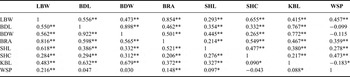
As shown in Table 7, positive correlations (P < 0.01) were observed among all studied linear body measurement traits. However, the associations of wing span with other traits were variable and insignificant. High correlations were observed between body weight and all linear body measurements for both sexes. The associations of body width with body length as well as breast angle with body weight were numerically higher than other parameters. In cocks, the correlation values of live body weight with those of breast angle, shank circumference and body length were comparatively higher than those of other values. Higher correlation values of body weight with breast angle, shank length, body width and length were also observed in female chickens.
Correlation coefficients of linear body measurement traits for local cocks (upper diagonal, N = 197) and hens (lower diagonal, N = 403).

*P < 0.05; **P < 0.01.
LBW, live body weight; BDL, body length; BDW, body width; BRA, breast angle; SHL, shank length; SHC, shank circumference; KBL, keel bone length; WSP, wing span.
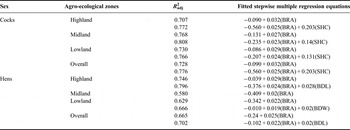
As presented in Table 8, the best predictors (R 2 adj) of body weight of cocks in all agro-ecological zones were found to be breast angle and shank circumference. The best estimators for assessing the body weight in hens reared in the high- and lowland areas were breast angle, body depth and body length, whereas in the midland it can be estimated using breast angle alone.
Stepwise multiple regression equations for estimation of body weight of cocks and hens reared in different agro-ecologies by fitting linear body weight measurements.

BRA = breast angle; SHC = shank circumference; BDL = body length; BDW = body width.
Discussion
Flock size and productivity
The results indicated that the sex ratio (female to male) were more skewed towards the former, which is explainable since farmers need to regularly replace their breeding stocks. The values for the numbers of chicken per household in the present study find similarity with the observations of Mekonnen (Reference Mekonnen2007) for Southern Ethiopia and Hunduma et al. (Reference Hunduma, Chala, Dawo, Bekana and Leta2010) for the Rift Valley region of Oromia, Ethiopia. However, the values reported in various regions of Ethiopia by Halima et al. (Reference Halima, Neser, Van Marle-Koster and De Kock2007), Dana et al. (Reference Dana, Dessie, van der Waaij and van Arendonk2010) and Melesse and Negesse (Reference Melesse and Negesse2011) are lower than those observed in the current study. Higher values for the numbers of chickens reared per household were reported by Dessie et al. (Reference Dessie, Million, Alemu and Peters2003) and Moges, Melesse and Dessie (Reference Moges, Melesse and Dessie2010) from the central parts of Ethiopia and in Northwestern Ethiopia, respectively. The flock size variations reported in various parts of the country might be due to the occurrence of diseases, presence of predators, availability of feed resources as well as the economic status of the owners who regularly sell chickens to meet their immediate financial requirements.
The average age at maturity of the hens reared in the low- and highland agro-ecologies in the present study are in accordance with the observations of Dessie et al. (Reference Dessie, Million, Alemu and Peters2003), Kugonza, Kyarisiima and Lisa (Reference Kugonza, Kyarisiima and Lisa2008) and Iqbal and Pampori (Reference Iqbal and Pampori2008) who reported about 6–7 months. The average age of maturity in the midland agro-ecology finds similarity with the observations of Mengesha, Tamir and Dessie (Reference Mengesha, Tamir and Dessie2008) from northeastern part of Ethiopia who indicated that the maturity of the chickens was 5.4 months. The reason for delayed age of sexual maturity of those chickens reared in the low- and highland agro-ecologies could be attributed to lack of supplementary feeds and exposure of chickens to excessive high and low ambient temperatures, which are characteristics of both two agro-ecologies.
The present finding pertaining to the clutch size, egg production per clutch per hen, number of eggs incubated and number of chicks hatched differed from the results of Worku, Melesse and Teklegiorgis (Reference Worku, Melesse and Teklegiorgis2012) and Melesse, Worku and Teklegiorgis (Reference Melesse, Worku and Teklegiorgis2013), who reported significant differences in the traits among the chickens reared in the northwest region of Ethiopia. This could be explained by the management differences practiced by households in different regions such as provision of supplementary feeding, housing, control of parasitic diseases, etc. The average numbers of eggs per hen as obtained from the present study find similarity with the observations of Mandal, Khandekar and Khandekar (Reference Mandal, Khandekar and Khandekar2006) from India. The results of studies by Aganga et al. (Reference Aganga, Omphile, Malope, Chabanga, Motsamai and Motsumi2000) from Botswana however indicated that the numbers of egg produced by the native chickens were lower than those observed in the present study. The results also indicated that the average numbers of eggs incubated by a hen in the study areas are higher than those reported by Yakubu (Reference Yakubu2010). The figures are, however, comparable with the observations of Pedersen (Reference Pedersen2002) who reported that the average number of egg incubated per individual hen was 10.6 with average hatchability rate of 73 percent. The figures observed in the present study are however lower than those of Ssewannyana et al. (Reference Ssewannyana, Ssali, Kasadha, Dhikusooka, Kasoma, Kalema, Kwatotyo and Aziku2008) who reported higher hatchability percentage (87 percent) among native chickens of Uganda. Hatchability of eggs from the scavenging local chicken could be affected by a number of factors including age of the hen and the mating cock, type of nesting used, season and number of eggs incubated by the hen.
Qualitative morphometric traits
The present study indicated that majority of the female chicken possessed single comb, which is in accordance with the findings of several studies from other developing countries (Egahi et al., Reference Egahi, Dim, Momoh and Gwaza2010; Faruque et al., Reference Faruque, Siddiquee, Afroz and Islam2010; Apuno, Mbap and Ibrahim, Reference Apuno, Mbap and Ibrahim2011; Guni and Katule, Reference Guni and Katule2013). The findings of Melesse and Negesse (Reference Melesse and Negesse2011) indicated that 55 percent of the chickens in Southern Ethiopia were characterized by single comb followed by rose (28.5 percent) and pea (15.2 percent) combs. Single and rose combs were reported to be the most prominent types in local chicken of Bure district of Amhara region, Ethiopia (Moges, Melesse and Dessie, Reference Moges, Melesse and Dessie2010). The fact that single combed chickens were predominant followed by those possessing rose and pea combs are also in good agreement with the observations of Ikeobi et al. (Reference Ikeobi, Ozoje, Adebambo and Adenowo2001), and Daikwo, Okpe and Ocheja (Reference Daikwo, Okpe and Ocheja2011) for indigenous chickens of Nigeria. Studies by Badubi, Rakereng and Marumo (Reference Badubi, Rakereng and Marumo2006) indicated that 90 percent of the indigenous chickens in Botswana were single combed, whereas very low proportion of rose (4.9 percent) and pea (1 percent) combs were observed.
Badubi, Rakereng and Marumo (Reference Badubi, Rakereng and Marumo2006) reported that the indigenous chickens of Tanzania were mostly single combed as was also observed by Bhuiyan, Bhuiyan and Deb (Reference Bhuiyan, Bhuiyan and Deb2006) among the indigenous chickens of Bangladesh. The higher values observed for the single comb type suggests a selection advantage and greater adaptability to the production environments in which they have been reared for many decades. Combs are important structures for heat loss in birds (Van Kampen, Reference Van Kampen, Morris and Freeman1974) and since the tropical climate is predominantly characterized by high ambient temperature, large combs would provide an efficient means of heat dissipation through the process of vasodilatation. Although not reported separately for both sex groups, all of the above reports are in close agreement with the findings of the present study for hens, whereas only those reports for indigenous chicken in Ethiopia wherein rose combs are most prominent agrees with the present finding for the male chicken.
The results of the shank colour in the present study are in line with the findings of Melesse and Negesse (Reference Melesse and Negesse2011) who reported that about 53 percent of the chicken populations in Southern Ethiopia had a yellow shank. The results also indicated that above 80 percent of cocks had yellow shank, which is consistent with the reports of Guni and Katule (Reference Guni and Katule2013). It is evidenced that the shank colour is mainly affected by the plane of nutrition mainly feed sources containing carotene. Most scavenging chickens are apparently dependent on naturally available feed resources, which are mainly composed of kitchen and household wastes with sporadic supplementation of low-quality grains. The results as observed in the study suggest that cocks might have better access to feed resources as they can compete better than hens.
Eye colour to a large extent depends on the pigmentation (carotenoid pigments and blood supply) of a number of structures within the eye (Crawford, Reference Crawford1990). In the present study, above 55 percent of the studied chickens were characterized by blue black eye colour and is consistent with the findings of Apuno, Mbap and Ibrahim (Reference Apuno, Mbap and Ibrahim2011) who reported eye colours of dark brown (37.9 percent), light brown (28.8 percent) and dark red (28.6 percent) for indigenous chickens of Nigeria. On the other hand, Mancha (Reference Mancha2004) and Guni and Katule (Reference Guni and Katule2013) reported orange eye colour as most common among the indigenous chickens of Nigeria and Tanzania, respectively. Similar findings were also reported by Ssewannyana et al. (Reference Ssewannyana, Ssali, Kasadha, Dhikusooka, Kasoma, Kalema, Kwatotyo and Aziku2008) for Ugandan local chickens. The eye colour values obtained from the present study however could not be compared among Ethiopian chicken populations due to lack of literature pertaining to the trait. The results as observed for the earlobe colour are not in agreement with the observations of Duguma (Reference Duguma2006) and Egahi et al. (Reference Egahi, Dim, Momoh and Gwaza2010) from western and eastern parts of Ethiopia and Nigeria, respectively. The fact that earlobe colour is a breed-specific trait, the observed variations across regions could suggest the existence of local chickens with specific genetic backgrounds. Breeds of the Mediterranean Class (Leghorn) for instance possess white earlobes while most other chicken breeds are characterized by having red earlobes.
Substantial amount of phenotypic diversity for various traits in the indigenous chicken genetic resources of Ethiopia is expected because of diverse agro-climates, ethnic groups, socio-economic, religious and cultural differentiations. In the present study, highly diverse plumage manifestations were observed among the local chickens of the study region. It can vary between different age classes, sexes and season. Studies on the traditional poultry production systems as was also observed in the present study have indicated that farmers prefer to raise birds with different plumage colours for various purposes such as for egg production, meat production, healing ceremony and cultural purposes (Dana et al., Reference Dana, Dessie, van der Waaij and van Arendonk2010; Melesse and Negesse, Reference Melesse and Negesse2011) indicating selection for each of these attributes.
Red, yellowish brown with mixed colour patterns and black plumages were the dominant plumages as observed in the study area and are similar to those observations reported by Worku, Melesse and Teklegiorgis (Reference Worku, Melesse and Teklegiorgis2012) and Moges (Reference Moges2008), from Western Amhara Region of Ethiopia. The results as obtained by Halima et al. (Reference Halima, Neser, Van Marle-Koster and De Kock2007) however indicated that the chickens of Northwestern Ethiopia had predominantly white colour of feathers. Studies by Kibret (Reference Kibret2008) indicated that chickens in the Fogera district of Northwestern Ethiopia had mostly white and red colour feathering. The occurrence of several plumage colours observed in the local chicken population of Ethiopia in general might be the result of uncontrolled breeding of local chickens with exotic chickens in the rural areas under free range management system. Moreover, preference of the people in the study area (for socio cultural reasons) towards red and brown plumages might have accounted for the largest occurrence of these feather colours (Moges, Melesse and Dessie, Reference Moges, Melesse and Dessie2010; Melesse and Negesse, Reference Melesse and Negesse2011).
Quantitative traits
The average live weight values for both sexes in the current study are comparable with those reported by Fayeye et al. (Reference Fayeye, Ayorinde, Ojo and Adesina2006), Dana et al. (Reference Dana, Dessie, van der Waaij and van Arendonk2010) and Apuno, Mbap and Ibrahim (Reference Apuno, Mbap and Ibrahim2011). The results as obtained by Melesse and Negesse (Reference Melesse and Negesse2011) for average live weight of the cocks reared in Southern Ethiopia are comparable with the present findings. However, the values of hens as reported by the same authors were higher than those observed in the present study. These variations for the trait could be attributed to the genetic background of local chickens and the quality and quantity of the available scavengable feed resources in different regions. Sexual dimorphism as was observed for live weight with cocks weighing higher than the hens are in accordance with the reports of Halima et al. (Reference Halima, Neser, Van Marle-Koster and De Kock2007) and Dana et al. (Reference Dana, Dessie, van der Waaij and van Arendonk2010).
The average body width and length values of the native chickens as were observed in this study are comparable with those of Fayeye et al. (Reference Fayeye, Ayorinde, Ojo and Adesina2006) but the values were lower than those reported by Daikwo, Okpe and Ocheja (Reference Daikwo, Okpe and Ocheja2011) for native chickens of Nigeria. The study also indicated higher values for the two traits as compared with those reported by Youssao et al. (Reference Youssao, Tobada, Koutinhoun, Dahouda, Idrissou, Bonou, Tougan, Ahounou, Yapi-Gnaoré, Kayang, Rognon and Tixier-Boichard2010) for native hens and cocks reared in Benin. Body width is an indicator of fleshing, which would be used for selecting chickens suitable for meat production.
The values pertaining to the breast angle could not be compared due to lack of available literature for the trait among the chickens reared in Ethiopia. The wing span values obtained from the present study was lower than those reported by Halima et al. (Reference Halima, Neser, Van Marle-Koster and De Kock2007) for local chickens of Northwestern Ethiopia.
The average values of shank length in cocks are lower than those reported by Halima et al. (Reference Halima, Neser, Van Marle-Koster and De Kock2007) in Northwestern Ethiopia and Melesse and Negesse (Reference Melesse and Negesse2011) for those reared in Southern Ethiopia. The shank length values as reported by Badubi, Rakereng and Marumo (Reference Badubi, Rakereng and Marumo2006) from Botswana and Daikwo, Okpe and Ocheja (Reference Daikwo, Okpe and Ocheja2011) from Nigeria were however within the range of the present findings. Shank circumference values in the present study are consistent with those of Mulyono, Sartika and Nugraha (Reference Mulyono, Sartika and Nugraha2009) reported for Wareng–Tangerang Indonesian local chickens; but higher than those reported by Halima et al. (Reference Halima, Neser, Van Marle-Koster and De Kock2007) for Northwestern Ethiopia. The body weight to shank length ratio is an indicator of degree of fleshing in relation to body size and the heavier the bird the higher would be the ratio (Renema et al., Reference Renema, Robinson, Beliveau, Davis and Lindquist2007).
Sexual dimorphism was observed for the most traits with cocks having higher values when compared with the hens. Sexual dimorphisms for various morphological traits have also been reported in local chickens (Msoffe et al., Reference Msoffe, Mtambo, Minga, Olsen, Juu-lMadsen, Gwakisa, Mutayoba and Katule2004; Fayeye et al., Reference Fayeye, Ayorinde, Ojo and Adesina2006; Halima et al., Reference Halima, Neser, Van Marle-Koster and De Kock2007; Dana et al., Reference Dana, Dessie, van der Waaij and van Arendonk2010; Youssao et al., Reference Youssao, Tobada, Koutinhoun, Dahouda, Idrissou, Bonou, Tougan, Ahounou, Yapi-Gnaoré, Kayang, Rognon and Tixier-Boichard2010), in the Muscovy duck (Raji, Igwebuike and Usman, Reference Raji, Igwebuike and Usman2009; Yakubu, Reference Yakubu2011) and in the turkey (Ogah, Reference Ogah2011). Owens and Hartley (Reference Owens and Hartley1997) were of the opinion that sexual dimorphism in size is associated with high levels of social polygamy, a sort of intra-sexual competition described by traditional classifications of social mating systems. Baeza et al. (Reference Baeza, Williams, Guemene and Duclos2001) observed that sexual dimorphism is attributable to the normal between sex differential hormonal actions, which invariably leads to differential growth rates. Another possible explanation for the appearance of sex-related differences is the strong selection of females for high quality males or competition among males for limited access to females, which leads to fixation of larger body size and other secondary sexual characters in males (McCracken, Paton and Afton, Reference McCracken, Paton and Afton2000). According to Remes and Szekeley (Reference Remes and Szekeley2010), difference in sizes of males and females is perceived as a key evolutionary feature that is related to ecology, behaviour and life histories of organisms.
Prediction of live weight from linear body measurements
In the present study, high correlations were observed between body weight and all linear body measurements for both sexes and are in agreement with the findings Apuno, Mbap and Ibrahim (Reference Apuno, Mbap and Ibrahim2011). Body weight is a trait of economic importance to livestock farmers, and therefore, selection for body weight in order to improve productivity in indigenous chickens is increasing (Peters et al., Reference Peters, Ikeobi, Ozoje, Famakinwa, Oshodi and Adebambo2007). In animal breeding, predicting body weight from linear measurements is a common practice (Ogah et al., Reference Ogah, Musa, Yakubu, Momoh and Dim2009). The positive and significant correlations between body weight with breast angle, body length, body width, breast angle and shank circumferences suggest that selection for any of these linear body parameters will cause direct improvement in body weight. Moreover, the significant correlations observed in the present study indicate that in the absence of some measuring facilities, measuring one of these easily measurable traits could enable predicting the values for the correlated traits without additional cost and time.
Regression analysis is frequently used in animal research to describe quantitative relationships between a response variable such as body weight and one or more explanatory variables including linear body measurements, particularly when there is no access to weighing equipment. The high and significant correlation coefficients between body weight and linear body measurements for both sex groups suggest that either of these variables or their combination could provide a good estimate for predicting live body weight of the studied indigenous chickens. Breast angle had the highest correlation coefficient values with body weight in both sexes followed by shank length and circumference, body length and width suggesting the suitability of these variables in predicting body weight of local chickens under scavenging production system.
As shown in Table 8, breast angle was the primary variable to explain most of the variations followed by shank circumference (in cocks), shank length (in hens), body length and body width. However, it would be worthwhile to note that under field conditions it becomes difficult to take multiple measurements on individual animals as catching the bird would be a problem and hence becomes impractical.
Conclusions
Female chickens were characterized by having single and pea combs, while males had rose combs. The main body feather colour in hens was yellowish brown followed by red, whereas males were characterized by red followed by yellowish brown. The colour of the shank in cocks was predominantly yellow, while in females it varied considerably between agro-ecological zones. The predominant eye colour in both sexes was blue black in all agro-ecological zones. The average values of body length and width, shank length and body shank length ratio for both groups of chicken were comparable across all the three agro-ecological zones. The authors recommend an in-depth assessment of the local chickens using the FAO's confirmatory characterization approach (preferably on-station comparison) to identify suitable chicken ecotypes for defined production purposes. We further recommend similar evaluation practices through FAO's exploratory characterization approach in the adjoining districts of the study area to obtain comprehensive information on qualitative and quantitative phenotypic characteristics of indigenous chicken populations.
Acknowledgements
This research project was financially supported jointly by Adama Science and Technology University and the Ethiopian Ministry of Education for which the authors are highly grateful. The Alexander von Humboldt Foundation is highly appreciated for awarding a research fellowship for the corresponding author during the preparation of this manuscript. The authors express their sincerely gratitude to all participating farmers in giving access to their chickens for visual appraisal and quantitative measurements.