INTRODUCTION
Considerable research has focused on delineating profiles of cognitive strengths and weaknesses among children with Intellectual Disability (ID) to inform clinical decision-making and planning for early interventions and accommodations (Daunhauer & Fidler, Reference Daunhauer and Fidler2011). A number of etiologies, including congenital and neurological factors (e.g., genetic conditions, teratogen exposures, prenatal/perinatal traumatic events, postnatal injuries, and infections), have been associated with an ID phenotype (Mahone, Slomine, & Zabel, Reference Mahone, Slomine, Zabel, Morgan and Ricker2018). The majority of ID results from early disruption in brain development, which interferes with normal neuronal migration and proliferation, and developmental patterns of dendrites, which underlie the development of the brain structures and connectivity. This early alteration of neural pathways facilitates the reorganization of the lost functions housed in the damaged brain region within the available brain region (plasticity). However, if the injury is significant and beyond the brain’s ability to compensate, this leads to global, multi-systemic functional deficits often seen in ID (Jacobson & Gerner, Reference Jacobson, Gerner and Gliddenin press). The timing of disruption to brain development plays an important role in determining the severity and the extent of neuropsychological outcomes. Importantly, regardless of the etiological differences, ID is conceptualized and defined by behavioral presentation of concurrent deficits in intellectual and adaptive functioning, as assessed through clinical evaluation. In clinical practice, understanding how neuropsychological measures perform (clinical utility) is, therefore, particularly important to delineate functional impairment and understand prognosis in youth with ID.
The neuropsychological phenotype of ID has been primarily characterized by its core diagnostic features, intellectual and adaptive impairments (Diagnostic and Statistical Manual of Mental Disorders, Fifth Edition; DSM-5; American Psychiatric Association, 2013), as well as atypical development across the life span (Fidler, Reference Fidler2005). An emerging body of research indicates that difficulties in executive function (EF) also contribute to the functional limitations of individuals with ID, independent of the impact of their intellectual deficits (Schmitt, Shaffer, Hessl, & Erickson, Reference Schmitt, Shaffer, Hessl and Erickson2019). Indeed, executive dysfunction has been found to be associated with difficulties with adaptive functioning (Papazoglou, Jacobson, & Zabel, Reference Papazoglou, Jacobson and Zabel2013) and to be more effective in predicting academic difficulties than IQ (Daunhauer et al., Reference Daunhauer, Fidler, Hahn, Will, Lee and Hepburn2014) among individuals with intellectual and developmental disabilities.
EF reflects a set of cognitive processes that are critical for purposeful goal-oriented and self-regulatory behavior. EF enables individuals to plan and organize actions, monitor and modify emotional and behavioral reactions to fit the context, break out of routines, and cope with novel situations (Carlson, Reference Carlson2011; Snyder, Miyake, & Hankin, Reference Snyder, Miyake and Hankin2015). EF is, therefore, essential for successfully navigating nearly all daily activities; executive dysfunction has been found to predict broad and significant consequences in academic and occupational functioning, mental and physical health, and interpersonal relationships (Diamond, Reference Diamond2013; Snyder et al., Reference Snyder, Miyake and Hankin2015). In particular, everyday EF skills, such as initiating actions, monitoring and modifying affect and behavior to fit the context, and planning and deciding future actions, are all crucial for people with ID to achieve functional independence, attain employment, and live more independently in the community (Costanzo et al., Reference Costanzo, Varuzza, Menghini, Addona, Gianesini and Vicari2013; Lee et al., Reference Lee, Fidler, Blakeley-Smith, Daunhauer, Robinson and Hepburn2011).
Although EF difficulties are commonly reported in individuals with ID (Schmitt et al., Reference Schmitt, Shaffer, Hessl and Erickson2019), the research using performance-based EF measures has yielded variable results (Daunhauer, Gerlach-McDonald, Will, & Fidler, Reference Daunhauer, Gerlach-McDonald, Will and Fidler2017). Most commonly, EF has been examined primarily among young adults and adults with Down syndrome (DS), with considerable research finding impairments across multiple EF dimensions tested, including inhibition, sustained attention, set-shifting, planning/organizing, and working memory (Costanzo et al., Reference Costanzo, Varuzza, Menghini, Addona, Gianesini and Vicari2013; Danielsson, Henry, Messer, & Rönnberg, Reference Danielsson, Henry, Messer and Rönnberg2012; Lanfranchi, Jerman, Dal Pont, Alberti, & Vianello, Reference Lanfranchi, Jerman, Dal Pont, Alberti and Vianello2010). However, with the exception of working memory, findings regarding performance on other EF dimensions are variable among individuals with DS (Daunhauer et al., Reference Daunhauer, Gerlach-McDonald, Will and Fidler2017). Broad EF difficulties are also evident among individuals with Fragile X syndrome (FXS), albeit with more consistent findings of poor perseveration (set-shifting; for a systemic review, see Schmitt, et al., Reference Schmitt, Shaffer, Hessl and Erickson2019). Given the inconsistencies, coupled with a range of reported weaknesses, it remains unclear whether reported findings of the performance-based EF measures reflect a generalized EF deficit or a specific pattern of weaknesses and preserved EF skills among individuals in which ID is a common feature. Importantly, there is considerable phenotypic functional heterogeneity among individuals within conditions associated with ID in that many, but not all, individuals, who have been diagnosed with the conditions typically associated with ID, meet criteria for ID. Given the incremental contribution of EF to functional impairments beyond IQ (Schmitt et al., Reference Schmitt, Shaffer, Hessl and Erickson2019), the investigation of EF may also help delineate such functional variability among individuals with ID.
EF is particularly challenging to assess in the context of ID. A target EF is typically measured in the course of one or more specific laboratory task(s), which necessarily taps multiple cognitive processes. Thus, scores from EF tasks are confounded by variance associated with non-EF processes, in particular, processing speed, motor functioning, and aspects of memory (Miyake & Friedman, Reference Miyake and Friedman2012; Miyake et al., Reference Miyake, Friedman, Emerson, Witzki, Howerter and Wager2000), which are often impaired among individuals with ID. Furthermore, low completion rates of performance-based EF measures are commonly reported in this population. For example, a systemic review of EF measures in FXS revealed that completion rates of working memory tasks are highly dependent on task complexity, with tasks that require greater working memory predicting higher failure rates (Schmitt et al., Reference Schmitt, Shaffer, Hessl and Erickson2019). Similarly, the floor effects (the limited measurement of very low scores below a distinct point) on performance-based cognitive measures are well documented in individuals with ID (Sansone et al., Reference Sansone, Schneider, Bickel, Berry-Kravis, Prescott and Hessl2014). Given the variable results, coupled with the complexity and challenges associated with performance-based EF measures, EF has not been well characterized among individuals with ID.
Increasingly, research is utilizing informant ratings, such as the Behavior Rating Inventory of Executive Function (BRIEF; Gioia, Isquith, Guy, & Kenworthy, Reference Gioia, Isquith, Guy and Kenworthy2000), as a means to assess children’s behaviors thought to reflect executive function skills in real-world situations (Gioia, Kenworthy, & Isquith, Reference Gioia, Kenworthy and Isquith2010). BRIEF scores have been found to correlate variably with performance-based measures of EF (Mcauley, Chen, Goos, Schachar, & Crosbie, Reference Mcauley, Chen, Goos, Schachar and Crosbie2010; Toplak, West, & Stanovich, Reference Toplak, West and Stanovich2013), suggesting an incremental contribution of the BRIEF to the assessment of everyday EF skills in children (Isquith, Roth, Kenworthy, & Gioia, Reference Isquith, Roth, Kenworthy and Gioia2014). Furthermore, growing research suggests that different developmental disorders demonstrate unique patterns of EF strengths and weaknesses rather than global EF deficits (Lee et al., Reference Lee, Fidler, Blakeley-Smith, Daunhauer, Robinson and Hepburn2011), with the BRIEF found to be useful for identifying different profiles of EF strengths and weaknesses in a range of developmental disorders. For example, children with Autism Spectrum Disorder (ASD) showed significantly higher scores across all BRIEF scales than the typically developing peers, but with the highest elevation found on the Shift scale (Granader et al., Reference Granader, Wallace, Hardy, Yerys, Lawson, Rosenthal and Kenworthy2014). The measure’s revision, the Behavior Rating Inventory of Executive Function, Second Edition (BRIEF2) (Gioia, Isquith, Guy, & Kenworthy, Reference Gioia, Isquith, Guy and Kenworthy2015), has been found to discriminate children with and without Attention-Deficit/Hyperactivity Disorder (ADHD), as well as among subtypes of ADHD; while children with ADHD consistently exhibited higher clinical scale scores than those without ADHD, the most significant scale elevation was found on the Working Memory scale for the inattentive type, the Inhibit scale for the hyperactive/impulsive type, and both scales for the combined type (Jacobson, Pritchard, Koriakin, Jones, & Mahone, Reference Jacobson, Pritchard, Koriakin, Jones and Mahone2016). While such profile analyses of clinical populations indicate generally higher index and scaled scores than in nonclinical populations (Krivitzky, Walsh, Fisher, & Berl, Reference Krivitzky, Walsh, Fisher and Berl2016), the BRIEF/BRIEF2 appears helpful in capturing distinct EF features associated with specific neurodevelopmental disorders (Gioia et al., Reference Gioia, Isquith, Guy and Kenworthy2015, page 6–8).
Compared to other developmental disorders, few studies have investigated the utility of the BRIEF with ID, and those have focused on individuals with DS, primarily young adults matched for mental age (2–5 years old) on the BRIEF-Preschool (BRIEF-P; Gioia, Espy, & Isquith, Reference Gioia, Espy and Isquith2003) based on their estimated intellectual functioning. Findings indicated significant elevations on the Global Executive Composite Score (GEC) as well as on the Working Memory and Plan/Organize scales, relative to “mental age norms.” Even fewer studies have examined everyday EF in individuals with ID using the school-aged version. In a sample of youth and adults with DS, the BRIEF revealed elevated, but not clinically significant, scores on the Working Memory, Monitoring, and Shift scales relative to mental age norms (Loveall, Conners, Tungate, Hahn, & Osso, Reference Loveall, Conners, Tungate, Hahn and Osso2017). In the only study that used chronological age norms, the BRIEF2 (Teacher Form) school-aged version demonstrated clinically significant (T > 65) elevations on the GEC and multiple scale scores, with greater effect sizes on the Initiate, Working Memory, and Shift scales (Memisevic & Sinanovic, Reference Memisevic and Sinanovic2014). Of note, the Initiate and Monitor scales are only included in the school-aged BRIEF, not the BRIEF-P version. Although limited, the published work examining the BRIEF-P and BRIEF illustrates overall EF difficulties, but with more consistent weaknesses within the cognitive regulation domain among individuals with DS or mixed clinical samples, suggesting the potential utility of the BRIEF for identifying unique EF features in this population.
Despite the promising preliminary data from the original BRIEF, only a few external studies have examined the clinical utility of the BRIEF2 to date, and none have investigated its use in an ID population. The renaming [e.g., the Cognitive Regulation Index (CRI) replacing the Metacognitive Index], rearrangements [e.g., moving the Shift and Emotional Control scales to the Emotional Regulation Index (ERI), moving the Organization of Materials scale to the CRI], and an addition (e.g., the Task-Monitor scale to the CRI) of indices and clinical scales indicate that previous studies, suggestive of cognitive regulation dimensions as factors that best discriminate groups with or without ID, may no longer be useful. Accordingly, external validation of the new index and scale rearrangement is warranted to determine its clinical utility for youth with ID. Furthermore, in a clinical setting, youth who are referred for ID are typically enrolled in school and experience significant behavioral and/or learning problems in mainstream classrooms. In the absence of evidence for ID upon referral, the current clinical practice replies on age-appropriate (school-aged) ratings from caregivers and teachers to understand their everyday executive behaviors. As such, examining the utility of the school-aged BRIEF2 using chronological age norms is important for clinical diagnostic practice.
The present study examined the clinical utility of the BRIEF2 through investigating group differences in the patterns of indices and scaled scores between the ID and non-ID comparison groups. The current study subsequently examined patterns among indices and clinical scale scores within the ID and Average IQ groups. Consistent with the existing literature, we hypothesized that clinically referred youth with and without ID would show generally elevated index and scaled scores, with the ID group showing greater elevations than the Average IQ group. Given the dearth of literature concerning EF in youth with ID, our hypotheses for the ID group were based on common caregiver concerns, in particular, behavioral dysregulation and cognitive concerns (Center for Disease Control and Prevention, Reference Danielsson, Henry, Messer and Rönnberg2012). We hypothesized that greater elevations would be found within the Behavioral Regulation Index (BRI), as well as aspects of cognitive regulation, such as working memory (Working Memory scale) in youth with ID.
METHODS
Participants
Participants included a mixed clinical sample of 504 pediatric patients aged 8–18 years (M age = 12.42, SD = 2.96), referred for outpatient neuropsychological assessment at a large, urban academic medical center. Data from routine clinical assessments are entered into a clinical database via the electronic medical record and maintained securely by the hospital’s Information Systems department. Following approval by the local Institutional Review Board, a limited, de-identified dataset was extracted from the larger clinical database. Individuals were included in the data extraction if caregiver ratings on the BRIEF2, as well as scores from measures of intellectual functioning and adaptive functioning (as specified in Measures, below), were available and if criteria for group assignment were met. Patients were categorized into the ID group if their Full-Scale IQ (FSIQ) or composite scores and overall adaptive functioning composite scores were equal to or less than 70 (−2 SD) and 75 (−1.67 SD), respectively. Criteria for the “Average IQ” comparison group included FSIQ or composite scores between 90 and 110 (e.g., within the average range). Adaptive functioning was not a priori inclusion criteria for the Average IQ group. There were three children in the ID group, and two in the Average IQ group who were missing BRIEF2 index scores (but had scale scores), and one child in the Average IQ group was also missing some BRIEF2 scale scores (but had index scores). These children were retained for analyses as all other data were available.
The final sample included 157 youth in the ID group and 347 youth in the Average IQ group. Participants in each group were characterized in terms of age, race, sex, and reason for referral based on the primary billing diagnosis as well as the primary referral concerns (i.e., mental health, medical, or autism). Of note, the ID group was not characterized based upon clinical diagnosis, but rather represents children with demonstrated cognitive and adaptive functioning at a level that is consistent with those who would be considered to meet diagnostic criteria for ID under DSM-5 (American Psychiatric Association, 2013). Similarly, the comparison group of children with average intellectual functioning does not represent a nondiagnostic group, as all participants were clinically referred for outpatient (neuro)psychological assessment. Patients were excluded from the dataset if they did not meet the above criteria.
Measures
Executive Function
Behavior Rating Inventory of Executive Function, Second Edition, Parent-report form (BRIEF2; Reference Gioia, Isquith, Guy and Kenworthy Gioia et al., 2015 ). The BRIEF2 is a behavioral rating questionnaire designed to assess everyday behaviors reflecting EF in children aged 5–18 years. The BRIEF2 parent-report form consists of 63 items, of which 60 items assess nine theoretically and factor analytically derived clinical scales (Inhibit, Self-Monitor, Shift, Emotional Control, Initiate, Working Memory, Plan/Organize, Task Monitor, and Organization of Materials), with three validity items excluded from the clinical scales. These scales form three index scores [Behavioral Regulation Index (BRI), ERI, CRI] as well as the overall composite score (GEC). The BRIEF2 has shown strong internal consistency and test–retest reliability. The measure has been validated across several clinical populations, but not yet in youth with ID. For the present study, scale and index T scores were used for analyses.
Intellectual Functioning
FSIQ or composite scores from widely accepted, standardized, measures of intellectual functioning were used to identify the groups. These measures included Wechsler Intelligence Scale for Children, Fifth Edition (WISC-V; Wechsler, Reference Daunhauer, Fidler, Hahn, Will, Lee and Hepburn2014), Wechsler Adult Intelligence Scale, Fourth Edition (WAIS-IV; Wechsler, 2008), Stanford–Binet Intelligence Scales, Fifth Edition (SB-5; Roid, Reference Gioia, Espy and Isquith2003), and Differential Ability Scales, Second Edition (DAS-II; Elliott, 2007). Each measure has shown strong internal consistency and test–retest reliability (WISC-V; Wechsler, Reference Daunhauer, Fidler, Hahn, Will, Lee and Hepburn2014; WAIS-IV; Wechsler, 2008; SB-5; Roid, 2003; DAS-II; Elliott, 2007), and has been validated for identifying children with ID (WISC-V; Wechsler, Reference Daunhauer, Fidler, Hahn, Will, Lee and Hepburn2014; WAIS-IV; Wechsler, 2008; SB-5; Roid, 2003; DAS-II; Elliott, 2007). The Wechsler tests have been found to show moderate to high correlations with the SB-5 (Roid, Reference Gioia, Espy and Isquith2003) and DAS-II (Elliott, 2007).
Adaptive Functioning
Adaptive Behavior Assessment System, Second/Third Edition, Parent form (Ages 5–21) (ABAS-2 and -3; Harrison & Oakland, 2003, 2015). The ABAS-2 and -3 Parent form (Ages 5–21) are behavioral rating questionnaires designed to assess functional daily living skills for youth aged 5–21 years. The ABAS-2 and -3 assess nine primary adaptive skill areas which are subsumed under three theoretically derived domains: Conceptual (Communication, Functional Academics, and Self-Direction skills), Social (Leisure and Social skills), and Practical (Community Use, Home Living, Health and Safety, and Self-Care skills) domains, which then form a general adaptive composite score (GAC). The ABAS-2 and -3 have shown strong internal consistency, test–retest reliability, and have demonstrated adequate validity in a sample of children with ID (Harrison & Oakland, 2003, 2015).
Data Analyses
Following group assignment based on intellectual and adaptive functioning as described above, descriptive statistics were examined to explore sample demographic and clinical characteristics. Chi-square tests, as well as post hoc analyses using the z ratio, were used to identify significant differences between groups on age, gender, race, and reason for referral (i.e., primary billing diagnosis and primary referral concern). Bivariate analyses were performed for all key variables within each group. As a first step in investigating the clinical utility of the BRIEF2 for children with ID, a series of analyses were conducted to assess whether children with and without ID differ on the BRIEF2. First, two multivariate analyses of variance (MANOVA) were performed to assess mean differences in the BRIEF2 index and scale scores between groups. Post hoc tests, correcting for multiple comparisons (Bonferroni correction), were examined to identify indices and scales that discriminated between the groups. Cohen’s d was used as a measure of effect size to identify the BRIEF2 indices and scales that best discriminate between groups. Next, to examine differences in index/scale scores within each group, two repeated measures analyses of variance (ANOVA) were performed. In these within-group analyses, the BRIEF2 T scores served as dependent variables, and matched indices and scales as the independent variable(s), allowing for examination of differences among these highly correlated measures. Post hoc tests with Bonferroni correction were examined to identify indices and scales that discriminated the most within each group.
RESULTS
Demographic variables for the ID and Average IQ groups are presented in Table 1. While no significant group differences were found for age or gender, the groups significantly differed on race and reason for referral. In both the ID and Average IQ groups, the majority of the sample was male, Caucasian, referred for mental health concerns, and had a mental health billing diagnosis. However, a significantly higher percentage of the ID group was African American (35.70%), referred for autism (27.40%), and had a primary billing diagnosis of medical (29.29%) or genetic (12.74%) disorder.
Sample characteristics

Note: N = 504. ID = Intellectual Disability. SD = standard deviation. NS = nonsignificant. ICD-10 = International Classification of Diseases, Tenth Edition. IQ and ABAS-2/3 scores are presented in standard scores.
* Excludes seven patients admitted to day rehabilitation program.
** Significant group differences listed, p <.01; numbers in Differences column indicate the results of Chi-square test.
Bivariate associations among key variables differed between groups. In the ID sample, FSIQ was positively associated with ABAS-2/-3 GAC (r = .28, p < .01), whereas no such correlations were found in the Average IQ group. FSIQ was differentially associated with selective cognitive dimensions of EF (Plan/Organize r = .17, p < .05, Organization of Materials. r = .21, p < .01 for the ID group; Working Memory r = −.17, p < .01 for the Average IQ group). In comparison, GAC was negatively associated with almost all BRIEF2 index and scale scores (rs = –.17 to –.32) in both groups.
Between-Group Differences
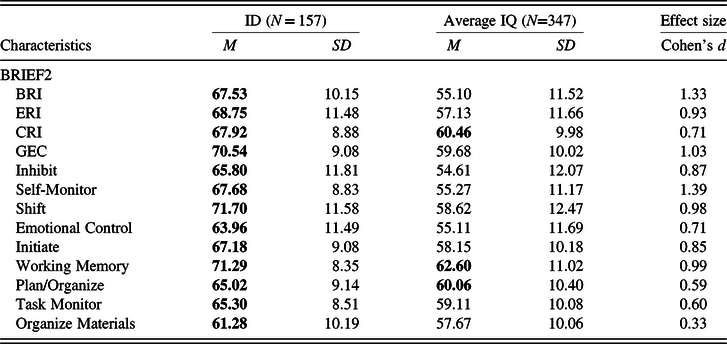
Scale (BRIEF2) and composite (BRIEF2, IQ, ABAS) scores are presented in Table 2. On average, children in the ID group evidenced concurrent intellectual (M FSIQ = 60.02) and adaptive (M GAC = 64.96) impairments that were broadly consistent with the cognitive profile of children with ID as conceptualized in the DSM-5, while those in the Average IQ group presented with cognitive (M FSIQ = 99.68) and adaptive (M GAC = 94.33) functioning that was well within the average range. When compared, mean scores of the intellectual and adaptive functioning of the ID group fell two standard deviations below those of the Average IQ group whose cognitive and adaptive functioning was consistent with the normative mean. Furthermore, children in the ID group demonstrated clinically significant elevations (e.g., T > 65) across mean BRIEF2 index and clinical scales, suggesting global EF deficits. In contrast, the Average IQ group showed mild elevations on selective clinical scales (Working Memory, Plan/Organize), but BRI and ERI scores within normal limits, indicating milder and more specific problems in cognitive regulation (CRI).
BRIEF2 indices and scales

Note. N = 504. BRIEF2 scores are presented as T scores, with higher scores indicating more problematic functioning. All scores indicated significant group differences, p <.01. Bolded results in BRIEF2 indicate clinically elevated scores. ID = Intellectual Disability; M = mean; SD = standard deviation; BRI = Behavioral Regulation Index; ERI = Emotional Regulation Index; CRI = Cognitive Regulation Index; GEC = General Executive Composite.
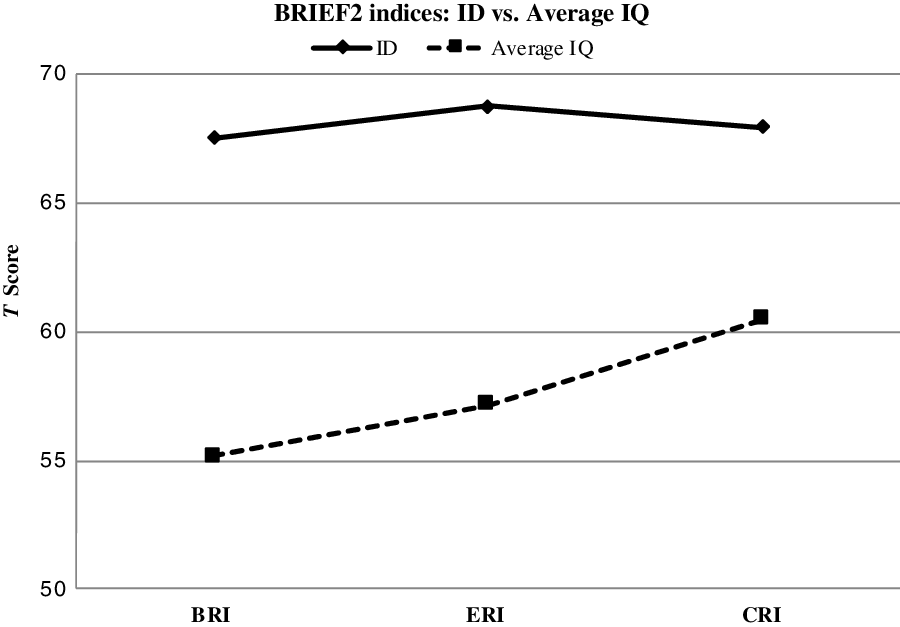
As shown in Figures 1 and 2, on average, the ID and Average IQ groups differed across all BRIEF2 indices (F(3, 495) = 50.31, p < .01; η p 2 = .23) and clinical scales (F (9,493) = 27.28, p < .01; η p 2 = .33). Effect sizes ranged from medium to large (ds = .59–1.39), except for the Organization of Materials scale (Table 1); were largest for the behavioral regulation domain (i.e., Self-Monitor, Inhibition), Working Memory, and Shift scales; and were lowest within the cognitive regulation domain (i.e., Organization of Materials, Plan/Organize, Task Monitor).
Profiles of mean BRIEF2 clinical scale scores for the ID and Average IQ groups. Note: BRI = Behavior Regulation Index; ERI = Emotion Regulation Index; CRI = Cognitive Regulation Index; SelfMon = Self-Monitor; EmoCtrl = Emotional Control; WM = Working Memory; PlanOrg = Plan/Organize; TaskMon = Task Monitor, OrgMat = Organization of Materials.

Profiles of mean BRIEF2 index scores for the ID and Average IQ groups. Note: BRI = Behavior Regulation Index; ERI = Emotion Regulation Index; CRI = Cognitive Regulation Index.

Within-Group Differences
In the Average IQ group, significant mean differences were found among the BRIEF indices (F(2, 343) = 40.97, p < .001; ηp 2 = .19) as well as clinical scales (F(8, 338) = 31.64, p < .001; ηp 2 = .42), with large effect sizes. Post hoc analyses indicated a statistically significant difference between each pair of indices (BRI 55.15 ± 11.51 vs. ERI 57.15 ± 11.67, p < .001; BRI 55.15 ± 11.51 vs. CRI 60.46 ± 9.98, p < .001; ERI 57.15 ± 11.67 vs. CRI 60.46 ± 9.98, p < .001). In contrast, no such differences between indices emerged in the ID group, as these children exhibited clinically elevated scores across the BRIEF2 indices, resulting in low variability between indices (Figure 2). However, significant mean differences were found across the BRIEF2 clinical scales (F(8, 149) = 38.78, p < .01; ηp 2 = .68). Post hoc analyses revealed significant differences between the scales with the highest [Working Memory (71.70), Shift (71.29)] and the lowest [Organization of Materials (61.28)] scores.
DISCUSSION
The present study provides promising preliminary evidence in support of the clinical utility of the BRIEF2 in characterizing distinct EF profiles for clinically referred youth with and without ID. Specifically, youth with ID demonstrated clinically significant elevations (e.g., T > 65) across all indices and almost all clinical scales, with the greatest elevations seen in the Shift, Working Memory, Initiate, and Inhibition scales. The highest elevation on the Shift scale likely reflects the sample characteristics of the ID group, in which over 27% were referred for autism, a population that has been found to show the highest elevations on the Shift scale (Granader et al., Reference Granader, Wallace, Hardy, Yerys, Lawson, Rosenthal and Kenworthy2014). Contrary to hypotheses, significant elevations were found across behavioral, emotional, and cognitive domains, potentially suggesting generalized EF deficits in this population.
The findings of the study suggest that the BRIEF2 does differentiate between clinically referred youth with and without ID. As hypothesized, the overall composite score (GEC), indices, and scales all differed significantly between the ID and Average IQ groups. Group differences were greatest in behavioral regulation (BRI) and lowest in cognitive regulation (CRI) domains. However, group differences at a scale level were more nuanced; between-group differences were highest among the Self-Monitor, Working Memory, and Shift scales, and were lowest within the cognitive regulation (CRI) domain (i.e., Organization of Materials, Plan/Organize, Task Monitor scales).
Although we hypothesized that both the ID and Average IQ groups would report generally elevated scores, those with average IQ showed milder, but not clinically significant, elevations within selective cognitive regulation (CRI) dimensions, particularly on the Working Memory and Plan/Organize scales. These results may also reflect the restriction of IQ to the average range, which in turn may have attenuated executive difficulties in the sample, despite the clinically referred nature of the sample as a whole.
The present study represents the first investigation to date of the clinical utility of the BRIEF2 in distinguishing EF profiles for clinically referred youth with and without ID. The strengths of this study include a large mixed clinical sample of prospectively seen patients, which allows for the identification of both a substantial group meeting ID criteria and an “Average” IQ comparison group. Of note, the participants in the ID group do not reflect a specific and isolated diagnosis of ID and likely include a range of etiologies given the context of the clinically referred sample. The study is also the first to examine the utility of the school-aged BRIEF2 using chronological age norms in an ID population. As previously noted, current clinical practice necessitates the use of the age-appropriate school-aged BRIEF2 version when working with youth who are referred for suspected ID. Broader use of the BRIEF-P outside of the normed age range may be useful in addressing the possible floor effects for individuals with more severe ID. However, the school-aged BRIEF2 represents a more age-appropriate measure to capture relevant, day-to-day EF behaviors for youth with ID in their natural settings (e.g., home, school, community), where they are often expected to demonstrate age-appropriate levels of everyday functioning. Altogether, examination of the BRIEF2 using chronological age norms with this population can help to inform clinical diagnostic practice, as well as to more accurately characterize everyday EF skills required for functional independence.
Although these findings have important implications for clinical practice, this study has several limitations. All children were clinically referred, and results, especially concerning the Average IQ group, may not be consistent with potential findings in a nonreferred sample. Specifically, while the Average IQ group, by definition, demonstrated age-appropriate cognitive reasoning abilities, the nature of the clinically referred sample indicates the presence of concerns in other neuropsychological domains, which likely include EF. Additional examination of the BRIEF2 in samples of nonreferred, typically developing youth is needed. Additionally, group assignment was based on measures of IQ and adaptive functioning, but clinical diagnosis of ID was not available. As expected everyday EF behaviors vary by age and developmental level, the content of the BRIEF2 questions may not be equally relevant across all ages. Further, how the measure performs in younger children, in particular, whether the timing and sequencing of EF skill acquisition are similar to those with the same-age/developmental peers or occur over the extended time frame remains unclear. Longitudinal studies that examine the pattern of EF skill development are warranted. Given that the intellectual and adaptive functioning data of our sample were truncated to create the ID and Average IQ groups, our data did not reflect a full range of the normal distribution of intellectual or adaptive functioning. Finally, the current study employed multiple measures of intellectual and adaptive functioning that used different normative groups and standardization years. Future studies should consider including clinician diagnosis of ID, multimodal (e.g., performance-based EF tasks), and multi-informant (e.g., teacher ratings) assessments, to confirm the generalizability of the current findings.
Limitations notwithstanding, the results of the current study have considerable implications for clinical practice and future research. As shown in Figure 2, an overall elevated but less variable pattern of index scores was identified in the ID group compared to the Average IQ group, potentially suggesting generalized EF deficits. However, the overall pattern of scaled scores appeared similar between the groups, albeit with consistently higher scores seen for the ID group (Figure 1). The less variable and consistently elevated profile may suggest fewer EF factors in youth with ID than the model proposed in the test manual (nine factors; Gioia, et al., Reference Gioia, Isquith, Guy and Kenworthy2015). That is, the results of the present study may suggest that not all nine BRIEF2 scales may be necessary to evaluate executive behaviors in individuals with ID, potentially allowing greater efficiency of EF assessment in this population. That said, the similar scale profiles between the groups may reflect differences in severity rather than the structural differences in EF. Further study of the BRIEF2 is needed to clarify the EF factor structure for youth with ID.
ACKNOWLEDGEMENTS
The authors have no financial support to declare concerning this manuscript.
CONFLICT OF INTEREST
The authors have nothing to disclose.