Introduction
Tsunamis are a serious threat to the community. According to the Historical Tsunami Database (NGDC/WDS), tsunamis have caused 940,000 deaths and unpredictable damages.Reference Ronan, Crellin and Johnston 1 Geologically, Indonesia is a country facing a high-risk of tsunamis. It is located on the meeting area of the Eurasian plate, the Indo Australian plate, and the Pacific Ocean plate spreading from the west coast of Sumatra, the southern coast of Java and Bali, the southern and northern islands of Nusa Tenggara, Maluku, the northern coast of Papua, and almost the entire eastern and western coasts of northern Sulawesi,Reference Viverita, Kusumastuti and Husodo 2 potentially resulting in volcanic eruptions and earthquakes that produce tsunamis.Reference Mimura 3 One of the high-risk areas is the Mentawai Islands. Mentawai is an area that has a long coastline (1,798,800 km) compared to other districts in western Sumatra. Geologically, the Mentawai Island lies on the active subduction zone between the Euro-Asia plate tectonics and the Indian-Australian Ocean plate. Thus, Mentawai is located in the subduction zone in which there is a zone of appointment or Megathrust. It becomes the center of earthquakes which can cause tsunamis. 4 The tsunami incident in Mentawai in 2010 caused 509 deaths, five wounded, 21 people disappeared, and 2,553 were displaced, as well as minor to heavy damages to residents’ houses and damages to public facilities such as roads and bridges. Seven units of worship and six schools were severely damaged. The estimated loss is $348.92 billion. All stakeholders should learn from the incident, particularly the school community, which is a vulnerable group. This can be seen from the damages to schools in Mentawai.Reference Thomas, Griffith, Harp and Cioffi 5
Preparedness is an important element and part of disaster management.Reference Rachmalia, Hatthakit and Chaowalit 6 Building such a culture requires innovative, economic, logical, human-oriented, and needs-oriented interventions.Reference Ostad Taghizadeh, Hosseini, Navidi, Mahaki, Ammari and Ardalan 7 School is one of the main stakeholders responsible for building preparedness. According to Takahashi,Reference Takahashi, Kodama and Gregorio 8 besides being the source of knowledge, schools have several strategic roles in building preparedness, such as being the source of knowledge dissemination of disasters, being participatory educational centers for communities, providing practical guidance on what to prepare before disasters, and actions should be done during and after the disaster. So, school readiness becomes crucial in improving public preparedness.Reference Sakurai, Bisri and Oda 9
In the World Conference on Disaster Risk (United Nations International Strategy for Disaster Reduction [UNISDR]; Geneva, Switzerland), it was proposed that comprehensive school safety consists of three pillars: (1) safe school facilities, (2) effective school disaster management and disaster risk reduction (DRR), and (3) endurance education. 10 The establishment of Sekolah Siaga Bencana/SSB (School-Based Disaster Preparedness) is a preparedness effort for facing disasters in schools, which is the implementation of the Hyogo Framework 2005-2015. School-based disaster preparedness is a school that has the capability of managing disaster risks. These capabilities are measured by having disaster management planning (before, during, and after a disaster); availability of logistics; security and comfort in education; infrastructure and emergency systems supported by knowledge and skills of preparedness; standard operational procedures; and early warning systems. 11
A study by Lesmana and PurboriniReference Lesmana 12 indicated that the level of SSB preparedness is still low, in terms of knowledge, attitude, and actions undertaken by SSB in DRR. Further, research by the Indonesian Institute of Science (LIPI; Jakarta, Indonesia) and UNISDR in Aceh Besar indicated that in the city of Bengkulu, Padang, school preparedness is lower than public and government preparedness, with an index value of 40 (less ready). This means the schools are not ready in facing earthquakes and tsunamis. The results of this study indicate school preparedness in the Mentawai districts, which are still inadequate in many aspects, particularly compared to that of the city of Padang. Meanwhile, school is a public space that has high vulnerability to disasters. 11
Methods
This research is quantitative research carried out by using observational analysis with a cross-sectional approach. The setting of the study was in three elementary schools, namely state schools SDN 13, SDN 16, and SDN 17, of which locations were areas prone to a tsunami disaster in Mentawai Island, Indonesia. This study had been carried out from January 9 to February 1, 2018. The population was 150 students from three elementary school SSB in Mentawai Island, and the sample size in the study was 109 students in SSB taken from grades five and six with a purposive sampling technique. The instrument used was a questionnaire (Appendix 1; available online only), and it was modified by researchers from LIPI and UNISDR and had been tested for validity and reliability using the Pearson test and Richardson Kuder (KR20). All questionnaires were declared valid and reliable. The data were brought to be analyzed with uni-variate, bi-variate techniques with gamma correlation test as well as multi-variate with regresi logistic test. The study was examined and approved by Health Research Ethics Committee of Andalas University, Padang, Indonesia (Number 016/KEP/FK?2018). There were three types of analysis: uni-variate, bi-variate, and multi-variate. The uni-variate was conducted to identify characteristics of the respondent; bi-variate analysis was conducted to describe the relationship between knowledge and attitude with SSB students’ preparedness to deal with a tsunami disaster, using gamma correlation test with significant level (α) = 0,005; and multi-variate logistic regression was used to see how much influence knowledge and attitude had towards student preparedness SSB.
Results
Based on the data obtained from the results of the study, the general characteristics of respondents based on age, gender, training experience, knowledge, attitude, and preparedness were as follows.
As Table 1 indicates, from 109 respondents, the average respondent was 11 years old with standard deviation of 744. The youngest age was 10 years and the oldest age was 13 years.
Distribution of Respondents by Age in SDN 13, SDN 16, and SDN 17 Tua Pejat

Source: Primary Data (2018).
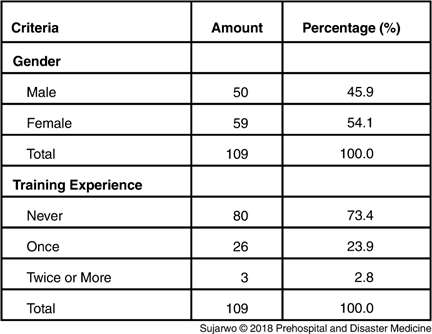
Table 2 illustrates that the number of male students was almost equal to that of the female students; the number of male students was 50 (45.9%) and the number of female students was 59 (54.1%). Meanwhile, based on training experience, more than one-half of the students never had disaster training (73.4%). This was due to the absence of training programs related to disaster preparedness for students from the government, schools, and private parties. Training and simulation had been done by Regional Disaster Management Agency (BPBD) of Mentawai Islands district to all communities in Sipora, Mentawai Islands district. However, the simulation and training were not done routinely.
Distribution of Respondents by Gender and Training Experience of Students SDN 13, SDN 16, and SDN 17 Tua Pejat

Source: Primary Data (2018).
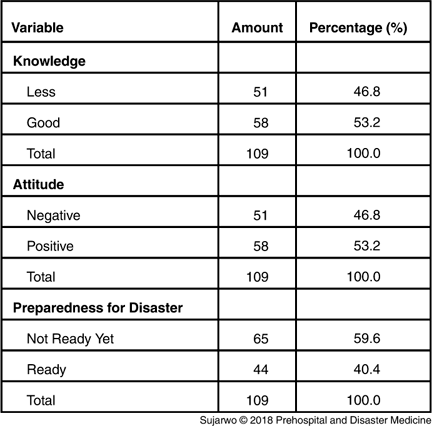
Data from each variable are presented in Table 3. The result of the uni-variate analysis showed that from 109 respondents, more than one-half of the students had good knowledge (53.2%) with a positive attitude (53.2%). Overall, the SSB students’ preparedness in tsunami DRR in Sipora Mentawai Islands was still low (59.6%).
Distribution Respondent by Knowledge Variable, Attitude, and Students’ Preparedness in SDN 13, SDN 16, and SDN 17 Tua Pejat

Source: Primary Data (2018).
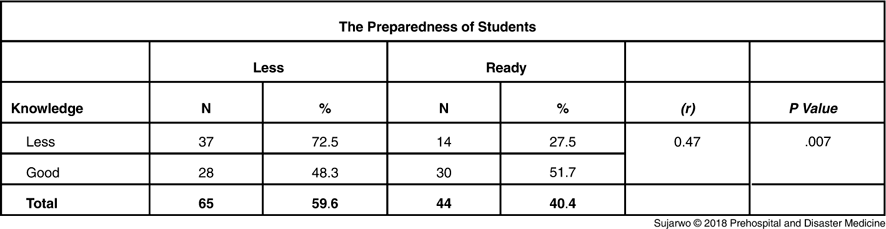
From Table 4, a P value of .007 was obtained, less than alpha (5%), indicating that there was a significant relationship between knowledge and the preparedness of SSB students in Sipora, Mentawai Islands district. The correlation value of 0.47 showed a positive correlation.
Results of Bi-variate Analysis Gamma Correlation Knowledge Relation to SSB Student Preparedness in Tsunami Disaster Risk Reduction

Source: Primary Data (2018).
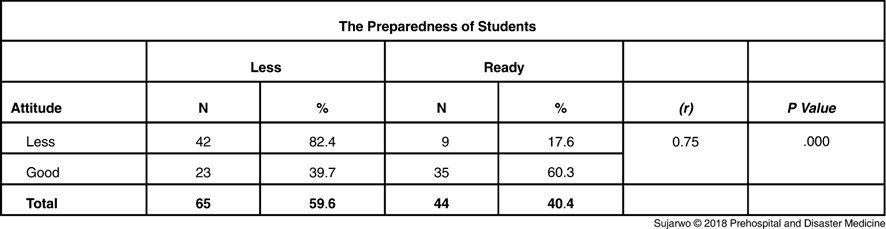
From Table 5, a P value of .000 was obtained, less than alpha (5%), which indicated that there was a significant relationship between attitudes and the preparedness of SSB students in Sipora, Mentawai Islands district. The correlation value of 0.75 showed a positive correlation.
Results of Bivariate Analysis Gamma Correlation Attitude Relation to SSB Student Preparedness in Tsunami Disaster Risk Reduction

Source: Primary Data (2018).
Based on Table 6, it can be seen that attitude was the variable that had the greatest influence on preparedness, that is OR = 4.308; meaning, the attitude of “poor” students of SSB would cause the low preparedness of SSB students in DRR for tsunamis four times compared to SSB students who have a “good” attitude after controlled knowledge variables. For knowledge became the second-factor affecting preparedness, with value OR = 159. Knowledge was not very significant when the logistic regression modeling test with P value .240 was greater than five percent, but the knowledge variable was considered important in the preparedness so that it was still included for analysis; the result of the knowledge variable was not significantly influencing the SSB students’ preparedness in tsunami disasters in Sipora Sub-Regency of Mentawai Islands. The quality of calibration and discrimination of data used could be seen from the Hosmer and Lemeshow Test value of 0.568>five percent and the value of Area Under the Curve (AUC) was 0.60>50% with 95% confidence level; it could be believed that the obtained equation had good calibration or was able to explain the data well when done with multi-variate analysis.
Results of Analysis Regresi Logistic Factor Analysis That Influences the SSB Students’ Preparedness in Disaster Risk Reduction

Discussions
Based on the results of the analysis of the knowledge variable, it was found that there is a significant relationship between knowledge and the preparedness of SSB students in DRR, with the significance of 0.007 less than alpha (5%) with correlation value of 0.47, showing a positive correlation with enough correlation strength.
The results of the analysis show that more than one-half (53.2%) of SSB students have good knowledge of DRR. Most of the students are able to answer all questions correctly in the knowledge questionnaire.
According to the researchers’ assumption, the above-average knowledge of SSB students is because education about disasters is given to SSB students. The students are taught about the types of disasters, signs of disasters, the need to save themselves the right way, the place of evacuation in the event of a tsunami, early warning systems in schools, and emergency equipment brought in anticipating risk reduction of tsunami disasters. However, lesson materials about the disaster have not been integrated into the subjects, such as local contents, natural science, or penjaskes (physical education); the SSB students obtained the lessons through extra-curricular activities not scheduled regularly. Meanwhile, teachers who provide disaster-related lessons are not those who already have special disaster-related training. As a result, the knowledge of SSB students does not increase significantly and does not support their readiness in DRR, as shown by the SSB students’ unpreparedness index, which is less than optimal in facing a tsunami disaster.
The results of this study are in line with the results of research conducted by Thomas,Reference Thomas, Griffith, Harp and Cioffi 5 which suggests that knowledge of respondents will be related to the level of preparedness of individuals in facing disasters. Ostad Taghizadeh, et alReference Ostad Taghizadeh, Hosseini, Navidi, Mahaki, Ammari and Ardalan 7 also explained that the knowledge and disaster preparedness in students are closely related. Low knowledge can lead to low readiness. Low knowledge may be affected by past disaster experiences and risk areas.
The findings of research by Ronan, et alReference Ronan, Crellin and Johnston 1 also suggest that increasing one’s knowledge of hazards will increase preparedness, decrease fear among students and parents, and increase discussions among family members related to disaster hazards. Meanwhile, the research of Pathirage, et alReference Pathirage, Seneviratne, Amaratunga and Haigh 13 also indicates that preparedness is influenced by one’s knowledge of disasters and the obtained training experience.
In this case, it can be seen that almost all SSB students (73.4%) have no disaster-related training experience. Knowledge management plays an important role in ensuring the availability and accessibility of disaster-related information that is accurate and reliable that is necessary with effective lessons such as training and simulation.Reference Pathirage, Seneviratne, Amaratunga and Haigh 13
According to Notoatmodjo,Reference Notoatmodjo and Kesehatan. 14 one of the factors that determines someone’s behavior is knowledge. This is because knowledge is an intellectual aspect that is closely related to all that is known by the man himself. Knowledge gained is an accumulation of education given to a person, both formally and informally, which will support someone in solving a problem. This is because of knowledge-oriented intelligence, thinking power, and knowledge, as well as the understanding of someone.Reference Notoatmodjo and Kesehatan. 14
A person’s preparedness for disasters will be formed by how often the person is exposed to knowledge and information about prevention and preparedness. The diverse media of disaster-related information and techniques will affect one’s preparedness.
According to Takahashi, et al,Reference Takahashi, Kodama and Gregorio 8 in improving preparedness, knowledge is an important aspect to be considered. Efforts to disseminate information that can be useful for the community in building preparedness should be based on sound knowledge. In this case, the school becomes a source of information for SSB students in increasing knowledge, so that the knowledge given must be innovative, economical, logical, human-oriented, and needs-oriented.Reference Oetting, Jumper-Thurman, Plested and Edwards 15
Schools have a very strategic role in disseminating information to increase knowledge of the community. Good knowledge, of course, will increase individuals’ preparedness for disasters to minimize the worst risk in case of disasters.Reference Sakurai, Bisri and Oda 9 In an effort to improve preparedness, knowledge is a key factor, but there are other factors and limitations that may hamper SSB students’ preparedness in DRR, such as the availability of resources, which include trained teachers, materials and equipment, facilities, funds, and support from the government, which is still very minimal for increasing the preparedness of SSB students in Sipora District.
According to Sakurai, et al,Reference Sakurai, Bisri and Oda 9 most disaster education and school-based disaster preparedness interventions should be externally encouraged. This is evident from the tsunami that occurred in the Mentawai Islands in 2010. It appears that most of the rehabilitation is driven by multi-lateral international organizations and nongovernmental organizations (NGOs) that dedicate resources in the education sector (ie, the fifth in the overall sectoral allocation of post-disaster recovery funds), including school reconstruction and DRR education, in the hope of creating long-term impacts and providing an efficient prevention scheme.Reference Mimura 3
In the Sipora sub-district, one NGO that plays a role in improving community preparedness, particularly the school, is the ASB (Arbeiter-Samariter-Bund; Cologne, Germany), an NGOs originating from Germany. In this case, the external role of the ASB is DRR. However, what the government should realize is that the role cannot be done continuously or permanently by the ASB. There must be local education disaster management and DRR. However, what happened in Sipora is that the government still relies heavily on NGOs. So, many activities stopped after the external support ended. Even government programs such as BPBD for schools do not exist; this is acknowledged by the head of the implementation of the preparedness and secretary of BPBD Mentawai Island district who stated that there is no special program aimed at school students at all levels in the effort of DRR in schools. Existing programs only target the general public. Meanwhile, in the World Conference on Disaster Risk Reduction, it is clear that the priority of the DRR is to make school safety more comprehensive. One form of DRR is an effort to increase knowledge; a lack of knowledge can factor into interactions that can lead to increased casualties and material losses. This is due to a lack of understanding of hazards, resulting in unpreparedness and powerlessness in facing these threats.Reference Fatemi, Ardalan, Aquirre, Mansouri and Muhammadfam 16
Based on the result of the analysis on the attitude variable, it was found that there is a significant correlation between knowledge and the preparedness of SSB students in DRR, with the significance of .000 less than alpha (5%), with correlation value of 0.75, showing a positive correlation with correlation strength.
This is in line with the research of Ostad Taghizadeh,Reference Ostad Taghizadeh, Hosseini, Navidi, Mahaki, Ammari and Ardalan 7 which states that attitudes have a significant influence on a person’s preparedness in facing disasters. However, it should be acknowledged that the positive or negative attitudes have confounding factors that can influence a person to behave, such as previous experience, education level, region, and disaster knowledge. The study of Codreanu, et alReference Codreanu, Celenza, Ali and Alabdulkarim 17 also indicates that someone who has a positive attitude tends to be calmer in facing disaster threats.
The shifting of government and community perspectives to disasters is a factor that can play a key role in low preparedness. The strategic location of the Mentawai Islands consisting of beautiful islands makes the Mentawai Islands a tourist destination. Nowadays, the government and society are more focused on tourism promotion. There are schools that integrate knowledge about tourism in school learning, while efforts to increase preparedness are less in the school. This will certainly affect students’ preparedness. This perspective shift should be a matter of concern in an effort to improve SSB students’ preparedness.
Although most SSB students have a positive attitude, there are SSB students who have negative attitudes toward preparedness, who are mostly less prepared for DRR. According to Azwar,Reference Azwar 18 many factors can influence a person to behave towards the object of attitude, such as personal experience, which is the basic factor in the formation of attitudes. Therefore, personal experience must leave a strong impression. Attitude will be easily formed if it involves emotional factors. The personal experience that SSB students have in coping with the disaster in Sipora is a solid foundation for students to have a positive attitude in DRR. However, the experience of students in dealing with disasters is not a major factor in shaping awareness of preparedness, but must be supported by good disaster education.Reference Shaw, Kobayashi and Kobayashi 19
In addition, it is not realized that the influence of culture inculcates an attitude in seeing a problem. The existence of Mentawai tribe culture, which is called “sabulungan,” is a good local wisdom for anticipating disasters. “Sabulungan” culture teaches the balance between nature and human. The Mentawai people are taught to preserve nature, to grow plants, to keep water and animals, as well as to protect themselves. It can be seen from the ban on cutting down trees without permission from the rimata (tribal chief) and sikerei (shaman), as well as the effort to plant mangrove trees around the coast.
However, there is also a Mentawai culture called “teteu,” assuming that the coming disaster is a form of soil fertility and fruits. This way of viewing can certainly hinder the attitude of the community to be prepared for DRR. This culture is slowly eliminated by the increased knowledge of students and communities related to disasters. The success or failure of disaster management depends on the involvement of culture, traditions, and customs. It is important to consider the cultural context of the affected regions, such as customs, traditions, local practices, and ethnic composition of a region for effective and easy implementation.Reference Kusumasari and Alam 20
Factual media also affect individuals’ behavior. The lack of information media, be it printed media, radio, and other communication media obtained by SSB students in Sipora sub-district in DRR, will have an impact on students’ attitude in responding to a disaster. Therefore, educational institutions have an important role in shaping students’ attitudes in an innovative and appropriate way.Reference Sakurai, Bisri and Oda 9 The achievement of preparedness is very important to be improved, especially in areas that are high-risk of disasters. The Mentawai Islands are one of the most potentially tsunami-prone areas. 21 The school-based disaster preparedness (SSB) should be a strategic place for the government to build preparedness as early as possible. Disaster risk reduction education should encourage various competencies and skills of school students to be able to proactively contribute to disaster preparedness and mitigation so as to create a school that is alert and has rescue skills.Reference Sakurai, Bisri and Oda 9
Learning activities are interactive, inspiring, and challenging, motivating learners to participate actively and providing sufficient space for an initiative, creativity, and independence according to the talents, interests, and physical and psychological development of learners. These activities are carried out systematically through exploration, elaboration, and confirmation processes to form a positive attitude. 22
Although some of the infrastructures are already available, such as evacuation routes from musholla direction, canteen, classrooms, and a gathering point by utilizing the soccer field, there are still many shortcomings that must be improved and added in DRR efforts, such as the school does not provide guidance direction of evacuation paths and evacuation maps. It is needed by students in building attitude and behavior, especially when disasters happen and cause panic conditions.Reference Ostad Taghizadeh, Hosseini, Navidi, Mahaki, Ammari and Ardalan 7
In addition, there are no vehicles and special lanes to mobilize students quickly in the event of a tsunami, considering that one of the schools, SDN 13, is very close to the coast. So, the potential for tsunami impact is a very high. Therefore, the functions and responsibilities of schools and students in emergency situations become an important point in DRR at schools, so that competent human resources are needed. 23
While comprehensive DRR initiatives should not be confined to infrastructure alone, they should cover a wide range of issues, such as representing the schools of thought in science, engineering, structural, and physical organization, since infrastructure plays an important role in reducing vulnerability of risky communities, such as schools.Reference Wedawatta, Kulatunga and Parvez 24 This is particularly important for developing countries such as Indonesia, where the ability of communities to implement DRR is very limited.
Limitations
Researchers did not examine the relevant policies and guidelines that are owned by SSB, so it cannot be known the implementation process.
Conclusions
There is a significant relationship between knowledge and attitude with SSB students’ preparedness in DRR in Sipora, Mentawai Islands district. The results of this study can become feedback to solve the problem of SSB students’ lack of preparedness in school-based DRR. Prevention and preparedness efforts cannot stand alone. The SSB should get encouragement from all parties, including the government, non-government parties, and the society. The government should be cautious in utilizing the concept of SSB as a DRR by innovating and improving students’ knowledge of disasters and encouraging a positive attitude for preparedness.
Supplementary Material
To view supplementary material for this article, please visit https://doi.org/10.1017/S1049023X18000778