


Introduction
The implementation of constitutions relies heavily on the collaboration of relevant actors. Academic research and political realities have provided plenty of proof on the importance of political parties, especially in the development of democracy and rule of law in Africa.Footnote 1 As will be shown by this paper, framers of African constitutions have high expectations of political parties, looking forward to their positive role in the implementation of the constitutions. In reality, however, political parties have their own interests which under certain circumstances might be at odds with the agenda of a constitution. Experiences of other countries, inside or outside Africa alike, have consistently revealed the impact of political parties as a double-edged sword in the implementation of constitutions. Taking this into consideration, framers of African constitutions lay out many specific provisions, especially on the purpose, organization principles, rights and obligations of political parties, to guide them to contribute to the implementation of constitutions. The real effect of these provisions is yet to be explored.
This paper starts from the importance of political parties in African constitutionalism and democracy. Then, the position of the framers of African constitutions on the issues relevant to political parties is summarized based on a thorough reading and analysis of the texts of all African constitutions, especially constitutional provisions supporting political parties and those preventing negative impacts from political parties upon African constitutionalism and democracy. A further exploration of this position reveals a somewhat self-contradicting attitude of the framers, ie, high expectation on political parties as constitutional institutions, while deep suspicion against them as individual political organizations. Although the analysis carried out is based on what the constitutions state and not necessarily how this is implemented in practice, the attitude of the framers of African constitutions reveals the difficulties and dilemma African countries are still facing in the development of constitutionalism and democracy.
Importance of political parties in African constitutions
Framers of African constitutions always plan to reshape African countries with their constitutions. For example, with economic and social rights, framers want to eliminate the universal poverty and inequalities in African countries.Footnote 2 Therefore, African constitutions are not politically neutral on many political and social issues. The concept of transformative constitutionalism even originated from the African context.Footnote 3 Against this backdrop, political parties play an indispensable role in the successful implementation of African constitutions, especially in regard of fulfilling the constitutional values, enhancing political stability and supporting the effectiveness of constitutions.
Fulfilling the constitutional values
Apparently, African constitutions are different from the classic liberal constitutions. From the standpoint of the classic liberal constitutionalism, constitutions are the guarantee of civil rights, whose main purpose is to protect the citizen from the abuse of power by the state.Footnote 4 The main function of the state is to provide common good, such as national security and public utilities infrastructure, which the market tends to fail to provide.Footnote 5 National development depends largely on the self-propelled advancement of the free market, with the state playing only a minor role in safeguarding the order of the market and society. A laissez-faire policy is a typical reflection of the classic liberal constitutionalism.
After World War One, however, the classic liberal constitutionalism has given some way to Keynesian economics, with the state beginning to intervene in the economic and social lives of its citizens.Footnote 6 As a result, the boundary between the state and the society has become increasingly vague. In the Western world, however, interventions of the state always lead to political and social controversy. Classic liberal constitutionalism and laissez-faire arguments still play an important role in the implementation of the Western constitutions.Footnote 7
In comparison to the Western countries which have a long history, most African countries were artificial creations of colonial powers.Footnote 8 When the African countries were created, none of them had a well-developed capitalist economy and there is little mutual cultural bond in their society, while their constitutions were basically transplanted from their former suzerain country. As a result, since their founding era, there has been a disparity between a formally advanced constitution and severely underdeveloped social and political realities. The implementation of the constitution is more a top-down process which aims to reshape the country and the society with the guidance and mandate of the constitution.Footnote 9 In this process of reshaping, intermediate agencies like political parties are indispensable.
Additionally, the current political system of African countries is based on massive participation. Political experiences from many other countries have testified the indispensable organizational function of political parties in this.Footnote 10 In terms of political education, literacy and other factors contribute to healthy mass politics. Unfortunately, African countries are also underdeveloped.Footnote 11 Consequently, the intermediate role of political parties is further highlighted. As a result, a true supportive attitude of political parties towards the values of African constitutions is key to the successful implementation of the constitutions.
Enhancing political stability
Since their independence, most African countries have witnessed much political turmoil, including coup d’états, civil wars and even genocide. Even nowadays, coups still occur frequently in some African regions.Footnote 12 Learning from this painful and still ongoing history, framers of African constitutions pay high attention to political stability. For example, 41 African countries (75.9 per cent) established presidential systems, where the president is elected directly by the voters.Footnote 13 36 African constitutionsFootnote 14 adopted the theory of self-defence democracy,Footnote 15 such as prohibition of amending certain principles or provisions of the constitution, ban of unconstitutional political parties or resistance rights of the citizens etc.
Besides, during the 1990s, most African countries restarted the democratization process, which allowed more participation of society. However, at least under the African context, experiences have shown that the greater the level of participation, the more difficulties there are in maintaining political stability.Footnote 16 Since their independence, issues such as tribal rivalry, ethnic conflict and religious tension have consistently disrupted the peace of African countries. Currently though, while the influence of these factors has to some extent been diminishing, they are far from gone.Footnote 17 Therefore, achieving a delicate balance between encouraging mass participation and maintaining political stability is a huge challenge for African countries.
In mass democracy, political parties are indispensable intermediate agencies in the organization of the population. The inherent divisive impact of political competitions of political parties on political stability, however, has also received much research attention. This divisive impact even exists in established democracies.Footnote 18 In established democracies, it used to be believed that the tradition of “loyal opposition” guaranteed a minimum consensus among the political antagonists.Footnote 19 Under the influence of this tradition, the temporary losers of the political game would accept the result peacefully. However, in newborn or flawed democracies where the political actors are yet to endorse this tradition, the political contest of political parties would act as a dividing factor. To maintain its power, the ruling and opposition parties alike would adopt strategies that in some instances aggravate conflicts, at the cost of the political stability of the country. Recent developments in certain established democracies like the US have even shown the fragility of the “loyal opposition” tradition.Footnote 20 How to cope with this inherent divisive effect of party politics, while keeping the constitutional promise to maintain an open political arena, is a critical issue in African constitutionalism.
Supporting the effectiveness of the constitution
The famous phrase “constitution without constitutionalism” originated from lessons of African constitutions.Footnote 21 Recognizing their complicated history legacy and realities, framers of African constitutions apparently pay much attention to the effectiveness of the constitution. Taking their value goals of the constitution further into consideration, this effectiveness appears to be more decisive in the successful implementation of the constitution.
The end receivers of a constitutional mandate are actors in the political and social realities. Therefore, the effectiveness of a constitution relies heavily on the attitude and behaviours of these actors. As one of the most important actors in African politics, the respect and acceptance of political parties of the constitutions will, to a large degree, determine the effectiveness of the constitution in political realities.
Additionally, political parties mobilize and educate the electorate. Each party has its own understanding of the constitution. This understanding can be in line or at odds with the letter and spirit of the constitution. Whatever the case, its understanding will be transmitted to the electorate through its engagement with the voters, especially to its members and followers.
Furthermore, when engaging with citizens, the organizational structure, fashion of leadership and way of communication reflect the political culture of the individual party. As most citizens in African countries are politically undereducated, they will learn more from the role model of the political party as a form of political education. The elected candidate recommended by political parties will also duplicate this model into the formal governmental structure. As a result, the behaviour of political parties will to a large degree determine the behaviour of the average citizens as well. This combining effect further contributes to the role of political parties in supporting the effectiveness of the constitution.Footnote 22
Constitutional provisions supporting political parties
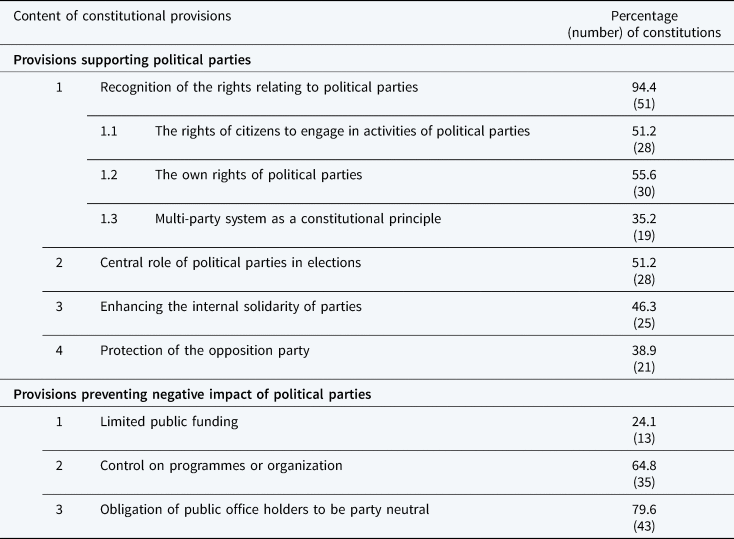
Recognizing the crucial role of the political parties, most African constitutionsFootnote 23 have provisions supporting political parties, especially affirming their positive role in implementation of the constitution. Except for Mauritius, Eritrea and Eswatini, all the other 51 African constitutions (94.4 per cent) contain provisions confirming the positive function of political parties and therefore provide certain constitutional support to them. This very high percentage is solid evidence which testifies the friendly attitude of the framers of African constitutions towards political parties.
The Mauritius ConstitutionFootnote 24 mentions political parties several times, and political parties play a noticeable role in the organization of the government, as with many other African countries. There is only a lack of explicit confirmation of the rights of citizens to engage in party activities or of the own rights of political parties. The Eritrea ConstitutionFootnote 25 recognizes the freedom of citizens to form organizations for political ends and the Eswatini Constitution recognizes citizens’ equality before the law, “regardless of their political opinion”,Footnote 26 but neither of these two constitutions mention political parties at all.
Provisions supporting political parties in these 51 African constitutions take various forms and they can be roughly classified into four categories: 1) confirming the rights relating to political parties; 2) recognizing the central role of political parties in elections; 3) enhancing the internal solidarity of parties and 4) protecting the opposition parties (see Table 1 for a summary of provisions).
Constitutional provisions supporting political parties and preventing their negative impact
Confirming the rights relating to political parties
Political parties are a form of citizens’ association. When formally founded, political parties possess their own identity distinct from those of their members. Therefore, in discussion of the rights relating to political parties, it might be the rights of the party members or the rights of the political party itself. Out of this rights complex, provisions on the rights relating to political parties in African constitutions can be further divided into three categories. The first category is protection of the right of citizens to form and engage political parties.Footnote 27 The second one is protection of the rights of political parties themselves.Footnote 28 The third one is recognition of the multi-party democracy as a constitutional principle.Footnote 29 It is easy to find that each category provides more protection to political parties than the previous one. As mentioned above, there are 51 African constitutions (94.4 per cent) containing at least one category of these provisions.
Interestingly, of all the 52 constitutions mentioning political parties explicitly, few of them provide a detailed definition. Article 77 of the Burundi Constitution might provide the most detailed one: “A political party is defined as an association without a lucrative end and which organizes citizens around a project of democratic society founded on national unity; which has a definite political program of precise objectives; is concerned with serving the general interest; and to assure that all citizens thrive”.Footnote 30
This definition clearly describes the instrumental value of political parties, especially its value to “assure that all citizens thrive”. Under this definition, protection of the rights of citizens to engage political parties is a way to advance the interests of the citizens.
There are 28 constitutions (51.2 per cent)Footnote 31 containing provisions of the first category, especially protecting the civil right to establish political parties and participate in the events of political parties. Some constitutions further ban states from discriminating against citizens based on their party affiliation.Footnote 32 It is noteworthy that these protections focus on the rights of the individuals rather than the political parties themselves. Judging from this first category of protection alone, it is hard to declare that political parties possess any rights. Within this framework, the rights of political parties are at most a derivative of the rights of citizens.
Considering the unique function of political parties in the mass democracy of African countries, this derivative nature of the right of political parties might not be sufficient to guarantee the special constitutional role of political parties. Framers of African constitutions apparently recognized this insufficiency. There are a few more African constitutions (30 constitutions, 55.6 per cent) recognizing the own rights of political parties.Footnote 33 These rights mainly include the right to organize themselves and hold events, against the intervention of the state, and to be treated equally by public institutions. But this recognition of the own rights of political parties is still largely based on their instrumental value in mass democracy. This instrumental value is mainly demonstrated in two forms. First, to help the voters exercise their political right, partake in the political process and better form “the will of the people”.Footnote 34 Second, to enhance realization of constitutional principles and values, especially pluralist democracy,Footnote 35 and contribution to political education.Footnote 36 However, it is noteworthy that when contributing to constitutional values, political parties serve not only the citizens, but also the whole constitutional system. In the latter case, the institution of political parties themselves appears to be of constitutional significance.
Some framers of African constitutions have also realized this own constitutional value of political parties. At least 19 constitutions confirm the importance of party institutions in their constitutional system.Footnote 37 For example, the Egypt Constitution declares that the political system of Egypt is based on “partisan multiplicity”Footnote 38 and the Zimbabwe Constitution declares that the principles of good governance include “a multi-party democratic political system”.Footnote 39 In some African constitutions, multi-partyism as a constitutional principle enjoys restriction in the amendment process of the constitution, even as an unamendable constitutional principle.Footnote 40
Recognizing the central role of political parties in elections
As discussed before, framers of African constitutions expect political parties to organize the people to participate efficiently and reasonably in the political process. Democracy envisioned by African constitutions is based on periodic elections. In the view of many observers, the election accounts for the most important form of public participation. The success level of the elections is also treated by many researchers as an indicator of the health of African democracies.Footnote 41 Taking the importance of elections in African constitutionalism into consideration, 28 African constitutionsFootnote 42 emphasize the central role of political parties in the organization of elections.
Among these provisions, the most remarkable might be the provision which states that only party members should be entitled to run for public office.Footnote 43 Some constitutions do not ban non-party members from running for election, but stipulate that only political parties can present candidates for public office.Footnote 44 The third category of these 28 African constitutions does not explicitly establish this monopoly position for political parties in elections. However, their election systems are solely based on the proportional representation system.Footnote 45 It is well known that a proportional representation system relies on the organizational role of political parties. In a pure proportional representation system, political parties are the indispensable intermediate organizations, which provides them with the factual monopoly position in elections as well.
Even after elections, the central role of political parties in the democratic process, especially in parliamentary activities, is further recognized by many African constitutions. For example, as the oldest constitution in Africa, the Mauritius Constitution provides that after elections, eight additional seats should be allocated to “persons belonging to parties who have stood as candidates for election as members at the general election but have not been returned as members to represent constituencies”.Footnote 46 In many other African countries, during the process of determining the government officialsFootnote 47 or members of parliamentary committees,Footnote 48 party affiliation is a decisive factor. The Mozambique Constitution even contains a provision giving an elaborate definition to the parliamentary bench (faction),Footnote 49 the “party within the parliament”. Judging from these provisions, it might be safe to say that the African democracies envisioned by framers of African constitutions are based on an active role of political parties, at least in elections.
Enhancing the internal solidarity of political parties
A precondition for the active role of political parties is that they can mobilize their members and followers successfully, especially prompting them into coordinated action. On the contrary, if the decisions of political parties are not respected or followed by their members and followers, and there is little solidarity within the party, political parties can hardly fulfil their function as political intermediate agencies. As forementioned, in most African countries, the leading government officials and parliament members are normally nominated or elected under the sponsorship of political parties. When these officials repeatedly ignore or even betray the directives of their party in political realities, this party would soon lose its political credibility. Besides, when elections of African countries are organized around the central role of political parties, if officials elected from the party show no sense of party loyalty after the election, the voters would feel confused or even be fooled. This feeling of confusion and deception will inevitably damage the reputation of the democracy and the constitution. Consequently, solidarity within political parties, at least for the public office holders, is a critical precondition for the success of African democracy.
As efforts to enhance this internal solidarity, 25 African constitutionsFootnote 50 introduce provisions enhancing solidarity. The most common form of these provisions is one that states that when an elected candidate quits or is dispelled from his or her party, that candidate will lose the entitlement to the office.Footnote 51 These provisions take party affiliation as a prerequisite for performing public duty, which obviously works in tandem with the central role of political parties in elections.
In countries where elections are based on a proportional representation system, it appears to be a logical conclusion that loss of party affiliation should lead to loss of public office. In a proportional representation system, the party background of a candidate is a deciding factor in the decision-making process of voters. Voters might regard the alteration of party affiliation after the election as a betrayal of the campaign promise, of both candidate and the party. However, what is interesting is that in many African countries whose election system is based on a district representation system, one can also find many of these similar provisions. For example, elections in Uganda are basically based on a district representation system, and there is no formal proportional representation element in its election system. But article 83(1)(g) of its Constitution prescribes: “A member of Parliament shall vacate his or her seat in Parliament – if that person leaves the political party for which he or she stood as a candidate for election to Parliament to join another party or to remain in Parliament as an independent member”. Other countries in this category are Gambia, Ghana, Malawi, Nigeria, Republic of the Congo, Sierra Leone, Tanzania and Zambia. It might be safe to say that emphasis on solidarity within political parties is an important consideration across African countries with diverse election systems.
Protection of opposition parties
The success of a multi-party system relies on an active role of the opposition. The realization of this active role depends on protection for the opposition against the government and the ruling party. In the history of African countries, many of them established the one-party rule regime.Footnote 52 After the 1990s, as an effort to break from the tragic history, the one-party regime appears to be an unacceptable option in the design of the government structure. This political determination has also been reflected in many African constitutions. The ban of establishing one-party regimes is stated clearly in the constitutions of Gambia, Ghana, Liberia and Uganda. In addition to that, the rights of the opposition parties enjoy explicit protection from 21 African constitutions.Footnote 53
As has been shown, there are 51 African constitutions having provisions protecting rights of individual citizens to engage in party politics and the own rights of political parties. These provisions can serve soundly as a normative foundation for the protection of the opposition party. This might be the reason why one seldomly finds prescriptions on the protection of the opposition in constitutions of established democracies. This contrasting constitutional design might further contribute to the conclusion that in African countries, the role of the opposition draws special attention.
Besides a general statement of the importance of the opposition,Footnote 54 the most common form of protection is the entitlement of the opposition to exert influence in the parliamentary decision-making process. Some of these constitutions establish the right of the opposition to have seats on parliamentary committees.Footnote 55 Some others enable members of the opposition to serve in the leadership of the parliament.Footnote 56 Additionally, the Constitutions of Madagascar, Mauritius, South Africa, Seychelles, South Sudan and Uganda recognize the leader of the opposition as a formal public office holder. For the youngest constitution on the African continent, the South Sudan Constitution ranks the minority leader “fourth in protocol after the President, the Vice President and the Speaker”. From these prescriptions, it might be found that the political conventions of established democracies have been formalized by these African constitutions.
Furthermore, protection of the opposition is treated as a fundamental principle by certain African constitutions. The Cape Verde Constitution prohibits any amendment to the rights of the opposition, through neither popular referendumFootnote 57 nor constitution revision.Footnote 58 According to the Mozambique Constitution, matters relating to the statute of the opposition shall be carried by a majority of two thirds of the votes of the deputies.Footnote 59 These few but remarkable prescriptions further testify the emphasis placed by the framers of African constitutions on the protection of the opposition.
Constitutional provisions preventing the negative impact of political parties
In a multi-party democracy, the immediate goal of political parties is to obtain the state power. In the struggle for state power, the attitude of political parties towards the goals and values pursued by the national constitution is not a given. Political parties may even take measures which can be at odds with demands of the constitution, such as bribing election officials, transmission of fake news or even incitement of violence. Even after its success of obtaining the state power, the ruling party might misrepresent or even revise the constitution to further its political interests. These revisions would not necessarily be in line with the true spirit of the constitution. All these scenarios have already happened and are happening in African countries, and it is needless to reiterate the tragic history of African countries here. These negative phenomena concerning political parties appear in contradiction with the high expectation of the framers of African constitutions on political parties.
However, it is noteworthy that political parties are after all an instrument for political competitions in mass democracy. Just like fire is a tool which could be used to warm a room or cook a meal, it could also be used to burn houses or destroy forests. The actual impact of political parties on democracy and constitutionalism depends on the practical behaviours of the political parties in political realities. An optimistic expectation of the framers of African constitutions on political parties does not automatically lead to the positive role of political parties in reality. Furthermore, as mentioned at the beginning of this paper, local political culture and tradition on the African continent is not always in line with values of the African constitutions. In the history and realities of African countries, tribalism, corruption and clientelism have damaged the health of African politics. Without intervention or corrections, these negative cultures and traditions might continue to do harm to African democracies, especially through competitive party politics. Facing these possibilities challenging the success of African constitutionalism and democracy, framers of African constitutions have adopted many measures to deal with the negative impact from political parties. They hesitate to establish public funding for political parties, set limitations on their programme, organization and activities, and demand many public office holders or even certain state organs to be party politically neutral. From these measures, a suspicion of the framers of African constitutions against political parties might be found.
Limited public funding
The phrase “constitution without constitutionalism” reveals starkly that a mere existence of a constitution does not necessarily lead to constitutionalism in reality. Similarly, a textual affirmative recognition of political parties will not automatically build a robust institution supporting democracy and constitutionalism in political practices. Political parties are not only indispensable institutions, but are also expensive organizations. Their premises and staff members including cadres and political campaign activities etc are all costly. Without adequate financial support, it is very hard for political parties to perform their constitutional function.
Financial support from society, such as membership dues and private donations, are regular forms of financial resources of political parties in Western countries. Unfortunately, most African countries are still economically underdeveloped. Inevitably, this economically underdeveloped background leads to limited resources for political parties obtained from society. These limited resources can be taken as an advantage by plutocrats with political ambition. A financially disadvantaged political party can be easily manipulated by a handful of members with economic advantages. This manipulation exists not only insideFootnote 60 but also outsideFootnote 61 the African continent, both in developed and underdeveloped democracies.
Facing such economic underdevelopment of the African countries, public funding for political parties seems to be a good alternative to private financing. Since political parties are performing a semi-official function, there can be a constitutionally sound conclusion that the state should provide official support for the performance of this function. In fact, in many developed countries, public funding for political parties has already been a common practice.Footnote 62 In these developed countries, the public financial support for political parties appears to be a conducive factor for the health of democracy. For the economically underdeveloped countries like African countries, public funding seems to be of more help to political parties.
Some framers of African constitutions do realize the importance of public funding, but altogether, there are only 14 constitutionsFootnote 63 (26 per cent) in African countries which authorize the state to provide financial support to political parties. This financial support is mainly in two forms, namely, access to public media and direct budgetary assistance.
Considering the high percentage (94.4 per cent) of African constitutions recognizing the right relating to political parties, 14 countries obviously account for a sharply contrasting minority. This fact reveals remarkably the hesitation of the framers of African constitutions on the public funding issues for political parties. Such hesitation is not unreasonable. Public funding for political parties means more entanglement of money with politics, which is unavoidably a hotbed for corruption. Furthermore, state power is ultimately controlled by the ruling party. Constitutional authorization of public funding provides the ruling party the chance to make rules for the arena of political games, in which it is absolutely tempting for the ruling party to make convenient rules for themselves. Cases of other countries, including established democracies, have repeatedly testified this possibility. In terms of rule of law and democracy, most African countries are still quite lagging. Against this background, public funding could do more damage than help to democracy and constitutionalism in African countries. The framers of the Egypt Constitution apparently realized this risk as it expressly forbids any public funding for political parties.Footnote 64 But so far, this absolute ban only exists in one constitution. Framers of African constitutions seemingly leave some leeway to the legislators.
As a result, the underdeveloped economic realities in African countries lead to a political dilemma, that is, less money means less robust party institutions; more public money means more intervention of the state in party contests which tends to compromise the freedom of political parties, and increased possibilities of corruption damaging the reputation of democracy.
Control of programmes or organization
While recognizing the importance of the freedom of political parties, at least 35 African constitutionsFootnote 65 set controls or even bans on the programmes, political goals and organizational structure of political parties. All the forementioned negative political cultures and traditions in Africa are apparently taken into consideration in these constitutional limitations. Political parties are generally banned from advocating religious, regional and ethnic discrimination.Footnote 66 The divisive effect of party politics draws special attention.Footnote 67
Of all these 35 constitutions, the programmes of political parties are universally banned from being linked with tribal, regional and ethnic characteristics. In certain countries, political parties are constitutionally obliged to abide by the provisions and principles of the constitution.Footnote 68 In addition to that, in some African countries, political parties have the constitutional duty to promote the unity and stability of the nation.Footnote 69 In comparison to citizen and other organizations, political parties are obviously under more surveillance of the framers of African constitutions.
The constitutional limitations on party programmes combatting their divisive effects are expanded into the organizational structure of political parties. At least 17 African constitutionsFootnote 70 demand political parties to be of inclusive or national features and its internal organization should adhere to democratic principles. The inclusiveness requirements are reflected in the constitutional demands to have offices or branches in most areas of the country. For example, the Ghana Constitution demands all political parties to have branches in all regions of the country and organized in no less than two-thirds of the districts in each region.Footnote 71 The Burundi Constitution requires the leadership of political parties to reflect the national character of the population. The Liberia Constitution requests any political parties presenting candidates in presidential elections to locate their headquarters in the capital of the country.Footnote 72
Concerning internal organization, many constitutions demand political parties to adhere to democratic principles. The Tanzania Constitution demands political parties hold periodic elections. Any party who fails to do so will be deprived of their qualification as a registered party,Footnote 73 and hence be disqualified to present candidates for public offices.Footnote 74
A robust democracy relies on active party institutions, which should principally be free of state control. However, these constitutional limitations on political parties have clearly showed the distrust of the framers of African constitutions in a laissez-faire political party ecology. With these strict limitations, sometimes it is difficult to maintain the freedom of political parties against the state. If the state control of political parties is abused by the ruling party, a healthy party politics ecology will be even more difficult to achieve. These seemingly self-contradicting institutional goals show again the difficulties in establishing a healthy mass democracy based on multi-party politics against an African backdrop. Maintaining a delicate balance between protection of freedom and restraint of any divisive effect of political parties is a prerequisite for the success of African democracy.
Obligation of public office holders to be party neutral
As forementioned, the constitutional confirmation and support for political parties are based on its indispensable and supportive role in the process of forming the will of the people. After the election, however, when such will has already been formed and the public offices have been filled with the elected party candidates, if the public officials continue to act only in the partisan interests, the representativeness of the government will be seriously compromised. Even in democracies based on multi-party systems, the public officials are normally expected to serve the whole country rather a faction of the population. Too much emphasis on the party interests in the governmental process will cause a divisive effect within the government itself. Furthermore, if the public officials behave obviously in a partisan way in the governmental process, voters, especially voters backing opposition parties, will cast doubt on the trustworthiness of these public officials, even on the government itself. Coupled with the declining trust in the public officials will be the weakened confidence in the democracy and constitution of the nation.
Almost from the beginning of African countries as independent nations, framers of African constitutions have spent much effort fighting divisive factors within the country. They would not allow a new dividing factor to sneak into the governmental process through the channel of political parties. Apparently, in the view of framers of African constitutions, one way to cope with this overexpansion of party politics into the governmental process is to introduce party neutral obligations for certain public officials. These provisions are included in at least 43 African constitutions (79.6 per cent).Footnote 75
The most common prescription is to define the parliamentarian as a representative of the whole country,Footnote 76 and therefore limit the influence of political parties on parliamentarians in the parliamentary process. Additionally, the Burundi Constitution defines the vote of deputies and senators to be personal.Footnote 77 It even bans senators from forming parliamentary groups.Footnote 78 The Malawi Constitution explicitly bans political parties from controlling the leaders of the Parliament, even these leaders are party members.Footnote 79 If a parliamentary member votes against the recommendation of the party to which he or she belongs, his or her seat should not be vacated due to this voting behaviour.Footnote 80 It is interesting to see that in the same section of the Malawi Constitution, it is prescribed that when one member of the National Assembly ceased to be a member of the political party which presented him or her as candidate, his or her seat will be vacated.Footnote 81 Therefore, it is demanded by the Malawi Constitution that any parliamentarian should have a party affiliation. Facing these two seemingly self-contradicting prescriptions in the same section, however, it will be a perplexing task for the parliamentarians to maintain freedom of conscience while adhering to party affiliation.
In addition to these obligations of the parliamentarians to represent the whole country and to adhere to their conscience rather than partisan interests, many African constitutions further demand holders of public offices outside parliament to keep a distance from political parties, both its directives and ideology. The most common form of these prescriptions is the ban for party cadres from holding key public offices. For example, article 77 of the Kenya Constitution provides: “[a]ny appointed State officer shall not hold office in a political party”.Footnote 82 Article 118(3) of the Somalia Constitution provides: “[c]ivil servants and public employees shall not be leaders of any political party”.Footnote 83 The main function of most public offices is to implement law and policy formulated by political organs. In performing their duties, instead of judging from a partisan perspective, these office holders are expected to behave in the interests of the whole country. To reduce the divisive effect of party politics, in comparison to parliamentarians, it is more understandable to keep these office holders some distance from party politics.
Some African constitutions further expand this obligation of party-political neutrality from office holders as individuals to some state organs, such as court officials,Footnote 84 police and military forces,Footnote 85 election organization bodiesFootnote 86 and national media commissions,Footnote 87 for example. For these state organs whose authority largely depends on their political neutrality, these institutional obligations of political neutrality are also apparently constitutionally reasonably designed.
However, it is interesting to see certain African constitutions have expanded this obligation to some traditionally political organs. For example, article 27 of the Mauritania ConstitutionFootnote 88 bans the president-to-be with belonging to the directive instances of a political party. There are similar provisions in the constitutions of the Democratic Republic of the Congo,Footnote 89 the Republic of the Congo,Footnote 90 Côte d’Ivoire,Footnote 91 Madagascar,Footnote 92 Niger,Footnote 93 Guinea,Footnote 94 ComorosFootnote 95 and Egypt.Footnote 96 The speaker of the Somalia Parliament is elected by members of the Parliament. But the Somalia Constitution requires the speaker elected to “relinquish any official position in a political party” and to “be strictly neutral in the performance of his or her functions”.Footnote 97 For these political elected officials, in political realities, it is difficult to imagine they would abruptly abandon their party background, and behave politically neutral, as if their previous ties with political parties did not exist or vanished immediately after election. These idealistic prescriptions again vividly reveal the dilemma that the framers of African constitutions face. On the one hand, they know the indispensability of political parties in organizing the African people to participate in the democratic process; on the other hand, they also realize the inherent divisive effect of party politics, especially against the backdrop of African realities. Out of this dilemma, they seem to have no choice but to introduce some self-contradicting provisions into the constitution.
Conclusion
In comparison to western countries, democracy on the African continent is much younger, even too young to be mature. Because of the prematurity, the formally advanced African constitutions are coupled with a lack of supportive political tradition and social culture. Facing this far from optimistic background, framers of African constitutions expect political parties to promote a behaviour pattern and culture conducive to democracy. Taking their tragic history of one-party regimes further into consideration, it is safe to say that nowadays the multi-party system is a widely acceptable constitutional principle on the African continent. In the eyes of these framers, a robust and healthy multi-party system is a precondition for the success of the reborn African democracies. The framers spend a lot of effort in designing a political party-centred democracy in African constitutions. Obviously, they hope to orchestrate a grand democratic symphony through the bandmaster of political parties.
Ironically, however, the distrust of these framers in the true qualities of political parties is also crystal clear. Firstly, they do not want the competitive character of party politics to spill over into governmental process. Secondly, they are very much concerned that divisive factors, such as ethnic division or religious conflict, would sneak into the governmental structure through the channel of political parties. Therefore, as shown by this paper, an abrupt separation effort could be found in many African constitutions. After the election and when the government is already formed, the framers want political parties to walk off the stage, and for many government officials to pretend the non-existence of political parties.
It is also noteworthy that these framers do not adopt a laissez-faire policy on political parties. On the contrary, the programmes and internal organizational structure of political parties are strictly regulated by most African constitutions. In the reborn African democracies, citizens might be free from control of political parties or at least one-party state with the protection of the constitution, but political parties themselves are not free from the control of the constitution and the state.
Facing this seemingly self-contradicting institutional design, it is unfair to criticize framers for their idealistic inclination, or their hypocrisy in limiting the freedom of political parties while promising to enhance the freedom of citizens. An in-depth analysis of African constitutions reveals a high expectation on the political parties as a group, while showing a deep suspicion against any individual political party. African democracies are still too young to let political parties develop by themselves, either in the role as a constitutional organ or as an individual political organization. Under the context of “constitution without constitutionalism”, purposeful constitutional assistance and guidance to African democracy based on a multi-party system might still be a necessary system design.
Meanwhile, one should not depend on the constitutional system design alone to create a healthy democratic political environment. Too many expectations always lead to disappointment or even frustration. After all, the success of constitution and democracy is a product of systematic development, in-and outside the constitutional law and political system. Only with a comprehensive improvement of the social and political background of African countries can a robust and healthy democracy and constitutionalism based on multi-party politics come true on the African continent.
Competing interests
None.



