INTRODUCTION
The changes in the distribution of species are becoming one of the most relevant issues in works on the biodiversity of the Mediterranean Sea (Bianchi & Morri, Reference Bianchi and Morri1993, Reference Bianchi and Morri1994; Bianchi, Reference Bianchi2007; Briand, Reference Briand2008; UNEP-MAP-RAC/SPA, 2008; Lejeusne et al., Reference Lejeusne, Chevaldonné, Pergent-Martini, Boudouresque and Pérez2009; Coll et al., Reference Coll, Piroddi, Steenbeek, Kaschner, Ben Rais Lasram, Aguzzi, Ballesteros, Bianchi, Corbera, Dailianis, Danovaro, Estrada, Froglia, Galil, Gasol, Gertwagen, Gil, Guilhaumon, Kesner-Reyes, Kitos, Koukouras, Lampadariou, Laxamana, Lopéz-Fé de la Cuadra, Lotze, Martin, Mouillot, Oro, Raicevich, Rius-Barile, Saiz-salinas, San Vicente, Somot, Templado, Turon, Vafidis, Villanueva and Voultsiadou2010). Whether driven by morphological modifications of the Basin (e.g. the opening of the Suez Canal), exploitation of marine species, bio-invasions or climate change, basic knowledge on the past and present distribution of species is essential to understand the status of marine biota and cause–effect interactions.
Eastonia rugosa (Helbling, 1779) (Bivalvia: Mactridae) inhabits sublittoral soft substrates. As reported by Albano (in press), since 1900 the known distribution of E. rugosa was limited to the Atlantic and south-western Mediterranean coast of the Iberian Peninsula, La Goulette in North Tunisia, the Canary Islands, Morocco and Algeria. During the second half of the 20th Century the colonization of Italy began. In 1972 a single valve was found at Marina di Ragusa and in 1977 complete and living specimens of this species were collected on the same beach. At the beginning of the 1970s the species was found also in Siracusa in 1980 at Scoglitti (Ragusa) and Marzamemi (Siracusa), in 1982 at Donnalucata (Ragusa), at the Anapo estuary (Siracusa) and Acitrezza (Catania), in 1983 at Messina, and in 1984 at Licata (Agrigento). Subsequent records confirmed the distribution around Sicily: Punta Braccetto (Ragusa) in 1994, Siracusa in 1995 and 1998. Abundant populations were recorded in northern Tunisia in the Gulf of Tunis in 1971. A first record from Djerba was in 1995; in 1998 the species was reported from several localities in the Gulf of Gabès. At the beginning of the 21st Century the species range extended fast along the Italian coastline. Living individuals of the species were reported as collected in 2003 from Ladispoli (Roma) and Marina di Cerveteri (Roma), in 2004 again from Marina di Cerveteri (Roma) and Palo Laziale (Roma). In 2005 the species was recorded from Marina di Cecina (Livorno) and again from Lazio in Anzio. It was later recorded from several localities in Lazio to the present. In 2007, a new area was colonized: specimens are found in Calambrone (Pisa) and the existence of a stable population is confirmed by subsequent findings.
No records have been reported from Sardinia so far, notwithstanding an intensive research in the literature and in private and public collections totalling 231 records of the species (see Albano (in press) for a review of the distribution of the species in the Mediterranean Sea and along the Italian coastline during the past two centuries).
MATERIALS AND METHODS
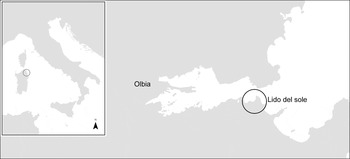
Research was carried out by diving and beach-combing by the first author along the coasts of north-eastern Sardinia. The specimens here described come from the delta of the Rio Padrongianus (Figure 1), at Lido del Sole. The Rio Padrongianus deltaic area (2.5 km2) is a wetland constituted by a grid of channels, partially submerged islands and small ponds delimited by a large number of beads of sand. It receives marine waters from the Gulf of Olbia, and freshwater from the Rio Padrongianus, a torrent-like river that originates in the eastern part of the Mount Limbara by the confluence of Rio Enas and Rio San Simone, and flows into the Gulf of Olbia after 35 km. It is immediately to the south-east to the Olbia harbour, the most important industrial and tourist port of eastern Sardinia; moreover the area hosts numerous fisheries and mollusc (Venerupis philippinarum, V. decussata and Mytilus galloprovincialis) aquaculture activities.
Map showing the position of Lido del Sole, in north-eastern Sardinia.

RESULTS
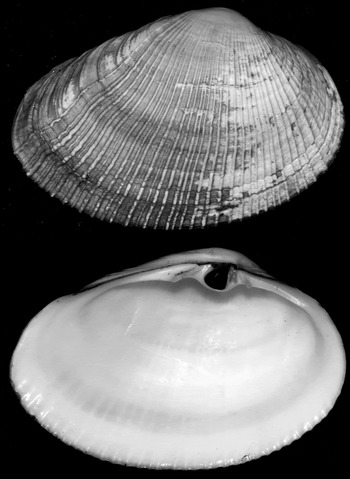
Eastonia rugosa was first found in the studied area on 20 September 2011. Two valves were collected on the beach: the first was a complete valve 70 mm long, the second was broken, but identification was straightforward since two-thirds of the shell was still present. A few days later, on 24 September 2011, a complete but empty specimen 66 mm long and a valve 35 mm long were found while diving at 3 m deep on a sandy substrate. On 3 October 2011, two living individuals were collected (63 and 68 mm long, the latter shown in Figure 2) among the tentacles of an octopus captured in his hole, while diving at 2 m deep on a sandy substrate with patches of Cymodocea nodosa (Ucria) Ascherson, 1869 and a few rocks. A valve 27 mm long was found during the same dive. Unfortunately it was impossible to conduct research until 19 February 2012, when more specimens were found while beach-combing: a small but complete juvenile specimen 28 mm long and three valves ranging in length from 50 to 76 mm were found. On 26 February 2012, a further beached valve 60 mm long was found. On 11 March 2012, two further beached valves respectively 55 and 59 mm long were found.
Eastonia rugosa (Helbling, 1779), Lido del Sole, Olbia, in north-eastern Sardinia: length 68 mm.

Research was carried out also on the northern shores of the Gulf of Olbia, but no specimens were found to date.
DISCUSSION
This is the first record of E. rugosa for Sardinia. The size of specimens, the presence of living individuals, and the continuity of findings in the past few months suggest that the settlement of the species in the delta of the Rio Padrongianus was successful. The influx of fresh water is known not to be a barrier for the species which was observed in similar conditions in southern Sicily (Orlando, Reference Orlando1979). Lack of records of E. rugosa for the northern shores of the Gulf of Olbia which are inhabited by most of the alien species found in the area suggests this is a very recent phenomenon: indeed, most alien species were first recorded from the area of the Rio Padrongianus and then spread to the north of the Gulf of Olbia.
Whether this is a true reproductive population or a pseudo-population fostered by the influx of transported larvae is not known. It is also still open to research whether this new record (like some other recent records along peninsular Italy) is exclusively the effect of natural drivers or if anthropogenic drivers may be playing a role, as suggested by Zaouali (Reference Zaouali and Briand2008). Indeed, the species has an almost continuous distribution along Sicily, but its distribution along peninsular Italy is patchy: it is not recorded from Calabria and Campania, while it is recorded from localities in Latium and Tuscany (Albano, in press).
The Gulf of Olbia is an area characterized by the presence of several alien species like Rapana venosa (Valenciennes, 1846), Venerupis philippinarum (A. Adams & Reeve, 1850) [=Ruditapes philippinarum], Arcuatula senhousia (Benson in Cantor, 1842) [=Musculista senhousia], Crassostrea gigas (Thunberg, 1793), Melibe viridis (Kelaart, 1858), Bursatella leachii Blainville, 1817, Fulvia fragilis (Forsskål in Niebuhr, 1775), Limnoperna securis (Lamarck, 1819) [=Xenostrobus securis], Anadara transversa (Say, 1822) and Brachidontes ustulatus (Lamarck, 1819) [=Brachidontes pharaonis (Fischer, 1870)] (Doneddu, Reference Doneddu2011)Footnote 1 . The dispersal mechanism is not known for all these species, but transport of larvae by ballast waters and accidental introduction with aquaculture are the most probable modes of introduction. In this context, it cannot be excluded that also E. rugosa reached this new locality by anthropogenic media.
In any case, this record fits the context of an increasing dispersion of the species in the Mediterranean Sea. The species was proposed as a descriptor of the ‘tropicalization’ of the Mediterranean Sea (CIESM ‘Tropical Signals' Programme) but its true value for this purpose depends upon the ability to discriminate a range extension driven only by exclusively natural or anthropogenic media. Also a better comprehension of the biological mechanism supporting its claimed affinity for warm waters would be desirable.
ACKNOWLEDGEMENTS
We thank the many Italian amateur collectors who provided data on the distribution of Eastonia rugosa. They supplement the lack of monitoring planned and carried out by institutions. Their work and data allowed us to place our observations in the context of the variations in the distribution of the species and eventually to recognize this as a further range extension.