I. INTRODUCTION
Noise analysis in oscillators, despite its long history dating back to the 1930s [Reference Berstein1–Reference Kurokawa4], still receives a large interest, from both theoretical and practical standpoints, because of the inherent complexity of fluctuation analysis in autonomous systems, and of the significant impact of oscillator noise performance on communication receivers [Reference Hajimiri and Lee5].
The widely accepted theory decomposes oscillator noise into time-reference fluctuations, which in analog applications are expressed in terms of phase noise, and into variations of the amplitude of the circuit working point: these give rise to the so-called amplitude or orbital noise contribution. Although the dominant component near to the oscillator frequency f 0 (and to its harmonics kf 0, k integer) is phase noise, orbital fluctuations become the stronger contribution at large offset frequencies, and therefore in the presence of a strong adjacent channel they contribute to impair the dynamic range of the receiver [Reference Hajimiri and Lee5].
The link between oscillator fluctuations and the circuit noise sources can be studied in several ways, with different degrees of complexity and, in turn, of accuracy. The two extrema are the purely linear perturbative analysis, and the full nonlinear treatment based on the derivation of a nonlinear partial differential equation having as unknown the probability density of the fluctuating state variables (i.e., the Fokker–Planck equation associated to the noisy oscillator dynamic equations). While the latter is of course a rigorous technique, its implementation is in general unpractical since very rarely a fully numerical integration can be avoided. On the other hand, in the linear perturbative approach the circuit variables are expressed as the sum of the noiseless oscillator value and of the noise-induced perturbation. Fluctuations are assumed of small amplitude, and the circuit is transformed into a linear time-varying system through linearization. This technique has been proved to provide an unphysical phase noise spectrum divergence for frequencies very close to the harmonics of the oscillating frequency, i.e., for vanishingly null offset (or sideband) frequency. Despite this limitation, however concentrated very near to f 0, linear perturbation is the most valuable tool in the hands of the circuit designer, at least for a first-order design, since quite often it allows for a fully analytical treatment.
The divergence issue has been overcome by the nonlinear perturbative analysis proposed in [Reference Demir, Mehrotra and Roychowdhury6], where only the phase noise component was considered. We have recently extended this treatment by deriving a consistent statistical characterization of the entire correlation matrix, i.e., by considering not only the phase noise but rather including orbital fluctuations and their correlation with phase noise as well [Reference Traversa and Bonani7]. We discuss here some results of the application of this approach to a couple of examples, showing the effects of orbital noise and the impact of the oscillator Q factor on its magnitude.
II. A GLIMPSE ON THE MODELING APPROACH
We assume that the oscillator is a lumped circuit represented by the autonomous ordinary differential equation:

where x(t) is the circuit state vector of size n. Let us consider the non-trivial periodic solution (limit cycle, of period T = 1/f 0) xS(t) for (1). We perturb (1) by adding the set ξ(t) of white Gaussian noise sources, so that z(t) satisfies

The solution-dependent matrix B(z) takes into account the possible modulation of the noise generators.
The nonlinear perturbation theory in [Reference Demir, Mehrotra and Roychowdhury6] is based on assuming for z(t) the following decomposition:

where α(t) is a stochastic process responsible for the oscillator phase noise, while y(t) corresponds to the orbital fluctuations (amplitude noise). The autocorrelation matrix of the noisy oscillator solution is therefore given by

where E{·} is the ensemble average operator and † denotes the complex conjugate and transpose operation. The first term  (t, τ) describes phase noise [Reference Demir, Mehrotra and Roychowdhury6].
Notice that the decomposition in (3) was already proposed in [Reference Kaertner8]: although both [Reference Kaertner8] and [Reference Demir, Mehrotra and Roychowdhury6] make use of the Floquet theory to develop their analysis, the advantage in the treatment of [Reference Demir, Mehrotra and Roychowdhury6] is in the choice of the projection operator chosen to decompose phase and amplitude fluctuations. Kaertner projects the equation along the tangent vector  , where u1(t) is the (direct) Floquet eigenvector associated to the null Floquet exponent μ1 = 0 always present when the linear system obtained by linearizing (1) around the steady-state solution xS(t) is studied [Reference Demir, Mehrotra and Roychowdhury6, Reference Traversa, Bonani and Donati Guerrieri9]. On the other hand, the derivation in [Reference Demir, Mehrotra and Roychowdhury6] shows that α(t) satisfies a nonlinear stochastic equation, derived by projecting the full equation along the Floquet adjoint eigenvector v1(t) associated to μ1. This decouples α(t) from orbital noise, thus allowing for a separated treatment of the two components.
The proof provided in [Reference Traversa and Bonani7] shows that including orbital fluctuations using the same projection system as in [Reference Demir, Mehrotra and Roychowdhury6], even the total noisy output z(t) is, at least asympotically with the observation time t, a stationary stochastic process (this result was obtained in [Reference Demir, Mehrotra and Roychowdhury6] with reference to phase noise only, i.e., by setting y(t) = 0). This means that, in the frequency domain, a stationary total spectrum can be defined as

where the partial spectra are the Fourier transforms of the asymptotic values of the correlation functions RxS,xS, RxS,y + Ry,xS and Ry,y, respectively.
Because of the decoupling of the α(t) equation from y(t), the phase noise contribution SxS,xS(ω) still is given by the same expression derived in [Reference Demir, Mehrotra and Roychowdhury6]. On the other hand, the second and third term in (5) depend on the remaining n − 1 Floquet exponents and direct and adjoint eigenvectors associated to the oscillator limit cycle. Closed-form expressions were mathematically derived [Reference Traversa and Bonani7], and reported in [Reference Traversa and Bonani10]. We repeat them here for the sake of self-consistency:


where i is the imaginary unit, ω 0 is the angular frequency of oscillation and  is the hth harmonic amplitude of the (exponential) Fourier representation of xS(t). The other coefficients are (here BT denotes the transpose of B) as follows:


In the previous expressions  is the DC harmonic component of v1(t)TB(t), and
 and
 are the Fourier coefficients of ul(t) and v1T(t)B(t), respectively.
Accordingly, the full noise spectrum evaluation is straightforward once two deterministic analyses are performed:
1. the oscillator working point xS(t) is calculated in the time or frequency domain, along with the oscillation frequency;
2. the oscillator equations are linearized around the limit cycle xS(t), and the corresponding linear system is analyzed according to the Floquet theory estimating all the n Floquet exponents μl, and all the associated direct ul(t) and adjoint vl(t) Floquet eigenvectors (l = 1, …,n). This evaluation can be, for instance, carried out in the frequency domain with the algorithms in [Reference Traversa, Bonani and Donati Guerrieri9, Reference Traversa and Bonani11].
III. RESULTS AND DISCUSSION
We consider here two examples of application: the HBT oscillator discussed in [Reference Traversa and Bonani10] and the Tow-Thomas oscillator studied in [Reference Demir, Mehrotra and Roychowdhury6, Reference Dec, Toth and Suyama12, Reference Brambilla, Gruosso and Storti Gajani13]. All simulations are carried out exploiting a simulation code written in the MATLAB environment [14].
A) HBT-based oscillator
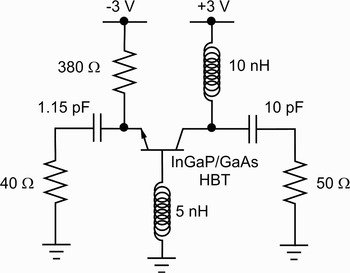
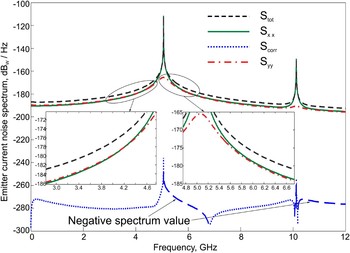
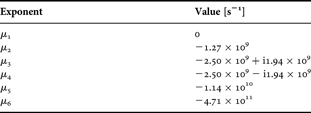
The first example is the negative-resistance oscillator shown in Fig. 1 [Reference Sweet15]. The active device is an InGaP/GaAs HBT represented by the Gummel-Poon model described in [Reference Sweet15], made of a static model complemented by the nonlinear capacitances connected between the base and emitter, and the base and collector. The emitter of the circuit exhibits a negative resistance and the rest of the circuit was designed to set up oscillations at 5 GHz. The circuit was simulated in the frequency domain with the harmonic balance (HB) technique including 30 harmonics plus DC. The calculated total emitter current noise spectrum and its components according to (5) are shown in Fig. 2 as a function of the absolute frequency. We found that the correlation spectrum is negligible, while orbital noise becomes the dominant term for frequencies away from the harmonics. The circuit is represented by a differential algebraic equation system made of nine scalar equations: according to [Reference Demir16], there are three infinite Floquet exponents and six Floquet exponents with the finite values listed in Table 1: apart from μ1, all exponents have negative real part thus implying that the oscillator is stable.
Circuit of the InGaP/GaAs HBT oscillator in [Reference Sweet15].

Total emitter current noise spectrum of the InGaP/GaAs HBT oscillator as a function of the absolute frequency (from [Reference Traversa and Bonani10]).

Floquet's exponents for the HBT oscillator.

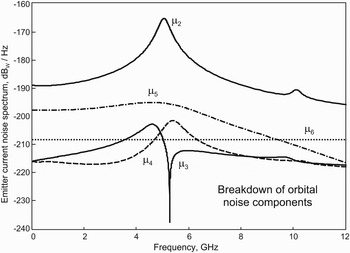
According to the expressions in [Reference Traversa and Bonani7, Reference Traversa and Bonani10], the partial contributions to the orbital noise spectrum due to the five non-null Floquet exponents are reported in Fig. 3. The dominant contribution is due to the exponent with the smallest real part, in qualitative agreement with the fact that the lth Floquet eigenvalue contribution to Sy,y(ω) is proportional to 1/μ l [Reference Traversa and Bonani10]. Notice, however, that the second largest component is due to μ 5, thus pointing out that the magnitude of the Floquet exponents is not the only contribution to be taken into account to assess the relative importance of amplitude noise.
Partial contributions to the orbital emitter current noise spectrum of the InGaP/GaAs HBT oscillator (from [Reference Traversa and Bonani10]).

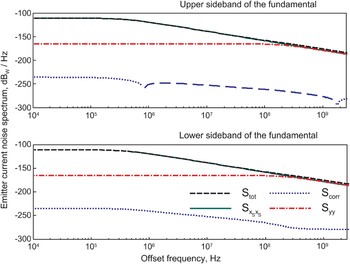
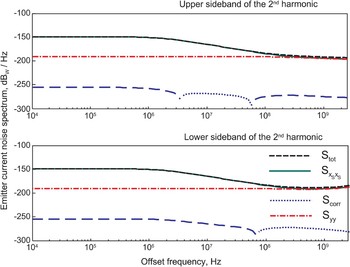
Figs 4 and 5 show, respectively, the sideband representation of the noise spectrum around the fundamental and the second harmonic component: the orbital contributions result into asymmetries in the spectrum around the oscillator harmonics, as also found in [Reference Brambilla, Gruosso, Redaelli, Storti Gajani and Caviglia17].
Upper and lower sideband total emitter current noise spectrum of the InGaP/GaAs HBT oscillator around the fundamental (from [Reference Traversa and Bonani10]).

Upper and lower sideband total emitter current noise spectrum of the InGaP/GaAs HBT oscillator around the second harmonic (from [Reference Traversa and Bonani10]).

B) Tow-Thomas oscillator
The second example is the Tow-Thomas oscillator presented in [Reference Demir, Mehrotra and Roychowdhury6, Reference Dec, Toth and Suyama12, Reference Brambilla, Gruosso and Storti Gajani13] and shown in Fig. 6. The operational amplifiers are ideal, noiseless and represented by nullors, while the inverter is approximated by the input–output relation v out = tanh(−αvin), where α is a parameter representing the slope of the transition. This circuit was chosen since it can be shown to be equivalent [Reference Demir, Mehrotra and Roychowdhury6] to a parallel RLC circuit with a Q factor corresponding to the Q coefficient in Fig. 6: this allows for a simple modulation of the Q value to study its impact on orbital noise. The output variable chosen for noise estimation is voltage v out.
Circuit of the Tow-Thomas oscillator. We used R = 1 kΩ and C = 20 nF.

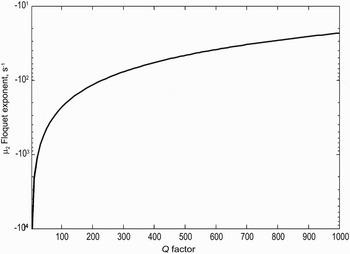
The oscillator has two state variables, therefore only two Floquet exponents μ 1 = 0 and μ 2 are present. The circuit was simulated with HB including 50 harmonics plus DC, assuming α = −3 and considering as noise sources only the thermal noise in the resistances. The resulting oscillation frequency is f 0 = 7.9172 kHz, while the Q-dependence of μ 2 (a real, negative number as expected for a stable oscillator) is presented in Fig. 7: as discussed in [Reference Demir16], a high-Q oscillator is characterized by at least a second Floquet exponent near to zero, which in turn should result into a larger amplitude noise component.
Floquet exponent μ 2 for the Tow-Thomas oscillator as a function of the Q factor of the equivalent RLC circuit.

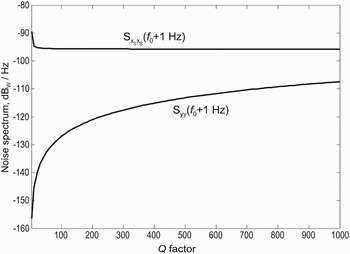
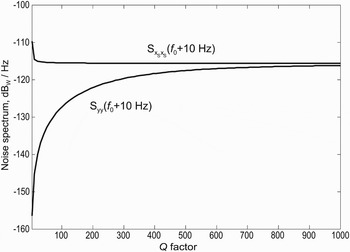
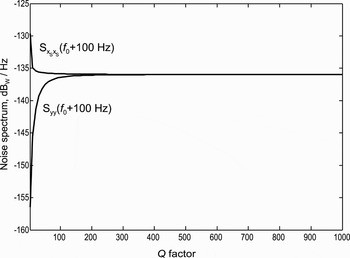
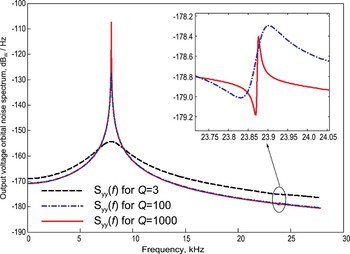
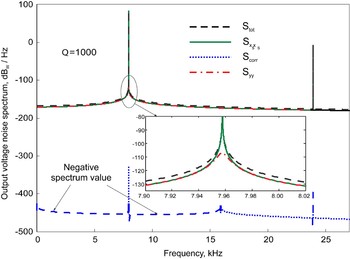
This is confirmed by Figs 8–10, which report the Q-dependence of the phase and orbital noise spectra at an offset frequency of 1, 10 and 100 Hz from f 0, respectively. As expected, the amplitude noise is steadily increasing with Q, reaching a maximum value equal to the corresponding phase noise spectrum. The absolute frequency dependence of the orbital noise spectrum using Q as a parameter is presented in Fig. 11, again confirming the impact of Q on the magnitude of amplitude noise. Notice also that in this circuit the correlation between phase and orbital fluctuations is negligible, as shown in Fig. 12, where the total output voltage noise spectrum and its partial components are shown for Q = 1000 as a function of the absolute frequency. Spectrum peaks are present at f 0 and 3f 0 only, as found also in [Reference Demir, Mehrotra and Roychowdhury6, Reference Dec, Toth and Suyama12].
Q-dependence of the phase and amplitude noise spectra at 1 Hz offset frequency from f 0 for the Tow-Thomas oscillator.

Q-dependence of the phase and amplitude noise spectra at 10 Hz offset frequency from f 0 for the Tow-Thomas oscillator.

Q-dependence of the phase and amplitude noise spectra at 100 Hz offset frequency from f 0 for the Tow-Thomas oscillator.

Orbital noise spectrum of the Tow-Thomas oscillator as a function of the absolute frequency for three values of Q.

Total noise spectrum of the Tow-Thomas oscillator as a function of the absolute frequency for Q = 1000.

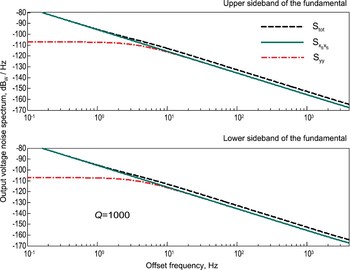
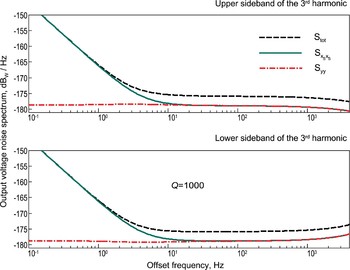
Finally, we show the offset frequency dependence of the relevant noise contributions around the fundamental and third harmonics in Figs 13 and 14, respectively. For this oscillator, although the noise spectrum is practically symmetric around the fundamental, an asymmetry appears around the third harmonics, again due to the orbital noise contribution.
Upper and lower sideband total noise spectrum of the Tow-Thomas oscillator around the fundamental for Q = 1000.

Upper and lower sideband total noise spectrum of the Tow-Thomas oscillator around the third harmonic for Q = 1000.

VI. CONCLUSION
Based on the rigorous extension of the nonlinear perturbative approach to oscillator noise analysis proposed in [Reference Demir, Mehrotra and Roychowdhury6], we discussed the effects of orbital noise on the fluctuation spectrum of autonomous circuits. We have provided two examples of application, showing that amplitude noise, the dominant fluctuation component sufficiently far away from the oscillation frequency, might be responsible for spectrum asymmetries around the oscillation frequency harmonics. Furthermore, we have provided evidence that orbital noise actually becomes more significant for high-Q oscillators, since its magnitude is, at least for the second-order oscillator considered in this study, an increasing function of the Q factor.
ACKNOWLEDGEMENTS
We acknowledge the partial support of Regione Piemonte through the research project CNT4SIC, and of the Spanish MEC project TEC 2009-06986. We also thank Dr. Simona Donati Guerrieri and Dr. Federica Cappelluti of Politecnico di Torino for useful discussions.
 Fabio L. Traversa was born in Bari, Italy, in 1979. He received the Laurea degree in Nuclear Engineering, and the Ph.D. degree in Physics from Politecnico di Torino, Italy, in 2004 and 2008, respectively. During 2008, he was a researcher fellow with the Electronics Department of the same institution, and since 2009 he is a Postdoctoral researcher at the Departament d'Enginyeria Electrònica, Universitat Autònoma de Barcelona, Spain. His research interests are mainly devoted to the physics-based simulation of transport in nano-devices, with special emphasis on the analysis and simulation of quantum correlations. Furthermore, he is also interested in the stability analysis of nonlinear circuits and systems, and in the noise analysis of nonlinear circuits.
 Fabrizio Bonani was born in Torino, Italy, in 1967. He received the Laurea degree, cum laude, and the Ph.D. degree in Electronic Engineering from Politecnico di Torino, Italy, in 1992 and 1996, respectively. Since 1995, he has been with the Electronics Department of the same institution, where he currently is an Associate Professor of Electronics. His research interests are mainly devoted to the physics-based simulation of semicondutor devices, with special emphasis on the noise analysis of field-effect and bipolar transistors, to the thermal analysis of power devices and circuits, and to the simulation and design of power semiconductor devices. He is also interested in the stability analysis of nonlinear circuits and systems, and in the noise analysis of nonlinear circuits.
From October 94 to June 95 he has been with the ULSI Technology Research Department of Bell Laboratories in Murray Hill (NJ) as a consultant, working on physics-based noise modeling of electron devices. From August to October 2008, he was Visiting Scientist at the Ferdinand-Braun-Institut für Höchstfrequenztechnik, Berlin, Germany, developing compact noise models for linear and nonlinear applications. He is a Senior Member of IEEE, and a member of the MTT-14 Technical Committee on Low-Noise Techniques. Since 2010, he serves in the Modeling and Simulation committee of IEDM.