

Clinical psychology, the subfield of psychology that focuses on the prevention, assessment and treatment of psychological maladjustment, disability and discomfort (American Psychological Association [APA], 2013), originated in the United States. In 1896, Lightner Witmer (1867–1956), a psychologist at the University of Pennsylvania, introduced a practical component of child guidance in the psychology training programme (Donn, Routh, & Lunt, Reference Donn, Routh and Lunt2000; Lawson, Graham, & Baker, Reference Lawson, Graham and Baker2007; Leahey, Reference Leahey2004). He called this applied psychology ‘clinical psychology’ (Kazarian & Evans, Reference Kazarian, Evans, Kazarian and Evans1998). Clinical psychological activities were extended to adults during the Second World War, when the US government stimulated expansion of the number of training opportunities (Kazarian & Evans, Reference Kazarian, Evans, Kazarian and Evans1998; Sarason, Reference Sarason, Pickren and Dewsbury2002). American universities adopted standardised models of clinical psychology with an empirical scientific base, such as the scientist-practitioner (Boulder) model in 1949, and the practitioner-scholar (Vail) model in 1973 (Donn et al., Reference Donn, Routh and Lunt2000; Sarason, Reference Sarason, Pickren and Dewsbury2002).
Today, these American models for clinical psychology are increasingly embedded outside the United States, for example in Australia and in Asian countries. However, little consideration is given to the impact, or the suitability, of ‘western’ models in clinical psychology for societies outside the United States, especially in culturally different regions such as Asia, and culturally diverse countries such as Australia which includes large populations of Indigenous Australians and other ethnic groups. Clinical psychology has been critiqued for being western-centric and intrinsically intertwined with western norms of behaviour and thought (Arnett, Reference Arnett2008; Davidson, Reference Davidson1993; Gone, Reference Gone2011; Henrich, Heine & Norenzayan, Reference Henrich, Heine and Norenzayan2010; Stewart, Reference Stewart2012; Watter, Reference Watter2010). Additionally, apart from a few notable exceptions (e.g. Blowers & Turtle, Reference Blowers and Turtle1987; Taft & Day, Reference Taft and Day1988), historical analysis of clinical psychology has mainly been an American endeavour (Kazarian & Evans, Reference Kazarian, Evans, Kazarian and Evans1998). Although it is likely through geographical movement and through the re-interpretations in different times and contexts, that clinical psychology has diversified (Geerlings & Lundberg, Reference Geerlings and Lundberg2014), nevertheless, little is known about the development and practices of clinical psychology other than mainstream American models. This paper seeks to explore this one-sided treatment of the history of psychology through a case study focusing on the expansion and diversification of clinical psychology education in Australia and three countries of the Malay Archipelago. The analysis is carried out through reviews of literature and information from university programmes, curricula and psychology associations.
Malay Archipelago
The Malay Archipelago is a region between Australia and South-East Asia, covering Singapore, Malaysia, Indonesia and, by most definitions, the Philippines. The term was first used by the British explorer Alfred Russel Wallace (1869) to describe the similarities in terms of biodiversity and indigenous cultures in the region. Wallace visited the countries of the Southern Malay Archipelago, including mainland Malaysia, which he included in the ‘archipelago’ due to the cultural, linguistic and trading links between the mainland and the surrounding islands. The term Maritime South-East Asia is often used synonymously with Malay Archipelago, however this term refers more to the islands than mainland Malaysia. For this reason we use the term Malay Archipelago and in this paper the term is used in the context of the southern Malay Archipelago – the areas of Wallace's journeys.
The three countries of the Malay Archipelago discussed in this paper are Indonesia, Malaysia and Singapore. These countries have historically maintained intensive trade relations both before and during colonialism, which was facilitated by the shared Malay language (Bahasa Melayu). Indonesia and the Federation of Malaya became independent from the Dutch and the British in 1950 and 1957 respectively. During this period, the Indonesian language (Bahasa Indonesia) was developed in Indonesia. In 1963, Sabah and Singapore became part of the Federation of Malaya, and Singapore became an independent nation in 1965. Malaysia kept the Malay language, Singapore adopted English, Mandarin and Tamil as official languages in addition to Malay. The countries in the Malay Archipelago remain connected through shared histories, cultures and languages. The Malay Archipelago countries, in turn, are historically linked through social, educational and economic ties with the regional neighbour, Australia.
Histories of Clinical Psychology
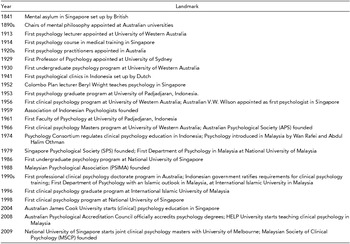
One way to explore the growth and diversification of psychology and the specialisation clinical psychology, with a view to stimulating further research into the history and development of clinical psychology in this region, is through reference to the available online and in-print resources from scientific databases, psychological organisations, universities and libraries. By considering each of the case study countries in chronological order, some interesting contrasts and comparisons can be made that show how the countries have appropriated initially foreign psychological knowledge. A summary of the dates discussed in this section can be found in Table 1.
Historical Landmarks of Australian and Malay Archipelago (Clinical) Psychology

Australia
Academic psychology in Australia has the longest history of the case studies presented here. It developed from the academic subject called ‘mental philosophy’ introduced in the 1890s by British colonial scholars to universities in Melbourne, Sydney and Adelaide (Taft, Reference Taft1982; Taft & Day, Reference Taft and Day1988). In 1913 the first specialist lecturer in psychology was appointed at the University of Western Australia (UWA), followed, in 1929, by a Professor of Psychology at the University of Sydney (Taft, Reference Taft1982; Taft & Day, Reference Taft and Day1988). One year later, an undergraduate programme in psychology started at UWA (Australian Psychological Society [APS], 2014). Such early Australian psychology programmes depended heavily on ideas from the northern hemisphere. For example, psychology lecturers were exclusively trained in the United Kingdom, Germany or the United States (Taft, Reference Taft1982).
The first applied psychology practitioners were appointed in Australia in the 1920s (APS, 2014), and the Second World War created a niche for clinical practice, which stimulated the development of clinical psychology education. The first specialist programme in clinical psychology was developed at UWA in 1956, and a decade later a professional Masters programme started (APS, 2014). Professional doctorates were introduced much later in the 1990s (APS, 2014). The rise in the number of clinical psychologists motivated the need for a professional organisation and the Australian Psychological Society (APS) was founded in 1966 with 941 original members. Clinical psychologists were expected to register with the APS, and since 2008 are required to have completed a clinical psychology programme that is accredited by the Australian Psychology Accreditation Council (APAC; Australian Psychology Accreditation Council, 2008).
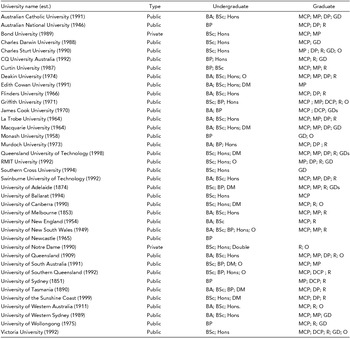
Today, psychology undergraduate education is offered at 38, and postgraduate clinical programs at 30, out of 40 Australian universities ‒ the majority of which are national, government-supported universities (see Table 2). Undergraduate programmes have high student intakes, whereas admission to postgraduate programmes is restricted. Thus the demand for clinical psychology education is still higher than Australian universities can presently offer. Psychology degrees in Australia are standardised in duration, methods and curriculum; quality is checked by the Australian Psychology Accreditation Council (APAC, 2010). The importance of addressing cultural diversity in specialty clinical psychology training is increasingly recognised (e.g. APAC, 2010). An example of two Queensland universities indicate that culture is integrated into both knowledge and skills development of clinical psychology trainees (James Cook University, 2014, 2014a, 2014b; University of Queensland, 2014, 2014a). Their clinical psychology programmes contain coursework, research and supervised practice (APAC, 2010), indicating a strong commitment to the scientist-practitioner model.
Psychology education in Australia (in alphabetical order)

Note. BA = Bachelor of Arts; BSc = Bachelor of Science; BP = Bachelor of Psychology; Hons = Honours; DM = Double Majors including Psychology; MCP = Master of Clinical Psychology; MP = Master of Psychology other than Clinical; DCP = Doctor of Clinical Psychology; DP = Doctor of Psychology other than Clinical; R; Research Master or PhD; GD = Graduate or Postgraduate Diploma; O = others
APAC accreditation of degrees enables unconstrained exchange of psychology students across Australian universities and ease of professional registration in Australia. However, it complicates admittance to Australian postgraduate psychology programmes for foreign students with non-APAC degrees. Even so, Australia is successful in exporting its psychology programmes to the Malay Archipelago. In 2012, seven Australian universities were involved in transnational education, resulting in 13 APAC-accredited programmes in Singapore, nine in Malaysia and one non-accredited degree in Indonesia (APAC, 2012; 2012a). These flows of knowledge are unidirectional, there are no foreign institutes involved in psychology education in Australia. However, as will be argued later, these flows are disturbed by bottom-up interpretations of psychology in each country. The next sections discuss the developments of psychology and the specialty clinical psychology in the countries in the Malay Archipelago, starting with the country in which there are no APAC accreditation programmes, Indonesia.
Indonesia
As with Australia, psychology was first introduced in Indonesia during the colonial era. In 1941, towards the end of colonisation, the Dutch set up clinics and taught psychology courses to teachers and medical students (see Table 1; Mumandar & Mumandar, Reference Mumandar, Munandar, Blowers and Turtle1987). During the struggle for Indonesian independence, most Dutch psychology experts returned to the Netherlands, leaving a scarcity of trained practitioners. Therefore, in the 1950s, selected Indonesian army personnel were sent to the Netherlands and Germany to study psychology. This was considered a temporary solution; the newly independent Indonesian government was quick to call for the development of local psychology training.
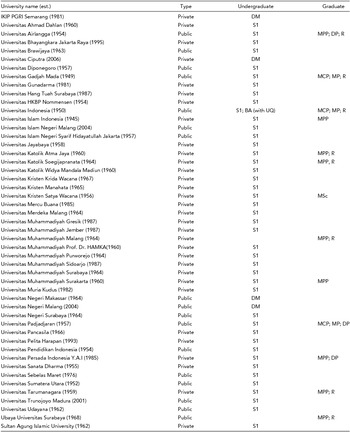
In 1953, Professor of Psychiatry, Slamet Iman Santoso, returned from the Netherlands to answer this call. He initiated the first psychology graduate programme at the National University of Indonesia (Universitas Indonesia) in Jakarta (Satiadarma, Reference Satiadarma2012; Singh, Reference Singh1998). However, this psychology programme was not fully independent: it was based on European programmes and texts, and was largely taught by graduates from the Netherlands and West Germany (Mumandar & Mumandar, Reference Mumandar, Munandar, Blowers and Turtle1987). In 1959, at a time when there were still only around 10 to 15 psychologists in Indonesia, the Association of Indonesian Psychologists (Ikatan Sarjana Psikologi Indonesia, now Himpunan Psikologi Indonesia, HIMPSI) was founded (Mumandar & Mumandar, Reference Mumandar, Munandar, Blowers and Turtle1987), perhaps indicating faith in the expansion of psychology in the country. Two years later, the first Faculty of Psychology was established at the University of Padjadjaran (Universitas Padjadjaran) in Bandung, after which psychology was adopted by other universities. Today, undergraduate psychology can be studied in 47 universities in Indonesia (see Table 3).
Psychology Education in Indonesia (in alphabetical order)

Note. S1 = Strata-1; DM = Double Major incl. Psychology; BA = Bachelor of Arts; MCP = Master of Clinical Psychology; MPP = Master of Professional Psychology; MP = Master of Psychology other than Clinical; DP = Doctor of Psychology other than Clinical; R = Research Master or PhD; UQ = University of Queensland, Australia.
Clinical psychology developed as a specific sub-discipline in Indonesia between the 1960s and 1990s (Satiadarma, Reference Satiadarma2012). Initially, clinical psychology practice was focused on military service, education and vocational guidance, with little attention to science (Mumandar & Mumandar, Reference Mumandar, Munandar, Blowers and Turtle1987). It was taught in three state universities: the National University of Indonesia, the University of Padjadjaran, and the University of Gadjah Mada (Universitas Gadjah Mada) in Jogjakarta. Currently, these three universities remain the only providers of clinical psychology education in the country. However, an additional nine universities, including some private universities with religious affiliations, offer ‘professional psychology’ programmes which are comparable to clinical psychology education. For example, the Muhammadiyah University of Malang (Universitas Muhammadiyah Malang), a private university from the Islamic Muhammadiyah organisation, interweaves Islamic perspectives with clinical psychology theories (Universitas Muhammediyah Malang, 2010). Clinical and professional psychology together constitute the majority of postgraduate programmes in psychology in Indonesia. Still, the number of clinical psychologists in the country remains low. Possible explanations include strict selection processes, limited available training places, demanding and costly study, and cultural norms.
Higher education is standardised and accredited by the Indonesian Ministry of Education and Culture (Kementerian Pendidikan dan Kebudayaan, Reference Pendidikan and dan2012). Although psychology education is not regulated or accredited by the Indonesian Association of Psychologists, in 1974 the Psychological Consortium (Konsorsium Psikologi; Mumandar & Mumandar, Reference Mumandar, Munandar, Blowers and Turtle1987) standardised training for clinical psychologists to a five-and-a-half year sequence. The Psychological Consortium is an advisory body consisting of members of the three state universities offering clinical psychology. The standardisation was ratified by the Indonesian government in the early 1990s (Satiadarma, Reference Satiadarma2012). Importantly, clinical psychology trainees are prepared to practice in Indonesia (Himpuman Psikologi Indonesia, 2012), although this focus may not be visible in curricula. For example, the present clinical psychology curriculum of the National University of Indonesia does not contain any specific reference to nationally-orientated adaptations of western clinical psychology, or to any courses on integration of psychology within the Indonesian cultural context. This national focus is paired with low international educational activity, for example only the National University of Indonesia offers a joint psychology undergraduate programme with the Australian University of Queensland (see Table 3).
Malaysia
Psychology and clinical psychology in Malaysia is substantially different from that of Indonesia, despite both countries initially relying on western psychology. Prior to separating from Singapore, psychology was introduced into the University of Malaya (Universiti Malaya) by Wan Mohammad Rafaei Wan Abdul Rahman and Abdul Halim Othman, when they taught psychology courses in the medicine and education curricula (Rahman, Reference Rahman, Ansari, Noor and Haque2005; Wan Rafaei Abdul Rahman, Reference Rafaei, Ansari, Noor and Haque1993; Ward, Reference Ward, Blowers and Turtle1987). These first psychology courses were taught in Malaysia in 1974, which is more than 20 years after the first psychology graduate programme was initiated in Indonesia. The psychology courses were preceded and facilitated by a conference on psychology and counselling organised by American Fulbright scholar Jerome Sattler in 1973 (Jerome Sattler, personal communication, 2014). Wan Rafaei Abdul Rahman and Abdul Halim Othman were both trained abroad, but made efforts to develop psychology locally with a Malaysian identity (Othman & Bakar, Reference Othman, Bakar, Othman and Awang1993).
After separation of Malaysia and Singapore and the founding of the National University of Malaysia (Universiti Kebangsaan Malaysia; UKM) by Malay nationalist scholars in 1968, psychology was adopted as an independent programme (Universiti Kebangsaan Malaysia, 2014). At the National University of Malaysia, psychology was linked with the social sciences (Universiti Kebangsaan Malaysia, 2013; Ward, Reference Ward, Blowers and Turtle1987), and expanded rapidly. In 1979, only five years after psychology's introduction into the country, the university established Malaysia's first Department of Psychology (Khan, Verma, & Subba, Reference Khan, Verma and Subba2012). This university also introduced a specialist programme in clinical psychology in the mid-1980s (L.O. Ng, Reference Ng, Noor and Dzulkifli2012; UKM, 2014). This Master of Arts programme moved to the Faculty of Medicine in 1994, until it was redesigned as a Master of Clinical Psychology under the Faculty of Allied Health Sciences in 2003 (L.O. Ng, Reference Ng, Noor and Dzulkifli2012).
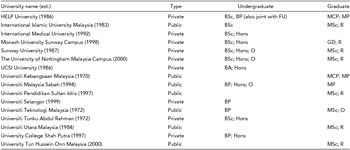
Currently psychology education is available in 16 universities in Malaysia, 12 of which offer undergraduate programmes and two offer postgraduate clinical psychology programmes (see Table 4). In 1990, a Department of Psychology was set up at the International Islamic University of Malaysia (Universiti Islam Antarabangsa Malaysia; IIUM; Singh, 1998; Haque & Masuan, Reference Haque and Masuan2002). This university was the first in Malaysia to teach psychology from an Islamic perspective (Wan Rafaei Abdul Rahman, Reference Rafaei, Ansari, Noor and Haque1993). Its clinical and counselling psychology programme, set up in 1996, has however, been non-active due to curriculum review since 2010 (L.O. Ng, Reference Ng, Noor and Dzulkifli2012). In addition, HELP University started offering clinical psychology in 2009 (Wan Rafaei Abdul Rahman, Reference Rafaei, Ansari, Noor and Haque1993). Both the National University of Malaysia and HELP University address the integration of clinical psychology in the Malaysian cultural context through a specific module (HELP University, 2011, 2012; Universiti Kebangsaan Malaysia, 2013a).
Psychology Education in Malaysia (in alphabetical order)

Note. BA = Bachelor of Arts; BSc = Bachelor of Science; BP = Bachelor of Psychology; Hons = Honours; MCP = Master of Clinical Psychology; MP = Master of Psychology other than Clinical; MSc = Master of Science, or coursework/research combined; R; Research Master or PhD; GD = Graduate Diploma or Postgraduate Diploma; O = Others; FU = Flinders University, Australia
The need for clinical psychologists in Malaysia is reported to be dire (Khan et al., Reference Khan, Verma and Subba2012; L.O. Ng, Reference Ng, Noor and Dzulkifli2012). The growth of the number of clinical psychologists has been slow, but seems to be improving: 20 years after the 1988 establishment of the Malaysian Psychological Association (called PSIMA) there were around 50 clinical psychologists in Malaysia (Rahmattullah Khan, Reference Rahmattullah Khan2008). More recently, in 2012, this number has climbed to 96 (L.O. Ng, Reference Ng, Noor and Dzulkifli2012). However, even though relatively low in numbers, clinical psychology has become more embedded in Malaysia. The Malaysian Society of Clinical Psychology (MSCP) was established as a registration and regulatory body for clinical psychologists in 2009 (L.O. Ng, Reference Ng, Noor and Dzulkifli2012) and had 69 members in 2013 (Malaysian Society of Clinical Psychology, 2012), the majority of which are locally trained clinical psychologists (Malaysian Society of Clinical Psychology, 2013). Together with the National University of Malaysia and HELP University, the MSCP is currently working towards registration of clinical psychologists and accreditation of training programmes.
Singapore
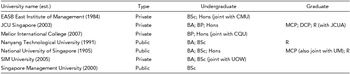
The foundations for psychology in Singapore were laid when the British established the Singaporean mental asylum in 1841 (Long, Reference Long, Blowers and Turtle1987). In the following decades psychology remained a profession solely focused on this early psychiatry background. This changed in 1914 when western academic psychology was introduced in medical training. This first psychology module, however, was considered of little academic value (Long, Reference Long, Blowers and Turtle1987). After the Second World War, psychology was re-introduced, this time as part of teacher training (Singh, Reference Singh1998), and in 1952, the Australian visiting lecturer Beryl Wright introduced psychology into the social work curriculum (Long, Reference Long, Blowers and Turtle1987). Wright visited the University of Malaya (now the National University of Singapore) as part of the Colombo Plan, a developmental aid scheme for Asia and the Pacific originally signed in Colombo by Australia, Canada, India, New Zealand, Pakistan, Sri Lanka and the United Kingdom (Colombo Plan, 2012). Psychology gradually gained recognition, and the Singapore Psychological Society was founded in 1979 with 40 founding members (Long, Reference Long, Blowers and Turtle1987; Singapore Psychological Society, 2014). Seven years later the first undergraduate psychology programme was established at the National University of Singapore (Singh, Reference Singh1998). Today, this programme is accompanied by undergraduate programmes in six other universities in Singapore (see Table 5).
Psychology Education in Singapore (in alphabetical order)

Note. BA = Bachelor of Arts; BSc = Bachelor of Science; Hons = Honours; MCP = Master of Clinical Psychology; DCP = Doctor of Clinical Psychology; R = Research Master or PhD; CMU = Cardiff Metropolitan University, United Kingdom; CQU = Central Queensland University, Australia; JCUA = James Cook University, Australia; UM = University of Melbourne, Australia; UOW = University of Wollongong, Australia
In 1956, a few years after Wright's visit to the then University of Malaya, the Australian V.W. Wilson was appointed as the first clinical psychologist under the Colonial Medical Service in Singapore. Wilson, like other psychologists in Singapore at the time, was trained abroad. The first opportunity to train in clinical psychology in Singapore became available in 1998 at the National University of Singapore (Singh & Kaur, Reference Singh and Kaur2002). As with the case studies of Australia and Indonesia, Singaporean clinical psychology education was dependent on imported ideas for the first decade of its existence (Long, Reference Long, Blowers and Turtle1987), with foreign textbooks and readings and with lecturers trained abroad (Singh & Kaur, Reference Singh and Kaur2002). More recently, in 2009, this foreign dependency has taken new shape with the National University of Singapore starting an APAC-accredited joint clinical psychology training programme with the Australian University of Melbourne, available for Singaporean candidates only (National University of Singapore, 2008). In addition, James Cook University, also Australian, started teaching clinical psychology Masters and Doctoral degrees in Singapore in 2004 (JCU Singapore, 2013). These programmes are also APAC-accredited, and attract predominately local candidates (Naylor & Hassan, Reference Naylor and Hassan2012; Singh & Kaur, Reference Singh and Kaur2002), indicating a strong Australian influence in the training of clinical psychologists in Singapore. Perhaps related to this Australian orientation, the curricula of the clinical psychology programmes in Singapore do not specifically address integration of clinical psychology into the Singaporean cultural context. In the APAC guidelines for accreditation several criteria refer to cultural awareness and intercultural competency, however, this ‘culture’ refers specifically to the Australian cultural milieu and has an emphasis on Indigenous Australia (APAC, 2010).
Knowledge Flows in Clinical Psychology
The introduction of psychology in Australia and the Malay Archipelago materialised through academic programmes (in Australia), clinics (in Indonesia) and mental asylums (in Singapore) set up by colonial scholars or professionals. Although clinics and education programmes were gradually taken over by local specialists, often they remained dependent upon foreign knowledge and expertise for at least their first few decades. This initial reliance on knowledge from the northern hemisphere was also the case in Malaysia, where psychology was taught by locals who were trained abroad. Thus psychology and clinical psychology in Australia and the Malay Archipelago may be considered, at least initially, to be Euro-American imports, and the early development of the discipline represents a neo-colonial continuation of the incorporation of foreign knowledge into the region (Geerlings, Lundberg, & Thompson, Reference Geerlings, Lundberg, Thompson and Mandal2013; Geerlings & Lundberg, Reference Geerlings and Lundberg2014).
The western basis of ideas and experiences introduced into psychology and clinical psychology in the Malay Archipelago and Australian contexts may have been at odds with the local traditions, political ideologies, religions, languages, cultures and ways of dealing with psychological distress. More recently, clinical psychology application in non-western contexts has come under increased scrutiny, and it has been critiqued for western ethnocentrism, for medicalisation of behaviour, for imposing western norms of behaviour on Asian and Indigenous societies, and for neglecting minority issues (Arnett, Reference Arnett2008; Davidson, Reference Davidson1993; Gone, Reference Gone2011; Henrich, Heine & Norenzayan, Reference Henrich, Heine and Norenzayan2010; Othman & Awang, Reference Othman and Awang1993; Stewart, Reference Stewart2012; Watter, Reference Watter2010). These concerns invite a postcolonial critique of the knowledge flows in psychology from west to east and north to south: they draw attention to power disparities in the production of knowledge in clinical psychology.
The above histories indicate that west to east and north to south knowledge flows in psychology are more recently accompanied by flows from Australia to Singapore and, to a smaller extent, to Indonesia and Malaysia (see Tables 3–5). These new flows of Australian influence move with transnational education, for instance, through joint university programmes and programmes taught at overseas branch campuses of Australian universities. Especially influential in these flows is the Australian Psychological Accreditation Council. APAC accreditation is used to standardise psychology education for the Australian context and to prevent cultural translation or change. It prioritises perspectives, knowledge and practices in psychology education that are deemed important for preparing students to practice in the Australian context. Transnational application of APAC accreditation, however, may lead to cultural imperialist tendencies in clinical psychology education. In other words, through overseas application APAC accreditation defines the priorities and aims of psychology education in Malay Archipelago countries. This may restrict the development of local cultural interpretations or accreditations of clinical psychology degrees in Singapore, Indonesia and Malaysia.
Similarly, the ‘restricting effects’ of accreditation may also take place within countries: priorities set by the APAC may not always represent important issues for communities in the various states and regions of Australia. The inverted situation in Indonesia confirms this. In the Indonesian context psychology and clinical psychology programs are not yet nationally accredited by the Indonesian Association of Psychologists or the Psychological Consortium. As a result, diverse interpretations of clinical psychology have developed, which is witnessed in, for example, education programs which interweave clinical psychology with Catholic or Islamic understandings. Possibly, these cultural translations of clinical psychology have been able to develop because of the absence of a national accreditation system – with the future of such diversity becoming uncertain once an accreditation system for psychology degrees is developed.
Flows of knowledge can thus take place between countries (such as from the United Kingdom to Australia, or from Australia to countries of the Malay Archipelago) and within countries (such as from the Australian national government to the various communities in Australia). As a result of such flows, people prioritise specific knowledge and practices in psychology and clinical psychology, which restricts bottom-up cultural interpretations. However, the existence of counter flows of ideas, challenging or interrupting the ones from Euro-America to the global ‘south’, for instance those originating from Australia, or religious interpretations of clinical psychology in Indonesia and of cultural courses in Malaysia, indicate that although clinical psychology may have historically been based upon western models, it has been adjusted to Australian and Malay Archipelago contexts in education programmes to some extent.
Culture and Clinical Psychology
Accreditation and standardisation rests upon the assumption of human commonality rather than on human diversity. Standardised clinical psychology curricula focus on models of psychopathology, methods for therapy and skills for clinicians that are deemed applicable to large populations, such as the entire Australian population. As a result, these programmes might be preparing clinical psychologists to work with imagined, but non-existent, ‘global citizens’ (S.W. Ng, Reference Ng, Noor and Dzulkifli2012), instead of with real Australians, Indonesians, Malaysians or Singaporeans (including large populations of Indigenous Australians, and other ethnic and indigenous groups in Australia, Indonesia, Malaysia and Singapore) whose mental health needs are shaped by their societal, cultural, interpersonal, national and local contexts. It is important to understand whether standardised clinical psychology programmes are meeting the needs of the societies in which they are taught – whether Australia or in the different countries of the Malay Archipelago.
Concerns about the neglect of culture by mental health professionals have been voiced in the United States and Canada since the 1960s (Kazarian & Evans, Reference Kazarian, Evans, Kazarian and Evans1998), and have more recently been raised in Australia (Davidson, 2007) and in the Malay Archipelago (Chong, Mohamad & Er, Reference Chong, Mohamad and Er2013; Haque, Reference Haque2010; Kao & Sinha, Reference Kao and Sinha1997; L.O. Ng, Reference Ng2012; Othman & Awang, Reference Othman and Awang1993). Some professional organisations have called attention to cultural competency in their ethical codes (APS, 2014a; Himpuman Psikologi Indonesia, 2010). However, the case studies in this paper indicate that culture is only addressed in a limited way in clinical psychology curricula. In Australia, clinical psychology trainees should be knowledgeable of the limitations of the application of clinical psychology to different cultural groups, and should be prepared to practice cross-culturally, however, alternative, or ‘non-western’ models for psychopathology or clinical practice are not specifically addressed. In the clinical psychology programme at the National University of Indonesia, culture is not mentioned, but religious understandings are interwoven in the professional psychology programme at the Muhammadiyah University of Malang. In Malaysia, the psychology programmes at the National University of Malaysia and HELP University focused on embedding psychology in the local cultural context from its inception. Such an emphasis on culture is not found in Singapore, where issues of diversity are not officially addressed in curricula.
Conclusions and Future Directions
University education serves an important function in preparing students to address societal needs (Altman, Reference Altman1996; Chan & Lo, Reference Chan and Lo2008; Chiang, Reference Chiang2012). However, psychology, including clinical psychology, has always been part of society: its ideas and practices cannot be separated from the culture(s) from which they originate and in which they are practiced. Psychology and clinical psychology in Australia and the Malay Archipelago have long been dependent upon ideas and practices from Europe and America. Although some bottom-up cultural interpretations have been made, especially in Indonesia and Malaysia, the current state of clinical psychology in the region could be interpreted as embodying western influence.
Despite several forays into this issue from academics and practitioners, the close relationship between clinical psychology and culture deserves more attention. The issue is often neglected in research and lacks significant theorisation. In addition, in the training of clinical psychologists little attention is paid to the historical cultural background of psychology, or on issues of cultural diversity. There is a concern that the current system may train a generation of clinical psychologists who are ‘culture-blind’ (Kazarian & Evans, Reference Kazarian, Evans, Kazarian and Evans1998, p. 9), and are not able to effectively address cultural diversity in their client groups. This, in turn, may negatively influence their ability to meet the mental health needs in their country of practice. On a larger scale, culture-blindness perpetuates a system of uneven production of knowledge and ideas in psychology and clinical psychology, in which Euro-American perspectives are prioritised over ‘non-western’ perspectives, and Australian perspectives over those arising from local communities or from countries in the Malay Archipelago. These issues raise important questions about the future direction of clinical psychology in Australia and in the Malay Archipelago region.
Due to uneven resources and disparities of power to produce and distribute knowledge, standardisation of degrees and transnational education may be at the expense of the development of local perspectives on mental health and wellbeing. In discourses of globalisation, commonalities are often emphasised. However, differences also need to be recognised and understood. There is a need to stimulate cultural perspectives in research and encourage the incorporation of diverse perspectives in psychology education and in clinical practice so that clinical psychology is prepared to meet the mental health demands of a globalised world.
Indigenous psychologies, which are locally developed psychologies within a specific cultural context (Allwood & Berry, Reference Allwood and Berry2006), could accelerate this process as they offer valid alternative perspectives in clinical psychology. These cultural approaches to psychology initially developed in India, and later in other countries in Asia and the Pacific, as a reaction to the assumption that western psychology represents universal psychology, and as a way to deal with social, political and cultural diversity (Allwood & Berry, Reference Allwood and Berry2006; Saw & Okazaki, Reference Saw, Okazaki and Chang2012). By stimulating the development of indigenous psychologies, bottom-up interpretations of clinical psychology are allowed to create alternative flows of knowledge that can help enrich clinical psychology professions and education programmes globally.
Acknowledgements
This research received no specific grant from any funding agency, commercial or not-for-profit sectors.
Declaration of interest
None.