Introduction
Changes in species diversity along gradients are well-known phenomena and many hypotheses have been proposed to explain the observed variability, not only in free-living organisms but also in parasites (Willig et al., Reference Willig, Kaufman and Stevens2003). The biological, ecological and evolutionary implications of those processes are obvious. In applied sciences such as fisheries, the knowledge of the stock structure and degree of mixing among populations is a critical issue for the rational management of marine resources (MacKenzie & Abaúnza, Reference MacKenzie and Abaúnza1998). Among the tools for stock determination, parasites as natural tags have been used successfully (MacKenzie, Reference MacKenzie2002). The theory underlying the use of parasites as biological tags refers to changes (qualitative and/or qualitative) in the parasite burdens of fish belonging to different stocks (MacKenzie & Abaúnza, Reference MacKenzie and Abaúnza1998). The use of multivariate statistical techniques to detect significant differences in the structure of the parasite communities that infect fish from different localities has increased dramatically in recent years. In brief, such techniques evaluate whether the composition of the parasite component communities (defined as all parasite infrapopulations associated with a subset of a host species, see Bush et al., Reference Bush, Fernandez, Esch and Seed2001) of fish from different localities along their geographical ranges differ. The main problem associated with this approach is that, strictly, in each locality the component community variability is not considered. Thus, observed results can be explained as a comparison of variability between two different hierarchical levels: component community (between localities) and infracommunities (within localities). To the best of our knowledge, there are no studies dealing with fish stock assessment, using parasites, which evaluate the potential local variability, considering different subsets of the host population for each locality.
Here, we evaluated whether local variability in parasite communities can be a confounding factor in the identification of fish stocks. For this, we use as a model the parasite communities of the anchoveta Engraulis ringens from northern Chile.
Materials and methods
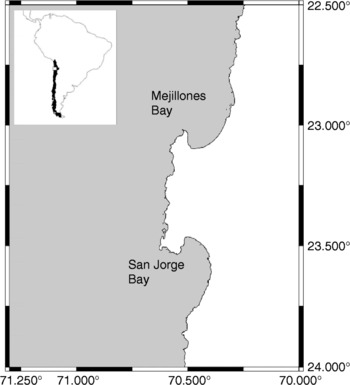
In order to avoid the potential effects of temporal variability, during April 2005 over short temporal windows (every 2 days), five independent samples of 60 specimens of E. ringens from two close localities in northern Chile were collected: Mejillones Bay (70°36′W, 23°27′S) and Bay of San Jorge (70°25′W, 23°41′S) (fig. 1). Fish were obtained directly from local fishermen in order to ensure that samples were closely associated with the landing port (Oliva & Ballón, Reference Oliva and Ballón2002). Fish were frozen ( − 18°C) and transported to the laboratory for parasitological analyses. After thawing, the fish were measured (nearest 0.1 cm), dissected, sexed and examined for metazoan parasites (both ectoparasites and endoparasites). For each fish host, the recorded parasites were identified and counted.
Sampled localities for Engraulis ringens in northern Chile.

For each parasite species, the population descriptors (prevalence and mean intensity) were calculated according to Bush et al. (Reference Bush, Lafferty, Lotz and Shostak1997). Univariate analyses were performed to evaluate the infections at the infrapopulation level (only for parasites with prevalence ≥ 5%) in each locality. The significance of differences in mean total length of the fish host was evaluated by one-way ANOVA. The same test was used in order to evaluate whether mean intensity of infection (previous log n+1 transformation) differed significantly within and between localities. The log-likelihood ‘G’ test was used to evaluate the significance of differences in prevalence of infection. A Multivariate Discriminant Analysis (MDA) was performed using each one of the parasite species in each sample for each locality as explanatory variables, so as to determine whether the parasite component communities vary within and between localities. Statistical analyses were applied following Zar (Reference Zar1996) and SYSTAT was used as statistical software (Wilkinson, Reference Wilkinson1990).
Results
Between localities, the mean size of fish (Bay of San Jorge and Mejillones Bay) did not differ significantly (F 1,596 = 3.94, P = 0.048). Within locality, mean size of fish from Mejillones did not differ among samples (F 4,295 = 1.83, P = 0.123) either. However, mean size of fish from Bay of San Jorge differed significantly among samples (F 4,295 = 10.448, P < 0.001). These differences are related to sample 2, which had specimens larger than those from the other samples (table 1).
Mean size of anchovy Engraulis ringens from five samples taken in two close localities in northern Chile.

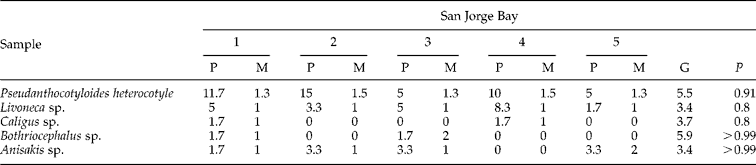
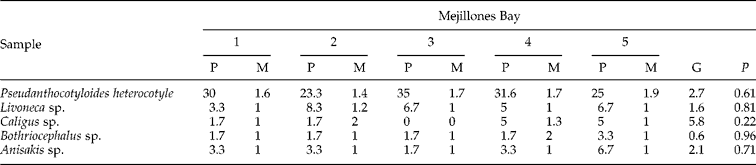
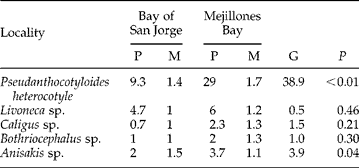
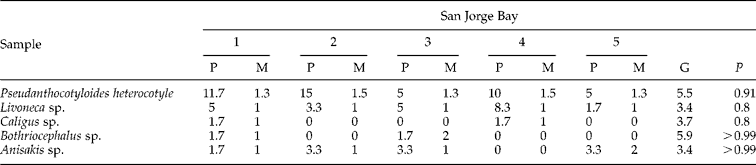
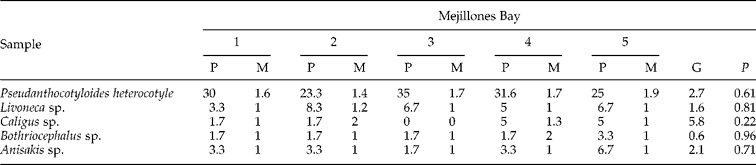
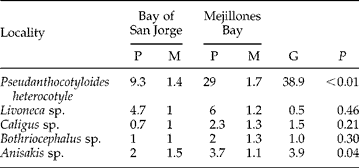
The same five parasite species were obtained from Mejillones Bay and Bay of San Jorge: the monogenean Pseudanthocotyloides heterocotyle, the cestode Bothriocephalus sp., the larval nematode Anisakis sp., the isopod Livoneca sp. and the copepod Caligus sp. Prevalence and mean intensity of infection did not differ within localities (tables 2 and 3), but the prevalence of P. heterocotyle was higher in Mejillones Bay than in Bay of San Jorge (table 4). The mean intensity of infection of the most important parasite, P. heterocotyle, did not differ significantly within (Mejillones Bay: F 4,82 = 0.704, P = 0.592; Bay of San Jorge: F 4,23 = 1.114, P = 0.374) or between localities (F 1,113 = 0.70, P = 0.405). Low values of prevalence of infection for the remaining parasites precluded the use of ANOVA. The results of the discriminant multivariate analyses demonstrated the lack of discrimination of the fish samples between localities (Bay of San Jorge: percentage of correct assignation 23%, Wilk's lambda = 0.937, F approx. 0.954, df = 20,966, P = 0.517; Mejillones Bay: percentage of correct assignation 21%, Wilk's lambda = 0.768, F approx. 1.674, df = 45,705, P = 0.564). A similar picture became evident when the samples from both localities were pooled. Correct assignation reached 14% (Wilk's lambda = 0.768, F approx. 0.951, df = 45,705, P = 0.564).
Metazoan parasites of Engraulis ringens from Bay of San Jorge; prevalence (P), mean intensity of infection (M), ‘G’ value and probability level (P).
Metazoan parasites of Engraulis ringens from Mejillones Bay; prevalence (P), mean intensity of infection (M), ‘G’ value and probability level (P).
Metazoan parasites of Engraulis ringens from Bay of San Jorge and Mejillones Bay; prevalence (P), mean intensity of infection (M), ‘G’ value and probability level (P).
Discussion
The use of multivariate techniques as an analytical tool for stock identification using parasites as biological tags has substantially increased in the past few years (for a review see MacKenzie, Reference MacKenzie2002). Multivariate techniques, such as detrended correspondence analysis and canonical multivariate discriminant analysis (see, for instance, George-Nascimento, Reference George-Nascimento2000; Oliva & Ballón, Reference Oliva and Ballón2002; Oliva & Sanchez, Reference Oliva and Sanchez2005) are adequate tools when quantitative instead of qualitative differences in the composition of parasite communities are used for stock discrimination. In brief, single samples captured from different localities along the geographical distribution of the host target species are analysed and compared. This approach means that variability at infracommunity level is compared, but we must look for variability at the component community. Such variability can be detected if we consider the component community as all the parasite infrapopulations associated with a subset of a host species, as described by Bush et al. (Reference Bush, Fernandez, Esch and Seed2001). Under this approach, we can analyse different samples that will represent independent replicates from the component community for each locality. To the best of our knowledge, this method has never been developed. A search in the specialized literature shows that at least 40 articles about parasites as biological tags have been published since 1995. All these articles, except Moore (Reference Moore2001) analysed just one fish sample from each locality. Moore (Reference Moore2001) analysed the metazoan parasites of the lesser-spotted dogfish Scyliorhinus canicula in order to assess their potential as stock discrimination tools. This author took samples from three localities (Plymouth: two samples; Cardigan Bay: three samples; and Eastern Solent: four samples). Unfortunately, sample size for each replicate was too small and the samples for each locality were pooled and analysed in the traditional way.
Our results show that, at least for E. ringens, the variability at local scale generated by 10 independent samples can be captured well by a single sample that can be used as a proxy of variability at the component community. In conclusion, the variability in the parasite composition among infracommunities of a single sample taken of a particular locality is a good representation of the variability in the parasite composition at component community level for this locality.
Acknowledgements
The authors thank Dr Ken MacKenzie (Zoological Department, University of Aberdeen) and Dr Ruben Escribano (COPAS Center, Universidad de Concepción) for comments and suggestions on an early draft of this paper. Partially funded by grant FONDECYT 1050528.