Introduction
The care of frail older people is of ever growing concern as populations age. The greater part of eldercare is provided by members of the family and other informal carers. A significant amount of care also comes from formal services, which range from home-delivered personal-care through day-care facilities to residential institutions. What happens when such formal and informal sources of support converge? (Litwin and Auslander Reference Litwin and Auslander1992). Understanding the inter-relationship between the formal and informal care of frail elderly people is a complex undertaking, and several competing explanations have been proposed – these arise partly from the various loci at which the interface occurs. This analysis focuses on the care of elderly people in their own homes and examines three main sources of care: informal carers within the household, informal carers outside the household, and formal carers. In concentrating our investigation on this tripartite division of care and by examining the socio-demographic and health correlates of the various combinations, we hope to provide new insight into variations in the sources of care.
The present inquiry examines the inter-relationship between formal and informal care in France and Israel. While not geographically a European country, Israel is economically, politically and culturally close to several European societies, which legitimates an Israeli-European comparison. We have chosen to limit the comparison to a single European country to allow greater depth of analysis, and to focus on France because of particular interest is the role of the family vis-à-vis the State or its agencies, and in this respect France is distinctive. As shown in numerous studies on French politique de la famille [family policy], among European countries, France has invested the most in the wellbeing of families for almost a century (see for example Pitrou Reference Pitrou1994; Commailles, Strobel and Villac Reference Commailles, Strobel and Villac2002; Damon Reference Damon2006). Although the French welfare system is classified as ‘conservative corporatist’ in the Esping-Andersen (Reference Esping-Andersen1990) typology, when looking exclusively at family welfare the arrangements are close to those of Scandinavian countries. Family policy in both France and Scandinavia is highly structured and legitimated through specific institutions and administrations. In contrast, family policy in southern and eastern European countries hardly exists, or still has slight recognition, funding and coherence. Between these two extremes are intermediate situations, such as Germany's, where ‘pro-family rhetoric’ is rising, but among policy makers there is still reluctance for public policies to interfere in private life (Damon Reference Damon2008: 36–7).
The importance of public welfare in family life in France means that an analysis of the interaction between formal and informal care is timely. Professional help and care for older people in France are mainly delivered through non-profit organisations funded partly by the State through the social security administration, and partly by the recipients, depending on their income and assets. There is also a new French funding programme, aide personnalisée à l'autonomie (APA) [personal benefits for autonomy], which provides benefits to older people according to their level of dependency, an arrangement comparable with that in Israel. France and Israel present some similarities in this respect, but nevertheless have many historical, philosophical and religious differences; these make a comparison of the interaction between family and public solidarity in the two countries both relevant and interesting.
Theoretical perspectives on the association between formal and formal care
As noted, there are competing propositions about the relationship between informal and formal care. The substitution hypothesis maintains that the entry of formal care into the care-giving network weakens and eventually replaces informal care (Agree et al. Reference Agree, Freedman, Cornman, Wolf and Marcotte2005; Moscovice, Davidson and McCaffrey Reference Moscovice, Davidson and McCaffrey1988; Penning Reference Penning2000). Much of the analysis of the formal/informal interface in the care of frail older people has centred on the substitution effect, but only a few studies have found empirical confirmation. Thus, for example, substitution has been found in the United States among elderly whites (but not among Blacks) (Miner Reference Miner1995), and in England among cognitively-impaired older persons (Schneider et al. Reference Schneider, Hallam, Islam, Murray, Foley, Atkins, Banerjee and Mann2003), but most empirical investigations have found little evidence that formal care replaces informal support (Kelman Reference Kelman1994; Li Reference Li2005; Penning Reference Penning2002). The available evidence tends rather to substantiate the co-existence of formal and informal care, a phenomenon termed variously as complementarity or supplementation (Davey et al. Reference Davey, Femia, Zarit, Shea, Sundström, Berg, Smyer and Savla2005; Sundström, Malmberg and Johansson Reference Sundström, Malmberg and Johansson2006). That is, formal care providers are seen to complement the efforts of informal care-givers at all times, or to supplement them when the needs of the care-recipient increase beyond the informal carers' capacity. Moreover, while there may be a slight distinction in the nature of complementarity and supplementation, both demonstrate collaboration between the formal and informal systems (Proux, Bourque and Savard Reference Prouix, Bourque and Savard2007; Sundström, Johansson and Hassing Reference Sundström, Johansson and Hassing2002).
In a study of the ‘Home and Community-Based Medicaid Waiver Program’ in Michigan, for example, Li (Reference Li2005) found that the extent of informal care declined when publicly-paid home care was first received, but that after a time it stabilised. She concluded that informal care-givers do not relinquish care-giving even when formal home care is available. Additional support for the complementarity thesis has been evinced in Canada (Denton Reference Denton1997), Sweden (Davey et al. Reference Davey, Femia, Zarit, Shea, Sundström, Berg, Smyer and Savla2005) and elsewhere (Motel-Klingebiel, Tesch-Roemer and Von Kondratowitz Reference Motel-Klingebiel, Tesch-Roemer and Von Kondratowitz2005). The generalisability of either a substitution or a complementarity effect is made problematic by the use of different measures of formal care. For example, several studies use entry into a residential facility as the indicator of formal care (Davey et al. Reference Davey, Femia, Zarit, Shea, Sundström, Berg, Smyer and Savla2005; Fischer et al. Reference Fischer, Green, Goodman, Brody, Aickin, Wei, Phelps and Leutz2003; Friedman et al. Reference Friedman, Steinwachs, Temkin-Greener and Mukamel2006). While institutionalisation can be regarded as the ultimate substitution, the transition is comparatively rare, and it fails to capture the dynamics of the formal/informal interface where it most often occurs, of the care provided in people's own homes. Research on this setting or locus of care needs to analyse the factors that influence the provenance, levels and mix of care.
Another theory frequently applied to the study of informal and formal care is that of hierarchical compensation. This holds that informal care is provided mainly by a primary care-giver in order of familial proximity and availability – first by spouse, followed respectively by adult children, more distant family and others (Cantor Reference Cantor1991; Feld, Dunkle and Schroepfer Reference Feld, Dunkle and Schroepfer2004; Messeri, Silverstein and Litwak Reference Messeri, Silverstein and Litwak1993). According to this hierarchy, formal care is invoked after informal care sources have been depleted or are unavailable. Although the hierarchical compensatory theory has not received widespread empirical verification, it invokes a broader issue, the influence of who is the primary carer on the relationship between informal and formal care. Specifically, it suggests the need to distinguish between spouse-based and other family-based care-giving.
Patterns of family care are frequently differentiated by the living arrangement. Habib and colleagues (Reference Habib, Sundström and Windmiller1993) used a residential classification, later employed by Davey et al. (Reference Davey, Femia, Zarit, Shea, Sundström, Berg, Smyer and Savla2005), that distinguishes co-residence with spouse and has/does not have children, resides alone and has/does not have children, and resides with a child. Another classification views the patterns of family care in terms of generational structure (Attias-Donfut, Ogg and Wolff Reference Attias-Donfut, Ogg and Wolff2005). For older adults, this means distinguishing between persons who belong to one-, two-, three- or four-generation families. While both approaches measure the potential availability of carers, they may not reliably indicate the actual providers of family care. For this, one needs to focus on those in the family who actually provide care.
On this matter, the prevailing belief has been that spouses provide more intensive care and for longer periods than adult children and other relatives, which suggests that the latter might refer the care recipient to formal care earlier. Gender differences in care-giving resiliency suggest, however, that the division of care among kin may be more complex than has been assumed (Arber and Ginn Reference Arber and Ginn1995; Spitze et al. Reference Spitze, Logan, Joseph and Lee1994). Moreover, some studies find more similarities than differences between spouse and child care-givers (Llacer et al. Reference Llacer, Zunzunegui, Gutierrez-Cuadra, Beland and Zarit2002). Yet another factor that shapes the inter-relationship between formal and informal care is the welfare regime, or the structural nature and context of care-delivery in the country (Albertini, Kohli and Vogel Reference Albertini, Kohli and Vogel2007; Lowenstein and Daatland Reference Lowenstein and Daatland2006). Thus, for example, results from the OASIS study of four countries in Europe and Israel showed that the total quantity of help received by older people was greater in countries that had well developed formal services (Motel-Klingebiel et al. Reference Motel-Klingebiel, Tesch-Roemer and Von Kondratowitz2005). The investigators maintained, moreover, that formal care and informal care were cumulative in societies with well-developed service infrastructures. This was not the case, on the other hand, in family-oriented welfare regimes.
The influence of the welfare regime
Regarding the respective welfare regimes in the two study countries, as noted earlier, France has a ‘conservative-corporatist’ welfare state (Bonoli Reference Bonoli1997; Esping-Andersen Reference Esping-Andersen1990; Ferrera Reference Ferrera1996). Dutton (Reference Dutton2002) maintained that France simultaneously pursues an industrial model of family welfare, in which class distinctions and employer control predominate, with a mutual-aid model that protects against the risks of illness, disability and old age. This duality explains the consistent strong support for the welfare state in France. There is less agreement as to how to classify the Israeli welfare regime. Writers have traced the transition of the Israeli welfare system from its social democratic origins to more recent neo-liberal features (Sabbagh, Powel and Vanhuysse Reference Sabbagh, Powel and Vanhuysse2007). Others have contended that Israel shares key elements of the ‘corporatist welfare’ regime (Lewin-Epstein, Stier and Braun Reference Lewin-Epstein, Stier and Braun2006), and that it has a ‘mixed’ regime in that legal backing of the family's obligation to provide care co-exists with high service levels (Lowenstein and Daatland Reference Lowenstein and Daatland2006). Indeed, among European countries, Israel ranks high in its support for filial norms (Daatland and Herlofson Reference Daatland and Herlofson2003).
A comparison of French and Israeli statistics on public social expenditure aids understanding of the differences between the two welfare regimes. France spent a higher percentage of its gross national product on public social expenditures in 2001 than Israel (respectively 27.5% and 19.3%) (Organisation for Economic Cooperation and Development 2007). A similar contrast applied to public spending on old-age and survivors' pensions in 2005 (12.3% in France, 4.8% in Israel) (Ben Shalom Reference Ben Shalom2007; Eurostat 2007). As for the respective poverty rates, some 14 per cent of the French population were below the poverty line in 2004, as compared to 23.6 per cent in Israel (European Commissions Reference European2006). Moreover, several measures of the gini coefficient show greater income inequality in Israel (Eurostat 2007). These figures suggest that the institutional base for social welfare is more developed in France than it is in Israel. The structure of social services also points to important differences between the two countries. In France, services are mostly private and older adults are provided with financial assistance (autonomy pensions) as a function of physical need and financial resources to purchase required services. In Israel, public in-kind long-term care benefits are available for older people with an assessed level of functional disability. This assistance provides a basic package of home-care assistance or institutional care. The extent of domiciliary personal care services is limited, however, and must frequently be supplemented by the family.
In sum, the literature shows that the interface of formal and informal care has been studied in several settings but that there remains much to be clarified regarding the inter-relationship between the two systems. The present inquiry examines the two care systems in relation to the most frequently applied theoretical propositions. By focusing on care delivered at home, moreover, we address the formal/informal interface at its most relevant intersection. In this analysis, we examine three formal hypotheses:
H1 Formal care received at home substitutes for informal care.
H2 Mixed formal and formal care is more prevalent among persons with high levels of need.
H3 Children and other family carers have more support from formal services than spouse carers.
We also consider whether the welfare regime is related to the association between formal and informal care. Given the range of opinions regarding this point, however, it is addressed as an open question.
Data and methods
The data for this study were drawn from Wave 1 of the Survey of Health, Ageing and Retirement in Europe (SHARE). France and Israel were among the countries included in the first wave. The wide range of areas covered in the multi-disciplinary database of SHARE uniquely facilitates the empirical examination of formal and informal care and their correlates. The data were collected using national probability household samples of persons aged 50 or more years and their spouses (of any age). The samples in both countries were drawn according to the uniform sampling guidelines of SHARE (Börsch-Supan and Jürges Reference Börsch-Supan and Jürges2005). In France, population registers were the basis of the sampling frame. The design for Israel sampled statistical areas and then individuals using the telephone directory database for those areas. Data were collected for 3,193 respondents aged 50 or more years in France in 2004, and for 2,492 respondents of the same age in Israel in 2005/6. To focus on the population most likely to have care needs, the current analysis examines only the respondents aged 75 or more years. The number of respondents of this age in France was 631 (19.8% of the French sample), and the corresponding number in Israel was 426 (17.1%). After the exclusion of 23 recent elderly immigrants from Russia to Israel, the analytical sample was 403. The data were unweighted, since the investigation focused upon sub-samples in the two national datasets and since the main purpose of the inquiry was to examine relationships among the selected variables.
Study variables
The SHARE questionnaire had measures related to all three sources of care with which this paper is concerned: (1) care provided by a person or persons from within the household, (2) care provided informally by a person or persons from outside the household, and (3) formal care delivered at the home of the care recipient. A question asked, ‘is there someone living in this household who has helped you regularly during the last 12 months with personal care, such as washing, getting out of bed, or dressing?’ The interviewer clarified, moreover, that such help referred to long-term care as opposed to temporary help during a short-term illness. The respondents answered ‘yes’ or ‘no’, and if the answer was positive they were asked to indicate the nature of the relationship with the provider(s) – spouse, child and so on. In the current analysis, a dichotomous variable ‘care by household member’ was created (‘0’ no and ‘1’ yes). A more specific additional measure, ‘care from household member’ specified the source of the care provided in the domicile as ‘spouse’ or ‘other’. The latter included children, other relatives and multiple family care-givers.
Care provided informally by persons from outside the household was computed from several questions. First, respondents were asked, ‘Has any family member from outside the household, any friend or neighbour given you or your partner any kind of help?’ They were asked to indicate the nature of the relationship with the help provider and to specify the type of help received: personal care, practical household help, or help with paperwork. This procedure was repeated for up to three informal carers from outside the household. In the current analysis, a dichotomous variable ‘informal support received from outside the household’ was created (‘0’ no, ‘1’ yes). The respondents who indicated receiving any kind of help at home from one or more persons from outside the household were scored ‘1’, and those who received no such help scored ‘0’.
The receipt of formal care was solicited by a question that asked whether respondents had received any of the following kinds of care in their own home: (1) professional or paid nursing or personal care, (2) professional or paid home-help for domestic tasks that could not be performed because of health problems, and (3) meals-on-wheels. The respondents were asked to indicate all that applied. In the current inquiry, a dichotomous variable ‘formal home care’ was created: respondents who indicated receiving any such home help were scored ‘1’, and those who received no such home help were scored ‘0’. Finally, a fourth care variable, ‘pattern of care received from outside the household’ was created by pairing the formal and informal measures of help received from outside the household. The four categories on this measure were ‘none’, ‘informal only’, ‘formal only’ and ‘both formal and informal’.
The background characteristics that may be related to the nature of care-giving were entered as control variables, namely age, gender, income and marital status of the care recipient. ‘Age’ had three categories (75–79, 80–84 and 85 or more years). ‘Gender’ was a dichotomy (1=man, 2=woman). ‘Income’ comprised the tertile ranges of yearly gross household income among those aged 75 or more years in each country (in Euros). The measure therefore indicates relative income in each country, and the tertiles are referred to as ‘low’, ‘medium’ and ‘high’. In France, the boundaries between the successive income categories were €20,530 and €45,502, and in Israel they were €12,481 and €22,555. Marital status was measured by a dichotomy (0=no spouse or partner, 1=spouse or partner).
The functional health status of the care recipient was also treated as a control variable, because it influences care-giving arrangements, and two measures were employed. The variable ADL is an ordinal categorisation of the number of difficulties in six basic Activities of Daily Living (dressing, bathing, eating, getting in or out of bed, walking across a room and toileting). The variable IADL is a similar summary measure of the number of difficulties in six Instrumental Activities of Daily Living (preparing a hot meal, shopping, making telephone calls, taking medications, housework and managing money). Both variables had three categories: none, one, and two or more.
Sample characteristics
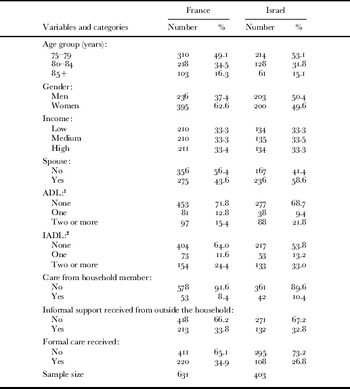
Table 1 presents the profiles of the French and Israeli samples. About one-half of each sample was aged 75–79 years, about one-third aged 80–84 years, and about 15–16 per cent aged 85 or more years. There were, however, gender differences. Just over one-third of the French respondents were male, but men constituted about one-half of the Israeli sample. The category medians of the income tertiles were a good deal higher in France, indicating much higher incomes. As for marital status, a small majority of the Israeli respondents aged 75 or more years had a spouse or partner, while in France a small majority of the respondents of the same ages did not. The ADL and IADL statistics show that the Israeli respondents reported worse functional health.
Socio-demographic characteristics, functional health status, and care need, people aged 75 or years in France (2004) and Israel (2005/6)

Notes: 1. Number of limitations in the Activities of Daily Living (ADL). 2. Number of limitations in the Instrumental ADL.
Modes of analysis
The analysis proceeded in several stages. The first step was a univariate description of the care variables by means of frequency distributions. This was followed by cross-tabulations of the care received from outside the household by ‘care by a household member’. The bivariate associations between the pattern of care received from outside the household and the control variables was also examined in each country. Finally, multinomial logistic regressions of the pattern of care received from outside the household were run with receipt of ‘care by a household member’ and the control variables as the independent variables. The reference category was the receipt of no help from outside the household. Here too, the analyses were executed separately for the French and Israeli samples.
Drawing upon the substitution or complementarity propositions, the first examined hypothesis was whether formal care received at home substituted for informal care. It would be supported if the most prevalent care pattern in France and Israel was either formal or informal, and would be rejected if cases of mixed formal and informal care were most prevalent. The second hypothesis is that formal care supplements informal care. It would be confirmed if mixed formal and informal care was most prevalent among care recipients with high levels of need, and would be rejected if mixed formal and informal care had low prevalence among those with greater need. The third hypothesis questions whether care provided by children and other extended family members co-exists with formal services more than spouse care. The hypothesis would be rejected if spouse care had more such support. Finally, we consider the care patterns in both countries in relation to the respective national welfare regimes. Broad similarity in the care patterns in both countries might attest to the universality of the inter-relationship between formal and informal care. Differences in the patterns, on the other hand, might suggest a structural effect of the welfare regime.
Results
Table 1 shows that in both countries only a minority of respondents reported care by a household member; fewer in France (8.4%) and slightly more in Israel (10.4%). Further analysis (not shown) revealed that spouses comprised about two-thirds of same household care-givers in France and in Israel. They were followed in relative frequency by children, other individuals and multiple household-member care-givers. About one-third of the respondents had informal care from outside the household in both France and Israel. As for formal home care, slightly more than one-third of the French respondents reported such care, but only just over one-quarter of the Israeli respondents.
Combinations of care
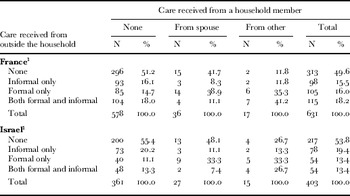
Turning to the variable, ‘pattern of care received from outside the household’, Table 2 shows that one-half of the French respondents and slightly more of the Israeli respondents reported no support or care from outside the household. The next most frequent care pattern in France was receipt of both formal and informal care (18.2%), while in Israel the second most frequent care pattern was receipt of informal care only from outside the household (19.4%). In France, the two least frequent patterns – receipt of informal support from outside the household only and receipt of formal home care only – were of similar frequency (16%). In Israel, the two least frequent patterns – receipt of formal home care and receipt of both formal and informal care from outside the household – had the same frequency (13.4%). Table 2 also presents the association between care received from a household member and the pattern of care received from outside the household. Note first that the associations were significant in both countries. Moreover, the trends reported earlier for care pattern remained generally the same when considered separately for those who received no care from within the household. This was not the case, however, when looking at those who reported having received care from spouse or others in the household.
Care received from within and without the household, persons aged 75 or more years in France and Israel

Notes: 1. Significance of the three-by-four comparisons: France, χ2=28.6 (degrees of freedom 6), p<0.001; Israel, χ2=20.4 (df 6), p<0.01.
In both France and Israel, receiving spousal care most frequently paired with no other care received, and then with receipt of formal care. A similar pattern did not apply, however, to care provided by other household members. Calculations (not shown) based on the figures in Table 2 show that in France, almost 90 per cent of the cases in which care was provided by other household members also received formal or informal support from outside the household (15 of 17 cases), and that in Israel, the comparable fraction was about three-quarters (11 of 15 cases). However, care by a household member other than spouse was relatively infrequent in both countries.
Next, we compare those who received care from a household member only (spouse or other) with those who received such care and support from outside the household (formal or informal). The data indicate that care provided exclusively by household members constituted only one-third of the cases in France (17 of 53 cases) and about 40 per cent of the cases in Israel (17 of 42 cases). Stated differently, the frequencies demonstrate that same household care-givers in both countries were more often than not reinforced by other sources of care-giving, whether formal, informal or both. Further calculations examined the overall formal/informal mix, counting all those who reported any source of informal care in relation to all respondents who received any care, formal or informal. Of all the French respondents who received any care (335 cases), one-third (115) received only informal care, about 40 per cent (135) received both formal and informal care, and one-quarter (85) received only formal care. The corresponding figures for the Israeli sample were that 203 persons received some kind of care, and among them almost one-half (95) received only informal care, about one-third (68) reported both formal and informal care, and about one-fifth (40) received only formal care.
Factors associated with care from outside the household
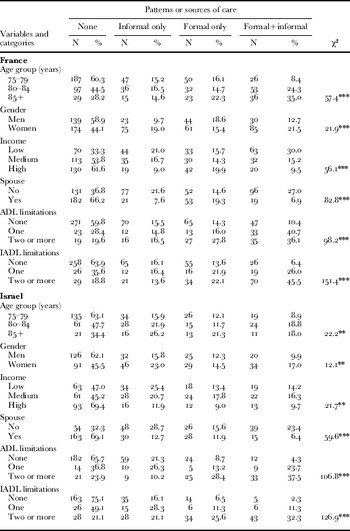
Table 3 presents the bivariate associations between the control variables and the pattern of care received from outside the household. All the control variables had significant associations with care patterns. Moreover, in the case of ‘no care from outside the household’, the directions of the associations were similar for both countries. Having no care from outside the household was less likely the older the respondent and the greater the number of ADL and IADL disabilities, but more likely among men, those who had a spouse or partner, and those with the highest incomes. There were similarities and differences in the factors associated with the other three patterns of care received from outside the household. For example, being male, higher income, and having a spouse or partner negatively associated with the receipt of informal support from outside the household in both France and Israel. By contrast, age was positively related to the informal support pattern in Israel but not in France, and the influence of the functional health measures differed in the two countries. As for the formal care pattern, it associated with age and the number of ADL difficulties (and to a lesser degree with the number of IADL difficulties). However, having a spouse was positively related to the formal care pattern in France, but negatively related in Israel. Finally, women and those without a spouse and with more IADL difficulties were more likely to have received both formal and informal care from outside the household. Greater age was more strongly associated with the mixed care pattern in France, while in Israel the number of ADL difficulties was more clearly related.
Patterns of care received from outside the household by background characteristics and functional health status

Significance levels: ** p<0.01, *** p<0.001.
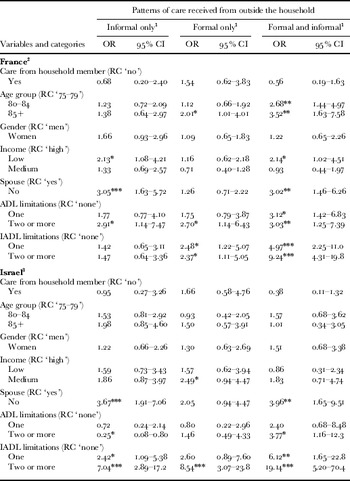
The results of the multinomial logistic regressions of the three patterns of care received from outside the household are presented in Table 4, with the reference category being ‘none received’. The odds ratios (OR) show the strength and the direction of the predictors. It should first be noted that in both France and Israel care received from a household member was not significantly related to the patterns of care received from outside the household. Among the control variables, the gender of the care receiver proved to be unrelated to patterns of care received from outside the household in both countries. On the other hand, age and income were for the most part unrelated to the care pattern in Israel, but they did predict the pattern of care from outside the household in France.
Multinomial logistic regressions of patterns of care received from outside the household

Notes: ADL: Activities of Daily Living. CI: confidence interval. IADL: Instrumental ADL. OR: odds ratio. RC: reference category. 1. The reference category for the pattern of care received is ‘none’. 2. Nagelkerke pseudo R 2=0.38. 3. Nagelkerke pseudo R 2=0.45. Significance levels: * p<0.05, ** p<0.01, *** p<0.001.
In comparison, functional health and having a spouse or partner were significant predictors in both countries, but not always in the same direction. The most powerful predictor was the measure of IADL limitations. Respondents having two or more such difficulties were much more likely to receive both formal and informal care from outside the household than to receive no care at all. This factor also predicted receipt of only formal care in both countries, and receipt of informal care from outside the household in Israel but not in France. Those having one IADL difficulty were also somewhat more likely to receive these types of care (in comparison with the reference group that received no care). ADL difficulties also predicted the receipt of all the care patterns in France and receiving formal and informal care in Israel, but in Israel were inversely related to the receipt of informal care from outside the household. That is, those with two or more difficulties in fulfilling basic tasks of daily living were much less likely to be in receipt of care from outside the household only from an informal carer. This is the inverse of the French finding that ADL difficulties predicted receipt of informal care from outside the household.
More consistent findings emerged on the influence of having a spouse. Respondents without a spouse or partner were more likely to receive informal care from outside the household, whether informal care only or informal and formal care. Lack of spouse, on the other hand, was unrelated to the receipt of formal care alone. As noted earlier, age and income were also predictors of the care pattern in France but not in Israel. The older of the French respondents had a greater likelihood of receiving formal and informal care or formal care only, and those with lower incomes were more likely to receive informal care from outside the household or informal care combined with formal care. Further analyses (not tabulated) ran the regressions with formal care alone as the reference category. The purpose was to contrast the exclusive receipt of informal care from outside the household with the exclusive receipt of formal care. In France, a single variable predicted the receipt of such informal care in relation to the receipt of formal care – marital status (OR=3.05, p=0.002). Those without a spouse in France were more likely to be in receipt of informal support from outside the household as their only source of care. In Israel, ADL limitations was the only corresponding predictor (OR=0.17, p=0.005). Those with two or more ADL difficulties were much less likely to be in receipt of only informal care from outside the household as compared to only formal care.
Discussion
This study has examined the inter-relationship between formal and informal care in France and Israel. The analysis focused on the receipt by older people of care in the domicile, the most prevalent locus of long-term care. There were several similar findings from the two countries. About one-half of the samples in both settings received no help whatsoever, and most of them reported having no functional difficulties. About one-in-ten of the respondents received care from a household member, most usually from a spouse (with additional care, if it was required, coming mostly from formal sources). And one-third of the respondents in both France and Israel reported having been helped by informal carers living outside the household. There was, however, a notable difference between the two countries. More of the French respondents (about one-third) received formal care services at home than did those in Israel (one-quarter). In addition, formal care was more frequently intertwined with informal care-giving in France. It seems that complementarity across formal and informal care delivery systems was more prevalent in France, perhaps a result of that country's more firmly established welfare regime.
The first hypothesis to be examined was whether formal care delivered to the domicile substitutes for informal care. Close to one-half of the respondents in both countries received some sort of care, whether formal, informal or both. Of those who received care in France, about one-third had only informal care, a quarter received only formal care, and some 40 per cent had both formal and informal care. The corresponding fractions in Israel were that among those who received care, one-half had only informal care, one-fifth received only formal care, and about a third had help from both formal and informal sources. These figures show that a mix of formal and informal care was more frequent in France than Israel, but that the combination was relatively uncommon in both countries. At first sight, this finding tentatively confirms the substitution hypothesis, but if we take into account that informal care-givers may not yet have turned to formal care services, to address the hypothesis it might be more appropriate to compare those already in receipt of formal care with those in receipt of both formal and informal care. This comparison shows that in France the prevalence of mixed care was greater than the exclusive receipt of formal care – the same was true in Israel. This suggests that complementarity is prevalent in the care systems of both countries. The first hypothesis, therefore, cannot be unequivocally confirmed.
The second hypothesis examined the notion of supplementarity, that mixed informal and formal care is more prevalent for those with greater need. To reiterate, the multivariate analyses found that respondents with more IADL and ADL difficulties had a high probability of receiving both formal and informal care, and so suggested that formal and informal care systems collaborate most when the recipient's care need is high. The second hypothesis was therefore confirmed. It can be argued that this finding also provides some support for the complementarity hypothesis. The third hypothesis examined the family care-giving pattern vis-à-vis the inter-relationship between formal and informal care. The hypothesis is that children and extended family members who provide care have a greater interchange (or more complementarity) with formal services than do spouse carers. The results showed that in France more than three-quarters of the non-spouse family carers were assisted by formal services, compared to about one-half of spouse carers. This finding confirms that the form of family care (or which family members provided the care) moderated the relationship with formal care. There were similar results in Israel: about 40 per cent of spouse carers were supported by formal services, and about 60 per cent of non-spouse family carers. These findings support the third hypothesis.
The final question considered here was whether any differences in the two countries' patterns of care could be related to their respective welfare regimes. The multiple regression analyses for the two countries produced quite similar results, with some differences in the factors that were significantly associated with a source of care but only one reversal of the direction of an association. More ADL limitations in Israel was associated with comparatively low reliance on informal care only, while in France it was associated with greater reliance. The broad similarity of the findings in both countries prompts alternative interpretations; first, that the inter-relationships between formal and informal care are shared and independent of the countries' welfare regimes (i.e. structural factors were not influential); or secondly, that the welfare regimes of France and Israel are more similar than had been assumed, with the main difference being the extent of coverage. The literature review had indeed found a lack of agreement as to how to characterise the Israeli welfare state. The similar findings from France and Israel might attest to similarities in the structures of the regimes being analysed. Further inquiry is therefore needed in order to confirm or reject the structural hypothesis.
Several limitations of the present analysis should be noted. First and foremost, the current study used cross-sectional data from the first wave of the SHARE survey. Although the findings point to substitution or complementarity, to fully ascertain a substitution effect (or the lack thereof), which of course occurs over time, longitudinal data are required. Such data will become available as later waves of the SHARE survey are executed. A second limitation is that the availability and the health of informal care-givers were not addressed in this analysis because these variables were not available from SHARE. There was also no information on accessibility to formal home-care services. It is also recognised that the inter-relationship between formal and informal care among the Arab minority in Israel might differ from that which applies to the Jewish majority, but given the small number of such cases in the sample, it was not possible to control for population group differences. Finally, it should be noted that the data did not identify the formal care provider from outside the home. This is an important question, given that there is increasing interest in domiciliary care provided by migrant workers, many of whom seem to be undocumented. It might be that such providers are not reported in formal surveys.
Despite these limitations, the current study has nevertheless provided important new findings that will inform the debate on the relationships and interface between formal and informal care for frail older people. The analysis shows that complementarity is a common outcome of the co-existence of the two care systems, and that a mix of formal and informal care tends to occur more frequently in situations of greater need. Moreover, while spousal care-givers tend to interact with formal providers less than children and other family care-givers, both have considerable support from formal care. The findings thus underscore the functional co-existence of informal and formal care systems, and suggest that service systems can indeed work with family care-givers to maximise the wellbeing of frail older people.
Acknowledgments
The SHARE data collection was primarily funded by the European Commission through the 5th Framework R&D Programme (project QLK6-CT-2001-00360 in the thematic programme Quality of Life). Additional funding came from the US National Institute on Aging (U01 AG09740-13S2, P01 AG005842, P01 AG08291, P30 AG12815, Y1-AG-4553-01 and OGHA 04-064). The SHARE data collection in Israel was funded by the US National Institute on Aging (R21 AG025169), by the German-Israeli Foundation for Scientific Research and Development (GIF), and by the National Insurance Institute of Israel. A preliminary version of this paper was presented in October, 2007, at the Second Franco-Israeli Bi-national Symposium on ‘Confronting Ageing: A Cross-National Perspective’ in Paris.