(As I'm sure you agree) it's a tragedy that the Estado docente operates as a kind of consortium for the unanimous production of knowledge. Some day, governments will instead give resources to those institutions and instances which are able to prove their efficiency in educating groups (…) schools with ideals, my friend, one with yours, another with mine, transparent organisations with a clear direction, socialist or capitalist, without masks.Footnote 1
Drawing on the theoretical contributions of critical pedagogy and social movement theory, this article advances the hypothesis that the Estado docente which emerged in Chile during the nineteenth century and was consolidated during the early part of the twentieth century was not an educational project supported by a consensus of civil society.Footnote 2 Instead it asserts that the Estado docente,Footnote 3 implemented in part through the Law of Compulsory Primary Instruction of 1920, represented an inter-elite attempt to homogenize political culture and head off the growing radicalisation of social movements during the so-called period of the ‘Social Question’Footnote 4. It also suggests that at the beginning of the twentieth century many workers' civic associations had their own pedagogic projects that were distinct and often quite radically distanced from official education policies. The article focuses on the pedagogic-cultural activities of the organisations grouped within the Workers Federation of Chile (Federación Obrera de Chile, FOCH) and reveals their critical stance toward the inter-elite teaching pact of the Estado docente. Specifically, it analyzes the historical development of an alternative critical social pedagogy: the rationalist schools of the Federation – more than twenty of which were established throughout the country – and aims to illuminate the tensions and dynamics between the formal teaching system, popular education and self-education.Footnote 5 The article concludes by examining the factors that contributed to the disappearance of these schools by 1926.
Teaching Freedom and Public Education
Claiming the right of ‘legitimate defence’, the authorities of the municipality of Gatico, a city some 1,600 kilometres north of Santiago, in the Department of Tocopilla, closed down the Escuela Obrera Federal Racionalista on 28 March 1924.Footnote 6 They claimed that in the school ‘they constantly and systematically preached against the state, teaching children to ridicule the flag, scorn our glorious traditions, and view our army, ennobled by a century of heroism, as a gang of assassins.’Footnote 7 The case of the workers' rationalist school at Gatico was discussed in parliament and El Despertar de los Trabajadores of Iquique published a transcript of the full session of the House of Deputies that discussed the closure.Footnote 8 The issue had been raised by Luis E. Recabarren, the only representative of the Partido Obrero Socialista in the parliament.Footnote 9 On behalf of the FOCH, Recabarren demanded that the school be re-opened. It was located near the Toldo copper mine and its own workers covered teachers' wages and the minimal running costs of the school.Footnote 10
A representative of the Liberal Party in the House spoke in defence not of the school but rather of the Constitution, asking: ‘By what right does the government suppress it, since Article 10 of the Constitution guarantees the Liberty to Teach?’Footnote 11
The opening of the school had been supported by the communal administration of Gatico and since it commenced activities, it appears that alcoholism had been almost completely eradicated from the immediate locality. Recabarren suspected that the reasons for the school's abrupt closure were political. Of the more than 500 workers of the Toldo mine, 450 were Communists and members of the FOCH. The socialist leader admitted to his parliamentary colleagues that in the mine school children were instructed ‘against the patria’, ‘against militarism’ and ‘against the capitalist regime’, yet asked: ‘[w]hich article of our Code says that having different views of the patria is a crime?Footnote 12
The parliamentary session seems to have become an intense debate over the freedom to teach and the nature of public education. If the law allowed religious congregations to establish their own schools, why could workers organisations not do the same? The latter were not denominational, but neither did they feel represented by the values promoted in the current educational system.
Unable to violate the constitutional principle of educational liberty, the Gatico authorities had invoked the ‘right to legitimate defence’ against a form of education which allegedly preached ‘against the prevailing order’. The Escuelas Obreras Federales Racionalistas were apparently created from within FOCH (founded in 1909) in 1921. The ‘Gran FOCH’, at it was initially called, was founded by the lawyer Paulo Marin Pinuer with the aim of controlling workers' dissatisfaction at the lack of progressive social legislation and was Catholic, conservative and mutualist in character. At first it associated only railway workers, but was soon extended to include societies and unions of workers of other trades, who together formed consejos federales. Although the majority identified with the ideas of the Partido Demócrata (Democratic Party),Footnote 13 towards 1917 the FOCH became identified with a more radical tendency and in 1919 declared itself revolutionary, becoming part of the Internacional Sindical Roja in 1921Footnote 14. It was at that moment, when the Federation enjoyed the support of the majority of Chilean workers' organisations, that the project to implement rationalist schools was initiated.
The government authorities were irritated by the schools' rejection of the official concept of patria, expressed by their opposition to parades that commemorated massacres and invasions of neighbouring territories. The FOCH saw itself as a source of knowledge, values, attitudes and specific social practices that could be promoted and disseminated amongst workers and their children. It was ultimately its capacity to define and administer an education distinct from that provided by ‘state instruction’ that motivated the authorities to take concrete measures to suppress the rationalist schools. ‘State instruction’ is understood here to mean that provided through the network of state, municipal and private schools established during the course of the nineteenth century. Although many of these institutions relied on private funding and often had quite different values and interests, the Chilean political elite shared a view of public education as a nation-building tool to impose order, unity and homogeneity. Ultimately it was this vision of the regulatory function of the Estado docente which eventually enabled a consensus to be reached the Law of Compulsory Primary Instruction by 1920.Footnote 15
The Crisis of the Estado docente and Popular State and Private Education
In Chile an Estado docente is said to have existed since the declaration of Independence in 1810; indeed public education was proclaimed ‘one of the first conditions of the social pact.’Footnote 16 However, to the extent that an Estado docente implies budgetary allocations for public education, this is questionable. Until 1850, financial support for education was practically non existent, constituting a mere 3.6% of the national budget. It only became significant from 1860 onwards, when education represented nine per cent of the national budget, and even more so after 1888, when it's share was increased to some 12.3%.Footnote 17 This lack of funding affected teachers' salaries, school buildings and equipment.
Disputes between Catholics and Liberals for control over public education also delayed the consolidation of a consensus over how to promote and regulate it.Footnote 18 Moreover, even those who agreed that the state should be responsible for education, disagreed about its social and cultural premises and the types of school management, administration and financing to be deployed.Footnote 19
What was not at issue, however, was the need to establish a segregated system of moral education that would both prepare the young offspring of oligarchic families to assume control of the state and efficiently subjugate the working classes to the discipline of the market and national laws. In effect, ‘popular education’ in Chile was initially associated with the idea of subordinating and disciplining the working class.Footnote 20
The absence of a clear definition of the state's role in public education translated into a weak system of popular instruction, which registered almost zero growth in attendance and registration throughout the whole of the nineteenth century.Footnote 21 A school inspector explained the situation thus: ‘(the people), not understanding the benefits of instruction, nor perceiving any immediate or positive results, referring only to their squalid interests and not seeing in their sons anything more than an instrument to make a profit, more than indifference, feel hatred for the school …’.Footnote 22
The disillusionment of significant sectors of the population, together with the meager nature of state educational provision, stimulated the establishment of private societies (masonic, industrial, Catholic, liberal and intellectual) which sought to channel their respective political or religious ideologies into pedagogic practice. These societies opened night schools for workers and artisans, and their children, which complemented state educational provision. The most notable were those established by the liberal Sociedad de Instrucción Primaria, created in 1856, and the conservative Society of Catholic Schools Santo Tomás de Aquino, established in 1870.Footnote 23 In general, all the night schools shared the aim of indoctrinating the popular sectors into the religious or political ideologies of their sponsors. Accordingly, they emphasised different issues: liberals, ‘civil liberty’; masons, the development of ‘scientific-technical knowledge’ (as the basis for the progress of the nation); Catholics, the consolidation or recuperation of ‘faith’, and industrialists ‘technical training’. Despite these differences however, they all provided the same kind of programmes; literacy, basic arithmetic calculation, hygiene, and moral and civic discipline. Moreover, they all shared the same underlying objective of social pacification. Together these private, municipal and fiscal schools constituted the dominant educational model.Footnote 24
At the turn of the century, in addition to these privately run night schools, state equivalents were established in which ‘socially aware’ academics organised popular instruction. In general, these enjoyed limited success, with attendance levels equal to or worse than those of other schools. In all probability, as M. A. Illanes indicated, children were too accustomed to wandering the streets.Footnote 25
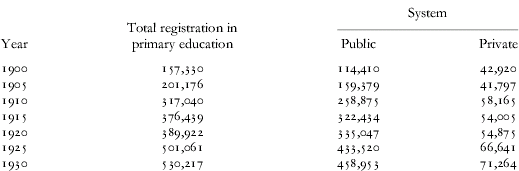
In addition to this increase in public and private initiatives aimed at providing popular instruction, the total education budget was quadrupled between 1900 and 1920.Footnote 26 Registrations for primary education, both public and private, similarly increased during the period. Yet as a Radical senator charged during the debate on the Law of Compulsory Primary Instruction, the global budget for public education still fell far short of that earmarked for the armed forces: while the former was allocated 42 million pesos in 1919, the army and the navy together received 97 million pesos.Footnote 27 Furthermore, despite the increase in the overall education budget, the amount allocated to public primary teaching declined dramatically: in 1914 it represented 62%, while in 1916 it was 52%, in 1918, 41% and in 1920, 36%.Footnote 28 This decline was combined with a progressive and sustained increase in total registrations at primary teaching levels (see table 1).
Registration of pupils in primary education 1900–1930
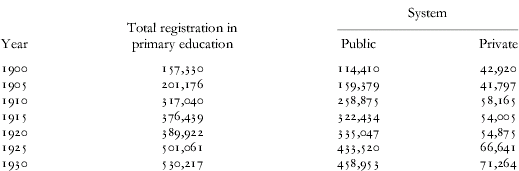
Source: Data collected from the Section of Statistics and Education Superintendency, Alejandro Fabres, Evolución histórica de la Ley de Instrucción Primaria Obligatoria en el cincuentenario de su promulgación (EIRE, Santiago, 1970), p. 113.
The Social Question and the Workers' Challenge to the Estado Docente
School desertions and high illiteracy ratios were also aggravated by infant mortality, the increase in food prices and constant overcrowding. The inadequate diet of the children and young people attending schools in working class districts, and indeed the parlous conditions of the classrooms themselves, signaled the crisis of the dominant political and economic model.
Towards the end of the nineteenth century, Chile had slowly begun to develop an incipient form of industrial capitalism. The annexation of nitrate producing territories following the war with Peru triggered industrialisation: nitrate exports generated sufficient foreign currency to allow the import of raw materials essential for the development of Chilean industry. State taxes on nitrate exports seemed to promise the means to finance national modernisation. But inflation, supposedly sparked by landowners who deliberately devalued the currency as a means to eliminate their mortgage debts, provoked a reduction in real incomes, negatively affecting the working classes. Prices multiplied nine-fold between 1890 and 1920.Footnote 29
While export-led modernisation continued apace, Chile still lacked a concrete plan of action to nurture the beginnings of domestic industrialisation. Following the First World War, the political elite was indifferent to the need to industrialise and promote a popular commercial sector, and halt the rise in social proletarisation. Elites, preoccupied with their own political and secular disputes, failed to legislate in response to demands from the working classes for cheaper food, housing and services. Demonstrations, which had begun as early as the mid-nineteenth century, progressively increased. The political elite's lack of credibility further fuelled massive street marches and strikes in the northern nitrate mines from the beginning of the twentieth century onwards. The Hunger Marches of 1918–1919; the formation of the Asamblea Obrera de Alimentación Nacional in 1918 (which saw 30,000 workers march on the national congress to present a bill to reduce food prices); the Congreso Social Obrero de 1923; and finally, the Asamblea Constituyente de Obreros e Intelectuales of 1925 signaled the determination of social movements to participate in the drafting of new laws to redefine the country's future.Footnote 30 At the same time discontent grew about a public education system that was unable to resolve social and political conflicts or improve workers' overall conditions.
Long before this, the schools of the mancomunales nortinas, legacies of the late nineteenth century tradition of mutual associations, had been the first to declare the need to prepare their members to ‘self-govern’ schools and combat prevailing conditions of injustice and social inequality (see footnote 5). While the mutualist associations viewed other services, such as health care, burial plans and pensions as being as important as education, the mancomunales placed teaching at the heart of their political activity. Despite their individual differences, the escuelas mancomunales represented the first attempt to forge a unified critical pedagogy from what had hitherto been isolated and spontaneous initiatives. They also represented the first systematic effort to construct an alternative to state and private schools. Through popular, free libraries they collected and distributed the first texts to arrive in Chile written by foreign anarchists and socialists.Footnote 31 As well as advancing new proposals for organising the state, these also promoted the transmission of knowledge based on critical visions of contemporary society, and values such as solidarity and social justice.
As demonstrations mounted, demanding a reduction in the cost of living and food prices, criticism of the state education system became more accentuated. The gap between the schools and the students, children and adults enrolled as pupils increased, and anti-statist sentiments were consolidated amongst anarchist and FOCH circles. The ‘noxious influence’ of state schools on their children provoked ever greater indignation amongst workers. While it is impossible to measure the true extent of protest, an important sector of society seemed to feel that a bifurcated, segmented, vertical and centralist education system would only perpetuate social injustice. The official education system, it was suggested, prepared children ‘for the perpetuation of the unjust social regime in which we live, systematically molding them and chaining their spirits to a life of the past.’Footnote 32 State schools came to be viewed as the principal cause of the ‘intellectual emaciation’ of workers' sons, and as a vehicle for ‘preserving the prevailing order.’ Complaints appeared in the pages of the FOCH newspaper charging that ‘instead of broadening children's knowledge [the state school] limits their horizons with the aim of constraining the natural desire of the discontented to be free. In this way, man is forced to put up with an unjust and criminal social regime, which subjugates the weak by all means possible. State schools and their supporters suffocate children's intellectual abilities in order to maintain these castes.’Footnote 33 Workers' indignation led to a growing distancing from ‘bourgeois schools’ and created fertile ground for the creation of new schools challenging the existing social order.
Moderate Reform vs. Radicalism and Self-management
In the first decade of the twentieth century the thesis of a ‘threatened social consensus’ began to figure in national debates, especially amongst the governing elites. Increasing the provision of education for the poor came to be seen as central to achieving national unity and social stability. Liberal political sectors prioritised free and compulsory primary education within their programmatic agenda; by the 1920s, conservatives followed suit, although no consensus yet existed on the question of lay education. The liberal deputy Arturo Alessandri Palma was a fervent defender of the Estado docente. In order to ‘combat popular movements’ – he said – it was necessary to go ‘to the root of the malady … drafting laws that define the relations between capital and labour … (moreover) it is necessary to teach the people, enlightening them, making them aware of their responsibilities and rights.’Footnote 34
Nonetheless, it was not until 1920 that a consensus was reached in parliament permitting the approval of the Law of Compulsory Primary Instruction.Footnote 35 Disagreements between liberals and conservatives had delayed its approval for two decades, the first bill having been presented to Congress as early as 1900. Tensions revolved around two fundamental issues: the budgetary resources required to implement compulsory schooling and the role municipalities were to play in this endeavour. The most important agreements related to the fate of religious teaching: an amendment was created that enabled parents who so chose to ‘opt out’ of religious instruction for their children. The quid pro quo was that the parish priest would sit on communal education committees to be created to inspect the schools, and a predetermined state subsidy would be set aside for religious schools. Other important matters were agreed, including the creation of a high level Consejo de Instrucción Primaria (to include representatives from the Executive, both houses of parliament and representatives of popular education), increased pay for tutorships, and the establishment of mechanisms to secure obligatory primary attendance amongst the labouring classes. Communal education committees, a key institution which would permit primary school teachers to shape the government's education agenda, were given powers to sanction parents and guardians, businesses and any other entities that failed to meet the compulsory school attendance requirements. They also had the power to visit and monitor schools, factories and other work places. Theoretically these communal committees could lobby the municipalities to allocate increased funds to primary education and it was envisaged that they would gradually assume the administration of state education.Footnote 36 But in fact this never occurred; neither did the promised increase in teachers' salaries materialise.
It was clear that the ‘educational question’ was in crisis. There was widespread institutional recognition of the parlous state of public education; debates in the press, congress and various publications about the very objectives of public education were intensifying, generating a widespread consensus on the need to change the education system. A broad range of actors voiced their discontent, including social movements that proposed alternatives to official education policy.
The educational crisis at the turn of the century was evident to the public in general, political and administrative authorities, educators, academics and intellectuals. For their part, the intellectuals Eduardo de la Barra, Tancredo Pinochet and Francisco Encina, proclaimed the ‘alienation’ of public education as the main factor explaining ‘educational backwardness’ and called for a recovery of national sentiment and a consolidation of the identity of the ‘Chilean race’.Footnote 37 Alejandro Venegas, who denounced the increasingly oligarchical character of government and the absence of a defined education policy, focused most clearly on the social impacts of inadequate public education.Footnote 38 Darío Salas, in his most famous work, asserted that the educational backwardness of the country could be overcome with the implementation of an entirely centralised education system.Footnote 39
Such ideas were widely disseminated in the Congreso Nacional de Educación Secundaria held in 1912. Yet this congress was denounced by the Centros de Estudios Anarquistas as ‘one of so many things without practical or concrete results, as is the case with most congresses and associations inspired by the rigid morality of the bourgeoisie’.Footnote 40 A few years later, members of Congress, high-ranking public officials, and representatives of the clergy and the private education sector met in a series of conferences organised by the newspaper El Mercurio in order to debate the crisis in popular education. The dysfunctional nature of public policies and institutions and economic and moral ‘backwardness’ were attributed to the high rate of illiteracy.Footnote 41 From within parliament voices were raised, such as those of the senator Arturo Alessandri who drew attention to the progressive increase in social demonstrations, emphasising the neutralising role that popular instruction ought to play: ‘as a most powerful antidote against these social poisons.’Footnote 42
Within social organisations of the middle and popular sectors, the crisis was analysed and evaluated. In 1913 the Federación de Estudiantes de la Universidad de Chile convened a Popular Education Congress to discuss the high national rates of illiteracy, yet five years later, at the first Primary Education Congress, organised by primary teachers from the Federación de Profesores de Instrucción Primaria (FPIP), a more assertive tone was in evidence. The FPIP incorporated younger teachers who were politically more progressive and had fewer ties to the educational authorities.Footnote 43 At the same time independent workers organised in associations of anarchist, socialist or revolutionary character and used the media, meetings, talks and conferences to denounce the deplorable material conditions of the schools their children attended. They also criticised the teaching itself which, apart from being viewed as chauvinist, militaristic and elitist, was – they charged – almost totally disconnected from the daily lives of the pupils.Footnote 44
In this way the first critical, public movement emerged in Chile during the first decades of the twentieth century in opposition to the official model of schooling. The old elitist, segregationist and centralised model of public education was challenged on the grounds of both practice and ideology. Neither the pedagogic debates, the volumes written by the principal educationalists of the time, nor numerous philanthropic initiatives had been able to halt this process. The authorities for their part sought a solution by passing the 1920 Law of Compulsory Primary Instruction. However, two years later, both the FOCH and the primary teachers grouped together in the Asociación General de Profesores de Chile declared the law a failure. It had not resolved the issue of the shortage of schools, given ‘the enormous number of children that ought to have attended them’. And yet, they charged, even had there been sufficient schools, ‘the majority of children would not have been able to attend them, given the lack of uniforms, food and equipment.’Footnote 45 Neither had the law resolved, nor would it be able to resolve, the problem of illiteracy, given that ‘its completely centralist’ modus operandi ignored the education of the distinct regions of the country. Thirdly, the communal education committees that were supposed to ensure school attendance had not been set up in many places, and in others their members were ‘incapable, negligent, political appointees or sectarian.’Footnote 46 Fourthly, the municipalities failed to comply with their corresponding legal obligations ‘and the funds that should have been allocated annually to schools were spent on other things.’Footnote 47 Finally, the FOCH and the primary school teachers of the Asociación General de Profesores de Chile declared that the high level Consejo de Instrucción Primaria, charged with the national responsibility of overseeing and directing primary education, ought to be ‘completely free from political, sectarian and religious influence and ensure proportional representation for women.’Footnote 48 They demanded the participation of a workers' representative within the Consejo because they wanted to imbue teaching with ‘democratic values’.Footnote 49
It seemed that the ‘educational question’ was not going to resolve itself via legislative or legal means. It was the primary teachers themselves and the workers organisations who most consistently asserted their demands and sought out alternatives. This would be either via reform, with the Asociación General de Profesores de Chile preparing a plan for the complete overhaul of public teaching, or via the formulation of a pedagogic project based on self-help and self-management. One such project was the federal rationalist workers' schools of the FOCH.Footnote 50
The Escuelas Obreras Federales Racionalistas and the Critical Pedagogic Movement of the Early Twentieth Century
In 1912 the Centros de Estudios Anarquistas defined the ‘free school’ as a space where teaching could develop without ‘any metaphysical abstractions and theosophical complications’, since, ‘these would be studied by those who wanted to, when they reached adulthood; nothing of scholarly programmes and confusing books to be learnt from memory; nothing about the patria, nor religion, nor authorities: but an open school, completely free, imparting lessons in the countryside or in large halls, with teaching materials and methods that enable children to understand what is being explained, with the images in easy sight, without tiring the imagination, nor demanding mental efforts beyond their strength; the school should be the garden of playtime where one can run freely and learn things about life, part of life (…).’Footnote 51
A decade later Salvador Barra Wöll, a prominent leader of FOCH and the Communist Party (PC) and previously a member of the Partido Obrero Socialista (POS), wrote from his prison cell in Iquique, describing the school centres in that city as ‘free institutions’ provided by independent members who collaborated together avoiding ‘handouts and charity’, challenging the ‘generalised dogma that only the state concerns itself with development and progress.’ According Barra Wöll, the prevalence of this dogma generated ‘the atrophy of any spirit of private or individual initiative that could contribute to the cultural betterment of the people.’ He continued that this ‘statist attitude (was) harmful and wrong’ since it produced amongst citizens a ‘hateful tyranny that obstructed the natural development of free organisations.’ Given this, he considered that the ‘dogmatic education’ offered by state schools, ‘as much in the political, as in the social and moral orders’ differed fundamentally from the rationalist education of the communists.Footnote 52
Despite the distinct political origin of the above extracts (the first anarchist, the second, communist) they both reflect the evident crisis in the legitimacy of the Chilean political elite and the desire of vast sectors of the population to transform the society in which they lived through essentially anti-statist and self-managed political practices. Within such a general context, it is easy to understand the proliferation of alternative pedagogic proposals.Footnote 53
Mutualist and mancomunal traditions had already demonstrated that self-managed schools could be established, even if these remained modeled on official schools. But it was the anarchists, communists and members of the FOCH who, between the early twentieth century and the mid-1920s, went one step further by distancing themselves from the popular state and private schools of the era in which they themselves had been trained. Going beyond their training, they continued their self-education through lectures held by the social and proletarian press, talks given by activists, workers' theatrical presentations, students' musical groups, workers choral societies, and conversations with adults and youth in the lengthy and enthusiastic ‘all-nighters’ developed in social centres and Sunday cultural associations. Within these activities, self-education was linked with entertainment; self-formation with creation. They involved the whole family and engendered a strong sense of belonging and, above all, a belief that this was their own project. Pedagogy, in this sense, was conceived of as ‘creation’. Rather than learning a particular doctrine, the important thing was to confront the difficulties of everyday life, gain economic, political and cultural agency and learn to stand on one's own two feet. Dance, poetry, theatre and literature occupied a central place in teaching activities and were hosted by popular libraries and centres of teaching, social studies and recreation. By preference these were held on Sundays, the day of rest for those attending: this was to ensure that not only the ‘most enlightened’ took part, but all those willing to enjoy and ‘if they were able, to leave some coins in the tin, well placed by the entrance’, even better. Teaching was conceived of as cultural action. Meetings were convened by anarchists, FOCH members, communists and independent workers. Hundreds of advertisements appeared throughout the newspapers of the time – not only those of workers, but liberal and conservative papers such as La Nación or El Diario Ilustrado – for activities arranged by the distinct cultural centres, committees, centres of social studies and workers associations and federations. The subjects were diverse: from the commemoration of the 1st of May to a Sunday's family entertainment. It mattered little who convened the activity; the important thing was making the connection between entertainment and rest, reflection and training. All members of the family needed to be entertained and able to relax. On Sundays hundreds of workers' families went to the neighbourhoods of Yungay, Quinta Normal, Brasil and Avenida Matta to participate in dancing competitions. There were also circuses with comedians and entertainers for the children. For the grown ups there were night time dances, where women received flowers and sweets. Between the dances, brief conferences were held about the current social, political and economic situation, the thoughts of a certain anarchist or socialist philosopher, or even a lecture about an important writer of the times. Above all, each and every activity projected an overall sense of the importance of starting to construct a new society in the here and now.
Within these urban sindicalist cultural spheres, the ideas of Francisco Ferrer Guardia became increasingly popular. Ferrer Guardia was born in Alellá, near Barcelona, in 1859 and was later exiled to Paris because of his republican beliefs. There he made contact with the French free thinker Paul Robin and his pedagogic project, the Experimental School of Cempius. On his return to Barcelona in 1901, Ferrer Guardia established the ‘Modern School’ based on the adoption of scientific teaching methods and rationalist philosophy, with a humanitarian and anti-military curriculum. In his own words, the school was for ‘rebellious citizens’.Footnote 54
Ferrer Guardia was adopted as an important figure by Latin American and Chilean workers movements from the beginning of the twentieth century. Even Luis Emilio Recabarren paid posthumous homage to him, stating in 1915 that before the official school that ‘makes a child a slave, an automata, an handmaiden to errors, an idolater, a rogue and immoral,’ there are those ‘like Ferrer Guardia who understand the malady that this brings for the future of humanity, the amount of misfortune that this produces, and need to compel society to transform the school system.’Footnote 55 Recabarren saw it as essential to form ‘pro-cultural popular groups’ with the objective of ‘promoting a love of reading of materials such as daily papers, magazines and, especially, pamphlets, to develop popular intelligence.’Footnote 56 ‘Popular intelligence’ was understood to mean not only the intellectual development of the people, but also their management and administrative capacities and values of solidarity based on self-help.Footnote 57 Evidence indicates, however, that it was the anarchist centres for social study – the initiators of a discourse and practice critical of the prevailing school model – that first mentioned Ferrer Guardia in their periodicals and bulletins. In fact, one of the first of these centres, established in the capital at the beginning of the twentieth century, was named ‘Francisco Ferrer.’Footnote 58
Ferrer Guardia's contact with Paul Robin had sparked his commitment to currents such as rationalism, collectivism and individual liberty within education and the so-called New School movement in Europe.Footnote 59 Robin had proposed an anti-dogmatic method of teaching in which obligatory learning, duty and religion were substituted for science. For Ferrer Guardia, a ‘teacher was a person who recognised their inadequacies and the best pupils those who rebelled against all knowledge that was presented as truth.’Footnote 60 On his return to Barcelona, with the aid of money from affluent friends who believed in his work, Ferrer Guardia developed a practical pedagogic experience with children of workers' families, based on rational, libertarian and anti-authoritarian principles. Central to this pedagogy was the idea of putting the child at the centre of learning and nurturing their potential abilities. According to Ferrer Guardia, rationalism and science could only combat dogma if they were accompanied by a deep sense of humanity. Rationalist thought that could encourage a child to question ‘truths’ that appeared ‘natural’ (such as private property and the idea of God) was only useful if it served to make them question, and ultimately, ‘know’ the origin of social injustices. This was the only way to begin the process of individual and collective emancipation.
The pedagogic thought and practice of Ferrer Guardia caught on amongst Latin America workers' movements following his execution in 1909, in the events of the Semana Trágica in Barcelona, when he became a martyr of the workers' struggles.Footnote 61 In Chile, only the FOCH, with the collaboration of the Communist Party, carried forth his proposed pedagogy.Footnote 62 From its conservative origins as a mutualist society, the FOCH had insisted on the need to ‘open schools for the primary instruction of the descendants and brothers of the Federation’ as well as to establish ‘whatever other means are useful for the moral, material and intellectual development of the members of the Federation and workers in general, and to improve their skills.’Footnote 63 But it was not until the FOCH's National Convention in Rancagua in 1921 that new programmes and statutes of the Federation were approved. Article 15 of the statutes, concerning workers' teaching, established the creation of juntas de instrucción in the FOCH's departmental and provisional bodies, with the mission of ‘promoting the education and instruction of members of the Federation and their families.’ Regarding the means, it proposed: ‘… schools, professional teaching workshops, libraries and theatres, musical auditioning and conference halls, gymnasiums or any other educational means directed at men, women and children.’Footnote 64 The FOCH's Executive Assembly was charged with the responsibility of elaborating the study programme of these proposed educational centres.
FOCH member Sandalio Montenegro presented the executive assembly with an outline of a ‘rational teaching programme’ with the aim of having it debated at the convention. Its aim was to guide children according to their ‘desire for freedom, so that from an early age, they can begin to develop their own ideas about social action.’ This 230 page document, divided into six chapters, stipulated that juntas de instrucción should be created in all the consejos federales of the FOCH, that teachers should be sincere and in agreement with the FOCH's ideals, and that the Federation's teaching should be rationalist.Footnote 65 Months later, a Plan General de Instrucción for the Federation's schools was drafted. This covered four topics: training, the types of education that the Federation should provide, auxiliary mechanisms for teaching (social study centres, workers cultural associations, school theatres, workshops for professional teaching, alternative classes), and the general principles of workers education. It also specified three ways in which the Federation's schools could sustain themselves economically: by making available ten per cent of the general funds destined for the ordinary costs of the consejos federales; by agreeing to a special quota to be paid once the consejo in question had purchased their own printing press and; through the creation of a school fund that would be the responsibility of the junta de instrucción of each consejo federal.Footnote 66
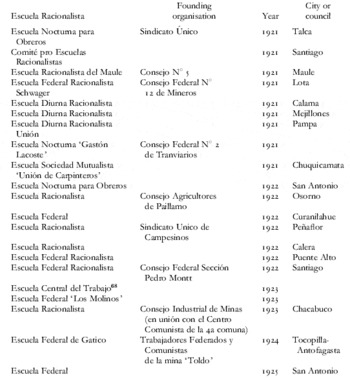
While state primary teachers of the Asociación General de Profesores de Chile designed different strategies for the application of the plan for an ‘integral reform of public teaching’, the FOCH mounted its own education plan. This was formally recognised by the governmental Dirección General de Instrucción Primaria and was more than a handful of isolated initiatives (see table 2).Footnote 67
Register of the Escuelas Obreras Federales Racionalistas

Source: Data obtained from newspapers La Federación Obrera de Chile, Justicia and El Despertar de los Trabajadores (1919–1928).
Although they lacked resources, some twenty schools appear to have operated throughout the country until 1926. Two emblematic cases, the Escuela Federal Racionalista de Peñaflor and the Escuela Federal de Puente Alto are discussed in more detail below.
The Escuela Federal Racionalista de Peñaflor
The Escuela Federal Racionalista de Peñaflor was established in December 1922 in the printing house of the Sindicato Unico de Campesinos de Peñaflor. It aimed to bury ‘dogmas and prejudices’ and be guided ‘by the experiences of scientific research without deception or false propositions’. Its establishment was a response to the ‘statist school’, since changing the social order required the ‘study of social problems.’Footnote 69 The workers organised to put an end to the ‘stultification’ to which they were submitted by ‘bourgeois education’, with the ‘thousands of stupidities and prejudices that they taught there.’ The time had arrived, they stated, ‘to take care of our own children.’ Some three weeks later it was announced that the Escuela Federal Racionalista de Peñaflor had begun to operate with ‘a steady number of students’ and courses held during the daytime and the evening.Footnote 70 Towards the end of December, the school was functioning with ‘truly encouraging success.’ Children between five and seven years old, who worked during the day, ‘gladly [attended] class’ given that ‘each day [classes were made] more agreeable by the diverse themes which were dealt with.’ Many men and children who ‘had never known a book or a blackboard’ began to read with ‘true ease’. History and natural science classes produced ‘real pleasure’ amongst students.
As new students continued to turn up at the school (the day course functioned with the attendance of roughly 15 students and the evening course with around 35), the appeal for material cooperation from the community was intensified.Footnote 71 Via the press a call went out for books, maps, chalk, exercise books, benches and other school equipment: ‘Do you have something? Bring it to the printing house and contribute to this most excellent work …’.Footnote 72
The location used by the Escuela Federal Racionalista de Peñaflor was also the place where Sunday cultural associations took place. The Sindicato Unico de Campesinos de Peñaflor, in charge of the school, gave talks and conferences to the workers' families on Sunday mornings and aimed particularly to attract ‘students from all the schools in this town, their parents and guardians.’ There was no charge for entry and all activities were accompanied by a ‘literary programme.’Footnote 73 Parties were also organised where students and teachers from the school participated, involving orchestras, poetry readings, songs and dances.Footnote 74 Amongst the fundraising activities was a commemorative anniversary celebration for Francisco Ferrer Guardia; the monies and equipment collected were destined for the Sindicato Unico.Footnote 75
Examinations also required the participation of the community. These took place on Sundays so that families and students could attend. The examining commission was composed of workers of the FOCH and members of the centre ‘El Despertar’ and tested students in subjects such as reading, writing, handwriting, arithmetic, dictation, composition, recitation, drawing, geography, singing, rationalism or naturalism and social history.Footnote 76
The school served both as a civic centre – the new site was only a block away from the town's main square – and everyone was welcomed at its functions. The locale was used for a range of cultural activities, generating a rich exchange between families, the Sindicato Unico and the school. In homage to his educational efforts, it adopted the name of Luis Emilio Recabarren at the beginning of the school year in 1925 (Recabarren had committed suicide a few months previously).
The school's most fervent enemies were those associated with the Catholic Church. The conservative newspaper, El Diario Ilustrado, published articles warning the local authorities about the centre since ‘it makes the children imbibe Soviet doctrine’ and supposedly taught them to ‘hate the patria’. The priest and the pious peñaflorinos also unleashed a relentless battle against the school.Footnote 77 According to them, at the free school at Peñaflor they taught, ‘pure science, love and fraternity’ while its motto was ‘Neither God nor Country, Free Humanity and Without Borders’.Footnote 78
The Escuela Federal de Puente Alto
An examination of the school at Puente Alto, on the other side of Santiago, reveals much about the rationalist schools' pedagogic proposal. This commenced activities in July 1922, a few months prior to the opening of the school at Peñaflor, with some 15 students, ‘which very quickly increased to 20 and then to 50 children of both sexes. Now some 70 pupils gather to class, with a ratio of 20 girls and 50 boys …’. Every day the students attended class for six hours, during which time they acquired slowly ‘every type of basic knowledge’. Towards the end of the course, ‘two comrades' assisted with the teaching, since one instructor was unable to attend to so many children.’Footnote 79 The school was maintained by the FOCH's consejo federal of Puente Alto. It had an extension, a gymnasium and a workshop. The idea was that pupils should attend the school since infancy in order to ‘practice the principles of class solidarity’ and strengthen the trade union because it was understood that children ‘formed a powerful link between workers' homes, the school and the organization.’Footnote 80
As with the Peñaflor school, the ‘free teaching’ method was practiced at Puente Alto to engender social solidarity. Instead of punishments or prizes, students were motivated by ‘persuasion’. They were warned of the ‘unhappy state of the uneducated worker’ and taught about the awfulness of the ‘cruel treatment meted out by some men to others.’ The effectiveness of this type of teaching, it was claimed, was evident in the lack of ‘hesitation, characteristic in other schools’; during exams, students responded in a ‘simple and clear’ manner to the questions asked.Footnote 81 Students also organised within the classroom, taking turns to do the cleaning and attend to the furniture and teaching materials, while it was prohibited to ‘throw papers or fruit peel on the floor.’Footnote 82 Reference materials were available for the teachers including; ‘a dictionary, geographical atlas and history texts, especially those about social history. Works of rationalist educators about natural science, physics, chemistry and cosmography’ were also at hand.Footnote 83 Amongst the courses provided was ‘social action’, which comprised ‘lessons about proletarian social activities’ which aimed to ‘awaken in young minds an appropriate aversion to things unjust.’
The physical and psychological health of students was also central to rationalist teaching. Students were kept in class for no more than 40 to 50 minutes. Breaks were sufficiently long so that, under the supervision of teachers, games could be used for the moral instruction of the children. Personal hygiene was also emphasised; children were told that ‘clean children, who look after their bodies, have an appreciable advantage in fighting the illnesses so prevalent within the poor conditions of working class homes.’Footnote 84
Although it is not possible to clarify the extent to which patterns of authority prevailing within the ‘bourgeois school’ were reproduced, evidence suggests that concrete efforts were made to counteract values such as military discipline, uncritical obedience to adults, and the separation of the school from the surrounding community. At the time, child labour was widely accepted within trade union circles and was a major source of income for working class families. Rationalist education adapted to this, ‘making the best possible use of the school year.’Footnote 85
Despite their pretensions to autonomy from state education, the FOCH's rationalist schools were concerned with the impression they had on the authorities, perhaps because of their desire to be recognised as an alternative to public education. An article in the La Federación Obrera relates the visit of the departmental governor and the police commander to the school at Puente Alto, describing the authorities' surprise and satisfaction at the good functioning of the school, the evident ability of the teacher in charge, and the cleanliness and order of the premises. The authorities had also gone to find out about the school's teaching methods, on which they promised to ‘deliver an appropriate report to the government.’Footnote 86
The demise of the Escuelas Obreras Federales Racionalistas
In general, the teaching methods of the Escuelas Obreras Federales Racionalistas challenged authoritarian and paternalist relations – workers taught other workers, and students and their families participated in the schools' management and finance, sexism and discrimination (schools were mixed), and the dogma and utilitarianism of the Catholic and liberal schools. Rather than teaching them ‘to do’, they promoted values about ‘being’; instead of ‘indoctrination’, they promoted ‘critical reflection.’ During this period, the right of the ‘freedom to teach’ stipulated in the 1833 Constitution stimulated the proliferation of schools set up and run by workers' organisations, which aimed to strengthen those very same organisations and establish a direct relationship between trade union, school and community.
Although in 1921 the FOCH's Fourth National Convention modified the Federation's structure, replacing the old territorial consejos federales, which had convened workers from different occupations, with a consejo industrial, organised by type of employment or trade, in practice the consejos federales continued to operate for a number of years. Yet, by 1926 there was no further mention in the press of the rationalist schools. The fact that the closure of that school at Gatico had been discussed in parliament (albeit thanks to Recabarren) suggests that they had a political impact out of all proportion to their relatively limited number and were repressed because of the direct threat they represented to the prevailing order. Some rationalist schools were closed down during the liberal government of Arturo Alessandri; under the subsequent dictatorship of Carlos Ibáñez del Campo, the FOCH and all trade unions that did not meet newly imposed union legislation were banned. Yet government repression alone does not account for the demise of this social and cultural workers' movement.
Two other factors were pertinent: first, the Constituent Assembly of Workers and Intellectuals and, second, the ‘bolchevisation’ of the FOCH.Footnote 87 In March 1925, in the face of rising living costs, workers' organisations and middle class sectors convened their own ‘constituent assembly’ with the aim of drafting the principles that would serve as a basis for the reduction of a new national constitution prior to the return from exile of ex-president Arturo Alessandri. This agreement established the social function of land and regarding public education confirmed that the state should intervene only to ‘provide the funds for this to meet its own objectives and monitor the technical qualifications of teachers, respecting absolutely the freedom of the profession.’Footnote 88 This proposal, the result of an agreement hammered out between members of the FOCH, communists, the Asociación de Profesores de Chile and the Federación de Estudiantes de Chile, would have guaranteed significant autonomy for social movements in the management of public education and, as such, constituted a direct assault on the Estado docente. Although it fell short of endorsing the Escuelas Federales Racionalistas as a national model for public education, the FOCH committed itself to fight for the reformist option promoted by the teachers.
The second factor was the ‘bolchevisation’ of the FOCH: in 1927 the first evidence surfaced of financial support channeled from the Soviet communist party to its Chilean counterpart – some 600 US dollars to help communist prisoners and those deported from Chile and 1000 US dollars for the running of the party.Footnote 89 This implied much more than the substitution of the party structure of assemblies for an organisation of vanguard cells; it involved the intervention of the South American Secretariat in the definition of party policy.Footnote 90 From this moment onwards the FOCH leadership became increasingly top-down and what were previously ‘suggestions’ became imposed ‘sanctions’. Proposals for education no longer emphasised its autonomous, self-managed and anti-statist character; rather, education was increasingly defined as a political issue, not a social and cultural one – it was no longer ‘social and rationalist’ but rather ‘trade union and communist,’ intended to ‘train leaders.’Footnote 91
Postscript
More than twenty years ago, Iván Núñez pointed to a bias in research on the history of education in Chile and Latin America, arguing that education tended to be seen solely in institutional terms, as something which happened within schools and universities, rather than as a reflection of specific social and historical formations.Footnote 92 Two decades later, according to Adriana Puiggrós, little had changed: research on the history of education in Latin America has tended to centre on a ‘history of ideas’, thereby negating the social character of education and its profound link with social struggles.Footnote 93 Both Núñez and Puiggrós signal the hegemony of a historiography that has tended to view alternative pedagogies originating within civil society as rare, marginal and accidental experiences.
In recent years historiographical contributions have focused on the gradual democratisation of education throughout the nineteenth and twentieth centuries, examining topics such as the approval of legislation, the development of policies to train teachers, political elites and the middle and working class, transformations of nineteenth century primary instruction, policies towards educating indigenous people, the contribution of the University of Chile, and women's role in the development of the national education system.Footnote 94 Dominant analytical approaches have tended to frame education as a question of being either ‘inside’ or ‘outside’ the formal school system, in this way reinforcing educational policies aimed at the progressive and large-scale integration of the working classes via the classroom. This has tended to produce a one-sided vision of the construction of the school system that seriously underplays the dynamic social processes and conflicts involved. In short, both academic analysis and institutional policies tend to see ‘schooling’ in terms which are essentially the same as nineteenth century paradigms, emphasising ‘integration’ and ‘inclusion’ (as opposed to ‘exclusion’) rather than recognising distinct pedagogical practices or social histories.
Chilean social historiography usually depicts the military coup of 11 September 1973 as an ‘historic rupture.’Footnote 95 The social, political and cultural impact of the coup led during the 1980s to a theoretical and historiographical re-evaluation of el pueblo as an object of study and to the emergence of a ‘new social history.’ This was characterised by approaches to the study of workers movements that aimed to overcome the strictures of classic Marxist historiography, focused exclusively on the contradictions between labour and capital. Instead the methodologies of the new social history emphasized the voice of the subject and began to research relatively understudied sectors, such as women or youth.Footnote 96 However, the desire to generate new hypotheses led many historians to conceive of el pueblo as an a-critical collective actor which simply reproduced the ideals of the dominant class, failing to challenge the political elite, and of limited political impact.Footnote 97 By contrast, it has been argued here that although workers' movements were certainly imbued with dominant nineteenth century discourses of ‘progress’, ‘science’ and ‘enlightenment’, they retained considerable agency and advanced values that were quite distinct from those of the dominant economic, political and intellectual elite.
The new historiography has undoubtedly made important contributions. Yet the tendency to view the Chilean popular movement as a subject which is ‘acted upon’ has led many to understand the politicisation of the movement which occurred in the early twentieth century as the result of its repression or cooptation and the eradication of its powers of critical reflection leading, in turn, to workers' adherence to the political options of anarchism, socialism or alessandrismo, as the only alternatives available at the time. Such approaches have found it difficult to distinguish themselves from more classic historiographical analyses of the Chilean popular movement, which see this as comprised of ‘young semi-proletarians, artisans and workers close to peasant culture who were [simply] disposed to receive liberal democratic, anarchist, sindicalist, or utopian ideas.’Footnote 98 Others have tried to explain the early twentieth century radicalisation of the workers movement as a result of the ‘ignorance’ and ‘high illiteracy and social resentment’ that rendered hacienda workers susceptible to extreme ideologies and violence, workers essentially changing the ‘master-patron’ for the ‘master-revolutionary ideology.’Footnote 99
There is clearly an outstanding historiographical debt to develop a history of the popular movement – and the social organisations which formed it – that takes into account its internal dynamics and proposals, including its production of ‘pedagogic knowledge’. Interest has recently increased in historically and contextually grounded studies of social movements and their cultural-pedagogical production, drawing on a variety of influences, including new social movement theory.Footnote 100 Melucci has defined new social movements as ‘systems of action’ or ‘complex networks’ whose identity is not predetermined, but rather the result of exchanges, negotiations, decisions and conflicts between diverse actors.Footnote 101 Such an analytical approach, which emphasises resistance and counter-hegemonic actions, can be usefully applied in the historical study of social movements and their cultural production. In a related vein, Henry Giroux has drawn attention to the legacy of the Frankfurt School of critical theorists, suggesting that an over-emphasis on the language of domination has led to the underestimation of social agents' possibilities of creating an alternative pedagogy in the ‘here and now’.Footnote 102 According to Giroux, educators create a ‘pedagogic encounter’ with students, enabling teaching practices to resonate with their life experiences and thereby generating critical awareness. In this way the school becomes a site of cultural production, not reproduction, something which he refers to as the ‘democratic public sphere.’ Only in this way can pedagogic practice become ‘critical’, ‘transformative’ and ‘emancipatory’.Footnote 103
Until the mid-1920s workers organisations in Chile were engaged in such an emancipatory cultural and pedagogic undertaking. They challenged the widely accepted thesis that the Estado docente would bring national economic, political and cultural progress, constituting the first, albeit not the last, clear challenge to the system of public education founded in the mid-nineteenth century. The Escuelas Obreras Federales Racionalistas meant the practice of self-education based, on the one hand, on the critical reproduction of knowledge previously acquired in official schools and, on the other, on the practical construction (‘from the here and now’) of the ‘new society’ to which they aspired.